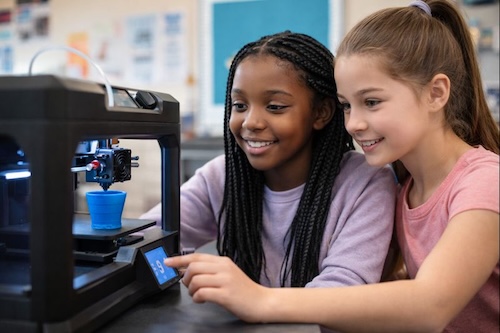
It’s truly incredible how much new technology has made its way into the classroom. Where once teaching consisted primarily of whiteboards and textbooks, you can now find tablets, smart screens, AI assistants, and a trove of learning apps designed to foster inquiry and maximize student growth.
While these new tools are certainly helpful, the flood of options means that educators can struggle to discern truly useful resources from one-time gimmicks. As a result, some of the best tools for sparking curiosity, creativity, and critical thinking often go overlooked.
Personally, I believe 3D printing is one such tool that doesn’t get nearly enough consideration for the way it transforms a classroom.
3D printing is the process of making a physical object from a three-dimensional digital model, typically by laying down many thin layers of material using a specialized printer. Using 3D printing, a teacher could make a model of a fossil to share with students, trophies for inter-class competitions, or even supplies for construction activities.
At first glance, this might not seem all that revolutionary. However, 3D printing offers three distinct educational advantages that have the potential to transform K–12 learning:
It develops success skills: 3D printing encourages students to build a variety of success skills that prepare them for challenges outside the classroom. For starters, its inclusion creates opportunities for students to practice communication, collaboration, and other social-emotional skills. The process of moving from an idea to a physical, printed prototype fosters perseverance and creativity. Meanwhile, every print–regardless of its success–builds perseverance and problem-solving confidence. This is the type of hands-on, inquiry-based learning that students remember.
It creates cross-curricular connections: 3D printing is intrinsically cross-curricular. Professional scientists, engineers, and technicians often use 3D printing to create product models or build prototypes for testing their hypotheses. This process involves documentation, symbolism, color theory, understanding of narrative, and countless other disciplines. It doesn’t take much imagination to see how these could also be beneficial to classroom learning. Students can observe for themselves how subjects connect, while teachers transform abstract concepts into tangible points of understanding.
It’s aligned with engineering and NGSS: 3D printing aligns perfectly with Next Gen Science Standards. By focusing on the engineering design process (define, imagine, plan, create, improve) students learn to think and act like real scientists to overcome obstacles. This approach also emphasizes iteration and evidence-based conclusions. What better way to facilitate student engagement, hands-on inquiry, and creative expression?
3D printing might not be the flashiest educational tool, but its potential is undeniable. This flexible resource can give students something tangible to work with while sparking wonder and pushing them to explore new horizons.
So, take a moment to familiarize yourself with the technology. Maybe try running a few experiments of your own. When used with purpose, 3D printing transforms from a common classroom tool into a launchpad for student discovery.
Jon Oosterman, Van Andel Institute for Education
Jon Oosterman is a Learning Specialist at Van Andel Institute for Education, a Michigan-based education nonprofit dedicated to creating classrooms where curiosity, creativity, and critical thinking thrive.
Latest posts by eSchool Media Contributors (see all)
Many years ago, around 2010, I attended a professional development program in Houston called Literacy Through Photography, at a time when I was searching for practical ways to strengthen comprehension, discussion, and reading fluency, particularly for students who found traditional print-based tasks challenging. As part of the program, artists visited my classroom and shared their work with students. Much of that work was abstract. There were no obvious answers and no single “correct” interpretation.
Instead, students were invited to look closely, talk together, and explain what they noticed.
What struck me was how quickly students, including those who struggled with traditional reading tasks, began to engage. They learned to slow down, describe what they saw, make inferences, and justify their thinking. They weren’t just looking at images; they were reading them. And in doing so, they were rehearsing many of the same strategies we expect when reading written texts.
At the time, this felt innovative. But it also felt deeply intuitive.
Fast forward to today.
Students are surrounded by images and videos, from photographs and diagrams to memes, screenshots, and, increasingly, AI-generated visuals. These images appear everywhere: in learning materials, on social media, and inside the tools students use daily. Many look polished, realistic, and authoritative.
At the same time, AI has made faking easier than ever.
As educators and school leaders, we now face urgent questions around misinformation, academic integrity, and critical thinking. The issue is no longer just whether students can use AI tools, but whether they can interpret, evaluate, and question what they see.
This is where visual literacy becomes a frontline defence.
Teaching students to read images critically, to see them as constructed texts rather than neutral data, strengthens the same skills we rely on for strong reading comprehension: inference, evidence-based reasoning, and metacognitive awareness.
From photography to AI: A conversation grounded in practice
Recently, I found myself returning to those early classroom experiences through ongoing professional dialogue with a former college lecturer and professional photographer, as we explored what it really means to read images in the age of AI.
A conversation that grew out of practice
Nesreen: When I shared the draft with you, you immediately focused on the language, whether I was treating images as data or as signs. Is this important?
Photographer: Yes, because signs belong to reading. Data is output. Signs are meaning. When we talk about reading media texts, we’re talking about how meaning is constructed, not just what information appears.
Nesreen: That distinction feels crucial right now. Students are surrounded by images and videos, but they’re rarely taught to read them with the same care as written texts.
Photographer: Exactly. Once students understand that photographs and AI images are made up of signs, color, framing, scale, and viewpoint, they stop treating images as neutral or factual.
Nesreen: You also asked whether the lesson would lean more towards evaluative assessment or summarizing. That made me realize the reflection mattered just as much as the image itself.
Photographer: Reflection is key. When students explain why a composition works, or what they would change next time, they’re already engaging in higher-level reading skills.
Nesreen: And whether students are analyzing a photograph, generating an AI image, or reading a paragraph, they’re practicing the same habits: slowing down, noticing, justifying, and revising their thinking.
Photographer: And once they see that connection, reading becomes less about the right answer and more about understanding how meaning is made.
Reading images is reading
One common misconception is that visual literacy sits outside “real” literacy. In practice, the opposite is true.
When students read images carefully, they:
identify what matters most
follow structure and sequence
infer meaning from clues
justify interpretations with evidence
revise first impressions
These are the habits of skilled readers.
For emerging readers, multilingual learners, and students who struggle with print, images lower the barrier to participation, without lowering the cognitive demand. Thinking comes first. Language follows.
From composition to comprehension: Mapping image reading to reading strategies
Photography offers a practical way to name what students are already doing intuitively. When teachers explicitly teach compositional elements, familiar reading strategies become visible and transferable.
What students notice in an image
What they are doing cognitively
Reading strategy practiced
Where the eye goes first
Deciding importance
Identifying main ideas
How the eye moves
Tracking structure
Understanding sequence
What is included or excluded
Considering intention
Analyzing author’s choices
Foreground and background
Sorting information
Main vs supporting details
Light and shadow
Interpreting mood
Making inferences
Symbols and colour
Reading beyond the literal
Figurative language
Scale and angle
Judging power
Perspective and viewpoint
Repetition or pattern
Spotting themes
Theme identification
Contextual clues
Using surrounding detail
Context clues
Ambiguity
Holding multiple meanings
Critical reading
Evidence from the image
Justifying interpretation
Evidence-based responses
Once students recognise these moves, teachers can say explicitly:
“You’re doing the same thing you do when you read a paragraph.”
That moment of transfer is powerful.
Making AI image generation teachable (and safe)
In my classroom work pack, students use Perchance AI to generate images. I chose this tool deliberately: It is accessible, age-appropriate, and allows students to iterate, refining prompts based on compositional choices rather than chasing novelty.
Students don’t just generate an image once. They plan, revise, and evaluate.
This shifts AI use away from shortcut behavior and toward intentional design and reflection, supporting academic integrity rather than undermining it.
The progression of a prompt: From surface to depth (WAGOLL)
One of the most effective elements of the work pack is a WAGOLL (What A Good One Looks Like) progression, which shows students how thinking improves with precision.
Simple: A photorealistic image of a dog sitting in a park.
Secure: A photorealistic image of a dog positioned using the rule of thirds, warm colour palette, soft natural lighting, blurred background.
Greater Depth: A photorealistic image of a dog positioned using the rule of thirds, framed by tree branches, low-angle view, strong contrast, sharp focus on the subject, blurred background.
Students can see and explain how photographic language turns an image from output into meaningful signs. That explanation is where literacy lives.
When classroom talk begins to change
Over time, classroom conversations shift.
Instead of “I like it” or “It looks real,” students begin to say:
“The creator wants us to notice…”
“This detail suggests…”
“At first I thought…, but now I think…”
These are reading sentences.
Because images feel accessible, more students participate. The classroom becomes slower, quieter, and more thoughtful–exactly the conditions we want for deep comprehension.
Visual literacy as a bridge, not an add-on
Visual literacy is not an extra subject competing for time. It is a bridge, especially in the age of AI.
By teaching students how to read images, schools strengthen:
reading comprehension
inference and evaluation
evidence-based reasoning
metacognitive awarenes
Most importantly, students learn that literacy is not about rushing to answers, but about noticing, questioning, and constructing meaning.
In a world saturated with AI-generated images, teaching students how to read visually is no longer optional.
It is literacy.
Author’s note: This article grew out of classroom practice and professional dialogue with a former college lecturer and professional photographer. Their contribution informed the discussion of visual composition, semiotics, and reflective image-reading, without any involvement in publication or authorship.
Nesreen El-Baz, Bloomsbury Education Author & School Governor
Nesreen El-Baz is an ESL educator with over 20 years of experience, and is a certified bilingual teacher with a Master’s in Curriculum and Instruction. El-Baz is currently based in the UK, holds a Masters degree in Curriculum and Instruction from Houston Christian University, and specializes in developing in innovative strategies for English Learners and Bilingual education.
Latest posts by eSchool Media Contributors (see all)
Central vision loss–a condition that impairs the ability to see objects directly in front of the eyes–can have profound academic and social impacts on K-12 students. Because this type of vision loss affects tasks that require detailed focus, such as reading, writing, and recognizing faces, students with central vision impairment often face unique challenges that can affect their overall school experience.
In the classroom, students with central vision loss may struggle with reading printed text on paper or on the board, despite having otherwise healthy peripheral vision. Standard classroom materials are often inaccessible without accommodations such as large print, magnification devices, or digital tools with text-to-speech capabilities. These students might take longer to complete assignments or may miss visual cues from teachers, making it difficult to follow along with lessons. Without appropriate support, such as assistive technology, students may fall behind academically, which can affect their confidence and motivation to participate.
As a result, they may be perceived as aloof or unfriendly, leading to social isolation or misunderstanding. Group activities, games, and unstructured time like lunch or recess can become sources of anxiety if students feel excluded or unsafe. Moreover, children with vision loss may become overly dependent on peers or adults, which can further affect their social development and sense of independence.
While this may seem daunting, there are assistive technologies to help students navigate central vision loss and have fulfilling academic and social experiences.
One such technology, eSight Go from Gentex Corporation’s eSight, uses an advanced high-speed, high-definition camera to capture continuous video footage of what a user is looking at. Algorithms optimize and enhance the footage and share it on two HD OLED screens, providing sharp, crystal-clear viewing. The user’s brain then synthesizes the images to fill any gaps in their vision, helping them to see more clearly, in real time.
“The ability to have central perception brought back into your set of tools for education is critically important,” said Roland Mattern, eSight’s director of sales and marketing. “Ease of reading, ease of seeing the board, using tablets or computers–all of these things [lead to] the ability to complete an academic task with greater ease.”
One key feature, Freeze Frame, lets the user capture a temporary photograph with the device’s camera, such as an image on an interactive whiteboard, a textbook page, or a graphic. The student can magnify the image, scan and study it, and take what they need from it.
“This eases the ability to absorb information and move on, at a regular pace, with the rest of the class,” Mattern noted.
Socially, central vision loss can create additional barriers. A major part of social interaction at school involves recognizing faces, interpreting facial expressions, and making eye contact–all tasks that rely heavily on central vision. Students with this impairment might have difficulty identifying peers or teachers unless they are spoken to directly. The glasses can help with these social challenges.
“There’s a huge social aspect to education, as well–seeing expressions on teachers’ and fellow students’ faces is a major part of communication,” Mattern said.
What’s more, the glasses also help students maintain social connections inside and outside of the classroom.
“Think of how much peer-to-peer communication is digital now, and if you have central vision loss, you can’t see your phone or screen,” Mattern said. “The educational part is not just academic–it’s about the student experience that you want to enhance and optimize.”
Educators, parents, and school staff play a crucial role in fostering inclusive environments–by educating classmates about visual impairments, encouraging empathy, and ensuring that students with central vision loss are supported both academically and socially. With the right accommodations and social-emotional support, these students can thrive in school and build strong connections with their peers.
“If we can make daily living, hobbies, and education easier and facilitate participation, that’s a win for everybody,” Mattern said.
Laura Ascione is the Editorial Director at eSchool Media. She is a graduate of the University of Maryland’s prestigious Philip Merrill College of Journalism.