Writing can be hard, equal parts heavy lifting and drudgery. No wonder so many students are turning to the time-saving allure of ChatGPT, which can crank out entire papers in seconds. It rescues them from procrastination jams and dreaded all-nighters, magically freeing up more time for other pursuits, like, say … doomscrolling.
Of course, no one learns to be a better writer when someone else (or some AI bot) is doing the work for them. The question is whether chatbots can morph into decent writing teachers or coaches that students actually want to consult to improve their writing, and not just use for shortcuts.
Maybe.
Jennifer Meyer, an assistant professor at the University of Vienna in Austria, has been studying how AI bots can be used to improve student writing for several years. In an interview, she explained why she is cautious about the ability of AI to make us better writers andis still testing how to use the new technology effectively.
All in the timing
Meyer says that just because ChatGPT is available 24/7 doesn’t mean students should consult it at the start of the writing process. Instead, Meyer believes that students would generally learn more if they wrote a first draft on their own.
That’s when AI could be most helpful, she thinks. With some prompting, a chatbot could provide immediate writing feedback targeted to each students’ needs. One student might need to practice writing shorter sentences. Another might be struggling with story structure and outlining. AI could theoretically meetan entire classroom’s individual needsfaster than a human teacher.
Related: Our free weekly newsletter alerts you to what research says about schools and classrooms.
In Meyer’s experiments, she inserted AI only after the first draft was done as part of the revision process. In a study published in 2024, she randomly assigned 200 German high school students to receive AI feedback after writing a draft of an essay in English. Their revised essays were stronger than those of 250students who were also told to revise, but didn’t get help from AI.
In surveys, those with AI feedback also said they felt more motivated to rewrite than those who didn’t get feedback. That motivation is critical. Often students aren’t in the mood to rewrite, and without revisions, students can’t become better writers.
Meyer doesn’t consider her experiment proof that AI is a great writing teacher. She didn’t compare it with how student writing improved after human feedback. Her experiment compared only AI feedback with no feedback.
Most importantly, one dose of AI writing feedback wasn’t enough to elevate students’ writing skills. On a second, fresh essay topic, the students who had previously received AI feedback didn’t write any better than the students who hadn’t been helped by AI.
It’s unclear how many rounds of AI feedback it would take to boost a student’s writing skills more permanently, not just help revise the essay at hand.
And Meyer doesn’t know whether a student would want to keep discussing writing with an AI bot over and over again. Maybe students were willing to engage with it in this experiment because it was a novelty, but could soon tire of it. That’s next on Meyer’s research agenda.
A viral MIT study
A much smaller MIT study published earlier this year echoes Meyer’s theory. “Your Brain on ChatGPT” went viral because it seemed to say that using ChatGPT to help write an essay made students’ brains less engaged. Researchers found that students who wrote an essay without any online tools had stronger brain connectivity and activity than students who used AI or consulted Google to search for source materials. (Using Google while writing wasn’t nearly as bad for the brain as AI.)
Although those results made headlines, there was more to the experiment. The students who initially wrote an essay on their own were later given ChatGPT to help improve their essays. That switch to ChatGPT boosted brain activity, in contrast to what the neuroscientists found during the initial writing process.
These studies add to the evidence that delaying AI a bit, after some initial thinking and drafting, could be a sweet spot in learning. That’s something researchers need to test more.
Still, Meyer remains concerned about giving AI tools to very weak writers and to young children who haven’t developed basic writing skills. “This could be a real problem,” said Meyer. “It could be detrimental to use these tools too early.”
Cheating your way to learning?
Meyer doesn’t think it’s always a bad idea for students to ask ChatGPT to do the writing for them.
Just as young artists learn to paint by copying masterpieces in museums, students might learn to write better by copying good writing. (The late great New Yorker editor John Bennet taught Jill to write this way. He called it “copy work” and he encouraged his journalism students to do it every week by copying longhand the words of legendary writers, not AI.)
Meyer suggests that students ask ChatGPT to write a sample essay that meets their teacher’s assignment and grading criteria. The next step is key. If students pretend it’s their own piece and submit it, that’s cheating. They’ve also offloaded cognitive work to technology and haven’t learned anything.
But the AI essay can be an effective teaching tool, in theory, if students study the arguments, organizational structure, sentence construction and vocabulary before writing a new draft in their own words. Ideally, the next assignment should be better if students have learned through that analysis andinternalized the style and techniques of the model essay, Meyer said.
“My hypothesis would be as long as there’s cognitive effort with it, as long as there’s a lot of time on task and like critical thinking about the output, then it should be fine,” said Meyer.
Reconsidering praise
Everyone likes a compliment. But too much praise can drown learning just as too much water can keep flowers from blooming.
ChatGPT has a tendency to pour the praise on thick and often begins with banal flattery, like “Great job!” even when a student’s writing needs a lot of work. In Meyer’s test of whether AI feedback can improve students’ writing, she intentionally told ChatGPT not to start with praise and instead go straight to constructive criticism.
Her parsimonious approach to praise was inspired by a 2023 writing study about what motivates students to revise. The study found that when teachers started off with general praise, students were left with the false impression that their work was already good enough so they didn’t put in the extra effort to rewrite.
In Meyer’s experiment, the praise-free feedback was effective in getting students to revise and improve their essays. But she didn’t set up a direct competition between the two approaches — praise-free vs. praise-full — so we don’t know for sure which is more effective when students are interacting with AI.
Being stingy with praise rubs real teachers the wrong way. After Meyer removed praise from the feedback, teachers told her they wanted to restore it. “They wondered about why the feedback was so negative,” Meyer said. “That’s not how they would do it.”
Meyer and other researchers may one day solve the puzzle of how to turn AI chatbots into great writing coaches. But whether students will have the willpower or desire to forgo an instantly written essay is another matter. As long as ChatGPT continues to allow students to take the easy way out, it’s human nature to do so.
Shirley Liu is a graduate student in education at Northwestern University. Liu reported and wrote this story along with The Hechinger Report’s Jill Barshay.
The Hechinger Report provides in-depth, fact-based, unbiased reporting on education that is free to all readers. But that doesn’t mean it’s free to produce. Our work keeps educators and the public informed about pressing issues at schools and on campuses throughout the country. We tell the whole story, even when the details are inconvenient. Help us keep doing that.
Rigorous research rarely shows that any teaching approach produces large and consistent benefits for students. But tutoring seemed to be a rare exception. Before the pandemic, almost 100 studies pointed to impressive math or reading gains for students who were paired with a tutor at least three times a week and used a proven curriculum or set of lesson plans.
Some students gained an extra year’s worth of learning — far greater than the benefit of smaller classes, summer school or a fantastic teacher. These were rigorous randomized controlled trials, akin to the way that drugs or vaccines are tested, comparing test scores of tutored students against those who weren’t. The expense, sometimes surpassing $4,000 a year per student, seemed worth it for what researchers called high-dosage tutoring.
On the strength of that evidence, the Biden administration urged schools to invest their pandemic recovery funds in intensive tutoring to help students catch up academically. Forty-six percent of public schools heeded that call, according to a 2024 federal survey, though it’s unclear exactly how much of the $190 billion in pandemic recovery funds have been spent on high-dosage tutoring and how many students received it.
Related: Our free weekly newsletter alerts you to what research says about schools and classrooms.
Even with ample money, schools immediately reported problems in ramping up high-quality tutoring for so many students. In 2024, researchers documented either tiny or no academic benefits from large-scale tutoring efforts in Nashville, Tennessee, and Washington, D.C.
New evidence from the 2023-24 school year reinforces those results.Researchers are rigorously studying large-scale tutoring efforts around the nation and testing whether effective tutoring can be done more cheaply. A dozen researchers studied more than 20,000 students in Miami; Chicago; Atlanta; Winston-Salem and Greensboro, North Carolina; Greenville, South Carolina; schools throughout New Mexico, and a California charter school network. This was also a randomized controlled study in which 9,000 students were randomly assigned to get tutoring and compared with 11,000 students who didn’t get that extra help.
Their preliminary results were “sobering,” according to a June report by the University of Chicago Education Lab and MDRC, a research organization.
The researchers found that tutoring during the 2023-24 school year produced only one or two months’ worth of extra learning in reading or math — a tiny fraction of what the pre-pandemic research had produced. Each minute of tutoring that students received appeared to be as effective as in the pre-pandemic research, but students weren’t getting enough minutes of tutoring altogether. “Overall we still see that the dosage students are getting falls far short of what would be needed to fully realize the promise of high-dosage tutoring,” the report said.
Monica Bhatt, a researcher at the University of Chicago Education Lab and one of the report’s authors, said schools struggled to set up large tutoring programs. “The problem is the logistics of getting it delivered,” said Bhatt. Effective high-dosage tutoring involves big changes to bell schedules and classroom space, along with the challenge of hiring and training tutors. Educators need to make it a priority for it to happen, Bhatt said.
Some of the earlier, pre-pandemic tutoring studies involved large numbers of students, too, but those tutoring programs were carefully designed and implemented, often with researchers involved. In most cases, they were ideal setups. There was much greater variability in the quality of post-pandemic programs.
“For those of us that run experiments, one of the deep sources of frustration is that what you end up with is not what you tested and wanted to see,” said Philip Oreopoulos, an economist at the University of Toronto, whose 2020 review of tutoring evidence influenced policymakers. Oreopoulos was also an author of the June report.
“After you spend lots of people’s money and lots of time and effort, things don’t always go the way you hope. There’s a lot of fires to put out at the beginning or throughout because teachers or tutors aren’t doing what you want, or the hiring isn’t going well,” Oreopoulos said.
Another reason for the lackluster results could be that schools offered a lot of extra help to everyone after the pandemic, even to students who didn’t receive tutoring. In the pre-pandemic research, students in the “business as usual” control group often received no extra help at all, making the difference between tutoring and no tutoring far more stark. After the pandemic, students — tutored and non-tutored alike — had extra math and reading periods, sometimes called “labs” for review and practice work. More than three-quarters of the 20,000 students in this June analysis had access to computer-assisted instruction in math or reading, possibly muting the effects of tutoring.
The report did find that cheaper tutoring programs appeared to be just as effective (or ineffective) as the more expensive ones, an indication that the cheaper models are worth further testing. The cheaper models averaged $1,200 per student and had tutors working with eight students at a time, similar to small group instruction, often combining online practice work with human attention. The more expensive models averaged $2,000 per student and had tutors working with three to four students at once. By contrast, many of the pre-pandemic tutoring programs involved smaller 1-to-1 or 2-to-1 student-to-tutor ratios.
Despite the disappointing results, researchers said that educators shouldn’t give up. “High-dosage tutoring is still a district or state’s best bet to improve student learning, given that the learning impact per minute of tutoring is largely robust,” the report concludes. The task now is to figure out how to improve implementation and increase the hours that students are receiving. “Our recommendation for the field is to focus on increasing dosage — and, thereby learning gains,” Bhatt said.
That doesn’t mean that schools need to invest more in tutoring and saturate schools with effective tutors. That’s not realistic with the end of federal pandemic recovery funds.
Instead of tutoring for the masses, Bhatt said researchers are turning their attention to targeting a limited amount of tutoring to the right students. “We are focused on understanding which tutoring models work for which kinds of students.”
The Hechinger Report provides in-depth, fact-based, unbiased reporting on education that is free to all readers. But that doesn’t mean it’s free to produce. Our work keeps educators and the public informed about pressing issues at schools and on campuses throughout the country. We tell the whole story, even when the details are inconvenient. Help us keep doing that.
President Donald Trump wants to collect more admissions data from colleges and universities to make sure they’re complying with a 2023 Supreme Court decision that ended race-conscious affirmative action. And he wants that data now.
But data experts and higher education scholars warn that any new admissions data is likely to be inaccurate, impossible to interpret and ultimately misused by policymakers. That’s because Trump’s own policies have left the statistics agency inside the Education Department with a skeleton staff and not enough money, expertise or time to create this new dataset.
The department already collects data on enrollment from every institution of higher education that participates in the federal student loan program. The results are reported through the Integrated Postsecondary Education Data System (IPEDS). But in an Aug. 7 memorandum, Trump directed the Education Department, which he sought to close in March, to expand that task andprovide “transparency” into how some 1,700 colleges that do not admit everyone are making their admissions decisions. And he gave Education Secretary Linda McMahon just 120 days to get it done.
Related: Our free weekly newsletter alerts you to what research says about schools and classrooms.
Expanding data collection on applicants is not a new idea. The Biden administration had already ordered colleges to start reporting race and ethnicity data to the department this fall in order to track changes in diversity in postsecondary education. But in a separate memorandum to the head of the National Center for Education Statistics (NCES), McMahon asked for even more information, including high school grades and college entrance exam scores, all broken down by race and gender.
Bryan Cook, director of higher education policy at the Urban Institute, a think tank in Washington, D.C., called the 120-day timeline “preposterous” because of the enormous technical challenges. For example, IPEDS has never collected high school GPAs. Some schools use a weighted 5.0 scale, giving extra points for advanced classes, and others use an unweighted 4.0 scale, which makes comparisons messy. Other issues are equally thorny. Many schools no longer require applicants to report standardized test scores and some no longer ask them about race so the data that Trump wants doesn’t exist for those colleges.
“You’ve got this effort to add these elements without a mechanism with which to vet the new variables, as well as a system for ensuring their proper implementation,” said Cook. “You would almost think that whoever implemented this didn’t know what they were doing.”
Cook has helped advise the Education Department on the IPEDS data collection for 20 years and served on technical review panels, which are normally convened first to recommend changes to the data collection. Those panels were disbanded earlier this year, and there isn’t one set up to vet Trump’s new admissions data proposal.
Cook and other data experts can’t figure out how a decimated education statistics agency could take on this task. All six NCES employees who were involved in IPEDS data collection were fired in March, and there are only three employees left out of 100 at NCES, which is run by an acting commissioner who also has several other jobs.
An Education Department official, who did not want to be named, denied that no one left inside the Education Department has IPEDS experience. The official said that staff inside the office of the chief data officer, which is separate from the statistics agency, have a “deep familiarity with IPEDS data, its collection and use.” Former Education Department employees told me that some of these employees have experience in analyzing the data, but not in collecting it.
In the past, there were as many as a dozen employees who worked closely with RTI International, a scientific research institute, which handles most of the IPEDS data collection work.
Technical review eliminated
Of particular concern is that RTI’s $10 million annual contract to conduct the data collection had been slashed approximately in half by the Department of Government Efficiency, also known as DOGE, according to two former employees, who asked to remain anonymous out of fear of retaliation. Those severe budget cuts eliminated the technical review panels that vet proposed changes to IPEDS, and ended training for colleges and universities to submit data properly, which helped with data quality. RTI did not respond to my request to confirm the cuts or answer questions about the challenges it will face in expanding its work on a reduced budget and staffing.
The Education Department did not deny that the IPEDS budget had been cut in half. “The RTI contract is focused on the most mission-critical IPEDS activities,” the Education Department official said. “The contract continues to include at least one task under which a technical review panel can be convened.”
Additional elements of the IPEDS data collection have also been reduced, including a contract to check data quality.
Last week, the scope of the new task became more apparent. On Aug. 13, the administration released more details about the new admissions data it wants, describing how the Education Department is attempting to add a whole new survey to IPEDS, called the Admissions and Consumer Transparency Supplement (ACTS), which will disaggregate all admissions data and most student outcome and financial aid data by race and gender. College will have to report on both undergraduate and graduate school admissions. The public has 60 days to comment, and the administration wants colleges to start reporting this data this fall.
Complex collection
Christine Keller, executive director of theAssociation for Institutional Research, a trade group of higher education officials who collect and analyze data, called the new survey “one of the most complex IPEDS collections ever attempted.”
Traditionally, it has taken years to make much smaller changes to IPEDS, and universities are given a year to start collecting the new data before they are required to submit it. (Roughly 6,000 colleges, universities and vocational schools are required to submit data to IPEDS as a condition for their students to take out federal student loans or receive federal Pell Grants. Failure to comply results in fines and the threat of losing access to federal student aid.)
Normally, the Education Department would reveal screenshots of data fields, showing what colleges would need to enter into the IPEDS computer system. But the department has not done that, and several of the data descriptions are ambiguous. For example, colleges will have to report test scores and GPA by quintile, broken down by race and ethnicity and gender. One interpretation is that a college would have to say how many Black male applicants, for example, scored above the 80th percentile on the SAT or the ACT. Another interpretation is that colleges would need to report the average SAT or ACT score of the top 20 percent of Black male applicants.
The Association for Institutional Research used to train college administrators on how to collect and submit data correctly and sort through confusing details — until DOGE eliminated that training. “The absence of comprehensive, federally funded training will only increase institutional burden and risk to data quality,” Keller said. Keller’s organization is now dipping into its own budget to offer a small amount of free IPEDS training to universities.
The Education Department is also requiring colleges to report five years of historical admissions data, broken down into numerous subcategories. Institutions have never been asked to keep data on applicants who didn’t enroll.
“It’s incredible they’re asking for five years of prior data,” said Jordan Matsudaira, an economist at American University who worked on education policy in the Biden and Obama administrations. “That will be square in the pandemic years when no one was reporting test scores.”
‘Misleading results’
Matsudaira explained that IPEDS had considered asking colleges for more academic data by race and ethnicity in the past and the Education Department ultimately rejected the proposal. One concern is that slicing and dicing the data into smaller and smaller buckets would mean that there would be too few students and the data would have to be suppressed to protect student privacy. For example, if there were two Native American men in the top 20 percent of SAT scores at one college, many people might be able to guess who they were. And a large amount of suppressed data would make the whole collection less useful.
Also, small numbers can lead to wacky results. For example, a small college could have only two Hispanic male applicants with very high SAT scores. If both were accepted, that’s a 100 percent admittance rate. If only 200 white women out of 400 with the same test scores were accepted, that would be only a 50 percent admittance rate. On the surface, that can look like both racial and gender discrimination. But it could have been a fluke. Perhaps both of those Hispanic men were athletes and musicians. The following year, the school might reject two different Hispanic male applicants with high test scores but without such impressive extracurriculars. The admissions rate for Hispanic males with high test scores would drop to zero. “You end up with misleading results,” said Matsudaira.
Reporting average test scores by race is another big worry. “It feels like a trap to me,” said Matsudaira. “That is mechanically going to give the administration the pretense of claiming that there’s lower standards of admission for Black students relative to white students when you know that’s not at all a correct inference.”
The statistical issue is that there are more Asian and white students at the very high end of the SAT score distribution, and all those perfect 1600s will pull the average up for these racial groups. (Just like a very tall person will skew the average height of a group.) Even if a college has a high test score threshold that it applies to all racial groups and no one below a 1400 is admitted, the average SAT score for Black students will still be lower than that of white students. (See graphic below.) The only way to avoid this is to purely admit by test score and take only the students with the highest scores. At some highly selective universities, there are enough applicants with a 1600 SAT to fill the entire class. But no institution fills its student body by test scores alone. That could mean overlooking applicants with the potential to be concert pianists, star soccer players or great writers.
The Average Score Trap
This graphic by Kirabo Jackson, an economist at Northwestern University, depicts the problem of measuring racial discrimination though average test scores. Even for a university that admits all students above a certain cut score, the average score of one racial group (red) will be higher than the average score of the other group (blue). Source: graphic posted on Bluesky Social by Josh Goodman
Admissions data is a highly charged political issue. The Biden administration originally spearheaded the collection of college admissions data by race and ethnicity. Democrats wanted to collect this data to show how the nation’s colleges and universities were becoming less diverse with the end of affirmative action. This data is slated to start this fall, following a full technical and procedural review.
Now the Trump administration is demanding what was already in the works, and adding a host of new data requirements — without following normal processes. And instead of tracking the declining diversity in higher education, Trump wants to use admissions data to threaten colleges and universities. If the new directive produces bad data that is easy to misinterpret, he may get his wish.
The Hechinger Report provides in-depth, fact-based, unbiased reporting on education that is free to all readers. But that doesn’t mean it’s free to produce. Our work keeps educators and the public informed about pressing issues at schools and on campuses throughout the country. We tell the whole story, even when the details are inconvenient. Help us keep doing that.
(Note: This is the second piece in a two-part series on absenteeism in schools. Read the first part, on seven insights from researchers.)
Chronic absenteeism, when students miss 10 percent or more of the school year, is 50 percent higher across the nation than before the pandemic. Researchers say it’s difficult for schools to address the problem because it is both so intense,with students missing huge chunks of the school year, and so extensive, affecting both rich and poor students and even high achievers.And the reasons vary widely, from asthma and bullying to transportation problems and the feeling that school is boring.
“It’s hard to know where and when to target resources,” said Sam Hollon, a data analyst at the American Enterprise Institute, which hosted a symposium on the problem in May. “Who do you help when every student potentially can be a candidate for help?”
Related: Our free weekly newsletter alerts you to what research says about schools and classrooms.
The Trump administration’s immigration enforcement is exacerbating the problem. A June draft paper by Stanford University professor Thomas Dee calculated that recent raids coincided with a 22 percent increase in daily student absences with particularly large increases in absenteeism among the youngest students.
Talking about the problem isn’t enough. Researchers say they want to study more schools that are making headway. It remains unclear if there are broadly applicablefixesor if each school or eveneach student needs individual solutions. Some underlying root causes for skipping school are more complex than others, requiring psychotherapy or housing assistance, which schools can’t provide alone. Here are a few examples of how very different communities are tackling the problem.
Providence: Bus stops and weekend food bags
Principal W. Jackson Reilly of Nathanael Greene Middle School in Providence, Rhode Island, said that when he arrived in April 2023, half of his 900 students in grades six to eight were chronically absent, up from 30 percent of students before the pandemic. Thirty percent of his teachers were also chronically absent. Achievement scores were in the state’s bottom 1 percent.
Reilly managed to slash his chronic absenteeism rate in half to 25 percent this past 2024-25 year. That’s still high. One in four students missed more than 18 days of school a year. But, it’s better.
He began by identifying 150 kids who were just over the threshold for chronic absenteeism, those who missed between 18 and 35 days, hoping that these kids would be easier to lure back to school than those who were more disengaged. Reilly and a group of administrators and guidance counselors each took 10 to 15 students and showed their families how much school they had missed and how low their grades were. His team asked, “What do you need in order for your kid to be coming to school?’”
The two most common replies: transportation and food.
Many students lived only a mile away, too close to school to qualify for bus service. Yet the walk deterred many, especially if it was raining or snowing. Yellow buses often passed these children’s homes as they were transporting children who lived farther out, and Reilly convinced the district to add stops for these chronically absent children.
Ninety percent of his students come from families who are poor enough to qualify for the federal free or reduced-price lunch program and 80 percent are Hispanic. Although many children were fed breakfast and lunch at school, their families admitted that their kids would get so hungry over the weekend that they didn’t want to wake up and come to school on Mondays. Reilly partnered with a food pantry and sent bags of meat and pasta home with students on Fridays.
Individual attention also helped. At the start of each school day, Reilly and his team check in with their assigned students. Kids who show up get five “green bucks” to spend on snacks and prizes. Administrators call the homes of those who didn’t come to school. “If they did not answer the phone, we’d make a home visit,” said Reilly.
The most dramatic overhaul was scheduling. Reilly scrapped individual schedules for students and assigned four teachers to every 104 students. The kids now move in pods of 26 that take all their classes together, rotating through the same four teachers throughout the day. The classrooms are right near each other, creating a smaller community within the school.
“It’s all about relationship building,” said Reilly. When students look forward to seeing their classmates and teachers, he said, they’re more motivated to come to school.
Researchers say fostering relationships is effective. Hedy Chang, executive director of Attendance Works, a nonprofit organization that advises schools on how to boost attendance rates, said it’s still a battle to persuade some school leaders (and school board members) that making school a more welcoming place is more productive than punishing kids and families for skipping school.*
Reilly said his school now posts the lowest student and teacher chronic absenteeism rates in Providence. And he said his school is the highest performing middle school in the city and among the highest statewide in reading.
New York City: Catching the butterflies
A cluster of New York City high schools are taking a more data-driven approach, guided by New Visions, a consulting organization that supports 71 city high schools.
After some experimentation, New Visions staff saw strong improvement in attendance in one subgroup of students who were on the cusp of missing 10 percent of school days, but had not yet crossed the chronic absenteeism threshold. These are students who might miss a day or two every week or every other week but were relatively engaged at school. Jonathan Green, a New Visions school improvement coach who is spearheading this effort, calls them “butterflies.” “They would flutter in and out every week,” he said.
Green suggested that someone at school meet weekly with these butterflies and show them their attendance data, set goals for the coming week and explain how their attendance was leading to better grades. The intervention took two to five minutes. “There were marked changes in attendance,” said Green.
New Visions built a website where school administrators could print out two-page documents for each student so the data, including monthly attendance and tardiness, appeared in an easy-to-digest format. The quick meetings took place for eight to 10 weeks during the final grading period for the semester. “That’s when there’s the most opportunity to turn those potentially failing grades into passing grades,” said Green. “We were finding these sweet spots within the school calendar to do this very high resource, high-energy intensive weekly check-in. It’s not something that anyone can easily scale across a school.”
Staff had to figure out the bell schedule for each child and intercept them between classes. One succeeded in holding their entire caseload of students below the chronic absenteeism threshold. Not everyone thought it was a good idea: Some school administrators questioned why so much effort should go into students who weren’t yet chronically absent rather than students in greater trouble.
The dramatic results help answer that question. Among schools in the Bronx that volunteered to participate in the butterfly intervention, chronic absenteeism rates dropped 15 percentage points from 47 percent in 2021 to 32 percent in 2025, still high. But other Bronx high schools in the New Visions network that didn’t try this butterfly intervention still had a chronic absenteeism rate of 46 percent.
Green said this solution wouldn’t work for other high schoolers. Some have trouble organizing their study time, he said, and need more intensive help from teachers. “Two- to five-minute check-ins aren’t going to help them,” said Green.
Indianapolis: Biscuits and gravy
The leader of an Indiana charter school told me he used a system of rewards and punishments that reduced the chronic absenteeism rate among his kindergarten through eighth graders from 64 percent in 2021-22 to 10 percent in 2024-25.
Jordan Habayeb, the chief operating officer of Adelante Schools, said he used federal funds for the school breakfast and lunch program to create a made-from-scratch restaurant-style cafeteria. “Fun fact: On homemade biscuit and gravy days, we saw the lowest rates of tardies,” he said.
Researchers recommend avoiding punishment because it doesn’t bring students back to school. But Habayeb said he adheres strictly to state law that requires schools to report 10 absences to the state Department of Child Services and to file a report with the county prosecutor. Habayeb told me his school accounted for a fifth of truancy referrals to the county prosecutor.
The school created an automated warning system after five absences rather than waiting for the critical 10-day loss. And Habayeb said he dispatched the safety and attendance officer in a van to have “real conversations with families rather than being buried in paperwork.” Meanwhile, students who did show up received a constant stream of rewards, from locker decorations to T-shirts.
Parent education was also important. During mandatory family orientations, the school illustrated how regular attendance matters for even young children. “We shared what a child might miss during a three-day stretch in a unit on ‘Charlotte’s Web’ — showing how easily a student could leave with a completely different understanding of the book,” said Habayeb. “This helped shift perspectives and brought urgency to the issue.”
Kansas City: Candy and notes
School leaders in Kansas City, Kansas, shared some tips that have worked for them during a webinar earlier this month hosted by Attendance Works. One elementary school reduced its chronic absenteeism from 55 percent in 2021 to 38 percent in 2024 by assigning all 300 students to an adult in the building, encouraging them to build an “authentic” relationship. Teachers were given a list of ideas but were free to do what seemed natural. One teacher left candy and notes on their assigned students’ desks. A preschoolerproudly pasted his note, which said he was a “genius,” on the front door of his house. “The smiles kids have on their faces are amazing,” said Zaneta Boles, the principal of Silver City Elementary School.
When students do miss school, Boles said educators try to take a “non-blaming approach” so that families are more likely to divulge what is going on. That helps the school refer them to other community agencies for assistance.
Albuquerque: A shining example regroups
Alamosa Elementary School in Albuquerque, New Mexico, was once a shining example of a school that persuaded more families to send their kids to class. Chronic absenteeism fell as low as 1 in 4 students in 2018, when The Hechinger Report wrote about the school.
But Alamosa has not been immune from the surge of absenteeism that has plagued schools around the nation. Chronic absenteeism spiked to 64 percent of students during the 2021-22 school year, when Covid variants were still circulating. And it remained shockingly high with 38 percent of students missing more than 10 percent of the 2024-25 school year — exactly matching the 50 percent increase in chronic absenteeism across the country since 2019.
“We were on a roll. Then life happened,” said Daphne Strader, Albuquerque Public Schools’ director of coordinated school health, who works to reduce absenteeism.
Strader said Alamosa and other Albuquerque schools have made some successful changes to how they’re tackling the problem. But the volume of absenteeism remains overwhelming. “There’s so many kids who have needs,” Strader said. “We need more staff on board.”
Strader said attendance interventions had been “too siloed” and they’re focusing more on the “whole child.” She’s encouraging schools to integrate attendance efforts with other initiatives to boost academic achievement and improve student behavior. “Students are hungry, they’re dysregulated, they don’t have grit,” said Strader, and all of these issues are contributing to absenteeism. But she also concedes that some students have more severe needs, and it’s unclear who in the system can address them.
Her biggest advice for schools is to focus on relationships. “Relationships drive everything,” said Strader. “One of the major consequences of the pandemic was the isolation. If I feel a sense of belonging, I’m more likely to come to school.”
*Clarification: This sentence was modified to make clear the Attendance Worksexecutive director did not say all school leaders oppose the idea of eliminating punishments for absenteeism.
The Hechinger Report provides in-depth, fact-based, unbiased reporting on education that is free to all readers. But that doesn’t mean it’s free to produce. Our work keeps educators and the public informed about pressing issues at schools and on campuses throughout the country. We tell the whole story, even when the details are inconvenient. Help us keep doing that.
Five years after the start of the pandemic, one of the most surprising ways that school has profoundly, and perhaps permanently, changed is that students aren’t showing up. Here are some insights from a May symposium at the American Enterprise Institute where scholars shared research on the problem of widespread absenteeism.
1. Chronic absenteeism has come down a lot from its peak in 2021-22, but it’s still 50 percent higher than it was before the pandemic.
Roughly speaking, the chronic absenteeism rate nearly doubled after the pandemic, from 15 percent of students in 2018-19 to a peak of almost 29 percent of students in 2021-22. This is the share of students who are missing at least 10 percent, or 18 or more days, of school a year. Chronic absenteeism has dropped by about 2 to 3 percentage points a year since then, but was still at 23.5 percent in 2023-24, according to the most recent AEI data.
Related: Our free weekly newsletter alerts you to what research says about schools and classrooms.
Chronic absenteeism is more than 50 percent higher than it used to be. There are about 48 million public school students, from kindergarten through 12th grade. Almost 1 in 4 of them, or 11 million students, are missing a lot of school.
2. High-income students and high achievers are also skipping school.
Absenteeism cuts across economic lines. Students from both low- and high-income families are often absent as are high-achieving students. Rates are the highest among students in low-income districts, where 30 percent of students are chronically absent, according to AEI data. But even in low-poverty districts, the chronic absenteeism rate has jumped more than 50 percent from about 10 percent of students to more than 15 percent of students. Similarly, more than 15 percent of students in the highest-achieving school districts (the top third) are chronically absent, up from 10 percent in pre-pandemic years.
“Chronic absenteeism affects disadvantaged students more often, but the rise in chronic absenteeism was an unfortunate tide where all boats rose,” said Nat Malkus, deputy director of education policy studies at AEI.
The data show strikingly large differences by race and ethnicity, with 36 percent of Black students, 33 percent of Hispanic students, 22 percent of white students, and 15 percent of Asian students chronically absent. But researchers said once they controlled for income, the racial differences were not so large. In other words, chronic absenteeism rates among Black and white students of the same income are not so disparate.
3. Moderate absenteeism is increasing.
Everyone is missing more school, not just students who are frequently absent. Jacob Kirksey, an associate professor of education policy at Texas Tech University, tracked 8 million students in three states (Texas, North Carolina and Virginia) from 2017 to 2023. Half had “very good” absentee rates under 4 percent in 2019. By 2023, only a third of students were still going to school as regularly. Two-thirds were not.
“A lot of students who used to miss no school are now missing a couple days,” said Ethan Hutt, an associate professor at the University of North Carolina at Chapel Hill, who noticed the same phenomenon in the North Carolina data that he studied. “That’s just become the norm.”
4. Many students say they skip because school is ‘boring.’
Researchers are interviewing students and families to try to understand why so many kids are skipping school.
Kevin Gee, a professor of education at the University of California, Davis, analyzed surveys of elementary, middle and high school students in Rhode Island from 2016 to 2024. He found that more students are reporting missing school for traditionally common reasons: not getting enough sleep and illness.
After the pandemic, parents are more likely to keep their kids home from school when they get sick, but that doesn’t explain why absenteeism is this high or why physically healthy kids are also missing so much school.
Gee found two notable post-pandemic differences among students in Rhode Island. Unfinished homework is less of a reason to skip school today than it used to be, while more elementary school students said they skipped school because “it’s boring.”
Researchers at the symposium debated what to do about school being boring. Some thought school lessons need to be more engaging for students who may have shorter attention spans. But others disagreed. “I think it’s OK for school to be boring,” said Liz Cohen, a research fellow at the Johns Hopkins Institute for Education Policy. “We need to adjust expectations that school should be as exciting as ‘Dora the Explorer’ all the time.”
5. Mental health issues contribute to absenteeism.
Morgan Polikoff, a professor of education at the University of Southern California, has also analyzed surveys and noticed a “strong connection” between mental health struggles and chronic absenteeism. It was unclear if the increase in mental illness was triggered or exacerbated by the pandemic, or if it reflects anxiety and depression issues that began before the pandemic.
He’s interviewing families and teenagers about why they’re absent, and he says he’s seeing high levels of “disengagement” and mental illness. Parents, he said, were often very concerned about their children’s mental health and well-being.
“Reading the transcripts of these parents and kids who are chronically absent is really difficult,” said Polikoff. “A lot of these kids have really severe traumas. Lots of very legitimate reasons for missing school. Really chronic disengagement. The school is not serving them well.”
6. Showing up has become optional.
Several researchers suggested that there have been profound cultural shifts about the importance of in-person anything. Seth Gershenson, an economist and associate professor of public affairs at American University, suggested that in-person school may seem optional to students in the same way that going to the office feels optional for adults.
“Social norms about in-person attendance have changed, whether it’s meeting with the doctor or whatever,” said Gershenson, pointing out that even his graduate students are more likely to skip his classes. “We’re going to be absent now for reasons that would not have caused us to be absent in the past.”
At the same time, technology has made it easier for students to skip school and make up the work. They can download assignments on Google Classroom or another app, and schedule a video meeting with a classmate or even their teacher to go over what they missed.
“It is easier to be absent from school and make up for it,” said USC’s Polikoff. In his interviews, 39 of the 40 families said it was “easy” to make up for being absent. “People like that everything is available online and convenient. And also, there is absolutely no question in my mind that doing that — which is well-intentioned — makes it much easier for people to be absent.”
The numbers back that up. Gershenson calculated that before the pandemic, skipping 10 days of school caused a student to lose the equivalent of a month’s worth of learning. Now, the learning loss from this amount of absenteeism is about 10 percent less; instead of losing a month of school, it’s like losing 90 percent of a month. Gershenson said that’s still big enough to matter.
And students haven’t felt the most severe consequence: failing. Indeed, even as absenteeism has surged, school grades and graduation rates have been rising. Many blame grade inflation and an effort to avoid a high school dropout epidemic.
7. Today’s absenteeism could mean labor force problems tomorrow.
Academic harm may not be the most significant consequence of today’s elevated levels of chronic absenteeism. Indeed, researchers calculated that returning to pre-pandemic levels of chronic absenteeism would erase only 7.5 percent of the nation’s pandemic learning losses. There are other more profound (and little understood) reasons for why students are so far behind.
More importantly, the experience of attending school regularly doesn’t just improve academic performance, researchers say. It also sets up good habits for the future. “Employers value regular attendance,” said Gershenson. He said employers he has talked to report having trouble finding reliable workers.
“There’s much more than test scores here,” Gershenson said. “This is a valuable personality trait. It’s part of a habit that gets formed early in school. And we’ve definitely lost some of that. And hopefully we can bring it back.”
Next week, I’ll be writing a follow-up column about how some schools are solving the absenteeism puzzle — at least with some students — and why the old pre-pandemic playbooks for reducing absenteeism aren’t working as well anymore.
The Hechinger Report provides in-depth, fact-based, unbiased reporting on education that is free to all readers. But that doesn’t mean it’s free to produce. Our work keeps educators and the public informed about pressing issues at schools and on campuses throughout the country. We tell the whole story, even when the details are inconvenient. Help us keep doing that.
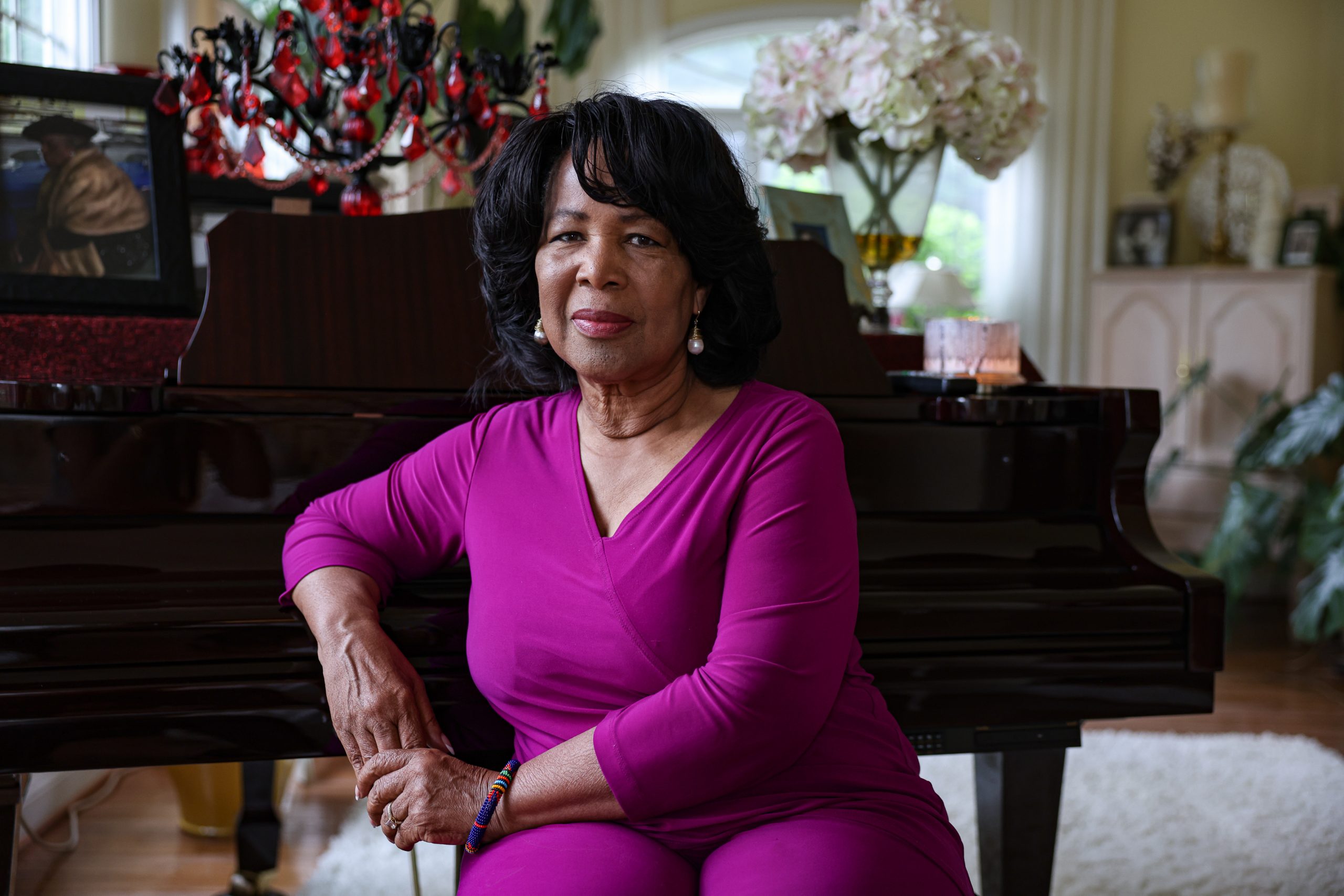
Peggy Carr, the former commissioner of the National Center for Education Statistics, at her Maryland home on July 1. Carr worked for the Education Department for more than 35 years before the Trump administration placed her on administrative leave on Feb. 24. Credit: Valerie Plesch for The Hechinger Report
Peggy Carr’s last day on the job came so abruptly that she only had time to grab a few personal photos and her coat before a security officer escorted her out of her office and into a chilly February afternoon. She still doesn’t know why she was summarily dismissed as commissioner of the National Center for Education Statistics (NCES), where she helped buildthe National Assessment of Educational Progress into the influential Nation’s Report Card. NCES is the federal government’s third-largest statistical agency after the Census Bureau and the Bureau of Labor Statistics. Running it for three and a half years was the capstone of Carr’s 35-year career at the Education Department.
And suddenly, she was out in the cold with no explanation.
“I would say that what has happened is a professional tragedy, not just for me, but for all of NCES and my staff,” said Carr, 71, in a recent interview. “But for me, it really was a personal tragedy because I have spent my career helping NCES build its solid reputation as a premier statistical agency in the federal system.”
Carr doesn’t know if the decision to fire her came from the White House, Elon Musk’s Department of Government Efficiency or an outside policy advocate.
But she is clear about what was lost by the firing of the head of a nonpartisan statistical agency: an objective assessment of how American students are doing. And she finds it “ironic,” she said, that her increasingly grim reports were President Donald Trump’s public rationale for dismantling the Education Department.
Although Carr was the first woman and the first Black person to run NCES, her “firsts” go back decades. She joined NCES in 1993, after teaching statistics at Howard University and a stint as a statistician in the Education Department’s Office of Civil Rights. “I was the first person of color in NCES to ever have a managerial job, period,” said Carr. She broke a long record: The education statistical agency dates back to 1867, created in the aftermath of the Civil War as part of an effort to help the South recover during Reconstruction. She was appointed commissioner by former President Joe Biden in 2021.
Related: Our free weekly newsletter alerts you to what research says about schools and classrooms.
“It’s a kill-the-messenger strategy,” she said. “We have just been the messenger of how students in this country are faring.”
Congress established a six-year term for the commissioner so that the job would straddle administrations and insulate statistics from politics. Carr’s term was supposed to extend through 2027, but she made history with yet another first: the first NCES commissioner to be fired by a president.
Carr wasn’t thinking about her gender or her race, despite the fact that three days earlier, Trump had abruptly fired another Black senior official, Gen. Charles Q. Brown Jr., the chairman of the Joint Chiefs of Staff. “Maybe they found out I was the only Biden appointee left in the department,” Carr said. “Maybe they didn’t realize that until then.”
Carr has reason to be puzzled by her firing. She is hardly a radical. She defended standardized tests against charges that they are racist. She publicly made the case that the nation needs to pay attention to achievement gaps, even if it sometimes means putting a spotlight on the low achievement of Black and Hispanic students. “The data can reveal things about what people can do to improve it,” Carr said.
She was dismissed on Feb. 24, more than a week before Education Secretary Linda McMahon’s Senate confirmation on March 3. The department named Carr’s deputy, Chris Chapman, to act as her replacement, but subsequently fired him in a round of mass layoffs on March 11. The agency was then leaderless until July 7,when another senior department official was told to add NCES to his responsibilities.
Civil servant
In January, at the start of the second Trump administration, Carr thought her job was relatively safe. As a career civil servant, she’d worked with many Republican administrations and served as second in command under James “Lynn” Woodworth, whom Trump appointed as NCES commissioner in his first term. Both Woodworth and Carr say they had a good working relationship because they both cared about getting the numbers right. Indeed, Woodworth was so troubled and disturbed by Carr’s dismissal and the fate of the nation’s education statistics agency that he spoke out publicly, risking retaliation.
Even Carr’s fiercest critics, who contend she was an entrenched bureaucrat who failed to modernize the statistical service and allowed costs to balloon, condemned the humiliating way she was dismissed.
“She deserves the nation’s gratitude and thanks” for setting up a whole system of assessments, said Mark Schneider, who served as the director of the Institute of Education Sciences (IES), which oversees NCES, from 2018 to 2024 and as NCES commissioner from 2005 to 2008.
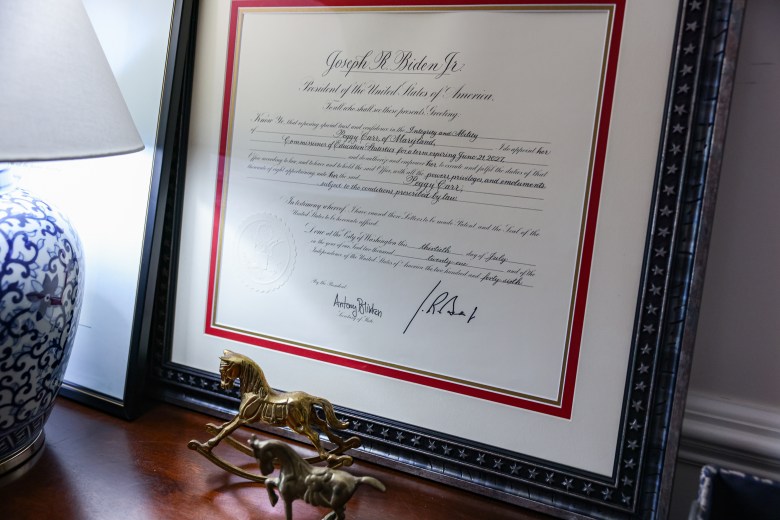
The official appointment of Peggy Carr as commissioner of the National Center for Education Statistics by former President Joe Biden. Credit: Valerie Plesch for The Hechinger Report
A landing team
The transition seemed normal at first. A “landing team” — emissaries from the Trump transition team — arrived in mid-January and Carr briefed them three times. They asked questions about NCES’s statistical work. “They were quite pleasant, to be honest,” Carr said. “They seemed curious and interested.”
Days later, DOGE arrived. Still, Carr wasn’t worried. “We actually thought we were going to be OK,” Carr said. “We thought that their focus was going to be on grants, not contracts.”
The Institute of Education Sciences had awarded millions of dollars in grants to professors and private-sector researchers to study ways to improve diversity and equity in the classroom — priorities that were now out of favor with the Trump team. Carr’s agency is housed under the IES umbrella, but Carr’s work didn’t touch upon any of that.
However, NCES has an unusual structure. Unlike other statistics agencies, NCES has never had many statisticians on staff and didn’t do much in-house statistical work. Because Congress put restrictions on its staffing levels, NCES had to rely on outside contractors to do 90 percent of the data work. Only through outside contractors was the Education Department able to measure academic achievement, count students and track university tuition costs. Its small staff of 100 primarily managed and oversaw the contracts.
Keyword searches
Following DOGE instructions, Carr’s team conducted keyword searches of DEI language in her agency’s contracts. “Everyone was asked to do that,” she said. “That wasn’t so bad. The chaotic part really started when questions were being asked about reductions in the contracts themselves.”
Carr said she never had direct contact with anyone on Musk’s team, and she doesn’t even know how many of them descended upon the Education Department. Her interaction with DOGE was secondhand. Matthew Soldner, acting director of IES, summoned Carr and the rest of his executive team to his office to respond to DOGE’s demands. “We met constantly, trying to figure out what DOGE wanted,” Carr said. DOGE’s orders were primarily transmitted through Jonathan Bettis, an Education Department attorney, who was experienced with procurement and contracts. It was Bettis who talked directly with the DOGE team, Carr said.
The main DOGE representative who took an interest in NCES was “Conor.” “I don’t know his last name,” said Carr. “My staff never saw anyone else but Conor if they saw him at all.” Conor is 32-year-old Conor Fennessy, according to several media reports. His deleted LinkedIn profile said he has a background in finance. (Fennessy has also been involved in getting access to data at Health and Human Services and spearheading cuts at the National Park Service, according to media reports.) Efforts to reach Fennessy through the Education Department and through DOGE were unsuccessful.
“It was chaotic,” said Carr. “Bettis would tell us what DOGE wanted, and we ran away to get it done. And then things might change the next day. ‘You need to cut more.’ ‘I need to understand more about what this contract does or that contract does.’”
It was a lot. Carr oversaw 60 data collections, some with multiple parts. “There were so many contracts and there were hundreds of lines on our acquisition plans,” she said. “It was a very complex and time-consuming task.”
Lost in translation
The questions kept coming. “It was like playing telephone tag when you have complicated data collections and you’re trying to explain it,” Carr said. Bettis “would sometimes not understand what my managers or I were saying about what we could cut or could not cut. And so there was this translation problem,” she said. (Efforts to reach Bettis were unsuccessful.) Eventually a couple of Carr’s managers were allowed to talk to DOGE employees directly.
Carr said her staff begged DOGE not to cut a technology platform called EDPass, which is used by state education agencies to submit data to the federal Education Department on everything from student enrollment to graduation rates. For Carr, EDPass was a particular point of pride in her effort to modernize and process data more efficiently. EDPass slashed the time it took to release data from 20 months in 2016-17 to just four months in 2023-24.
Carr said DOGE did not spare EDPass. Indeed, DOGE did not spare much of NCES.
On Feb 10, only about a week after DOGE arrived, Carr learned that 89 of her contracts were terminated, which represented the vast majority of the statistical work that her agency conducts. “We were in shock,” said Carr. “What do you mean it’s all gone?”
Even its advocates concede that NCES needed reforms. The agency was slow to release data,it usedsomeoutdated collection methods and there were places where costs could be trimmed. Education Department spokesperson Madi Biedermann said that the department, “in partnership with DOGE employees,” found contracts with overhead and administrative expenses that exceeded 50 percent, “a clear example of contractors taking advantage of the American taxpayer.”
Piloting an old airplane
Carr said she was never a fan of the contracting system and wished she could have built an in-house statistical agency like those at the Census Bureau and the Bureau of Labor Statistics. But that would have required congressional authorization for the Education Department to increase its headcount. That never happened. Carr was piloting an old airplane, taped together through a complicated network of contracts, while attempting to modernize and fix it. She said she was trying to follow the 2022 recommendations of a National Academies panel, but it wasn’t easy.
The chaos continued over the next two weeks. DOGE provided guidelines for justifying the reinstatement of contracts it had just killed and Carr’s team worked long hours trying to save the data. Carr was particularly worried about preserving the interagency agreement with the Census Bureau, which was needed to calculate federal Title I allocations to high-poverty schools. Those calculations needed to be ready by June and the clock was ticking.
The DOGE sledgehammer came just as schools were administering an important international test — the Program for International Student Assessment (PISA). The department was also in the midst of a national teachers and principals survey. “People were worried about what was going to happen with those,” said Carr.
Even though DOGE terminated the PISA contract, the contractor continued testing in schools and finished its data collection in June. But now it’s unclear who will tabulate the scores and analyze them. The Education Department disclosed in a June legal brief that it is restarting PISA. “I was told that they’re not going to do the national report, which is a little concerning to me,” Carr said. Asked for confirmation, the Education Department did not respond.
Another widely used data collection, the Early Childhood Longitudinal Survey (ECLS-K 2024), which tracks a cohort of students from kindergarten through elementary school, was supposed to collect its second year of data as the kindergarteners progressed to first grade. “We had to give up on that,” said Carr.
NAEP anxiety
Carr said that behind the scenes, her priority was to save NAEP. DOGE was demanding aggressive cuts, and she worked throughout the weekend of Feb. 22-23with her managers and the NAEP contractors to satisfy the demands. “We thought we could cut 28 percent — I even remember the number — without cutting into critical things,” she said. “That’s what I told them I could do.”
DOGE had been demanding 50 percent cuts to NAEP’s $185 million budget, according to several former Education Department employees. Carr could not see a way to cut that deep. The whole point of the exam is to track student achievement over time, and if too many corners were cut, it could “break the trend,” she said, making it impossible to compare the next test results in 2026 with historical scores.
“I am responsible in statute and I could not cut NAEP as much as they wanted to without cutting into congressionally mandated activities,” Carr said. “I told them that.”
While Carr and DOGE remained far apart in negotiations over cost, a security officer appeared at her office door at 3:50 p.m. on Feb. 24. Carr remembers the exact time because colleagues were waiting at her door to join her for a 4 p.m. Zoom meeting with the chair of the board that oversees NAEP.
The security officer closed the door to her office so he could tell her privately that he was there to escort her out. He said she had 15 minutes to leave. “Escort me where? What do you mean?” Carr asked. “I was in shock. I wasn’t even quite understanding what he was asking, to be honest.”
The security officer told her about an email saying she was put on administrative leave. Carr checked her inbox. It was there, sent within the previous hour.
The security officer “was very nice,” she said. “He refused to call me Peggy,” and addressed her as Dr. Carr. “He helped me collect my things, and I left.” He opened the doors for her and walked her to her car.
“I had no idea that this was going to happen, so it was shocking and unexpected,” Carr said. “I was working like I do every other day, a busy day where every minute is filled with something.”
She said she’s asked the department why she was dismissed so abruptly, but has not received a response. The Education Department said it does not comment to the public on its personnel actions.
Packing via Zoom
Two days later, Carr returned to pick up other belongings. Via Zoom, Carr’s staff had gone through her office with her — 35 years worth of papers and memorabilia — and packed up so many boxes that Carr had to bring a second car, an SUV.
When Carr and her husband arrived, she said, “there were all these people waiting in the front of the building cheering me on. The men helped me put the things in my husband’s car and my car. It was a real tearjerker. And that was before they would be dismissed. They didn’t know they would be next.”
Less than two weeks later, on March 11, most of Carr’s staff — more than 90 NCES staffers — was fired. Only three remained. “I thought maybe they just made a mistake, that it was going to be a ‘whoops moment’ like with the bird flu scientists or the people overseeing the weapons arsenal,” Carr said.
The fate of NCES remains uncertain. The Education Department says that it is restarting and reassessing some of the data collections that DOGE terminated, but the scope of the work might be much smaller. Carr says it will take years to understand the full extent of the damage. Carr was slated to issue a statement about her thoughts on NCES on July 14.
The damage
The immediate problem is that there aren’t enough personnel to do the work that Congress mandates. So far, NCES has missed an annual deadline for delivering a statistical report to Congress — a deadline NCES had “never, ever missed” in its history, Carr said — and failed to release the 2024 NAEP science test scores in June because there was no commissioner to sign off on them. But the department managed to calculate the Title I allocations to high-poverty schools “in the nick of time,” Carr said.
In addition to the collection of fresh data, Carr is concerned about the maintenance of historical datasets. When DOGE canceled the contracts, Carr counted that NCES had 550 datasets scattered in different locations. NCES doesn’t have its own data warehouse and Carr was trying to corral and store the datasets. She’s worried about protecting privacy and student confidentiality.
An Education Department official said that this data is safe and will soon be transferred to IES’s secure servers.
Peggy Carr holds artwork made by a former colleague at the National Center for Education Statistics. NAEP stands for the National Assessment of Educational Progress, which Carr helped build into the influential barometer of how American students are faring. Credit: Valerie Plesch for The Hechinger Report
In the meantime, Carr says she plans to stay involved in education statistics — but from the outside. “With this administration wanting to push education down to the states, there are opportunities that I see in my next chapter,” Carr said. She said she’s been talking with states and school districts about calculating where they rank on an international yardstick.
Carr is in close touch with her former team. In May, 50 of them gathered at a church in Virginia to commiserate. A senior statistician gave Carr a homespun plaque of glued blue buttons spelling the letters NAEP with a shiny gold star above it. It was a fitting gift. NAEP is regarded as the best designed test in the country, the gold standard. Carr built that reputation, and now it has gone home with her.
This story about Peggy Carr was written by Jill Barshay and produced by The Hechinger Report, a nonprofit, independent news organization focused on inequality and innovation in education. Sign up for Proof Points and other Hechinger newsletters.
The Hechinger Report provides in-depth, fact-based, unbiased reporting on education that is free to all readers. But that doesn’t mean it’s free to produce. Our work keeps educators and the public informed about pressing issues at schools and on campuses throughout the country. We tell the whole story, even when the details are inconvenient. Help us keep doing that.
UPDATE: After this story was published, the Education Department issued a press release Monday afternoon, July 7, announcing that Matthew Soldner will serve as acting commissioner of the National Center for Education Statistics, in addition to his role as acting director of the Institute of Education Sciences. The job of statistics chief had been vacant since March and had prevented the release of assessment results.
The repercussions from the decimation of staff at the Education Department keep coming. Last week, the fallout led to a delay in releasing results from a national science test.
The National Assessment of Educational Progress (NAEP) is best known for tests that track reading and math achievement but includes other subjects, too. In early 2024, when the main reading and math tests were administered, there was also a science section for eighth graders.
Why the delay? There is no commissioner of education statistics to sign off on the score report, a requirement beforeit is released, according to five current and former officials who are familiar with the release of NAEP scores, but asked to remain anonymous because they were not authorized to speak to the press or feared retaliation.
Related: Our free weekly newsletter alerts you to what research says about schools and classrooms.
Peggy Carr, a Biden administration appointee, was dismissed as the commissioner of the National Center for Education Statistics in February, two years before the end of her six-year term set by Congress. Chris Chapman was named acting commissioner, but he was fired in March, along with half the employees at the Education Department. The role has remained vacant since.
A spokesman for the National Assessment Governing Board, which oversees NAEP, said the science scores will be released later this summer, but denied that the lack of a commissioner is the obstacle. “The report building is proceeding so the naming of a commissioner is not a bureaucratic hold-up to its progress,” Stephaan Harris said by email.
The delay matters. Education policymakers have been keen to learn if science achievement had held steady after the pandemic or tumbled along with reading and math. (Those reading and math scores were released in January.)
The Trump administration has vowed to dismantle the Education Department and did not respond to an emailed question about when a new commissioner would be appointed.
Keeping up with administration policy can be head-spinning these days. Education researchers were notified in March that they would have to relinquish federal data they were using for their studies. (The department shares restricted datasets, which can include personally identifiable information about students, with approved researchers.)
But researchers learned on June 30 that the department had changed its mind and decided not to terminate this remote access.
Lawyers who are suing the Trump administration on behalf of education researchers heralded this about-face as a “big win.” Researchers can now finish projects in progress.
Still, researchers don’t have a way of publishing or presenting papers that use this data. Since the mass firings in mid-March, there is no one remaining inside the Education Department to review their papers for any inadvertent disclosure of student data, a required step before public release. And there is no process at the moment for researchers to request data access for future studies.
“While ED’s change-of-heart regarding remote access is welcome,” said Adam Pulver of Public Citizen Litigation Group, “other vital services provided by the Institute of Education Sciences have been senselessly, illogically halted without consideration of the impact on the nation’s educational researchers and the education community more broadly. We will continue to press ahead with our case as to the other arbitrarily canceled programs.”
Pulver is the lead attorney for one of three suits fighting the Education Department’s termination of research and statistics activities. Judges in the District of Columbia and Maryland have denied researchers a preliminary injunction to restore the research and data cuts. But the Maryland case is now fast-tracked and the court has asked the Trump administration to produce an administrative record of its decision-making process by July 11. (See this previous story for more background on the court cases.)
Just as the Education Department is quietly restarting some activities that DOGE killed, so is the National Science Foundation (NSF). The federal science agency posted on its website that it had reinstated 114 awards to 45 institutions as of June 30. NSF said it was doing so to comply with a federal court order to reinstate awards to all University of California researchers. It was unclear how many of these research projects concerned education, one of the major areas that NSF funds.
Researchers and universities outside the University of California system are hoping for the same reversal. In June, the largest professional organization of education researchers, the American Educational Research Association, joined forces with a large coalition of organizations and institutions in filing a legal challenge to the mass termination of grants by the NSF. Education grants were especially hard hit in a series of cuts in April and May. Democracy Forward, a public interest law firm, is spearheading this case.
The Hechinger Report provides in-depth, fact-based, unbiased reporting on education that is free to all readers. But that doesn’t mean it’s free to produce. Our work keeps educators and the public informed about pressing issues at schools and on campuses throughout the country. We tell the whole story, even when the details are inconvenient. Help us keep doing that.
Education Secretary Linda McMahon has repeatedly said that the February and March cancellations and firings at her department cut not only the “fat” but also into some of the “muscle” of the federal role in education. So, even as she promises to dismantle her department, she is also bringing back some people and restarting some activities. Court filings and her own congressional testimony illuminate what this means for the agency as a whole, and for education research in particular.
McMahon told a U.S. House committee last month she rehired 74 employees out of the roughly 2,000 who were laid off or agreed to separation packages. A court filing earlier this month says the agency will revive about a fifth of research and statistics contracts killed earlier this year, at least for now, though that doesn’t mean the work will look exactly as it did before.
The Trump administration disclosed in a June 5 federal court filing in Maryland that it either has or is planning to reinstate 20 of 101 terminated contracts to comply with congressional statutes. More than half of the reversals will restart 10 regional education laboratories that the Trump administration had said were engaged in “wasteful and ideologically driven spending,” but had been very popular with state education leaders. The reinstatements also include an international assessment, a study of how to help struggling readers, and Datalab, a web-based data analysis tool for the public.
Related: Our free weekly newsletter alerts you to what research says about schools and classrooms.
Even some of the promised reinstatements are uncertain because the Education Department plans to put some of them up for new bids (see table below). That process could take months and potentially result in smaller contracts with fewer studies or hours of technical assistance.
These research activities were terminated by Elon Musk’s Department of Government Efficiency (DOGE) before McMahon was confirmed by the Senate. The Education Department’s disclosure of the reinstatements occurred a week after President Donald Trump bid farewell to Musk in the Oval Office and on the same day that the Trump-Musk feud exploded on social media.
See which IES contracts have been or are slated to be restarted, or under consideration for reinstatement
Description
Status
1
Regional Education Laboratory – Mid Atlantic
Intends to seek new bids and restart contract
2
Regional Education Laboratory – Southwest
Intends to seek new bids and restart contract
3
Regional Education Laboratory – Northwest
Intends to seek new bids and restart contract
4
Regional Education Laboratory – West
Intends to seek new bids and restart contract
5
Regional Education Laboratory – Appalachia
Intends to seek new bids and restart contract
6
Regional Education Laboratory – Pacific
Intends to seek new bids and restart contract
7
Regional Education Laboratory – Central
Intends to seek new bids and restart contract
8
Regional Education Laboratory – Midwest
Intends to seek new bids and restart contract
9
Regional Education Laboratory – Southeast
Intends to seek new bids and restart contract
10
Regional Education Laboratory – Northeast and Islands
Intends to seek new bids and restart contract
11
Regional Education Laboratory – umbrella support contract
Intends to seek new bids and restart contract
12
What Works Clearinghouse (website, training reviewers, but no reviewing of education research)
Approved for reinstatement
13
Statistical standards and data confidentiality technical assistance for the National Center for Education Statistics
Reinstated
14.
Statistical and confidentiality review of electronic data files and technical reports
Approved for reinstatement
15
Datalab, a web-based data analysis tool for the public
Approved for reinstatement
16
U.S. participation in the Program for International Student Assessment (PISA), an international test overseen by the Organization for Economic Cooperation and Development (OECD)
Reinstated
17
Data quality and statistical methodology assistance
Reinstated
18
EDFacts, a collection of administrative data from school districts around the country
Reinstated
19
Demographic and geospatial estimates (e.g. school poverty and school locations) used for academic research and federal program administration
Approved for reinstatement
20
Evaluation of the Multi-tiered System of Supports in reading, an approach to help struggling students
Approved for reinstatement
21
Implementation of the Striving Readers Comprehensive Literacy Program and feasibility of conducting an impact evaluation of it.
Evaluating whether to restart
22
Policy-relevant findings for the National Evaluation of Career and Technical Education
Evaluating whether to restart
23
The National Postsecondary Student Aid Study (how students finance college, college graduation rates and workforce outcomes)
Evaluating whether to restart
24
Additional higher ed studies
Evaluating whether to restart
25
Publication assistance on educational topics and the annual report
Evaluating whether to restart
26
Conducting peer review of applications, manuscripts and grant competitions at the Institute of Education Sciences
Evaluating whether to restart
The Education Department press office said it had no comment beyond what was disclosed in the legal brief.
Education researchers, who are suing the Trump administration to restore all of its previous research and statistical activities, were not satisfied.
Elizabeth Tipton, president of the Society for Research on Educational Effectiveness (SREE) said the limited reinstatement is “upsetting.” “They’re trying to make IES as small as they possibly can,” she said, referring to the Institute of Education Sciences, the department’s research and data arm.
SREE and the American Educational Research Association (AERA) are suing McMahon and the Education Department in the Maryland case. The suit asks for a temporary reinstatement of all the contracts and the rehiring of IES employees while the courts adjudicate the broader constitutional issue of whether the Trump administration violated congressional statutes and exceeded its executive authority.
The 20 reinstatements were not ordered by the court, and in some instances, the Education Department is voluntarily restarting only a small slice of a research activity, making it impossible to produce anything meaningful for the public. For example, the department said it is reinstating a contract for operating the What Works Clearinghouse, a website that informs schools about evidence-based teaching practices. But, in the legal brief, the department disclosed that it is not planning to reinstate any of the contracts to produce new content for the site.
In the brief, the administration admitted that congressional statues mention a range of research and data collection activities. But the lawyers argued that the legislative language often uses the word may instead of must, or notes that evaluations of education programs should be done “as time and resources allow.”
“Read together, the Department has wide discretion in whether and which evaluations to undertake,” the administration lawyers wrote.
The Trump administration argued that as long as it has at least one contract in place, it is technically fulfilling a congressional mandate. For example, Congress requires that the Education Department participate in international assessments. That is why it is now restarting the contract to administer the Program for International Student Assessment (PISA), but not other international assessments that the country has participated in, such as the Trends in International Mathematics and Science Study (TIMSS).
The administration argued that researchers didn’t make a compelling case that they would be irreparably harmed if many contracts were not restarted. “There is no harm alleged from not having access to as-yet uncreated data,” the lawyers wrote.
One of the terminated contracts was supposed to help state education agencies create longitudinal data systems for tracking students from pre-K to the workforce. The department’s brief says that states, not professional associations of researchers, should sue to restore those contracts.
In six instances, the administration said it was evaluating whether to restart a study. For example, the legal brief says that because Congress requires the evaluation of literacy programs, the department is considering a reinstatement of a study of the Striving Readers Comprehensive Literacy Program. But lawyers said there was no urgency to restart it because there is no deadline for evaluations in the legislative language.
In four other instances, the Trump administration said it wasn’t feasible to restart a study, despite congressional requirements. For example, Congress mandates that the Education Department identify and evaluate promising adult education strategies. But after terminating such a study in February, the Education Department admitted that it is now too difficult to restart it. The department also said it could not easily restart two studies of math curricula in low-performing schools. One of the studies called for the math program to be implemented in the first year and studied in the second year, which made it especially difficult to restart. A fourth study the department said it could not restart would have evaluated the effectiveness of extra services to help teens with disabilities transition from high school to college or work. When DOGE pulled the plug on that study, those teens lost those services too.
The Hechinger Report provides in-depth, fact-based, unbiased reporting on education that is free to all readers. But that doesn’t mean it’s free to produce. Our work keeps educators and the public informed about pressing issues at schools and on campuses throughout the country. We tell the whole story, even when the details are inconvenient. Help us keep doing that.
The courts have pushed back against much of President Donald Trump’s agenda, but he did win a small victory this week in a dispute with education researchers.
On June 3, a federal judge in Washington, D.C., denied a request by four education research trade associations for a preliminary injunction, which means that the Education Department doesn’t have to temporarily reinstate fired employees and canceled contracts within its research and data arm, the Institute of Education Sciences.
Researchers had hoped to return the research division to its pre-Trump status while the court takes time to decide the overall issue in the case, which is whether the Trump administration exceeded its executive authority in these mass firings and contract terminations. Now, the cuts in the research arm of the department will remain while the case proceeds.
Four education research groups (the Association for Education Finance and Policy (AEFP), the Institute for Higher Education Policy (IHEP), the National Academy of Education (NAEd) and the National Council on Measurement in Education (NCME)) are suing the Education Department because their federally funded studies, evaluations and surveys have been slashed and their access to data is slated to be curtailed. They also contend that historical data archives are at risk, along with future data quality. Their legal argument is that the cuts were arbitrary and capricious and they say that the Trump administration eliminated many activities that Congress requires by law.
U.S. District Judge Trevor McFadden acknowledged that the “upheaval” at the Institute of Education Sciences is “understandably jarring for those who rely on studies and data produced by the Institute.” However, McFadden explained in a written opinion that the law that the researchers are using to sue the executive branch, the Administrative Procedure Act, was “never meant to be a bureaucratic windbreak insulating agencies from political gales.”
“It is not this Court’s place to breathe life back into wide swathes of the Institute’s cancelled programs and then monitor the agency’s day-to-day statutory compliance,” McFadden wrote.
In the opinion, McFadden noted that some of the researchers’ complaints, such as losing remote access to student data for research purposes, may be “ripe for standalone challenges,” but bundling all of their grievances together is a “losing gambit.”
The ruling not only denied researchers the short-term remedy they sought but also cast doubt on the prospects of their overall case. “We are disappointed with and disagree with the Court’s decision, and are evaluating our next steps,” said Adam Pulver, an attorney at Public Citizen, a nonprofit advocacy organization representing two of the research organizations.
A federal judge in Maryland is still considering a similar request to temporarily restore research-related cuts at the Education Department by two other education research groups. That suit, which also accuses the Trump administration of exceeding its executive power, was brought by the American Educational Research Association (AERA) and the Society for Research on Educational Effectiveness (SREE).
Educators fighting the cuts have had one victory so far, in a separate case filed in federal district court in Boston. On May 22, U.S. District Judge Myong Joun ordered the Trump administration to reinstate 1,300 Education Department employees terminated in March. The Trump administration is challenging the decision, but the court said on June 4 that the Education Department couldn’t postpone rehiring everyone while the appeal works its way through the courts. This case was brought by two Massachusetts school districts, a teachers union and 21 Democratic attorneys general.
This story about education researchers suing the Trump administration was written by Jill Barshay and produced by The Hechinger Report, a nonprofit, independent news organization focused on inequality and innovation in education. Sign up for Proof Points and other Hechinger newsletters.
The Hechinger Report provides in-depth, fact-based, unbiased reporting on education that is free to all readers. But that doesn’t mean it’s free to produce. Our work keeps educators and the public informed about pressing issues at schools and on campuses throughout the country. We tell the whole story, even when the details are inconvenient. Help us keep doing that.
When hackers hit a school district, they can expose Social Security numbers, home addresses, and even disability and disciplinary records. Now, cybersecurity advocates warn that the Trump administration’s budget and personnel cuts, along with rule changes, are stripping away key defenses that schools need.
“Cyberattacks on schools are escalating and just when we need federal support the most, it’s being pulled away,” said Keith Krueger, chief executive officer of the Consortium for School Networking, an association of technology officials in K-12 schools.
Related: Our free weekly newsletter alerts you to what research says about schools and classrooms.
The stakes are high. Schools are a top target in ransomware attacks, and cyber criminals have sometimes succeeded in shutting down whole school districts. The largest such incident occurred in December, when hackers stole personal student and teacher data from PowerSchool, a company that runs student information systems and stores report cards. The theft included data from more than 60 million students and almost 10 million teachers. PowerSchool paid an undisclosed ransom, but the criminals didn’t stop. Now, in a second round of extortion, the same cyber criminals are demanding ransoms from school districts.
Of chief concern is a cybersecurity service known as MS-ISAC, which stands for Multi-State Information Sharing and Analysis Center. It warns more than 5,700 schools around the country that have signed up for the service about malware and other threats and recommends security patches. This technical service is free to schools, but is funded by an annual congressional appropriation of $27 million through the Cybersecurity and Infrastructure Security Agency (CISA), an agency within the Department of Homeland Security.
On March 6, the Trump administration announced a $10 million funding cut as part of broader budget and staffing cuts throughout CISA. That was ultimately negotiated down to $8.3 million, but the service still lost more than half of its remaining $15.7 budget for the year. The non-profit organization that runs it, the Center for Internet Services, is digging into its reserves to keep it operating. But those funds are expected to run out in the coming weeks, and it is unclear how the service will continue operating without charging user fees to schools.
“Many districts don’t have the budget or resources to do this themselves, so not having access to the no cost services we offer is a big issue,” said Kelly Lynch Wyland, a spokeswoman for the Center for Internet Services.
Sharing threat information
Another concern is the effective disbanding of the Government Coordinating Council, which helps schools address ransomware attacks and other threats through policy advice, including how to respond to ransom requests, whom to inform when an attack happens and good practices for preventing attacks. This coordinating council was formed only a year ago by the Department of Education and CISA. It brings together 13 nonprofit school organizations representing superintendents, state education leaders, technology officers and others. The council met frequently after the PowerSchool data breach to share information.
Now, amid the second round of extortions, school leaders have not been able to meet because of a change in rules governing open meetings. The group was originally exempt from meeting publicly because it was discussing critical infrastructure threats. But the Department of Homeland Security, under the Trump administration, reinstated open meeting rules for certain advisory committees, including this one. That makes it difficult to speak frankly about efforts to thwart criminal activity.
Non-governmental organizations are working to resurrect the council, but it would be in a diminished form without government participation.
“The FBI really comes in when there’s been an incident to find out who did it, and they have advice on whether you should pay or not pay your ransom,” said Krueger of the school network consortium.
A federal role
A third concern is the elimination in March of the education Department’s Office of Educational Technology. This seven-person office dealt with education technology policies — including cybersecurity. It issued cybersecurity guidance to schools and held webinars and meetings to explain how schools could improve and shore up their defenses. It also ran a biweekly meeting to talk about K-12 cybersecurity across the Education Department, including offices that serve students with disabilities and English learners.
Eliminating this office has hampered efforts to decide which security controls, such as encryption or multi-factor authentication, should be in educational software and student information systems.
Many educators worry that without this federal coordination, student privacy is at risk. “My biggest concern is all the data that’s up in the cloud,” said Steve Smith, the founder of the Student Data Privacy Consortium and the former chief information officer for Cambridge Public Schools in Massachusetts. “Probably 80 to 90 percent of student data isn’t on school-district controlled services. It’s being shared with ed tech providers and hosted on their information systems.”
Security controls
“How do we ensure that those third-party providers are providing adequate security against breaches and cyber attacks?” said Smith. “The office of ed tech was trying to bring people together to move toward an agreed upon national standard. They weren’t going to mandate a data standard, but there were efforts to bring people together and start having conversations about the expected minimum controls.”
That federal effort ended, Smith said, with the new administration. But his consortium is still working on it.
In an era when policymakers are seeking to decrease the federal government’s involvement in education, arguing for a centralized, federal role may not be popular. But there’s long been a federal role for student data privacy, including making sure that school employees don’t mishandle and accidentally expose students’ personal information. The Family Educational Rights and Privacy Act, commonly known as FERPA, protects student data. The Education Department continues to provide technical assistance to schools to comply with this law. Advocates for school cybersecurity say that the same assistance is needed to help schools prevent and defend against cyber crimes.
“We don’t expect every town to stand up their own army to protect themselves against China or Russia,” said Michael Klein, senior director for preparedness and response at the Institute for Security and Technology, a nonpartisan think tank. Klein was a senior advisor for cybersecurity in the Education Department during the previous administration. “In the same way, I don’t think we should expect every school district to stand up their own cyber-defense army to protect themselves against ransomware attacks from major criminal groups.”
And it’s not financially practical. According to the school network consortium only a third of school districts have a full-time employee or the equivalent dedicated to cybersecurity.
Budget storms ahead
Some federal programs to help schools with cybersecurity are still running. The Federal Communications Commission launched a $200 million pilot program to support cybersecurity efforts by schools and libraries. FEMA funds cybersecurity for state and local governments, which includes public schools. Through these funds, schools can obtain phishing training and malware detection. But with budget battles ahead, many educators fear these programs could also be cut.
Perhaps the biggest risk is the end to the entire E-Rate program that helps schools pay for the internet access. The Supreme Court is slated to decide this term on whether the funding structure is an unconstitutional tax.
“If that money goes away, they’re going to have to pull money from somewhere,” said Smith of the Student Data Privacy Consortium. “They’re going to try to preserve teaching and learning, as they should. Cybersecurity budgets are things that are probably more likely to get cut.
“It’s taken a long time to get to the point where we see privacy and cybersecurity as critical pieces,” Smith said. “I would hate for us to go back a few years and not be giving them the attention they should.”
The Hechinger Report provides in-depth, fact-based, unbiased reporting on education that is free to all readers. But that doesn’t mean it’s free to produce. Our work keeps educators and the public informed about pressing issues at schools and on campuses throughout the country. We tell the whole story, even when the details are inconvenient. Help us keep doing that.