Category: Race and Equity

  • Three-fourths of NSF funding cuts hit education

    Three-fourths of NSF funding cuts hit education

    The outlook for federal spending on education research continues to be grim. 

    That became clear last week with more cutbacks to education grants and mass firings at the National Science Foundation (NSF), the independent federal agency that supports both research and education in science, engineering and math.

    A fourth round of cutbacks took place on May 9. NSF observers were still trying to piece together the size and scope of this wave of destruction. A division focused on equity in education was eliminated and all its employees were fired. And the process for reviewing and approving future research grants was thrown into chaos with the elimination of division directors who were stripped of their powers.

    Meanwhile, there was more clarity surrounding a third round of cuts that took place a week earlier on May 2. That round terminated more than 330 grants, raising the total number of terminated grants to at least 1,379, according to Grant Watch, a new project launched to track the Trump administration’s termination of grants at scientific research agencies. All but two of the terminated grants in early May were in the education division, and mostly targeted efforts to promote equity by increasing the participation of women and Black and Hispanic students in STEM fields. The number of active grants by the Division of Equity for Excellence in STEM within the education directorate was slashed almost in half, from 902 research grants to 461.

    Related: Our free weekly newsletter alerts you to what research says about schools and classrooms.

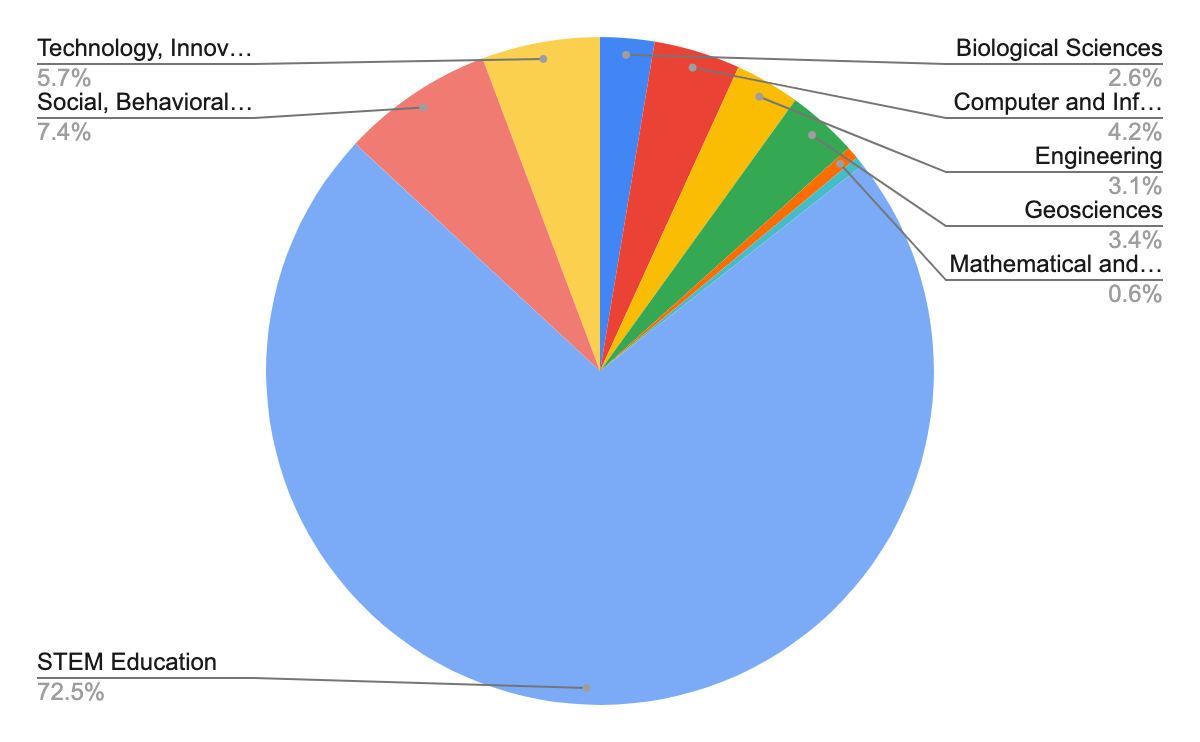
    Combined with two earlier rounds of NSF cuts at in April, education now accounts for more than half of the nearly 1,400 terminated grants and almost three-quarters of their $1 billion value. Those dollars will no longer flow to universities and research organizations. 

    Cuts to STEM education dominate NSF grant terminations

    Source: Grant Watch, May 7, 2025 https://grant-watch.us/nsf-summary-2025-05-07.html

    More than half the terminated grants…

    … and nearly three-quarters of their $1 billion value are in education 

    Data source: Grant Watch, May 7, 2025. Charts by Jill Barshay/The Hechinger Report

    The cuts are being felt across the nation. Grant Watch also created a map of the United States, showing that both red and blue states are losing federal research dollars. 

    Source: Grant Watch, May 7, 2025 

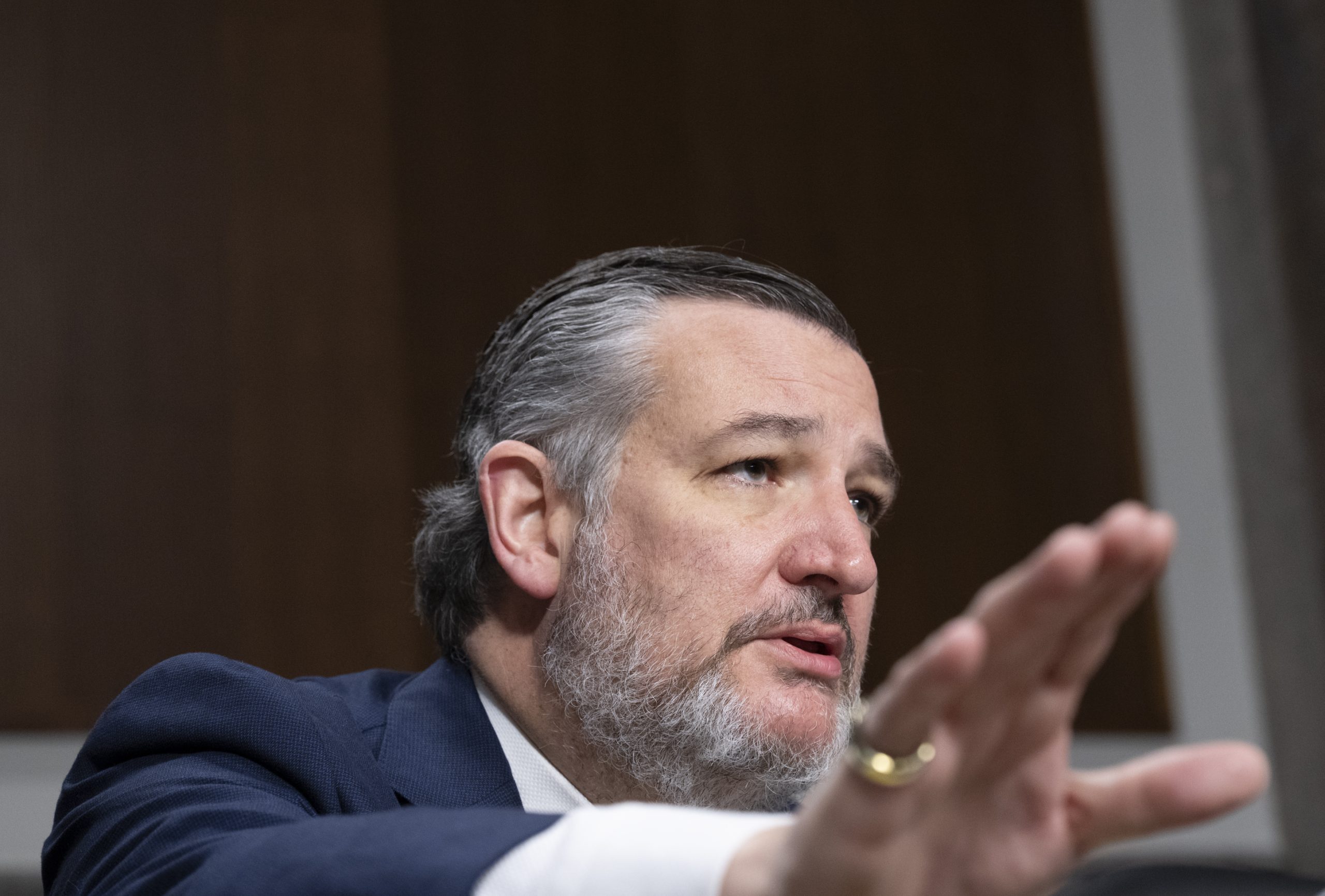
    It remains unclear exactly how NSF is choosing which grants to cancel and exactly who is making the decisions. Weekly waves of cuts began after the Department of Government Efficiency or DOGE entered NSF headquarters in mid April. Only 40 percent of the terminated grants were also in a database of 3,400 research grants compiled last year by Sen. Ted Cruz, a Texas Republican. Cruz characterized them as “questionable projects that promoted Diversity, Equity, and Inclusion (DEI) or advanced neo-Marxist class warfare propaganda.” Sixty percent were not on the Cruz list.

    Source: Grant Watch, May 7, 2025 

    Other NSF cuts also affect education. Earlier this year, NSF cut in half the number of new students that it would support through graduate school from 2,000 to 1,000. Universities are bracing to hear this summer if NSF will continue to support graduate students who are already a part of its graduate research fellowship program. 

    Related: Education research takes another hit in latest DOGE attack

    Developing story

    NSF watchers were still compiling a list of the research grants that were terminated on May 9, the date of the most recent fourth round of research cuts. It was unclear if any research grants to promote equity in STEM education remained active.

    The Division of Equity for Excellence in STEM, a unit of the Education Directorate, was “sunset,” according to a May 9 email sent to NSF employees and obtained by the Hechinger Report, and all of its employees were fired. According to the email, this “reduction in force” is slated to be completed by July 12. However, later on May 9, a federal judge in San Francisco temporarily blocked the Trump administration from implementing its “reduction in force” firings of federal employees at the NSF and 19 other agencies.

    Several congressionally mandated programs are housed within the eliminated equity division, including Louis Stokes Alliances for Minority Participation (LSAMP) and the Eddie Bernice Johnson initiative, which promotes STEM participation for students with disabilities.

    The process for reviewing and approving new grant awards was thrown into chaos with the elimination of all NSF division directors, a group of middle managers who were stripped of their powers on May 8. In addition, NSF slashed its ranks of its most senior executives and its visiting scientists, engineers and educators. That leaves many leadership positions at NSF uncertain, including the head of the entire education directorate.

    Legal update

    An initial hearing for a group of three legal cases by education researchers against the Department of Education is scheduled for May 16.  At the hearing, a federal judge in Washington, D.C., will hear arguments over whether the court should temporarily restore terminated research studies and data collections and bring back fired Education Department employees while it considers whether the Trump administration exceeded its executive authority. 

    A first hearing scheduled for May 9 was postponed. At the May 16 hearing, the court will hear two similar motions from two different cases: one filed by the Association for Education Finance and Policy (AEFP) and the Institute for Higher Education Policy (IHEP), and the other filed by National Academy of Education (NAEd) and the National Council on Measurement in Education (NCME). A third suit by the American Educational Research Association (AERA) and the Society for Research on Educational Effectiveness (SREE) was filed in federal court in Maryland and will not be part of the May 16 hearing.

    Contact staff writer Jill Barshay at 212-678-3595, jillbarshay.35 on Signal, or [email protected].

    This story about NSF education cuts was written by Jill Barshay and produced by The Hechinger Report, a nonprofit, independent news organization focused on inequality and innovation in education. Sign up for Proof Points and other Hechinger newsletters.

    The Hechinger Report provides in-depth, fact-based, unbiased reporting on education that is free to all readers. But that doesn’t mean it’s free to produce. Our work keeps educators and the public informed about pressing issues at schools and on campuses throughout the country. We tell the whole story, even when the details are inconvenient. Help us keep doing that.

    Join us today.

    Source link

  • Education researchers sue Trump administration, testing executive power

    Education researchers sue Trump administration, testing executive power

    UPDATE: The hearing scheduled for May 9 has been postponed until May 16 at the U.S. District Court for the District of Columbia. The court will hear two similar motions at the same time and consider whether to temporarily restore the cuts to research and data collections and bring back fired federal workers at the Education Department. More details on the underlying cases in the article below.

    Some of the biggest names in education research — who often oppose each other in scholarly and policy debates — are now united in their desire to fight the cuts to data and scientific studies at the U.S. Department of Education.

    The roster includes both Grover J. “Russ” Whitehurst, the first head of the Institute of Education Sciences (IES) who initiated studies for private school vouchers, and Sean Reardon, a Stanford University sociologist who studies inequity in education. They are just two of the dozens of scholars who have submitted declarations to the courts against the department and Secretary Linda McMahon. They describe how their work has been harmed and argue that the cuts will devastate education research.

    Professional organizations representing the scholars are asking the courts to restore terminated research and data and reverse mass firings at the Institute of Education Sciences, the division that collects data on students and schools, awards research grants, highlights effective practices and measures student achievement. 

    Related: Our free weekly newsletter alerts you to what research says about schools and classrooms.

    Three major suits were filed last month in U.S. federal courts, each brought by two different professional organizations. The six groups are the Association for Education Finance and Policy (AEFP), Institute for Higher Education Policy (IHEP), American Educational Research Association (AERA), Society for Research on Educational Effectiveness (SREE), National Academy of Education (NAEd) and the National Council on Measurement in Education (NCME). The American Educational Research Association alone represents 25,000 researchers and there is considerable overlap in membership among the professional associations. 

    Prominent left-wing and progressive legal organizations spearheaded the suits and are representing the associations. They are Public Citizen, Democracy Forward and the Legal Defense Fund, which was originally founded by the National Association for the Advancement of Colored People (NAACP) but is an independent legal organization. Allison Scharfstein, an attorney for the Legal Defense Fund, said education data is critical to documenting educational disparities and improve education for Black and Hispanic students. “We know that the data is needed for educational equity,” Scharfstein said.

    Related: Chaos and confusion as the statistics arm of the Education Department is reduced to a skeletal staff of 3

    Officers at the research associations described the complex calculations in suing the government, mindful that many of them work at universities that are under attack by the Trump administration and that its members are worried about retaliation.  

    “A situation like this requires a bit of a leap of faith,” said Elizabeth Tipton, president of the Society for Research on Educational Effectiveness and a statistician at Northwestern University. “We were reminded that we are the Society for Research on Educational Effectiveness, and that this is an existential threat. If the destruction that we see continues, we won’t exist, and our members won’t exist. This kind of research won’t exist. And so the board ultimately decided that the tradeoffs were in our favor, in the sense that whether we won or we lost, that we had to stand up for this.”

    The three suits are similar in that they all contend that the Trump administration exceeded its executive authority by eliminating activities Congress requires by law. Private citizens or organizations are generally barred from suing the federal government, which enjoys legal protection known as “sovereign immunity.” But under the Administrative Procedure Act of 1946, private organizations can ask the courts to intervene when executive agencies have acted arbitrarily, capriciously and not in accordance with the law. The suits point out, for example, that the Education Science Reform Act of 2002 specifically requires the Education Department to operate Regional Education Laboratories and conduct longitudinal and special data collections, activities that the Education Department eliminated in February among a mass cancelation of projects

    Related: DOGE’s death blow to education studies

    The suits argue that it is impossible for the Education Department to carry out its congressionally required duties, such as the awarding of grants to study and identify effective teaching practices, after the March firing of almost 90 percent of the IES staff and the suspension of panels to review grant proposals. The research organizations argue that their members and the field of education research will be irreparably harmed. 

    Of immediate concern are two June deadlines. Beginning June 1, researchers are scheduled to lose remote access to restricted datasets, which can include personally identifiable information about students. The suits contend that loss harms the ability of researchers to finish projects in progress and plan future studies. The researchers say they are also unable to publish or present studies that use this data because there is no one remaining inside the Education Department to review their papers for any inadvertent disclosure of student data.

    The second concern is that the termination of more than 1,300 Education Department employees will become final by June 10. Technically, these employees have been on administrative leave since March, and lawyers for the education associations are concerned that it will be impossible to rehire these veteran statisticians and research experts for congressionally required tasks. 

    The suits describe additional worries. Outside contractors are responsible for storing historical datasets because the Education Department doesn’t have its own data warehouse, and researchers are worried about who will maintain this critical data in the months and years ahead now that the contracts have been canceled. Another concern is that the terminated contracts for research and surveys include clauses that will force researchers to delete data about their subjects. “Years of work have gone into these studies,” said Dan McGrath, an attorney at Democracy Forward, who is involved in one of the three suits. “At some point it won’t be possible to put Humpty Dumpty back together again.” 

    Related: Education research takes another hit in latest DOGE attack

    In all three of the suits, lawyers have asked the courts for a preliminary injunction to reverse the cuts and firings, temporarily restoring the studies and bringing federal employees back to the Education Department to continue their work while the judges take more time to decide whether the Trump administration exceeded its authority. A first hearing on a temporary injunction is scheduled on Friday in federal district court in Washington.*

    A lot of people have been waiting for this. In February, when DOGE first started cutting non-ideological studies and data collections at the Education Department, I wondered why Congress wasn’t protesting that its laws were being ignored. And I was wondering where the research community was. It was so hard to get anyone to talk on the record. Now these suits, combined with Harvard University’s resistance to the Trump administration, show that higher education is finally finding its voice and fighting what it sees as existential threats.

    The three suits:

    1. Public Citizen suit

    Plaintiffs: Association for Education Finance and Policy (AEFP) and the  Institute for Higher Education Policy (IHEP)

    Attorneys: Public Citizen Litigation Group

    Defendants: Secretary of Education Linda McMahon and the U.S. Department of Education

    Date filed: April 4

    Where: U.S. District Court for the District of Columbia

    Documents: complaint, Public Citizen press release

    A concern: Data infrastructure. “We want to do all that we can to protect essential data and research infrastructure,” said Michal Kurlaender, president of AEFP and a professor at University of California, Davis.

    Status: Public Citizen filed a request for a temporary injunction on April 17 that was accompanied by declarations from researchers on how they and the field of education have been harmed. The Education Department filed a response on April 30. A hearing is scheduled for May 9.

    1. Democracy Forward suit

    Plaintiffs: American Educational Research Association (AERA) and the Society for Research on Educational Effectiveness (SREE)

    Attorneys: Democracy Forward 

    Defendants: U.S. Department of Education, Institute of Education Sciences, Secretary of Education Linda McMahon and Acting Director of the Institute of Education Sciences Matthew Soldner

    Date filed: April 14

    Where: U.S. District Court for the District of Maryland, Southern Division 

    Documents: complaint, Democracy Forward press release, AERA letter to members

    A concern: Future research. “IES has been critical to fostering research on what works, and what does not work, and for providing this information to schools so they can best prepare students for their future,” said Ellen Weiss, executive director of SREE. “Our graduate students are stalled in their work and upended in their progress toward a degree. Practitioners and policymakers also suffer great harm as they are left to drive decisions without the benefit of empirical data and high-quality research,” said Felice Levine, executive director of AERA.

    Status: A request for a temporary injunction was filed April 29, accompanied by declarations from researchers on how their work is harmed. 

    1. Legal Defense Fund suit

    Plaintiffs: National Academy of Education (NAEd) and the National Council on Measurement in Education (NCME)

    Attorneys: Legal Defense Fund

    Defendants: The U.S. Department of Education and Secretary of Education Linda McMahon 

    Date filed: April 24

    Where: U.S. District Court for the District of Columbia

    Documents: complaint, LDF press release

    A concern: Data quality. “The law requires not only data access but data quality,” said Andrew Ho, a Harvard University professor of education and former president of the National Council on Measurement in Education. “For 88 years, our organization has upheld standards for valid measurements and the research that depends on these measurements. We do so again today.” 

    Status: A request for a temporary injunction was filed May 2.*

    * Correction: This paragraph was corrected to make clear that lawyers in all three suits have asked the courts to temporarily reverse the research and data cuts and personnel firings. Also, May 9th is a Friday, not a Thursday. We regret the error. 

    Contact staff writer Jill Barshay at 212-678-3595, jillbarshay.35 on Signal, or [email protected].

    This story about Education Department lawsuits was written by Jill Barshay and produced by The Hechinger Report, a nonprofit, independent news organization focused on inequality and innovation in education. Sign up for Proof Points and other Hechinger newsletters.

    The Hechinger Report provides in-depth, fact-based, unbiased reporting on education that is free to all readers. But that doesn’t mean it’s free to produce. Our work keeps educators and the public informed about pressing issues at schools and on campuses throughout the country. We tell the whole story, even when the details are inconvenient. Help us keep doing that.

    Join us today.

    Source link

  • Education research takes another hit in latest DOGE attack

    Education research takes another hit in latest DOGE attack

    Education research has a big target on its back.

    Of the more than 1,000 National Science Foundation grants killed last month by Elon Musk’s Department of Government Efficiency, some 40 percent were inside its education division. These grants to further STEM education research accounted for a little more than half of the $616 million NSF committed for projects canceled by DOGE, according to Dan Garisto, a freelance journalist reporting for Nature, a peer-reviewed scientific journal that also covers science news.

    The STEM education division gives grants to researchers at universities and other organizations who study how to improve the teaching of math and science, with the goal of expanding the number of future scientists who will fuel the U.S. economy. Many of the studies are focused on boosting the participation of women or Black and Hispanic students. The division had a roughly $1.2 billion budget out of NSF’s total annual budget of $9 billion

    Related: Our free weekly newsletter alerts you to what research says about schools and classrooms.

    Neither the NSF nor the Trump administration has provided a list of the canceled grants. Garisto told me that he obtained a list from an informal group of NSF employees who cobbled it together themselves. That list was subsequently posted on Grant Watch, a new project to track the Trump administration’s termination of grants at scientific research agencies. Garisto has been working with outside researchers at Grant Watch and elsewhere to document the research dollars that are affected and analyze the list for patterns. 

    “For NSF, we see that the STEM education directorate has been absolutely pummeled,” Noam Ross, a computational disease ecologist and one of the Grant Watch researchers, posted on Bluesky

    Terminated grants fall heavily upon STEM Education 

    Graphic by Dan Garisto, a freelance journalist working for Nature

    The steep cuts to NSF education research follow massive blows in February and March at the Department of Education, where almost 90 research and data collection projects were canceled along with the elimination of Regional Education Laboratories and the firing of almost 90 percent of the employees in the research and data division, known as the Institute of Education Sciences.

    Many, but not all, of the canceled research projects at NSF were also in a database of 3,400 research grants compiled by Sen. Ted Cruz, a Texas Republican. Cruz characterized them as “questionable projects that promoted Diversity, Equity, and Inclusion (DEI) or advanced neo-Marxist class warfare propaganda.”  

    Ross at Grant Watch analyzed the titles and abstracts or summaries of the terminated projects and discovered that “Black” was the most frequent word among them. Other common words were “climate,” “student,” “network,” “justice,” “identity,” “teacher,” and “undergraduate.”

    Frequent words in the titles and summaries of terminated NSF research projects

    Word cloud of the most frequent terms from the titles and abstracts of terminated grants, with word size proportional to frequency. Purple is the most frequent, followed by orange and green. Source: Noam Ross, Grant Watch

    At least two of the terminated research studies focused on improving artificial intelligence education, which President Donald Trump promised to promote in an April 23 executive order,“Advancing Artificial Intelligence Education for American Youth.” 

    “There is something especially offensive about this EO from April 23 about the need for AI education… Given the termination of my grant on exactly this topic on April 26,” said Danaé Metaxa in a post on Bluesky that has since been deleted. Metaxa, an assistant professor of computer and information science at the University of Pennsylvania, was developing a curriculum on how to teach AI digital literacy skills by having students build and audit generative AI models. 

    Related: Chaos and confusion as the statistics arm of the Education Department is reduced to a skeletal staff of 3

    Another canceled grant involved college students creating educational content about AI for social media to see if that content would improve AI literacy and the ability to detect misinformation. The lead researcher, Casey Fiesler, an associate professor of information science at the University of Colorado Boulder, was almost midway through her two-year grant of less than $270,000. “There is not a DEI aspect of this work,” said Fiesler. “My best guess is that the reason it was flagged was the word ‘misinformation.’”

    Confusion surrounded the cuts. Bob Russell, a former NSF project officer who retired in 2024, said some NSF project officers were initially unaware that the grants they oversee had been canceled. Instead, university officials who oversee research were told, and those officials notified researchers at their institutions. Researchers then contacted their project officers. One researcher told me that the termination notice states that researchers may not appeal the decision, an administrative process that is ordinarily available to researchers who feel that NSF has made an unfair or incorrect decision. 

    Related: DOGE’s death blow to education studies

    Some of the affected researchers were attending the annual meeting of the American Educational Research Association in Denver on April 26 when more than 600 grants were cut. Some scholars found out by text that their studies had been terminated. Normally festive evening receptions were grim. “It was like a wake,” said one researcher. 

    The Trump administration wants to slash NSF’s budget and headcount in half, according to Russell. Many researchers expect more cuts ahead.

    Contact staff writer Jill Barshay at 212-678-3595, jillbarshay.35 on Signal, or [email protected].

    This story about NSF education research cuts was written by Jill Barshay and produced by The Hechinger Report, a nonprofit, independent news organization focused on inequality and innovation in education. Sign up for Proof Points and other Hechinger newsletters.

    The Hechinger Report provides in-depth, fact-based, unbiased reporting on education that is free to all readers. But that doesn’t mean it’s free to produce. Our work keeps educators and the public informed about pressing issues at schools and on campuses throughout the country. We tell the whole story, even when the details are inconvenient. Help us keep doing that.

    Join us today.

    Source link

  • OPINION: Policy changes sweeping the nation are harming our students. Educators must fight back

    OPINION: Policy changes sweeping the nation are harming our students. Educators must fight back

    Here’s a true story from North Carolina. Two elementary school children under the age of 10 waited for their parents to come home. We know they cleaned the dishes; the house was immaculate when someone finally came.

    The children did not attend school for a number of days. After three days, someone from their school reached out to a community member with concern for their well-being.

    While they were home alone instead of in school, the children made their own food and drank water. Their parents, who had been detained by ICE, had nurtured these skills of independence, so the children were not yet hungry or thirsty when someone finally came.

    Similar scenes are likely happening across the U.S. as President Trump aggressively steps up efforts to deport undocumented immigrants. The new policies sweeping the nation deeply affect and harm our children.

    Related: A lot goes on in classrooms from kindergarten to high school. Keep up with our free weekly newsletter on K-12 education.

    Teachers: This is the moment when we need to rise to the occasion, because children are being wronged in uncountable ways. Protections that allow them to express their gender identities are under threat. Their rights to learn their diverse histories and understand the value of their communities are being chipped away bit by bit.

    These threats, one at a time, layer after layer, amount to profound harm. So let us be especially vigilant.

    The responsibility to challenge these threats cannot fall solely on the shoulders of individual teachers. We must have systems in place that allow us to swiftly raise concerns about student well-being.

    Schools, districts, and states must provide resources and structures — like wellness checks, counseling and communication with community services — that allow us to act swiftly when the safety of our students is at risk.

    As public servants, we must live out our charge to protect and advocate for the children we serve by taking immediate action to ensure their safety in whatever ways we are able. That means actively noticing when students are missing and when they are struggling.

    Public education has long wrestled with the role of politics in schools. No matter how we answer questions about political content, educators have been unified in the goal of nurturing children’s thinking and flourishing.

    Our state constitution and many others’ declare that all children are entitled to a “sound basic education,” and our professional responsibilities extend to their safety. In North Carolina, the first category of the code of ethics for educators pertains to professional ethical commitments to students.

    To uphold these professional commitments, the educator “protects students from conditions within the educator’s control that circumvent learning or are detrimental to the health and safety of students.”

    This protection must be more than theoretical. When our students are at risk, we have our constitutional guarantees and ethical commitments.

    The brutal example of the children whose parents were taken away is one of many. We cannot fathom all that the children needed to know in order to survive those harrowing few days alone in their home. We do know they were ready.

    We can assume that perhaps they read their favorite books or calculated measurements while cooking themselves dinner, utilizing skills they learned in our classrooms. What we do know is that the knowledge taught to them by their families and community ensured their safety.

    The community member who ultimately went to check in on the missing students used a “safe word” — one that the children had been taught to listen for before ever opening their door to a stranger.

    The children did not open the door until that word was spoken. Hearing that word, they reportedly asked: “Are Mommy and Daddy OK? ICE?”

    These are the lessons young children are living by today. Safe words to protect themselves from adults who prey on their families. Skills of survival to hide at home, cooking and caring for themselves without seeking help from others if they find themselves alone.

    Related: Child care centers were off limits to immigration authorities. How that’s changed

    A protective silence now envelops all the children in the community where those parents were seized. An example has been made and now those in their community are hiding in fear or fleeing. The idea that this example is a model to be followed is a transgression of our ethical compact to care for these children, who are no longer in school, due to their fear, hiding with family members.

    Recognizing, acting on and speaking back to this injustice is precisely the sort of resistance and professionalism that binds our practice as educators. It is what we write of today.

    The children were ready. Educators need to be as well.

    We must use our voices to illuminate the harm being done to the children we know, honor and teach. Let us replace silences with spoken truths about their power and ours to survive and to resist; let us live out the expectation that public service must be enacted with humanity.

    We have a professional responsibility to not look away. This is not just a moral argument. We are their teachers, and we must ask: How will the students in my classroom survive? And how can we help them?

    Simona Goldin is a research professor in the Department of Public Policy at the University of North Carolina. Debi Khasnabis is a clinical professor at the University of Michigan’s Marsal School of Education.

    Contact the opinion editor at [email protected].

    This story about Trump administration policy changes and students was produced by The Hechinger Report, a nonprofit, independent news organization focused on inequality and innovation in education. Sign up for Hechinger’s weekly newsletter.

    The Hechinger Report provides in-depth, fact-based, unbiased reporting on education that is free to all readers. But that doesn’t mean it’s free to produce. Our work keeps educators and the public informed about pressing issues at schools and on campuses throughout the country. We tell the whole story, even when the details are inconvenient. Help us keep doing that.

    Join us today.

    Source link

  • COLUMN: Trump is bullying, blackmailing and threatening colleges, and they are just beginning to fight back

    COLUMN: Trump is bullying, blackmailing and threatening colleges, and they are just beginning to fight back

    Patricia McGuire has always been an outspoken advocate for her students at Trinity Washington University, a small, Catholic institution that serves largely Black and Hispanic women, just a few miles from the White House. She’s also criticized what she calls “the Trump administration’s wholesale assault on freedom of speech and human rights.”

    In her 36 years as president, though, McGuire told me, she has never felt so isolated, a lonely voice challenging an agenda she believes “demands a vigorous and loud response from all of higher education. “

    It got a little bit louder this week, after Harvard University President Alan Garber refused to capitulate to Trump’s demands that it overhaul its operations, hiring and admissions. Trump is now calling on the IRS to rescind Harvard’s tax-exempt status.

    The epic and unprecedented battle with Harvard is part of Trump’s push to remake higher education and attack elite schools, beginning with his insistence that Harvard address allegations of antisemitism, stemming from campus protests related to Israel’s bombardment of Gaza following attacks by Hamas in October 2023.

    Related: Become a lifelong learner. Subscribe to our free weekly newsletter featuring the most important stories in education.

    Garber responded that “no government — regardless of which party is in power — should dictate what private universities can teach, whom they can admit and hire, and which areas of study and inquiry they can pursue” — words that Harvard faculty, students and others in higher education had been urging him to say for weeks. Students and faculty at Brown and Yale are asking their presidents to speak out as well.

    Many hope it is the beginning of a new resistance in higher education. “Harvard’s move gives others permission to come out on the ice a little,” McGuire said. “This is an answer to the tepid and vacillating presidents who said they don’t want to draw attention to themselves.”

    Harvard paved the way for other institutions to stand up to the administration’s demands, Ted Mitchell, president of the American Council on Education, noted in an interview with NPR this week.

    Stanford University President Jonathan Levin immediately backed Harvard, noting that “the way to bring about constructive change is not by destroying the nation’s capacity for scientific research, or through the government taking command of a private institution.”

    Former President Barack Obama on Monday urged others to follow suit.

    A minuscule number of college leaders had spoken out before Harvard’s Garber, including Michael Gavin, president of Delta College, a community college in Michigan; Princeton University’s president, Christopher Eisgruber; Danielle Holley of Mount Holyoke; and SUNY Chancellor John B. King Jr. Of more than 70 prominent higher education leaders who signed a petition circulated Tuesday supporting Garber, only a handful were current college presidents, including Michael Roth of Wesleyan, Susan Poser of Hofstra, Alison Byerly of Carleton, David Fithian of Clark University, Jonathan Holloway of Rutgers University and Laura Walker of Bennington College.

    Speaking out and opposing Trump is not without consequences: The president retaliated against Harvard by freezing $2.2 billion in grants and $60 million in contracts to Harvard.

    Related: For our republic to survive, education leaders must remain firm in the face of authoritarianism

    Many higher ed leaders think it’s going to take a bigger, collective effort fight for everything that U.S. higher education stands for, including those with more influence than Trinity Washington, which has no federal grants and an endowment of just $30 million. It’s also filled with students working their way through school.

    About 15 percent are undocumented and live in constant fear of being deported under Trump policies, McGuire told me. “We need the elites out there because they have the clout and the financial strength the rest of us don’t have,” she said. “Trinity is not on anyone’s radar.”

    Some schools are pushing back against Trump’s immigration policies, hoping to protect their international and undocumented students. Occidental College President Tom Stritikus is among the college presidents who signed an amicus brief this month detailing concerns about the administration’s revocation of student and faculty visas and the arrest and detention of students based on campus advocacy.

    “I think the real concern is the fear and instability that our students are experiencing. It is just heartbreaking to me,” Stritikus told me. He also spoke of the need for “collective action” among colleges and the associations that support them.

    Related: Tracking Trump: His actions to abolish the Education Department, and more

    The fear is real: More than 210 colleges and universities have identified 1,400-plus international students and recent graduates who have had their legal status changed by the State Department, according to Inside Higher Ed. Stritikus said Occidental is providing resources, training sessions and guidance for student and faculty.

    Many students, he said, would like him to do more. “When I’m around students, I’m more optimistic for our future,” Stritikus said. “Our higher education system has been the envy of the world for a very long time. Clearly these threats to institutional autonomy, freedom of expression and the civil rights of our community put all that risk.”

    Back at Trinity Washington, McGuire said she will continue to make calls, talk to other college presidents and encourage them to take a stronger stand.

    “I tell them, you will never regret doing what is right, but if you allow yourself to be co-opted, you will have regret that you caved to a dictator who doesn’t care about you or your institution.”

    Contact Liz Willen at [email protected]

    This story about the future of higher education was produced by The Hechinger Report, a nonprofit, independent news organization focused on inequality and innovation in education. Sign up for the Hechinger newsletter.

    The Hechinger Report provides in-depth, fact-based, unbiased reporting on education that is free to all readers. But that doesn’t mean it’s free to produce. Our work keeps educators and the public informed about pressing issues at schools and on campuses throughout the country. We tell the whole story, even when the details are inconvenient. Help us keep doing that.

    Join us today.

    Source link

  • As EPA pulls back, advocates warn it’s schoolchildren who face the steepest risks

    As EPA pulls back, advocates warn it’s schoolchildren who face the steepest risks

    This story was produced by Floodlight and republished with permission. 

    President Donald Trump and his administration have called it the “Great American Comeback.” But environmental advocates say the U.S. Environmental Protection Agency’s reversing course on enforcing air and water pollution laws is more of a throwback — one that will exacerbate health risks for children who live and study in the shadows of petrochemical facilities. 

    The American Lung Association has found that children face special risks from air pollution because their airways are smaller and still developing and because they breathe more rapidly and inhale more air relative to their size than do adults.

    Environmental lawyers say Trump and EPA Administrator Lee Zeldin’s slashing of federal protections against toxic emissions could lead to increased exposure to dangerous pollutants for kids living in fenceline communities.

    Community advocates like Kaitlyn Joshua, who was born and raised in the southeast corridor of Louisiana dubbed “Cancer Alley,” say they are horrified about what EPA’s deregulation push will mean for the future generation.  

    “That is not an exaggeration; we feel like we are suffocating without the cover and the oversight of the EPA,” Joshua said. “Without that, what can we really do? How can we really save ourselves? How can we really save our communities?” 

    Kaitlyn Joshua is a native of the southeast corridor of Louisiana dubbed “Cancer Alley,” and has spent the last few years leading the fight against a hydrogen and ammonia facility being built within 2,000 feet of an elementary school in Ascension Parish. Joshua says she is ‘horrified’ about the recent deregulation measures the U.S. Environmental Protection Agency recently announced for the petrochemical industry.
    Credit: Claire Bangser/Floodlight

    Ashley Gaignard knows how hard it is to keep kids safe when pollution is all around. 

    When Gaignard’s son was in elementary school, a doctor restricted him from daily recess, saying the emissions from an ammonia facility located within 2 miles of his playground could be exacerbating a pre-existing lung condition, triggering his severe asthma attacks. 

    “I had asthma as a kid growing up, and my grandfather had asthma, so I just figured it was hereditary; he was going to suffer with asthma,” said Gaignard, who was born and raised in Louisiana’s Ascension Parish, also located within Cancer Alley. She’s now chief executive officer of the community advocacy group she created, Rural Roots Louisiana

    “I just never knew until the doctor said, ‘Okay, we have to think about what he is breathing, and what’s causing him to flare up the minute he’s outside’,” she said. 

    Gaignard said the further her son got away from that school, as he moved through the parish’s educational system, the less severe his attacks were. She said he’s now an adult living in Fresno, California — and no longer suffers from asthma.

    Related: How colleges can become ‘living labs’ for fighting climate change

    Zeldin sent shockwaves throughout the environmental justice sector on March 12 when he announced that the EPA was rolling back many of the federal regulations that were put in place under the administration of Joe Biden — many built around environmental justice and mitigating climate change. 

    Those included strengthening the Clean Air Act by implementing more stringent controls on toxic air emissions and increased air quality monitoring in communities near industrial facilities. The new standards were expected to reduce 6,000 tons of air toxins annually and reduce the emissions related to cancer risks in these communities in Texas, Louisiana, Delaware, New Jersey, the Ohio River Valley and elsewhere. 

    A new memo from the Office of Enforcement and Compliance Assurance, which serves as the law enforcement arm of the EPA — circulated the same day as Zeldin’s announcement — states that environmental justice considerations would no longer factor into the federal agency’s oversight of facilities in Black and brown communities. 

    Zeldin said the goal was “driving a dagger straight into the heart of the climate change religion.”

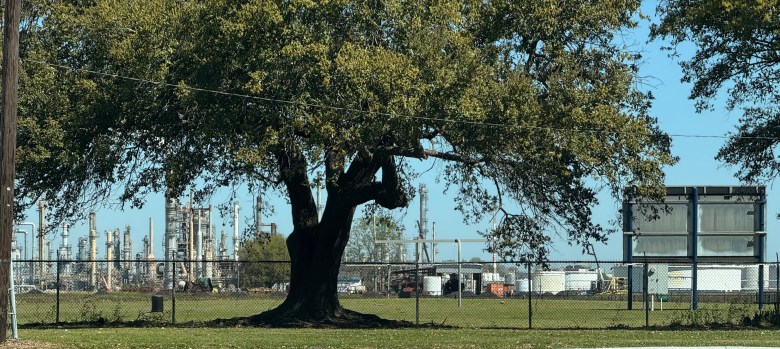
    Port Allen Middle School sits in the shadow of the Placid petrochemical refinery in West Baton Rouge Parish, La. A 2016 report found nearly one in 10 children in the U.S. attends one of the 12,000 schools located within 1 mile of a chemical facility, which for environmental advocates highlights the danger of the recently announced rollbacks of air and water pollution regulations by the U.S. Environmental Protection Agency. Credit: Terry L. Jones / Floodlight

    That means the EPA will no longer target, investigate or address noncompliance issues at facilities emitting cancer-causing chemicals such as benzene, ethylene oxide and formaldehyde in the places already overburdened with hazardous pollution. 

    “While enforcement and compliance assurance can continue to focus on areas with the highest levels of (hazardous air pollutants) affecting human health,” the memo reads, “…to ensure consistency with the President’s Executive Orders, they will no longer focus exclusively on communities selected by the regions as being ‘already highly burdened with pollution impacts.’”

    The agency also will not implement any enforcement and compliance actions that could shut down energy production or power generation “absent an imminent and substantial threat to human health.” 

    In is prepared video statement about the EPA’s deregulation measures, Zeldin said, “The agency is committed to fulfilling President Trump’s promise to unleash American energy, lower cost of living for Americans, revitalize the American auto industry, restore the rule of law, and give power back to states to make their own decisions. ”

    Related: How Trump is disrupting efforts by schools and colleges to combat climate change

    Top officials with the nonprofit environmental advocacy group Earthjustice recently said there is no way for the Trump administration to reconcile what it’s calling “the greatest day of deregulation” in EPA’s history with protecting public health. 

    Patrice Simms, vice president of litigation for healthy communities for Earthjustice, went a step further pointing out during a press briefing that the reason EPA exists is to protect the public from toxic air pollution. 

    “The law demands that EPA control these pollutants, and demands that EPA protect families and communities,” Simms said. “And these impacts on these communities most heavily land on the shoulders of children. Children are more susceptible to the harms from pollutants, and these pollutants are often happening right in the backyards of our schools, of our neighborhoods and our playgrounds.”

    A 2016 report published by the Center for Effective Government found that nearly one in 10 children in the country attends one of the 12,000 schools located within 1 mile of a chemical facility. These children are disproportionately children of color living in low-income areas, the report found. 

    For the past several years, Joshua has been leading the opposition to a hydrogen and ammonia facility being built within 2,000 feet of an elementary school in Ascension Parish. Air Products plans to start commercial operation in 2028 where an estimated 600,000 metric tons of hydrogen will be produced annually from methane gas.

    The $7 billion project has been touted as a clean energy solution because the company intends to use technology to collect its carbon dioxide emissions, and then transport them through pipelines to be stored under a recreational lake 37 miles away. 

    Carbon capture technology has been controversial, with skeptics highlighting the possibilities for earthquakes, groundwater contamination and CO2 leaking back into the atmosphere through abandoned and unplugged oil and gas wells or pipeline breaches. Pipeline ruptures in the past have also led to communities having to evacuate their homes. 

    Related: When a hurricane washes away a region’s child care system

    Joshua said these communities need more federal regulation and oversight — not less.

    “We had a community meeting … for our Ascension Parish residents, and the sentiment and the theme on that call was very much like ‘Kaitlyn, there is nothing we can do.’ Like, we just had to literally lie down and take this,” Joshua said. “We had to kind of challenge people and put them in the space, in time, of a civil rights movement. We have to get creative about how we’re going to organize around it and be our own version of EPA.”

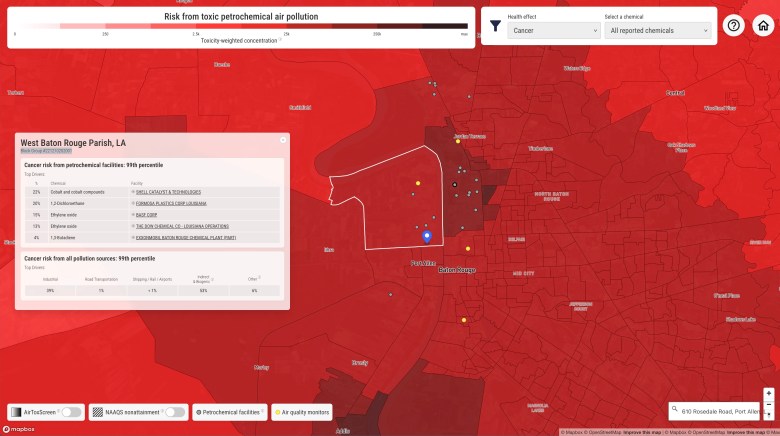
    This screenshot from CLEAR Collaborative’s Petroleum Pollution Map models health risks from hazardous air pollution from petrochemical facilities around West Baton Rouge Parish near Port Allen Middle School. The map uses U.S. Environmental Protection Agency data analyzed by the Environmental Defense Fund. Environmental advocates have sounded the alarm on the dangers of the EPA’s rollback of air and water regulations for children in fenceline communities. Credit: Provided by The Environmental Defense Fund

    Sarah Vogel, senior vice president of health communities with the Environmental Defense Fund, said the move toward deregulation comes as the U.S. Department of Justice announced on March 7 that it was dropping the federal lawsuit the Biden administration lodged against Denka’s Performance Elastomer plant in Louisiana. That plant had been accused of worsening cancer risks for the residents in the surrounding majority-Black community. 

    The DOJ said its decision was tied to Trump’s moves to dismantle all federal programs tied to diversity, equity and inclusion.

    “What they’re trying to do is just completely deregulate everything for oil and gas and petrochemical facilities, just absolutely take the lid off,” Vogel said. “We have long known that children are uniquely susceptible to air pollution and toxic chemicals. Like they’re huge, huge impacts. It’s why what they are doing is so devastating and cruel in my mind.”

    Floodlight, which produced this story, is a nonprofit newsroom that investigates the powers stalling climate action.

    The Hechinger Report provides in-depth, fact-based, unbiased reporting on education that is free to all readers. But that doesn’t mean it’s free to produce. Our work keeps educators and the public informed about pressing issues at schools and on campuses throughout the country. We tell the whole story, even when the details are inconvenient. Help us keep doing that.

    Join us today.

    Source link

  • With higher education under siege, college presidents cannot afford to stay silent 

    With higher education under siege, college presidents cannot afford to stay silent 

    Higher education is under siege from the Trump administration. Those opposing this siege and the administration’s attacks on democracy would do well to heed the wise advice of Benjamin Franklin given just prior to the signing of the Declaration of Independence in 1776: “We must all hang together, or most assuredly we shall all hang separately.” 

    This is particularly true right now for college and university presidents.

    College presidents come from a tradition based on the importance of ideas, of fairness, of speaking the truth as they understand it, whatever the consequences. If they don’t speak out, what will later generations say when they look back at this dark, dark time?

    The idea that Trump’s attacks on higher education are necessary to combat antisemitism is the thinnest of covers, and yet only a very few college presidents have been brave enough to call this what it is. 

    The president and those around him don’t care about antisemitism. Trump said people who chanted “Jews will not replace us” were “very fine people”; he dined with avowed antisemites like Nick Fuentes and Ye (Kanye West). 

    Marjorie Taylor Greene blamed the California wildfires of 2018 on space lasers paid for by Jewish bankers. Robert Kennedy claimed that Covid “targeted” white and Black people but spared Ashkenazi Jews and Chinese people. The Proud Boys pardoned by Trump for their part in the January 6 insurrection have routinely proclaimed their antisemitism; they include at least one member who has openly declared admiration for Adolf Hitler.

    Fighting antisemitism? That was never the motive for the Trump administration’s attacks on colleges and universities. The motive was — and continues to be — to discipline and tame institutions of higher learning, to bring them to heel, to turn them into mouthpieces of a single ideology, to put an end to the free flow of ideas under the alleged need to combat “wokeism.”

    Related: Interested in innovations in the field of higher education? Subscribe to our free biweeklyHigher Education newsletter.

    Columbia University has been a prime target of the Trump administration’s financial threats. I’ve been a university provost. I’m not naïve about the tremendous damage the withholding of federal support can have on a school. But the fate of Columbia should be a cautionary tale for those who think keeping their heads down will help them survive. (The Hechinger Report is an independent, nonprofit, nonpartisan organization based at Teachers College, Columbia University.) 

    Columbia was more than conciliatory in responding to concerns of antisemitism. The administration suspended two student groups, Students for Justice in Palestine and Jewish Voice for Peace, for holding rallies that allegedly included “threatening rhetoric and intimidation.” 

    They suspended four students in connection with an event featuring speakers who “support terrorism and promote violence.” 

    They called in police to dismantle the encampment created to protest the War in Gaza. Over 100 protesters were arrested

    They created a Task Force on Antisemitism, and accepted its recommendations. They dismissed three deans for exchanging text messages that seemed to minimize Jewish students’ concerns and referenced antisemitic tropes. 

    President Minouche Shafik resigned after little more than a year in office. (Last week, the university’s interim president, Katrina Armstrong, also resigned.) In September 2024, the ADL reports, the university went so far as to introduce “new policies prohibiting the use of terms like ‘Zionist’ when employed to target Jews or Israelis.” 

    None of this prevented the Trump administration from cancelling $400 million worth of grants and contracts to Columbia — because responding to antisemitism was never the real impetus for the attack. 

    Related: Tracking Trump: His actions to dismantle the Education Department, and more

    Was Marjorie Taylor Greene asked to renounce antisemitism as a condition for her leadership in Congress? 

    Was Robert Kennedy asked to renounce antisemitism in order to be nominated for a Cabinet position?

    Were the Proud Boys asked to renounce antisemitism as a condition for their pardoning? 

    This is an attack on higher education as a whole, and it requires a collective defense. Columbia yesterday. Harvard today, your school tomorrow. College presidents cannot be silent as individual schools are attacked. They need to speak out as a group against each and every incursion. 

    They need to pledge to share resources, including financial resources, to resist these attacks; they should mount a joint legal resistance and a joint public response to an attack on any single institution. 

    These days, as many have observed, are much like the dark days of McCarthyism in the 1950s. In retrospect, we wonder why it took so long for so many to speak up. 

    Today we celebrate those who had the moral strength to stand up right then and say, “No. This isn’t right, and I won’t be part of it.” 

    The politicians of the Republican Party have made it clear they won’t do that, though most of them understand that Trumpism is attacking the very values — freedom, democracy, fairness — that they celebrate as “American.” 

    They have earned the low opinion most people have of politicians. But college and university presidents should — and must — take a stand. 

    Rob Rosenthal is John E. Andrus Professor of Sociology, Emeritus, at Wesleyan University. 

    Contact the opinion editor at [email protected].

    This story about higher education and the Trump administration was produced byThe Hechinger Report, a nonprofit, independent news organization focused on inequality and innovation in education. Sign up for Hechinger’sweekly newsletter.

    The Hechinger Report provides in-depth, fact-based, unbiased reporting on education that is free to all readers. But that doesn’t mean it’s free to produce. Our work keeps educators and the public informed about pressing issues at schools and on campuses throughout the country. We tell the whole story, even when the details are inconvenient. Help us keep doing that.

    Join us today.

    Source link

  • Math can be a path to success after prison

    Math can be a path to success after prison

    Hancy Maxis spent 17 years incarcerated in New York prisons. He knew that he needed to have a plan for when he got out.

    “Once I am back in New York City, once I am back in the economy, how will I be marketable?” he said. “For me, math was that pathway.”

    In 2015, Maxis completed a bachelor’s degree in math through the Bard Prison Initiative, an accredited college-in-prison program. He wrote his senior project about how to use game theory to advance health care equity, after observing the disjointed care his mom received when she was diagnosed with breast cancer. (She’s now recovered.)

    When he was released in 2018, Maxis immediately applied for a master’s program at Columbia University’s Mailman School of Public Health. He graduated and now works as the assistant director of operations at Montefiore Medical Center in the Bronx. He helped guide the hospital’s response to Covid.

    Maxis is one of many people I’ve spoken to in recent years while reporting on the role that learning math can play in the lives of those who are incarcerated. Math literacy often contributes to economic success: A 2021 study of more than 5,500 adults found that participants made $4,062 more per year for each correct answer on an eight-question math test.

    While there don’t appear to be any studies specifically on the effect of math education for people in prison, a pile of research shows that prison education programs lower recidivism rates among participants and increase their chances of employment after they’re released.

    Hancy Maxis spent 17 years incarcerated in New York prisons. He now works as the assistant director of operations at Montefiore Medical Center in the Bronx. Credit: Yunuen Bonaparte for The Hechinger Report

    Plus, math — and education in general — can be empowering. A 2022 study found that women in prison education programs reported higher self-esteem, a greater sense of belonging and more hope for the future than women who had never been incarcerated and had not completed post-secondary education.

    Yet many people who enter prison have limited math skills and have had poor relationships with math in school. More than half (52 percent) of those incarcerated in U.S. prisons lack basic numeracy skills, such as the ability to do multiplication with larger numbers, long division or interpret simple graphs, according to the most recent numbers from the National Center for Educational Statistics. The absence of these basic skills is even more pronounced among Black and Hispanic people in prison, who make up more than half of those incarcerated in federal prisons.

    In my reporting, I discovered that there are few programs offering math instruction in prison, and those that do exist typically include few participants. Bard’s highly competitive program, for example, is supported primarily through private donations, and is limited to seven of New York’s 42 prisons. The recent expansion of federal Pell Grants to individuals who are incarcerated presents an opportunity for more people in prison to get these basic skills and better their chances for employment after release.

    Alyssa Knight, executive director of the Freedom Education Project Puget Sound, which she co-founded while incarcerated, said that for years, educational opportunities in prison were created primarily by people who were incarcerated, who wrote to professors and educators to ask if they might send materials or teach inside the prison. But public recognition of the value of prison education, including math, is rising, and the Pell Grant expansion and state-level legislation have made it easier for colleges to set up programs for people serving time. Now, Knight said, “Colleges are seeking prisons.”

    Related: Interested in innovations in higher education? Subscribe to our free biweekly higher education newsletter.

    Jeffrey Abramowitz understands firsthand how math can help someone after prison. After completing a five-year stint in a federal prison, his first post-prison job was teaching math to adults who were preparing to take the GED exam.

    Fast forward nearly a decade, and Abramowitz is now the CEO of The Petey Greene Program, an organization that provides one-on-one tutoring, educational supports and programs in reading, writing and now math, to help people in prison and who have left prison receive the necessary education requirements for a high school diploma, college acceptance or career credentials.

    The average Petey Greene student’s math skills are at a fourth- or fifth-grade level, according to Abramowitz, which is in line with the average for “justice-impacted” learners; the students tend to struggle with basic math such as addition and multiplication.

    “You can’t be successful within most industries without being able to read, write and do basic math,” Abramowitz said. “We’re starting to see more blended programs that help people find a career pathway when they come home — and the center of all this is math and reading.”

    Abramowitz and his team noticed this lack of math skills particularly among students  in vocational training programs, such as carpentry, heating and cooling and commercial driving. To qualify to work in these fields, these students often need to pass a licensing test, requiring math and reading knowledge.

    The nonprofit offers “integrated education training” to help  students learn the relevant math for their professions. For instance, a carpentry teacher will teach students how to use a saw in or near a classroom where a math teacher explains fractions and how they relate to the measurements needed to cut a piece of wood.

    “They may be able to do the task fine, but they can’t pass the test because they don’t know the math,” Abramowitz said.

    Math helped Paul Morton after he left prison, he told me. When he began his 10.5 years in prison, he only could do GED-level math. After coming across an introductory physics book in the third year of his time in prison, he realized he didn’t have the math skills needed for the science described in it.

    He asked his family to send him math textbooks and, over the seven years until his release, taught himself algebra and calculus.

    The recent expansion of federal Pell Grants to individuals who are incarcerated presents an opportunity for more people in prison to get these basic skills and better their chances for employment after release. Credit: Helen H. Richardson/The Denver Post via Getty Images

    “I relentlessly spent six hours on one problem one day,” he said. “I was determined to do it, to get it right.”

    I met Morton through the organization the Prison Mathematics Project, which helped him develop his math knowledge inside prison by connecting him with an outside mathematician. After his release from a New York prison in 2023, he moved to Rochester, New York, and is hoping to take the actuarial exam, which requires a lot of math. He continues to study differential equations on his own.

    Related: It used to be a notoriously violent prison. Now it’s home to a first-of-its-kind higher education program

    The Prison Mathematics Project delivers math materials and programs to people in prison, and connects them with mathematicians as mentors. (It also brings math professors, educators and enthusiasts to meet program participants through “Pi Day” events; I attended one such event in 2023 when I produced a podcast episode about the program, and the organization paid for my travel and accommodations.)

    The organization was started in 2015 by Christopher Havens, who was then incarcerated at Washington State Penitentiary in Walla Walla. Havens’ interest in math puzzles, and then in algebra, calculus and other areas of mathematics, was ignited early in his 25-year- term when a prison volunteer slid some sudoku puzzles under his door.

    “I had noticed all these changes happening inside of me,” Havens told me. “My whole life, I was searching for that beauty through drugs and social acceptance … When I found real beauty [in math], it got me to practice introspection.”

    As he fell in love with math, he started corresponding with mathematicians to help him solve problems, and talking to other men at the prison to get them interested too. He created a network of math resources for people in prisons, which became the Prison Mathematics Project.

    The group’s website says it helps people in prison use math to help with “rebuilding their lives both during and after their incarceration.”

    Related: How Danielle Metz got an education after incarceration

    But Ben Jeffers, its executive director, has noticed that the message doesn’t connect with everyone in prison. Among the 299 Prison Mathematics Project participants on whom the program has data, the majority — 56 percent — are white, he told me, while 25 percent are Black, 10 percent are Hispanic, 2 percent are Asian and 6 percent are another race or identity. Ninety-three percent of project participants are male.

    Yet just 30 percent of the U.S. prison population is white, while 35 percent of those incarcerated are Black, 31 percent are Hispanic and 4 percent are of other races, according to the United State Sentencing Commission. (The racial makeup of the program’s 18 female participants at women’s facilities is much more in line with that of the prison population at large.)

    “[It’s] the same issues that you have like in any classroom in higher education,” said Jeffers, who is finishing his master’s in math in Italy. “At the university level and beyond, every single class is majority white male.”

    He noted that anxiety about math tends to be more acute among women and people of any gender who are Black, Hispanic, or from other underrepresented groups, and may keep them from signing up for the program. 

    Sherry Smith understands that kind of anxiety. She didn’t even want to step foot into a math class. When she arrived at Southern Maine Women’s Reentry Center in December 2021, she was 51, had left high school when she was 16, and had only attended two weeks of a ninth grade math class.

    “I was embarrassed that I had dropped out,” she said. “I hated to disclose that to people.”

    Related: ‘Revolutionary’ housing: How colleges aim to support a growing number of formerly incarcerated students 

    Smith decided to enroll in the prison’s GED program because she could do the classes one-on-one with a friendly and patient teacher. “It was my time,” she said. “Nobody else was listening, I could ask any question I needed.”

    In just five months, Smith completed her GED math class. She said she cried on her last day. Since 2022, she’s been pursuing an associate’s degree in human services — from prison — through a remote program with Washington County Community College.

    In Washington, Prison Mathematics Project founder Havens is finishing his sentence and continuing to study math. (Havens has been granted a clemency hearing and may be released as early as this year.) Since 2020, he has published four academic papers: three in math and one in sociology. He works remotely from prison as a staff research associate in cryptography at the University of California, Los Angeles, and wrote a math textbook about continued fractions.

    Havens is still involved in the Prison Mathematics Project, but handed leadership of the program over to Jeffers in October 2023. Now run from outside the prison, it is easier for the program to bring resources and mentorship to incarcerated students.

    “For 25 years of my life, I can learn something that I wouldn’t have the opportunity to learn in any other circumstances,” Havens said. “So I decided that I would, for the rest of my life, study mathematics.”

    Contact editor Caroline Preston at 212-870-8965 or [email protected].

    This story about math in prison was produced by The Hechinger Report, a nonprofit, independent news organization focused on inequality and innovation in education. Sign up for the Hechinger higher education newsletter.

    The Hechinger Report provides in-depth, fact-based, unbiased reporting on education that is free to all readers. But that doesn’t mean it’s free to produce. Our work keeps educators and the public informed about pressing issues at schools and on campuses throughout the country. We tell the whole story, even when the details are inconvenient. Help us keep doing that.

    Join us today.

    Source link

  • STUDENT VOICE: The path to health equity begins in K-12 classrooms

    STUDENT VOICE: The path to health equity begins in K-12 classrooms

    Imagine a classroom in which young students are excitedly discussing their future aspirations and a career in medicine feels like a tangible goal rather than a distant dream. Now, imagine that most of the students come from historically marginalized communities — Black, Hispanic and Indigenous populations — that disproportionately face higher rates of chronic illness, shorter life expectancies and poorer health outcomes.

    We know that these disparities can shrink when patients are cared for by doctors who share their cultural backgrounds and lived experiences. The problem? Our health care workforce remains overwhelmingly unrepresentative of the communities it serves.

    For many students from underrepresented backgrounds, a medical career feels out of reach. The path to becoming a doctor is daunting, full of obstacles like financial hardship, lack of mentorship and systemic inequities in education. Many students are sidelined long before they consider medical school, while those who persist face an uphill battle competing against peers with far more resources and support.

    To mitigate these disparities, we must look beyond our hospitals and medical schools and into the places where young minds are shaped: our K-12 classrooms. Early exposure to health care careers can ignite curiosity and show students that they belong in places where they have historically been excluded.

    Related: Become a lifelong learner. Subscribe to our free weekly newsletter to receive our comprehensive reporting directly in your inbox.

    Organizations like the Florida State University College of Medicine, with its “Science Students Together Reaching Instructional Diversity and Excellence” (SSTRIDE) program, are leading the way in breaking down barriers to medical careers for underrepresented students. SSTRIDE introduces middle and high school students to real-world medical environments, giving them firsthand exposure to health care settings that might otherwise feel distant or inaccessible. Then, the program threads together long-term mentorship, academic enrichment and extracurricular opportunities to build the confidence and skills students need to reach medical school.

    The 15 White Coats program in Louisiana takes a complementary but equally meaningful approach: transforming classroom environments by introducing culturally relevant imagery and literature that reflect the diversity of the medical profession. For many students, seeing doctors who look like them — featured in posters or books — can challenge internalized doubts and dismantle societal messages that suggest they don’t belong in medicine. Through fundraising efforts and scholarships, other initiatives from 15 White Coats tackle the financial barriers that disproportionately hinder “minority physician aspirants” from pursuing medical careers.

    The impact of these programs can be profound. Research shows that students exposed to careers in science or medicine at an early age are far more likely to pursue these fields later in life. And medical students who belong to underrepresented groups are the most likely to return to underserved communities to practice. Their presence can improve communication, foster patient trust and drive innovation in addressing health challenges unique to those communities.

    These programs can even have a ripple effect on families and entire communities. When young people pursue careers in medicine, they become role models for siblings, friends and neighbors. This creates a culture of aspiration in which success feels both possible and accessible, shifting societal perceptions and inspiring future generations to aim higher.

    But programs like 15 White Coats and SSTRIDE cannot thrive without sustained investment. We need personal and financial commitments to dismantle the systemic barriers that prevent students from underrepresented groups from entering medicine.

    Policymakers and educators must step up. Federal and state educational funding should prioritize grants for schools that partner with hospitals, medical schools and health care organizations. These partnerships should offer hands-on experiences like shadowing programs, medical summer camps and health care-focused career fairs. Medical professionals also have a role to play — they can volunteer as mentors or guest speakers, offering valuable guidance and demystifying the path to a medical career.

    Related: The ‘Fauci effect’: Inspired by front-line health care workers, record numbers apply to medical schools

    As a medical student, I know how transformative these experiences can be. They can inspire students to envision themselves in roles they might never have imagined and gain the confidence to pursue dreams that once seemed out of reach.

    Let’s be clear, representation in medicine is not about optics. It’s about improving health outcomes and driving meaningful change. Building a stronger, more diverse pipeline to the medical profession is not just an educational priority. It’s a public health imperative.

    An investment in young minds today is an investment in a health care system that represents, understands and serves everyone. Equity in health care starts long before a patient walks into a doctor’s office. It begins in the classroom.

    Surya Pulukuri is a member of the class of 2027 at Harvard Medical School.

    Contact the opinion editor at [email protected].

    This story about health equity was produced by The Hechinger Report, a nonprofit, independent news organization focused on inequality and innovation in education. Sign up for Hechinger’s weekly newsletter.

    The Hechinger Report provides in-depth, fact-based, unbiased reporting on education that is free to all readers. But that doesn’t mean it’s free to produce. Our work keeps educators and the public informed about pressing issues at schools and on campuses throughout the country. We tell the whole story, even when the details are inconvenient. Help us keep doing that.

    Join us today.

    Source link

  • How a tribe won a legal battle against the federal Bureau of Indian Education — and still lost

    How a tribe won a legal battle against the federal Bureau of Indian Education — and still lost

    SUPAI, Ariz. — Kambria Siyuja always felt like the smartest kid in Supai. 

    Raised by educators in this tribal village at the base of the Grand Canyon, she started kindergarten a little ahead of her peers. Her teachers at Havasupai Elementary School often asked Siyuja to tutor younger students and sometimes even let her run their classrooms. She graduated valedictorian of her class. 

    But once she left the K-8 school at the top of her grade, Siyuja stopped feeling so smart.

    “I didn’t know math or basic formulas,” she said. “Typing and tech? Nonexistent.”

    Siyuja, now 22, wiped tears from her face as she sat alongside her mother and grandmother — the educators of the family — one afternoon last year in the Havasupai Tribal Council chambers. The trio wept as they recalled Siyuja’s move as a teenager to a private boarding school 150 miles away in Sedona, Arizona, which she’d chosen to attend because the federal agency that runs Havasupai Elementary, the only school in her village, provides no options for high school. 

    Kambria Siyuja, right, plans to teach in Supai, like her mother, Jackie Siyuja, middle, who teaches at the tribe’s preschool program. Grandmother and Havasupai Tribal Council chair Bernadine Jones, left, previously taught at the elementary school. Their tribe’s seal is reflected from a window onto a wall in the council chambers. Credit: Matt Stensland for The Hechinger Report

    Once there, however, Siyuja discovered how little she’d learned at the Supai school. She had only superficial familiarity with state and U.S. history, and knew none of the literature her peers had read years earlier. She was the only freshman who’d never taken pre-algebra.

    Last year, eight years after Siyuja graduated, the K-8 school still did not offer pre-algebra, a course that most U.S. public school students take in seventh or eighth grade, if not earlier. It had no textbooks for math, science or social studies. The school’s remoteness — on a 518-acre reservation the government forcibly relocated the Havasupai people to more than 150 years ago — makes it a challenge to staff, and chronic turnover required the few educators who remained to teach multiple grades at once. Only 3 percent of students test proficiently in either English language arts or math.

    “I know they struggle a lot because of how few resources we have down here,” said Siyuja of Supai, which visitors must reach either by an 8-mile hike or helicopter. “But what are they teaching here?”

    In 2017, six Havasupai families sued the federal government, alleging that the Bureau of Indian Education, which operates Havasupai Elementary and is housed within the Interior Department, deprived their children of their federal right to an education. The tribe, in a brief supporting the lawsuit, argued that the bureau had allowed Havasupai Elementary to become “the worst school in a deplorable BIE system” and that court intervention was required to protect students from the agency. 

    The families eventually secured two historic settlements that fueled hopes across Indian Country that true reform might finally improve outcomes both in Supai and perhaps also at BIE schools throughout the U.S.

    Related: Become a lifelong learner. Subscribe to our free weekly newsletter featuring the most important stories in education. 

    So far, the settlements have brought new staff to Supai, and the BIE had to reconstitute the school board. Teachers now must use lesson plans, and they finally have a curriculum to use in English, science and math classes. A new principal pledged to stay longer than a school year.

    “We now have some teachers and some repairs to the building that are being done,” said Dinolene Kaska, a mother to three former students and a new school board member. “It has been a long time just to get to this point.”

    Valencia Stinson leads a kindergarten class through a lesson matching lowercase letters with their corresponding uppercase letters. Credit: Matt Stensland for The Hechinger Report

    The legal wins followed an effort to reform the BIE as a whole. In 2014, federal officials unveiled a sweeping plan to overhaul the beleaguered bureau, which had long struggled to deliver better student outcomes with anemic funding. If the BIE were a state, the schools it operates would rank at or very near the bottom of any list for academic achievement. 

    But in the past decade, and after a nearly doubling of its budget, the BIE has finally started to make some progress. Graduation rates have improved, staff vacancies are down and the bureau built its own data system to track and support student achievement across its 183 campuses in 23 different states. Now, those milestones could be at risk.

    President Donald Trump, in his seismic restructuring of the federal government, laid off thousands of workers that will trigger deep cuts to the BIE, among other agencies that work directly on Indian Country. The White House in January also issued an executive order to turn the BIE into a school choice program, draining the bureau of funding and, according to some advocates in Washington, D.C., threatening the government’s long-established trust responsibility to tribal nations. It also remains unclear how the policy would benefit families in isolated communities like Supai where other schooling options are scant or nonexistent.

    “Tribes in rural areas don’t have a lot of school choice,” said Quinton Roman Nose, executive director of the Tribal Education Departments National Assembly, a nonprofit that works with tribal education agencies. “For Native students, that’s not a good model. I don’t think it’s going to work for so many.”

    Brian Schatz, a Hawaii Democrat and vice chairman of the Senate Committee on Indian Affairs, said the Trump administration’s actions are devastating. “What Trump is doing to the federal government isn’t just reckless — it’s arson,” he said in a statement to The Hechinger Report. “We will do everything we can to ensure that this manufactured chaos does not have lasting impacts on our trust and treaty responsibilities to Native communities.” 

    Last fall, as conservative critics called for dismantling the BIE and converting its funding into vouchers, longtime director Tony Dearman defended the bureau. He also pitched a new, five-year strategic direction that will emphasize tribal sovereignty and cultural education — both promises the bureau made in its reform agenda more than a decade ago.

    “We have really built the capacity of the BIE,” Dearman said. “It’s just taken a while. Anything in the government does.”

    Still, he insisted that the BIE could fulfill the government’s obligation to deliver a quality education to tribal nations. “I truly believe that we can handle the trust responsibility with the support from Congress through appropriations,” Dearman said.

    For decades, the Department of the Interior, which manages natural resources and wildlife, placed control of schools on tribal reservations within its Bureau of Indian Affairs. The agency oversees law and justice across Indian Country, as well as agriculture, infrastructure, economic development and tribal governance. The agency’s poor management of schools, meanwhile, had been well documented, and in 2006, an internal shakeup resulted in the creation of the BIE.

    Almost from the start, the new bureau faced criticism.

    In 2008, the Government Accountability Office dinged the BIE for stumbling in its early implementation of the No Child Left Behind education law. A year later, the Nation’s Report Card found Native students in traditional public schools performed much better than those in BIE schools. (About 92 percent of Native students attend traditional public schools and 8 percent attend BIE schools.) Senators scolded the bureau after only 1 in 4 of its schools could meet the new federal education standards. A 2011 report, “Broken Promises, Broken Schools,” cataloged the deterioration of BIE schools, estimating it would cost $1.3 billion to bring every educational facility to an “acceptable” condition. 

    In 2013, then-Interior Secretary Sally Jewell assembled a study group to diagnose the root causes of academic failures in BIE schools. A year later, the group released the Blueprint for Reform. At its unveiling, Arne Duncan, then the federal education secretary, had damning words for why the BIE needed to change, calling it “the epitome of broken” and “utterly bankrupt.” 

    The blueprint, issued through a formal secretarial order, called for dramatically restructuring the BIE over two years, starting with its management of tribally controlled schools. In 1988, as part of a renewed focus on tribal sovereignty, Congress had created a grant program to help tribes take control of their respective BIE schools, and as of 2014, a full two-thirds of campuses had already converted.

    The 70-page blueprint proposed transforming the agency from a top-down operator of schools into more of an educational services and support center. It would create a division within the BIE to focus on assisting principals with the day-to-day operation of schools. New regional directors and offices would oversee tribally controlled schools, BIE-operated campuses and schools on the sprawling Navajo Nation.

    The plan also pitched the addition of “school support solutions teams” at each regional office that would assist with teacher and principal recruitment, school facilities, financial management and technology. A new Office of Sovereignty and Indian Education would help tribes convert their schools to local control and encourage them to shape culture and language classes. Other proposed changes included allowing tribes to tie staff pay to student performance and creating incentives to replicate successful tribally controlled schools.

    Related: As coronavirus ravaged Indian Country, the federal government failed its schools

    The study group, however, did not address whether the bureau needed additional funding to pull off the reforms. And without additional funding, the BIE faced deep cuts as budget negotiations pressured then-President Barack Obama to require all federal agencies to reduce their spending by 20 percent. 

    That essentially tasked the BIE with achieving a turnaround of its failing schools with a fifth less funding. By the time of the blueprint, those cuts were already phasing in: Between 2011 and 2014, for example, the number of full-time administrators located on or near Indian reservations to oversee school spending fell from 22 to 13, leaving the remaining staff to still split 64 reservations among them.

    “It was a terrible set up,” said one former top agency official who worked at the BIE during the blueprint’s release. The official, like many of the more than 75 interviewed by The Hechinger Report for this story, spoke on the condition of anonymity because of the DOI’s large role in tribal communities and worries that criticizing the agency could cost them jobs or contracts.

    Famous for its turquoise waterfalls — Havasupai means “people of the blue-green water” — Supai village greets visitors at the banks of Havasu Creek.

    The creek and waterfalls feed a hidden canyon oasis here. Trees bursting with blooms of apricot and pomegranate offer much-welcome shade for backpacking tourists and the mules carrying their gear. Tribal elders wind their way through Supai’s unmarked dusty roads as children on the preschool playground shield their eyes from sand swirling around the adjacent helipad. Benches, some made from milk crates, ring the town square at the front gate of Havasupai Elementary.

    Eight years ago, lawyer Alexis DeLaCruz sat on one of those benches in Supai town square. She had recently started working at the Native American Disability Law Center, a firm based in Farmington, New Mexico, that represents Native Americans with disabilities. The firm had recently hosted a training on special education law for parents, and several from Supai, incensed about their kids’ education, traveled out of the canyon to attend. They convinced DeLaCruz and two colleagues to book a helicopter ride into the village to hear directly from parents about their experiences with the BIE. 

    Parents described how their children couldn’t tell the difference between North and South America and, despite BIE regulations requiring Native culture in all curriculum areas, the students never had a class in Havasupai culture, history or language. Because of a teacher shortage, children learned in classes that combined students from three or even four grades. The school had 10 principals in as many years. The BIE closed Havasupai Elementary for nearly a month in 2015 because of insufficient staffing.

    About 100 students each year enroll in Havasupai Elementary School, one of 183 schools that the Bureau of Indian Education manages on 64 tribal reservations across the U.S. Credit: Matt Stensland for The Hechinger Report

    Siyuja, who graduated from the school in 2016, remembered cooks and janitors stepping in as teachers — and then having to leave class midday to check on school lunch or plumbing problems. 

    Until Siyuja reached the fourth grade, Havasupai Elementary, which serves about 80 students, had two tribal members on staff. They led culture and language classes, and Siyuja still owns a copy of the Havasupai dictionary they gifted her as a child. But then they left, and most of the other teachers soon followed, during the 2011-12 school year, she recalled.

    That’s when Obama tasked federal agencies with cutting a fifth of their administrative budgets, hollowing out the BIE’s ability to support its schools. In Supai, the already revolving door of educators suddenly started spinning much faster, Siyuja said.

    “We were just in this constant loop of relearning the same thing over and over,” she said.

    It wasn’t until college, at Fort Lewis College in Colorado, where Siyuja chose to study education, that she learned it was not normal for a school to lump so many grades together in one classroom. “That’s one of the major big no-nos,” she said. (In an email, a BIE spokesperson said, “Many schools implement implement multi-grade instruction as an intentional and effective educational model,” particularly in rural and remote locations, “to enhance individualized learning, maximize resources and promote peer collaboration.”)

    In January 2017, nine students from six families sued the BIE and the Interior Department, naming as defendants Dearman, Jewell — who did not respond to interview requests — her deputy assistant secretary and the Havasupai Elementary School principal. The lawsuit listed all plaintiffs under pseudonyms to protect their identity, and the two families involved in the lawsuit who spoke with The Hechinger Report for this story asked to remain anonymous even after the settlements were signed. Some of the students still attend BIE schools, and parents remain worried about exposing any of their children’s privacy, even as adults.

    The families hinged their case on a well-established federal right to education for Native American children.

    There is no federal right to education in the Constitution, according to a landmark 1973 Supreme Court decision. But for Native Americans, congressional statutes, executive orders, treaties and other Supreme Court opinions dating back virtually to this nation’s founding have cemented education as a major component of the government’s trust responsibility — a set of legal and moral obligations to protect tribal sovereignty and generally look out for the welfare of tribal members. In 1972, lawmakers made it even more clear with the Indian Education Act, which says that the “federal government has the sole responsibility for the operation and financial support” of tribal schools. They also required the BIA — the BIE had not yet been established — to work with tribes to create a system of schools of “the highest quality.” To this day, the BIE pitches itself as a provider of a “world class education.”

    Related: Native Americans turn to charter schools to reclaim their kids’ education

    DeLaCruz, not long after filing the Havasupai case, started imagining what impact it could have beyond that tiny community.

    “Most cases in our legal system end in money,” she said. “This isn’t the same calculus. We’re weighing what we think we can get in place that won’t just make a difference for students now but frankly for generations to come.”

    The lead plaintiff in the case was a sixth grader described in the lawsuit as Stephen C. Diagnosed with ADHD, he had never received counseling as mandated in his Individualized Education Program, or IEP, a legal document detailing the interventions and supports that a student with a disability will get from their school. None of the fifth grade teachers the school hired stayed more than two weeks, the lawsuit said, and Stephen C. was taught in a combined sixth, seventh and eighth grade class.

    His teacher’s attention split among kids across three grades, Stephen C. started to act out. The school sent him home three to four times a week for behavior issues related to his disability, the lawsuit alleged. Even as an eighth grader, he could barely read or write.

    In its friend-of-the-court brief, the Havasupai Tribe said its “people have been isolated at the bottom of one of the world’s most rugged canyons and for more than a century have been forced to depend on the federal government to educate their children.

    “Although the days of forced removal and assimilation are over,” the brief continued, “the BIE is still failing its students.”

    The federal government didn’t entirely dispute the claims of Stephen C. and his co-plaintiffs.

    The BIE and DOI, in June 2017, formally petitioned the U.S. District Court of Arizona to dismiss the case, arguing that the students couldn’t prove the BIE failed or refused to comply with its regulations for what counts as a “basic” education. Also, by that point Stephen C. and four other plaintiffs all had graduated or transferred from Havasupai Elementary, making them ineligible to pursue compensatory educational services, according to the government.

    But Lisa Olson, an attorney for the U.S. Department of Justice, also acknowledged the BIE’s shortcomings.

    “We are not saying there’s no accountability here. We are just saying that it’s for Congress and the executive to resolve these problems,” Olson said during a November 2019 hearing before U.S. District Judge Steven Logan. “The agency doesn’t dispute that its efforts have been unsatisfactory and they have fallen short.”

    Olson asked Logan to consider the many challenges of providing instruction in Supai: There was no funding for an agency helicopter to transport teachers in and out, for example, and new hires often failed their background checks or took other positions before the FBI checks were completed.

    “There’s nothing we can do to change that,” she said.

    Passengers load into a helicopter at a landing zone next to the preschool’s playground in a central part of Supai village.  Credit: Matt Stensland for The Hechinger Report

    Logan seemed unmoved. “So what you are basically saying, counsel, is it is the problem of the parents, and they need to make better decisions about where they have children so they can be properly educated?” he said. Olson responded, saying, “It is not the parents’ fault, but we need the cooperation of the parents and the community.” She continued, “I’m saying that BIE is doing its best and tries to enlist the support of parents and the tribe.”

    Related: A crisis call line run by Native youth, for Native youth

    The families also presented a secondary argument — that the complex trauma of Native American children qualifies them for services and protections of the sort that are guaranteed for students with disabilities. They argued that exposure to adversity — specifically, the long-lasting trauma from this nation’s official policy to separate Native children from their families in order to eradicate their cultures and seize tribal land — limited their ability to access the benefits of a public education. To this day, Havasupai families must ship their children away to attend high school, often in other states, and the BIE has no plans to open one in the canyon.

    The government warned Logan against following that line of logic, cautioning that it would set a dangerous precedent linking childhood adversity to a student’s ability to learn. The families filed their lawsuit under the Rehabilitation Act of 1973, which prevents discrimination against people with disabilities in federal programs. It does not include adversity or trauma on its list of qualifying conditions, and its applicable regulations expressly note that social disadvantage, such as homelessness or family violence, do not count as impairments, the government noted.

    Expanding that definition would threaten to impose “unwieldy” obligations on high-poverty schools across the U.S., the government’s attorneys argued.

    “The alleged ‘forced relocation, loss of homes, families and culture,’ and poverty within the Havasupai community … do not constitute a physical or mental impairment,” the motion to dismiss reads.

    In August 2020, the federal court issued a mixed decision. Logan allowed the case to continue for students with disabilities. The families also persuaded the court that complex trauma — including interaction with juvenile justice systems, extreme poverty and a denial of access to education — qualifies as a protected disability in the rehabilitation law. But he dismissed the general education claims, deciding that the older students, including Stephen C., had aged out of the school and no potential remedy would be precise enough for a court to enforce.  

    The Havasupai families cheered Logan’s ruling, but only in part. As they continued to pursue the special education claims, the Havasupai families challenged his decision to dismiss the rest of the case. A three-judge panel of the U.S. Court of Appeals for the 9th Circuit, which includes Arizona, heard their arguments in February 2022.

    “The agency is attempting to comply,” Laura Myron, a Justice Department attorney, told the judges. There are, she added, “numerous, practical obstacles to operating a school at the bottom of the Grand Canyon.”

    Kathryn Eidmann, president and CEO of Public Counsel, a pro bono public interest law firm, represented the Havasupai families and argued that their ancestors never chose to permanently live in such an isolated location. The government restricted the tribe to the reservation to make way for Grand Canyon National Park.

    Hoai-My Winder, new principal at Havasupai Elementary Schools, holds a student’s hand while walking with him during recess. Credit: Matt Stensland for The Hechinger Report

    “The obstacles that the government is pointing to that make compliance hard are entirely problems of the government’s own making,” Eidmann said.

    In a short five-page decision, the 9th Circuit panel allowed the older students to continue their lawsuit against the BIE. They clarified that judges — namely, Logan — could indeed compel an agency to comply with its own regulations. 

    The three judges also ruled that the students could seek monetary compensation for the educational services they never received.

    Related: 3 Native American students try to find a home at college

    Tara Ford, also a pro bono attorney on the Stephen C. case, said at the time that the ruling would reverberate across Indian Country: “Students who have been harmed by the Bureau of Indian Education’s broken promises now have a path to hold the federal government accountable for its failures.”

    By then, the students and government had settled the special education claims. Their deal provided each student with $20,000 for compensatory services and required the BIE to follow anti-discrimination provisions of the Rehabilitation Act while creating its first-ever complaint process for parents to challenge suspected discrimination. After the 9th Circuit ruling, however, negotiations to settle the rest of the Stephen C. case stretched beyond a year.

    The eventual deal, signed in May 2023, established an $850,000 compensatory education fund for any student who attended Havasupai Elementary since 2011. The BIE estimates about 215 kids could qualify to use that money, meaning each child would receive roughly $4,000, less than some families had hoped for. It also agreed to pay stipends to help recruit and retain teachers in Supai, build additional housing for staff and hire a cultural instructor from the community. The BIE also had to form a new school board.

    A year after the case closed, Breanna Bollig, a fellow at the California Tribal Families Coalition, wrote in a legal publication that it could change Native education far beyond Supai.

    “The BIE could be held accountable at every other BIE school through similar lawsuits,” Bollig wrote. “Perhaps the federal right to education for Indian children can even be used to improve inadequate and inequitable state public schools that Indian children attend.”

    Billy Vides stopped counting at 19.

    That’s how many principals he worked with in his first three years as a teacher at Havasupai Elementary. He stayed two more years, submitting his resignation in June.

    A longtime educator in Phoenix public schools, Vides first heard of Supai from a pair of grandmothers at an early learning conference. He had considered retiring, but knew he would miss working with kids. Vides searched online for Havasupai, bookmarked an article calling it “America’s Worst Tribal School” and sent in his application.

    “I wanted to make a difference,” he said.

    The BIE hired Vides in 2019 as a kindergarten and first grade teacher. On his first day, the interim principal assigned him to a combined kindergarten, first, third and fourth grade class. The ages didn’t mix well, he said, and the older kids bullied and sometimes assaulted the younger children.

    Joy Van Est, a special education teacher who quit in June, said many of her students’ IEPs had not been updated for several years. It took her four months, the entirety of her tenure there, to update every child’s support plan.

    Related: Native American students miss school at higher rates. It only got worse during the pandemic

    As part of the settlement, an independent monitor every six months must visit Supai and inspect whether the BIE has complied with its own regulations at the school. The monitor must review 104 specific requirements covering student-to-teacher ratios, curriculum taught in each subject, textbooks, grading rules and more. In its first report following a January 2024 visit, the monitor found the bureau in violation of 72 of those requirements.

    The school had a curriculum for just one subject — English language arts — and no textbooks for math, science and social studies, the compliance report reads. Teachers used no lesson plans, in any subject, and the school had no librarian. Only one tribal member taught at the school, leading culture and language classes once a week for 45 minutes. 

    The compliance officer granted the BIE some credit for hiring a school counselor and physical education teacher. However, once-a-week P.E. classes only happened if the part-time teacher could catch a helicopter flight. The counselor started in November 2023, but staff shortages required her to cover teachers’ classrooms too often for her to do any counseling work, the compliance officer found. 

    The compliance report seemed to have some impact: In the spring, the BIE went on a hiring spree to replenish the beleaguered staff in Supai. A second counselor and special education teacher — Van Est — plus a few additional teachers meant Havasupai Elementary was fully staffed for the first time in years.

    A more recent work plan for the school, updated in December, documented further changes: The bureau hired enough staff to meet class size caps. Teachers now submit weekly lesson plans, and the school selected a curriculum and purchased computers for all grades.

    The recent recruits include Hoai-My Winder, the school’s new principal. Winder had been working for the Department of Defense, as an administrator at an elementary school in Japan. She previously taught and worked as an assistant principal in Las Vegas, where her family settled after fleeing Vietnam during the fall of Saigon.

    Havasupai Elementary School enrolls students from kindergarten through eighth grade. The Bureau of Indian Education directly operates the campus in Supai village, which visitors must reach via an 8-mile hike or helicopter ride. Credit: Matt Stensland for The Hechinger Report

    “Day Six!” Winder hollered one afternoon this past May as she entered the spiked gates that separate Havasupai Elementary from the rest of the village. It was her tally of the number of days she’d been principal — both at Havasupai Elementary and ever.

    While her husband unpacked boxes in their new home, Winder took inventory at her new school. She discovered 40-year-old math textbooks on classroom shelves. Havasupai teachers at some point had created a Supai dictionary and draft curriculum for language instruction; Winder found it collecting dust in a box.

    As she met with parents and tribal members during her first week, ahead of the eighth grade graduation ceremony that afternoon, Winder repeated a pledge to stay at Havasupai Elementary for at least five years, maybe 10.

    Felicia Siyuja, the longtime school secretary, stood next to Winder as families packed into the cafeteria for the ceremony. As the aroma of frybread wafted from the kitchen, Siyuja tapped the mic before addressing the 13 students sitting in the front row.

    “I also want to apologize,” she told the soon-to-be freshmen. “All the teachers and principals rotating for all these years. It was hard for me as a grown-up. I can’t imagine how it was for you.”

    Eighth graders wearing turquoise-and-gold colored gowns prepare for their graduation ceremony at Havasupai Elementary School. The tribal village, at the base of the Grand Canyon, is famous for its turquoise waterfalls. Credit: Matt Stensland for The Hechinger Report

    Aside from Winder and her supervisor, the BIE would not allow The Hechinger Report to interview school staff on the record. But six current or former Havasupai teachers, most of whom spoke on the condition of anonymity, placed blame on the bureau for Havasupai Elementary’s dysfunction.

    “The BIE is the problem,” said one teacher. “The BIE lacks humility.”

    The educator, who now works at another BIE school, said he never received cultural training to prepare him for working with Native children and families. Several colleagues resigned before winter break his first year in Supai, making him the most veteran teacher on staff. 

    “I had no curriculum. No student names, no mentor, no oversight or guidance,” he said. “You don’t want to be yet another teacher who comes and goes. After three years, it gets old. It’s just exhausting.”

    In a February 10 email, a BIE spokesperson wrote that cultural training, including language preservation, had been scheduled for later that month.

    Van Est, who joined the bureau specifically to support its mission of uplifting tribal communities, said last summer that she no longer believed it was capable of doing that job. “The entity that has most recently oppressed the Havasupai people is making absolutely no effort to use education as a tool for repair, as a gold mine for building their future,” she said.

    Related: Tribal colleges are falling apart. The U.S. hasn’t fulfilled its promise to fund the schools

    The BIE blames Havasupai Elementary School’s isolation and lack of housing for its troubles.

    Even before the Stephen C. lawsuit, the BIE offered lucrative stipends to lure educators to Supai. It also guarantees housing, in theory, but in a pinch has forced teachers to room together. And a recent hiring spree, to satisfy the settlement, has made housing even tighter.

    Dearman said a recent housing needs analysis determined the BIE now needs 30 beds in Supai, but has only 12. One teacher simply didn’t return to their position this fall when the bureau couldn’t secure housing for more than a few weeks.

    “That puts a major strain on us being able to keep staff there,” Dearman said about the housing shortage. “We have housing needs at other locations as well. However, Havasupai is so isolated that if you’re not able to stay in our quarters there, there’s no other options.”

    He said that it’s hard for some educators to uproot their lives to live in Supai. “It’s a difficult place to come in and out of. It really is,” Dearman said.

    Poverty surrounds many BIE schools on tribal reservations, largely as a result of former government policies to eradicate Native peoples. In Supai, nearly 40 percent of the tribe lives in poverty, almost four times the national average. Tourism provides an economic bedrock for the Havasupai economy, though many families rely on government assistance.

    Vides, the teacher, struggled with his decision to quit. His wife had remained 300 miles away in Phoenix, raising their 3-year-old daughter without him. He missed a lot of her firsts, and felt torn between her and the Havasupai children.

    “It was difficult. I was grieving for the future of these students,” Vides said.

    “Either the system is continually broken,” he added, “or the system is working successfully to slowly eradicate this tribe.”

    Long before Trump’s executive order in January, some conservatives had pushed school choice as a solution to the BIE’s troubles. In 2016, the right-wing Heritage Foundation proposed turning the BIE into an education savings account, or ESA, which would grant families a portion of their child’s per-pupil funding to spend on private school tuition, home-school supplies and other educational expenses. That same year, the late Arizona Sen. John McCain introduced legislation offering ESAs equal to 90 percent of what the BIE spends on each student.

    The bill didn’t advance, but Heritage resurrected the idea last year in its Project 2025 transition plan for the next president. Notably, the conservative think tank — despite citing the BIE’s poor track record as justification for converting much of its funding into vouchers — also proposed granting it even more authority over the education of all Native American students, in all U.S. public schools.

    In his January order, Trump required the BIE to identify “any available mechanisms” for families to tap federal funding for private and faith-based schools, as well as to report on the performance of its schools and identify alternatives for families to consider. The agency has until April to submit its plan, for implementation this fall. The White House did not respond to several requests for comment.

    In certain tribal communities across Arizona, some parents have started to consider opting out of the BIE system. The state passed a universal school voucher program in 2022, giving any family who wants roughly $7,400 to spend on private or parochial schools or other options. Christian academies on the Gila River Indian Community, a reservation near Phoenix, have already used the program to recruit students.

    The walls of Havasu Canyon surround the village of Supai, where water from Havasu Creek later connects to the Colorado River at the Grand Canyon.  Credit: Matt Stensland for The Hechinger Report

    But in Supai, some residents worry the ESA option is meaningless. The closest private schools, in Kingman, are more than two hours away. Internet access in the village is virtually nonexistent, a hurdle for any parents trying to teach their kids at home.

    The National Indian Education Association, an advocacy group, has yet to issue a position on Trump’s order but said in a statement that it’s “closely monitoring” potential impact on cultural preservation and access to education for Native students. In the past, the group has said BIE is the best option to fulfill the federal government’s responsibility to educate Native students. It blames its poor results on Congress — the branch of government holding the purse strings.

    “The BIE in general, they just have a difficult time,” said Roman Nose, with the national group for tribal education departments. He noted that Department of Defense schools — the only other K-12 system run by the federal government — receive more funding. And Roman Nose worried how the recent federal layoffs and school choice proposal could further erode BIE’s ability to fulfill the trust responsibility.

    The BIE lost dozens of employees in the recent layoffs, sources told ICT. Among those laid off were approximately 30 from non-school positions in the BIE agency offices, excluding kindergarten through 12th grade schools.

    “There won’t be any progress made during this administration,” Roman Nose said. “It’s a difficult job, but these are treaty obligations.”

    Related: Schools bar Native students from wearing traditional regalia at graduation 

    Dearman, the bureau’s longtime director, insisted that the BIE could fulfill the government’s obligation to deliver a quality education to tribal nations.

    Under his leadership, the BIE has secured some financial wins for its schools. Lawmakers now funnel about $235 million into the bureau for school construction – it has asked for more than $400 million – and $150 million for replacing older campuses, according to the agency. Counselors and teachers now make the same amount as their counterparts in Department of Defense schools. And Dearman, a longtime champion of early childhood education, has expanded the bureau’s popular preschool program into more schools.

    Traditional beadwork decorates an eighth grader’s graduation cap at a Havasupai Elementary School ceremony. The school’s mascot is the eagle. Credit: Matt Stensland for The Hechinger Report

    Graduation rates have also climbed. Last year, according to the bureau, 75 percent of its high schoolers earned a diploma on time — a 31 percentage point jump since 2014 and slightly above the national average for Native American students. As of 2021, the last time the BIE reported achievement data, 17 percent of students tested on grade level in English language arts, and 11 percent in math. For three states where the BIE runs two-thirds of its schools, students have posted 8 percentage point increases on English exams and 13-point increases on math exams since 2016, according to the bureau.

    The U.S. Government Accountability Office, which has tracked the BIE’s “systemic management weaknesses” since 2013, recently reported that it had achieved substantial progress on school construction and safety. The bureau’s oversight of special education, distance learning and school spending remain open problems, the GAO found, while also noting in its report — released just days before Trump’s recent layoffs — that meager staffing “has been a challenge for BIE for over a decade.”

    DeLaCruz left the Native American Disability Law Center in October to work on education litigation for the Tulalip Tribe in northern Washington state. A little more than a year after closing the Havasupai case, she hesitated to call either settlement a win. 

    Still, she noted in an email that the creation of a school board at Havasupai Elementary had been a big step forward: “The fact there is a community-led School Board to ask questions and voice concerns to the BIE is vital to improving education at Havasupai Elementary School.”

    Kambria Siyuja works during her summer break at Supai’s preschool program. Siyuja graduated from Havasupai Elementary School down the road and plans to teach there after graduating from Fort Lewis College next year. Credit: Matt Stensland for The Hechinger Report

    The morning after the eighth grade graduation ceremony, Kambria Siyuja walked past her old elementary school as the sun crawled over the rust-red walls of Supai Canyon.

    She greeted parents dropping off their sleepy toddlers at the federal Head Start preschool. Siyuja has worked there every summer break in college, hoping to decide whether to pursue a job in early learning or teaching down the road, at Havasupai Elementary.

    Her grandmother, Bernadine Jones, attended Havasupai Day School in the 1960s, when it only offered K-2 classes, before attending and graduating from a Phoenix high school. She eventually returned to Supai and taught at her old school and the village preschool for 20 years. Siyuja’s mother teaches at the tribal Head Start program.

    Academically, Siyuja finally feels prepared to be a teacher.

    “It’s really weird taking a class in college and learning stuff they should have taught me at that elementary school,” she said. “Now I’m really able to understand math, and also teach math.”

    This winter, Siyuja returned home for break with big news. Not only had she finally finished remedial math and qualified for a math class this past semester that would earn her full college credit, she’d passed it, receiving a B.

    Siyuja also recently learned she qualified for about $3,500 from the Stephen C. settlement. She said she had planned to use the money to pay for her spring semester of college, but as of February, had not heard back from a BIE representative about the payment.

    She graduates from Fort Lewis College, the former site of a notorious Indian boarding school, in 2026. 

    Despite her misgivings about the BIE, she said she views becoming an educator at the school as the best way possible to help her community. “I just want the younger kids to have a much better education than we got.”

    Contact staff writer Neal Morton at 212-678-8247 or [email protected].

    This story about the Bureau of Indian Education was produced by The Hechinger Report, a nonprofit, independent news organization focused on inequality and innovation in education, in collaboration with ICT (formerly Indian Country Today). Sign up for the Hechinger newsletter. Sign up for the ICT newsletter.
    The Hechinger Report provides in-depth, fact-based, unbiased reporting on education that is free to all readers. But that doesn’t mean it’s free to produce. Our work keeps educators and the public informed about pressing issues at schools and on campuses throughout the country. We tell the whole story, even when the details are inconvenient. Help us keep doing that.

    Join us today.

    Source link