Race Discrimination Commissioner Giridharan Sivaraman said all institutions have a responsibility to stamp out racism in his National Press Club address on Wednesday.
Please login below to view content or subscribe now.
Membership Login


Race Discrimination Commissioner Giridharan Sivaraman said all institutions have a responsibility to stamp out racism in his National Press Club address on Wednesday.
Please login below to view content or subscribe now.

The Australian Human Rights Commission’s landmark Racism@Uni survey will appear in student and staff inboxes from August 11.
Please login below to view content or subscribe now.

The first time someone told me I was “too loud” in Latvia, I laughed. Not because it was funny, but because I genuinely hadn’t realized I was being loud. We were eating pizza one evening at Easy Wine in Riga, and despite being the only one not tipsy on the refreshments, I was still somehow the rowdiest at the table.
I shrank down an inch in my seat. The moment gave me pause. It was oddly familiar, like déjà vu. Everything around me felt almost known, just slightly askew, like it had been tilted on its axis.
The shame of taking up too much space? That I knew. But this time, it didn’t come from being Brown. It came from being American.
In the United States, my race is always top of mind. I’m a university student, and as a Government major, it’s a regular feature of my coursework. Having grown up in a nearly all-White town, I’ve been explaining my identity to others since I could talk.
With nearly two decades of practice under my belt, I’m well-versed in how my skin color and ancestry shape the world around me, and how to articulate that for others. So, the longer I spent in Riga, the more unsettled I felt by how absent race seemed from the conversation.
Hours spent gazing out the windows of trolleybuses gliding through the city confirmed what I suspected: Riga is not very diverse. Among the small number of people of color I did see, most were other South Asians, like me. In the United States, race is an ever-present topic, whether it’s in political debates, academic syllabi or heated threads on X. In Latvia, it felt like race had slipped out of the cultural vocabulary altogether.
As part of my study abroad program, we often heard from expert guest lecturers. And as each one spoke, a quiet confusion grew inside me: Why is nobody talking about race? I started to feel like a foreign lunatic, playing an internal game of “spot the non-white person” on every street. But the more I searched, the more questions I had. Where was the discussion? Why wasn’t it happening?
So, I brought it up with a friend I’d made in my hostel. Arsh is an Indian student studying mechanical engineering at Riga Technical University. He had been living in the city since February. When I asked if he’d experienced discrimination as a visibly Punjabi Sikh, his answer surprised me.
“No,” he said.
And then he added something that completely shifted my perspective.
“Nobody talks.”
I’d known Latvians were famously quiet, but I’d never considered how that silence might shape their understanding and construction of race.
In the United States, your racial identity is often the first thing people ask about. Strangers want to know what you are and where you’re from. Race in America is personal, political and inescapable. The constant conversation can be both exhausting and empowering: it pushes systems to change, creates space for shared stories of resilience and holds people accountable.
But it also creates a kind of fatigue. As a person of color, you’re constantly on: explaining, reacting, defending. You’re visible, but often through a lens of trauma or tension.
In Latvia, it was different. What I came to think of as a kind of “quiet neutrality” reigned. People didn’t ask where I was from. They didn’t comment on my skin tone. They didn’t bring up diversity or inclusion, mainly because they weren’t speaking to me in the first place.
At first, that silence felt like relief. But eventually, it began to feel like an absence, because bias still exists, even if no one’s talking about it.
After speaking with Arsh, I turned to the Internet, searching for other South Asian perspectives on racism in Latvia. I found plenty.
One Quora user bluntly wrote, “Indians are treated like shit here in Latvia.” Another shared that she didn’t know if others felt negatively about her brown skin, but if they did, they didn’t confront her about it. A Redditor described being told to “go back to your own country.” These stories varied wildly from hate crimes to total indifference, but they painted a clear picture: racism existed here. It just didn’t look the same.
Curious to dig deeper, I reached out to Gokul from @lifeinlatviaa on Instagram. A popular Indian content creator who’s lived in Latvia for seven years, Gokul shares his takes on life in the Baltics. Many of his videos humorously cover topics of social culture, stereotypes, education and work. He also co-hosts the podcast Baltic Banter with Brigita Reisone.
When I asked Gokul about his experience, he described the racism in Latvia as mostly “passive.” Latvians, he said, are reserved. “If they don’t like something, they won’t be in your face about it,” he said.
Still, he shared more overt examples, like housing ads that openly say Indians need not call. He noted persistent stereotypes, too: that Brown people are dirty kebab shop owners or delivery drivers.
None of this was unfamiliar to me. I’ve experienced housing discrimination. I’ve been called dirty by a White person. The common style of racism in Latvia was new to me: distant and quiet. In the United States, I once had a tween boy bike past me and mock an Indian accent — it was less traumatic than it was bizarre. There was certainly nothing subtle about it though.
Looking further, I found several reports from Latvian Public Broadcasting documenting hate crimes and prejudice against South Asians. So no, it’s not that racism doesn’t exist in Latvia. It’s that it shows up differently, and more importantly, it’s not widely discussed.
That difference matters.
Race is fluid and contextual; its meaning shifts with time, place and history. In the United States, racism is foundational. It began with colonization and slavery, extending through the systemic injustice known as Jim Crow in the 19th and 20th centuries, to modern-day Islamophobia and racial profiling by police. Racial violence and resistance are woven into the country’s DNA.
Latvia’s history tells a different story. Latvia is a nation shaped more by being colonized than by colonizing. Ethnic Latvians have fought for sovereignty under foreign rule, whether by Germans or Soviets. Today, its population is overwhelmingly White, and ethnic tensions tend to focus on Latvians and Russians, or Roma communities. Immigration is relatively new here, so the language to talk about race may simply not have developed yet.
And that brings me back to volume.
In the United States, being loud is often classed and racialized as “trashy,” especially when tied to communities of color. In Latvia, loudness is framed differently: it’s seen as a kind of cultural rudeness. It’s not about being Brown, it’s about being foreign. And because everyone is generally quieter, the social cues around race, identity and belonging shift, too.
Little things like volume, friendliness and eye contact build the scaffolding around how race is perceived in different societies. They may seem like surface-level quirks, but they shape deep-rooted assumptions.
And they remind us: racism may look different in various places, but it doesn’t disappear. It just changes form. And recognizing that change is the first step to dismantling it.
1. Why do many people outside the United States connect loudness with being American?
2. Why was the author troubled about the lack of conversation about racism in Latvia?
3. What kind of conversations do you have about race and do they make you feel more or less comfortable?
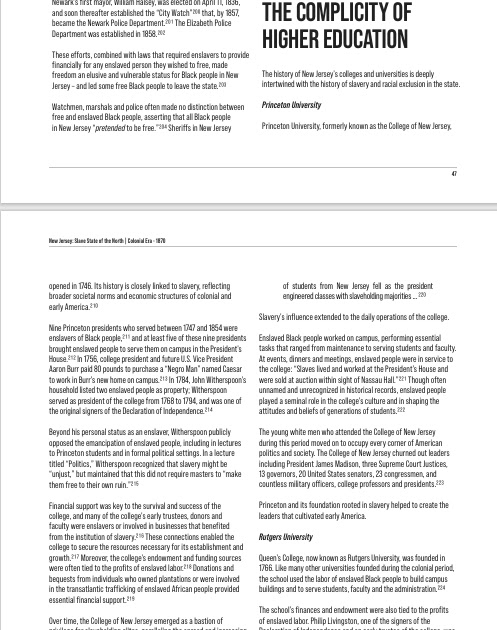
New Jersey’s legacy as a “slave state of the North” is often overlooked, especially in the sanitized histories of its most prestigious universities. Yet a closer examination reveals that the state’s institutions of higher education—particularly Princeton University and Rutgers University—were not only complicit in slavery, but were active beneficiaries of racial exploitation. Their histories are deeply intertwined with a system that built wealth and social power through the bondage of Black people.
This article is based on the findings of For Such a Time as This: The Nowness of Reparations for Black People in New Jersey, a landmark report from the New Jersey Reparations Council. The report is an urgent call for transformative change through reparative justice. It draws a direct throughline from New Jersey’s foundational embrace of slavery, through its Jim Crow era and more recent forms of structural racism, to today’s reality of “Two New Jerseys”—one Black, one white, separated by a staggering $643,000 racial wealth gap between median Black and white family wealth.
Founded in 1746 as the College of New Jersey, Princeton University’s early leadership reads like a roll call of slaveholders. Nine of its first presidents enslaved Black people. At least five brought enslaved individuals to live and labor on campus—including Aaron Burr Sr., who in 1756 purchased a man named Caesar to work in the newly built President’s House. Another, John Witherspoon, signer of the Declaration of Independence and president from 1768 to 1794, kept two people in bondage and spoke out against emancipation, claiming that freeing enslaved people would bring “ruin.”
Financially and culturally, Princeton thrived on slavery. Many of its trustees, donors, and faculty enriched themselves through plantation economies and the transatlantic slave trade. Historian Craig Steven Wilder has shown that the university’s enrollment strategy was deliberately skewed toward elite southern families who owned enslaved people. From 1768 to 1794, the proportion of southern students doubled, while the number of students from New Jersey declined. Princeton became a finishing school for the sons of America’s racial aristocracy.
Slavery was not just in the background—it was present in the daily life of the institution. Enslaved Black people worked in kitchens, cleaned dormitories, and served food at official university events. Human beings were bought and sold in full view of Nassau Hall. These men and women, their names often lost to history, were the invisible labor force that built the foundation for one of the wealthiest universities in the world.
The results of this complicity are measurable. Princeton graduates shaped the American Republic—including President James Madison, three U.S. Supreme Court justices, 13 governors, 20 senators, and 23 congressmen. Many of them carried forward the ideologies of white supremacy and anti-Black violence they absorbed in their youth.
Rutgers University, originally established as Queen’s College in 1766, shares a similarly grim legacy. The college’s early survival depended on donations and labor directly tied to slavery. Prominent among its early trustees was Philip Livingston, a signer of the Declaration of Independence who made his fortune by trading enslaved people and operating Caribbean plantations.
Enslaved labor helped build Rutgers, too. A man named Will, enslaved by the family of a college trustee, is among the few individuals whose name has survived. His work helped construct the early physical campus, though his story, like so many others, is only briefly mentioned in account books and correspondence.
The intellectual environment of Queen’s College mirrored the dominant racial attitudes of the time. While some students and faculty opposed slavery, their voices were overwhelmed by an institution that upheld the social, political, and economic status quo. Rutgers, like Princeton, prepared white elites to rule a society built on racial exclusion.
The For Such a Time as This report from the New Jersey Reparations Council underscores that the legacy of slavery is not a relic of the past—it is embedded in the material realities of today. New Jersey’s racial wealth gap—$643,000 between Black and white families—is not accidental. It is the result of centuries of dispossession, disinvestment, and discrimination.
The state’s leading universities played a formative role in that history. Acknowledgment of this fact is only a first step. True reckoning means meaningful reparative action. It means directing resources and power toward the communities that have been systematically denied them. It means funding education, housing, healthcare, and business development in Black communities, and making structural changes to how wealth and opportunity are distributed.
Princeton and Rutgers are not just relics of the past; they are major economic and political actors in the present. As institutions with billion-dollar endowments and vast influence, they have both the means and the moral obligation to contribute to a just future.
The question now is whether they will answer the call.
