Category: Reading

  • What Football Can Tell Us About How to Teach Reading – The 74

    What Football Can Tell Us About How to Teach Reading – The 74


    Get stories like this delivered straight to your inbox. Sign up for The 74 Newsletter

    When I go to my son’s football games, I can tell you which team will win — most of the time — just by watching them warm up. It’s not necessarily having the flashiest uniforms or the biggest player; it’s about the discipline, the focus and the precision of their routines.

    A school is no different.

    In my Texas school district, I can walk into a classroom and, in the first five minutes, tell you if effective reading instruction is happening. I don’t need to see the lesson plan or even look at the teacher. I just need to look at the kids. Are they engaged? Are they in a routine? Are they getting the “reps” they need?

    For too long, districts have been losing the game before it starts. They buy a new playbook (i.e., a curriculum) as a “hail Mary,” hoping for a fourth-quarter miracle. Still, they ignore the fundamentals, practice and team culture required for sustainable success.

    Chapel Hill Independent School District is committed to educating all children to compete in an ever-changing world. To that end, we’ve made literacy a nonnegotiable priority across all campuses. We anchor our approach in research-based practices and a culture of continuous learning for both students and staff.

    We’re building for the long run: a literacy dynasty. But our literacy success hasn’t come without putting in the work. We have a relentless focus on the fundamentals and, most importantly, a culture where every player — every teacher and administrator — fits our system.

    Trust the Analytics, Not Your Gut

    In reading instruction, we can’t make assumptions; all instruction has to start with the fundamentals. For decades, instruction was based on gut feelings, like an old-school coach deciding whether to go for it on fourth down or punt based on a hunch. But today, the best coaches trust the analytics, not their gut. They watch the game film.

    Chapel Hill is an analytics district; we do our research. And our game film is the science of reading.

    Many years ago, we started using structured literacy for a small group of students with dyslexia. It worked so well that we asked ourselves: If structured literacy is effective for a small group of students with dyslexia, shouldn’t it be essential for all students?

    We didn’t just adopt a new curriculum; we redesigned our literacy infrastructure — from structured literacy professional development for every teacher to classroom coaching and a robust tiered system of support to ensure no student falls through the cracks.

    That logic is our offensive strategy. It’s why we use tools like the Sold a Story podcast to show our staff why we’ve banned the strategies of a bygone era, like three-cueing. We have to be willing to reprogram the brain to align with what research proves works. But having the right playbook is only half the battle.

    A great playbook is useless without the right team to execute it.

    This is the most crucial part: “First who, then what.” In the NFL draft, teams don’t always draft the most talented player available. They conduct interviews and personality assessments and ultimately draft the player who best fits their system—the cultural fit.

    Tom Brady is arguably the greatest quarterback of all time, but he couldn’t run a read-option offense, which requires a fast, running quarterback. He wouldn’t fit the system, and the team would fail. But put Brady in a play-action offense, sit back and watch the magic happen.

    We operate the same way. When we interview, we’re not just looking for a teacher with excellent credentials and experience; we’re looking for a “Chapel Hill Way” teacher. It’s a specific profile: someone who believes in our philosophy of systematic, explicit, research-based instruction.

    This culture starts with our team captains: our campus principals. We need them to believe in our playbook, not just buy in because the district office said so. We invest in their development so they can champion literacy daily, monitor instruction and ensure every classroom executes our playbook with fidelity. It’s their conviction that turns a curriculum on a shelf into a living, breathing part of our culture.

    Talented teams win games. Disciplined, team-first organizations build dynasties.

    Building a dynasty requires sacrifice. When an educator joins our team, whether they’re a rookie or a seasoned veteran, we ask them to let go of the “I’ve always done it this way” mindset. That’s the equivalent of a player prioritizing their personal stats over a team win.

    It’s a team-first mindset. It’s about a willingness to put personal preference aside to build a championship team. For Chapel Hill ISD, our championship is ensuring every child learns to read.

    Our team-first philosophy has translated into measurable results: Across campuses, students are gaining the foundational skills they need, and data shows growth for every subgroup, including students with dyslexia and multilingual learners. We want students to become a product of our expectations, rather than their environment. Our district, which serves a diverse population, including a high percentage of students classified as low socioeconomic status, consistently scores above the state average in third-grade reading.

    At Wise Elementary, our largest campus[MOU1] , 56% of third graders met grade-level standards, and 23% scored above grade level on the 2023-2024 STARR assessment. And we had similar results across the district.

    So to my fellow education leaders: Before you shop for a new playbook, ensure you have the right team culture in place. Define your culture. Draft the right players. Build your team. Coach your captains. And obsess over the fundamentals.

    That’s how you win.


    Did you use this article in your work?

    We’d love to hear how The 74’s reporting is helping educators, researchers, and policymakers. Tell us how

    Source link

  • In Los Angeles, 45 Elementary Schools Beat the Odds in Teaching Kids to Read – The 74

    In Los Angeles, 45 Elementary Schools Beat the Odds in Teaching Kids to Read – The 74

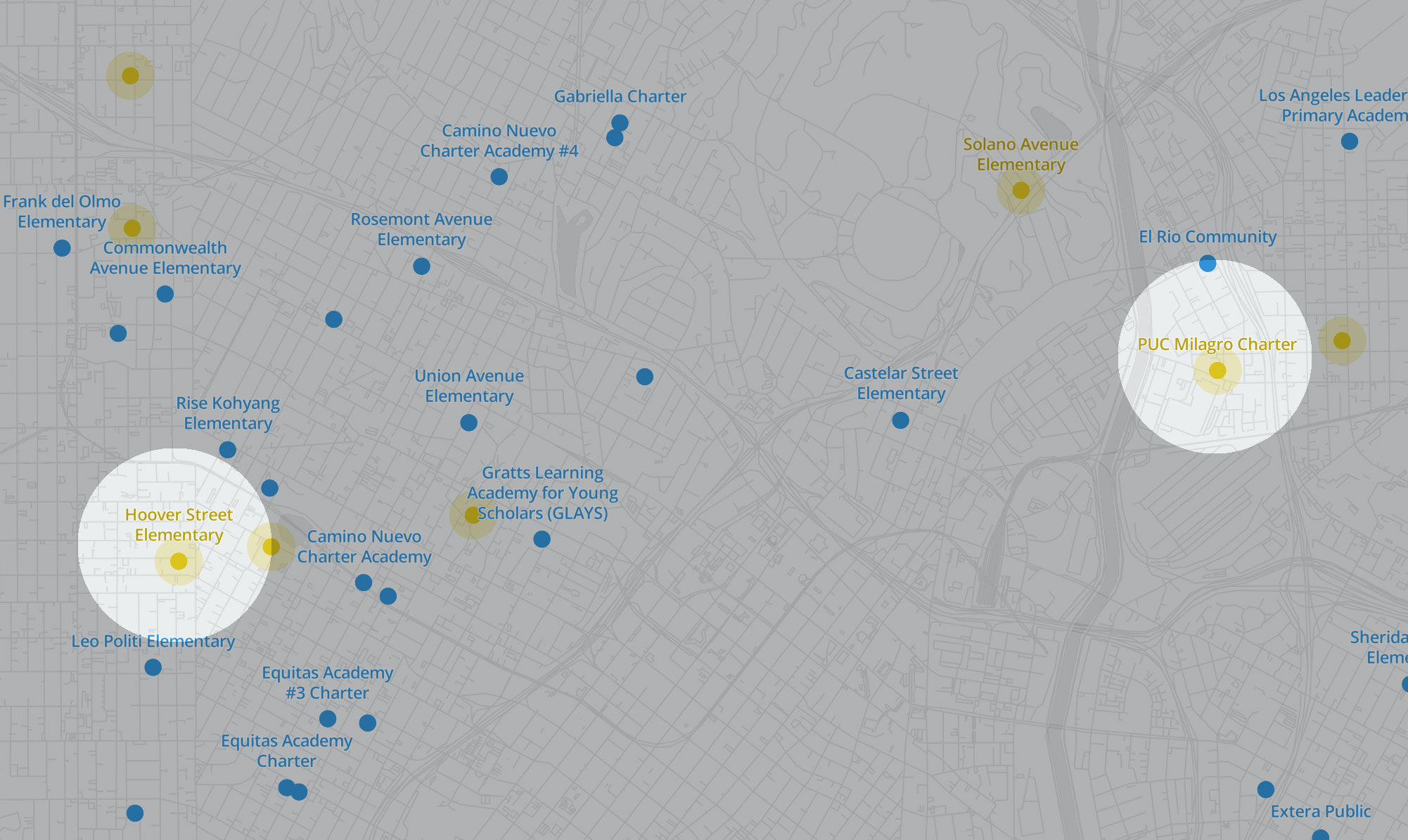
    This article is part of Bright Spots, a series highlighting schools where every child learns to read, no matter their zip code. Explore the Bright Spots map to find out which schools are beating the odds in terms of literacy versus poverty rates.

    This story is part of The 74’s special coverage marking the 65th anniversary of the Los Angeles Unified School District. Read all our stories here.

    When The 74 started looking for schools that were doing a good job teaching kids to read, we began with the data. We crunched the numbers for nearly 42,000 schools across all 50 states and Washington, D.C. and identified 2,158 that were beating the odds by significantly outperforming what would be expected given their student demographics. 

    Seeing all that data was interesting. But they were just numbers in a spreadsheet until we decided to map out the results. And that geographic analysis revealed some surprising findings. 

    For example, we found that, based on our metrics, two of the three highest-performing schools in California happened to be less than 5 miles apart from each other in Los Angeles. 

    The PUC Milagro Charter School came out No. 1 in the state of California. With 91% of its students in poverty, our calculations projected it would have a third grade reading rate of 27%. Instead, 92% of its students scored proficient or above. Despite serving a high-poverty student population, the school’s literacy scores were practically off the charts.  

    PUC Milagro is a charter school, and charters tended to do well in our rankings. Nationally, they made up 7% of all schools in our sample but 11% of those that we identified as exceptional. 

    But some district schools are also beating the odds. Just miles away from PUC Milagro is our No. 3-rated school in California, Hoover Street Elementary. It is a traditional public school run by the Los Angeles Unified School District. With 92% of its students qualifying for free- or reduced-price lunch, our calculations suggest that only 23% of its third graders would likely be proficient in reading. Instead, its actual score was 78%. 

    For this project, we used data from 2024, and Hoover Street didn’t do quite as well in 2025. (Milagro continued to perform admirably.)

    Still, as Linda Jacobson reported last month, the district as a whole has been making impressive gains in reading and math over the last few years. In 2025, it reported its highest-ever performance on California’s state test. Moreover, those gains were broadly shared across the district’s most challenging, high-poverty schools. 

    Our data showed that the district as a whole slightly overperformed expectations, based purely on the economic challenges of its students. We also found that, while Los Angeles is a large, high-poverty school district, it had a disproportionately large share of what we identified as the state’s “bright spot” schools. L.A. accounted for 8% of all California schools in our sample but 16% of those that are the most exceptional. 

    All told, we found 45 L.A. district schools that were beating the odds and helping low-income students read proficiently. Some of these were selective magnet schools, but many were not. 

    Map of Los Angeles Area Bright Spots

    Some of the schools on the map may not meet most people’s definition of a good school, let alone a great one. For example, at Stanford Avenue Elementary, 47% of its third graders scored proficient in reading in 2024. That may not sound like very many, but 97% of its students are low-income, and yet it still managed to outperform the rest of the state by 4 percentage points. (It did even a bit better in 2025.)

    Schools like Stanford Avenue Elementary don’t have the highest scores in California. On the surface, they don’t look like they’re doing anything special. But that’s why it’s important for analyses like ours to consider a school’s demographics. High-poverty elementary schools that are doing a good job of helping their students learn to read deserve to be celebrated for their results.


    Did you use this article in your work?

    We’d love to hear how The 74’s reporting is helping educators, researchers, and policymakers. Tell us how


    Source link

  • 3 strategies to boost student reading fluency this school year

    3 strategies to boost student reading fluency this school year

    Key points:

    With the new school year now rolling, teachers and school leaders are likely being hit with a hard truth: Many students are not proficient in reading.

    This, of course, presents challenges for students as they struggle to read new texts and apply what they are learning across all subject areas, as well as for educators who are diligently working to support students’ reading fluency and overall academic progress. 

    Understanding the common challenges students face with reading–and knowing which instructional strategies best support their growth–can help educators more effectively get students to where they need to be this school year.

    Understanding the science of learning

    Many districts across the country have invested in evidence-based curricula grounded in the science of reading to strengthen how foundational skills such as decoding and word recognition are taught. However, for many students, especially those receiving Tier 2 and Tier 3 interventions, this has not been enough to help them develop the automatic word recognition needed to become fluent, confident readers.

    This is why coupling the science of reading with the science of learning is so important when it comes to reading proficiency. Simply stated, the science of learning is how students learn. It identifies the conditions needed for students to build automaticity and fluency in complex skills, and it includes principles such as interleaving, spacing practice, varying tasks, highlighting contrasts, rehearsal, review, and immediate feedback–all of which are essential for helping students consolidate and generalize their reading skills.

    When these principles are intentionally combined with the science of reading’s structured literacy principles, students are able to both acquire new knowledge and retain, retrieve, and apply it fluently in new contexts.

    Implementing instructional best practices

    The three best practices below not only support the use of the science of learning and the science of reading, but they give educators the data and information needed to help set students up for reading success this school year and beyond. 

    Screen all students. It is important to identify the specific strengths and weaknesses of each student as early as possible so that educators can personalize their instruction accordingly.

    Some students, even those in upper elementary and middle school, may still lack foundational skills, such as decoding and automatic word recognition, which in turn negatively impact fluency and comprehension. Using online screeners that focus on decoding skills, as well as automatic word recognition, can help educators more quickly understand each student’s needs so they can efficiently put targeted interventions in place to help.

    Online screening data also helps educators more effectively communicate with parents, as well as with a student’s intervention team, in a succinct and timely way.

    Provide personalized structured, systematic practice. This type of practice has been shown to help close gaps in students’ foundational skills so they can successfully transfer their decoding and automatic word recognition skills to fluency. The use of technology and online programs can optimize the personalization needed for students while providing valuable insights for teachers.

    Of course, when it comes to personalizing practice, technology should always enhance–not replace–the role of the teacher. Technology can help differentiate the questions and lessons students receive, track students’ progress, and engage students in a non-evaluative learning environment. However, the personal attention and direction given by a teacher is always the most essential aid, especially for struggling readers. 

    Monitor progress on oral reading. Practicing reading aloud is important for developing fluency, although it can be very personal and difficult for many struggling learners. Students may get nervous, embarrassed, or lose their confidence. As such, the importance of a teacher’s responsiveness and ongoing connection while monitoring the progress of a student cannot be overstated.

    When teachers establish the conditions for a safe and trusted environment, where errors can occur without judgment, students are much more motivated to engage and read aloud. To encourage this reading, teachers can interleave passages of different lengths and difficulty levels, or revisit the same text over time to provide students with spaced opportunities for practice and retrieval. By providing immediate and constructive feedback, teachers can also help students self-correct and refine their skills in real time.

    Having a measurable impact

    All students can become strong, proficient readers when they are given the right tools, instruction, and support grounded in both the science of learning and the science of reading. For educators, this includes screening effectively, providing structured and personalized practice, and creating environments where students feel comfortable learning and practicing skills and confident reading aloud.

    By implementing these best practices, which take into account both what students need to learn and how they learn best, educators can and will make a measurable difference in students’ reading growth this school year.

    Latest posts by eSchool Media Contributors (see all)

    Source link

  • Nevada Funding for Dolly Parton Book Program in Clark County Dries Up – The 74

    Nevada Funding for Dolly Parton Book Program in Clark County Dries Up – The 74


    Join our zero2eight Substack community for more discussion about the latest news in early care and education. Sign up now.

    Over the past two years, upwards of 18,000 young children in the Las Vegas metro area have received free monthly books in the mail as part of an early literacy program started by country icon Dolly Parton. But that ends this month.

    Storied Inc., the Clark County-based nonprofit partner for Parton’s Imagination Library, last week announced to parents and guardians that its October books would be the last until additional funding for the program is secured. The program, when funded, provides a free, age-appropriate monthly book to children 0 to 5 years old.

    According to Meredith Helmick, executive director of Storied, the nonprofit sought funding from the Nevada State Legislature earlier this year to keep the program going after an initial two-years of state grant funding ended, but they came up empty handed.

    Assembly Speaker Steve Yeager sponsored a bill to appropriate $3.9 million to the United Way of Northern Nevada and the Sierra, which currently runs the Imagination Library for Washoe County residents, to expand the program statewide. The bill was referred to the Assembly Committee on Ways & Means, where it languished until the end of the regular session without a hearing or even a mention, according to the legislature’s website.

    Helmick also hoped the nonprofit program might be able to secure funding through Senate Bill 460, Senate Majority Leader Nicole Cannizzaro’s omnibus education legislation.

    An early version of that bill appropriated $50 million for early childhood literacy readiness programs, but an amendment reduced that to $0 for the fiscal year beginning July 2025 and $12 million for the fiscal year beginning July 2026. Helmick says lawmakers chose to prioritize expansion of preschool seats, a Cannizzaro priority.

    SB460 was heavily negotiated and amended to include many of Gov. Joe Lombardo’s education priorities. Those priorities included setting aside $7 million in grant funding for charter school transportation.

    It appears those other priorities came at the expense of existing innovative programs that were working.

    Helmick says a survey of her families last year found 62% of them had fewer than 20 children’s books in their homes before enrolling their children in the program.

    “This program is such a low cost, high reward program,” she added.

    Helmick is hopeful the program can return to the Las Vegas area. She says Storied is having conversations with large companies and other nonprofits, reaching out to elected officials at all levels of government, and urging their supporters to do the same.

    “We’ve heard rumors of a special session,” she adds. “Can we rewrite SB460 to include the language that it took out? Are there other funds that we could add or tap into that we could fit under? Maybe that’s an avenue.”

    ‘It isn’t just about the books’

    Meredith Helmick and her husband, Kyle, were inspired to start Storied Inc. after attempting to sign up their daughter for Imagination Library only to learn the nationwide program didn’t serve their area.

    Dolly Parton launched Imagination Library in 1995 and the program has since given out more than 250 million free books to children in the United States and four other countries.

    Storied Inc. is one of several partners running the program in Nevada. According to Helmick, the other partners have managed to continue their programs, either in whole or by scaling down the number of kids served.

    The sheer size of Clark County’s population makes that a tougher task for Storied. According to the Imagination Library’s website, nearly 29,000 Nevada children are enrolled, the vast majority through Storied.

    Helmick says that before they even had a chance to market the program or figure out stable funding, an intrepid stranger found the sign up form and shared it on a social media group for parents in Las Vegas.

    “In 48 hours, we had 3,500 kids registered,” she recalls. “It was, like, ‘I guess we’re doing it now.’ But it all worked out beautifully.”

    From there, the program quickly grew just by word of mouth. It was funded from June 2023 to July 2025 by a grant from the state’s Early Childhood Innovative Literacy Program. Participation fluctuates each month as kids are signed up or age out at 5 years old, but Helmick says it stays in the range of 18,000 or 19,000 thousand children spanning most of Clark County.

    (Boulder City residents have a dedicated partner, Reading to Z, which currently serves fewer than 200 kids. Rural Clark County residents who live in Valley Electric Association’s service area can sign up for a program run by the energy cooperative’s charitable foundation.)

    Over the summer, with the funding drying up, Storied stopped accepting new kids into the program.

    “We didn’t want to disappoint families” by starting to send them books only to stop sending them a few months later, said Helmick. “One thing that sets (Imagination Library) apart is these books are sent directly to their home. I am a huge proponent of libraries. I’m there practically every week. But not everybody is able to do that. That is a barrier.”

    Additionally, the books arrive addressed to the child.

    “Getting it in the mail, the label with their name, it gives them ownership of the book,” says Helmick. “It makes a huge difference. I didn’t realize it until I heard it from families.”

    On the inside of each book cover is a note from Imagination Library with tips for parents on conversations they can have with their child about the book, or questions they can ask to boost critical thinking and early reading skills.

    “It isn’t just about the books and the words and the stories you’re reading with your kids,” said Helmick. “It’s sitting together side by side. It’s having conversations with them.”

    Nevada Current is part of States Newsroom, a nonprofit news network supported by grants and a coalition of donors as a 501c(3) public charity. Nevada Current maintains editorial independence. Contact Editor Hugh Jackson for questions: [email protected].


    Did you use this article in your work?

    We’d love to hear how The 74’s reporting is helping educators, researchers, and policymakers. Tell us how

    Source link

  • How We Outperformed National Reading Scores – And Kept Students at Grade Level – The 74

    How We Outperformed National Reading Scores – And Kept Students at Grade Level – The 74


    Get stories like this delivered straight to your inbox. Sign up for The 74 Newsletter

    As reading scores remain a top concern for schools nationwide, many districts are experimenting with ability-based grouping in the early grades. The idea is to group students in multiple grade levels by their current reading level — not their grade level. A classroom could have seven kindergartners, 10 first graders, and three second graders grouped together for reading because they all read at the same level.

    While this may work for some schools, in our district, Rockwood School District in Missouri, we’ve chosen a different path. We keep students together in their class during whole-class instruction — regardless of ability level — and provide support or enrichment by creating flexible groups based on instructional needs within their grade level.

    We’re building skilled, confident readers not by separating them, but by growing them together.

    Children, like adults, learn and grow in diverse groups. In a Rockwood classroom, every student contributes to the shared learning environment — and every student benefits from being part of it.

    Our approach starts with whole-class instruction. All students, including English multilingual learners and those working toward grade-level benchmarks, participate in daily, grade-level phonics and comprehension lessons. We believe these shared experiences are foundational — not just for building literacy, but for fostering community and academic confidence.

    After our explicit, whole-group lessons, students move into flexible, needs-based small groups informed by real-time data and observations. Some students receive reteaching, while others take on enrichment activities. During these blocks, differentiation is fluid: A student may need decoding help one day and vocabulary enrichment the next. No one is locked into a static tier. Every day is a new opportunity.

    Students also engage in daily independent and partner reading. In addition, reading specialists provide targeted, research-based interventions for striving readers who need additional instruction.

    We build movement into our instruction, as well — not as a brain break, but as a learning tool. We use gestures for phonemes, tapping for spelling and jumping to count syllables. These are “brain boosts,” helping young learners stay focused and engaged.

    We challenge all students, regardless of skill level. During phonics and word work, advanced readers work with more complex texts and tasks. Emerging readers receive the time and scaffolded support they need — such as visual cues and pre-teaching or exposing students to a concept or skill before it’s formally taught during a whole-class lesson. That can help them fully participate in every class. A student might not yet be able to decode or encode every word, but they are exposed to the grade-level standards and are challenged to meet the high expectations we have for all students.

    During shared and interactive reading lessons, all students are able to practice fluency and build their comprehension skills and vocabulary knowledge. Through these shared experiences, every child experiences success.

    There’s a common misconception that mixed-ability classrooms hold back high achievers or overwhelm striving readers. But in practice, engagement depends more on how we teach rather than who is in the room. With well-paced, multimodal lessons grounded in grade-level content, every learner finds an entry point.

    You’ll see joy, movement, and mutual respect in our classrooms — because when we treat students as capable, they rise. And when we give them the right tools, not labels, they use them.

    While ability grouping may seem like a practical solution, research suggests it can have a lasting downside. A Northwestern University study of nearly 12,000 students found that those placed in the lowest kindergarten reading groups rarely caught up to their peers. For example, when you group a third grader with first graders, when does the older child get caught up? Even if he learns and progresses with his ability group, he’s still two grade levels behind his third-grade peers.

    This study echoes what researchers refer to as the Matthew Effect in reading: The rich get richer, and the poor get poorer. Lower-track students are exposed to less complex vocabulary and fewer comprehension strategies. Once placed on that path, it’s hard to catch up. Once a student is assigned a label, it’s difficult to change it — for both the student and educators.

    In Rockwood, we’re confident in what we’re doing. We have effective, evidence-based curricula for Tier I phonics and comprehension, and every student receives the same whole-class instruction as every other student in their grade. Then, students receive intervention or enrichment as needed.

    At the end of the 2024–25 school year, our data affirmed what we see every day. Our kindergarteners outperformed national proficiency averages in every skill group — in some cases by more than 17 percentage points, according to our Reading Horizons data. Our first and second graders outpaced national averages across nearly every domain. We don’t claim to have solved the literacy crisis — or know that our model will work for every district, school, classroom or student — but we’re building readers before gaps emerge.

    We’ve learned that when every student receives strong Tier I instruction, no one gets left behind. The key isn’t separating kids by ability. It’s designing instruction that’s universally strong and strategically supported.

    We recognize that every community faces distinct challenges. If you’re a district leader weighing the trade-offs of ability grouping, consider this: When you pull students out of the room during critical learning moments, the rich vocabulary, the shared texts and the academic conversation, you are not closing the learning gap, but creating a bigger one. Those critical moments build more than skills; they build readers.

    In Rockwood, our data confirms what we see every day: students growing not only in skills, but also in confidence, stamina and joy. We’re proving that inclusive, grade-level-first instruction can work — and work well — for all learners.


    Get stories like these delivered straight to your inbox. Sign up for The 74 Newsletter

    Source link

  • NAEP scores for class of 2024 show major declines, with fewer students college ready

    NAEP scores for class of 2024 show major declines, with fewer students college ready

    This story was originally published by Chalkbeat. Sign up for their newsletters at ckbe.at/newsletters.

    Students from the class of 2024 had historically low scores on a major national test administered just months before they graduated.

    Results from the National Assessment of Educational Progress, or NAEP, released September 9, show scores for 12th graders declined in math and reading for all but the highest performing students, as well as widening gaps between high and low performers in math. More than half of these students reported being accepted into a four-year college, but the test results indicate that many of them are not academically prepared for college, officials said.

    “This means these students are taking their next steps in life with fewer skills and less knowledge in core academics than their predecessors a decade ago, and this is happening at a time when rapid advancements in technology and society demand more of future workers and citizens, not less,” said Lesley Muldoon, executive director of the National Assessment Governing Board. “We have seen progress before on NAEP, including greater percentages of students meeting the NAEP proficient level. We cannot lose sight of what is possible when we use valuable data like NAEP to drive change and improve learning in U.S. schools.”

    These results reflect similar trends seen in fourth and eighth grade NAEP results released in January, as well as eighth grade science results also released Tuesday.

    In a statement, Education Secretary Linda McMahon said the results show that federal involvement has not improved education, and that states should take more control.

    “If America is going to remain globally competitive, students must be able to read proficiently, think critically, and graduate equipped to solve complex problems,” she said. “We owe it to them to do better.”

    The students who took this test were in eighth grade in March of 2020 and experienced a highly disrupted freshman year of high school because of the pandemic. Those who went to college would now be entering their sophomore year.

    Roughly 19,300 students took the math test and 24,300 students took the reading test between January and March of 2024.

    The math test measures students’ knowledge in four areas: number properties and operations; measurement and geometry; data analysis, statistics, and probability; and algebra. The average score was the lowest it has been since 2005, and 45% of students scored below the NAEP Basic level, even as fewer students scored at NAEP Proficient or above.

    NAEP Proficient typically represents a higher bar than grade-level proficiency as measured on state- and district-level standardized tests. A student scoring in the proficient range might be able to pick the correct algebraic formula for a particular scenario or solve a two-dimensional geometric problem. A student scoring at the basic level likely would be able to determine probability from a simple table or find the population of an area when given the population density.

    Only students in the 90th percentile — the highest achieving students — didn’t see a decline, and the gap between high- and low-performing students in math was higher than on all previous assessments.

    This gap between high and low performers appeared before the pandemic, but has widened in most grade levels and subject areas since. The causes are not entirely clear but might reflect changes in how schools approach teaching as well as challenges outside the classroom.

    Testing officials estimate that 33% of students from the class of 2024 were ready for college-level math, down from 37% in 2019, even as more students said they intended to go to college.

    In reading, students similarly posted lower average scores than on any previous assessment, with only the highest performing students not seeing a decline.

    The reading test measures students’ comprehension of both literary and informational texts and requires students to interpret texts and demonstrate critical thinking skills, as well as understand the plain meaning of the words.

    A student scoring at the basic level likely would understand the purpose of a persuasive essay, for example, or the reaction of a potential audience, while a students scoring at the proficient level would be able to describe why the author made certain rhetorical choices.

    Roughly 32% of students scored below NAEP Basic, 12 percentage points higher than students in 1992, while fewer students scored above NAEP Proficient. An estimated 35% of students were ready for college-level work, down from 37% in 2019.

    In a survey attached to the test, students in 2024 were more likely to report having missed three or more days of school in the previous month than their counterparts in 2019. Students who miss more school typically score lower on NAEP and other tests. Higher performing students were more likely to say they missed no days of school in the previous month.

    Students in 2024 were less likely to report taking pre-calculus, though the rates of students taking both calculus and algebra II were similar in 2019 and 2024. Students reported less confidence in their math abilities than their 2019 counterparts, though students in 2024 were actually less likely to say they didn’t enjoy math.

    Students also reported lower confidence in their reading abilities. At the same time, higher percentages of students than in 2024 reported that their teachers asked them to do more sophisticated tasks, such as identifying evidence in a piece of persuasive writing, and fewer students reported a low interest in reading.

    Chalkbeat is a nonprofit news site covering educational change in public schools.

    For more news on national assessments, visit eSN’s Innovative Teaching hub.

    Latest posts by eSchool Media Contributors (see all)

    Source link

  • Strengthening family engagement to support the science of reading

    Strengthening family engagement to support the science of reading

    Key points:

    While most teachers are eager to implement the science of reading, many lack the time and tools to connect these practices to home-based support, according to a new national survey from Lexia, a Cambium Learning Group brand.

    The 2025 Back-to-School Teacher Survey, with input from more than 1,500 K–12 educators nationwide, points to an opportunity for district leaders to work in concert with teachers to provide families with the science of reading-based literacy resources they need to support student reading success.

    Key insights from the survey include:

    • 60 percent of teachers are either fully trained or interested in learning more about the science of reading
    • Only 15 percent currently provide parents with structured, evidence-based literacy activities
    • 79 percent of teachers cite time constraints and parents’ work schedules as top barriers to family engagement
    • Just 10 percent report that their schools offer comprehensive family literacy programs
    • Teachers overwhelmingly want in-person workshops and video tutorials to help parents support reading at home

    “Teachers know that parental involvement can accelerate literacy and they’re eager for ways to strengthen those connections,” said Lexia President Nick Gaehde. “This data highlights how districts can continue to build on momentum in this new school year by offering scalable, multilingual, and flexible family engagement strategies that align with the science of reading.”

    Teachers also called for:

    • Better technology tools for consistent school-to-home communication
    • Greater multilingual support to serve diverse communities
    • Professional learning that includes family engagement training

    Gaehde concluded, “Lexia’s survey reflects the continued national emphasis on Structured Literacy and shows that equipping families is essential to driving lasting student outcomes. At Lexia we’re committed to partnering with districts and teachers to strengthen the school-to-home connection. By giving educators practical tools and data-driven insights, we help teachers and families work together–ensuring every child has the literacy support they need to thrive.”

    The complete findings are available in a new report, From Classroom to Living Room: Exploring Parental Involvement in K–12 Literacy. District leaders can also download the accompanying infographic, What District Leaders Need To Know: 5 Key Findings About Family Engagement and Literacy,” which highlights the most pressing data points and strategic opportunities for improving school-to-home literacy connections.

    Latest posts by eSchool Media Contributors (see all)

    Source link

  • English Teachers Work to Instill the Joy of Reading. Testing Gets in the Way – The 74

    English Teachers Work to Instill the Joy of Reading. Testing Gets in the Way – The 74


    Get stories like this delivered straight to your inbox. Sign up for The 74 Newsletter

    A new national study shows that Americans’ rates of reading for pleasure have declined radically over the first quarter of this century and that recreational reading can be linked to school achievement, career compensation and growth, civic engagement, and health. Learning how to enjoy reading – not literacy proficiency – isn’t just for hobbyists, it’s a necessary life skill. 

    But the conditions under which English teachers work are detrimental to the cause – and while book bans are in the news, the top-down pressure to measure up on test scores is a more pervasive, more longstanding culprit. Last year, we asked high school English teachers to describe their literature curriculum in a national questionnaire we plan to publish soon. From responses representing 48 states, we heard a lot of the following: “soul-deadening”; “only that which students will see on the test” and “too [determined] by test scores.”

    These sentiments certainly aren’t new. In a similar questionnaire distributed in 1911, teachers described English class as “deadening,” focused on “memory instead of thinking,” and demanding “cramming for examination.” 

    Teaching to the test is as old as English itself – as a secondary school subject, that is. Teachers have questioned the premise for just as long because too many have experienced a radical disconnect between how they are asked or required to teach and the pleasure that reading brings them.

    High school English was first established as a test-driven subject around the turn of the 20th Century. Even at a time when relatively few Americans attended college, English class was oriented around building students’ mastery of now-obscure literary works that they would encounter on the College Entrance Exam. 

    The development of the Scholastic Aptitude Test in 1926 and the growth of standardized testing since No Child Left Behind have only solidified what was always true: As much as we think of reading as a social, cultural, even “spiritual” experience, English class has been shaped by credential culture.

    Throughout, many teachers felt that preparing students for college was too limited a goal; their mission was to prepare students for life. They believed that studying literature was an invaluable source of social and emotional development, preparing adolescents for adulthood and for citizenship. It provided them with “vicarious experience”: Through reading, young people saw other points of view, worked through challenging problems, and grappled with complex issues. 

    Indeed, a national study conducted in 1933 asked teachers to rank their “aims” in literature instruction. They listed “vicarious experience” first, “preparation for college” last.

    The results might not look that different today. Ask an English teacher what brought her to the profession, and a love of reading is likely to top the list. What is different today is the  unmatched pressure to prepare students for a constant cycle of state and national examinations and for college credentialing. 

    Increasingly, English teachers are compelled to use online curriculum packages that mimic the examinations themselves, composed largely of excerpts from literary and “informational” texts instead of the whole books that were more the norm in previous generations. “Vicarious experience” has less purchase in contemporary academic standards than ever. 

    Credentialing, however, does not equal preparing. Very few higher education skills map neatly onto standardized exams, especially in the humanities. As English professors, we can tell you that an enjoyment of reading – not just a toleration of it – is a key academic capacity. It produces better writers, more creative thinkers, and students less likely to need AI to express their ideas effectively.

    Yet we haven’t given K-12 teachers the structure or freedom to treat reading enjoyment as a skill. The data from our national survey suggests that English teachers and their students find the system deflating. 

     “Our district adopted a disjointed, excerpt-heavy curriculum two years ago,” a Washington teacher shared, “and it is doing real damage to students’ interest in reading.” 

    From Tennessee, a teacher added: “I understand there are state guidelines and protocols, but it seems as if we are teaching the children from a script. They are willing to be more engaged and can have a better understanding when we can teach them things that are relatable to them.”

    And from Oregon, another tells us that because “state testing is strictly excerpts,” the district initially discouraged “teaching whole novels.”  It changed course only after students’ exam scores improved. 

    Withholding books from students is especially inhumane when we consider that the best tool for improved academic performance is engagement – students learn more when they become engrossed in stories. Yet by the time they graduate from high school, many students  master test-taking skills but lose the window for learning to enjoy reading.

    Teachers tell us that the problem is not attitudinal but structural. An education technocracy that consists of test making agencies, curriculum providers, and policy makers is squeezing out enjoyment, teacher autonomy and student agency. 

    To reverse this trend, we must consider what reading experiences we are providing our students. Instead of the self-defeating cycle of test-preparation and testing, we should take courage, loosen the grip on standardization, and let teachers recreate the sort of experiences with literature that once made us, and them, into readers.


    Get stories like these delivered straight to your inbox. Sign up for The 74 Newsletter

    Source link

  • Texas Students Make Gains in Reading but Struggle with Math, STAAR Scores Show – The 74

    Texas Students Make Gains in Reading but Struggle with Math, STAAR Scores Show – The 74


    Get stories like this delivered straight to your inbox. Sign up for The 74 Newsletter

    Texas’ students saw some wins in reading but continued to struggle to bounce back from pandemic-related learning losses in math, state testing results released Tuesday showed.

    Elementary students who took the State of Texas Assessments of Academic Readiness exam this year made the biggest gains in reading across grade levels. Third graders saw a three percentage point increase in reading, a milestone because early literacy is a strong indicator of future academic success. Progress among middle students in the subject, meanwhile, slowed.

    “These results are encouraging and reflect the impact of the strategic supports we’ve implemented in recent years,” said Texas Education Agency Commissioner Mike Morath. “We are seeing meaningful signs of academic recovery and progress.”

    This year’s third grade test takers have benefited from state investments in early literacy in recent years. Teachers in their classrooms have completed state-led training in early literacy instruction, known as reading academies. The state also expanded pre-K access and enrollment in 2019.

    Morath did acknowledge students needed more help to make similar gains in math. Five years after pandemic-related school closures, students are still struggling to catch up in that subject, the results showed. About 43% of students met grade-level standards for math, a 2 percentage point increase from the previous year, but still shy of the 50% reached in 2019.

    Low performance in math can effectively shut students out of high-paying, in-demand STEM careers. Economic leaders have been sounding the alarm about the implications that weak math skills can have on the state’s future workforce pipeline.

    The STAAR exam tests all Texas public school students in third through eighth grade in math and reading. A science test is also administered for fifth and eighth graders, as well as a social studies test for eighth graders. Science performance improved among fifth and eighth grades by 3 and 4 percentage points respectively, but students in those grades are still below where they were before the pandemic.

    Students in special education also made small gains. English learners, meanwhile, saw drops in all subjects but one — a 4% decrease in reading, a 2% decrease in math, and a 2% decrease in social studies.

    The test scores give families a snapshot of how Texas students are learning. School accountability ratings — which the Texas Education Agency gives out to each district and campus on an A through F scale as a score for their performance — are also largely based on how students do on the standardized tests.

    The test often casts a shadow over classrooms at the end of the year, with teachers across the state saying they lose weeks of valuable instructional time preparing children to take the test. Some parents also don’t like the test because of its high-stakes nature. They have said their kids don’t want to go school because of the enormous pressure the hours-long, end-of-year test puts on them.

    A bill that would have scrapped the STAAR test died in the last days of the 2025 legislative session. Both Republican and Democratic legislators expressed a desire to overhaul STAAR, but in the end, the House and Senate could not align on what they wanted out of an alternative test.

    Legislators this session did approve a sweeping school finance package that included academic intervention for students who are struggling before they first take their STAAR test in third grade. The package also requires teachers get training in math instruction, mirroring existing literacy training mandates.

    Parents can look up their students’ test results here.

    Graphics by Edison Wu

    This article originally appeared in The Texas Tribune, a member-supported, nonpartisan newsroom informing and engaging Texans on state politics and policy. Learn more at texastribune.org.


    Get stories like these delivered straight to your inbox. Sign up for The 74 Newsletter

    Source link

  • Ignite Reading Again Approved as 1:1 High-Dosage Early Literacy Tutoring Provider in Massachusetts

    Ignite Reading Again Approved as 1:1 High-Dosage Early Literacy Tutoring Provider in Massachusetts

    BOSTON — Ignite Reading — a Science of Reading-based virtual tutoring program serving students in 18 states nationwide — today announced its approval by the Massachusetts Department of Elementary and Secondary Education (DESE) to continue providing 1:1 high-dosage evidence-based literacy tutoring to K-3 students across the commonwealth.

    Massachusetts Governor Maura Healey’s administration called on her state to invest heavily in high-dosage tutoring (HDT) earlier this year, earmarking $25 million in her state budget proposal to help accelerate literacy growth, “complementing the more systemic, long-term improvement work” being supported under the administration’s five-year literacy improvement campaign, Literacy Launch.

    In its approval process, DESE evaluated Ignite Reading’s services to Massachusetts districts over the past three school years and approved the literacy company to again provide school districts and charter schools with tutoring that is focused on building foundational skills — including phonological awareness, phonics knowledge and decoding skills — to help students become independent fluent readers in the early grades.

    Since Ignite Reading first gained DESE approval during the 2022-23 school year:

    • 30 Massachusetts schools and districts have partnered with Ignite Reading to provide students with 15 minutes of daily, 1:1 virtual tutoring.
    • Ignite Reading’s tutor educators have delivered differentiated, evidence-based early literacy instruction to more than 7,800 Massachusetts students.
    • Researchers at Johns Hopkins University’s Center for Research and Reform in Education have followed approximately 2,000 Massachusetts 1st graders enrolled in the program. The quasi-experimental study found the number of students reading on benchmark increased 213% after a year of Ignite Reading tutoring. At the same time, the percentage of students who required intensive reading intervention decreased 55%. All student groups — including Black and Hispanic students, those with IEPs and Multilingual Learners — had equitable skills growth, and those meeting end-of-year reading benchmarks grew more than 125%.

    The Healey-Driscoll Administration recently announced that schools and districts in Massachusetts are invited to apply for high-dosage early literacy tutoring for K-3 students with 1st grade as the state’s top priority.

    “When we get kids reading proficiently by the end of 1st grade, we set them up for a lifetime of academic success,” said Ignite Reading CEO Jessica Sliwerski. “Our continued approval by DESE means we can keep delivering the intensive, personalized support that Massachusetts 1st graders need to learn to read on grade level and on time. We are honored to be able to continue to partner with Massachusetts districts to ensure all students can access the tools they need to succeed as readers.”

    For more information about Ignite Reading’s Massachusetts partnerships, visit https://info.ignite-reading.com/massachusetts.

    About Ignite Reading

    Ignite Reading is on a mission to ensure every student can access the tools they need to be a confident, fluent reader by the end of 1st grade. School districts nationwide depend on Ignite Reading’s virtual tutoring program to deliver literacy support at scale for students who need help learning to read. Our highly trained tutors provide students with 1:1 tutoring in foundational literacy skills each school day, helping them go from learning to read to reading to learn.

    A recent study by the Center for Research and Reform in Education at Johns Hopkins University found that Ignite Reading students across demographics — including students who are English Learners, Black, Hispanic, and those with Individualized Education Programs (IEPs) — achieve the same outstanding gains of more than 5 months of additional learning during a single school year.  For more information about Ignite Reading, visit www.ignite-reading.com.

    eSchool News Staff
    Latest posts by eSchool News Staff (see all)

    Source link