A new national study shows that Americans’ rates of reading for pleasure have declined radically over the first quarter of this century and that recreational reading can be linked to school achievement, career compensation and growth, civic engagement, and health. Learning how to enjoy reading – not literacy proficiency – isn’t just for hobbyists, it’s a necessary life skill.
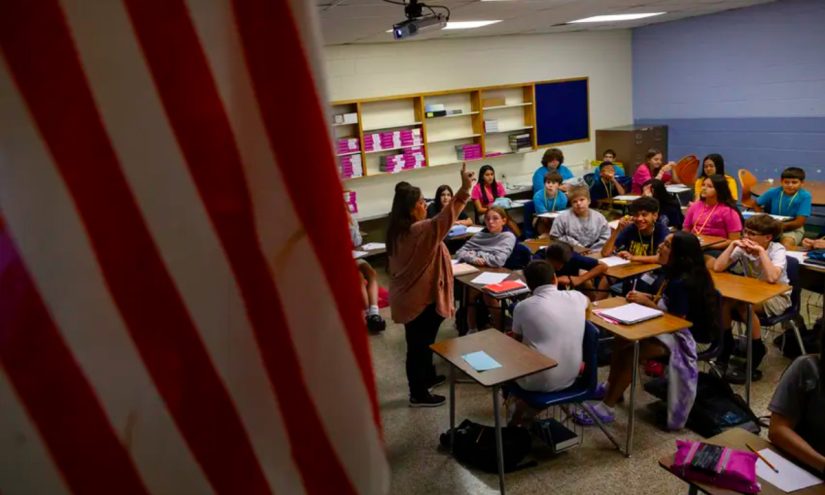
But the conditions under which English teachers work are detrimental to the cause – and while book bans are in the news, the top-down pressure to measure up on test scores is a more pervasive, more longstanding culprit. Last year, we asked high school English teachers to describe their literature curriculum in a national questionnaire we plan to publish soon. From responses representing 48 states, we heard a lot of the following: “soul-deadening”; “only that which students will see on the test” and “too [determined] by test scores.”
These sentiments certainly aren’t new. In a similar questionnaire distributed in 1911, teachers described English class as “deadening,” focused on “memory instead of thinking,” and demanding “cramming for examination.”
Teaching to the test is as old as English itself – as a secondary school subject, that is. Teachers have questioned the premise for just as long because too many have experienced a radical disconnect between how they are asked or required to teach and the pleasure that reading brings them.
High school English was first established as a test-driven subject around the turn of the 20th Century. Even at a time when relatively few Americans attended college, English class was oriented around building students’ mastery of now-obscure literary works that they would encounter on the College Entrance Exam.
The development of the Scholastic Aptitude Test in 1926 and the growth of standardized testing since No Child Left Behind have only solidified what was always true: As much as we think of reading as a social, cultural, even “spiritual” experience, English class has been shaped by credential culture.
Throughout, many teachers felt that preparing students for college was too limited a goal; their mission was to prepare students for life. They believed that studying literature was an invaluable source of social and emotional development, preparing adolescents for adulthood and for citizenship. It provided them with “vicarious experience”: Through reading, young people saw other points of view, worked through challenging problems, and grappled with complex issues.
Indeed, a national study conducted in 1933 asked teachers to rank their “aims” in literature instruction. They listed “vicarious experience” first, “preparation for college” last.
The results might not look that different today. Ask an English teacher what brought her to the profession, and a love of reading is likely to top the list. What is different today is the unmatched pressure to prepare students for a constant cycle of state and national examinations and for college credentialing.
Increasingly, English teachers are compelled to use online curriculum packages that mimic the examinations themselves, composed largely of excerpts from literary and “informational” texts instead of the whole books that were more the norm in previous generations. “Vicarious experience” has less purchase in contemporary academic standards than ever.
Credentialing, however, does not equal preparing. Very few higher education skills map neatly onto standardized exams, especially in the humanities. As English professors, we can tell you that an enjoyment of reading – not just a toleration of it – is a key academic capacity. It produces better writers, more creative thinkers, and students less likely to need AI to express their ideas effectively.
Yet we haven’t given K-12 teachers the structure or freedom to treat reading enjoyment as a skill. The data from our national survey suggests that English teachers and their students find the system deflating.
“Our district adopted a disjointed, excerpt-heavy curriculum two years ago,” a Washington teacher shared, “and it is doing real damage to students’ interest in reading.”
From Tennessee, a teacher added: “I understand there are state guidelines and protocols, but it seems as if we are teaching the children from a script. They are willing to be more engaged and can have a better understanding when we can teach them things that are relatable to them.”
And from Oregon, another tells us that because “state testing is strictly excerpts,” the district initially discouraged “teaching whole novels.” It changed course only after students’ exam scores improved.
Withholding books from students is especially inhumane when we consider that the best tool for improved academic performance is engagement – students learn more when they become engrossed in stories. Yet by the time they graduate from high school, many students master test-taking skills but lose the window for learning to enjoy reading.
Teachers tell us that the problem is not attitudinal but structural. An education technocracy that consists of test making agencies, curriculum providers, and policy makers is squeezing out enjoyment, teacher autonomy and student agency.
To reverse this trend, we must consider what reading experiences we are providing our students. Instead of the self-defeating cycle of test-preparation and testing, we should take courage, loosen the grip on standardization, and let teachers recreate the sort of experiences with literature that once made us, and them, into readers.
Texas’ students saw some wins in reading but continued to struggle to bounce back from pandemic-related learning losses in math, state testing results released Tuesday showed.
Elementary students who took the State of Texas Assessments of Academic Readiness exam this year made the biggest gains in reading across grade levels. Third graders saw a three percentage point increase in reading, a milestone because early literacy is a strong indicator of future academic success. Progress among middle students in the subject, meanwhile, slowed.
“These results are encouraging and reflect the impact of the strategic supports we’ve implemented in recent years,” said Texas Education Agency Commissioner Mike Morath. “We are seeing meaningful signs of academic recovery and progress.”
This year’s third grade test takers have benefited from state investments in early literacy in recent years. Teachers in their classrooms have completed state-led training in early literacy instruction, known as reading academies. The state also expanded pre-K access and enrollment in 2019.
Morath did acknowledge students needed more help to make similar gains in math. Five years after pandemic-related school closures, students are still struggling to catch up in that subject, the results showed. About 43% of students met grade-level standards for math, a 2 percentage point increase from the previous year, but still shy of the 50% reached in 2019.
Low performance in math can effectively shut students out of high-paying, in-demand STEM careers. Economic leaders have been sounding the alarm about the implications that weak math skills can have on the state’s future workforce pipeline.
The STAAR exam tests all Texas public school students in third through eighth grade in math and reading. A science test is also administered for fifth and eighth graders, as well as a social studies test for eighth graders. Science performance improved among fifth and eighth grades by 3 and 4 percentage points respectively, but students in those grades are still below where they were before the pandemic.
Students in special education also made small gains. English learners, meanwhile, saw drops in all subjects but one — a 4% decrease in reading, a 2% decrease in math, and a 2% decrease in social studies.
The test scores give families a snapshot of how Texas students are learning. School accountability ratings — which the Texas Education Agency gives out to each district and campus on an A through F scale as a score for their performance — are also largely based on how students do on the standardized tests.
The test often casts a shadow over classrooms at the end of the year, with teachers across the state saying they lose weeks of valuable instructional time preparing children to take the test. Some parents also don’t like the test because of its high-stakes nature. They have said their kids don’t want to go school because of the enormous pressure the hours-long, end-of-year test puts on them.
A bill that would have scrapped the STAAR test died in the last days of the 2025 legislative session. Both Republican and Democratic legislators expressed a desire to overhaul STAAR, but in the end, the House and Senate could not align on what they wanted out of an alternative test.
Legislators this session did approve a sweeping school finance package that included academic intervention for students who are struggling before they first take their STAAR test in third grade. The package also requires teachers get training in math instruction, mirroring existing literacy training mandates.
Parents can look up their students’ test results here.
Graphics by Edison Wu
This article originally appeared in The Texas Tribune, a member-supported, nonpartisan newsroom informing and engaging Texans on state politics and policy. Learn more at texastribune.org.
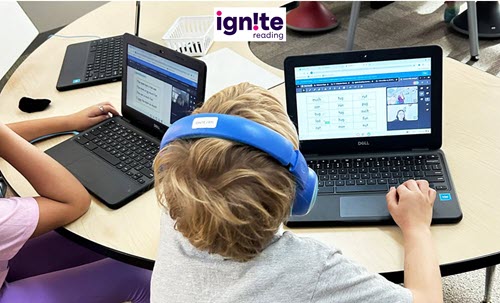
BOSTON — Ignite Reading — a Science of Reading-based virtual tutoring program serving students in 18 states nationwide — today announced its approval by the Massachusetts Department of Elementary and Secondary Education (DESE) to continue providing 1:1 high-dosage evidence-based literacy tutoring to K-3 students across the commonwealth.
Massachusetts Governor Maura Healey’s administration called on her state to invest heavily in high-dosage tutoring (HDT) earlier this year, earmarking $25 million in her state budget proposal to help accelerate literacy growth, “complementing the more systemic, long-term improvement work” being supported under the administration’s five-year literacy improvement campaign, Literacy Launch.
In its approval process, DESE evaluated Ignite Reading’s services to Massachusetts districts over the past three school years and approved the literacy company to again provide school districts and charter schools with tutoring that is focused on building foundational skills — including phonological awareness, phonics knowledge and decoding skills — to help students become independent fluent readers in the early grades.
Since Ignite Reading first gained DESE approval during the 2022-23 school year:
30 Massachusetts schools and districts have partnered with Ignite Reading to provide students with 15 minutes of daily, 1:1 virtual tutoring.
Ignite Reading’s tutor educators have delivered differentiated, evidence-based early literacy instruction to more than 7,800 Massachusetts students.
Researchers at Johns Hopkins University’s Center for Research and Reform in Education have followed approximately 2,000 Massachusetts 1st graders enrolled in the program. The quasi-experimental study found the number of students reading on benchmark increased 213% after a year of Ignite Reading tutoring. At the same time, the percentage of students who required intensive reading intervention decreased 55%. All student groups — including Black and Hispanic students, those with IEPs and Multilingual Learners — had equitable skills growth, and those meeting end-of-year reading benchmarks grew more than 125%.
The Healey-Driscoll Administration recently announced that schools and districts in Massachusetts are invited to apply for high-dosage early literacy tutoring for K-3 students with 1st grade as the state’s top priority.
“When we get kids reading proficiently by the end of 1st grade, we set them up for a lifetime of academic success,” said Ignite Reading CEO Jessica Sliwerski. “Our continued approval by DESE means we can keep delivering the intensive, personalized support that Massachusetts 1st graders need to learn to read on grade level and on time. We are honored to be able to continue to partner with Massachusetts districts to ensure all students can access the tools they need to succeed as readers.”
Ignite Reading is on a mission to ensure every student can access the tools they need to be a confident, fluent reader by the end of 1st grade. School districts nationwide depend on Ignite Reading’s virtual tutoring program to deliver literacy support at scale for students who need help learning to read. Our highly trained tutors provide students with 1:1 tutoring in foundational literacy skills each school day, helping them go from learning to read to reading to learn.
A recent study by the Center for Research and Reform in Education at Johns Hopkins University found that Ignite Reading students across demographics — including students who are English Learners, Black, Hispanic, and those with Individualized Education Programs (IEPs) — achieve the same outstanding gains of more than 5 months of additional learning during a single school year. For more information about Ignite Reading, visit www.ignite-reading.com.
eSchool Media staff cover education technology in all its aspects–from legislation and litigation, to best practices, to lessons learned and new products. First published in March of 1998 as a monthly print and digital newspaper, eSchool Media provides the news and information necessary to help K-20 decision-makers successfully use technology and innovation to transform schools and colleges and achieve their educational goals.
Central vision loss–a condition that impairs the ability to see objects directly in front of the eyes–can have profound academic and social impacts on K-12 students. Because this type of vision loss affects tasks that require detailed focus, such as reading, writing, and recognizing faces, students with central vision impairment often face unique challenges that can affect their overall school experience.
In the classroom, students with central vision loss may struggle with reading printed text on paper or on the board, despite having otherwise healthy peripheral vision. Standard classroom materials are often inaccessible without accommodations such as large print, magnification devices, or digital tools with text-to-speech capabilities. These students might take longer to complete assignments or may miss visual cues from teachers, making it difficult to follow along with lessons. Without appropriate support, such as assistive technology, students may fall behind academically, which can affect their confidence and motivation to participate.
As a result, they may be perceived as aloof or unfriendly, leading to social isolation or misunderstanding. Group activities, games, and unstructured time like lunch or recess can become sources of anxiety if students feel excluded or unsafe. Moreover, children with vision loss may become overly dependent on peers or adults, which can further affect their social development and sense of independence.
While this may seem daunting, there are assistive technologies to help students navigate central vision loss and have fulfilling academic and social experiences.
One such technology, eSight Go from Gentex Corporation’s eSight, uses an advanced high-speed, high-definition camera to capture continuous video footage of what a user is looking at. Algorithms optimize and enhance the footage and share it on two HD OLED screens, providing sharp, crystal-clear viewing. The user’s brain then synthesizes the images to fill any gaps in their vision, helping them to see more clearly, in real time.
“The ability to have central perception brought back into your set of tools for education is critically important,” said Roland Mattern, eSight’s director of sales and marketing. “Ease of reading, ease of seeing the board, using tablets or computers–all of these things [lead to] the ability to complete an academic task with greater ease.”
One key feature, Freeze Frame, lets the user capture a temporary photograph with the device’s camera, such as an image on an interactive whiteboard, a textbook page, or a graphic. The student can magnify the image, scan and study it, and take what they need from it.
“This eases the ability to absorb information and move on, at a regular pace, with the rest of the class,” Mattern noted.
Socially, central vision loss can create additional barriers. A major part of social interaction at school involves recognizing faces, interpreting facial expressions, and making eye contact–all tasks that rely heavily on central vision. Students with this impairment might have difficulty identifying peers or teachers unless they are spoken to directly. The glasses can help with these social challenges.
“There’s a huge social aspect to education, as well–seeing expressions on teachers’ and fellow students’ faces is a major part of communication,” Mattern said.
What’s more, the glasses also help students maintain social connections inside and outside of the classroom.
“Think of how much peer-to-peer communication is digital now, and if you have central vision loss, you can’t see your phone or screen,” Mattern said. “The educational part is not just academic–it’s about the student experience that you want to enhance and optimize.”
Educators, parents, and school staff play a crucial role in fostering inclusive environments–by educating classmates about visual impairments, encouraging empathy, and ensuring that students with central vision loss are supported both academically and socially. With the right accommodations and social-emotional support, these students can thrive in school and build strong connections with their peers.
“If we can make daily living, hobbies, and education easier and facilitate participation, that’s a win for everybody,” Mattern said.
Laura Ascione is the Editorial Director at eSchool Media. She is a graduate of the University of Maryland’s prestigious Philip Merrill College of Journalism.
Many school districts have adopted an evidence-based literacy curriculum called the “science of reading” that features phonics as a critical component.
Phonics strategies begin by teaching children to recognize letters and make their corresponding sounds. Then they advance to manipulating and blending first-letter sounds to read and write simple, consonant-vowel-consonant words – such as combining “b” or “c” with “-at” to make “bat” and “cat.” Eventually, students learn to merge more complex word families and to read them in short stories to improve fluency and comprehension.
In practice, Louisiana used a variety of science of reading approaches beyond phonics. That’s because different students have different learning needs, for a variety of reasons.
Yet as a scholar of reading and language who has studied literacy in diverse student populations, I see many schools across the U.S. placing a heavy emphasis on the phonics components of the science of reading.
If schools want across-the-board gains in reading achievement, using one reading curriculum to teach every child isn’t the best way. Teachers need the flexibility and autonomy to use various, developmentally appropriate literacy strategies as needed.
This was the case with my own child. He had been a proficient reader from an early age, but struggles emerged when his school adopted a phonics program to balance out its regular curriculum, a flexible literature-based curriculum called Daily 5 that prioritizes reading fluency and comprehension.
I worked with his first grade teacher to mitigate these challenges. But I realized that his real reading proficiency would likely not have been detected if the school had taught almost exclusively phonics-based reading lessons.
Another weakness of phonics, in my experience, is that it teaches reading in a way that is disconnected from authentic reading experiences. Phonics often directs children to identify short vowel sounds in word lists, rather than encounter them in colorful stories. Evidence shows that exposing children to fun, interesting literature promotes deep comprehension.
Balanced literacy prompts children to learn words encountered in authentic literature during guided, teacher-led read-alouds – versus learning how to decode words in word lists. Teachers use multiple strategies to promote reading acquisition, such as blending the letter sounds in words to support “decoding” while reading.
Another balanced literacy strategy that teachers can apply in phonics-based strategies while reading aloud is called “rhyming word recognition.” The rhyming word strategy is especially effective with stories whose rhymes contribute to the deeper meaning of the story, such as Marc Brown’s “Arthur in a Pickle.”
The rhyming structure of ‘Arthur in a Pickle’ helps children learn to read entire words, versus word parts.
After reading, teachers may have learners arrange letter cards to form words, then tap the letter cards while saying and blending each sound to form the word. Similar phonics strategies include tracing and writing letters to form words that were encountered during reading.
There is no one right way to teach literacy in a developmentally appropriate, balanced literacy framework. There are as many ways as there are students.
What a truly balanced curriculum looks like
The push for the phonics-based component of the science of reading is a response to the discrediting of the Lucy Calkins Reading Project, a balanced literacy approach that uses what’s called “cueing” to teach young readers. Teachers “cue” students to recognize words with corresponding pictures and promote guessing unfamiliar words while reading based on context clues.
A 2024 class action lawsuit filed by Massachusetts families claimed that this faulty curriculum and another cueing-based approach called Fountas & Pinnell had failed readers for four decades, in part because they neglect scientifically backed phonics instruction.
The intention here is for learners to acquire words in the context of engaging literature. But critics of Calkins contend that “cueing” during reading is a guessing game. They say readers are not learning the fundamentals necessary to identify sounds and word families on their way to decoding entire words and sentences.
Here are five evidence-based tips to promote reading for all readers that combine phonics, balanced literacy and other methods.
1. Maintain the home-school connection. When schools send kids home with developmentally appropriate books and strategies, it encourages parents to practice reading at home with their kids and develop their oral reading fluency. Ideally, reading materials include features that support a diversity of learning strategies, including text, pictures with corresponding words and predictable language.
The recent NAEP scores have confirmed a sobering truth: Our schools remain in the grips of a literacy crisis. Across the country, too many children are struggling to read, and too many teachers are struggling to help them. But why? And how do we fix it?
There are decades of research involving thousands of students and educators to support a structured literacy approach to teaching literacy. Teacher preparation programs and school districts across the nation have been slow to fully embrace this research base, known as the science of reading. Since 2017, consistent media attention focused on the literacy crisis has created a groundswell of support for learning about the science of reading. Despite this groundswell, too many educators are still entering classrooms without the skills and knowledge they need to teach reading.
While there is steady progress in teacher preparation programs to move toward the science of reading-aligned practices, the National Council on Teacher Quality’s latest report on the status of teacher preparation programs for teaching reading (2023) still shows that only 28 percent of programs adequately address all five components of reading instruction. Furthermore, according to the report, up to 40 percent of programs still teach multiple practices that run counter to reading research and ultimately impede student learning, such as running records, guided reading, leveled texts, the three cueing systems, etc. This data shows that there is still much work to be done to support the education of the teacher educators responsible for training pre-service teachers.
The disconnect between theory and practice
When it comes to literacy instruction, this problem is especially glaring. Teachers spend years learning about teaching methods, reading theories, and child development. They’re often trained in methods that emphasize comprehension and context-based guessing. However, these methods aren’t enough to help students develop the core skills they need to become proficient readers. Phonics–teaching students how to decode words–is a critical part of reading instruction, but it’s often left out of traditional teacher prep programs.
One primary reason this disconnect happens is that many teacher prep programs still rely on outdated methods. These approaches prioritize reading comprehension strategies that focus on meaning and context, but they don’t teach the foundational skills, like phonics, essential for developing fluent readers.
Another reason is that teacher prep programs often lag when it comes to incorporating new research on reading. While the science of reading–a body of evidence built from decades of research and studies involving thousands of students and educators about how humans learn to read and the instructional practices that support learning to read–has been gaining deserved traction, it’s not always reflected in the teacher preparation programs many educators go through. As a result, teachers enter classrooms without the knowledge, skills, and up-to-date methods they need to teach reading effectively.
A way forward: Structured literacy and continuous professional development
For real progress, education systems must prioritize structured literacy, a research-backed approach to teaching reading that includes explicit, systematic instruction in phonics, decoding, fluency, and comprehension. This method is effective because it provides a clear, step-by-step process that teachers can follow consistently, ensuring that every single student gets the support they need to succeed.
But simply teaching teachers about structured literacy is not enough. They also need the tools to implement these methods in their classrooms. The goal should be to create training programs that offer both the theoretical knowledge and the hands-on experience teachers need to make a lasting difference. Teachers should graduate from their prep programs not just with a degree but with a practical, actionable plan for teaching reading.
And just as important, we can’t forget that teacher development doesn’t end once a teacher leaves their prep program. Just like doctors, teachers need to continue learning and growing throughout their careers. Ongoing professional development is critical to helping teachers stay current with the latest research and best practices in literacy instruction. Whether through in-person workshops, online courses, or coaching, teachers should have consistent, high-quality opportunities to grow and sharpen their skills.
What do teacher educators need?
In 2020, the American Federation of Teachers published an update to its seminal publication, Teaching Reading is Rocket Science. First published in 2000, this updated edition is a collaboration between the AFT and the Center on Development and Learning. Although some progress has been made over the past 20 years in teaching reading effectively, there are still too many students who have not become proficient readers.
This report outlines in very specific ways what pre-service and in-service teachers need to know to teach reading effectively across four broad categories:
Knowing the basics of reading psychology and development
Understanding language structure for word recognition and language comprehension
Applying best practices (based on validated research) in all components of reading
Using validated, reliable, efficient assessments to inform classroom teaching
There should be a fifth category that is directly related to each of the four areas listed above: the knowledge of how to address the specific oral language needs of multilingual learners and speakers of language varieties. Structured, spoken language practice is at the heart of addressing these needs.
Moving forward: Reimagining teacher training
Ultimately, fixing the literacy crisis means changing the way we think about teacher preparation and ongoing professional development. We need to create programs that not only teach the theory of reading instruction but also provide teachers with the practical skills they need to apply that knowledge effectively in the classroom. It’s not enough to just teach teachers about phonics and reading theory; they need to know how to teach it, too.
Literacy instruction must be at the heart of every teacher’s training–whether they teach kindergarten or high school–and ongoing professional development should ensure that teachers have the support they need to continuously improve.
It’s a big task, but with the right tools, knowledge, and support, we can bridge the gap between theory and practice and finally begin to solve a literacy crisis that has stubbornly endured for far too long.
Lacey Robinson, UnboundEd & CORE Learning
Lacey Robinson, CEO of UnboundEd and board chair of CORE Learning, has devoted her career to empowering educators to break the predictability of student achievement outcomes. She oversees UnboundEd’s vision for how grade-level, engaging, affirming, and meaningful–GLEAM®–instruction can ensure every single student succeeds and thrives. A former teacher, principal, professional development specialist, and author of Justice Seekers, Robinson was named to Forbes 50 Over 50 list in 2023.
Latest posts by eSchool Media Contributors (see all)
When students become literacy influencers, reading transforms from a classroom task into a global conversation.
When teens take the mic
Recent studies show that reading for pleasure among teens is at an all-time low. According to the National Assessment of Educational Progress (NAEP), only 14 percent of U.S. students read for fun almost every day–down from 31 percent in 1984. In the UK, the National Literacy Trust reports that just 28 percent of children aged 8 to 18 said they enjoyed reading in their free time in 2023.
With reading engagement in crisis, one group of teens decided to flip the narrative–by turning on their cameras. What began as a simple classroom project to encourage reading evolved into a movement that amplified student voices, built confidence, and connected learners across cultures.
Rather than writing traditional essays or book reports, my students were invited to create short video book reviews of their favorite titles–books they genuinely loved, connected with, and wanted others to discover. The goal? To promote reading in the classroom and beyond. The result? A library of student-led recommendations that brought books–and readers–to life.
Project overview: Reading, recording, and reaching the world
As an ESL teacher, I’ve always looked for ways to make literacy feel meaningful and empowering, especially for students navigating a new language and culture. This video review project began with a simple idea: Let students choose a book they love, and instead of writing about it, speak about it. The assignment? Create a short, personal, and authentic video to recommend the book to classmates–and potentially, to viewers around the world.
Students were given creative freedom to shape their presentations. Some used editing apps like Filmora9 or Canva, while others recorded in one take on a smartphone. I offered a basic outline–include the book’s title and author, explain why you loved it, and share who you’d recommend it to–but left room for personal flair.
What surprised me most was how seriously students took the project. They weren’t just completing an assignment–they were crafting their voices, practicing communication skills, and taking pride in their ability to share something they loved in a second language.
Student spotlights: Book reviews with heart, voice, and vision
Each student’s video became more than a book recommendation–it was an expression of identity, creativity, and confidence. With a camera as their platform, they explored their favorite books and communicated their insights in authentic, impactful ways.
Mariam led the way with a polished and emotionally resonant video review of John Green’s The Fault in Our Stars. Using Filmora9, she edited her video to flow smoothly while keeping the focus on her heartfelt reflections. Mariam spoke with sincerity about the novel’s themes: love, illness, and the fragility of life. She communicated them in a way that was both thoughtful and relatable. Her work demonstrated not only strong literacy skills but also digital fluency and a growing sense of self-expression.
In one of the most touching video reviews, Dana, a student who openly admits she’s not an avid reader, chose to spotlight “Dear Tia,” written by Maria Zaki, her best friend’s sister. The personal connection to the author didn’t just make her feel seen; it made the book feel more real, more urgent, and worth talking about. Dana’s honest reflection and warm delivery highlight how personal ties to literature can spark unexpected enthusiasm.
Farah’s confident presentation introduced her classmates to Utopia, a dystopian novel by Egyptian author Ahmed Khaled Towfik. Through her review, she brought attention to Arabic literature, offering a perspective that is often underrepresented in classrooms. Farah’s choice reflected pride in her cultural identity, and her delivery was clear, persuasive, and engaging. Her video became more than a review–it was a form of cultural storytelling that invited her peers to expand their literary horizons.
Rita’s review of Frostblood, a fantasy novel by Elly Blake, stood out for its passionate tone and concise storytelling. She broke down the plot with clarity, highlighting the emotional journey of the protagonist while reflecting on themes like power, resilience, and identity. Rita’s straightforward approach and evident enthusiasm created a strong peer-to-peer connection, showing how even a simple, sincere review can spark curiosity and excitement about reading.
Literacy skills in action
Behind each of these videos lies a powerful range of literacy development. Students weren’t just reviewing books–they were analyzing themes, synthesizing ideas, making connections, and articulating their thoughts for an audience. By preparing for their recordings, students learned how to organize their ideas, revise their messages for clarity, and reflect on what made a story impactful to them personally.
Speaking to a camera also encouraged students to practice intonation, pacing, and expression–key skills in both oral language development and public speaking. In multilingual classrooms, these skills are often overlooked in favor of silent writing tasks. But in this project, English Learners were front and center, using their voices–literally and figuratively–to take ownership of language in a way that felt authentic and empowering.
Moreover, the integration of video tools meant students had to think critically about how they presented information visually. From editing with apps like Filmora9 to choosing appropriate backgrounds, they were not just absorbing content, they were producing and publishing it, embracing their role as creators in a digital world.
Tips for teachers: Bringing book reviews to life
This project was simple to implement and required little more than student creativity and access to a recording device. Here are a few tips for educators who want to try something similar:
Let students choose their own books: Engagement skyrockets when they care about what they’re reading.
Keep the structure flexible: A short outline helps, but students thrive when given room to speak naturally.
Offer tech tools as optional, not mandatory: Some students enjoyed using Filmora9 or Canva, while others used the camera app on their phone.
Focus on voice and message, not perfection: Encourage students to focus on authenticity over polish.
Create a classroom premiere day: Let students watch each other’s videos and celebrate their peers’ voices.
Literacy is personal, public, and powerful
This project proved what every educator already knows: When students are given the opportunity to express themselves in meaningful ways, they rise to the occasion. Through book reviews, my students weren’t just practicing reading comprehension, they were becoming speakers, storytellers, editors, and advocates for literacy.
They reminded me and will continue to remind others that when young people talk about books in their own voices, with their personal stories woven into the narrative, something beautiful happens: Reading becomes contagious.
Nesren El-Baz, ESL Educator
Nesren El-Baz is an ESL educator with over 20 years of experience, and is a certified bilingual teacher with a Master’s in Curriculum and Instruction. El-Baz is currently based in the UK, holds a Masters degree in Curriculum and Instruction from Houston Christian University, and specializes in developing in innovative strategies for English Learners and Bilingual education.
Latest posts by eSchool Media Contributors (see all)
Collaborative Classroom, a leading nonprofit publisher of K–12 instructional materials, announces the publication of SIPPS, a systematic decoding program. Now in a new fifth edition, this research-based program accelerates mastery of vital foundational reading skills for both new and striving readers.
Twenty-Five Years of Transforming Literacy Outcomes
“As educators, we know the ability to read proficiently is one of the strongest predictors of academic and life success,” said Kelly Stuart, President and CEO of Collaborative Classroom. “Third-party studies have proven the power of SIPPS. This program has a 25-year track record of transforming literacy outcomes for students of all ages, whether they are kindergarteners learning to read or high schoolers struggling with persistent gaps in their foundational skills.
“By accelerating students’ mastery of foundational skills and empowering teachers with the tools and learning to deliver effective, evidence-aligned instruction, SIPPS makes a lasting impact.”
What Makes SIPPS Effective?
Aligned with the science of reading, SIPPS provides explicit, systematic instruction in phonological awareness, spelling-sound correspondences, and high-frequency words.
Through differentiated small-group instruction tailored to students’ specific needs, SIPPS ensures every student receives the necessary targeted support—making the most of every instructional minute—to achieve grade-level reading success.
“SIPPS is uniquely effective because it accelerates foundational skills through its mastery-based and small-group targeted instructional design,” said Linda Diamond, author of the Teaching Reading Sourcebook. “Grounded in the research on explicit instruction, SIPPS provides ample practice, active engagement, and frequent response opportunities, all validated as essential for initial learning and retention of learning.”
Personalized, AI-Powered Teacher Support
Educators using SIPPS Fifth Edition have access to a brand-new feature: immediate, personalized responses to their implementation questions with CC AI Assistant, a generative AI-powered chatbot.
Exclusively trained on Collaborative Classroom’s intellectual content and proprietary program data, CC AI Assistant provides accurate, reliable information for educators.
Other Key Features of SIPPS, Fifth Edition
Tailored Placement and Progress Assessments: A quick, 3–8 minute placement assessment ensures each student starts exactly at their point of instructional need. Ongoing assessments help monitor progress, adjust pacing, and support grouping decisions.
Differentiated Small-Group Instruction: SIPPS maximizes instructional time by focusing on small groups of students with similar needs, ensuring targeted, effective teaching.
Supportive of Multilingual Learners: Best practices in multilingual learner (ML) instruction and English language development strategies are integrated into the design of SIPPS.
Engaging and Effective for Older Readers: SIPPS Plus and SIPPS Challenge Level are specifically designed for students in grades 4–12, offering age-appropriate texts and instruction to close lingering foundational skill gaps.
Multimodal Supports: Integrated visual, auditory, and kinesthetic-tactile strategies help all learners, including multilingual students.
Flexible, Adaptable, and Easy to Teach: Highly supportive for teachers, tutors, and other adults working in classrooms and expanded learning settings, SIPPS is easy to implement well. A wraparound system of professional learning support ensures success for every implementer.
Accelerating Reading Success for Students of All Ages
In small-group settings, students actively engage in routines that reinforce phonics and decoding strategies, practice with aligned texts, and receive immediate feedback—all of which contribute to measurable gains.
“With SIPPS, students get the tools needed to read, write, and understand text that’s tailored to their specific abilities,” said Desiree Torres, ENL teacher and 6th Grade Team Lead at Dr. Richard Izquierdo Health and Science Charter School in New York. “The boost to their self-esteem when we conference about their exam results is priceless. Each and every student improves with the SIPPS program.”
Kevin is a forward-thinking media executive with more than 25 years of experience building brands and audiences online, in print, and face to face. He is an acclaimed writer, editor, and commentator covering the intersection of society and technology, especially education technology. You can reach Kevin at [email protected]
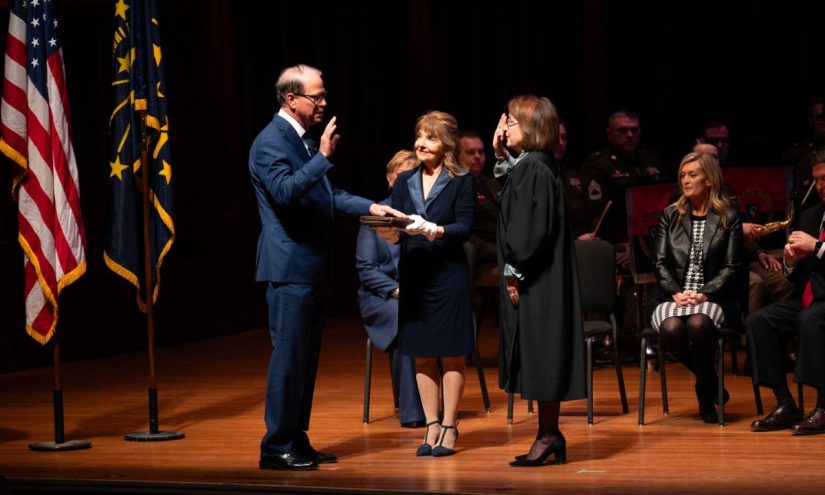
After slashing a popular reading program from the budget, Gov. Mike Braun said Friday he asked First Lady Maureen Braun to spearhead an initiative to keep Dolly Parton’s Imagination Library in Indiana.
“She has agreed and she will work with philanthropic partners and in consultation with state leadership to identify funding opportunities for the book distribution program,” the governor said in a news release.
The program gifts free, high quality, age-appropriate books to children from birth to age five on a monthly basis, regardless of family income.
Former Gov. Eric Holcomb included a statewide expansion of the program in his 2023 legislative agenda. The General Assembly earmarked $6 million for the program in the state’s last biennial budget — $2 million in the first year and $4 million in the second — to ensure that all Hoosier kids qualify to receive free books.
But when Gov. Braun prepared his budget proposal in January he discontinued the funding as part of an overall effort to rein in state spending.
“I am honored to lead this work to help ensure our youngest Hoosiers have as much exposure as possible to books and learning,” said First Lady Maureen Braun. “Indiana has many strong community partners and I am confident we will collaborate on a solution that grows children’s love of reading.”
Jeff Conyers, president of The Dollywood Foundation, said he appreciates Braun’s commitment to early childhood literacy.
“The Imagination Library brings the joy of reading to over 125,000 Hoosier children each month in all 92 counties across the state, and we are encouraged by Governor and First Lady Braun’s support to ensure its future in Indiana. We look forward to working with the Governor and First Lady, state leaders, and Local Program Partners to keep books in the hands of Indiana’s youngest learners and strengthen this foundation for a lifetime of success,” he said.
Indiana Capital Chronicle is part of States Newsroom, a nonprofit news network supported by grants and a coalition of donors as a 501c(3) public charity. Indiana Capital Chronicle maintains editorial independence. Contact Editor Niki Kelly for questions: [email protected].
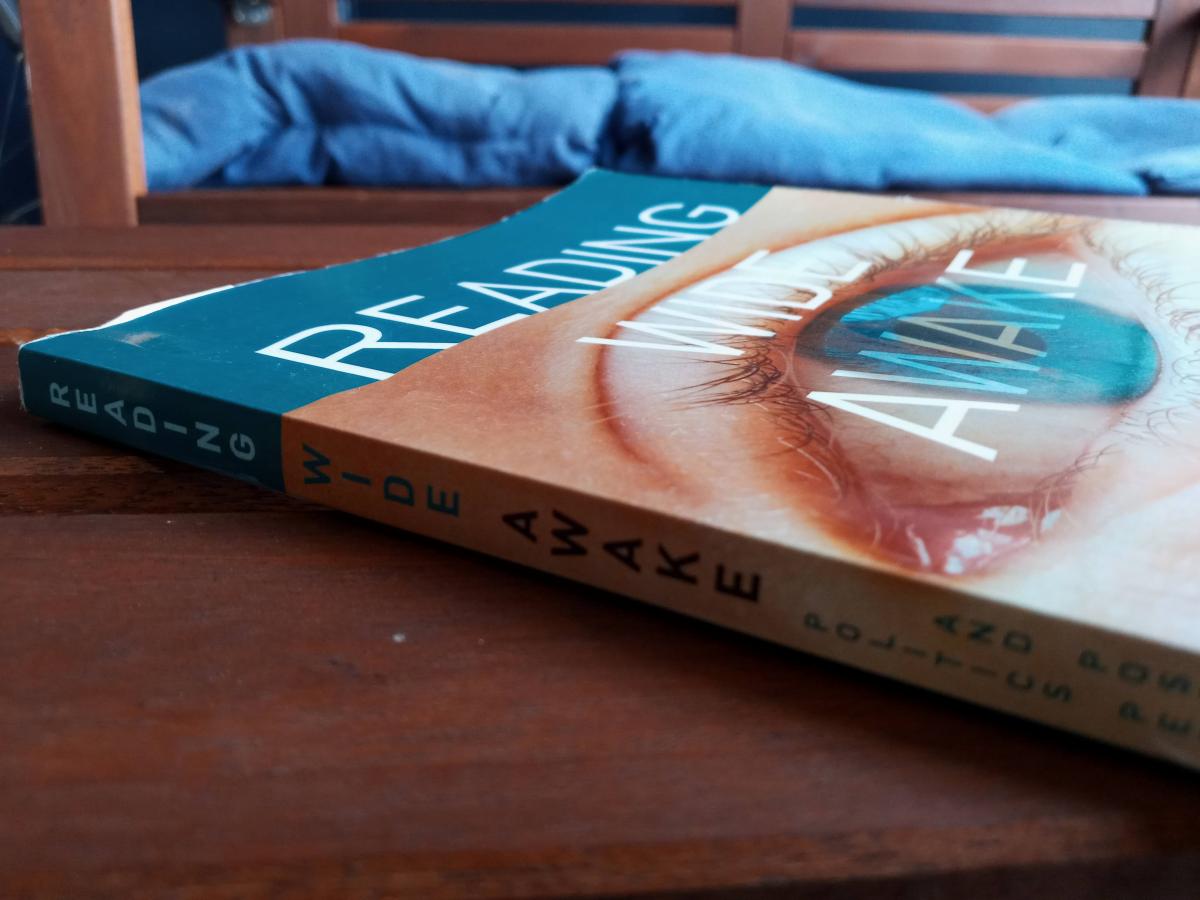
CORRIGAN: Is there anything else you’d like to share about reading, teaching, or Reading Wide Awake that I haven’t asked you?
SHANNON: I’ll start here. Reading Wide Awake examines reading as flexible practices of personal and social agency necessary for the continuous remaking of ourselves and democracy in and across changing times and contexts. By telling stories of my reading social objects (including printed texts) in everyday life, I invite readers to awaken to the ways these ‘texts’ work for and against their interests and the promises of democracy. By analyzing my reading experiences critically, I demonstrate how to take up these practices and why they are vital to acting in and on the world. I hope I wrote with some intelligence and humor.
This short book is organized according to paraphrased questions that people asked me across the first forty of my now fifty years as an educator: Why read? What is text? How do texts work? Where is meaning? Isn’t reading out of date? Can reading like this get me in trouble? Do regular people read like this? Fifteen years prior to this book, I offered a different structure in text, lies & videotape, a book about whose stories get told in and out of school. That text began with a reading of my junior high principal enforcing “school integrity” with a ping pong ball down my pant leg and a wooden paddle on my backside. My (our) reading practices are always in-the-making, and I’m only five years away from the next installment!
CORRIGAN: In Reading Wide Awake, you seem to use the words “read” and “reading” loosely and expansively—to mean not just looking at written texts but more broadly seeing, recognizing, understanding, or thinking about the world. I’m wondering, how do you define “reading” and why use the word “reading” instead of something broader like “thinking”?
SHANNON: Originally, my choice of the term reading was purely tactical. If seeing, recognizing, understanding, thinking, assessing, and acting in and about the world through the production of social things can be separated from the term reading, then they can be excluded from school curricula. If they are inseparable moments of reading, then they remain basic skills (See Herb Kohl’s pre-TikTok Basic Skills – 1982). My route to this realization maps my development as a critically pragmatic reader with a sociological imagination. That is, the choice stemmed from reading personal experiences (my problem?) and eventually recognizing that they are actually social issues produced and maintained through the texts of powerful discourses in and out of schools (K-20).
By the early 1970s when I was a history graduate student, Americans had been lied to about the Bay of Pigs, Tet Offensive, and bombing of Cambodia; two Kennedys, Malcolm X, Salvador Allende, Fred Hampton and Martin Luther King assassinations; the “collapse” of Students for a Democratic Society and the Black Panthers; and the Angela Davis and the Chicago 7 trials. Official and mainstream representations of these events across time and media led to Richard Nixon being elected and re-elected with an agenda to win the cold war militarily and to bring law and order back to American streets. I lost faith in the path I had chosen at the end of college to become a historian of societal outsiders, which I believed would help more people to develop their “sociological imaginations” (C. Wright Mills), overcoming the “repressive tolerance of a one-dimensional society” (Herbert Marcuse), and thus, freeing their minds to rationally pursue the truth (J. S. Mill). Although certainly necessary, more historically accurate information (reconstructed history books) about the neglected in society no longer seemed adequate. Rather I thought what would be vital, but lacking, was the habitual practice of accessing, interpreting, assessing, and acting upon daily information, artifacts, and events to secure the original promises of liberal democracy. To me, that practice was the act of reading which could be extended and spread through public schooling. I joined the Teacher Corp and set my sights on the first R.
Despite the economic, racial, cultural, and religious diversity among the families of my first class of kindergarten students, the school district supplied me with the DISTAR Language and Reading program and required me to “teach reading” by following the scripts in its teacher’s manual for a specified amount of time daily. The authors of DISTAR assumed that my students had little or no prior experience with reading, phonological or syntactic command of English, or interest in learning to read or in the world around them. They argued their approach was scientifically based. Lessons consisted of small groups articulating phonemes in unison with me. When those articulations were “mastered”, I was to point to manipulated letter symbols arranged randomly on a page in the teacher’s manual and groups were to produce the corresponding sounds (pretending that English has one-to-one letter to sound correspondence). When mastered, I was to point to a symbol to elicit the assigned sound from all, and then, run my finger to another symbol to “make a syllable or blend” as students slurred the first with second phoneme. Eventually, we all graduated to words, phrases, short sentences, and sentence strings (called stories).
All materials were black print on off white newsprint with no illustrations. To ensure that parents participated in these reading instructions, students were to bring home half-sheet “student copies” of the stories to demonstrate their mastery of reading. Standardization through teacher and student fidelity to the program assumptions and scripts were presented as the keys to success in reading, in school, and in life. There were no expected discussions of the meaning of the program’s texts or the practices encouraged in or outside of the classroom. When the students finished the last DISTAR lessons, they and I began the daily lessons supplied in commercially prepared reading materials, (called basals), following more loosely scripted lessons as we worked our way through anthologies, workbooks, worksheets, and criterion reference tests across grades 1 through 6. This defined learning “to read at school.”
Because the remainder of the kindergarten curriculum was not prescribed except by name of subjects, the students and I had time to discuss their lives outside of school, their interests, habits, family traditions, ideas about how the world works, media use (TV and radio)….Later, I came to recognize these discussions as examples of what William James meant by “pluralism:” there will always be different perspectives and interpretations of any idea, event or artifact – all work in some situations and none are superior in all. We used these talks and their surroundings to read their worlds to consider how people use symbols to make meaning and get things done. While emphasizing the “why” of reading, we engaged in the “how”, attending to salient features (color, size, position) in images and things and studying phonics by recognizing and using Sylvia Ashton Warner’s Key Words techniques (Zoo), examples from Septima Clark’s and Beatrice Robinson’s Freedom Schools (“What’s a good a word? Amendment”), local store signs (Red and White), and learning to recognize everyone’s printed name (from Abby to Zimbalist) posted on their cubbies and supply boxes. To varying degrees, all participated in what Allan Luke and Peter Freebody would later call the four-resource model of reading – code cracking, meaning making, determine use and effects of genre, and social analyses – without any of us knowing these labels.
I found willing confederates among the music, art, and gym teachers to help us study how sounds, images, and bodies can be used symbolically to represent our intentions to mean. We called this “reading”, and because I lived in the neighborhood and looped with many of these students through the primary grades (K-3), I had time to demonstrate how this reading blended with their family members’ reading outside of school. By our third year together, we had convinced our building administrator that DISTAR was not appropriate for our community; unfortunately, my fellow teachers chose to replace DISTAR with a single K-6 set of commercial reading materials (with significant amounts of promised free components and staff development promised by their publishers) for reading instruction at our school. That “other stuff” that we employed daily as reading, while not necessarily harmful, was considered “beside the point”. Those practices, you see, were not essentials in an elementary school curriculum…
I finished my four-year commitment to shepherd those students and families through the primary grades and enrolled at the University of Minnesota (then famous for its reading research program) to try to understand how my colleagues’ decision could make sense. The best outcome of that move was that I read my first-day schedule incorrectly, went to the wrong office, and met Kathleen (I’m married to Kathleen). Another outcome was that I began to develop an understanding of reading at school. My first course – History of Research on Reading – assigned titles such as The Psychology and Pedagogy of Reading (Huey, 1908), Reading as Reasoning (Thorndike, 1917), Remembering (Barlett 1932), Literature as Exploration (Rosenblatt, 1933)….These texts and my peers’ discussion of them taught me that my interpretation of reading was not wrong or beside the point because reading was information processing, not ever mastered or easily transferred among situations or tasks, colored by cultural attitudes and personal habits, and involved emotions as well as reason.
Buoyed with those insights, I used the intellectual tools I brought with me to class (Marxism/critical theory) and began to develop new ones (pragmatism – old, new, American and French – Richard Bernstein) to understand my experiences with past colleagues (and continued experiences in and around reading education over 40 years). Marxism directed me toward analyses of the social relations embedded in those commercially prepared basals. Critical theory honed my attention to how power was/is used in reading education (in at least the U. S.). The pragmatists pointed toward the language school personnel use to represent and reflect upon their interests and experiences while teaching reading, and then, to follow the consequences of their acting on those reflections. I concluded initially that three hegemonic discourses (science, business, and the state) speak through school personnel’s words and actions (Broken Promises, 1988). I’ve tracked the consequences of those discourses over time (e.g., Reading Against Democracy, 2007; Closer Readings of the Common Core, 2013; and Reading Poverty in America, 2014).*
You can read current consequences of the continued power of those three discourses in the recent struggles over the definitions of reading and reading instruction as it played out in the New York Times this spring – insisting reading is a psychological, not a set of social, cultural, and historical practices; treating reading instruction as a market and reading as human capital, not creative, contextualized, human endeavors; and mandating guidelines for schools and teachers to overcome social and economic inequalities, not social problems in need of collective democratic solutions.
For example, the New YorkTimes reported that the COVID pandemic resulted in a “reading crisis” across the country as systematic reading lessons moved online render the lessons to be parents’ responsibility (Jonathan Wolfe). Reflecting on his struggles with learning to read at school, the new mayor of New York City mandated that city teachers be “trained” to use phonics-based commercial reading programs to teach reading in order to overcome the crisis (Lola Fadulu). Ten days later, a Times reporter described how Columbia University professor Lucy Calkins “retreated” from meaning centered lesson to a more sound oriented position in her commercial materials (which occupies one quarter of the US market for reading education) (Dana Goldstein).
*I address a history of counter-discourses in The Struggle to Continue, 1990; Progressive Reading Instruction in America, 2017.
CORRIGAN: Throughout the middle chapters of the book you discuss reading specific types of social texts (like NPR and Google Maps), and you also present a more general theory of reading (regarding sociological competence, sociological imagination, pluralism, etc.). In other words, these chapters take up the somewhat traditional matters related to reading: texts, ideas, the life of the mind. But all of that appears bookended with two case studies from “real life,” a less traditional concern for reading: one case is about the fate of a canyon wilderness area and the other is about a dying town being revitalized and the questions are about what to do and what is being done in each situation that affects real lives of real people and environments. Through this bookending, the reading life gets anchored in the life of action—even activism—such that reading is not just about thinking and feeling but also about doing. Can you elaborate on that?
SHANNON: Bear with me…I find it not useful to consider ideas separately from actions because we must experiment to adapt to continuously changing physical and social environments. That need to adapt, to experiment, induces our ideas; not the other way around. Wide-awake reading is an array adaptation practices – ways for Americans to enhance our “self-evident” right to participate as peers with all others in the making of democratic social life. Perhaps, that is what could be meant by reading as activism – wide awake readers refuse to cede that right to others and exercise ‘intelligent action.’ I didn’t make this up – see quotes below – listed in chronological order, not the order of my ‘discovery’ of these authors (Marx, Foucault, Dewey, Emerson).
Emerson: Circles 1841
In nature every moment is new; the past is always swallowed and forgotten; the coming only is sacred. Nothing is secure but life, transition, the energizing spirit. No love can be bound by oath or covenant to secure it against a higher love. No truth so sublime but it may be trivial to-morrow in the light of new thoughts. People wish to be settled; only as far as they are unsettled is there any hope for them.
I am only an experimenter. Do not set the least value on what I do, or the least discredit on what I do not, as if I pretended to settle anything as true or false. I unsettle all things. No facts are to me sacred; none are profane; I simply experiment, an endless seeker, with no Past at my back.
Marx: Eleventh Thesis on Feuerbach, 1888
The philosophers have only interpreted the world in various ways; the point, however, is to change it.
Dewey: Democracy and Education (1916)
We can definitely foresee results only as we make careful scrutiny of present conditions, and the importance of the outcome supplies the motive for observations. The more adequate our observations, the more varied is the scene of conditions and obstructions that presents itself, and the more numerous are the alternatives between which choice may be made. In turn, the more numerous the recognized possibilities of the situation, or alternatives of action, the more meaning does the chosen activity possess, and the more flexibly controllable it is.
Foucault: “On the Genealogy of Ethics’ (1983)
My point is not that everything is bad, but that everything is dangerous, which is not exactly the same as bad. If everything is dangerous, then we always have something to do. So my position leads not to apathy but to a hyper- and pessimistic activism. I think that the ethico-political choice we have to make every day is to determine which is the main danger.
Human agency begins in the deep and critical reading of the present conditions in our attempts to adapt to continuously changing environments. Marx directs Emerson’s experimenters to collective action within their historical contexts, and toward equality; Dewey engages experimenters in intelligent actions to address social problems to move closer to the realization of the promises of democracy; and Foucault warns experimenters that consequences of all alternatives are dangerous, at least to some group(s), regardless of experimenters’ aims. He rejects cynicism and passivity, setting individual and collective daily agendas to decide and act on the main dangers.
CORRIGAN: In Reading Wide Awake, you connect reading to an embrace of such values as democracy, dissensus, difference, pluralism. The idea is that reading can enable and motivate readers to genuinely dialogue with those who are different and who hold different values, beliefs, opinions. But Reading Wide Awake came out in 2011, a few years before what appeared to me to be a remarkable intensification of conflict, fake news, and bad faith arguments in the United States—the Trump era. Has your hope for the possibilities of collaboration, dissensus, and dialogue changed since?
SHANNON: My short answer is “no.” If anything, the last decade has made me more committed to those values, and I thank you for considering that “reading wide awake” could serve as a tool in the on-going “real utopian project” of the making of democracy for these times. Many share your interpretation (although they vary in readings of the problem): Zolan Kanno-Youngs and Michael D. Shear, Sarah Vowell, Max Fisher.
Liberal democracy is not a thing or a template to be applied; rather, it is a method for identifying and solving the common problems of securing the rights of life and pursuit of happiness for all, across time and contexts. According to John Dewey, “The democratic faith in equality is the faith that each individual shall have the chance and opportunity to contribute whatever he is capable of contributing, and that the value of his contribution be decided by its place and function in the organized total of similar contributions: —not on the basis of prior status of any kind whatever.”
For the individual, democracy means having a share in directing the activities of the group – participatory parity; for the group, democracy demands the development and maintenance of social arrangements enabling the liberation of the potentials of each individual member. Those are unmet promises made in the second sentence of The Declaration of Independence. Democratic patriots are keepers of that faith, acting to ensure that this country lives up to those principles within and across its borders. I am a patriot.
Other patriots and I read the texts and contexts to name, resist, dismantle barriers to democratic possibilities and to develop and maintain social arrangements which would enable greater participatory party among all groups and individuals. Even among patriots, however, conflict is likely because we begin our searches for just social arrangements from differing historical positions, and therefore, while we share at least a rhetorical goal, our interests and strategies will differ necessarily. Chantel Mouffe (2018) argues “in a democratic polity, conflict and confrontation, far from being a sign of imperfection, indicate that democracy is alive and inhabited by pluralism.” What we patriots need then are ways to keep that agonism from becoming antagonism. Many imply that it might already be too late for dissensus – a process of identifying differences and locating these differences in relation to each other, leading to collective explanations of how people differ, where their differences come from, and whether they can live and work together with these differences. However, unless individuals and groups have given up entirely on democratic faith, I believe dissensus is possible and necessary to build coalitions among disparate groups to continue the search for and reality of democratic social arrangements.
If we engage in real utopian projects for liberal democracy within pluralistic societies, then patriots must engage in practices of dissensus to support others and ourselves as we sort through our repertoires of social discourses to find points of, at least temporary, agreement. Dissensus affords the possibility(ies) for coalitions to form around specific goals and strategies to act intelligently toward the promises of democracy. As Eric Olin Wright (2010) explained, these projects are utopian because we are thinking about alternatives that embody our deepest aspirations for a just society, and each is real because we continue to experiment with and deliberate within our associated ways of living as we struggle toward the just (and flexible) social arrangements across contexts and time. Reading wide awake can alert us to the ways power works through the “texts” of our lives, enabling us patriots to tame the harm caused by barriers to participatory parity, to erode those barriers through our actions, and to experiment toward just social arrangements. Keep the democratic faith!
CORRIGAN: Since you are on one hand a college professor and on the other hand a scholar who studies K12 education and a teacher who teaches (future) K12 teachers, it seems you have an unique view into both worlds: education in college and education before college. Traditionally and unfortunately, there has been, at least in my experience, little exchange of pedagogy across that line. But I think there are things we could learn from some cross pollination. So in that spirit, I’m curious if you might comment on what commonalities and what differences you see between what we ought to be teaching about reading before college compared to in college.
SHANNON: Most texts I encounter are institutionally produced to teach me who I am, what I should know, value, and do. Unfortunately for me, but certainly by design, they are intended to position me as a consumer, not a producer. Government, business, media news and entertainment, church, science, sports, and other institutions teach me not only to consume goods and services, but also, to swallow expert opinion, idealized representations of the past, and the spectacle of celebrity and success, as if their texts were representations of the way things are and should be. I am to receive from others and not create for myself and contribute with others; I am free to choose among, but not to determine, alternatives. These institutional texts leave little space for me to think outside their intended parameters or to imagine what they left unstated. Their intentions are not my personal problems alone; they are social issues affecting many if not all. These texts, most texts, intend to teach us that civic life is complex and boring, we’re not smart enough to understand or change it, and therefore, we should seek only comfort and security for ourselves and family. These lessons are dangerous for our individual and collective identities and agencies, and I believe, main dangers for the health of our pluralistic democracy.
Except for middle school/junior high, I’ve taught at every level from preschool to doctoral study. (I am afraid of tweens and early adolescents for reasons obvious to anyone who has personal knowledge of this age group.) Reading the texts of my teaching experiences tells me that schools participate in limiting the potential power of reading through decisions surrounding the social arrangements of school curricula and pedagogy. From my first encounter with official reading instruction as a teacher (and a student in the 50s) to the assigned reading list for the History of Reading Research which began my focused study of reading, to my assignment to teach a course on reading and teaching to 300 or more students each semester, schooling has undersold readings’ personal, social, and civic potential. The result, I fear, is that school teaches our students that they are consumers of social life, and not active, equal participants in its continuous making. So my comment to preK-25 teachers about reading is a question (an on-going inquiry really). How can we tame and erode the intentions behind school texts in order to disrupt the production of ‘sleepy’ readers, to develop the social arrangements of our classes, engaging all our students in reading wide awake; and to encourage participatory parity in the making of pluralistic democracies in and out of school?
My recommendation is to trust our students, to see them as interesting and interested, to arrange our courses and readings to enable participatory parity across the differences they bring to class, to seek real reasons for them to engage in dissensus, and to act on their new knowledge and convictions through the discourses we represent.
I’ll share one effort to address this question. During the decade before I retired, I worked with others to reorganize our university’s K-12 reading specialist certification coursework. We sought to add secondary discourses to our students’ repertoires so that they could choose to critique, tame, and erode the typical specialist habitus. Specialists are assigned officially to support students at any grade level who have been labeled as struggling to learn to read and write at school. By law and tradition, these public-school programs are typically organized around assumptions that during their cognitive development of the reading process to date, strugglers have failed to learn one or more code-breaking skills and/or mechanical strategies for extracting meaning from passages – that is their cognitive development of the reading process is incomplete for the demands of their schooling. Specialists are to repair these failures by diagnosing and remediating these problems, bringing students to mastery through scientifically-based reading instruction, and then, to send repaired students back to regular classes able to complete reading assignments. Often, specialists are taught to focus primarily on the how to read and to devote less or little attention to: why read; how texts work; why and how struggling students should assess texts’ intentions; or how struggling students make sense of (all types of) texts outside of school. If these typical reading specialist assumptions, practices, and absences brought the desired consequences, then perhaps, all these explicit and implicit lessons would be warranted. However, beyond the immediate contexts of those lessons, desired outcomes have been scarce – even by their gold standard measure, annual reading test scores. *
Our efforts were complicated by the accreditation processes legally and professionally required for all specialized certification courses. We could not just “do as we pleased.” We proposed our changes as a design experiment with the expected outcome of specialists with competence and imagination. We were approved with “some” concern from the state and some accolades from the profession. Our graduates would be competent (all would pass the state certification licensing exam for reading specialists and be recommended by practicing specialists based on a practicum experience) and imaginative (able to design and act upon social arrangements for learning to read that are not yet, but could be, if specialist focused on the roles for reading in the development of self and democracy). Our assumption for the experiment was that if the specialist could see themselves as reading agents – participants as peers with all others in the decisions of reading programs – they could demonstrate that agency for their students and negotiate/develop social arrangements in their classroom that immersed their students in participatory parity of its social life.
This is getting long and you’re probably now sorry you asked. I’ll be brief. We tripled our teaching workloads to develop three discourses for reading specialists: cognitive, socio-cultural, and political – creating three identity kits of how to speak, think, value and act accordingly across issues of pluralism, policy, scientific warrants, curriculum, and pedagogy. We arranged students in groups of at least three, encouraging the members to deliberate over meanings and likely consequences of their readings of the social things of reading specialists (e.g., cultural differences of experiences, ability grouping, technical reports, time scheduling, state mandates, book chapters, room arrangements, journal articles, pedagogical strategies, tests and assessment procedures, parents/guardians…). Whole class discussions became purposeful exercises of dissensus – always with obligation to move forward toward our state obligation to enter schools to demonstrate reading specialist competence (equipped with multiple discourses with which to read the intentions behind existing school texts), and then, to use our individual and collective imaginations to design, construct, and implement the social arrangements we thought most likely to support our first through eighth grade struggling students as wide-awake readers. From the first course to the tenth, university instructors and school supervisors worked to communicate to each cohort of university students that we expected them to be successful and we were there to support them.
Early in our efforts to remake the reading specialist courses, the students and the instructors decided that a museum was most likely to enable us to develop social arrangements that would afford struggling students the opportunity and support to develop wide awake reading. (There are ten museums on campus of various sizes and budgets.) Each university student cohort began its courses with severe doubts that such students were capable to produce exhibits individually and a museum collectively based solely on their readings and actions. Before the final imagination practicum, we worked collectively to develop our students’ language to discuss, if not believe, that a museum was possible. Doubling down on the university instructors’ belief that our (now) Teachers and their Curators could and would indeed engage actively in the inquiries and production, we scheduled a grand opening for the museum on the last day of practicum.
Following John Dewey’s (1938) notion that the realization of any ideal must be based on experience, Teachers organized practicums’ social arrangements to reduce, if not eliminate, barriers to each Curator’s participation as a peer in the design, construction, and presentation of multimodal museum exhibits on a central topic (e.g., habitats, transportation, weather). Prior to the practicum, neither Teachers nor Curators were experts concerning museums or the central topic, although each brought differing amounts of experience with each. They would learn both together. Teachers provided support for Curators as they read to become experts on the topic (“What do you know about . . . ? How do you know that? What would you like to learn about? Would you like help with that?”), and then, write and with the assistance of a resident community artist create multimodal texts to represent their new knowledge for the expected visitors to the museum (“What caught your interest in the museum we visited? How was it interesting? What would you like to write and show about your new knowledge? Would you like help with that?”).
Scores of family members, university personnel, and former participants visited the two-hour museum opening each year. We never had to defend our goals and methods to visitors, parents or Curators because our practice-based events (process and product) trumped the evidence-based practices that Curators (and their parents/guardians) experienced at school. Although the thick school folders that accompany Curators label them as autistic, behind, ELL, learning disabled, dyslexic, or ADHD, every Curator demonstrated her/his/their literate competence by producing and presenting (proudly) an exhibit situated prominently within the museum (two university classrooms and a connecting hallway). And every Teacher showed some signs of reading wide awake. Here’s an excerpt of Teacher Joshua’s final report on Curator Tim.
What does Tim need? It depends:
If you read his folder….
If you watch him during independent reading,…
If you sit next to him and listen to him read a book you picked for him….
But if you work with him on his model train, then….
The first three “ifs” suggest that Tim can’t read well enough to engage in inquiry, and therefore, he needs preliminary skill lessons before you start. The last one shows you that you don’t know Tim or his capabilities unless you let him participate (2014).
* Despite a century of reading research and billions of dollars invested annually in reading education, students from low income families (Carnoy & Rothstein, 2013)— confounded by race (Vigor, 2011), immigrant status (Swartz & Stiefel, 2011) and segregated location (Burdkick-Will et al., 2011)—continue to “struggle” with school literacy. Although some schools have made modest improvements (Rowan, 2011), the overall income achievement gap has increased by 40% since the Reagan Administration (Reardon, 2011).
CORRIGAN: You stress in Reading Wide Awake that you’re still learning how to read. So what have you learned since writing this book?
SHANNON: In 2017, Penn State offered the ARod-deal to all employees of a certain age and length of employment. We had lived in the Happy Valley since 1990. I qualified, took the year’s salary to not come back (the NY Yankees offered this deal to Alex Rodriguez to induce his retirement), and began to write an operetta entitled ‘Bourne in the USA’ (while trying vainly to read ‘flow offense’ during noon basketball games). I’m working on a third draft, learning how to read many genres of musical theater in front of and behind the curtain as well as popular music at the turn of the 19th century and symbols of American social, economic, intellectual, and political history between the depression of ’93 and the end of WWI. It continues to be a thrilling, and humbling experience. When I admit to others what I’m doing “these days”, they often ask: “How are you prepared?” “Who’s Bourne?” “Why now?” “What will Bruce say?”
I have played in a garage band since 1966 (The Root Beer Beaver), appeared in several musicals as a high school student (portraying a sailor in the South Pacific, a Jet, and Conrad Birdie), and maintained a dozen or so pages of decades-old notes on Randolph Bourne. I have formal training in neither music nor theater. When Kathleen and I visit theaters now, we are becoming “wide awake” to ways in which all involved work collectively to produce that play on that “stage” in these times to teach the audience who we are, what we should know and value, and what we should do. In State College, NYC and the Twin Cities, these lessons have changed our theatering experiences, making us attentive differently than my pre-Bourne afternoons and evenings.
I declare that I’m a playwright in the making who is sampling the melodies from popular songs of Bourne’s times, rewriting lyrics to “teach” audiences Bourne’s democracy faith, and drawing images of staging for each scene, both acts, and the whole play. This is shorthand for the new ways I’m reading: new technologies, musical notation, emotional effects of auditory, physical, and visual symbols, historical presentism, lyricism across time, and technical, kinesthetic, physical, and aesthetic practices and objects of musical theater. Keeps me busy.
I picked Bourne as a subject because his life offers remarkable examples of reading wide awake and the challenges of patriotism. Bourne was a social critic and essayist who died in 1918 at the age of 32. I “discovered” Bourne (and began my notes) while reading about John Dewey and the counter-hegemonic discourse of progressive education (unassigned, but necessary texts for that first course in the UMN doctoral program). Bourne was Dewey’s student at Columbia University and wrote two books on education (and another concerning youth culture). I reconnected with Bourne when I read Jeremy McCarter’s 2017 New Yorker piece “The Critic Who Refuted Trump’s World View, in 1916.” McCarter called Bourne, the “Anti-Trump” for Bourne’s essay “Trans-National America” (published in The Atlantic Monthly). Jennifer Ratner-Rosenhagen devoted three pages to that essay in her 2021 book American Intellectual History: A Very Short Introduction (Thomas Jefferson gets two pages and Dewey none in the 130 pages of prose). Between 1911 and 1918, Bourne wrote over 1400 essays that were published in regional and national magazines (e.g., Columbia Review, The Atlantic Monthly, The New Republic, The Masses, The Dial, Seven Arts).
In its current form, the operetta has two acts. I’ve structured the first around Bourne’s writing of his first national publication “The Handicapped by One of Their Own” (The Atlantic Monthly, 1914). The attending physician misused forceps during Bourne’s birth, changing the shape of his head and altering his breathing, voice, and hearing. At four, Bourne contracted spinal tuberculosis, which over three years curved his spine and limited his gate and height. The Atlantic publisher asked Bourne to write an autobiographical piece to explain his life “struggles.” That essay is often cited as a founding manifesto of the disability rights movement in America. It ends: “Do not take the world too seriously, nor let too many social conventions oppress you. Keep sweet your sense of humor, and above all do not let any morbid feelings of inferiority creep into your soul.”
Floyd Dell’s obituary for Bourne (1919) frames the second act, highlighting Bourne’s participation in the bohemian culture of Greenwich Village, his “Trans-National America” argument for cosmopolitanism over melting pot assimilation to adopted Anglo Saxon cultural expectations, and his vanguard leadership of the anti-war movement (See Twilight of Idols, 1917). In the latter, Bourne explained that Americans couldn’t “make the world safe for democracy” by suppressing it at home or through military force abroad. Bourne’s positions proved unpopular with business and the state, and Bourne died of the Spanish Flu penniless and sleeping on his fiancee’s divan. As Dell (1919) explained:
“There are few avenues of expression for protest, however sane and far-seeing, against the mood of a nation in arms; and one by one, most of these were closed to him as he went on speaking out his thought. It is one of the more subtly tragic aspects of his death, a misfortune not only to a fecund mind that needed free utterance, but to a country which is nearly starved for thought, that he should in these last years have been doomed to silence.”
Oh, and I anticipate Springsteen and E Street will play the opening bars of the overture…