Category: Recruitment

  • We need to talk about high-tariff recruitment behavior

    We need to talk about high-tariff recruitment behavior

    There’s a storm brewing in UK higher education and, if we’re honest, it’s been brewing for a while.

    We all know the pattern. Predicted grades continuing to be, well, predicted. Students stacking their UCAS applications with at least one high-tariff choice. Those same high-tariff universities making more offers, at lower grades, and confirming more students than ever before.

    Confirmation charts that had us saying “wow” in 2024 are jaw-dropping in 2025 and by 2026 we’ll need new numbers on the Y axis just to keep up.

    [Full screen]

    On their own, you could shrug and rationalise these shifts: post-pandemic turbulence, demographic rises and dips depending on where you regionally look, financial pressures. But together? Here’s your perfect storm.

    Grades remain overpredicted because schools and colleges know universities will flex at offer stage and, in all likelihood, at confirmation. Universities flex because grades are overpredicted, and because half-empty halls of residence don’t pay the bills. Students expect both to continue, because so far, they have.

    This is not harmless drift. It’s a cycle. And it’s reshaping the market in ways that don’t serve students, teachers, or institutions well.

    What’s really at stake

    Sure, more students in their first-choice university sounds like a win. But scratch beneath the surface and the consequences are real.

    For students, it’s about mismatched expectations. That ABB prediction might have got you a BCC place confirmed, but the reality of lectures and labs can feel a whole lot tougher. The thrill of “getting in” can be followed quickly by the grind of “catching up” and not everyone has the support infrastructure available to bridge the gap.

    For schools and teachers, it’s a lose–lose. Predict realistically and you risk disadvantaging your pupils against those down the road with a more generous hand. Predict optimistically and you fuel the cycle, while the workload and stress keep piling up.

    For universities, tariffs are being squeezed like never before. If ABB, BBB, and BCC are all getting the same outcome, what does “high-tariff” even mean anymore? And what happens to long-term planning if your recruitment strategy rests on quietly bending standards just a little more each year?

    And for the sector as a whole, there’s the reputational hit. “Falling standards” is a headline waiting to be written, at a time when the very value of HE is under political scrutiny, that’s not the story we want to hand over. It doesn’t matter how nuanced the reality is, because nuance rarely makes the cut

    How long can we keep this up?

    The uncomfortable truth is the longer we let this run, the harder it’ll be to unravel. Predictions that don’t predict. Offers that don’t mean what they say. A confirmation system that looks more like a safety net than a filter. Right now, students get good news, schools celebrate, universities fill places. everyone’s happy…until they’re not.

    We all know the ideas that surface. Post-qualification admissions. Post-qualification offers. The radical stuff. I’m not convinced they’re coming back, that ship feels well and truly sailed after multiple crossings.

    Sector-wide restraint sounds great in theory. But let’s be real, who’s going to blink first at a time when most of the sector is unlikely to welcome a restraint on numbers of entrants.

    And then there’s regulation. Hard rules on entry standards, offers, or tariffs. Politically tempting, practically messy, and likely to create more problems than it solves. Do we really want government second-guessing how universities admit students? I’m not sure we do.

    None of this is easy. But pretending nothing’s wrong is also a choice and, in both the short and long-term, not a very good one.

    Time for a proper conversation

    Please don’t take this as a “booo, high-tariff unis” article. These are some of the best institutions in the world, staffed by incredible people doing incredible work. But we can’t ignore the loop we’re stuck in.

    Universities want stability. Teachers want credibility. Students want fairness. Right now, we’re not giving any of them what they need. Because if offers don’t mean what they say, and predictions don’t accurately predict, what exactly are we asking applicants to believe in?

    Unless we start having the grown-up conversation about how predictions, offers, student decision making and confirmation intertwine and interact, the storm will keep building.

    We often see and hear about specific mission groups having their own conversations about admissions, recruitment-type topics but, very rarely, do you see or hear anything cross-cutting in the sector which I think is a missed opportunity. Anyone want to make an offer?

    Source link

  • High quality recruitment practices is everyone’s responsibility

    High quality recruitment practices is everyone’s responsibility

    The UK’s international higher education sector is at yet another crossroads.

    The positioning of international students as not only economic contributors to universities, but also cultural and intellectual assets to our campuses and communities is a well-told tale. But with ever-increasing government scrutiny of international recruitment practice, it is essential that the sector can unequivocally demonstrate that it operates with integrity and transparency.

    It is not just the government institutions must convince of the UK’s commitment to high quality opportunities, but students themselves to ensure the UK remains a destination of choice.

    Last month, IDP published its global commitment to quality and, as part of this, announced we are fully compliant with the British Council’s Agent Quality Framework (AQF). I imagine some might read that and ask “so what? Were you not already working in a compliant way already?”

    To be clear, we were (and always have been) committed to being ethical and responsible in our approach to recruitment, and it is what our partners know and trust us for. But our public commitment to the AQF in January 2024 and more latterly basic compliance assessment (BCA) requirements changes inspired us to have a wholesale review of our processes to ensure all our processes and practices drive quality. Transparency matters more now than ever – the more reassurance we can give our partners that we take our role in their student recruitment seriously sends the right signal to the government that we are committed to sustainable growth focused on right metrics.

    We are in this for the right reasons, that is, the right students, with the right standards and intentions, going to the right universities to complete their studies while living and thriving in our towns and cities. But it’s our hope that by being public about our official compliance, we can encourage others to do the same.

    The fact it has taken us, a well-established world-leading recruitment partner, months to feel confident the checks and balances are in place and that we have full adherence to the framework, demonstrates the complexity behind compliance. As we go along, we’ll no doubt learn more about how we can improve and strengthen those assurances to our partners (and therefore to the government) that international education is not full of ‘bad actors’.

    This is about more than compliance with external standards. It is a need for the international education community to be loud and proud about our work at a time when quality assurance in recruitment is under a brighter spotlight than ever.

    Regulation, regulation, regulation

    The UK government has made clear that international student recruitment cannot be divorced from broader debates around immigration, compliance and the sustainability of the sector. Parliamentary inquiries. Home Office interventions. The MAC review. The Immigration White Paper. The Home Office English Language Test. Freedom of Information requests. Intensified media focus. All this has raised questions about whether recruitment practice is always consistent with the standards expected of a world-leading education system. And this isn’t just about immigration rhetoric – this is about how those practices impact students and the enormous financial and emotional investment they make in choosing the UK for higher education, and make them feel their investment is worth it.

    In this environment, questions may be asked as to whether self-regulation is sufficient. The AQF, developed by the British Council in partnership with BUILA, UKCISA and Universities UK International, provides the only recognised, sector-wide framework for professionalism, ethical practice, and student-centred advice. To ignore or sidestep it is to invite greater external regulation and risk undermining already-precarious confidence in the sector.

    International students deserve more than transactional recruitment processes; they deserve ethical, transparent, and student-first guidance that empowers them to make the right choices for their future. Likewise, the UK needs to demonstrate to policymakers that the sector is capable of regulating itself to the highest standard.

    Quality is a shared responsibility

    The AQF sets out clear principles in five areas; organisational behaviour, ethical business practice, objective advice and guidance, student-centred practice and organisational competence

    Compliance across all these standards is not the endpoint. Instead, it is a baseline for our work. Compliance establishes credibility, but the leadership requires continuous improvement and a proactive commitment to go beyond minimum requirements.

    The onus is now on all organisations involved in international student recruitment – universities, agents, sub-agents, aggregators and service providers – to align with the AQF and evidence their compliance. AQF compliance is a collective responsibility. The question is no longer whether institutions and agents should adopt the AQF, but instead how quickly they can demonstrate alignment and ensure that these standards are consistently embedded in practice. Anything less risks weakening trust in the UK’s international education offer.

    The message to the sector is clear – quality must take precedence over volume until we are confident we’re in a position to grow sustainably and deliver on student expectations. Only by embedding AQF standards across all recruitment channels can the UK demonstrate to government, students and the wider international community that it is serious about maintaining excellence.

    The UK has an opportunity to lead globally on quality standards. Let’s do it together.

    Source link

  • UCAS applications and offer making by June deadline, 2025

    UCAS applications and offer making by June deadline, 2025

    The UCAS 30 June application deadline is the last point an applicant can apply outside of clearing.

    Though most applications (particularly from UK 18 year olds) happen by the January deadline, the June figures allow for a complete analysis of application behaviour in the UCAS main scheme.

    The number of 18 year old UK applicants has reached a record high of 328,390 (up 2.2 per cent on last year) – with the total number of applicants at 665,070 (up 1.3 per cent on last year).

    Application rates

    As always it is salutary to compare the often-pushed narrative that young people are being tempted away from expensive/poor-value/woke (delete as per your personal preference) higher education with the actuality that numbers are rising. You could even be tempted to imagine what the application rates might be like in a sector with a realistic student maintenance offer.

    I mention application rates because this is what declinist commentators will seize on. For UK domiciled 18 year old applicants, the application rate is 41.20 – down from 41.80 per cent last year. This fall is visible across most measures of deprivation: in England, for example, every IMD quintile but quintile 5 (the least disadvantaged) sees a falling application rate.

    [Full screen]

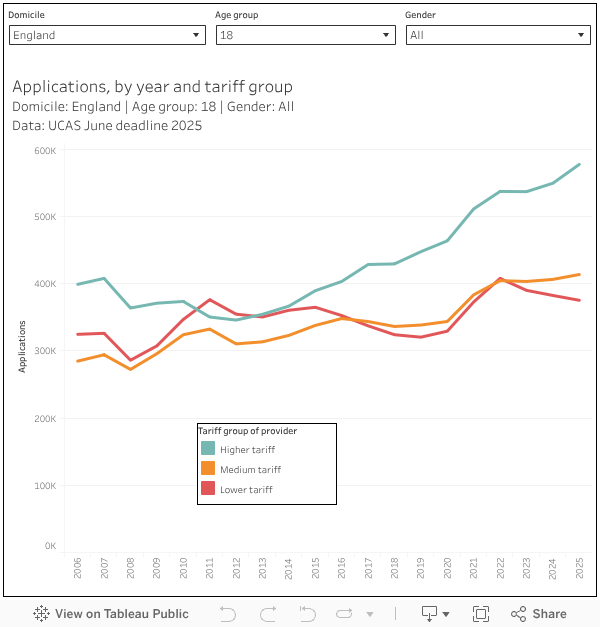
    In part, this could be a function of another year where the dominance of higher tariff providers in driving applications has increased: higher tariff providers disproportionately inspire applications from (and recruit) better off young people.

    This chart shows the number of applications to each of three tariff groups. For UK 18 year olds the default is fast becoming an application to a high tariff provider. We don’t (unfortunately) get application numbers by deprivation and tariff group.

    [Full screen]

    These number of placed students is likely to rise too: UCAS and Ofqual have suggested that there are 28,000 places available in Clearing this year.

    Offer rates

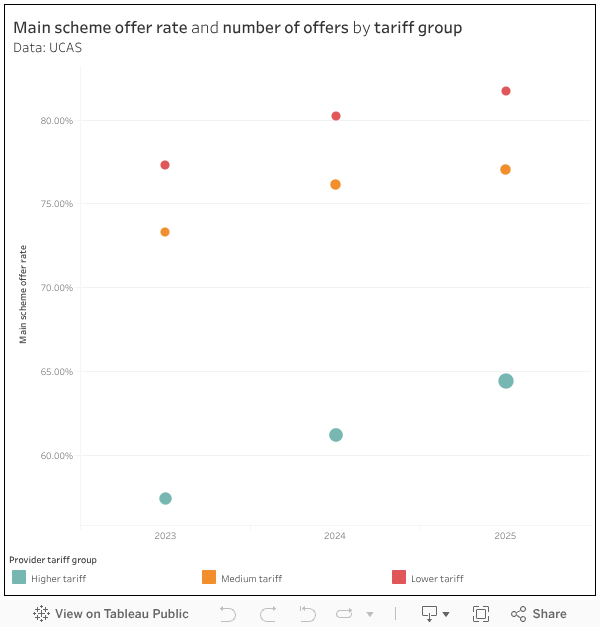
    One innovation in this year’s release is information on offer rates – the proportion of applications that result in an offer being made. We get three years of data, which demonstrate that offer rates are rising across the sector – and that (as you may expect) high tariff providers are less likely to make offers than lower tariff providers. The growth among high tariff providers is driven both by rising application numbers and a rising offer rate.

    [Full screen]

    For believers of the other recruitment myth (that universities load up on international students and are less keen to take even very able home students) we get a timely corrective. It turns out that 98.5 per cent of UK 18 year old applicants have an offer, compared with 89.7 per cent of international students.

    [Full screen]

    Subjects

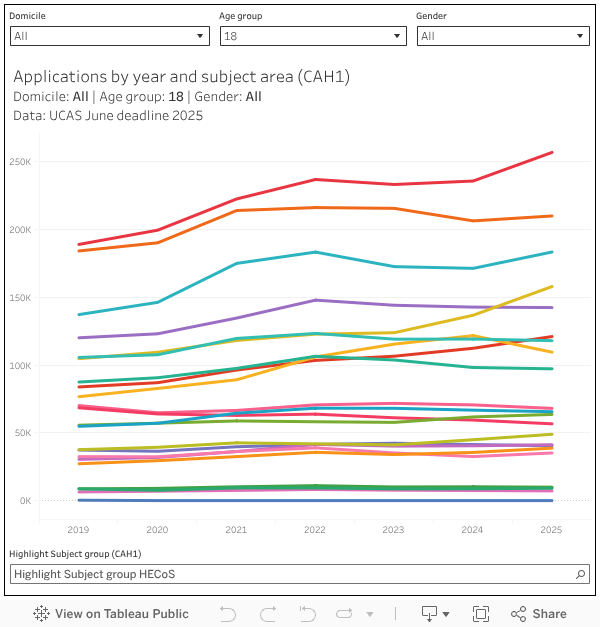
    Finally, it’s always fascinating to look at applications by subject area – a plot by CAH1 groups shows a sharp rise in the popularity of business, subjects allied to medicine, engineering, and law: with an intriguing drop in applications to computing subjects. There may be a generative AI effect on computing applications – the rise of “vibe coding” and other uses of agents in software development may mean that the attraction of learning to programme computers properly may be waning.

    That’s the best explanation I have – and it is curious that law (a domain where predictions of AI tools eating entry level roles are ten a penny) doesn’t appear to be experiencing a similar phenomenon.

    [Full screen]

    Source link

  • How can open days help applicants?

    How can open days help applicants?

    Like many Wonkhe readers, I’ve been lucky enough this year to support a young person weighing up their post-18 options.

    If you are the person in someone’s life that “really understands universities” it does often fall to you to sift through the vagaries of our recruitment and application process. Just what are “predicted grades” and why are they different from what someone got in their mocks? Why can you only apply to five courses on UCAS? Why, for that matter, does it cost money to apply via UCAS? Why are league tables so silly? Is there really a “Discover Uni”?

    The new aspect for me this year has been the world of the open day. On a succession of unseasonably rainy weekends I’ve been finding my way around campuses, under strict instructions not to mention who I work for or wear any Wonkhe merch (“so embarrassing!”) and speaking to academics and support staff about undergraduate entry in 2026.

    Performativity

    I’d love to say it has all brought back memories of my own open day adventures many years ago – in all honesty it has not. I never visited the university I ended up studying at prior to securing a place, my memory of the others is more of the cities and towns than the campuses and corridors.

    And that’s kind of the thing. If you are visiting an open day you are asking about third year options and work placements, but the decision that is being made is more along the lines of what it would be like to live and study in a place. The most successful open days I have seen this year have leaned into this – what would a lecture be like? How would you get from where you live to where you study? What else would I be doing outside of my studies? Where might I get a job?

    Academic staff – be they course leaders making a presentation or just generally making themselves available to chat, have often seemed terrified to speak to young applicants and their escorts. I’ve heard an awful lot about course revalidations and QAA Subject Benchmark Statements (yes really!), and while this is clearly great for me I can’t really see anyone else getting much out of it. When you sign up to “the talk” on your subject of choice what I would expect to get is a sense of enthusiasm about the subject and an openness to engage with others who have an interest: we can perhaps assume that anyone who wants to will have read about the course structure on the internet (or even, at one university, in an actual honest-to-god paper prospectus).

    My go-to approach for speaking to shy academics is to ask about their personal research interests – all the best conversations we’ve had have been around the particular interests of my prospective student and those of the academics. I feel like it would be good to work some of this into the more formal aspects of the day.

    The feel

    Applicants and their adults have often asked about practical “feel” based stuff – there’s been a lot of questions raised about assessment strategies and exams versus essays and presentations. The interest in post-degree employment is very real – and there is a trend towards listing industry partners (when done best it has offered tangible examples of how students would experience these partnerships).

    There’s also the inevitable question of entry requirements. Just about everywhere I’ve been has taken pains to reassure that there may be a place even if the grades aren’t quite there next summer – staff at all kinds of providers are actively promoting clearing entry.

    If you are not involving current students in open days you should be (and if you are, be sure to pay them – as you should everyone involved – for what is a very hard day’s work). Speaking to somebody only a few years older than you, who is living the life you are trying on for size, is what really seems to light applicants up. And the more informal the conversation the better it seems – interpolations in course presentations are good, a student-led tour is better, seeing students demonstrate the skills they have learned was excellent, and a sly joke shared in the student accommodation viewing is pretty much the best of all.

    Vibes

    Applicants are very good at picking up the overall mood of the day. If people act like the event has arrived suddenly on campus, and nobody is really clear what is going on, you can pick it up a mile off. And this year keeping the positive mood is not easy if you know the scale and direction of staff and funding cuts coming your way: it is very hard to “sell” an applicant on a course if you know it will have less options and less resources than it did this year.

    Likewise, basic hygiene factors stand out a mile (and I don’t just mean the halls of residence bathrooms…). If we’re sat having a coffee in the SU – something we always tried to do as a way of getting a sense of what campus life is like – it does rather stand out when there was supposed to be food available but it has all gone, or if all the posters seem to be for events that happened in 2023. I mean, posters are infinitely preferable (if the LGBT+Soc ran Chappell Roan bingo for pride day I am one hundred per cent there for it!) to glossy pictures and sidewinders wheeled out for the day, but maybe check if they are recent?

    Likewise, if visitors will be parking on campus some kind of an advanced plan would help – and if you have student services folks sitting at tables make sure there are actual people at the tables to talk to throughout the day.

    It’s the little moments. We were surprised to meet a vice chancellor that was clearly and obviously proud of their university, and who had signed up to do a series of rolling introductory talks. The question I got from next to me (“how often would I meet the vice chancellor as a regular student?”) was interesting – all though frankly I was more exercised about the fact that I’d seen the vice chancellor present a golden slide promoting a “TEF Gold in student experience” with the overall silver noted in tiny writing at the bottom.

    The awards and the league table placings really come across as noise – I didn’t see any applicant looking remotely impressed, although some were interested in graduate destinations and links to employers.

    An open day is an audition. An applicant is trying on the idea of being a student at your university – the best way to respond (and I’ve seen this done really well) is to set out just how great the student experience actually is: the TEF components are perhaps less impressive than what actual students say and the intangible “feel” of the campus. Students spend a lot of time asking “where do I go now?” – applicants have pretty much the same question.

    Source link

  • Private international foundation courses, and what they say about university leadership

    Private international foundation courses, and what they say about university leadership

    by Morten Hansen

    My research on the history of private international pathway providers and their public alternatives shows how some universities have stopped believing in themselves. Reversing this trend requires investment in their capabilities and leadership.

    The idea that universities have stopped believing in themselves as institutions that can take on the challenges of the day and find solutions that are better than those developed by private rivals echoes a point recently revived by Mariana Mazzucato. Mazzucato explains how private firms often are portrayed like lions. Bold animals that make things happen. The public sector and third-sector organisations, on the contrary, are too often seen as gerbils. Timid animals that are no good at developing new and innovative solutions.

    Skilled salesmen convinced some universities that private companies are better than universities at teaching and recruiting for university preparatory programmes. The inbuilt premise of this pitch is that universities are gerbils and private providers are lions. One university staff member explained what it felt like meeting such salesmen:

    “The thing that sticks most in my mind is the dress. And how these people sat differently, looked differently, spoke differently, and we felt parochial. We felt like a bunch of country bumpkins against some big suits.” (University staff)

    The lion-gerbil pitch worked in institutions across England because universities were stifled by three interlocking practices of inaction: outsourcing capability development; taking ambiguous stands on international tuition fees; and refusing to cooperate with other universities.

    Outsourcing capability

    Universities are increasingly outsourcing core aspects of their operations, such as recruiting international students. While university leadership is often characterised as conservative, my research suggest that this trope misses something critical about contemporary university leadership in English higher education. The problem with the term ‘conservative’ is that it implies that leadership is risk-averse, and comfortable projecting past power structures, practices and norms into the future. This does not correspond to historical developments and practices in the sector for international pathways.

    The University of Exeter, for example, submitted incorporation documents for their limited liability partnership with INTO University Partnerships only six years after the Limited Liability Partnerships Act 2000 was passed, which marked the first time in England’s history that this legal setup was possible. They took a big leap of faith in the private sector’s ability to recruit students for them, and after doing so invested time and resources helping INTO to further develop its capability. They even invited them onto their campuses. It is hard to overstate how much these actions diverged from historical practice and thus ‘conservative’ leadership.

    What was once a highly unusual thing to do, has over the last two decades thoroughly normalised—to the extent that partnering with pathways now seems unavoidable. One respondent from the private sector explained this change in the following way:

    “In 2006, ‘07, ‘08, ‘09, ‘10, the pathway providers were, if you like, the unwelcome tenants in the stately home of the university. We had to be suffered because we did something for them. Now, the relationship has totally moved. It’s almost as if they roll out the red carpet for the pathway providers” (C-suite)

    The far more conservative strategy would have been to lean into the university’s core capabilities – teaching and admissions – and scale this up over time. Yet that is precisely what my respondents said ‘conservative’ university leaders were unwilling to do: they did not believe the university could manage overseas recruitment by themselves. As argued by former Warwick VC Nigel Thrift, this timidity is not unique to the recruitment of international students, but also extends to their engagement with government agencies. University management by and large “has done as it has been told. It hasn’t exactly rolled over and played dead, but sometimes it can feel as though it is dangerously close to Stockholm Syndrome” (Thrift, 2025, p3).

    Ambiguous stands on international fees have deepened the current crises

    There is no law in England that compels universities to charge high international students fees. By setting them as high as possible and rapidly increasing the intake of international students, universities de facto offset and thus obfuscated the havoc that changing funding regimes wreaked on university finances. This has contributed to what Kings’ Vice Chancellor Shitij Kapur calls the ‘triangle of sadness’ between domestic students, universities, and the government.

    Had universities chosen to stand in solidarity with their international students by aligning their fees more closely to the fees of home students, then the subsequent crises in funding would have forced universities to either spend less money, or make it clearer to the wider public that more funding was needed, before building up the dependencies and subsequent vulnerabilities to intake fluctuations that are currently on full display. These vulnerabilities were exacerbated by overoptimistic growth plans, and university leadership not always fully understanding the added costs that came with such growth. In an example of this delayed realisation, one Pro-Vice-Chancellor explained to me what it felt like to partner with a private foundation pathway:

    “At the time you are signing up for these things, there is euphoria around because they are going to deliver against this business plan, which is showing hundreds of students coming in. International student is very buoyant, you sign up for a 35-year deal. So, everything is rosy. If you then just take a step back and think ‘so what am I exposing the university to?’  …  because in year seven, eight, ten, fifteen whatever, it can all go pear-shaped, and you are left then with the legacy building.” (Pro-Vice-Chancellor)

    By seeing fee setting as a practice, that is, something universities do to their own students rather than something that is inflicted by external (market or government) powers, we make visible its ideological nature and implications. The longer history of international fees in Brittan was thus an important site of ideological co-option; it was a critical juncture at which universities could have related in a more solidaric manner towards their students.

    Unwillingness to cooperate on increased student acquisition costs

    You might, at this stage, be wondering: what was the alternative? The answer is in recognising the structure of the market for what it is: efficiently recruiting and training a large number of international students requires some degree of cooperation between universities. My research, however, suggests that universities have often been unwilling to cooperate because they see each other chiefly as competitors. This competition is highly unequal given the advantage conferred to prestigious universities located in internationally well-known cities.

    The irony is that many universities nevertheless end up – perhaps unwittingly – cooperating by partnering with one of the few private companies that offer international foundation programmes. These private providers can only reach economies of scale because they partner with multiple universities at the same time. One executive explains how carrying a portfolio of universities for agents to offer their clients is precisely what gives them a competitive advantage:

    “The importance of the pathways to the agents is that they carry a portfolio of universities, and the ambition is that you have some which are very well-ranked and academically quite difficult to get into. And, you try and have a bottom-feeder or two, which is relatively easy to get into academically. The agent is then able to talk to its clients and say, look, I can get offers into these universities. Some of them are at the very top. If you are not good enough there, then you might get one in the middle and I’ve always got my insurance offer for you. […] what the pathways do is that they provide a portfolio that makes that easier.” (Private Executive)

    A public consortium with pooled resources and that isn’t shy about strategically coordinating student flows would have functioned just as well, and the Northern Consortium is living proof of this. The consortium in fact inspired Study Group to get into the pathway business themselves. The limited growth of the Consortium, relative to its private rivals, is equally proof of missed chances and wasted opportunities.

    Could the gerbil eat the lion?

    Private providers can use and have used these practices of inaction to pit universities against each other, over time resulting in lower entry requirements and higher recruitment costs. In this climate, public alternatives such as in-house programmes struggle to survive. Once invited in, pathway companies are also well positioned to expand their business with their partner universities in other ways, deepening their dependence. As one senior executive told me:

    “Our aspiration is to say that the heart of what we are is a good partner to universities. They trust us. […] for some of our core partners, we bring in a lot of revenue. And, that then puts us in a really good position to think about the other services that we can add of value.” (Private Executive)

    The economic downside of relying on these ‘good’ partners is the expensive and volatile market dynamics that follow. As long as universities are trapped by the notion that they are chiefly competitors best served by outsourcing capabilities to sales-oriented firms and leaving international students to pick up the bill, there is limited hope for any genuine inter-university collaboration and innovation. This limits the public potential for scaling an economically viable and resilient market in the long-run.  As a sector, HE has the know-how, experience, capital, and repute to do this. It’s just about getting on with it!

    Morten Hansen is a Lecturer in Digital Economy and Innovation Education at the Department of Digital Humanities, King’s College London.

    Author: SRHE News Blog

    An international learned society, concerned with supporting research and researchers into Higher Education

    Source link

  • How to Recruit Undergraduate Students Who Persist

    How to Recruit Undergraduate Students Who Persist

    Key Takeaways:

    • Today’s undergraduate enrollment and recruitment strategies should be data informed and personalized, prioritizing quality over quantity.
    • “Flipping the funnel” shifts the focus from mass marketing to building meaningful, tailored connections with students, ensuring better matches and higher retention rates.
    • Student personas and data analytics enable institutions to craft targeted messaging that resonates with individual student goals.
    • Liaison’s tools empower colleges to use predictive analytics, real-time engagement, and tailored outreach to attract and retain students who are well-suited to their programs.

    For today’s higher education institutions, attracting the right students is more important than reaching a high volume of applicants. Traditional enrollment models that rely on casting a wide net and filtering through broad pools of applicants are no longer enough. Colleges and universities must instead adopt data-informed, personalized strategies that focus on quality over quantity.

    Liaison’s suite of advanced tools makes this possible, offering data-focused insights, real-time engagement capabilities, and tailored outreach options. This approach not only streamlines recruitment but also ensures a stronger match between students and their chosen programs, leading to higher yield and retention rates and ultimately providing a more fulfilling educational journey.

    Flipping the Funnel: Moving From Volume to Value

    Historically, institutions have used a “funnel” approach to undergraduate admissions and recruitment, beginning with a large pool of prospective students and narrowing the field. But with today’s intensified competition, this model is proving less effective. Rather than expanding the top of the funnel by acquiring more student names, “flipping the funnel” is a strategic approach that begins with the end goal in mind: enrolling and retaining the students who will thrive at your institution.

    Flipping the funnel shifts the focus from raw numbers to meaningful connections. Instead of mass marketing, this approach encourages institutions to recruit based on the distinct needs, goals, and interests of each student cohort. Just as each program or field has unique strengths, each student brings unique aspirations and potential. This customized outreach means that a prospective engineering student, for instance, might receive information about hands-on lab opportunities, while a fine arts student sees highlights of campus studios and faculty profiles. Liaison’s Enrollment Marketing and CRM solutions facilitate this tailored approach, allowing schools to reach specific audiences on digital platforms with messages that resonate with individual student interests.

    Building Student Personas to Enhance Targeting

    Understanding how to recruit undergraduate studentswho are likely to succeed and remain engaged throughout their academic journey requires a clear understanding of those students. Creating detailed student personas—representations of ideal applicants based on real data—lets institutions tailor their outreach with pinpoint accuracy. For example, Liaison’s CRM solutions facilitate this process by analyzing key data points such as academic background, geographic location, and behavioral insights, helping teams identify the students most likely to flourish and stay enrolled.

    With clear student personas in mind, institutions can deliver customized messaging that aligns with students’ priorities. For example, a prospective first-generation student may be most interested in affordability and support services, while a STEM-oriented applicant might respond better to information about research facilities and career pathways. Crafting communications based on these personas enhances engagement and strengthens student bonds from the beginning. By sending recruitment messages that truly speak to students’ goals, institutions foster a sense of belonging, which in turn improves retention and satisfaction rates.

    Utilizing Data Analytics for Personalized Interactions

    Data analytics has become an essential tool for individualizing outreach to connect with the right students with the right message at the right time. Real-time data enables institutions to track student responses, identify prospective students’ preferences, and adapt strategies based on what works best. Liaison’s AI solutions are designed for this agile approach, allowing institutions to monitor interactions and adjust their recruitment efforts dynamically throughout the enrollment cycle.

    With predictive and prescriptive analytics, schools can employ advanced tactics like retargeting, which reconnects with students who may have previously shown interest but haven’t yet committed. By capturing students’ attention during “micro-moments” as they browse social media or search online, institutions can stay relevant and timely in their communications. This data-informed approach—using Liaison’s Enrollment Marketing and digital services—increases enrollment numbers and forms trust with students by providing content that aligns with their journeys. The result? Stronger engagement and a greater likelihood of success.

    Transforming Enrollment With Data-Informed Precision

    In higher education, student recruitment requires a thoughtful, data-centered approach that emphasizes quality over quantity and personalization over generalization. By leveraging tools like Liaison’s Enrollment Marketing, TargetX, Outcomes, Search, and Othot, institutions can move beyond traditional methods and create recruitment strategies that attract students who are well-suited to their programs. By creating tailored recruitment strategies aligned to student cohort needs, you inspire students with a stronger sense of belonging and deeper engagement throughout the enrollment cycle. That, in turn, drives long-term success on your campus.

    To discover how Liaison’s technology solutions can transform your recruitment practices, reach out to us today. Our team is ready to help you implement data-backed, individualized outreach strategies that benefit your institution and future students alike. Contact us for a demo or a consultation to see how Liaison’s tools can elevate your enrollment efforts!


    About the Author

    Craig Cornell is the Vice President for Enrollment Strategy at Liaison. In that capacity, he oversees a team of enrollment strategists and brings best practices, consultation, and data trends to campuses across the country in all things enrollment management. Craig also serves as the dedicated resource to NASH (National Association of Higher Education Systems) and works closely with the higher education system that Liaison supports. Before joining Liaison in 2023, Craig served for over 30 years in multiple higher education executive enrollment management positions. During his tenure, the campuses he served often received national recognition for enrollment growth, effective financial aid leveraging, marketing enhancements, and innovative enrollment strategies.

    Source link

  • College of Western Idaho Boosts Enrollment and Retention with Data-Driven Solutions

    College of Western Idaho Boosts Enrollment and Retention with Data-Driven Solutions

    In late 2021, the College of Western Idaho (CWI) needed to address a consistent enrollment decline and improve student retention. With an ambitious vision to improve and optimize its technological infrastructure and student outreach, CWI sought to build a best-in-class system to enhance student engagement and elevate enrollment strategies. To ensure that data and technology were aligned with CWI’s growth objectives, the college partnered with Collegis Education to analyze their combined impact. Were its data and tech aligned for impact, or were gaps hindering progress and creating unnecessary burdens across the team?

    Key Takeaways

    • Six consecutive terms of YoY enrollment growth
    • Experienced the highest YoY increase in persistence in history of the college from Fall 2022 to Fall 2023
    • Consistent improvement in term-over-term retention

    CHALLENGES:

    • Declining enrollment
    • No established retention strategy
    • Lack of CRM
    • Underutilized LMS
    • Siloed technology and data systems

    SOLUTIONS:

    • Connected Core®
    • Advanced analytics + business intelligence
    • LMS support
    • Website optimization
    • Data-driven outreach and support for students identified as at-risk

    Strategy

    Collegis Education and CWI began collaborating on building a best-in-class student journey from the point of initial inquiry through graduation.

    A comprehensive evaluation of existing CWI systems allowed Collegis to assess the college’s digital readiness, technology infrastructure, and enrollment ecosystem to understand how they aligned with its growth objectives. The partnership quickly proceeded from consultation to implementation.

    Collegis prescribed a set of solutions to enhance student engagement from first contact and elevate the school’s enrollment strategies:

    • Connected Core® to unite siloed systems, data sets, and other enrollment technologies, providing more accurate, actionable, unified institutional intelligence with clear visualizations to support data-enabled decision-making at all levels.
    • Website optimization to improve conversion and deliver a student-centric digital experience that supports the objectives, goals, and mission.
    • Prospective student nurturing campaigns with a messaging protocol designed to drive conversion and prospective student engagement with CWI.

    Collaborating closely with CWI, Collegis developed a well-defined student retention strategy that established meaningful student-advisor relationships early on, ensuring students felt supported from their first interaction onward.

    • Enrollment conversation training gave student-facing staff the tools to drive positive experiences for CWI learners while embracing a liaison approach to student engagement.
    • Collegis student success coaches conducted proactive outreach to engage students while leveraging an at-risk alert system to drive intervention. This early alert system flags students needing support based on learning management system (LMS) data on attendance, current grades, and assignment completion.

    Results: Average YoY growth each semester since our partnership began has averaged 5%

    By working with Collegis, CWI could focus on its student journey and how it could better use data and technology to deliver superior student engagements and reach its growth targets. This has helped not only stop, but reverse historical enrollment declines. In 2024, CWI projected year-over-year growth for the sixth consecutive academic term. The school has achieved an average year-over-year term growth of 5%, with a trendline for fall 2024 of over 9% growth.

    “Our partnership with Collegis has provided expertise, speed, and flexibility in areas where we, as an institution of higher education, have been unable to improve so nimbly.  Where most consultants provide an analysis and leave, Collegis follows through with ‘and this is how we’ll make that happen for you’.  Trusting their recommendations is easy because I know they are signing themselves up to do the work with me.”

    Tyler Brown, Associate Vice President Enrollment & Student Services, College of Western Idaho

    Value-based conversations with prospective students have resulted in increased applications. Further, pre-start engagement from the advising and student success coaching teams has increased registrations from admitted students.

    By fostering a culture of meaningful interaction and support for students, CWI paved the way for improved student retention. The LMS-based at-risk model has driven 19,000+ proactive student engagements and interventions in one academic year.

    Within just one year of implementing these targeted strategies, CWI witnessed a remarkable in retention rates, all while alleviating the workload on faculty and staff.  Similar retention strategies deployed by other Collegis partner institutions have yielded term-over-term retention rates exceeding 90%, underscoring the effectiveness of our approach.

    Whenever we want to try something new or have a challenge we need help with, my first thought now is let’s call Collegis and see if this is something they can help us with.”

    Denise L. Aberle-Cannata, Provost, College of Western Idaho

    With a proven retention strategy and access to a proactive model, CWI can now build out its internal retention capabilities and plans to take over the student success coaching function.

    The Future

    CWI’s commitment to embracing change and being agile is demonstrated by the school’s evolving partnership with Collegis to exceed industry best practices and realize sustained growth. Ongoing services and incremental work are targeting LMS initiatives to stabilize, standardize, optimize, and transform CWI’s instance of Blackboard Learn and redesign its new student orientation, among other things.

    Source link

  • Higher Education Marketing Job Titles and Salaries

    Higher Education Marketing Job Titles and Salaries

    Elevate your marketing team with strategic expertise

    Does your higher education marketing team have what it takes to capture the attention of right-fit students in a competitive landscape? Marketing budgets can be tight, but without the right mix of talent, increasing your ability to reach and convert key audiences, clearly connect upstream efforts to enrollment outcomes, and producing actionable marketing intelligence will be a constant challenge.

    Dive into our latest infographic to uncover the key roles essential for enhancing the student journey and driving a robust return on investment.

    If you hired them all, you could spend $1M+ in annual salaries alone. But you don’t need all the roles all the time. Hire the ones you do and outsource the part-time or specialized roles where you can.

    Partner with Collegis to expand your marketing approach

    Ready to assemble a marketing super team that engages students with personalized, AI-driven experiences at scale? Join forces with Collegis Education to access tailored marketing services that maximize the data, tech, and talent you already have.

    Source link

  • 10 Reasons to Go Digital with Your Course Materials – Eric Stoller

    10 Reasons to Go Digital with Your Course Materials – Eric Stoller


    When I was a college student, there were times when I skipped out on buying a required textbook for a course. Finances were always tight, so I tried to balance my checkbook with buying actual books. Even then, textbooks weren’t cheap. Today, students are paying more and more for their higher education experience. If a university can find ways to make attending college more affordable, accessible, and “high-tech/high-touch”, well, it’s not really an option, it’s a necessity.

    Today’s technology makes it easy to distill course materials into digital formats and enhances them as a result.  Colleges and universities are quickly shifting from books to bytes to improve the student experience and boost course outcomes.

    Here are 10 reasons why your university should go digital with its course materials:

    1. Affordability: This may seem like an obvious reason to move to digital delivery of course materials. Students will end up paying less for digital course materials. From production to shipping, textbooks require a lot of costly infrastructure. Digital materials eliminate these costs and pass the savings on to students.
    2. A better experience for students with disabilities. Unlike print books, modern eTextbooks can be accessible “out of the box.”  When eTextbooks include features such alternative text descriptions of visuals and content that can be used with assistive technology, students can start reading right away, without waiting for a disability services department to create a file.
    3. Learning Analytics and Digital Integration: Can you remember when a physical book connected to a digital learning system? It’s just not possible. However, with digital course materials, integration with the campus LMS/VLE is possible. Plus, with learning analytics built in, digital materials can help support at-risk learners who may need additional assistance.
    4. Recruitment: Digital course materials might not seem like they give universities a recruitment edge, but in an increasingly competitive enrollment landscape, everything helps. Students seek modern solutions for their educational experience. For bring-your-own-device (BYOD) campuses and institutions that provide technology platforms for students, digital course materials hit the sweet spot. They create more affordances for student success and showcase a university experience that is effectively using the latest technologies.
    5. Multi-Platform Capability: The ability to view course materials on a variety of devices represents a huge advantage for digital course materials. If a student needs to read a chapter while on the go, odds are, they will be able to access it on whichever device they have with them. Also, it’s a good bet that no one misses having a backpack filled with textbooks.
    6. Seamless Group Work: University campuses are filled with versatile seating and project workspaces. You can’t project a textbook onto a large screen, but you can with digital course content. It’s simply a matter of either plugging in or wirelessly beaming content to a screen. It makes group work and collaboration a much easier task. 
    7. Always Current: Have you ever tried to update a textbook? Editions come and go, each one costing more than the last. With digital course materials, content is as up to date as possible and it doesn’t cost students more for this “always current” content. Who wants a used book when you can have a new digital version? 
    8. Instant Access: No longer do students have to search for the lowest price option or wait until after term starts. Instant access to digital materials, through programs such as Pearson Inclusive Access and others, ensures all students are ready to learn on the first day of class, not the third week. It’s as easy as logging into the university system, selecting the appropriate course, and downloading the material to a compatible device.
    9. Interactivity: Textbooks have been surpassed in form, function, and capability. Digital course materials allow authors the opportunity to embed audio and video into their work. This makes for a much more interactive and “real” experience for students. 
    10. Retention: Anything that a college or university can do to assist students with their academic success is a good thing. Digital course materials aid and enhance an institution’s ability to improve their overall retention rates and bolster student success with all of the supportive elements in this list. 

    What would you add to this list?

    Digital course materials are not the future for higher education; they’re the present. It’s only a matter of time before your institution goes digital for student success.


    This post was sponsored by Pearson as part of a higher education influencers collaboration.


    Source link