
Category: Recruitment and Selection

  • NATA Provides Insights Into the Collegiate Athletic Trainer Labor Crisis – CUPA-HR

    NATA Provides Insights Into the Collegiate Athletic Trainer Labor Crisis – CUPA-HR

    by CUPA-HR | August 23, 2023

    Editor’s note: The information in this post came from the National Athletic Trainers’ Association’s white paper “The Collegiate Athletic Trainer Labor Crisis,” which includes a checklist and a library of resources to assist collegiate ATs and leaders in evaluating recruitment, hiring, retention and advancement practices.


    Like much of higher ed, collegiate athletics is struggling with a labor crisis due to the post-pandemic “Great Resignation.” Particularly in the area of athletic training, colleges and universities are finding it more and more difficult to attract and retain talent. Given the role and value ATs and their sports medicine departments have in reducing risk for their athletic department and institution, it is critical for leaders to understand and address the current labor crisis.

    To identify some reasons for this labor challenge, the National Athletic Trainers’ Association (NATA) Intercollegiate Council for Sports Medicine (ICSM) in collaboration with the NATA Compensation Task Force surveyed more than 1,120 collegiate athletic trainers (ATs) across the country. Pay, organizational culture, burnout and increased work responsibilities were the themes that emerged.

    Findings

    Salary remains the most important factor for collegiate ATs as they evaluate employment options.
    As the AT profession continues to see increasing employment opportunities within hospitals, sports medicine clinics, industrial settings, physician offices, and military and municipality services, the market is becoming more competitive. The collegiate AT average salary of $54,000 remains below the overall athletic trainer average salary of $61,000.

    Workload is a cause for concern. More than half of the survey respondents indicated they were caring for more than 100 student-athletes, and 65 percent said they had received additional responsibilities from their supervisor without an increase in compensation. Due to workload, respondents expressed concerns around being able to provide student-athletes with the attention they deserve, being able to devote time to preventative care and/or corrective exercise, and an inability to provide one-on-one rehab time to student-athletes. Research suggests that ATs with very high patient loads perceive an inability to meet the demands of their athletic administrators and coaches, which leads to increased emotional exhaustion and burnout. The survey found that only 12 percent of respondents have been employed in collegiate athletics beyond 10 years.

    Organizational culture plays a large role in attracting and retaining ATs. The survey found that collegiate ATs expect a positive work culture that promotes student-athlete health and safety, an understanding of ATs responsibilities, appropriate time demands, independent medical care and a  collaborative team environment. Additionally, respondents indicated a desire for formal onboarding and mentorship programs specific to the AT position — while 60 percent of respondents indicated such a program would be favorable, only a third had any formal onboarding with their current position.

    How Can Institutions Respond?

    Institutions that are slow to respond to the athletic trainer labor crisis will continue to have challenges hiring and retaining ATs. To this end, NATA has outlined several steps institutions can take to address the challenges around attracting and retaining talent in the athletic trainer field:

    • Conduct a salary and benefits review of your institution’s ATs, with particular attention to different AT employment opportunities within your local area; additional provisions that could be offered (sign-on bonuses and/or retention bonuses); market rates and compa-ratios; and compensation for increased roles, responsibilities and job duties.
    • Audit your institution’s AT job descriptions to ensure they are reflective of AT duties and responsibilities.
    • Offer more work flexibility, support services and work-life balance resources for ATs.
    • Create AT-specific mentorship and onboarding programs.

    For more on the collegiate athletic trainer labor shortage and strategies leaders can use to attract, recruit and retain these employees in an increasingly competitive environment, read NATA’s white paper, The Collegiate Athletic Trainer Labor Crisis: A Data-Driven Guide Outlining the Current Collegiate Workplace Environment and Strategies to Improve Workplace Engagement.

    Source link

  • More Than Half of College and University Employees Say They Are Likely to Look for Other Employment in the Near Future – CUPA-HR

    More Than Half of College and University Employees Say They Are Likely to Look for Other Employment in the Near Future – CUPA-HR

    by CUPA-HR | July 21, 2022

    New research from CUPA-HR shows that higher education institutions are in the midst of a talent crisis, as many staff, professionals and administrators are considering other employment opportunities due to dissatisfaction with their pay, their opportunities for advancement, their institutions’ remote and flex work policies, and more.

    The newly published research report, The CUPA-HR 2022 Higher Education Employee Retention Survey: Initial Results, provides an overview of what proportion of the higher ed workforce is at risk for leaving, why they’re considering leaving employment, and with which policies, work arrangements and benefits employees are satisfied or dissatisfied. The report includes several recommendations for addressing these issues.

    Data from 3,815 higher ed employees across 949 institutions and representing 15 departments/functional areas were analyzed for this report.

    Findings

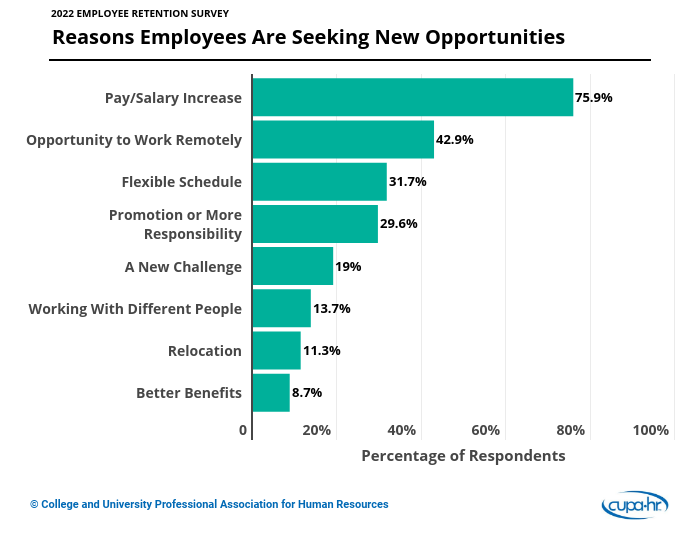
    Higher ed employees are looking for other jobs, mostly because they desire a pay increase. More than half (57%) of the higher ed workforce is at least somewhat likely to look for other employment opportunities in the next 12 months. The most common reason for seeking other employment (provided by three-fourths of those likely to look for another job) is an increase in pay. Other reasons are that they desire more remote work opportunities, a more flexible schedule, and a promotion or more responsibility.

    Higher ed institutions are not providing the remote work opportunities that employees want. Nearly three-fourths (71%) of employees report that most of their duties can be performed remotely, and 69% would prefer to have at least at least a partially remote work arrangement, yet 63% are working mostly or completely on-site.

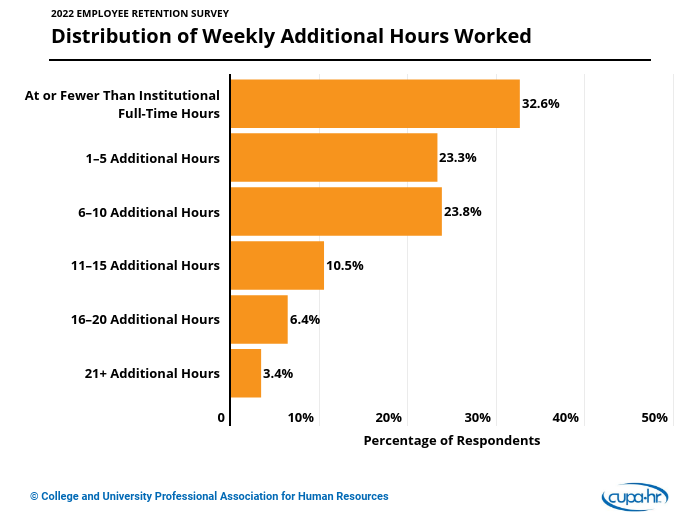
    Higher ed employees are working longer and harder than ever. Two-thirds (67%) of full-time staff typically work more hours each week than what is considered full-time. Nearly two-thirds (63%) have taken on additional responsibilities of other staff who have recently left, and nearly three-fourths (73%) have taken on additional responsibilities as a direct result of the pandemic.

    Higher ed employees have clear areas of satisfaction and dissatisfaction. Areas of satisfaction include benefits, relationship with supervisor, job duties, and feeling a sense of belonging. Areas of dissatisfaction include investment in career development, opportunities for advancement, fair pay, remote work policies and parental leave.

    Read the full report.


    Source link

  • 3 Takeaways From the CUPA-HR Annual Conference – CUPA-HR

    3 Takeaways From the CUPA-HR Annual Conference – CUPA-HR

    by CUPA-HR | October 7, 2021

    Thank you to all who attended the CUPA-HR Annual Conference and Expo in person and virtually this week! It was wonderful to welcome new and familiar faces, celebrate CUPA-HR’s 75th anniversary, and explore outstanding sessions with so many of you.

    For those who weren’t able to attend, here are three conference takeaways you can put to use wherever you are.

    • The Power of Kindness — Opening keynote and host of the Netflix series, “Kindness Diaries,” Leon Logothetis shared some of his experiences travelling the world fueled only by the kindness of strangers. “Kindness,” said Logothetis, “is simply a portal into human connection.” Overwhelmed by all the work to be done to support your institution’s workforce? Logothetis offered this advice: “To change the world, start by changing one life.” Who can you connect with and invest in at your institution? How can you use the power of kindness to make a difference in their life?
    • Birds and Frogs — Tuesday’s keynote speaker, David Epstein, spoke about the data supporting the value of generalists in a world increasingly focused on specialization. During his presentation, he offered an insightful message on how organizations can adapt successfully to change. Epstein used the example of birds and frogs; frogs are down on the ground, seeing all the granular details while the birds soaring above have a broader view of the big picture. Epstein asserted that we need both of these types of people to enhance our campus “ecosystems,” and should actively seek them out.
    • Ubuntu: I am because we are — Shola Richards topped off the conference with his energetic and inspiring message about the African concept of Ubuntu, which means “I am because we are.” Richards encouraged HR pros to use the spirit of Ubuntu in our various units and teams back on campus and to recognize that we will go a lot farther together than we will if we go alone no matter how small we feel (“be the mosquito, tiny but impossible to ignore”) or how difficult the situation (“be the buffalo, and run toward the storm”).

    We can’t wait to hear about the projects, initiatives, conversations and connections sparked by this year’s conference. Be sure to save the dates for our Virtual Spring Conference, April 19-21, and our 2022 Annual Conference, taking place October 22-24 in San Diego! Registration details coming soon.


    Source link