Category: Repayment

  • What Happens to Your Student Loans If You Move Abroad?

    What Happens to Your Student Loans If You Move Abroad?

    Moving abroad doesn’t erase your student loans — it just makes managing them more complicated.

    Your loans stay with you, and so do the repayment rules.

    Where things change is in how your income is reported, verified, and used to calculate payments under an Income-Driven Repayment (IDR) plan. The way you file your U.S. taxes — especially if you claim the Foreign Earned Income Exclusion (FEIE) — can affect what your loan servicer sees as your income and what you owe each month.

    Let’s break down what really happens when you take your student loans overseas.

    What Moving Abroad Means for Your Federal Student Loans

    Living abroad doesn’t cancel your loans, but it changes how you handle them — from repayment calculations to paperwork to keeping contact with your servicer.

    Here’s what actually changes when your student loans follow you overseas:

    1. Payment Calculation and the FEIE

    The biggest shift happens in how your income is treated.

    If you claim the FEIE, your Adjusted Gross Income (AGI) looks smaller on your U.S. tax return — and that can lower your IDR payment if your servicer accepts that number as-is.

    But that outcome isn’t guaranteed. The Department of Education allows income to be verified using either your AGI from tax data or alternative documentation of all taxable income (Per 34 CFR §685.209(a)(1)(viii)). If that happens, your excluded foreign income could be included in the review.

    In practice, though, some borrowers (especially those using the IRS data link on StudentAid.gov) report their lower AGI being accepted, while others are asked to provide pay stubs or other proof of income, which can wipe out the FEIE benefit.

    So your payment amount depends on how your income is verified — whether through the IRS data pull (the FTI system) or through Alternative Documentation of Income (ADOI). Even if your excluded income is added back, borrowers with modest earnings or larger households may still qualify for $0 payments under IDR.

    2. Communication and Logistics

    Keep your contact info current through your servicer’s portal — some accept foreign addresses, others require a U.S. one. If you use a family address, confirm it’s allowed. Go paperless when possible; it’s faster and more reliable overseas.

    Most servicers prefer payments from a U.S. bank account, though some do accept online payments from international accounts or via wire transfers. It’s not universal, so always confirm which payment types your servicer supports.

    Finally, watch exchange rates and transfer fees — small swings can quietly raise your real payment cost each month.

    Related:  If you’ll be overseas for a long time, read our guide on managing your student loans while living abroad. It covers practical steps like setting up e-bills, auto-pay, and mail management to avoid missed payments or surprises while you’re away.

    3. What Happens If You Don’t Pay

    Moving abroad doesn’t make your loans uncollectible.

    4. Continued U.S. Tax Obligations

    U.S. citizens must file taxes every year, no matter where they live.

    Your tax return plays a double role — for compliance and as the base income document for your IDR recertification.

    Whether your servicer uses IRS data or ADOI, your tax return is still the foundation for verifying your income.

    Common Mistakes for Borrowers Living Abroad

    Here are the biggest mistakes expats make — and how to avoid them.

    1. Forgetting to recertify income.

    Even while abroad, you must update your income for IDR plans every year. Miss it, and your payment jumps to the standard amount.

    2. Ignoring U.S. tax filing rules.

    You still have to file a U.S. tax return annually. Skipping it breaks tax compliance and can disrupt income verification for your repayment plan.

    3.  Overlooking how your spouse’s income is counted.

    If you’re married filing jointly, your spouse’s income (even if earned abroad) can raise your AGI and your payment. Some borrowers file separately to manage this — but that comes with trade-offs.

    4. Failing to cut state tax ties.

    If you left a state like California or Virginia without ending residency properly, that state can still tax your income — inflating your AGI and, in turn, your loan payment.

    5. Ignoring how interest accrues on $0 payments.

    A $0 payment doesn’t mean your balance stops growing. Under most IDR plans, unpaid interest continues to accrue.

    Before You Move Abroad (Quick Checklist)

    Heading overseas with student loans? Run through this first:

    Understand the FEIE/IDR Rule.
    Don’t expect a guaranteed $0 payment just because your AGI looks smaller on paper. Know how your servicer verifies income and that your total income before exclusions may be used.

    Assess FEIE and FTC implications.
    Learn how the FEIE or FTC affects both your taxes and IDR payments. Servicers may request tax documents or alternative proof of income — plan for both scenarios.

    Update your contact info.
    Make sure your loan servicer has your correct email, phone, and mailing address (ask if a foreign address is allowed).

    Keep a U.S. bank account open.
    Most servicers still process payments through U.S. accounts. If you rely on a foreign bank, confirm accepted payment methods or wire options first.

    Budget for currency and transfer logistics.
    Decide how you’ll make payments — online or via transfer — and factor in exchange rates and fees. Some servicers accept international transfers; others require USD payments from a domestic account.

    File your taxes every year. You’ll need a current return for IDR recertification, even if your FEIE wipes out your taxable income. Keeping your filings up to date also makes it easier to verify income automatically through the IRS data link.

    Time your IDR recertification wisely.
    If you claim the FEIE, consider recertifying soon after your most recent tax return is fully processed and accurate. That timing can improve the odds your AGI will transfer correctly through the IRS data link, reducing the need for manual income verification that might include your excluded foreign income.

    Plan for data-sharing with your loan servicer.
    Some servicers pull IRS data automatically; others require copies of tax returns or income verification. Decide in advance whether you’ll authorize data sharing with your servicer.

    Store every document. Keep digital copies of your tax return, Form 2555, pay stubs, and proof of residence — they’re gold if your file ever gets flagged for manual review.

    Bottom Line

    Moving abroad doesn’t erase your loans — it just changes how you manage them.

    Your income-driven payment could drop if your AGI from the IRS data pull is accepted — but that outcome isn’t guaranteed. Depending on how your income is verified or what documentation is used, your excluded foreign earnings might still be considered in the calculation.

    If you’re living or planning to live overseas, understand the rules, document everything, and stay ahead of deadlines.

    Subscribe for student loan updates or book a consult with a CFP® who understands international borrowers.

    Disclaimer: This article provides general information and should not be taken as personalized tax, legal, or financial advice. Rules change frequently, and your situation may vary. Consult a qualified student loan or tax professional before acting on this information.

    FAQs: Student Loans and Living Abroad

    Will my student loans be wiped after three years abroad?

    No. There’s no law or program that automatically cancels your student debt after living abroad — that’s a myth. However, living overseas can lower your required payments if you qualify for an income-driven plan and report foreign income correctly.

    Do student loans follow you to another country?

    Yes. Federal student loans remain your responsibility no matter where you live. The Department of Education can still collect through tax refunds or Social Security if you return, and your credit report remains active while you’re abroad.

    Can I stop making payments if I move overseas?

    Not safely. Missing payments can lead to default, wage garnishment (if you return to the U.S.), and long-term credit damage. Instead, apply for an IDR plan or a deferment if you qualify.

    Can I qualify for forgiveness or PSLF while living abroad?

    Yes, but it depends. Time spent abroad can count toward IDR forgiveness if you stay on an eligible plan and keep payments current. PSLF, on the other hand, requires qualifying employment.

    Can I refinance or consolidate my loans while living abroad?

    You can consolidate federal loans from anywhere, since it stays within the U.S. system. But refinancing through a private lender can be tricky — most lenders require a U.S. address, bank account, and credit history. Some expat-friendly lenders may still consider you, but it’s rare.

    Pedro Gomez is the new Student Loan Sherpa and a Certified Financial Planner™ with over a decade of experience helping clients navigate complex financial decisions. He is the founder of Global Financial Plan, where he writes about international living, geoarbitrage, and strategies for retiring young, and also leads Brickell Financial Group, a registered investment advisory firm focused on accelerating financial freedom.

    Pedro is the architect behind the “12 Levels of Financial Freedom” framework and blends student loan strategy with long-term planning, tax efficiency, and investing. His work is especially geared toward upwardly mobile professionals, entrepreneurs, and those looking to design a life beyond the default path.

    Pedro is available for strategy sessions and press inquiries.
    Source link

  • How to Get Out of Student Loan Default in 2025 The Student Loan Sherpa

    How to Get Out of Student Loan Default in 2025 The Student Loan Sherpa

    The “Default Cliff” Has Arrived — Here’s What It Means for You

    Millions of borrowers are inching toward what experts call a student loan default cliff. According to new reports from the Congressional Research Service and CNBC, more than 9 million borrowers are behind on payments — with 5.3 million already in default and another 4.3 million just a few missed payments away.

    Sen. Elizabeth Warren called it an “economic disaster in the making,” urging the Department of Education to act fast. But for borrowers, the more immediate question is simpler: What happens if my loans default — and can I fix it?

    The short answer: yes, you can fix it.

    Even if your student loans are in default, there are proven ways to recover, repair your credit, and get back into good standing. Here’s what default really means, why it’s spiking in 2025, and what steps you can take right now to get out.

    What It Means to Default on Your Student Loans

    Defaulting on your student loans means you’ve gone long enough without making payments that your lender or the federal government officially labels your debt as seriously past due.

    For federal student loans, that happens after 270 days (about nine months) of missed payments without deferment, forbearance, or an active repayment plan. Once you hit that mark, your entire balance becomes due immediately — a process called acceleration — and your loan is transferred from your servicer to the Department of Education’s Default Resolution Group or a collection agency.

    For private student loans, the timeline is shorter — usually 90 to 180 days of nonpayment, depending on the lender. Private loans don’t qualify for federal relief programs like income-driven repayment or rehabilitation, and lenders can move quickly to collections or even lawsuits.

    In short: default turns your loan problem into a legal problem — one that can trigger collections, wage garnishment, and serious credit damage if left unaddressed.

    What Happens When You Default on a Student Loan

    Defaulting on your student loans can hit hard and fast. Here’s what to expect if it happens:

    • Your entire balance becomes due immediately. You lose access to flexible repayment options.
    • You lose federal benefits. That includes deferment, forbearance, new aid eligibility, and access to forgiveness programs.
    • Collection actions begin. Wage garnishment, tax refund seizure, or withheld Social Security benefits are common.
    • Your credit score drops. Many borrowers see a hit of 60 to 170 points, making it harder to qualify for loans, credit cards, or housing.
    • Additional fees pile on. Collection costs and interest can quickly inflate your balance.
    • The damage lingers. Default stays on your credit report for up to seven years.

    That’s the tough part — but the good news is, you can reverse it. Through rehabilitation or consolidation, most borrowers can bring their loans back to good standing and start rebuilding credit within months.

    Why Millions of Borrowers Are Facing Default in 2025

    After years of pandemic relief, millions of borrowers are falling behind again as student loan payments resume. Reports from the Congressional Research Service show more than 5 million borrowers already in default and another 4 million close behind — what economists now call the “student loan default cliff.”

    The End of Post-Pandemic Relief and the “Default Cliff”

    When the post-pandemic relief period ended in fall 2024, many borrowers who hadn’t made payments in years suddenly had to restart them. Some managed to catch up, but millions didn’t — either because they couldn’t afford the new bills or never received clear guidance from their servicers.

    With delinquency reporting and wage garnishments now back in play, defaults are climbing fast. Economists warn that this wave could squeeze consumer spending and credit access, particularly for families already stretched thin.

    Policy Shifts Under the Big Beautiful Bill

    The One Big Beautiful Bill Act (OBBB), signed in July 2025, made repayment even tougher for many. The law tightened borrowing limits, replaced familiar repayment plans like SAVE and REPAYE with new ones (RAP and revised IBR), and reduced access to relief programs.

    At the same time, staffing cuts at the DoE left over 1 million IDR applications pending — meaning many borrowers are still waiting for payment adjustments that could prevent default.

    Why Borrowers Are Falling Behind

    Beyond policy, everyday economics are making repayment harder than ever:

    • Rising costs: Inflation and high housing prices are squeezing budgets.
    • Administrative delays: Servicer confusion and IDR backlogs leave many unsure of their payment status.
    • Borrower fatigue: After years of pauses and shifting policies, some borrowers simply checked out.
    • Defaults spreading: Even high-credit borrowers are missing payments, often prioritizing essentials over student loans.

    The bottom line: the system restarted before it was ready, and millions are paying the price. But while the headlines sound grim, default isn’t permanent — there are still clear, proven ways to fix it and start fresh.

    How to Fix a Defaulted Student Loan

    Default feels final, but it’s not. The federal system gives borrowers a few clear paths to recover, and most people can get back on track within months — not years.

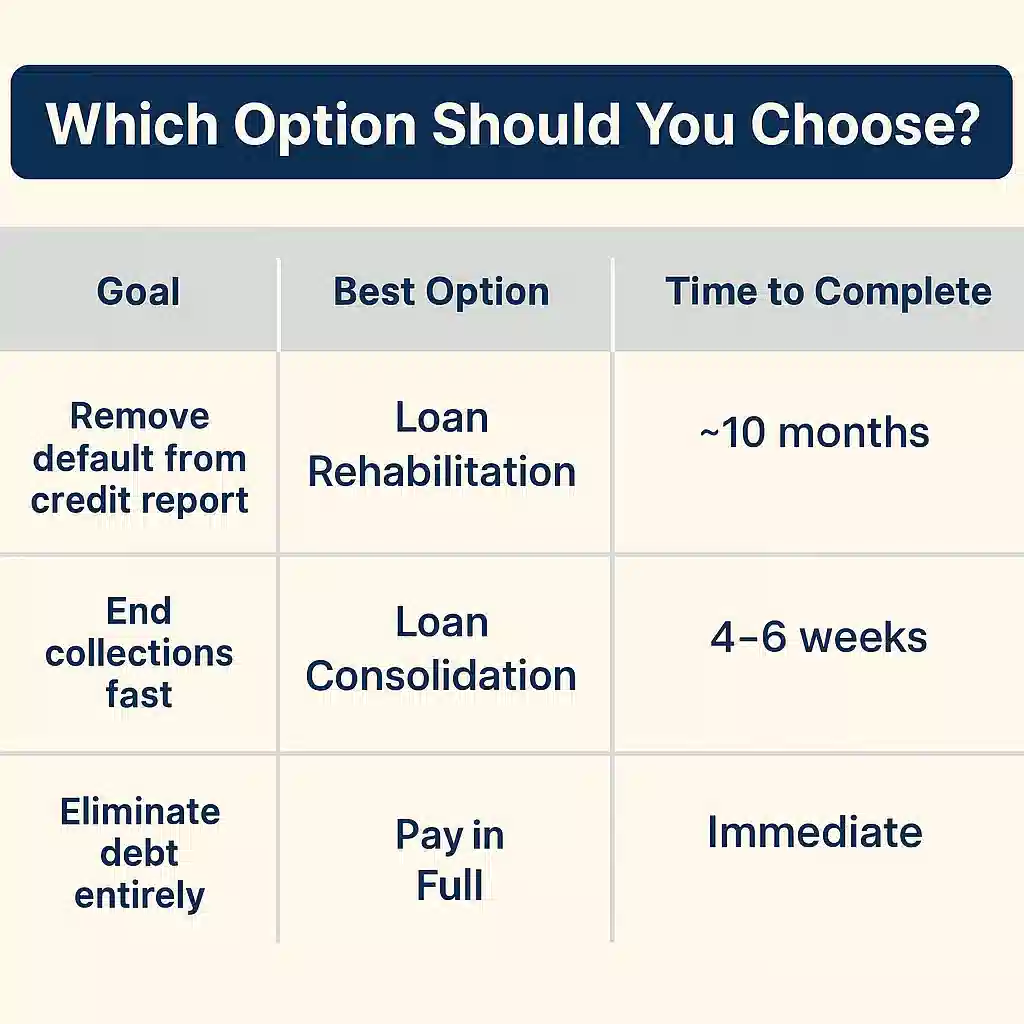
    The best way to fix student loan default depends on your situation, but for federal loans, there are three main options: rehabilitation, consolidation, and paying in full. (Private loans work differently — we’ll cover those next.)

    Option 1: Loan Rehabilitation (Best for Credit Repair)

    Loan rehabilitation is usually the best fix if you want to remove the default mark from your credit report and regain federal loan benefits.

    You’ll make nine on-time monthly payments within ten months — typically around 15% of your discretionary income. If that’s too high, your servicer can set a lower amount (sometimes as little as $5) based on your financial situation.

    Once you’ve made all nine payments:

    • Your loans are taken out of default and reassigned to a new servicer.
    • Collection actions like wage garnishment and tax refund seizures stop.
    • You regain eligibility for deferment, forbearance, forgiveness, and new aid.
    • The default is removed from your credit report (though late payments before default stay).

    Best for: Borrowers who want to rebuild credit and have a steady enough income to make small monthly payments.

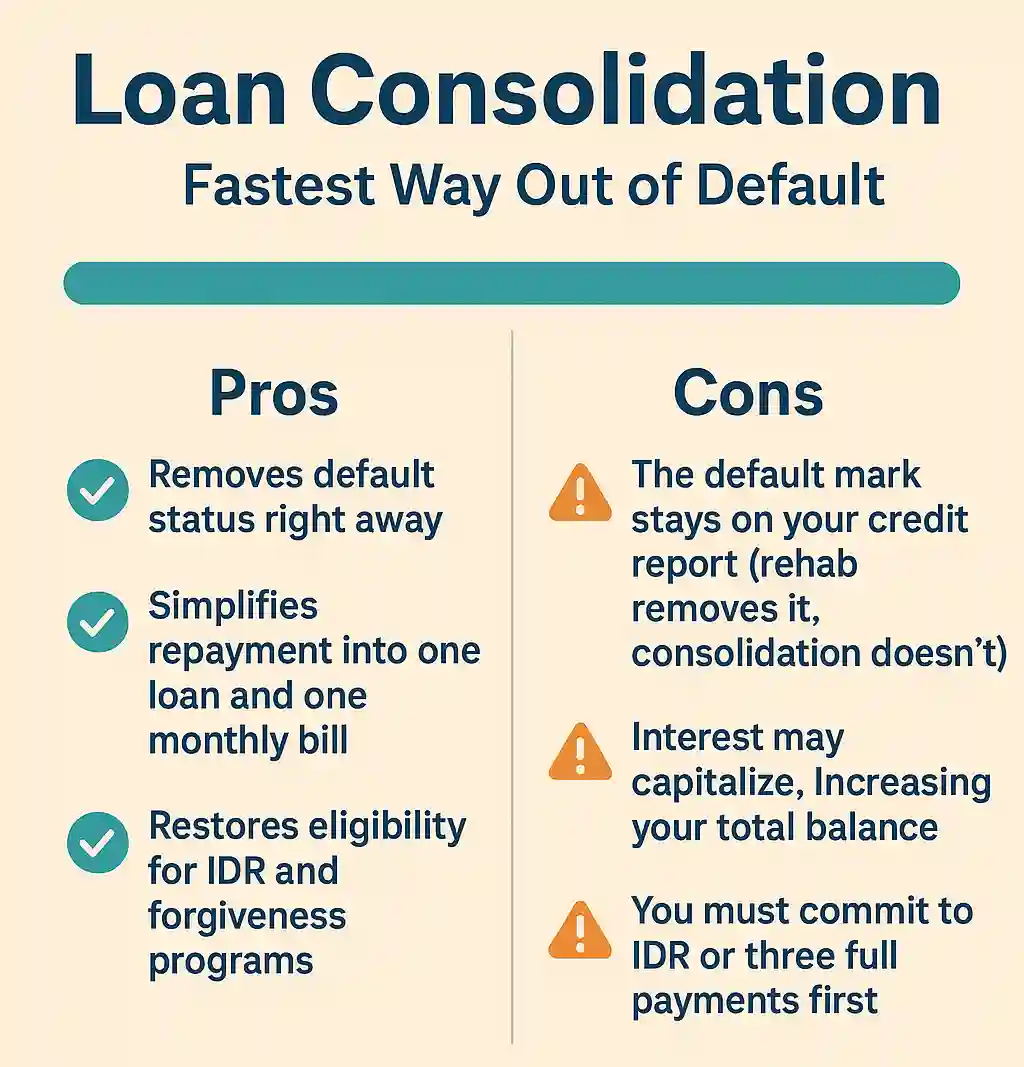
    Option 2: Loan Consolidation (Fastest Way Out of Default)

    If you need to get your loans out of default quickly, consolidation is faster. You’ll combine one or more defaulted federal loans into a new Direct Consolidation Loan, instantly bringing your account current.

    To qualify, you must either:

    1. Agree to repay the new loan under an income-driven repayment (IDR) plan, or
    2. Make three consecutive, on-time, full monthly payments before consolidating.

    Once approved, your new loan pays off the old ones, ending collections immediately.

    loan consolidation pros and cons

    Best for: Borrowers who need a fast fix or are facing wage garnishment or collection pressure.

    Quick tip: If you plan to apply for a mortgage or new credit soon, consider rehabilitation first — it offers better long-term credit recovery, even if it takes longer.

    Further Reading: Not sure whether rehabilitation or consolidation makes more sense for your situation? Check out our detailed comparison: Rehabilitation or Consolidation for Defaulted Student Loans? — it breaks down the pros, cons, fees, and long-term credit impact of each option.

    Option 3: Paying the Loan in Full (Rare but Instant Fix)

    If you can afford it, paying your defaulted loan in full is the quickest way to clear the debt and end all collection activity. Once paid, your loan is immediately considered current.

    However, this isn’t realistic for most borrowers — and it doesn’t remove the default from your credit report. It simply stops the bleeding.

    Best for: Borrowers with access to large funds (like an inheritance or settlement) who want to close the chapter on student debt entirely.

    options for fixing student loan default

    Once you’ve fixed the default, the next step is keeping it from happening again. The good news: that’s much easier — and it starts with setting up a repayment plan that actually fits your income.

    Related: Fact or Fiction: Can I Pay Off My Student Loans with a Lump Sum? — This article breaks down why lump-sum payoffs rarely work and how to use big payments wisely without wrecking your credit.

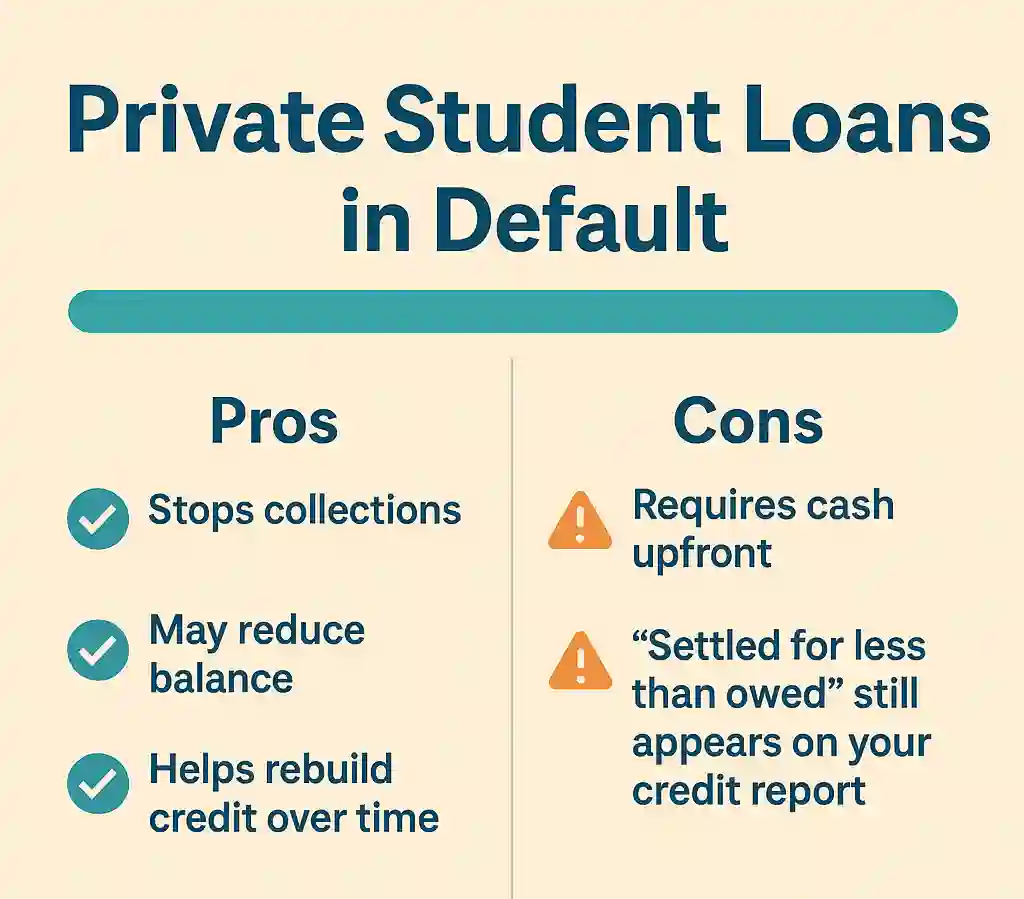
    Private Student Loans in Default

    Private loans don’t follow federal rules, and they don’t offer rehabilitation. Most private lenders consider a loan in default after 90–180 days of missed payments.

    If your private loan defaults:

    • Contact your lender immediately — many will negotiate new repayment terms to avoid litigation.
    • You can request a settlement, often paying 50–70% of the total balance in a lump sum or short-term plan.
    • Be aware that lawsuits are common. Private lenders can sue to garnish wages or seize assets (depending on state law).
    private student loans default pros and cons

    Related: Why Most Borrowers Should Repay Private Student Loans First — This article explains why private loans are riskier, how they differ from federal debt, and when it actually makes sense to pay them off first.

    Once you’ve fixed the default, the next step is keeping it from happening again. The good news: that’s much easier — and it starts with setting up a repayment plan that actually fits your income.


    How to Avoid Student Loan Default Again

    Once your loans are back in good standing, the goal is simple: keep them that way. The best way to avoid default again is to make your payments affordable, automatic, and always up to date — even when life gets messy.

    Here’s how to stay out of the red for good:

    1. Enroll in an Affordable Income-Driven Repayment Plan (IDR)

    If your payments feel impossible, that’s a sign you’re probably on the wrong plan.

    Switching to an IDR plan keeps monthly payments tied to your income and family size — not your loan balance.

    As of 2025, the IBR plan and the new RAP are the most reliable options. The SAVE Plan is still in legal limbo, so new enrollments are limited, but IBR and RAP remain open and safe choices.

    Enrolling in an IDR plan can:

    • Lower your payment to as little as $0 per month if your income qualifies.
    • Keep your account in good standing even if you’re earning very little.
    • Keep you eligible for forgiveness programs down the road.

    If you’re unsure where to start, visit Studentaid.gov/idr and use the Loan Simulator to compare plans.

    Related: Federal Student Loan Repayment Plan Options and Strategy — This article breaks down every repayment plan (SAVE, IBR, PAYE, and more) and explains how to pick the one that minimizes interest and maximizes forgiveness.

    Pro tip: If your servicer hasn’t processed your IDR application yet, make at least one small monthly payment anyway — it helps prevent delinquency while you wait through the backlog.

    2. Set Up Auto-Pay and Track Your Loan Status

    It sounds obvious, but automation is the easiest way to prevent missed payments.
    Setting up auto-pay through your loan servicer ensures payments are made on time, every time — and you might even get a small interest rate discount (usually 0.25%).

    Don’t just set it and forget it, though. Log in to your StudentAid.gov dashboard at least once a month to:

    • Check your payment history
    • Verify your servicer hasn’t changed (it happens more than you’d think)
    • Review your IDR recertification dates

    Even a quick five-minute check can catch errors before they spiral into delinquency.

    3. Recertify on Time (Even if the DOE Is Backlogged)

    The Department of Education is still digging out from a massive 1.1 million IDR application backlog, which means your paperwork could sit for months. That’s why it’s critical to recertify early — ideally 60 to 90 days before your annual deadline.

    If your income or family size changes, recertify right away to keep your payments accurate. Missing your recertification date can cause your payments to jump or your IDR plan to lapse, putting you back on a higher standard plan — the fastest path back to delinquency.

    Bottom Line: Consistency Beats Perfection

    Avoiding default isn’t about being perfect — it’s about staying consistent.
    Pick a repayment plan that fits your life, automate what you can, and keep tabs on your loans at least once a month.

    Once you’ve climbed out of default, the hard part’s over. From here, it’s all about maintaining progress — and knowing where to get help before small problems turn into big ones.

    Final Take

    Defaulting on your student loans can feel like the end of the road — but it’s not. It’s a detour, not a dead end.

    Millions of borrowers have been where you are right now and made it out. Whether you choose rehabilitation to clean up your credit or consolidation for a faster fix, the key is to take action before collections get worse. Once you’re out of default, enrolling in an affordable income-driven repayment plan and setting up auto-pay are your best defenses against sliding back.

    If your loans are already in default, don’t ignore the problem — you can recover faster than you think.

    Check your status on StudentAid.gov, call your servicer, and start the process that fits your situation. Every payment, every step, moves you closer to financial stability and future forgiveness.

    Ready to get back on track?
    Schedule a one-on-one consultation with Pedro Gomez, CFP®, and get a personalized plan to fix your default, choose the right repayment strategy, and rebuild your financial future — faster.

    Book a Student Loan Consultation

    FAQs on Student Loan Default

    Federal student loans typically go into default after 270 days (about nine months) of missed payments without deferment, forbearance, or an active repayment plan. Private lenders often declare default sooner, usually after 90 to 180 days depending on the loan contract.

    For federal loans, you can check your status on Studentaid.gov, which tracks your loan standing. For private loans, you need to monitor your loan servicer’s communications or check your credit report for defaults or collection entries.

    The primary ways are loan rehabilitation, consolidation, or settlement. Rehabilitation requires nine on-time monthly payments and removes default status. Consolidation pays off the defaulted loan with a new loan, and settlement involves negotiating payoffs with lenders or collectors.

    A federal student loan default typically stays on your credit report for seven years. However, successful rehabilitation removes the default status sooner, improving your credit profile more quickly.

    Discharge of defaulted student loans is rare. It is usually granted only in cases of total and permanent disability, school closure, or very limited bankruptcy conditions. Regular discharge through bankruptcy is generally not allowed.

    Pedro Gomez is the new Student Loan Sherpa and a Certified Financial Planner™ with over a decade of experience helping clients navigate complex financial decisions. He is the founder of Global Financial Plan, where he writes about international living, geoarbitrage, and strategies for retiring young, and also leads Brickell Financial Group, a registered investment advisory firm focused on accelerating financial freedom.

    Pedro is the architect behind the “12 Levels of Financial Freedom” framework and blends student loan strategy with long-term planning, tax efficiency, and investing. His work is especially geared toward upwardly mobile professionals, entrepreneurs, and those looking to design a life beyond the default path.

    Pedro is available for strategy sessions and press inquiries.
    Source link