It’s been a busy summer at HESA Towers. We’ve been developing Boardwise, our new suite of governance products with our partners at Balsam Advisory, and exploring new ideas on data governance and analytics with our friends at Plaid Analytics. We’ve also been touring the country with the Royal Bank of Canada (RBC) Thought Leadership Office and the Business + Higher Education Roundtable (BHER) to talk about higher education, economic growth and productivity. The “what we heard” document from those sessions will be out in mid-September, and there are several follow-up events scheduled, including a leaders’ summit hosted by RBC later this month. This event will focus mainly on how higher education and business can work together to tackle some of the country’s most pressing challenges, such as clean energy and technology, artificial intelligence, and defence. Further insights from this work will also be explored at the BHER Executive Summit in February 2026.
And, of course, our own Re: University conference – where we will be presenting some of the most interesting ideas out there to improve and inspire the quality, effectiveness and experience of postsecondary education in Canada – is coming up in late January in Ottawa. (Tickets are going fast – reserve your spot!)
A couple of other small programming notes:
The State of Post-Secondary Education in Canada 2025 will be released tomorrow.
The World of Higher Educationpodcast will still come out every Thursday, but we’re back to an audio-only format because editing is a hassle and apparently very few of you are videophiles.
TheFifteen will continue to bring you the top global higher education stories every other week.
Next Friday will mark the debut of a new biweekly webinar series, Friday Focus, to be hosted by Tiffany MacLennan, surfacing the most interesting shifts and innovations in Canadian higher education – from AI & technology, cutting-edge programming, and the everchanging student experience – through the voices of those leading the change. We hope you can join us.
Our University Vice Presidents Network (UVPN) is going strong and is scheduled to convene in Victoria in November, Quebec City in February, and then internationally for a May 2026 Study Tour in Germany.
Finally, we are targeting the first week of December for the launch of the World of Higher Education Annual Review 2025, a new year-in-review publication which tries to document the year’s shifts across the whole of our crazy sector, right around the globe, using statistics, stories and strategic planning documents.
Now, on to the year ahead.
In most places, I think the hard part for colleges is over. 2025-26 isn’t going to be an easy year, by any means, but the big decisions have mostly been made, future directions have been set and the floor on institutional income has either been reached or is in sight.
Universities, on the other hand, are a different story. They have – not everywhere, but in the main – been more hesitant to act. It’s a conservative sector that is resistant to change, be it financial, organizational or cultural. And the financial problems the sector faces – again, not everywhere but in the main – are going to drag on for quite awhile mainly because international student numbers aren’t bouncing back the way they might have (more on that next week) and because an imminent recession is the opposite of helpful when it comes to provincial finances.
So, it’s going to be a tough year ahead. In my mind, I think there are 5 rules for success.
Rule 1 – Act like Universities are a Means to an End, not an End in Themselves. Literally the worst thing universities can say right now is “universities are crucial, give us more money”. It’s an utterly tone-deaf approach, even if you give it an “elbows up” spin. The sector has been saying it for years and it clearly hasn’t worked, so continuing with this approach is the literal definition of insanity. And the reason it doesn’t work is because Canadians (or at least Canadian politicians) simply don’t believe that universities are crucial because they don’t believe that knowledge and science is useful. Rather, they far prefer a Canada where the construction and natural resources industries continue to call the shots (if there is a Deep State in Canada, it is surely comprised of these two sectors and their watercarriers). The case we need to make is not “spend on universities”, it’s “a knowledge-driven Canada is a better Canada”. And more importantly, it’s not a case institutions can make on their own – they need to make it with lots of other actors, particularly from industry. Alliances, people. Form alliances. Downsize your government relations team, build up your community relations efforts.
Rule 2 – Stop with the Tri-Council Fundamentalism. Federal budgets for research are going to get hammered in the coming months. This will make a lot of people argue that we should ditch all research funds except the tri-councils because inquiry-driven research is sacred etc. I understand the instinct here because so many institutions make council success a key part of the tenure/promotion process. But it’s a bad instinct. No one in Ottawa cares about your tenure processes. You can argue all you want about how basic research is more cost-efficient in terms of driving long-term discovery, but i) the public likes some short-term wins mixed in with the long-term ones and b) nobody outside universities is buying that one story about NSERC funding Geoffrey Hinton’s AI research 30 year ago as a business case for science. Like, nobody. Get over it. Understand that if there is to be growth in Canadian research funding in future, it’s going to look a lot more like Horizon Europe or the Biden Administration’s Chips and Science Act, both of which were widely hailed as being good for science despite – or perhaps because – they are largely mission-driven rather than inquiry-driven. If this is the hill the community chooses to die on, God help us all.
Rule 3 –Focus on what you can control, not what you can’t. Yes, things are bad. You can spend time complaining about it – government is short-sighted, we’re always getting shafted by the granting councils, etc. – or you can get busy. Fire up your friend-raising and fund-raising. Ramp up your spend/effort on international recruitment (more on this next week). Make a big bang with some new programs that stand out. Go big on one theme. Stand out. Please.
Rule 4 –Faster Collegiality is a Must. Part of regaining public confidence is going to involve being able to make changes at the institutional level with much more speed and determination than is historically the case. That means being able to deliver on promises and priority in the immediate term, not in some far-off future, to be able to act as an institution and not just as a sack full of cats fighting over research priorities and teaching schedules. The way this normally happens is to concentrate power in the hands of the upper administration. This is how it works in most of Asia, most of the United States, and increasingly in Europe as well (though crucially, senior admin tends to be elected in Europe). But it doesn’t have to be like that. There’s no obvious reason why collegial governance needs to be slow: it’s just custom and practice. I’ve been saying for a while that better, faster governance is key to institutions in rough times and while too few have heeded that advice, it’s never too late to start.
Rule 5 – Do less, but do it better. Universities are ridiculously strung out. Many forces are at work here, but I will single out two. At a system level, we have governance systems that are great at approving new programs and initiatives but absolutely rotten at pruning them once they have outlived their purpose. Result: institutions do too much, but do it badly, thus leading to enshittifcation. But it works at the level of individual faculty too, since departments tend to hire the biggest keeners in the system, the kind of people who won’t say no to more research, or extra teaching, or whatever. Result: burnout. In a normal organization, a manager would come along and try to make workloads manageable. But since Canadian academia long ago decided that the main purpose of department chairs is to protect staff from unwanted Decanal or Provostial schemes rather than to manage academics’ workloads, there is no one in the system who can actually make the problem go away (high-sounding talk about “wellness” doesn’t do the trick either). So, seriously, do less.
It’s going to be a hard year (or let’s face it, a hard few years), but if everyone gets the basics right, we can come out of this better and stronger.
New research has found that rural LGBTQ+ teens experience significant challenges in their communities and turn to the internet for support.
The research from Hopelab and the Born This Way Foundation looked at what more than 1,200 LGBTQ+ teens faced and compared the experiences of those in rural communities with those of teens in suburban and urban communities. The research found that rural teens are more likely to give and receive support through their online communities and friends than via their in-person relationships.
“The rural young people we’re seeing were reporting having a lot less support in their homes, in their communities, and their schools,” Mike Parent, a principal researcher at Hopelab, said in an interview with the Daily Yonder. “They weren’t doing too well in terms of feeling supported in the places they were living, though they were feeling supported online.”
However, the research found that rural LGBTQ+ teens had the same sense of pride in who they were as suburban and urban teens.
“The parallel, interesting finding was that we didn’t see differences in their internal sense of pride, which you might kind of expect if they feel all less supported,” he said. “What was surprising, in a very good way, was that indication of resilience or being able to feel a strong sense of their internal selves despite this kind of harsh environment they might be in.”
Researchers recruited young people between the ages of 15 and 24 who identified as LGBTQ+ through targeted ads on social media. After surveying the respondents during August and September of last year, the researchers also followed up some of the surveys with interviews, Parent said.
According to the study, rural teens were more likely than their urban and suburban counterparts to find support online. Of the rural respondents, 56% of rural young people reported receiving support from others online several times a month compared to 51% of urban and suburban respondents, and 76% reported giving support online, compared to 70% of urban and suburban respondents.
Conversely, only 28% of rural respondents reported feeling supported by their schools, compared to 49% of urban and suburban respondents, the study found, and 13% of rural respondents felt supported by their communities, compared to 35% of urban and suburban respondents.
Rural LGBTQ+ young people are significantly more likely to suffer mental health issues because of the lack of support where they live, researchers said. Rural LGBTQ+ young people were more likely to meet the threshold for depression (57% compared to 45%), and more likely to report less flourishing than their suburban/urban counterparts (43% to 52%).
The study found that those LGBTQ+ young people who received support from those they lived with, regardless of where they live, are more likely to report flourishing (50% compared to 35%) and less likely to meet the threshold for depression (52% compared to 63%).
One respondent said the impact of lack of support impacted every aspect of their lives.
“Not being able to be who you truly are around the people that you love most or the communities that you’re in is going to make somebody depressed or give them mental issues,” they said in survey interviews, according to Hopelab. “Because if you can’t be who you are around the people that you love most and people who surround you, you’re not gonna be able to feel the best about your well-being.”
Respondents said connecting with those online communities saved their lives.
“Throughout my entire life, I have been bullied relentlessly. However, when I’m online, I find that it is easier to make friends… I met my best friend through role play [games],” one teen told researchers. “Without it, I wouldn’t be here today. So, in the long run, it’s the friendships I’ve made online that have kept me alive all these years.”
Having support in rural areas, especially, can provide rural LGBTQ+ teens with a feeling of belonging, researchers said.
“Our findings highlight the urgent need for safe, affirming in-person spaces and the importance of including young people in shaping the solutions,” Claudia-Santi F. Fernandes, vice president of research and evaluation at Born This Way Foundation, said in a statement. “If we want to improve outcomes, especially for LGBTQ+ young people in rural communities, their voices–and scientific evidence–must guide the work.”
Parent said the survey respondents stressed the importance of having safe spaces for LGBTQ+ young people to gather in their own communities.
“I think most of the participants recognize that you can’t do a lot to change your family if they’re not supportive,” he said. “What they were saying was that finding ways for schools to be supportive and for communities to be supportive in terms of physical spaces (that allowed them) to express themselves safely (and) having places where they can gather and feel safe, uh, were really important to them.”
Hopelab seeks to address mental health in young people through evidence-based innovation, according to its organizers. The Born This Way Foundation was co-founded by Lady Gaga and her mother, West Virginia native Cynthia Bisset Germanotta.
The organization is focused on ending bullying and building up communities, while using research, programming, grants, and partnerships to engage young people and connect them to mental health resources, according to the foundation’s website.
As a classroom teacher and district leader with over 26 years of experience, I’ve attended countless professional development (PD) sessions. Some were transformative, others forgettable. But one thing has remained constant: the need for PD that inspires, equips, and connects educators. Research shows that effective PD focuses on instructional practice and connects to both classroom materials and real- world contexts.
I began my teaching career in 1999 through an alternative certification program, eager to learn and grow. That enthusiasm hasn’t waned–I still consider myself a lifelong learner. But over time, I realized that not all PD is created equal. Too often, sessions felt like a checkbox exercise, with educators asking, “Why do I have to be here?” instead of “How can I grow from this?”
Here are some of my favorite PD resources and experiences:
edWeb
edWeb is free to join, and once you’re in, you can dive into as many sessions as you want. The service offers a live calendar of events or on-demand webinars covering a range of topics. Plus, the webinars come with CE certificates, which are approved for teacher re-licensure in states like New York, Massachusetts, Texas, Pennsylvania, Arkansas, Utah, and Nevada.
You can go deeper into the state-specific options with an interactive map. I also love the community aspect of the platform, as you can connect with peers and learn from experts on so many topics for all preK-12 educators.
Career Connect This summer, I attended the Discovery Education Summer of Learning Series at the BMW facility in Spartanburg, South Carolina, for a day-long professional learning event focused on workforce readiness and preparing students for evolving career landscapes. It was an energizing day being surrounded by passionate educators. One standout resource we dove into more deeply is Career Connect by Discovery Education. Career Connect is within Discovery Education Experience and is available to all educators in South Carolina by the Department of Education.
This is quickly becoming a priority tool in our district. With early access in the spring, we’ve integrated it across grade levels–from elementary STEM classrooms to our Career Center. The platform offers students live interactions with professionals in various fields, making career exploration both engaging and real. I witnessed this firsthand during a virtual visit with an engineer from Charlotte, N.C., whose insights captivated our students and sparked meaningful conversations about future possibilities.
Professional Development Hub The ASCD + ISTE professional learning hub offers sessions on innovative approaches and tools to design and implement standards-aligned curriculum. Each session is led by educators, authors, researchers, and practitioners who are experts in professional learning. Schools and districts receive a needs assessment, so you know the learning is tailored to what educators really need and want.
Tips for Meaningful PD With over 26 years of experience as a classroom teacher and district leader, I have participated in my fair share of professional learning opportunities. I like to joke that my career began in the late 1900s, but professional development sessions from those first few years of teaching now do feel like they were from a century ago compared to the possibilities presented to teachers and leaders today.
Over these decades I’ve seen a lot of good, and bad, sessions. Here are my top tips to make PD actually engaging:
Choose PD that aligns with your goals. Seek out sessions that connect directly to your teaching practice or leadership role.
Engage with a community. Learning alongside passionate educators makes a huge difference. The Summer of Learning event reminded me how energizing it is to be surrounded by people who lift you up.
Explore tech tools that extend learning. Platforms like Career Connect and others aren’t just add-ons–they’re gateways to deeper engagement and real-world relevance.
Professional development should be a “want to,” not a “have to.” To get there, though, the PD needs to be thoughtfully designed and purpose-driven. These resources above reignited my passion for learning and reminded me of the power of connection–between educators, students, and the world beyond the classroom.
Bucky Ware, School District of Newberry County
Bucky Ware is a Technology Integration Specialist and Public Information Officer for the School District of Newberry County with over 26 years of experience in education. A former English and Journalism teacher, he specializes in integrating instructional technology, leading professional learning, and fostering community engagement. Beyond his district role, Bucky serves on statewide advisory groups and professional associations, including the South Carolina Association for Educational Technology Board of Directors, SCASA Instructional Technology Roundtables, and the National School Public Relations Association.
Latest posts by eSchool Media Contributors (see all)
Organization recognized for excellence in high-impact tutoring design and student achievement gains
PHILADELPHIA, Aug. 25, 2025 –Catapult Learning, a division of FullBloom that provides academic intervention programs for students and professional development solutions for teachers in K-12 schools, today announced it earned the Tutoring Program Design Badge from the National Student Support Accelerator (NSSA) at Stanford University. The designation, valid for three years, recognizes tutoring providers that demonstrate high-quality, research-aligned program design.
The recognition comes at a time when the need for high-impact tutoring (HIT) has never been greater. As schools nationwide work to close learning gaps that widened during the COVID-19 pandemic and accelerate recovery, Catapult Learning stands out for its nearly 50-year legacy of delivering effective academic support to students who need it most.
“Catapult Learning is honored to receive this prestigious national recognition from the NSSA at Stanford University,” said Rob Klapper, president at Catapult Learning. “We are excited to be recognized for our high-impact tutoring program design and will continue to uphold the highest standards of excellence as we support learners across the country.”
Each year, Catapult Learning’s programs support more than 150,000+ students with nearly four million in-person tutoring sessions, in partnership with 2,100 schools and districts nationwide. Its tutors, many of whom hold four-year degrees, are highly trained professionals who are supported with ongoing coaching and professional development.
Recent data from Catapult Learning’s HIT programs show strong academic gains across both math and reading subject areas:
8 out of every 10 math students increased their pre/post score
9 out of every 10 reading students increased their pre/post score
These results come from programs that have also earned a Tier 2 evidence designation under the Every Student Succeeds Act, affirming their alignment with rigorous research standards.
The Badge was awarded following a rigorous, evidence-based review conducted by an independent panel of education experts. The NSSA evaluated multiple components of Catapult Learning’s program – including instructional design, tutor training and support, and the use of data to inform instruction – against its Tutoring Quality Standards.
“This designation underscores the strength and intentionality behind our high-impact tutoring model,” said Devon Wible, vice president of teaching and learning at Catapult Learning. “This achievement reflects our deep commitment to providing high-quality, research-based tutoring that drives meaningful outcomes for learners.”
Tutoring is available in person, virtually, or in hybrid formats, and can be scheduled before, during, or after school, including weekends. Sessions are held a minimum of three times per week, with flexible options tailored to the needs of each school or district. Catapult Learning provides all necessary materials for both students and tutors.
Catapult Learning, a division of FullBloom, provides academic intervention programs for students and professional development solutions for teachers in K-12 schools, executed by a team of experienced coaches. Our professional development services strengthen the capacity of teachers and leaders to raise and sustain student achievement. Our academic intervention programs support struggling learners with instruction tailored to the unique needs of each student. Across the country, Catapult Learning partners with 500+ school districts to produce positive outcomes that promote academic and professional growth. Catapult Learning is accredited by Cognia and has earned its 2022 System of Distinction honor.
A new DESSA screener to be released for the Fall ‘25 school year–designed to be paired with a strength-based student self-report assessment–accurately predicted well-being levels in 70 percent of students, a study finds.
According to findings from Riverside Insights, creator of research-backed assessments, researchers found that even students with strong social-emotional skills often struggle with significant mental health concerns, challenging the assumption that resilience alone indicates student well-being. The study, which examined outcomes in 254 middle school students across the United States, suggests that combining risk and resilience screening can enable identification of students who would otherwise be missed by traditional approaches.
“This research validates what school mental health professionals have been telling us for years–that traditional screening approaches miss too many students,” said Dr. Evelyn Johnson, VP of Research & Development at Riverside Insights. “When educators and counselors can utilize a dual approach to identify risk factors, they can pinpoint concerns and engage earlier, in and in a targeted way, before concerns become major crises.”
The study, which offered evidence of, for example, social skills deficits among students with no identifiable or emotional behavioral concerns, provides the first empirical evidence that consideration of both risk and resilience can enhance the predictive benefits of screening, when compared to strengths-based screening alone.
In the years following COVID, many educators noted a feeling that something was “off” with students, despite DESSA assessments indicating that things were fine.
“We heard this feedback from lots of different customers, and it really got our team thinking–we’re clearly missing something, even though the assessment of social-emotional skills is critically important and there’s evidence to show the links to better academic outcomes and better emotional well-being outcomes,” Johnson said. “And yet, we’re not tapping something that needs to be tapped.”
For a long time, if a person displayed no outward or obvious mental health struggles, they were thought to be mentally healthy. In investigating the various theories and frameworks guiding mental health issues, Riverside Insight’s team dug into Dr. Shannon Suldo‘s work, which centers around the dual factor model.
“What the dual factor approach really suggests is that the absence of problems is not necessarily equivalent to good mental health–there really are these two factors, dual factors, we talk about them in terms of risk and resilience–that really give you a much more complete picture of how a student is doing,” Johnson said.
“The efficacy associated with this dual-factor approach is encouraging, and has big implications for practitioners struggling to identify risk with limited resources,” said Jim Bowler, general manager of the Classroom Division at Riverside Insights. “Schools told us they needed a way to identify students who might be struggling beneath the surface. The DESSA SEIR ensures no student falls through the cracks by providing the complete picture educators need for truly preventive mental health support.”
The launch comes as mental health concerns among students reach crisis levels. More than 1 in 5 students considered attempting suicide in 2023, while 60 percent of youth with major depression receive no mental health treatment. With school psychologist-to-student ratios at 1:1065 (recommended 1:500) and counselor ratios at 1:376 (recommended 1:250), schools need preventive solutions that work within existing resources.
The DESSA SEIR will be available for the 2025-2026 school year.
This press release originally appeared online.
eSchool Media staff cover education technology in all its aspects–from legislation and litigation, to best practices, to lessons learned and new products. First published in March of 1998 as a monthly print and digital newspaper, eSchool Media provides the news and information necessary to help K-20 decision-makers successfully use technology and innovation to transform schools and colleges and achieve their educational goals.
An email pings into my inbox: peerreviewer comments on your submission #1234. I take a breath and click.
Three reviewers have left feedback on my beloved paper. The first reviewer is gentle, constructive, and points out areas where the work could be tightened up. One reviewer simply provides a list of typos and points out where the grammar is not technically correct. The third reviewer is vicious. I stop reading.
Later that afternoon, I sit in the annual student assessment board for my department. Over a painstaking two hours, we discuss, interrogate, and wrestle with how we, as educators, can improve our feedback practices when we mark student work. We examine the distribution of students marks closely, looking out for outliers, errors, or evidence of an ill-pitched assessment. We reflect upon how we can make our written feedback more useful. We suggest thoughtful and innovative ways to make our practice more consistent and clearer.
It then strikes me how these conversations happen in parallel – peer review sits in one corner of academia, and educational assessment and feedback sits in another. What would happen, I wonder, if we started approaching peer review as a pedagogical problem?
Peer review as pedagogy
Peer review is a high stakes context. We know that we need proper, expert scrutiny of the methodological, theoretical, and analytical claims of research to ensure the quality, credibility, and advancement of what we do and how we do it. However, we also know that there are problems with the current peer review system. As my experience attests to, issues including reviewer biases and conflicts, lack of transparency in editorial decision-making, inconsistencies in the length and depth of reviewer feedback all plague our experiences. Peer reviewers can be sharp, hostile, and unconstructive. They can focus on the wrong things, be unhelpful in their vagueness, or miss the point entirely. These problems threaten the foundations of research.
The good news is that we do not have to reinvent the wheel. For decades, people in educational research, or the scholarship of teaching and learning (SoTL), have been grappling both theoretically and empirically with the issue of giving and receiving feedback. Educational research has considered best practices in feedback presentation and content, learner and marker feedback literacies, management of socioemotional responses to feedback, and transparency of feedback expectations. The educational feedback literature is vast and innovative.
However – curiously – efforts to improve the integrity of peer review don’t typically frame this as a pedagogical problem, that can borrow insights from the educational literature. This is, I think, a woefully missed opportunity. There are at least four clear initiatives from the educational scholarship that could be a useful starting point in tightening up the rigour of peer review.
What is feedback for?
We would rarely mark student work without a clear assessment rubric and standardised assessment criteria. In other words, as educators we wouldn’t sit down to assess students work without at least first considering what we have asked them to do. What are the goalposts? What are the outcomes? What are we giving feedback for?
Rubrics and assessment criteria provide transparent guidelines on what is expected of learners, in an effort to demystify the hidden curriculum of assessment and reduce subjectivity in assessment practice. In contrast, peer reviewers are typically provided with scant information about what to assess manuscripts for, which can lead to inconsistencies between journal aims and scope, reviewer comments, and author expectations.
Imagine if we had structured journal-specific rubrics, based on specific, predefined criteria that aligned tightly with the journal’s mission and requirements. Imagine if these rubrics guided decision-making and clarified the function of feedback, rather than letting reviewers go rogue with their own understanding of what the feedback is for.
Transparent rubrics and criteria could also bolster the feedback literacy of reviewers and authors. Feedback literacy is an established educational concept, which refers to a student’s capacity to appreciate, make sense of, and act upon their written feedback. Imagine if we approached peer review as an opportunity to develop feedback literacy, and we borrowed from this literature.
Do we all agree?
Educational research clearly highlights the importance of moderation and calibration for educators to ensure consistent assessment practices. We would never allow grades to be returned to students without some kind of external scrutiny first.
Consensus calibration refers to the practice of multiple evaluators working together to ensure consistency in their feedback and to agree upon a shared understanding of relevant standards. There is a clear and robust steer from educational theory that this is a useful exercise to minimise bias and ensure consistency in feedback. This practice is not typically used in peer review.
Calibration exercises, where reviewers assess the same manuscript and have opportunity to openly discuss their evaluations, might be a valuable and evidence-based addition to the peer review process. This could be achieved in practice by more open peer review processes, where reviewers can see the comments of others and calibrate accordingly, or through a tighter steer from editors when recruiting new reviewers.
That is not to say, of course, that reviewers should all agree on the quality of a manuscript. But any effort to consolidate, triangulate, and calibrate feedback can only be useful to authors as they attempt to make sense of it.
Is this feedback timely?
Best practice in educational contexts also supports the adoption of opportunities to provide formative feedback. Formative feedback is feedback that helps learners improve as they are learning, as opposed to summative feedback whereby the merit of a final piece of work is evaluated. In educational contexts, this might look like anything from feedback on drafts through to informal check-in conversations with markers.
Applying the formative/summative distinction to peer review may be useful in helping authors improve their work in dialogue with reviewers and editors, rather than purely summative, which would merely judge whether the manuscript is fit for publication. In practice, adoption of this can be achieved through the formative feedback offered by registered reports, whereby authors receive peer review and editorial direction before data is collected or accessed, at a time where they can actually make use ot it.
Formative feedback through the adoption of registered reports can provide opportunity for specific and timely suggestions for improving the methodology or research design. By fostering a more developmental and formative approach to peer review, the process can become a tool for advancing knowledge, rather than simply a gatekeeping mechanism.
Is this feedback useful?
Finally, the educational concept of feedforward, which focuses on providing guidance for future actions rather than only critiquing past performance, needs to be applied to peer review too. By applying feedforward principles, reviewers can shift their feedback to be more forward-looking, offering tangible, discrete, and actionable suggestions that help the author improve their work in subsequent revisions.
In peer review, approaching comments with a feedforward framing may transform feedback into a constructive dialogue that motivates people to make their work better by taking actionable steps, rather than a hostile exchange built upon unclear standards and (often) mismatched expectations.
So the answers to improving some parts of the peer review process are there. We can, if we’re clever, really improve the fairness, consistency, and developmental value of reviewer comments. Structured assessment criteria, calibration, formative feedback mechanisms, and feedforward approaches are just a few strategies that can enhance the integrity of peer review. The answers are intuitive – but they are not yet standard practice in peer review because we typically don’t approach peer review as pedagogy.
There are some problems that this won’t fix. Peer review relies on the unpaid labour of time-poor academics in an increasingly precarious academia, which adds challenge to efforts to improve the integrity of the process.
However, there are steps we can take – we need to now think about how these can be achieved in practice. By clarifying the peer review practice, tightening up the rigour of feedback quality, and applying educational interventions to improve the process, this takes an important step in fixing peer review for the future of research.
Professor Paul Young and other researchers working on a rapid response vaccine in 2020. Picture: Liam Kidston
Breakthrough vaccine technology invented by the University of Queensland is at the centre of a landmark deal worth up to $1.6bn struck with global pharmaceutical giant Sanofi.
Please login below to view content or subscribe now.
The submission deadline for REF is autumn 2028. It is not very far away and there are still live debates on significant parts of the exercise without an obvious way forward in sight.
As the Contributions to Knowledge and Understanding guidance makes clear there are still significant areas where guidance is being awaited. The People, Culture and Environment (PCE) criteria and definitions will be published in autumn this year. Undoubtedly, this will kick off rounds of further debate on REF and its purposes. It feels like there is a lot left to do with not much time left to do it in.
Compromise
The four UK higher education funding bodies could take a view that the levels of disquiet in the sector about REF, and what I am hearing at the events I go to and from the people I speak to it does seem significant, will eventually dissipate as the business of REF gets underway.
This now seems unlikely. It is clear that there are increasingly entrenched views on the workability or not of the new portability measures, and there is still the ongoing debate on the extent to which research culture can be measured. Research England has sought to take the sector toward ends which have broad support, improving the diversity and conditions of research, but there is much less consensus on how to get there.
The consequences for continuing as is are unpredictable but they are potentially significant. At the most practical level the people working on REF only have so much resource and bandwidth. The debate about the future of REF will not go away as more guidance is released, in fact the debate is likely to intensify, and getting to submission where there is still significant disagreement will drain resources and time.
The debate also crowds out the other work that is going on in research. All the while that the future of REF is being debated it is time taken away from all of the funding which is not allocated through REF, all of the problems with research that do not stem from this quinquennial exercise, and the myriad of other research issues that sit beyond the sector’s big research audit. The REF looms large in the imagination of the sector but the current impasse is eclipsing much else.
If the government believes that REF does not have broad support from the sector it could intervene. It is faulty to assume that the REF is an inevitable part of the research landscape. As Chancellor, Gordon Brown attempted to axe its predecessor on the basis that it had become too burdensome. Former advisor to the Prime Minister Dominic Cummings also wished to bin the REF. UCU opposed REF 2014. Think Tank UK Day One also published a well shared paper on the argument for scrapping the current REF.
The REF has survived because of lack of better alternatives, its skilful management, and its broad if not sometimes qualified support. The moment the political pain of REF outweighs its perceived research benefits it will be ripe for scrapping by a government committed to reducing costs and reducing the research burden.
The future
The premise of the new REF is that research is a team sport and the efforts of the team that create the research should be measured and therefore rewarded. The corollary of identifying research as a product of a unit rather than an individual is that the players, in this case researchers and university staff, have had their skills unduly diminished, hidden, or otherwise not accounted for because of pervasive biases in the research landscape.
It is impossible to argue that by any reasonable measure there aren’t significant issues with equality in research. This impacts the lives and career prospects of researchers and the UK economy as whole. It would be an issue for any serious research funder to back away from work that seeks to improve the diversity of research.
It is in this light where perhaps the biggest risk of all lies for Research England. If it pushes on with the metrics and measures it currently has and the result of REF is seen as unfair or structurally unsound it will do irreversible harm to the wider culture agenda. The idea of measuring people, culture, and environment will be put into the “too hard to do” box.
This work is too important to be done quickly but the urgency of the challenge cannot be dropped. It is an unenviable position to be in.
REF 2030?
If a conclusion is reached that it is not feasible to carry the sector toward a new REF in time for 2029 there only seems to be one route forward which is to return to a system more like 2021. This is not because the system was perfect (albeit it was generally seen as a good exercise) but because it would be unfeasible to carry out further system changes at this stage. Pushing the exercise back to 2030 would mean allocating funding from an exercise completed almost a decade prior. It seems untenable to do so because of how much institutions will have changed in this period.
The work going on to measure PCE is not only helpful in the context of REF but alongside work coming out of the Metascience Unit and UKRI centrally, among others, part of the way in which the sector can be supported to measure and build a better research culture and environment. This work within the pilots is of such importance that it would make sense to stand these groups up over a long time period with a view to building to the next exercise, while improving practice within universities more generally on an ongoing basis.
As I wrote back in 2023 complexity in REF is worthwhile where it enhances university research. The complexity has now become the crux of the debate. If Research England reaches the conclusion that the cost and complexity of the desired future outstrips the capacity and knowledge of the present, the opportunity is to pause, pilot, learn, improve, and go again.
Tactical compromise for now – with the explicit intention of taking time to agree a strategic direction on research as more of a shared and less of an individual endeavour – is possible. To do so it will require making the political and practical case for a different future (as well as the moral one) ever more explicit, explaining the trade-offs it will involve, and crucially building a consensus on how that future will be funded and measured. Next year is a decade on from the Stern Review; perhaps it is time for another independent review of REF.
A better future for research is possible but only where the government, funders, institutions, and researchers are aligned.
Indianapolis, IN — Project POTUS, a national middle school history initiative from the Benjamin Harrison Presidential Site, has named winners for this year’s competition.
Since the founding of our nation, there have been nearly half a billion American citizens. Of those, over 12,000 of us have served in Congress. Just 115 have become Supreme Court Justices. Only 45 citizens have become President of the United States. There’s something exceptional about each POTUS — good, bad, or otherwise. Project POTUS? challenges students in middle school to research an American president and create a video, 60 seconds or less, representing the POTUS chosen in a way that is creative, supported by good history research, and fun. A Citizen Jury made up of nearly 100 people reviewed all qualifying submissions and selected this year’s winners.
Grand Jury’s Grand Prize and Spotlight Award Selections
Grand Prize Winner ($500 award)
6th grader Peter Gestwicki from Muncie, Indiana won grand prize for his video about Theodore Roosevelt. Watch his winning video here.
Spotlight Award Winners ($400 award winners)
8th grader Grace Whitworth from St. Richard’s Episcopal School in Indianapolis, Indiana won for her video about President Thomas Jefferson. Watch her winning video here.
8th grader Izzy Abraham from Sycamore School in Indianapolis, Indiana for her video about President Calvin Coolidge. Watch his winning video here.
8th grader Clara Haley from St. Richards Episcopal School in Indianapolis, Indiana for her video about President George W. Bush. Watch his winning video here.
8th graders Delaney Guy and Nora Steinhauser from Cooperative Middle School in Stratham, New Hampshire for their video about President James Polk. Watch their winning video here.
37 students throughout the country each won their Presidential Category and received $100 awards. Check out all of their videos here.
The 2026 Project POTUS competition begins Election Day, November 4, 2025 and all submissions must be entered by Presidents Day, February 16, 2026. Learn more here.
Project POTUS is made possible by the generous support from Russell & Penny Fortune.
About the Benjamin Harrison Presidential Site
The Benjamin Harrison Presidential Site is the former home of the 23rd U.S. President. Now celebrating its 150th anniversary, it is a stunningly restored National Historic Landmark that shares the legacy of Indiana’s only President and First Lady with tens of thousands of people annually through guided tours, educational programs, special events and cultural programs. Rated “Top 5 Stately Presidential Homes You Can Visit” by Architectural Digest, the Harrison’s 10,000 square foot Italianate residence in downtown Indianapolis houses nearly 11,000 curated artifacts spanning more than two centuries of American and presidential history. Recently expanded and restored through a $6 million campaign, the Benjamin Harrison Presidential Site is also consistently ranked a Top 5 Thing To Do in Indianapolis by TripAdvisor. Signature programs and initiatives include: Future Presidents of America; Project POTUS, Candlelight Theatre; Juneteenth Foodways Festival; Wicket World of Croquet; and Off the Record. Founded in 1966 as a private 501c(3) that receives no direct federal support, the Benjamin Harrison Presidential Site is dedicated to increasing public participation in the American system of self-government through the life stories, arts and culture of an American President. Find out more at PresidentBenjaminHarrison.org.
eSchool Media staff cover education technology in all its aspects–from legislation and litigation, to best practices, to lessons learned and new products. First published in March of 1998 as a monthly print and digital newspaper, eSchool Media provides the news and information necessary to help K-20 decision-makers successfully use technology and innovation to transform schools and colleges and achieve their educational goals.
When a white teacher at Decatur High School used the n-word in class in 2022, students walked out and marched in protest. But Reyes Le wanted to do more.
Until he graduated from the Atlanta-area school this year, he co-led its equity team. He organized walking tours devoted to Decatur’s history as a thriving community of freed slaves after the Civil War. Stops included a statue of civil rights leader John Lewis, which replaced a Confederate monument, and a historical marker recognizing the site where Rev. Martin Luther King, Jr. was jailed for driving with an out-of-state license.
Reyes Le, a Decatur High graduate, sits at the base of Celebration, a sculpture in the town’s central square that honors the city’s first Black commissioner and mayor. (Linda Jacobson/The 74)
But Le feared his efforts would collapse in the face of the Trump administration’s crackdown on diversity, equity and inclusion. An existing state law against “divisive concepts” meant students already had to get parent permission to go on the tour. Then the district threw out two non-discrimination policies April 15.
“I felt that the work we were doing wouldn’t be approved going into the future,” Le said.
Decatur got snared by the U.S. Department of Education’s threat to pull millions of dollars in federal funding from states and districts that employed DEI policies. In response, several organizations sued the department, calling its guidance vague and in violation of constitutional provisions that favor local control. Within weeks, three federal judges, including one Trump appointee, blocked Education Secretary Linda McMahon from enforcing the directives, and Decatur promptly reinstated its policies.
The reversal offers a glimpse into the courts’ role in thwarting — or at least slowing down — the Trump education juggernaut. States, districts, unions, civil rights groups and parents sued McMahon, and multiple courts agreed the department skirted the law in slashing funding and staff. But some observers say the administration is playing a long game and may view such losses as temporary setbacks.
“The administration’s plan is to push on multiple fronts to test the boundaries of what they can get away with,” said Jeffrey Henig, a professor emeritus of political science and education at Teachers College, Columbia University. “Cut personnel, but if needed, add them back later. What’s gained? Possible intimidation of ‘deep state’ employees and a chance to hire people that will be ‘a better fit.’ ”
A recent example of boundary testing: The administration withheld nearly $7 billion for education the president already approved in March.
But the move is practically lifted from the pages of Project 2025, the right-wing blueprint for Trump’s second term. In that document, Russ Vought, now Trump’s director of the Office of Management and Budget, argues that presidents must “handcuff the bureaucracy” and that the Constitution never intended for the White House to spend everything Congress appropriated.
The administration blames Democrats for playing the courts. White House Deputy Chief of Staff Stephen Miller accused “radical rogue judges” of getting in the president’s way.
The end result is often administrative chaos, leaving many districts unable to make routine purchases and displaced staff unsure whether to move on with their lives.
While the outcome in the lower courts has been mixed, the Supreme Court — which has looked favorably on much of Trump’s agenda — is expected any day to weigh in on the president’s biggest prize: whether McMahon can permanently cut half the department’s staff.
In that case, 21 Democratic attorneys general and a Massachusetts school district sued to prevent the administration from taking a giant step toward eliminating the department.
“Everything about defunding and dismantling by the administration is in judicial limbo,” said Neal McCluskey, director of the libertarian Cato Institute’s Center for Educational Freedom. As a supporter of eliminating the department, he lamented the slow pace of change. “If the Supreme Court allows mass layoffs, though, I would expect more energy to return to shrinking the department.”
The odds of that increased last week when the court ruled that mass firings at other agencies could remain in effect as the parties argue the case in the lower courts.
While the lawsuits over the Education Department are separate, Johnathan Smith, chief of staff and general counsel at the National Center for Youth Law, said the ruling is “clearly not a good sign.” His case, filed in May, focuses on cuts specifically to the department’s Office for Civil Rights, but the argument is essentially the same: The administration overstepped its authority when it gutted the department without congressional approval.
Solicitor General John Sauer, in his brief to the Supreme Court, said the states had no grounds to sue and called any fears the department couldn’t make do with a smaller staff merely “speculative.”
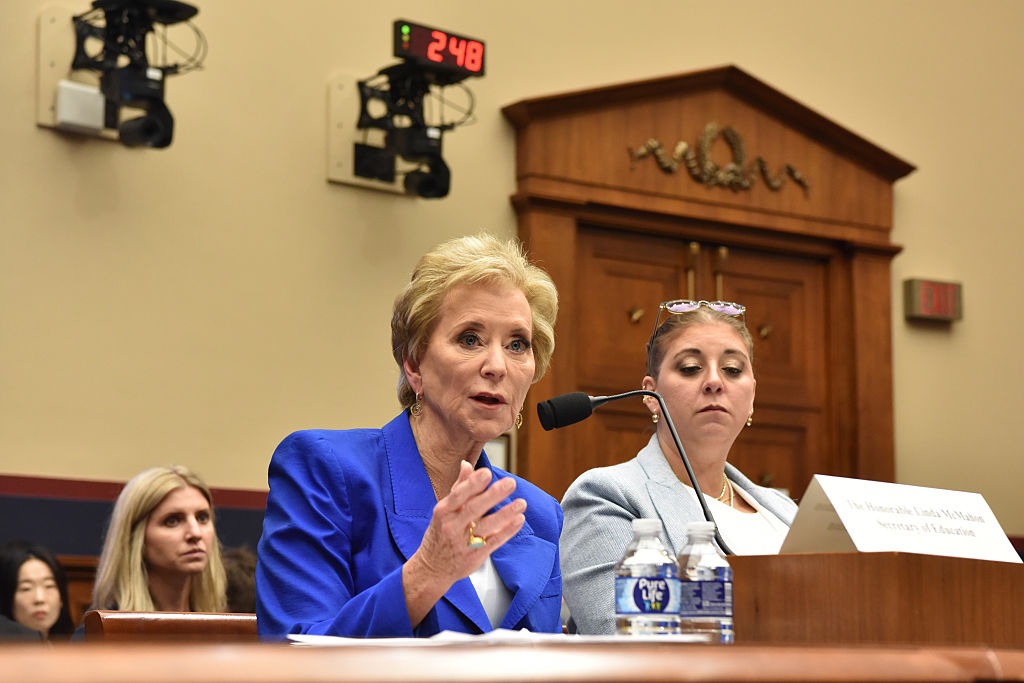
Education Secretary Linda McMahon defended her cuts to programs and staff before a House education committee June 4. (Sha Hanting/China News Service/VCG via Getty Images)
Even if the Supreme Court rules in McMahon’s favor, its opinion won’t affect previous rulings and other lawsuits in progress against the department.
Here’s where some of those key legal battles stand:
COVID relief funds
McMahon stunned states in late March when she said they would no longer receive more than $2 billion in reimbursements for COVID-related expenses. States would have to make a fresh case for how their costs related to the pandemic, even though the department had already approved extensions for construction projects, summer learning and tutoring.
On June 3, a federal judge in Maryland blocked McMahon from pulling the funds.
Despite the judicial order, not all states have been paid.
The Maryland Department of Education still had more than $400 million to spend. Cherie Duvall-Jones, a spokeswoman, said the agency hasn’t received any reimbursements even though it provided the “necessary documentation and information” federal officials requested.
The cancellation forced Baltimore City schools to dip into a reserve account to avoid disrupting tutoring and summer school programs.
Madison Biedermann, a spokeswoman for the department, declined to comment on why it had yet to pay Maryland or how much the department has distributed to other states since June.
Mass firings
In the administration’s push to wind down the department, McMahon admits she still needs staff to complete what she calls her “final mission.” On May 21, she told a House appropriations subcommittee that she had rehired 74 people. Biedermann wouldn’t say whether that figure has grown, and referred a reporter to the hearing video.
“You hope that you’re just cutting fat,” McMahon testified. “Sometimes you cut a little in the muscle.”
The next day, a federal district court ordered her to also reinstate the more than 1,300 employees she fired in March, about half of the department’s workforce. Updating the court on progress, Chief of Staff Rachel Oglesby said in a July 8 filing that she’s still reviewing survey responses from laid off staffers and figuring out where they would work if they return.
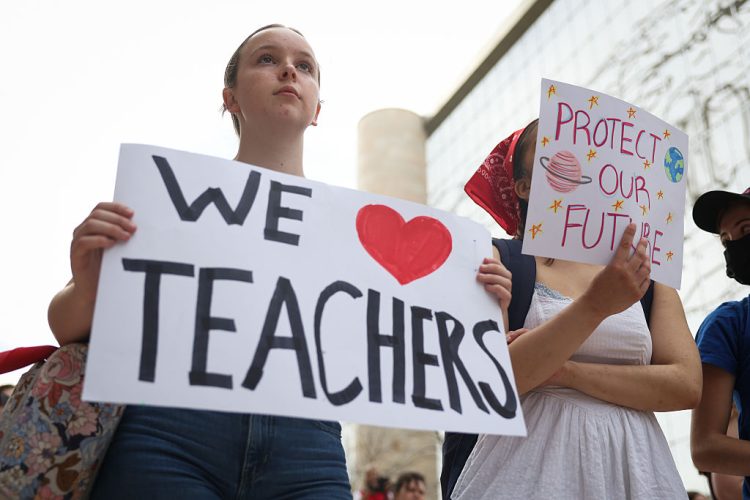
Student protestors participate in the “Hands Off Our Schools” rally in front of the U.S. Department of Education on April 4 in Washington, D.C. (Getty Images)
But some call the department’s efforts to bring back employees lackluster, perhaps because it’s pinning its hopes on a victory before the Supreme Court.
“This is a court that’s been fairly aggressive in overturning lower court decisions,” said Smith, with the National Center for Youth Law.
His group’s lawsuit is one of two challenging cuts to the Office for Civil Rights, which lost nearly 250 staffers and seven regional offices. They argue the cuts have left the department unable to thoroughly investigate complaints. Of the 5,164 civil rights complaints since March, OCR has dismissed 3,625, Oglesby reported.
In a case brought by the Victim Rights Law Center, a Massachusetts-based advocacy organization, a federal district court judge ordered McMahon to reinstate OCR employees.
Even if the case is not reversed on appeal, there’s another potential problem: Not all former staffers are eager to return.
“I have applied for other jobs, but I’d prefer to have certainty about my employment with OCR before making a transition,” said Andy Artz, who was a supervising attorney in OCR’s New York City office until the layoffs. “I feel committed to the mission of the agency and I’d like to be part of maintaining it if reinstated.”
DEI
An aspect of that mission, nurtured under the Biden administration, was to discourage discipline policies that result in higher suspension and expulsion rates for minority students. A 2023 memo warned that discrimination in discipline could have “devastating long-term consequences on students and their future opportunities.”
But according to the department’s Feb. 14 guidance, efforts to reduce those gaps or raise achievement among Black and Hispanic students could fall under its definition of “impermissible” DEI practices. Officials demanded that states sign a form certifying compliance with their interpretation of the law. On April 24, three federal courts ruled that for now, the department can’t pull funding from states that didn’t sign. The department also had to temporarily shut down a website designed to gather public complaints about DEI practices.
The cases, which McMahon has asked the courts to dismiss, will continue through the summer. In court records, the administration’s lawyers say the groups’ arguments are weak and that districts like Decatur simply overreacted. In an example cited in a complaint brought by the NAACP, the Waterloo Community School District in Iowa responded to the federal guidance by pulling out of a statewide “read-In” for Black History Month. About 3,500 first graders were expected to participate in the virtual event featuring Black authors and illustrators.
The department said the move reflected a misunderstanding of the guidance. “Withdrawing all its students from the read-In event appears to have been a drastic overreaction by the school district and disconnected from a plain reading of the … documents,” the department said.
Desegregation
The administration’s DEI crackdown has left many schools confused about how to teach seminal issues of American history such as the Civil Rights era.
It was the Civil Rights Act of 1964 that established “desegregation centers” across the country to help districts implement court-ordered integration.
In 2022, the Biden administration awarded $33 million in grants to what are now called equity assistance centers. But Trump’s department views such work as inseparable from DEI. When it cancelled funding to the centers, it described them as “woke” and “divisive.”
Judge Paul Friedman of the U.S. District Court for the District of Columbia, a Clinton appointee, disagreed. He blocked McMahon from pulling roughly $4 million from the Southern Education Foundation, which houses Equity Assistance Center-South and helped finance Brown v. Board of Education over 70 years ago. His order referenced President Dwight Eisenhower and southern judges who took the ruling seriously.
“They could hardly have imagined that some future presidential administration would hinder efforts by organizations like SEF — based on some misguided understanding of ‘diversity, equity, and inclusion’ — to fulfill Brown’s constitutional promise to students across the country to eradicate the practice of racial segregation.”
He said the center is likely to win its argument that canceling the grant was “arbitrary and capricious.”
Raymond Pierce, Southern Education Foundation president and CEO, said when he applied for the grant to run one of the centers, he emphasized its historical significance.
“My family is from Mississippi, so I remember seeing a ‘colored’ entrance sign on the back of the building as we pulled into my mother’s hometown for the holidays,” Pierce said.
Trump’s Justice Department aims to dismiss many of the remaining 130 desegregation orders across the South. Harmeet Dhillon, assistant attorney general for civil rights, has said the orders force districts to spend money on monitoring and data collection and that it’s time to “let people off the hook” for past discrimination.
But Eshé Collins, director of Equity Assistance Center-South, said the centers are vital because their services are free to districts.
“Some of these cases haven’t had any movement,” she said. “Districts are like ‘Well, we can’t afford to do this work.’ That’s why the equity assistance center is so key.”
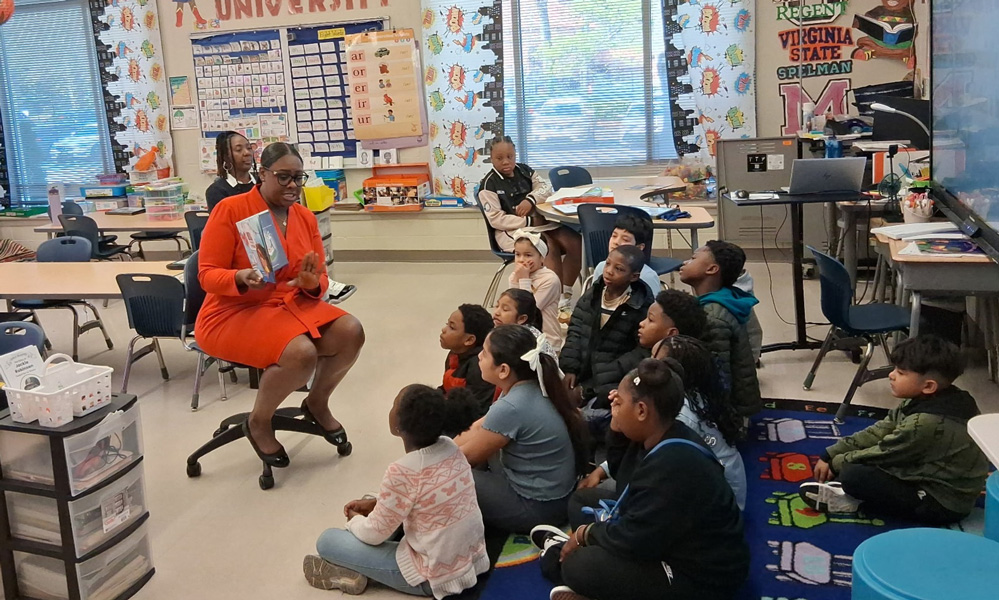
Eshé Collins, director of Equity Assistance Center-South and a member of the Atlanta City Council, read to students during a visit to a local school. (Courtesy of Eshé Collins)
Her center, for example, works with the Fayette County schools in Tennessee to recruit more Black teachers and ensure minority students get an equal chance to enroll in advanced classes. The system is still under a desegregation order from 1965, but is on track to meet the terms set by the court next year, Collins said. A week after Friedman issued the injunction in the foundation’s case, Ruth Ryder, the department’s deputy assistant secretary for policy and programs, told Collins she could once again access funds and her work resumed.
Research
As they entered the Department of Education in early February, one of the first moves made by staffers of the Department of Government Efficiency was to terminate nearly $900 million in research contracts awarded through the Institute for Education Sciences. Three lawsuits say the cuts seriously hinder efforts to conduct high-quality research on schools and students.
Kevin Gee from the University of California, Davis, was among those hit. He was in the middle of producing a practice guide for the nation on chronic absenteeism, which continues to exceed pre-pandemic levels in all states. In a recent report, the American Enterprise Institute’s Nat Malkus said the pandemic “took this crisis to unprecedented levels” that “warrant urgent and sustained attention.” Last year’s rate stood at nearly 24% nationally — still well above the 15% before the pandemic.
Gee was eager to fully grasp the impact of the pandemic on K-3 students. Even though young children didn’t experience school closures, many missed out on preschool and have shown delays in social and academic skills.
Westat, the contractor for the project, employed 350 staffers to collect data from more than 860 schools and conduct interviews with children about their experiences. But DOGE halted the data collection midstream — after the department had already invested about $44 million of a $100 million contract.
Kevin Gee, an education researcher at the University of California, Davis, had to stop his research work when the Trump administration cancelled grants. (Courtesy of Kevin Gee)
“The data would’ve helped us understand, for the first time, the educational well-being of our nation’s earliest learners on a nationwide scale in the aftermath of the pandemic,” he said.
The department has no plans to resurrect the project, according to a June court filing. But there are other signs it is walking back some of DOGE’s original cuts. For example, it intends to reissue contracts for regional education labs, which work with districts and states on school improvement.
“It feels like the legal pressure has succeeded, in the sense that the Department of Education is starting up some of this stuff again,” said Cara Jackson, a past president of the Association for Education Finance and Policy, which filed one of the lawsuits. “I think … there’s somebody at the department who is going through the legislation and saying, ‘Oh, we actually do need to do this.’ ”
Mental health grants
Amid the legal machinations, even some Republicans are losing patience with McMahon’s moves to freeze spending Congress already appropriated.
In April, she terminated $1 billion in mental health grants approved as part of a 2022 law that followed the mass school shooting in Uvalde, Texas. The department told grantees, without elaboration, that the funding no longer aligns with the administration’s policy of “prioritizing merit, fairness and excellence in education” and undermines “the students these programs are intended to help.”
The secretary told Oregon Democratic Sen. Jeff Merkley in June that she would “rebid” the grants, but some schools don’t want to wait. Silver Consolidated Schools in New Mexico, which lost $6 million when the grant was discontinued, sued her on June 20th. Sixteen Democrat-led states filed a second suit later that month.
The funds, according to Silver Consolidated’s complaint, allowed it to hire seven mental health professionals and contract with two outside counseling organizations. With the extra resources, the district saw bullying reports decline by 30% and suspensions drop by a third, according to the district’s complaint. Almost 500 students used a mental health app funded by the grant.
A judge has yet to rule in either case, but Republican Rep. Brian Fitzpatrick of Pennsylvania and other members of a bipartisan task force are holding McMahon to her word that she’ll open a new competition for the funds.
“These funds were never intended to be a theoretical exercise — they were designed to confront an urgent crisis affecting millions of children,” Fitzpatrick said in a statement. “With youth mental health challenges at an all-time high, any disruption or diversion of resources threatens to reverse hard-won progress and leave communities without critical supports.”