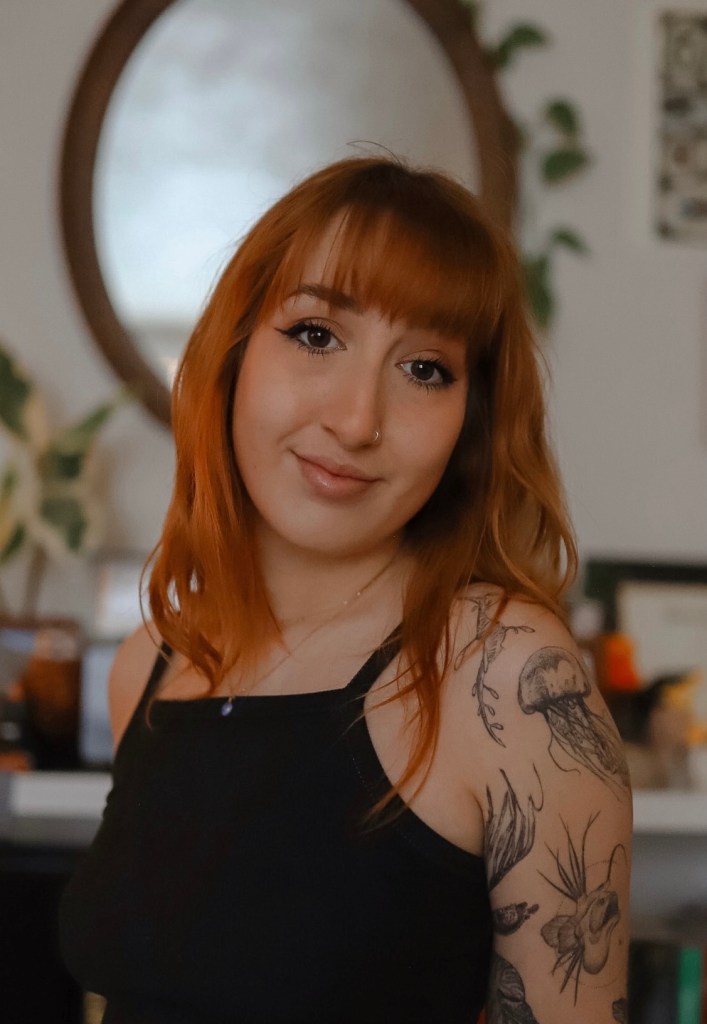
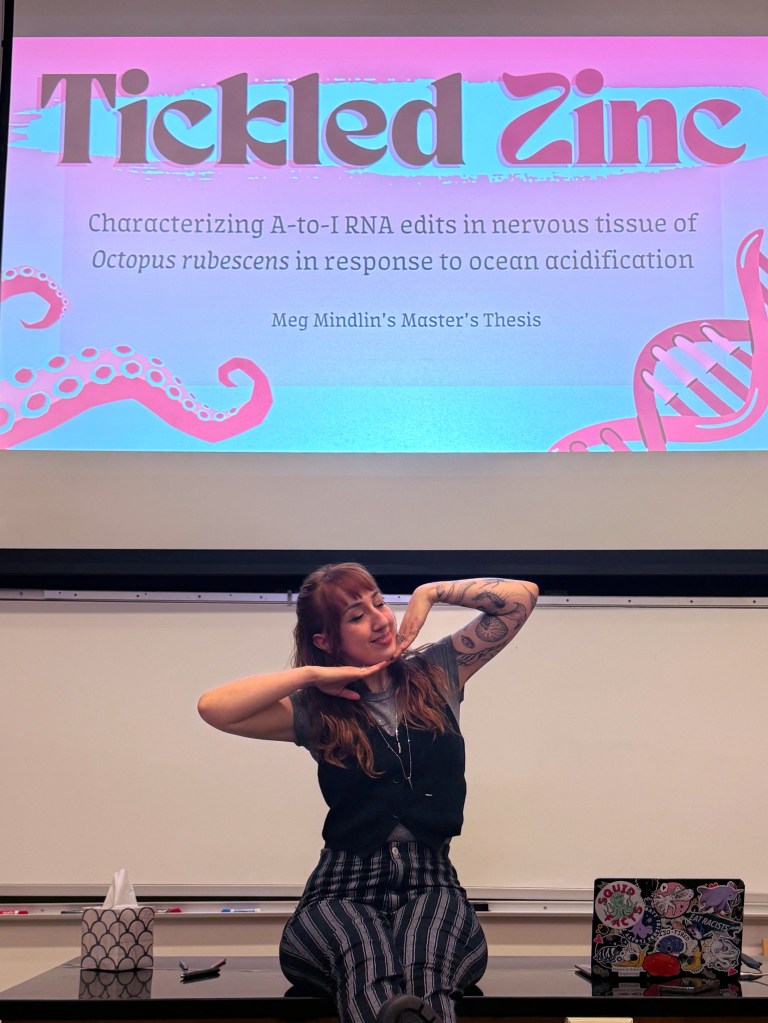
What’s it like to be an artist and scientist? Meg Mindlin studies octopuses, shares videos for Instagram Reels and TikTok. And, she’s a talented artist who helps people communicate science in engaging way. I felt lucky to attend her thesis defense live on YouTube.
In this conversation, we talk about her research, dealing with the political spectrum when speaking up on social media, and sharing her art online.
Bio
Meg Mindlin (@invertebabe) is a molecular biologist and science communicator. She combines her background in art with an ability to communicate complex science in an engaging manner. She received her Masters in Biology studying octopuses and how ocean acidification effects a molecular process known as RNA editing.
Are you on the job market or seeking a new career? Professors and researchers, this interview is especially for academics considering leaving academia (or if you’re forced to leave unexpectedly). I’m happy career coach, Dr. Jennifer Polk of From PhD to Life is back for this 2025 episode.
Jen’s been on The Social Academic to chat with me back in 2022 when we talked about Informational Interviews. She also joined me for a YouTube live in 2020 where she answered the question, What Is Networking? This year especially, mid-career and senior academics may be pivoting away from their more traditional academic career path. Many researchers and scientists in the United States of America have been let go. While there’s many resources out there to help with your next steps, such as the From PhD to Life blog, you may want personalized support from a career coach and community. We talk about Jen’s PhD Career Clarity Program which you may find helpful.
While we talk about a service for academics in this and other interviews on The Social Academic, I don’t receive any gift or monies if you choose to move forward with Jen’s PhD Career Clarity Program. I share people including Dr. Jen Polk with you, because I trust and recommend her to clients and friends.
In this interview
Reintroducing Dr. Jennifer Polk (@FromPhDToLife)
Jennifer Van Alstyne[‘Jennifer’]: Hi! Welcome back to The Social Academic, a podcast, blog, YouTube channel about online presence for professors, researchers, PhDs, people who are in academia. Dr. Jennifer Polk is back with me today. She’s someone who we featured here on The Social Academic in the past. She’s been live on the YouTube channel, but this time we have new things to talk about. I mean, the social media landscape has changed in 2025. Jen, would you start by introducing yourself?
Dr. Jennifer Polk [‘Jen’]: Oh no, I’m on the spot!
Yes, I’m Jen Polk. My business is called From PhD to Life. I work with professors, postdocs, and other PhDs who are ready to leave academia and go somewhere where they will be respected and valued and all that good stuff, even if they don’t yet know what the heck that could ever be. I’ll help them figure it out.
Jennifer: I love that. You’re a career coach who’s like, you’re not new to this space, right? You’ve been doing this for a while.
Jen: A while, indeed. What’s a while? More than 10 years? More than 10 years, yes.
Jennifer: Amazing.
Jen: Yes. Someone called me the OG PhD career coach. Am I saying that right? OG, is that what the kids say?
Social media climate for academics in 2025
Jennifer: OG, yeah. I love it. I love it. I’m curious because you’re actually like an early social media user, early online user. How have you seen things shifting or changing in social media in the past year or so?
Jen: Big sigh, sob, hysterics. [Sighs]. Okay, one way of putting it is Twitter is dead to me. I mean, Twitter is dead, right? Twitter is dead to me and Twitter is dead. And now that was a big problem. And please interrupt me when I go on and on and on about this. Most of my clients the last few years found me via Twitter. Not 100%, but that was a big place where people got to know me and eventually work with me. And that was true for individuals who wanted to work with me as like for career coaching, guidance on their own individual job searches, as well as the folks who work in universities and bring in speakers to do workshops and presentations. And so a lot of my business happened in part on Twitter.
Now, I don’t even go to Twitter anymore. So just for me personally, Elon Musk has ruined my life. No, I’m being dramatic. Yeah, just like that’s a small but sort of huge thing for me when it comes to social media. I mean, that’s the first thing that comes to mind.
Jennifer: I’m curious, like, gosh, you’ve been such a prolific Twitter user. Are you finding community elsewhere? Like, are you using other platforms the way you used to use Twitter or what?
Jen: Yeah, it’s a good question. And I don’t have a good answer because my answer right now is also a sigh. And I am on Bluesky, but I haven’t quite started using it for my career. Let’s put it that way. So it’s not that I’m not using it at all, but I tend to go on there more as like a personal, I want to share a thing. And ideally, if it was, if it made sense to spend the time, it would have a mix of like me as a person and me as a business owner that you could work with. That is how I always used Twitter. And Bluesky is different in terms of reach and engagement. That is not just because I’m bad at it, but that was like a deliberate, you know, that’s how it works.
Jennifer: I think that’s so helpful to share with people. I mean, like you are, you have a huge following on social media. Whether Twitter is dead or not, like people still follow you there. And yet on Bluesky, what was working for you in the past, maybe it doesn’t feel the same, maybe it doesn’t get the same engagement. The same thing on different platforms can have different results. And that’s something helpful for people to know when someone has an audience size of yours is still experiencing that, I don’t know, that frustration.
Jen: Yeah. And something else that might be interesting for your audience is that I have mixed feelings, I mean, I have mixed feelings about so many things in life, but including LinkedIn as well. I go through like seasons with LinkedIn. Last year, what is it, 2025 now. So back in 2024, for the first almost six months of the year, most days of the week, I would say I was posting on LinkedIn. And yeah, I did that consistently for those first six months and I got out of the habit and I’m much more sporadic now and I want to like it, but it’s just never, it’s just never really done it for me the way it’s . . . oh, lament, lament for Twitter of old.
I don’t know. I don’t know. I mean, I don’t know social media, you’re not doing it for me, but I want to like it.
Social media for academics who are job seekers in 2025
Jennifer: Mm. Hmm. Now, there are so many job seekers right now, whether they’ve been laid off in federal government and their PhDs or their academics who are finding funding issues that are now unexpectedly needing to search for jobsl for their financial future. I’m curious, what we just talked about in terms of social media, how might that impact job seekers?
Jen: Man, it’s such a scary time. One thing that comes to mind for the impact on job seekers is folks that do have jobs in the US federal government, in the US in general maybe, in universities, I think they might want to be a little bit more circumspect if that’s the right word. A little more cautious about what they put out there. I mean, we’re reading like insane things. Who knows if they’re true, but like, is Grok reading your tweets? Is DOGE [Department of Government Efficiency], are the teenagers surrounding Musk like turning the AI on your tweets and deciding who to fire that way? Like, I don’t mean to sound like a conspiracy theorist, but I think there’s some evidence that, anyways, I think people might be right to be a little bit more cautious about what they put out there. Even Bluesky, my understanding is that Bluesky is open. So you don’t even, I mean, even though it’s not owned by bad faith actors, foreign actors, it’s still maybe, you still want to maybe be a bit cautious about it. I don’t know if that’s what you were getting at with your question, but that’s one thing. That’s not the only thing, but I think that’s one thing that folks might want to think about.
Jennifer: Yeah, I really appreciate you saying that because that’s a question that’s been on my mind lately as professors who, this actually came up in a workshop, have sensitive topics. That was a good way of putting it. Sensitive in the sense that if they talk about it, the thing that they do in their research, in their work every day, they could attract hate. They could attract political controversy, even if they’re just posting about a new publication. And so this is actually something I brought up in a social media mastermind group that I’m in monthly because I wanted to hear how other people, how strategists who work on social media with companies and different agencies are handling the political divide. And it was really great to be open about the worries and fears that some professors are having right now. Yeah, everyone kind of said, “Airing on the side of caution.” Airing on the side of facts doesn’t even always work. It’s not enough anymore. And so really thinking about protecting yourself and having that feeling of safety, if you’re unsure before you post, maybe don’t do it. Ask a friend to look it over in advance. It’s hard.
Jen: I hate it, right? I hate it. I don’t want this. I have a client who is, well, let me not give away too many details, but who is a target of bad actors, right-wing bad actors as a person that shows up on lists, the kind of lists that you don’t want to be on and that is just total BS, right? And her solution, one solution anyways, to continue to be a public intellectual, to write because that’s important to her, is that she has changed the name that she uses. So it’s still kind of basically the same name, but the addition of like an initial or, I forget exactly what it was, the decision, but like of using like the first name instead of the middle name kind of thing as just one, it just makes it easier to differentiate herself from the person who’s being targeted on the internet. And I thought that was a nice, you know, partial kind of practical thing that was in her control, you know, because she can’t scrub the web, doesn’t have any control over that, but she could, you know, add an initial or anyways, you know what I’m saying?
Jennifer: I really like that. That’s such a, it’s a doable solution for people when you’re unsure, just know that you have that option. And maybe now is a time that anonymous accounts could protect you. If you’re someone who does want to say something politically, and you don’t want it to touch your professional or your personal kind of social media. I did hear from a couple of people who do like to say, what is truth? What is science? What is facts? And they need to protect themselves in order to do that by creating maybe an anonymous profile that’s not connected with themselves. So there are options, even though yes, it is scary. Yes, things have changed. [Sighs]
Jen: It’s just like you’re in that lament mode.
Jennifer: I know. I’m sorry. I’m kind of a downer. But honestly, I think that’s how people are feeling. And that’s what people are experiencing right now. So if we didn’t say it, it would be not right.
Jen: Yeah. The free speech brigade is, that’s not what they care about. I mean, this is obvious, right? But let’s just say we know that this is obvious. They don’t have consequences, but you might experience consequences.
Blogging and other ways to share online
Jennifer: Exactly. Exactly. Now, there are other ways to create content and you’re someone who’s actually for a long time tried different forms of content. Blogging is one of them.
Jen: [Laughs] In other words, you have failed so many times, Jen. You have failed to hit on the thing that works.
Jennifer: No. In other words, you’ve experimented with lots of different forms of media and you found things that really work for you for a time. And then sometimes you get curious about something else. And so you switch it up.
Jen: That’s a better way to put it.
Jennifer: I think that’s really what’s happened with you because you were prolific at the things that you do try and experiment with. And the From PhD to Life blog is one of them. I mean, when did you start that? That’s pretty old, right?
Jen: It’s old. So unless my memory is going, I started, so From PhD to Life started as a blog and a website the same day, December 12, 2012. I bought the domain and I got the WordPress site and I wrote my first two posts, I think, if memory serves. Yes, back in 2012, I was really excited about it. The internet was a different place back in 2012, but that is how I started and that is how I grew my business in the early years. I was on Twitter pretty quickly as well, but first the blog, then came Twitter. I think important for folks to know is that although I started my blog on my own website, within, I think I’m getting this right, within a few months, I got asked to blog on an external site. So universityaffairs.ca, which is a Canadian post-secondary ed sector magazine. I don’t know if they’re still a physical magazine, but they were like a 10 times a year kind of magazine and they also had a website. And so I was one of their bloggers, one of their columnists as they called me, but just online. So that was amazing for reach in Canada and beyond as a legitimizing place. Again, the internet is different now, but that was cool.
Jennifer: That is so cool. And you actually, I remember you won an award for that, didn’t you?
Jen: Three!
Jennifer: Three! You won three awards!
Jen: I mean, it’s been a few years now. I think back in 2015, 16, 17, I got the Gold Award in front of the Canadian Online Publishing Awards for best blog or column in the Blue category, which was for business.
Jennifer: Amazing. It’s amazing. I mean, it’s amazing because having a blog about PhDs seeking careers and finding a path that works for their life is like, that should be awarded. But I mean, it’s exciting that that’s the topic that they chose because your blog was so great. Now, the blog did win awards and it did have this big reach, but recently kind of disappeared from the university affairs website, which is typical. I will say like, websites do this. They take down the public writing sometimes in order to put new stuff up. And so when did you notice that it was gone?
Jen: Yeah. So I think I noticed maybe late fall 2024, something like that. I noticed because I think it was when a client alerted me to a broken link in our online platform for my online course. And I was like, “Oh. Oh, it’s all gone. Okay. Okay. All right. Fair enough.” I know. Gut punch, stab, but also, “Yeah, fair enough.” Okay. It’s been a few years. I stopped blogging for them back in 2020. So it’s been a few years. They owe me nothing. But there was a bit of a moment of, there was at least some good content there that, of course, I didn’t have a record of because who’s that organized? Maybe everybody else listening, but not me.
Jernnifer: No, when I’m thinking about it now, like my first two years of blogging, I backed up everything. Like I have like a word document of them at least. Recently, nothing. I don’t have anything saved outside of the website itself.
Jen: Well, it’s time.
Reclaiming online presence from out of the past
Jennifer: I know, it’s time, especially after what happened with the University Affairs version of your blog. Now, what did you do? Like, that stuff was just gone and you had a solution for actually finding the most important things and bringing it back. What happened?
Jen: Yeah. So the immediate issue was that there was this post that I’d linked to from my course that I think was a good one and useful. And I found it on Internet Archive. And so when it came time to think sort of beyond this immediate problem of like, “Okay, that one post, I want to continue to link to it. Oh, can I find all of the ones on Internet Archive?” In fact, I made a donation to Internet Archive because I was like, “Thank you so much!” Yeah. So then with your help JVA, I went through and picked out the blog posts that I thought were worth saving. I mean, there were, there were a handful that was like, “Eh, that was what I was thinking, you know, eight years ago, but whatever.” And yeah, you helped me put them on my website, copy and paste. Anyways, if you want to say more about that, I’ll let you say more about that. But I’m glad for that because now it’s on my site, I own it. Well, whoever owns the internet owns it. I feel like it’s a little bit more in my hands.
Jennifer: Yeah. I think that process is overwhelming for people. So it was kind of nice that we got to do it together. But my father-in-law, for instance, is a critic of art. And so he’s had a long career where he’s written, I mean, like hundreds, like thousands, I don’t know, like so many reviews and articles that, when art critics were being laid off quite a while ago and since then, his writing has disappeared from, a lot of his writing has disappeared from the website. And they did give him permission to pull all of the things that he wanted. But like, is he going to go back through the Internet Archive and pull all of those things? No, he doesn’t have the same drive or motivation that someone like you does. So a lot of that stuff, it’s not lost. He has it in physically bound, beautiful books, but it doesn’t mean that it’s like accessible for other people. And so when that’s the goal, when like that’s what you want, yeah, sometimes the project takes a little bit longer than we might want. It can be a little bit frustrating to have to search down old things, but then you have agency and choice in what you do about it next. And so for Jen, she got to pick the ones that were most important to her, we put them back on her blog, on her website FromPhDtolife.com. And that’s something that you could do for your own website. There’s so many options for you, but just knowing that the Wayback Machine and the Internet Archive exist for you to search, it’s a huge tip for people. Actually, after we worked together on that, I went back and I found some things that I’d written as like guest posts for other people in the past that had disappeared. Like they weren’t on the blog anymore because maybe the business had changed or what they were doing with the organization had changed. And so it was really easy for me to pull my original writing, which I didn’t have a good copy of, and put it back on my website so it could still help people. And when I did, I still put a little note at the bottom that said this has originally appeared on this place because I still want to honor that original purpose for the writing. And it’s really interesting to see how we can create afterlives for the things that we’ve written and created. So I love that.
Jen: Yeah, I will say one thing for folks to know, at least in my experience, the Internet Archive kind of crapped out after a few years. So if you’ve got stuff from like 20 years ago, well, is it even alive after 20 years, I don’t know. But anyways, just do it now. You know, put an hour or two in your calendar, do it now. Don’t wait for five years.
Jennifer: Yeah, right. Pull the content now and you can always do something with it later.
Jen: Yep. Yeah, it really only took me an hour or two-
Jennifer: Perfect.
Jen: And I didn’t have your father-in-law’s archive, but you know, I had a few years of stuff.
Jennifer: There was actually more than I expected in a good way, in the sense that like it really created new life for those pieces of writing that were just lost in the Internet Archive. Now, I’m curious about how your website has kind of changed over time, because the website is 2012. That’s a long time to have a website and actually add new things to it. Like, that’s a lot of new things. So what’s it been like to have a website for that long?
Jen: Whew, boy. Yeah. And for most of that time, I, and only I was the one doing all the things and you could tell. That’s okay, but you know. I always used a free WordPress. So it’s always been a WordPress and I, it’s always been on WordPress.org, is that right?
Jennifer: Yeah, that’s correct for you.
Jen: Yeah. And it’s always been connected to my domain FromPhDtolife.com. Anyways, I’m veering from your question. What was it, a year and a half ago that I hired you? Two years ago?
Jennifer: Yeah, something like that.
Jen: And you, so we’ve done this in two or three stages now. Which has felt manageable, you know, both financially and also in terms of my own need to do some homework, pre-work.
Jennifer: We only have so much capacity to do things for our own websites and stuff.
Jen: Yeah. So that was, I think that’s really a key point because I had not an outrageous number of pages, but it’s not, it’s not just a one page or two or three page website. There’s a few more pages than that. And for the most part I think my pages were ones that I wanted to keep, but they just over, over time they get longer like an academic CV, right? I’m thinking of like one or two pages in particular that they just, they just grow. You know, as if I was some sort of like tenured professor. So it was really good to say, “Okay, let’s focus on this page and this page and then let’s stop.” And then six months later, “Okay, now I’m ready to do this and this,” right? So that was, so yeah, it just made the process a lot more manageable. And now if you go to my website now, unless I’ve messed it up, unless I have messed it up, it’s looking so much more in-, it’s just more inviting and welcoming, easier for people to use and get at the information that will help them. Yeah, so that I can help them, whether they’re just looking at my website or wanting to take another step or two into working with me.
How to work with Dr. Jen Polk
Jennifer: Yeah. Like what, what does that look like? Like what if someone does come to your website and they want to take those next steps to work with you? How can PhDs, professors, researchers thinking of leaving academia, you know, work one-on-one with you, work in a group with you? How does that work?
Jen: Yeah. So folks that are like raring to go. They have options to just pay me money and start working with me immediately. Of course, that’s not going to be most people, especially if you’ve never heard of me before. The main thing that I recommend, so this is for individuals who are interested in their own job search, right? You know, getting another job. There is a free webinar, it’s a video on my website and then there’s like a yellow button kind of all over the place. So I recommend starting with that. You can sign up, you can watch this whenever, you can put it in your schedule and watch it later. It’s got captions and you can press pause, all that good stuff, right? So that I really recommend because it is a, a rich intro to what I teach my clients and the step-by-step process that I recommend everybody go through from like, “Uhh” to “Okay!” You know, I have a great offer and I’m starting a job. Yeah, and then at that point, what most folks do is of course, they feel more confident and more ready to, and they just have a sense of, “Okay, I’m going to stop doing that approach and,” you know, shift my energies more in this direction. And they can go off and do it on their own. There’s a couple of options after that. Individuals can sign up for a one-on-one with me, over Zoom, phone if you want and we can go more in depth for an hour on, you know, your particular issue, whether that’s networking or LinkedIn, or I don’t even know what I should be doing for the rest of my life. Or even better, depending on the person, I have a program. It’s an online course plus, plus other stuff, right? I called a PhD Career Clarity Program and that’s really great for professors, postdocs, other PhDs who are ready to leave academia and leaving academia can mean that you are right now working in academia, or it can mean like in some way you still identify with that profession even if you don’t currently work there. I often get clients who already got a job outside of academia, but that’s not the right fit. So anyways, that’s a very long answer. Start with the free thing and then take it from there.
Feeling hope with the PhD Clarity Program
Jennifer: I love that. And one of the things that we talked about when we were working on kind of the sales page for the PhD career clarity program is that feeling of hope that people have when they are joining this group and feeling like, “Oh, okay, now I can have that support.” What is the emotional journey for some of these people who are going through your program?
Jen: Yeah, it’s really interesting because I asked one of my clients a while back, asked somebody that was in the program like, “Why did you join?” And what my, the things that I thought that she would share or that I think sort of in general people share is that they’re feeling kind of like, despair. Maybe not completely, but like there’s some moment of, there’s some feeling of, “I can’t do anything. I’m no good for anybody. Nobody’s ever going to pay me money to do anything. I can’t do it.” And I think sometimes that’s relatable for some people, not everybody.
Jennifer: Yeah, yeah.
Jen: There are certainly other people that are like, “No, I’m feeling confident. I know I have something to offer. I don’t know what it is outside of academia. And so it’s not that I feel bad about myself. It’s that I need to figure out like, what is this called elsewhere?” So those are kind of two things that I had in mind, depending on the person. I mean, maybe you can tell resonated more personally with the first one.
Jennifer: I think my husband did too. He’s also a PhD who felt some despair. Yeah.
Jen: Yes. So okay, you’re in good company. If you consider me to be good company anyways.
Jennifer: Yes!
Jen: So there was a third option that I found when I asked my own client who was in the program. And, I think of course she probably felt both of those two things. And a third thing, which is the moment that she decided to join the program, she felt hope. Right? It was like, okay, I don’t know. I don’t know what it is that I’m going to do. Right? I don’t, I’m not entirely sure about my place in the world and what I have to offer and how to tell people about who I am and all of that stuff. But I’m hopeful and I’m going to invest that hope, that energy, that time, some money into moving myself forward. And I really, I love that, right? Cause that’s actually, that was I think a missing piece in my understanding of where people were at. Because yeah, I want you to bring some energy, some hope into this, which is not to downplay any of the other emotions: good, bad, ugly. But I think there’s some . . . Yeah, I think that’s a good, that’s a good, helpful thing to have and a hard thing, a hard thing, right?
Jennifer:The PhD Career Clarity Program has like a core course, it has workshops and resources. It also has a community. I’d love to hear a little bit more about that community aspect and how people from all these different fields are coming together and like actually finding support within their job search process?
Yeah. So the community I would say tends to exist, communities are amorphous things, but I would say it comes alive for the most part during our live meetings. And I, there’s two types of live meetings. One is the small group coaching sessions, which these days I do three times a month for an hour. Those are drop-in, you know, bring yourself and whatever’s going on. And then three of those a month. And then once a month, you mentioned I do live workshops. That’s really where the community comes alive, yeah? And it’s really great because the question that sometimes folks ask me is, “Oh, have you ever worked with, you know, a biochemical engineer, right? Or have you ever worked with somebody who goes into like X specific company, right? And the answer could very well be yes, but then the second part of the answer is it doesn’t matter. It doesn’t matter because it’s really magical what happens when people with disparate backgrounds and career trajectories and, you know, knowledge, expertise and skill areas. In fact, we have a lot in common and that there are differences really enrich the discussions that we have because of course, we’re all different. We’re all different men, women, trans folks, like we, you know, life is different: mothers, fathers, people without kids, et cetera. But it really, it’s really great what happens when we’re together sharing updates and commiserations and strategizing and putting our eyeballs, you know, on each other’s resumes and LinkedIn profiles. I think it really helps people feel much more confident. Academia can be so siloed within disciplines that it can be difficult to imagine yourself stepping into a professional world where you’re not surrounded by other chemists or other anthropologists or whoever, right?
Jennifer: Yeah.
Jen: So in a way this is like part of growing your confidence, is interacting in a semi-professional space with people from different backgrounds.
Jennifer: I think it sounds really warm. I think that I’m someone who personally had avoided community or group type things in the past and it was only in the last like five years or so that I have found not just comfort, but like comfortableness within myself because of group programs. Like because I feel more comfortable in smaller communities where we can actually get like a surprising amount of stuff done, whether it’s like emotional relationship building or whether it’s like really getting down and working on strategy and doing something harder. But like my resistance to group programs is like something that, I’m so glad that I have left behind because it really opens up my world to new things. So I’m glad you said that. Yeah.
Jen: You know, when I started my business, I was doing one-on-one coaching and that’s like the typical model for someone with a coaching approach. And I sometimes do that now, but the coaching I do for the most part is group coaching. And it’s facilitation, group discussions, And that I think is, yeah, is just really powerful and fun. You know, I’m happy to chat with anybody who’s interested but concerned because I know that, there are concerns that people have like, “Am I going to be drowning in all of these other people? Am I going to be the odd person out with nothing in common with anybody else,” etc. But let me know. Let’s chat about it. It’s not for everybody, but I think it’s probably for you.
Big sigh, last words
Jennifer: I appreciate you, Jen. I’m so glad you came back on The Social Academic. Is there anything else you’d like to add before we wrap up?
Jen: Big sigh. You know, I think there’s still connection to be made online. There’s still good people out there trying to make a difference in the world in the ways that they can, including online.
Jennifer: Yeah.
Jen: There’s still value in sharing what you’re about. Even if right now in some circumstances, you might choose to be a little bit more circumspect. There’s still value in that. And in the meantime, you may build community in other ways and that’s okay too. You know, you don’t owe your social media followers. Can I say this? You don’t owe them anything, right? You don’t owe them your presence. You don’t, you can choose to pause your activity and you don’t have to stress about it. I mean, what would you say?
Jennifer: Yeah, I think that’s really good. I think that last year, personally, I leaned into more of the pause in the sense that like, I didn’t put as much effort into social media. I really tried to be more relaxed about it. And that meant I was posting less. It meant I was taking some long breaks, sometimes weeks. And it made a difference for my mental health, but it also made a difference for like my brain and what I was able to focus on instead. Letting go of some of that need to post was helpful for me. But on the flip side of that, if you’re someone who struggles to post, being conscientious, being cautious does make sense, but also know that there’s other ways that you can have a strong online presence, whether it’s filling out your LinkedIn profile, creating a simple personal website or portfolio website. There’s so many options for you. And it’s okay if social media isn’t where you want to be spending your time.
Jen: Yeah, it’s great when people reach out and they write because they found you somewhere.
Jen: Thank you. Always, always nice to chat, even if it’s a bit formal like this.
Jennifer: And for everyone who’s listening, I’m going to drop the links to Jen and I’s past interviews on informational interviews and on what is networking so you can check those resources out too.
Jen: Can I say one more thing?
Jennifer: Yeah.
Jen: Just anybody who is thinking about hiring my friend JVA to help with your online presence, writing a bio, you know, let me be more specific, getting your website looking a little better, maybe a lot better. Do not hesitate. Act now. Run, don’t walk.
It’s been really, really fun to work with you, Jennifer. And we’re going to do it again. I’m warning you now. We’re not done.
Jen: Thank you. I love it. I love it. Thank you so much for coming on the Social Academic, Jen.
Dr. Jennifer Polk’s Bio
Dr. Jennifer Polk, photo by Nadalie Bardowell
Jennifer Polk, PhD, is a career coach and expert on PhD careers. Since 2013, she’s worked with graduate students and doctoral degree holders based in Canada, the United States, the UK, Australia, and elsewhere. Jen created her PhD Career Clarity Program to help PhDs navigate their career paths with confidence.
Jen has spoken on university campuses and at academic and professional conferences throughout North America on issues related to graduate education and career outcomes for PhDs. Jen regularly facilitates professional development workshops (now online) and delivers presentations for graduate students and postdocs. In addition, she currently serves on the board of directors for CAGS, the Canadian Association for Graduate Studies.
Her writing has appeared in University Affairs, Inside Higher Ed, the Chronicle of Higher Education, the Globe and Mail, and Academic Matters. Her University Affairs blog (2013–20), “From PhD to Life,” won three gold awards at the Canadian Online Publishing Awards. She’s also contributed essays to three books: Moving On: Essays on the Aftermath of Leaving Academia (2014), Reflections on Academic Lives: Identities, Struggles, and Triumphs in Graduate School and Beyond (2017), and How to Get Your PhD: A Handbook for the Journey (2021). Jen was also an expert panelist for the 2021 Canadian Council of Academies report, Degrees of Success, on the challenges PhDs face transitioning to employment.
Jen was co-founder of Beyond the Professoriate from the company’s founding until her departure in January 2020. Between 2014 and 2019 she co-produced and -hosted several online conferences attended by hundreds of graduate students, PhDs, and career education professionals. For several years she also ran Self-Employed PhD, an online network of freelancers, independent consultants, entrepreneurs, and small business owners. She hosted #withaPhD chat, a twice-monthly Twitter discussion, for three years.
Jen is actively engaged in online conversations about careers for PhDs, especially on social media. Follow her @FromPhDtoLife, or interact with her on LinkedIn and Facebook.
Jen earned her PhD in history from the University of Toronto in 2012, and an MA and BA from Carleton University.
Do you need an online presence yesterday? You may be wondering how can I improve my online presence as a professor, researcher, or scientist quick.
“I have a big talk coming up, it would be great tohave my website up by then.”
“My tenure review packet is due next month. Any chance we could have the website up?”
“The book comes out in X month, my publisher needs my bio soon.”
“It would be great to have this done before our grant proposal is submitted.”
You may want to be intentional about your online presence if you need it for a
Conference, talk, or event
Book
Job search
Funding application or annual review
Award
Application
Press release
Board meeting
I’m not always able to help academics who come to me with a short turnaround. But that doesn’t mean there aren’t ways for you to have a stronger online presence now. You have agency in how you show up online.
What should I do 1st?
Google yourself. What’s can people find about you and your research now? What makes up your digital footprint?
Gather what they need from you. We’re you asked for specific materials such as your bio, headshot, or social media handle? If yes, these may be items to consider improving. This is more for an event, media appearance, or announcement.
Here’s advice for writing your LinkedIn headline specifically.
Need new photos of you? It’s okay to ask for support. For instance, can your university provide a professional photographer for the event? If not, can they recommend someone local? You can seek approval for use of funds towards that or other things for your online presence. If you’re doing a media appearance or event, it’s okay to ask your host if there will be photos or video.
You can also ask a friend or family member to take photos of you. While selfie are a good option, a phone-camera savvy friend is ideal.
I did my 1st professional photo shoot this year. It was much more comfortable than I expected because I had a great team there to help me. You can hear all about it in an upcoming interview for The Social Academic with the photographer and makeup artist I’ll be recommending to my clients. I can’t wait to share our conversation with you. I’ll update this article when that interview goes live, so bookmark it if you’d find it useful.
If you have access to make updates yourself, your faculty profile is a great way to improve your online presence. For most academics, it can be a slow process to request an update be made. If you’re unsure how to make changes to your faculty profile, now is a great time to ask.
If you need your website today,Owlstown is a great option for you.
If you don’t want a website, but you still want something for people to view online, consider a Google Doc, Word Doc view only, PDF or other media with a public share link. If you need something more visual, consider a Canva presentation.
Need a social media graphic? Canva is my favorite option. I’ve helps professors around the world feel comfortable using Canva for their social media. I even went to Cava Create last year in Los Angeles. This year’s event is coming up on April 10.
Social media graphic ideas:
Introduce yourself
Share your research
Meet your team
Share a paper or publication
Talk or event info
Invite people to your course (okay this one isn’t as timely, but still a fun idea, I had to share it with you)
You don’t need to work with me to have a stronger online presence now. Find resources on The Social Academic blog (try searching by category). There are interviews you may find helpful on the podcast and on YouTube. You’ve got this! ✨
Work with me on your online presence
You don’t have to do it alone. I’m Jennifer van Alstyne. I help individual professors, research labs and groups communicate who you are and what you care about online. You can have your website designed for you. You can have set-up of their LinkedIn profile done for you. You don’t have to write your own bio (unless you want to). It’s okay to get support for your digital presence as a faculty or researcher.
Professors with a tight turnaround typically book a private 1-on-1 consultation with me on Zoom. That way we can work together in real time to make a difference for your online presence. Academics like having an expert to ask their questions. Most save significant time with ideas that just won’t work for their goals and needs. I’m happy to help you on a private consultation too.
But if your schedule is a bit more flexible, let’s meet on a no pressure Zoom call about working together so we can customize a service that fit your lifestyle, needs, and goals. Find a time on this online calendar.
While I can’t promise I’m able to work with you when it comes to a quick turnaround, I promise to help you in the right direction (even when it isn’t working with me).
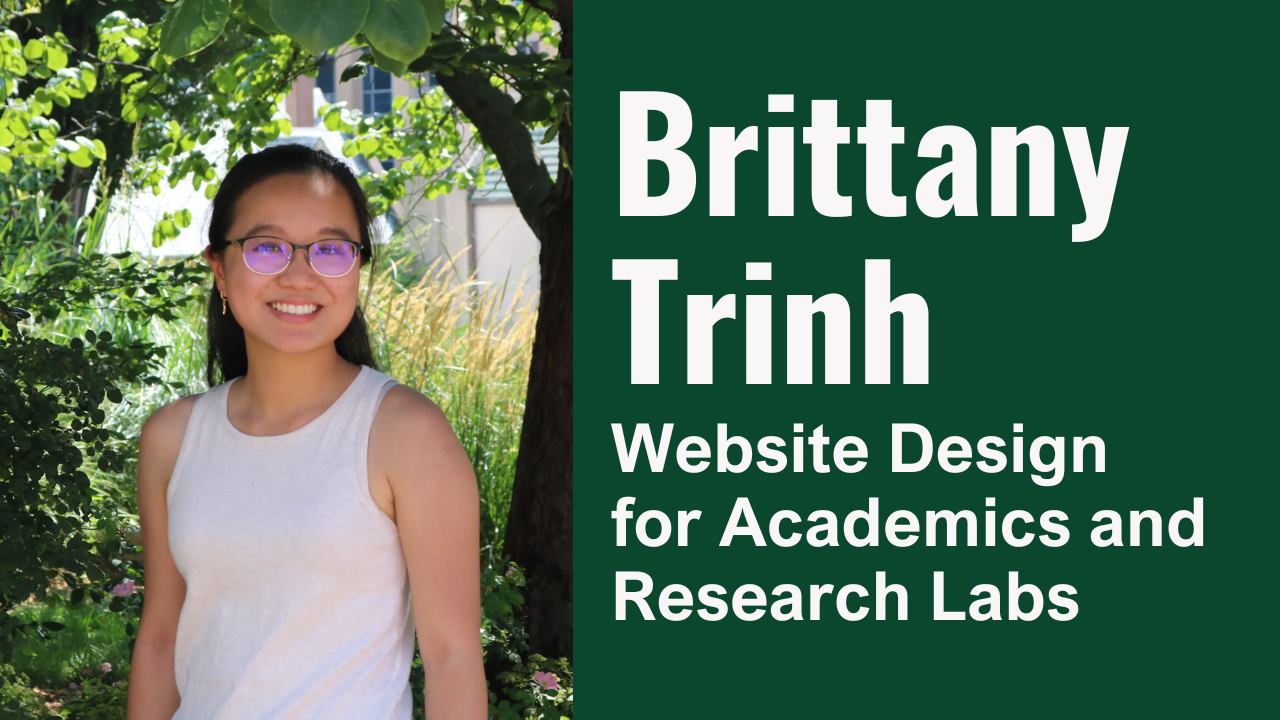
Brittany Trinh returns to The Social Academic featured interview series. We talk about how her thinking on websites for professors, scientists, and researchers has changed. We also talk about how her life has changed now that she’s back in grad school (and what that means for her online presence). Plus, hear about our Team VIP Day service for research lab websites. Read Brittany’s bio.
In this interview
Meet Brittany
Jennifer: Hi everyone. It is Jennifer van Alstyne. Welcome to The Social Academic. I’m here today with my friend and one of my business partners, Brittany Trinh. We’re talking about personal academic websites, research lab websites, websites for academics. Brittany, would you say hi and introduce yourself? Or, reintroduce yourself since you’ve already been a guest on our show?
Brittany: Hi everyone. My name is Brittany Trinh. Yeah, I feel like the last time I was on your show was maybe in like 2020 or something like that. It was a while ago.
Jennifer: Oh my goodness. It’s been that long and we’ve been friends ever since. I mean, Brittany, you were at my wedding this summer. I can’t believe how time has flown by and your life has changed. You’re back in grad school. Tell me about that.
Brittany: Yeah, so I was working and running my side business as a website designer at the time when we’ve met. Since then, I had started grad school in 2021. I am now a PhD candidate in Chemistry at the University of Wisconsin Madison.
Jennifer: Amazing. I really like how you reached out and introduced yourself to me in the very beginning. I felt like there wasn’t a need to be in competition with each other. It was so nice to be able to have someone to talk with about something that we both care about, which is having an online presence when you’re a scientist or someone who’s in academia. And also, we’ve been able to work together and partner together on some fun projects.
Brittany: When I first started getting in the online space and I heard about you. When I saw you at first, I was kind of thinking like, “Oh, we are kind of competitors in a sense that we have similar services” and things like that. But after I thought about it and kind of learned more about the space, I figured at that time we had slightly different audiences. You were still more targeting professors and people who were further along, whereas I was trying to target with graduate students and earlier career. But obviously since starting grad school, a lot of my side business web design stuff has kind of been put on the back burner. I’m still kind of working on it here and there, and I love collaborating with you as of late. So that has been a really good kind of easing back into the web design business.
Jennifer: That’s really fun. And I love hearing about your grad school experiences on social media. What was it like to start sharing that part of your new lifestyle in your online space that was kind of different from how you were showing up before?
Brittany: When I was showing up before, I was mostly just sharing a lot of tips and information on Twitter at the time. That worked for some time. But once I got to grad school, I thought, first of all, I don’t want to just be known for websites anymore. But I also had to take a break because I wasn’t really sure about my scientific identity yet because I just started grad school, and even though I had worked in industry for some time, starting grad school made me feel like a beginner again. And actually it took me probably the last three-ish years or so to finally feel a little bit more confident about posting things on social media regarding grad school.
Because for me personally, I just didn’t really want to be just a PhD influencer. There’s a lot of PhD influencers. I follow them too because I like their contents motivating and things like that, of course. But there’s just certain aspects of it that I didn’t really align with. And, I didn’t want to create that type of content. It took me a really long time up until maybe last year to finally figure out, “Oh, actually I still do want to talk about some things about grad school and about being a scientist, being in STEM and all that. But it just looks a little bit different than how a lot of people are currently doing it.” That’s because a lot of people are also science communicators, so they’re communicating their research, which is great. But for me personally, that wasn’t exactly something that I wanted to do.
Jennifer: Oh, that’s so interesting because the way that I see websites is part of science communication. At least for scientists, it’s a way to communicate who they are and what they’re doing. And that’s something you’re so great at. It’s totally okay that it’s not an interest of yours when it comes to the other areas of your life. That’s so interesting to me. I’m curious if you’re open to it, would you share with me what aspect of influencer life maybe didn’t appeal to you? Because there may be people who are listening to this who are considering the same thing and hearing your thoughts might be really helpful for them.
Brittany: Yeah, I guess for me, a lot of it was just hearing the over romanticizing the lifestyle was one thing that I wasn’t really a fan of, especially without context. I love the aesthetic. When I was in high school, I was obsessed with study aesthetic and everything. So, I get it. It’s very appealing to see that type of content. But I think that when you create that type of content and you share that without sharing the context in which a PhD program happens. I guess what goes on in a PhD program, it can be a bit deceiving to say the least, or just a little bit. I don’t know what the right word is, but I just didn’t feel like that’s something I wanted to do. I think that it’s a good thing that they’re inspiring younger people or anybody who wants to pursue a PhD. I think that’s good to be a source of inspiration. But I think that for me, I didn’t want it to just be an aesthetic look like a lifestyle.
Jennifer: Yeah, I absolutely understand that. And what’s interesting to me is that if I came across your channel and didn’t know that you didn’t want to be an influencer, I would think that you’re quite realist in what you share about your PhD life. And, you even have a podcast about what it’s like to be in grad school. I think that there’s a difference between influencer in terms of the intention of creating partnerships and brand deals and maybe even gaining a certain type of following for being an influencer in that space. And then also just having influence over a space because you are more open about sharing your story. And I think that your openness is really refreshing because you do share maybe some of the negative experiences too, some of the struggles and some of the highlights. It feels very real every time I check out your social media stories. Yeah, I don’t know. That’s so refreshing for me. What was that like for you to decide to actually start posting about these things?
Brittany: That was kind of hard, actually. For the first two years, I think the way I described it to people was that I felt like I was kind of ‘in a shell.’ I was very withdrawn because a lot of my PhD struggles took up a lot of my mental capacity. I just really didn’t have the desire at all to show up and to be seen, and honestly, to be that vulnerable to so many people online and to show them I’m struggling. Because a lot of people, again, like I mentioned, were set up the aesthetic. Everyone looks like, “Oh, they’re having such a good time in their PhD, they’re accomplishing so much. Why don’t I feel that way? Why am I not doing X, Y, Z?”
What I realized recently was that I guess I could go through those times, but I didn’t have to share it in real time. I can still share it now, which is what I’m learning to do right now, which is part of this project I’m working on for my podcast. I’m trying to write a series or make it episode, whatever series of episodes of all the different struggles I’ve kind of gone through. And sharing my thought process through that and what I did, what I wish I did differently, so that hopefully people who listen to the podcast or future people who encounter the podcast can learn from it. And can see, I wouldn’t say the bad side of things, but just these are things that people don’t want to openly talk about. And I think that it does take time to get over it so that you have fully processed it in a way that you can talk about it in a more meaningful way than just, I guess venting about it. Because I never really want to come off that way, even though in real life in the moment, I’m just like, “Oh my God, this was so stressful. Why are things like this?”
But when I talk to other people, younger students and things like that, I have to actively reframe it in my mind. How do I make this useful or helpful to them? Or what can I take away from it? How can I improve through this experience? Which has been happening a lot recently.
Jennifer: You’ve been doing more mentoring yourself, haven’t you?
Brittany: Yeah, a lot of mentoring in terms of in the lab. I’ve had four undergrads so far, and I have two right now. And then I also do some mentoring for first year students. So when they come in, they have a lot of questions about how do I join a group? How do I talk to a professor? Which group should I join and what are things I should look out for and stuff like that. Whenever I give advice, I always preface it with, this was my experience, because I never want to come off as I know everything. I’m just being like, I’m just sharing my experience, and you can take away what you want to take away from it. Honestly, I feel like that’s the same approach I have for my podcast as well.
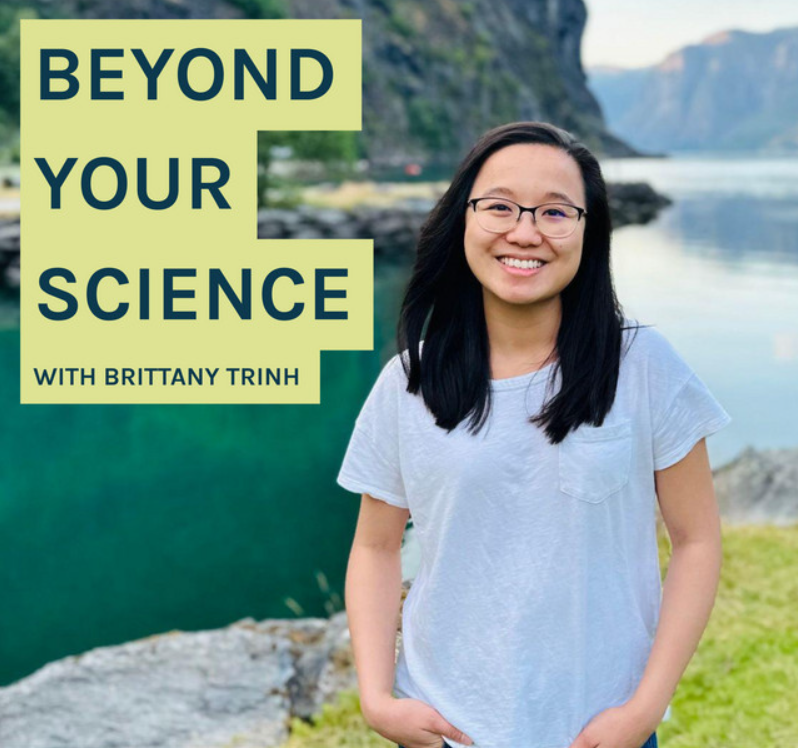
Beyond Your Science, a podcast for grad students and early career scientists
Jennifer: So who should subscribe to your podcast? What’s it called, and where can people find it?
Brittany: My podcast is called Beyond Your Science. It’s available on Apple Podcast and Spotify. It’s really for any graduate student or early career scientist who wants to explore the intersection between science, creativity, and entrepreneurship. And so those are some of the core pillars I talk about on my podcast. Grad school is just a part of it for now just because I’m in it, but that’s not giving advice on how to get into grad school or anything. One thing I really would love to focus on more in the future is kind of small businesses in STEM, just because I think that’s a really niche area that we don’t really hear a lot about when we’re in grad school. In grad school, we hear about becoming a professor or going to industry, and we also actually hear a lot about people going into startups and entrepreneurship and stuff.
But at least on the grad school level, I haven’t really heard a lot about people choosing a small business route after grad school. But because of getting to know so many academics on online over the years and seeing where they’ve gone, a lot of them have started their own businesses and things like that because of the flexibility, the freedom to do what they would like to pursue their own ideas. I think those are all things that we as graduate students, we really value. And so I kind of want to show more people that this is a possibility for you if you could consider it. Yeah.
How Brittany’s thinking about academic websites has changed
Jennifer: Oh, that’s so cool. That’s really exciting for me to hear. And that’s kind of the first time I’m hearing about this too. So I love that you shared that. Now, I’m curious, how has your thinking about websites changed since our last interview? It’s been a while. I know we’ve worked on websites together. Overall, how has maybe your thinking changed over time?
Brittany: Oh my God, that’s such a good question because let me tell you, when I first started, I had just gotten out of undergrad and I was starting my job. I was trying to convince grad students to create websites for their work. And at the time when I started four years ago before coming to grad school, I was just really baffled. I was like, why don’t you want to create websites for your work? Why aren’t you proud of your work? Because you’re doing cool stuff and you’re super qualified. But no amount of me encouraging them could really get them to change anything. So I would just be like, “Oh, well, whenever you’re ready, this information is here for you.” But now that I became a grad student, I understand why.
Jennifer: Oh, wait, wait. Tell me a couple of reasons why. Because there’s definitely grad students listening to this that are like, ‘I think that might be me.’
Brittany: Yeah. Okay. Because I have my website and my website has all my website design stuff, my podcast stuff. But for the longest time, I didn’t really want to talk about my research at all. I didn’t want to share it with people.
Jennifer: What’s your research on?
Brittany: My research is focused on polymer chemistry specifically. Right now, I’m learning or developing a method to make more make up this polymerization more environmentally friendly. Before that, I was learning about how polymers can be made stronger and tougher for high impact materials, aerospace equipment, military equipment, things like that. So I’m just really interested in polymers and how their mechanical properties are useful. But now, right now I’m mostly focusing on how to synthesize polymers in a more eco-friendly way.
Jennifer: I love that! And I love the environment, so that’s my favorite. What about that felt like you wanted to hold it back or hold that part of yourself back from sharing on your website, and have you shared it?
Brittany: I think it was because I just didn’t really have the tangible result to show: because I didn’t have a paper. I still don’t have a paper. I’m a fourth year student PhD candidate. I have no papers. It just reminded me of that Pride and Prejudice quote, “I’m 27 years old and I have no prospects.”
Jennifer: I love it. We’re both readers. We both love classical music. Brittany and I are good friends, and there’s so many reasons why.
Brittany: But seriously, that’s the reason why I feel so, I don’t want to say ashamed, but just a little bit hesitant to be like, ‘This is my research.” I haven’t published anywhere. I maybe presented at a conference, but that work is unpublished and I don’t know if that will be published anytime soon. All those reasons combined. Plus, just the way that just by the nature of the PhD experience. I just naturally feel more inadequate than before. Imposter syndrome, right? All those reasons combined makes me not want to own up to it. I guess at least professionally, it’s easy for me to just say, “I’m a Graduate Research Assistant, because that’s what I am on paper. But to be like, “I’m a scientist.” I don’t really know about that.
Jennifer: It feels like a stretch, even though that’s not true. You’re mentoring future scientists already [laughing].
Brittany: I’m doing science, more science than a normal person does. Even if I don’t feel that that way, I am already doing it. That’s kind of what I had to tell myself. Yeah.
Jennifer: So did you put it on your website?
Brittany: I finally did put it on my website.
Jennifer: Oh my goodness.
Brittany: Yeah, because I was like, oh, my bio has nothing about chemistry. So it’s just in my bio, it’s like a little blurb. It says, Brittany is a PhD candidate in chemistry. Her research focuses on synthesizing high impact polymers in a more eco-friendly way and leveraging their tough mechanical properties into industrial applications.
It was really hard to condense what I do into a couple of words that are easy to understand. On one hand, it felt like I was oversimplifying, but on the other hand, I was like, I’m not going to go into the details. If someone was really interested, they could ask. But that was also really hard because I was like, it makes it sound like what I do sounds really, I don’t know, noble and great? But I don’t feel that way on the day to day. You know what I mean? At least I assume a lot of graduate students probably feel some type of way about their research.
Jennifer: Oh my goodness. Professors feel that kind of way about their research. Let me tell you, that feeling of being unsure about how you’re talking about your research and the things you care about most? That doesn’t go away when you become a mid-career researcher or a senior researcher, and you might even struggle to talk about it the way that you feel when you’re retired. So I think that it’s something many people struggle with it. And I love that you shared what you wrote with us because it sounded great.
Brittany: Yeah. I used your tips from a previous podcast interview, I think with Dr. Echo Rivera.
Jennifer: Ooh. For anyone who is listening, we do talk about how to write an amazing conference speaker bio. That’s great for academics writing any kind of bio. So I hope you’ll check that out.
Updating her personal website
Jennifer: Now, your online presence has changed as your new life experiences and goals have popped up. One of the things that you did was redoing your website, and you just talked about adding in that bio. What prompted you to want to redo your website? I know as a website designer myself, that’s a project I’ve been putting off for so long. I need to do it. So what prompted you to do it?
Brittany: Yeah. For the longest time, I had started with all my services about website design or workshops about website design. And then as I was realizing I don’t really have the capacity to do this anymore, I started making those pages hidden. I didn’t want to highlight that anymore. And then just throughout grad school, I realized I don’t really know if I want to just leave it open for website design right now. So I kind of want to just make it very clear that I’m trying to build my personal brand instead. That my personal brand still includes website design tips, but that I’m not actively soliciting new clients.
And I think that has really helped because now on my website, it’s just me featuring my podcast, which is my main mode of sharing and building my personal brand through the podcast and also LinkedIn newsletter. Then also kind of just repackaging some of the things I already had, some of the resources I had so that it’s still useful to people, but it’s more organized. I finally did that a couple months ago. And I also did a podcast episode where I talked about the process of me deciding to do that. But again, it was also something that I had put off for the longest time too. Because school, life, all the other things that come first.
Jennifer: Exactly. Sometimes we have to prioritize all the other things, and it’s okay to put off the thing with your online presence as long as you need to. I love that Brittany made that list because what she was ready, she knew what she wanted to do.
Best Personal Academic Websites Contest returns in 2025
Jennifer: Now we have done, since we last did our interview, two annual Best Personal Academic Website Contests. It was so fun to be able to share some amazing websites from grad students, postdocs, early career researchers, people who were in research labs. Oh my goodness. There were just so many people who were curious to submit to this contest. Would you be open to doing another one with me next year? What do you think?
Brittany: Yeah, I love doing it. I love seeing how people show their research, show themselves through their websites. It’s very interesting to see how people interpret also website tips and then implement it on their website too. And I think also because we do it with Owlstown. Owlstown is [a website builder] made for academics. I think it’s really fun to see how people still are able to customize it to their own needs.
Jennifer: Brittany and I are both designers, and so we’re thinking about every little detail, but for so many people, all you need is a website. And it is totally amazing that Dr. Ian Li has created Owlstown, a free academic website builder that you can easily make your website in. What is it? Like 15 minutes? I mean, it’s really fast. We did it on that call.
Brittany: Yeah, it’s very fill in the blank type of [website design]. That’s what I told this to the grad students in my department too. I was like, if you guys need a website, just use this. It’s so fast and easy. You don’t need to think about the design.
Jennifer: Even if you do eventually want that fully designed website in the future, if you know it’s not on your list this year or next, I mean make an Owlstown website, it will create a stronger online presence for you like today.
Brittany: Yeah. And I also met Ian, around the same time I met you or reached out to him around the same time. I also had to test it out for myself before I recommended it to people. When I tested it out, it was in its early stages, and even in its early stages, I was like, wow, this is really good. And then over time, he started developing more features and things and I was like, sold. This is so good now.
Jennifer: Right? I love how responsive he is. If you have a question about it or a suggestion, some kind of feature that you want to see, if he thinks it’ll help people, he’ll try and make that feature happen. It’s so cool.
Jennifer: Now, research lab and group websites, that is something we’ve been teaming up on for VIP days where professors get a done-for-you website in one day. I mean, seriously, we gather the materials in advance. We have a Planning Meeting. We talk about things like website aesthetics and colors and stuff and what you want. But then Brittany and I, and my husband, Matthew, we team up, we create the website for you in just one day. Oh my goodness. Brittany teaming up with you on this has been amazing. It’s been so transformative. I’m honestly shocked by how much we’ve been able to get done in one day.
Brittany: Yeah, me too. I think it’s really nice to work in a team like this because before I had just been working on my own. I think the workflow of gathering all the content beforehand helps so much. Because then you know what needs to go on the page, and it just makes everything go by so much faster.
Jennifer: Exactly. Now we can totally work together. If you’re looking for that bigger done-for-you research lab website [Strategic Website Design service]. Brittany, and I may still be able to help with that, but Team Website VIP days is what I recommend for most research labs, especially if this is going to be your first website. It’s not like a redesign. So we only have a couple days left in 2024, but please reach out about the new year. We would love to work with you and help your research lab or group. Brittany, what should people know about their research lab website or group website? Do they need one? Who should consider this kind of service?
Brittany: If you are a professor who’s actively recruiting students, you definitely need a website. I remember even when I was looking for groups and such, or even students now when they’re coming in and they’re looking at professors, they check the website. They go and see when was it last updated? Are students graduating? Is your group still active? Because the student is trying to prepare as much as they can to know about the professor so that when they meet the professor, they can talk about the research or ask about active projects and how they can get involved. Or, talk about what skills they bring to the table and things like that. But it’s going to be kind of hard for them to do that if there’s no website. Or, if you just have a very broad research statement on your faculty page or something.
The other thing is that students may be interested in the general area of research, but they may not know exactly what the research work entails. Maybe some people will be like, “Oh, just read the papers.” But in all honesty, a lot of students when they’re coming in, they’re very overwhelmed with enrolling in classes, teaching classes, looking for a group, acclimating to their new city. Trying to also parse out which papers are relevant to current projects at the moment is also very difficult. I really advocate for professors to have this on their website: a very clear or recently updated Projects page with publications that are most relevant or recent so that the student can easily pick out. “Okay, let me read the update on this and see where, what they’re doing right now, where could I fit in,” and things like that. So definitely professors of any age that wants to get students interested in their work. And, especially younger professors. I think now a lot of younger professors are, they’re trying to build a personal brand and everything in addition to the research.
Jennifer: This is a great use of startup funds. You can pay with your university monies. So please don’t hesitate to reach out if you are interested in having a VIP Day website for your research group or lab.
Jennifer: Brittany has been so much fun to have you back on The Social Academic podcast. Is there anything you’d like to chat about or add before we wrap up?
Brittany: No, thanks for having me. I really enjoyed working on the VIP days with you because it lets me still be a part of the helping academics with their websites, but kind of more on the back end of things. That just helps me as a graduate student right now because I’m just not able to do the front facing stuff at the moment.
Jennifer: Yeah, we’re perfect partners on this. And Dr. Makella Coudray, whose research lab website we did recently. We just had a workshop with her research group and she said that she now feels like her online presence is a 10 on a scale of 1 to 10. It’s a 10, and her website is a huge part of that. It makes her feel really good about her research and it makes her lab really excited to help share it. So I’m just so proud of the work that we’ve been able to do together so far, and excited for all the work to come.
Brittany: Yeah, me too.
Jennifer: Brittany, thank you so much for coming on today’s show.
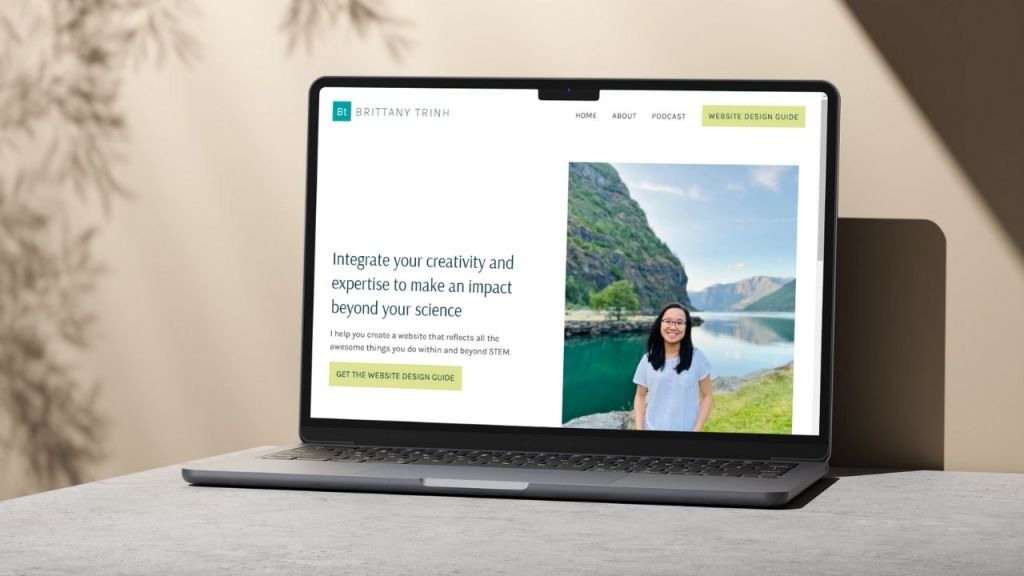
Brittany Trinh is a Vietnamese-American website designer and chemist. She helps enterprising scientists, science communicators, and academic entrepreneurs create a website that integrates your creativity and expertise. Brittany knows when your website reflects the awesome things you do within and beyond STEM, it helps you forge your own path.
She hosts the Beyond Your Science Podcast, where she talks about integrating science, entrepreneurship, and creativity within and beyond STEM, from her own experiences and interviews with other scientists and small-business owners. Listen to the Beyond Your Science Podcast.
Brittany is a PhD candidate in Chemistry at the University of Wisconsin-Madison. Her research focuses on synthesizing high-impact polymers in a more eco-friendly way and leveraging their tough mechanical properties into industrial applications. She received her BS in Chemistry with a minor in Psychology from the University of Houston. Follow her research on Google Scholar.
When she’s not in the lab, she’s probably playing piano or violin, watching slice-of-life anime, or cooking some kind of noodle.
Ideas for Your Online Presence Before, During, and After Your Talk or Presentation
The best time to share about your upcoming talk or presentation is before it happens. Some people find that their most engaged post on social media is announcing that you’ve submitted your abstract to speak (or your publication). People are excited by the possibility and what you care about. Telling your story of your upcoming speaking engagement is a great way to do that.
Sharing on social media can start early, but I don’t want you to think it’s the only way to help your online presence and the people coming to your talk. You’re going to explore many ideas today, but you don’t have to try all of them. I hope that there’s at least one idea that resonates with you and you’d feel comfortable trying it yourself.
When you submit an abstract for or are invited to speak
Add your website URL and social media handle to your bio. This will help people find you before, during, and after your presentation.
I’ve just submitted an abstract to speak at…
Announce that you’ve submitted – If you’ve been invited to speak, a good time to share on social media is when you’ve agreed or committed to that engagement. It’s great to add your social media handle and a link to your personal academic website if you have one, along with your bio. You might add that information to your CV.
Connect with people before you go
Once your talk is confirmed, you can add it to your website and you might take time to connect with your fellow panelists or event organizers before the event.
Conference Hashtag
If there is one, you can check out the conference hashtag and make plans with people who will also be at the event that you want to see, especially if you live in different cities or countries.
Business cards
If you have a business card, add your social media handle and website there is a good idea.
Share your talk on social media
When you’re sharing your talk on social media, people need more information than you expect. They need to know what your talk is about, when your talk is to know if they can attend, what the event is, and any link where they can learn more information. This is something you can share on any social media platform or across all your platforms.
Some professors hesitate to share their upcoming talk on Facebook where they may have a more personal audience, but these people are excited by what you care about when it comes to your research and how you choose to spend your energy. You might include , on all social media posts, any definition or story that helps people better understand why this talk or research matters to you.
Tag people or organizations that are related to your talk or event.
The conference hashtag can be added to your post about your talk but you can also add a hashtag that relates to the topic of what you are presenting on.
You can share the post about your talk before, during or after the event.
Create a graphic or infographic
If you create a graphic or share an image to go with your talk, a great resource is Writing image Descriptions on Accessible Social – which helps you create social media posts accessible for people with disabilities.
The next ideas are for things you can do while the event is happening.
Check out the conference hashtag, again
If you checked out the event hashtag, you might find that people weren’t using it. Once the event starts, you can start using the conference hashtag and check it out! See if there is a conversation you want to be part of, or an event you want to check out.
Be open about your online presence
The best thing you can do for your online presence while at an in person event, is to be open that you have a website or that you’re on social media.
Help people find and connect with you
You can make this easier for people by making a QR code that helps people go to your website, have this info on a business card, create a hand out with information or resource about your talk (that includes people need to your online presence) , or use an end slide in your presentation to help people connect with you after the event is over.
Resources to take home and share
When you create a resource like a handout or links /slides to share, that can go on your personal academic website. They can also be shared on social media using that conference hashtag to help people find this resource that you’ve already taken the time to gather.
Will this be recorded?
Ask if there is going to be a recording. Sometimes, there isn’t an official recording but you can ask if you can record yourself.
Stay connected once you’re gone
Connect with people you meet or you like and admire on social media, while at the conference. Helps others be more likely to learn about you.
It’s okay if you don’t do any of that too
I have never had time for any of that at conferences, personally. In person events can be overwhelming for me as an introvert. Because of that, I don’t have the brain capacity to remember things like take a photo, much less record some videos.
Anything I just talked about – some of those things can be prepped in advance others you don’t have to do live (you can do afterward)
Next are ideas you can do after your presentation or talk is over.
Whether there was a recording of your talk or not, you could always record your talk and slides using zoom, then post the video to your website or social media. There are options to share the full version of your talk, if you like to. You can just share the title slide, or full text version of the talk, or even the full slides.
Connect with people when you’re back at home
If you didn’t connect with people during the event, sometimes connecting AFTER the event is easier. You can look at the conference hashtag. Look through the business cards you collected. See the conference program and look at the bios to see who is on social media.
Create and/or share resources
If you didn’t have resources to share at your talk, if there are things you want people to know after the fact, you can create a graphic or handout that is shareable on social media or a page on your website.
Celebrate other people
While you can post about your own talk, you can also post about your panel and thank the conference and event organizers. If you want to participate in the conference community but not want to talk about your own talk, you can celebrate others instead. It’s a great opportunity for PIs to celebrate their lab members or grad students who are at the event. There are so many ways to celebrate people instead of yourself, if that feels comfortable or more exciting for you.
These don’t have to be professional shots. A messy desk shot or photo of you working on your slides or going over your notes on the plane. Something that feels quick or easy to you.
Take pictures during the event
Snap a photo of things you see, people you meet, friends you catch up with. Ask someone to take photos of you while you’re speaking or pose at the conference.
You could record a video of your talk
This can be before, during, or after the event.
You can record a video about your talk
Record a short video introducing your talk and the main takeaways. This video is especially for people who couldn’t be there live for your presentation.
Record some b-roll
If you like video, record b-roll video. Take a sip of coffee, getting ready to speak, short travel clips, video of fellow panelists or friends. These might be put into a longer video or Instagram reel.
But these might feel like too much – so even though they are fun ideas, don’t be stressed if you do none of them.
Ideas for Your Online Presence Before, During, and After Your Talk or Presentation
The best time to share about your upcoming talk or presentation is before it happens. Some people find that their most engaged post on social media is announcing that you’ve submitted your abstract to speak (or your publication). People are excited by the possibility and what you care about. Telling your story of your upcoming speaking engagement is a great way to do that.
Sharing on social media can start early, but I don’t want you to think it’s the only way to help your online presence and the people coming to your talk. You’re going to explore many ideas today, but you don’t have to try all of them. I hope that there’s at least one idea that resonates with you and you’d feel comfortable trying it yourself.
Before your speaking engagement
When you submit an abstract for or are invited to speak
Add your website URL and social media handle to your bio. This will help people find you before, during, and after your presentation.
I’ve just submitted an abstract to speak at…
Announce that you’ve submitted – If you’ve been invited to speak, a good time to share on social media is when you’ve agreed or committed to that engagement. It’s great to add your social media handle and a link to your personal academic website if you have one, along with your bio. You might add that information to your CV.
Connect with people before you go
Once your talk is confirmed, you can add it to your website and you might take time to connect with your fellow panelists or event organizers before the event.
Conference Hashtag
If there is one, you can check out the conference hashtag and make plans with people who will also be at the event that you want to see, especially if you live in different cities or countries.
Business cards
If you have a business card, add your social media handle and website there is a good idea.
Share your talk on social media
When you’re sharing your talk on social media, people need more information than you expect. They need to know what your talk is about, when your talk is to know if they can attend, what the event is, and any link where they can learn more information. This is something you can share on any social media platform or across all your platforms.
Some professors hesitate to share their upcoming talk on Facebook where they may have a more personal audience, but these people are excited by what you care about when it comes to your research and how you choose to spend your energy. You might include , on all social media posts, any definition or story that helps people better understand why this talk or research matters to you.
Tag people or organizations that are related to your talk or event.
The conference hashtag can be added to your post about your talk but you can also add a hashtag that relates to the topic of what you are presenting on.
You can share the post about your talk before, during or after the event.
Create a graphic or infographic
If you create a graphic or share an image to go with your talk, a great resource is Writing image Descriptions on Accessible Social – which helps you create social media posts accessible for people with disabilities.
These are ideas are for your online presence and networking while a conference or event is happening.
Check out the conference hashtag, again
If you checked out the event hashtag, you might find that people weren’t using it. Once the event starts, you can start using the conference hashtag and check it out! See if there is a conversation you want to be part of, or an event you want to check out.
Be open about your online presence
The best thing you can do for your online presence while at an in person event, is to be open that you have a website or that you’re on social media.
Help people find and connect with you
You can make this easier for people by making a QR code that helps people go to your website, have this info on a business card, create a hand out with information or resource about your talk (that includes people need to your online presence) , or use an end slide in your presentation to help people connect with you after the event is over.
Resources to take home and share
When you create a resource like a handout or links /slides to share, that can go on your personal academic website. They can also be shared on social media using that conference hashtag to help people find this resource that you’ve already taken the time to gather.
Will this be recorded?
Ask if there is going to be a recording. Sometimes, there isn’t an official recording but you can ask if you can record yourself.
Stay connected once you’re gone
Connect with people you meet or you like and admire on social media, while at the conference. Helps others be more likely to learn about you.
It’s okay if you don’t do any of that too
I have never had time for any of that at conferences, personally. In person events can be overwhelming for me as an introvert. Because of that, I don’t have the brain capacity to remember things like take a photo, much less record some videos.
Anything I just talked about – some of those things can be prepped in advance others you don’t have to do live (you can do afterward)
Next are ideas you can do after your presentation or talk is over.
After your talk is over
Record your talk
Whether there was a recording of your talk or not, you could always record your talk and slides using zoom, then post the video to your website or social media. There are options to share the full version of your talk, if you like to. You can just share the title slide, or full text version of the talk, or even the full slides.
Connect with people when you’re back at home
If you didn’t connect with people during the event, sometimes connecting AFTER the event is easier. You can look at the conference hashtag. Look through the business cards you collected. See the conference program and look at the bios to see who is on social media.
Create and/or share resources
If you didn’t have resources to share at your talk, if there are things you want people to know after the fact, you can create a graphic or handout that is shareable on social media or a page on your website.
Celebrate other people
While you can post about your own talk, you can also post about your panel and thank the conference and event organizers. If you want to participate in the conference community but not want to talk about your own talk, you can celebrate others instead. It’s a great opportunity for PIs to celebrate their lab members or grad students who are at the event. There are so many ways to celebrate people instead of yourself, if that feels comfortable or more exciting for you.
These don’t have to be professional shots. A messy desk shot or photo of you working on your slides or going over your notes on the plane. Something that feels quick or easy to you.
Take pictures during the event
Snap a photo of things you see, people you meet, friends you catch up with. Ask someone to take photos of you while you’re speaking or pose at the conference.
You could record a video of your talk
This can be before, during, or after the event.
You can record a video about your talk
Record a short video introducing your talk and the main takeaways. This video is especially for people who couldn’t be there live for your presentation.
Record some b-roll
If you like video, record b-roll video. Take a sip of coffee, getting ready to speak, short travel clips, video of fellow panelists or friends. These might be put into a longer video or Instagram reel.
But these might feel like too much – so even though they are fun ideas, don’t be stressed if you do none of them.
I love virtual events. Maybe you do too. But it’s okay if you don’t. As my guest on The Social Academic, Dr. Julia Barzyk said, “research is becoming virtual first.” Virtual events are here to stay when it comes to academics and researchers.
Your online presence can enhance how you experience and interact with people at conferences and events. This is true for both in person and virtual events. But today, I want to chat with you about what to do for your online presence when you’re attending or presenting virtually. In this blog post:
Tell people you’re attending the virtual conference or event
Sometimes, professors hesitate to tell people you’re going to a conference or event because it feels self-promotional.
But, actually, when you share you’re headed to an event (even when it’s virtual), you help a lot of people. You can help your
Colleagues
Students
event organizers
Speakers
There are also people who are anxious to join the conversation. Conference attendees sometimes wait for someone, anyone else to use the conference hashtag on social media first. I get that. It can be hard to start a conversation.
When you think about the people you have the potential to help? Thinking about those people helps the time I’ve put into crafting a post be a lot more meaningful. My professor clients have found that’s true for them too.
Here are a few places you can share you’re headed to a virtual event:
Social media
Your website
Mentioning in person
Tip: The most dynamic way you can improve your online presence and your presence at any event you’re presenting at is by improving your speaker bio.
Watch my video on speaker bios with Dr. Echo Rivera
Share about the specific talks you’re presenting or attending
When you share the talk you’re presenting specifically, it helps people know if they can attend. If they can attend (or even if they can’t), it helps people share the event with others who may be interested. Like their grad students.
Sometimes conference programs are hundreds of pages and multiple days, with concurrent sessions to choose from. I love that virtual events tend to come with options to plan your schedule in advance.
Let’s say you share your talk on social media too. And, you use the conference hashtag. Only a small percentage of the people presenting are using the conference hashtags (or posting about their talk at all). Already it’s more likely you’ll get eyes on your event.
When you share the details people need to know if the talk is right for them, things like
What your session is about
The time and date you’re presenting at
Where people can find more info
It makes a huge difference for people to have ease when learning about your particular event. Some professors make a graphic on Canva, but virtual events tend to create graphics for you. So it’s a good idea to log into the conference platform early to see if there’s a visual way for you to enhance your social media post about your talk. It’s also worth asking the conference hosts if that’s something they plan on having to avoid unnecessary labor (unless you love graphic design, in which case yay!).
I’ve also worked with a lot of professors who host or moderate events. Sometimes they have multiple events and presentations at the same conference over several days. There’s an inclination to not share their own thing, so it’s okay if you find comfort in sharing the thing you’re hosting instead. It makes a big difference for the panelists or speakers at your event.
The truth is, people often wait to share about themselves until the last minute (if they ever do). I think that’s often because of either imposter syndrome or time. As a host, you care about this. And you can help make it easy for the speakers at your event to share with ease when you tag them. It’s much easier to repost than to craft it themselves.
Tips for your social media post reach the right people
Use the conference hashtag using #CamelCase where you capitalize the first letters of each word
Use up to 1 other hashtag related to your field at the end of your post
When you have a link where people can learn more info about your talk or event, please know that most social media algorithms downgrade how many people it shows your post to when you include a link in your post. When you have a link to share, one way to do that is by including the link in the comments or replies of your post. For Twitter/X, you can include the link in a thread.
At virtual events, connecting with people in ways that are lasting can actually be easier. That’s because virtual events have virtual platforms where you can have a profile, get a link to click on to find someone’s social media or website, or download their slides/resources. Virtual events may have networking sessions, pre or post events, and ways for you to stay involved.
Most virtual events have a space for you to create a profile. Your profile helps people see you and get to know who you are. And when you update your profile early (like when access to them opens), you give people opportunity to learn about you as they’re updating their own profile.
One way to connect with people in advance is by adding an invitation in your bio. For example:
Adding a scheduling link and inviting people to meet you for coffee
Adding your email and inviting people to contact you if they are interesting in collaborating or networking
Some conferences have space for you to create your own virtual event (like a hangout with a shared topic of conversation).
There are also asynchronous ways to feel like you’re part of the community. For instance, the option to ask a Question to all attendees, or to create a poll. Some virtual conferences have games you can participate in. Or a scavenger hunt.
I love that virtual events can often create better environments to communicate with speakers as compared to in person conferences. When you’re in person, you have what, 10 minutes before your next session starts? Virtual allows for asynchronous options, giving you opportunity to ask questions to speakers before their session (even when you can’t make it live). There’s even space for speakers to upload resources and share links for you to take home.
When their session has ended, the chat space often stays so people can engage in conversations when watching the replay. And actually, don’t wait for someone else to do it first. If you’re at a virtual even and you see that no one has said anything in the chat (after the event has ended), you can start by thanking the speaker. You can build meaningful relationships with people virtually even when you don’t have a specific conversation or feel unsure of what to say at the moment. Every relationship doesn’t need to be built on something “big” or “deep” or “collaborative.” Do what feels natural.
Virtual events allow us to have more control, even when it comes to our schedule. I love the flexibility and accessibility they create for academics and researchers. And I know that for some people they’re maybe not your cup of tea. And that’s okay.
Whether you prefer virtual or in person events, there are ways for you to connect with people in meaningful ways online. And there are ways you can have agency with your online presence to help the people at that conference better know who you are and what you care about.
Your online presence is a great way to share your research, teaching, and academic life. To find collaborators and make lasting connections. And I want that for you, if it’s something you’re curious about for yourself.
There are a lot of misconceptions about what your online presence should look like as a professor. And it stops people from feeling confident or comfortable showing up online, even when you know a strong online presence aligns with your goals.
Your online presence creates a legacy for your work and supports your professional goals for your research, teaching, and leadership. And yes, you probably have been putting it at the bottom of your to-do list… Join us and let’s change that!
This Q&A was hosted by Ana Pineda, PhD, of I Focus And Write on October 10, 2024.
Introduction
Ana: This happens a lot to me too. Just quickly for the rest of us watching the recording. I started the recording a bit late, but I was introducing you to Jennifer Van Alstyne, and she’s the expert on having an online presence, not only academic, but personal branding, especially for academics. Although I think your profile goes much further and you all should start following her, and I will send you some links later for her social media, her channels, her website.
I discovered [Jennifer] very early on in this business and something that I hope we are going to speak more about it, I was struggling with my, my online presence as an academic and also as a business. I thought, “Ah, Jennifer one day she, she should come and tell us more. I teach you, this is something I encourage you all when you want to connect with someone, send them an email, send them a message in social media, tell them what you would like to maybe have a coffee with them or organize something with them. And that’s it. This is how Jennifer and I contacted and now she’s here talking with all of you and I’m super excited. Thank you. Jennifer, do you want to tell us a bit about you to start?
Jennifer: Hi everyone. I’m so happy to be here and to talk with you all. Let’s see, I have been helping professors one-on-one with their online presence since 2018. And it really started off as, as thinking that I would help with websites specifically, but most of my clients needed help with more than just their website because being online isn’t just about having a website. You can actually be online without a website, too. And so really figuring out online presence wasn’t a one size fits all solution. A website wasn’t going to be the answer for everyone helped me evolve my business over time.
Now, it’s been like, what, six and a half years and I help people with websites, social media, and bio writing. And really I’d say our work is about confidence. Our work is about the confidence to be able to show up and to feel like you’re worthy enough, and that you deserve space online. I love getting to help people with that.
Ana: Oh, so nice. And I love that you linked to, to this, to the aspect of feeling confident because I was telling to Jennifer like, I think 90% of my audience, of you here, of our students suffer severe imposter syndrome, and this feeling that we are not good enough. And I see that for me, but also probably for many of you that here, this stops us from showing up online and sharing our words. We always feel, I sent an email today with some of those thoughts. The, “who am I to say this on LinkedIn,” or, “am I bragging if I’m sharing this paper that got published.” Something also like, “What is this person going to think when it says that I post this,” right? Something some of my students say is I think on that teacher I had once or something a supervisor said that you had 10 years ago. Sometimes you still have these thoughts of, “What is this specific person going to think? And this stops us. It truly stops us. I hope that also for all of you that you live with some ideas of how to stop these imposter thoughts when it comes to your online presence today. Love it. So for today, it’s a, Jennifer told me, I love interactive sessions and we need your help. Please, we need your help for the, of course I have questions here ready for Jennifer, but we would love to hear your questions.
Jennifer: I have a question if that’s okay for everyone who’s listening. This is one of the questions that I, I like to ask people when we start working together because it really is different for everyone, no matter where you are on feeling imposter syndrome, no matter where you are in your career.
How you feel about your online presence is, is very internal. It’s very personal. So I’m curious if 0 is like, “I don’t have an online presence at all,” and 10 is like, “I have a great online presence, I’m really confident in it. It’s the exact online presence I want.” Where are you on that range? From like zero of no online presence at all to 10, amazing online presence.
How would you rate yourself? 4, 2, 3. Yeah. Quite low. Good. This is very, very normal. Very normal to feel like maybe there’s a lot more you could do or maybe want to do to have a stronger online presence.
I’m curious, those of you who feel like you’re on the really lower end of the scale, 0, 1, 2, 3, I’m curious, have you done something for your online presence already or is this like, “There’s a bunch of things that I want to do that I know I’m not doing and I really don’t have an online presence at all.”
Where are you thinking when you’re at the lower numbers? Is it more about actions that I haven’t taken or actions that I’ve taken that don’t feel like enough?
‘I think I’ve tried a lot.’ Yeah. Oh my, ‘the university forces me to,’ I love that answer. For a lot of people that is perfect. Yeah. Okay.
I just wanted to show even though we’re all here and we’re all here together and there is a range for where people feel for your online presence, my hope is that by the end of this workshop you’ll feel like there’s at least one small step that you can take to improve that in a way that’s really meaningful to your life. If not more. My hope is for more, but at least one.
‘I haven’t done anything because I thought why do I have to be online?’ Well, we’ll chat about that. It’s different for different people. So, saying that you have to be online for your research, you have to be online for a job market or you have to be online for, you know, any specific reason. It’s not going to work for everyone. And finding the true reason (or reasons), it’s going to be helpful for you. Hopefully we can get closer to that today as well.
What are reasons scientists and academics should have an online presence?
Ana: Oh, I love that. And actually that is how I would like to start. So what are the main reasons, Jennifer, that you say why you should, everyone have an online presence? Maybe there are a few things that you think, oh this situation, these moments, you really need to, to work on this.
Jennifer: Well, I’ll tell you why I thought when I started people should have a stronger online presence. I really thought that if you put your publications online and you create a way to help people find them, that more people from your potentially really niche topic would be able to read them, engage with them, and share them.
And that’s true, but that’s not actually a motivating reason for the majority of people that I work with. I would say for most of the professors that I work with, they want to help more people.
They want to help more people. They want to invite opportunity for themselves, but not just any opportunity. They want to invite aligned opportunities aligned with their research, aligned with their values, aligned with what they want to be focusing their time on.
Attracting opportunities is all about finding the right people. It’s about making sure that people can see and engage with what you share. That can potentially lead to greater connection, collaboration, or a long-term working relationship. I would say it’s mostly about people and making sure that that connection is possible even when you’re not in the same space.
Ana: Oh, I love this. And actually, you know, I mainly started using as online presence, let’s say Twitter, on social media. And I don’t know if you, you also said this, but in the past there was some, they did some study and they saw that the more people tweeted about papers, than the more citations they have.
Jennifer: Yes, that is definitely true. It’s also a bit limited in how we think about it.
Ana: Yes.
Jennifer: Yes, more people will see your paper when you share it online. The question is, is it the right people? Is it the right timing? Are they still going to see it after your one post?
There’s so many ways that we can share publications, really thinking about who we want it to reach and how we want to be able to help people with the hard work we’ve already done makes a really big difference for how we show up online.
So yes, always sharing your work gets more citations, gets more readers, which is great. My hope is that it’s really engaged readers, aligned readers. Readers who could potentially cite and use your work.
Jennifer: So I’ve actually gotten more narrow in my focus for who I’m hoping to reach in my work with professors.
Ana: Yes, I love that. And actually, it was later on that I think there was another paper that also, like you said, it was like, “more citations, really, but what was then the impact of this effect?” But what they saw is that the big impact in the end, like you said in people, in networking, in collaborations, in relationships. And this is really beautiful.
Lenny says here, ‘they trying to build multidisciplinary approach of a problem, building a network is the only way and networks are so important, right?’ Networks of the right people, like you said. I love that. Yeah. So good.
Why do professors want a website, social media, or blog?
Ana: And continue with the why Jennifer. I would also like to know why your clients come to you. So do they come, do they want a website? Do they want social media? Do they want blog? What is it? Tell us more please.
Jennifer: I would say most people come to me because they want, or are thinking about a website. Oftentimes it’s something that they’ve wanted for a long time. Maybe they tried to do themselves or did do themselves, but it isn’t meeting their needs.
My most popular service is like a big website plan where we either redesign or create a website that really meets their long-term needs. That takes in-depth interviews, I mean we spent about five hours talking before I even start planning the website. That’s because for a lot of people, their needs are are so nuanced. And we really get to understand what’s going to be exciting for them, what’s going to be engaging for the people that they hope their research or their teaching research reaches.
And then some people also have different areas of their life that they want to be able to share on their website. A lot of people also come to me because they want to bring together multiple identities into one personal academic website.
Or, occasionally a website that works for both your personal website and your lab website.
The website that’s right for you doesn’t necessarily look like the website that was right for someone else. That’s why professors like to work with me, cause we find that together. They feel like they don’t have to do it alone and if they don’t want to. They don’t have to touch the website themselves, they can just have it done for them.
So especially the people a bit later in their career, like to be a little bit hands off. People who are early career researchers, we get more involved and do more things together. So yeah, it’s really fun. We customize it to what best meets the professors need.
Ana: Yes, I love that also that you said it. Every need will be different, right? And I think that’s the problem with university websites, that they are very standard first and you don’t have much there to say. So actually, if you have any questions about websites right now, please share it in the chat. So maybe we can go through there.
Holly has posted a a question, Jennifer. Maybe you can read it.
Professional website vs. Academic website vs. Lab website
Jennifer: [Holly]: ‘What are the main differences between a professional website vs. an academic website?’
I’d say there, there’s not really one. I mean it’s just the label that we’ve called the website that is meant to represent you. So, if you as a person feel like your professional identity is different from your academic identity, which is true for many people, sometimes those people actually prefer two websites.
Or they prefer to focus their website on just their professional identity vs. their academic identity. When I say that, it’s more about the audience that you hope comes to the website. If you’re hoping to mostly focus on other academics and researchers, you might have academic content there even if you have a separate professional life and maybe you’re picking and choosing what goes on there. But overall, they could be the exact same website. You could have the same label for it. It’s more how you think about your own identity, if that makes sense.
Ana: And yes, jumping in the to the effort example, I find something really useful of websites that you can attract like stakeholders, right? Like people more like maybe policy makers or companies who might be interested in applying what you are working on or, or the press, right? More for science communication. Do you then recommend to have like one single website but maybe with different sections or apps? How, how do you recommend people to deal with that?
Jennifer: I always recommend one website when possible. The websites I recommend separating out are if you have a research lab where you’re going to be highlighting your team, oftentimes the professional/academic website, the personal website version of that. It makes better sense when it’s separate.
That’s not to say that a research lab website can’t support a personal identity. It’s just that the website that you may want to build out for yourself, maybe as extensive as the research lab website, but highlighting different things. I often, often recommend separate personal website and research lab website.
In terms of consulting or like a professional identity that is separate from an academic one, I often don’t recommend dividing it. Now, if you have a business that is like officially registered, you may have to divide it for like legal reasons for. Maybe for a Terms and Conditions page or a Privacy Policy that is specific to your country.
But for most people I would say that that one website works. You can have two in one. Adding a Consulting page, adding a Services page to your academic website can really enhance how people who are at NGOs, at corporations, at other universities, at federal and foundation funders. All sorts of people like publishers, people that are outside of academia, or outside of your institution will be able to better understand you and your services and your consulting. How you approach those things from the academic pages on your website as well. I don’t typically recommend splitting your identities when possible.
It’s also easier to manage one website. So less less work overall.
Stories about opportunities from your online presence
Ana: Yeah. That’s great. And actually I was wondering, do you have any win story of people after making their websites for us? We love those.
Jennifer: I’ll be really honest and say that I’m bad at keeping up with professors that I’ve worked with after the fact. But when I have, I get really delightful stories. So one of them, this is just like a few weeks after we’d launched his website and we were adding something in. We were meeting again live. He told me this funny story that he was just at a conference in his field. This was someone who was on sabbatical this year, so he wasn’t engaging as much with the research community. He was working for the federal government at the time for the year so he hadn’t been super engaged in the research community.
When he was at this conference and someone came up to him, they recognized him, like they’d seen his photo. They said, ‘I’ve explored your whole website, I learned all about you. I would like to talk with you about a job offer.’ Now my client was not job searching, he was very happy in his position. He had his next few years very planned out. But just the fact that someone knew so much about him, about the things that he cared about and brought this actually quite aligned conversation into an actual meeting space in person so soon after the website was launched was shocking.
Also, a PhD student whose dissertation was requested by a national publication. Like they wanted them to do a writeup for a national publication just a week after launch. That’s another example of opportunities that can just come essentially as soon as you have a stronger online presence.
But those are really kind of short-term things. And the long-term things that I care more about are really about how you feel about sharing what you do.
Most of the professors that come to me, no matter where they are in their career, I wouldn’t say it’s necessarily imposter syndrome, but there is a feeling that people might not care. Like, you can know that your research is really good, you can know that you’re respected, you can know that you have people who care about you and still feel like there’s not someone who will care when you celebrate something that might feel small in comparison to other things. Or, that might feel big but almost too overwhelming to share.
What I like about working with professors is that by the end of our work together, there is this transformation of, “I deserve to have this space.” Like, “I deserve to take up this space and when I take up this space, it helps more people. It helps more of the people that I’m already trying to reach with my research. It helps more people and more students that I’m teaching,” find maybe the network or connection that they’re hoping to. There are ways to help far more people than just yourself with your website or with your online presence.
Ana: Yes. This is so nice. Connecting how you can help others is a big thing. And you just pointed also to the students, it is said that many of my colleagues, especially those that have websites, they’re also very popular with students who want to do their master thesis with them.
Jennifer: Yeah.
You can have a website for your teaching (even when research isn’t your focus)
Ana: And and that’s really nice, right? That you are also sharing your work and students can find their passions thanks to that too. Eh, love it. Oh, there are some questions.
Jennifer: Before we jump into questions, I just wanted to say that I’ve had clients who are very research focused with their website and I’ve had clients who are very teaching focused with their website.
And you can be both, but some people who are more teaching focused in life sometimes feel like they don’t deserve that same space online. But teaching resources are so valuable for students, for other faculty, for other graduate students or PhD students who might be starting to teach in your field.
Oftentimes when we get into those interviews about: What can we create with your website? How can it change and impact your life? We find really nuanced ways that it’s going to be meaningful for you. Whether it’s creating a Recruiting page or sharing a Student Internships list. There’s just so many options for how to talk with and connect with your students through your online presence. If you want to.
Having an online presence when your research is about sensitive topics
Ana: Yes. So nice. Yes. So there are some questions coming in. So, something that was asked, “How can we deal with being out there online when we research sensitive topics such as police violence?”
Jennifer: Ah, that’s a great question. Actually, one of the examples that we can look at today with Dr. Cheryl L. Johnson, she’s an early career researcher who works with violence and weapons and guns, especially juveniles who carry weapons.
Sensitive topics is something that makes a lot of people stop in whatever actions they’re taking to have a stronger online presence. Part of that is for self-protection. Part of that is also knowing the reactions that people might have based on what you share.
Whenever you have a sensitive topic, I really want you to think about the people that you want to help. Think about the people who really you do need to reach rather than thinking about all the people you want to avoid focusing on who needs to see your research to make that difference. That’s the introspective part that I recommend starting with.
For many of the professors I work with who have a sensitive topic, I would say that is another reason why people come to me to work together. We have found that sometimes posting on social media feels less safe. There are some spaces online that feel less safe and that maybe they don’t want to explore at this time.
Whereas having a stronger online presence, it doesn’t mean that it’s necessary to be on social media. And so we found what they felt and we felt together were safer options was through having their personal website and through having a LinkedIn profile that was filled out to a point where it would show up in Google quite easily and people would be able to find them based on that particular research topic online. But, they wouldn’t feel like they had to post about their topic specifically inviting potential negative reactions in order to help people find them.
If you’re someone who has a sensitive topic and you’d like to be talking about that online, I also want you to consider your safety, your personal safety, but also your emotional and mental safety and think about how you’d like to respond to things and come up with kind of like worse, like what you’re going to do in a worst case scenario. Like, let’s say you do post about a sensitive topic and it goes viral and you know, this is really bad. You’re getting, you know, messages and comments and it just feels so overwhelming. What are the steps you’re going to take at that time to make yourself feel safe to, to help yourself move past this hopefully momentary situation? Yeah.
Ana: Yes. And just for everyone also to realize that indeed in social media, people comment, but on your website you don’t need to activate any comments, eh?
Jennifer: Yes.
Ana: So that is, it’s a way of keeping yourself safe and it, so social media platforms, you can deactivate comments too, right? That nobody can comment on your posts.
Jennifer: You can, but I do want to say that deactivating comments, having, having a website, like not inviting comments doesn’t mean that you won’t get comments. People who feel really strongly about things may still email you.
Ana: Yes.
Jennifer: People will report you to your university. I just want you to know that anything you do or say online, it can be screenshotted, it can be shared, it may be reported.
This isn’t to create fear in you. It’s to let you know that universities typically do not do anything on the other end of that. They get reported to all the time and oftentimes, there’s not a lot that happens.
Ana: Okay, thank you. Thank you for that Jennifer.
When social media doesn’t feel authentic to your personal values
Ana: Now actually, you are making recommendations about social media. So indeed we have another question from Vidal: “What to do when our online presence does not feel authentic to our personal values, especially in social media, but our field is very much dependent on that?” Do you have any advice for this?
Jennifer: I wouldn’t recommend anyone be on social media unless they want to. There have been scientists and researchers for decades who have not used social media and still found connection.
But then you’d want to potentially be intentional about how you are connecting with people and keeping those long-term relationships in some other way.
I like social media because it means I can connect with those people and I can still message them or communicate with them at some point in the future, even if we haven’t talked in years. And so if you’re someone who’s open to being on social media but not posting, that could be a good way to still get that kind of interaction online.
But if it goes against your values, like I’m not going to ask you to change your values and your university shouldn’t ask you that either. In fact, universities sometimes come and ask me to do workshops and I have said no depending on what they’re asking because I won’t force any professor to accept the terms and conditions of a social media platform. You know, there are, there are some things that they just don’t agree with.
I’m also not going to force any professor to have a website if they don’t want one. I really think that it is a personal choice and there are other ways to create connection lasting networking in your field beyond social media, even if that’s the norm in your field.
Ana: Yes, thank you so much. And actually a couple of comments about that that I only realized later, right? That social media is a type of marketing, social media marketing, but it’s not the only one. Actually something very common with scientists is to do PR, public relations and speaking and going to conferences. This is also a powerful way of marketing that you are doing. I don’t know if in, if it is required for social media, but maybe what is required is to do more of this marketing. So you could also consider to, well go to conferences which are more scientific, but maybe also work more with the press in journals, interviews with the radio, maybe block platforms that publish blog posts. There are indeed, definitely there are other ways.
What is your online presence for professors and scientists?
Jennifer: Now when I say online presence, what I mean is that when someone goes to Google or another search engine, if they put in your name (or maybe your name + the area of your research), are you going to come up?
And when you do appear in search results, can they find what you hope for them to find quickly? What you hope for them to find is probably a bit about you, potentially a photo of you, contact information, your areas of research.
Now when you’re hoping to communicate with journalists in the press, you want to come up pretty high. Like you want to come up high in those search results. You want to make sure that they’re able to find you for topics that you actually want to speak about. You don’t have to have a website, you don’t have to have social media profiles in order to attract media attention. But you do have to, if you go to Google, you have to be findable with your name and also with your areas of research.
Ana: And actually I want to drop there a little tip for everyone. If you don’t have Google Scholar, activate it. Please do so because Google Scholar is from Google. So if you search your name in Google and you have a Google Scholar account, that will pop up, often quite high. And when we do this, actually if you, I hope you all know how to add Incognito window in your browser. Maybe just now do this exercise. Open an Incognito window if you know how to do it. Otherwise just open a browser window and Google your name and research and see where do you appear.
Tell us in the chat, I’m curious. Count the number of position and are you the number one, are you the number 10, you are not on the first page. We’d love to see how that is because if-
Jennifer: Yeah, let’s do that.
Ana: Yeah, if you are not high, definitely there is more there to do. But if not, indeed Google Scholar, please be sure everyone has it with a picture, it’s really with the papers that are yours because otherwise Google Scholar puts random papers. So have a, an updated Google Scholar profile. We would love to see that.
Ana: In the meantime Jennifer, we can see more of the questions that came in. Jacqueline asks, ‘Are there specific website hosts domain you can recommend? I’m always a bit concerned about hidden costs with publishing a website.’
Jennifer: Yeah. Easiest way to make a website for free or very low cost is Owlstown.
Ana: Love that.
Jennifer: Owlstown is run by my friend Dr. Ian Li. He wanted to help more professors and scientists be able to create a website with ease.
And when I tell you it can go up in as little as 15 minutes, like if you start it now, it could be done by the end of our workshop. That is true. We have done it together live on a demo. So I really recommend that for a lot of people.
If you don’t care deeply about how your website looks and feels in terms of having control over all of the parts of it, Owlstown is an excellent option for you. I recommend it to a lot of people.
For professors who do want more control over the look and feel of your website, you want to be able to change all of the colors and have different types of pages and formats and layouts. I love WordPress.com.
WordPress.com has great customer service. It’s more affordable than some of the other hosts and it has built-in security and protection. If something goes wrong with your website because someone’s trying to attack it, they have a whole office that will deal with that.
If your website goes down like mine has twice, they have resolved that for me within an hour. I really like WordPress.com. That’s what I set up most of my clients on.
I also like Squarespace.
I do not like Wix. Wix is very buggy and glitchy. In fact, most of the people who’ve come to me for website redesigns have been quite unhappy with their experience on Wix. And so we’re migrating their site to typically WordPress.com.
If you like WordPress, but you don’t want WordPress.com, you want more control over your WordPress, Reclaim Hosting has really great prices for academics and they focus on the academic community. Yeah, Reclaim Hosting is my recommendation for a managed WordPress host where you have full control.
WordPress.com is my number one recommendation.
No Wix, no Weebly.Does that answer your questions?
Oh, Google Sites. I should mention that because my friend Brittany Trinh, who does websites for scientists, she likes Google Sites for people who are just starting out.
But if you like that personalization, WordPress.com or Squarespace is probably going to be a better fit.
Oh, for people who are trying to decide between WordPress.com and Squarespace ’cause they’re both very trusted, highly recommended companies? Squarespace is a little bit more sleek, but its features are a little bit more geared towards ecommerce and selling products. So, in the future you’ll see that some of the changes are more geared towards that.
Whereas WordPress has been a blogging platform for so long that it’s never going to lose all of those capabilities and it’s going to continue to improve them. I like WordPress if you ever plan to have a blog, podcast, or YouTube channel in the future ’cause it’ll give you more, like backend options for the structure of your website that helps Google better understand it. So if you think, “I don’t want to blog now, but I want one in like six years,” start your website on a WordPress site.
Ana: I just want to add something really funny. I have your worst recommendation that is Wix.
Jennifer: Sorry, sorry, If you have a Wix website and you like it, please keep it. Don’t worry.
Ana: No, but I recognize if I were to start over for what I do, which indeed I need much more capabilities, I would definitely do WordPress.
But I always recommend also Owlstown for academics who wants a simple solution because you can also do quite a lot and they show examples and they are really nice actually. Maria Jose, yes. Did hers and really enjoyed the process. Yeah, she was very fast in making it. It was amazing. This also is great. How funny. Okay, so I see Jennifer a lot of people are ranking number one. Amazing! But they had a very nice point, which links to another question we had.
Website, LinkedIn, X, or ResearchGate for scientists?
Ana: Natalia actually was asking also, “What is the difference between the website being active in LinkedIn, X, or ResearchGate? Do they have similar impacts? What’s your opinion?
Jennifer: Academic social media platforms are mostly for academics. And by that I mean that if you’re hoping to reach people in policy, if you’re hoping to reach practitioners, if you’re hoping to reach maybe researchers outside of the academy, if you’re hoping to reach nonprofits, NGOs or foundation or fellowship funding, all of these people like may not have access to or may not regularly use those academic social media platforms.
And that’s one of the reasons why having Google Scholar set up, making sure that when you Google yourself people can find you is really beneficial because there’s so many people beyond the researchers who like to read peer reviewed research who would benefit from finding and connecting with you and who you would benefit from finding and connecting with as well.
Because of that, I really like LinkedIn profiles because it’s where most of those professionals outside of academia do at least have a presence, even if they’re not actively spending time there. Google Scholar because it helps you better show up in Google search results.
And having any of the places that show up at the top of those search results. So maybe your faculty profile, maybe you have a bio on another website of some kind. Making sure those places that do show up at the top of Google search results are updated when possible. That’s going to help.
Anything else you do is going to enhance that. So like if you create a website that’s then going to show up at the top of search results, so it’s going to be an even better and more engaging experience where people can learn even more. But if, when you Google your name, you’re finding the search results that you want, you probably don’t need to increase your online presence in that kind of way unless it’s something that you want for yourself. Did that make sense?
Ana: Yes. We have Natalia there. I also always recommend, in terms of social media, for those of you who want to do social media, to do either LinkedIn or X, Twitter, is through, you hear and see in Twitter and X that there’s quite some haters, but at least in my experience in the academic world, no. And again, not in my academic world, but maybe indeed if you work in sensitive topics, you might get more of these haters. In my world, not really.
Jennifer: I would also say if you are a minority, if you are a person of color, again, yeah, sensitive topics, if you identify as LGBTQ+, there are haters on every platform.
So it’s not like if you go to Instagram over X, it’s going to drastically improve your experience. The people that I’ve interviewed on The Social Academic who’ve experienced really negative reactions experience them everywhere they go.
So I just want you to know that it’s not like you can avoid everything just by being on one, you know, the, the one platform where that doesn’t happen. People thought that Mastodon was going to be like that and it wasn’t. There was just as much hate people thought that Bluesky was going to be like that and it wasn’t.
There’s just as much negative reaction everywhere you go. I just want to put that out there. Like if you are feeling unsafe, it may not be the platform. It may be how you’re interacting with it. It may be that how you feel means that you shouldn’t be there at all.
And as someone who survived domestic violence and had to escape an abusive ex-husband, there have been points in my life where being online was not the safe choice. Where I really wanted to hide. And so I just want to put that out there if something happens that makes you feel unsafe online, it’s okay to remove yourself.
Ana: Yes. Thank you so much for sharing Jennifer. Because there might be people here who also feel like that. And you shouldn’t feel like also guilty for not being online.
Jennifer: Right, that’s what I wanted.
Ana: Yeah. Yes, exactly. I love that you pointed to that. So good. Just to add something to this conversation that adds something that I also recommend when you’re trying to choose like, “Okay, I cannot be doing everything. What should I choose?”
I always say like, what do you enjoy the most? Right? Yeah, some people really have fun on Twitter, others is on LinkedIn, others is maybe in ResearchGate. So just also maybe put more effort on that platform that you enjoy the most.
You also said the key word that I always tell my students, like updated, that’s the key word. I wonder whatever you choose is updated. Not with that. The last paper that you are showing is from four years ago. Have that profile updated and be where you also enjoy it.
I don’t know if I told you all this story, but I started, I just wanted to be a lurker. I just wanted to be there and not interact with anyone and just see what people were doing. So first a colleague told me, ‘but you can create a fake account so nobody knows it’s you, nobody’s going to follow you.’ And I say, ‘oh great.’ But my fake account had a name that was a little bit similar to mine. So of course once I started following the people I knew, they started following me back and this was like, okay, this fake account is not working.
But for years I would not do anything, just look at post. And this was great to stay updated about research, new papers. And then later I did my next step, which was liking and reposting. That would be it. I would never write a comment, I would never write a post, that was it.
And then came the next level which will be commenting to things of my friends, right? Like celebrating with them, they got a new job, you know, they got this grant, this paper and that will be it. There was all these levels that for me at least, each level was more and more challenging. So you also gotta decide what is your level that you feel comfortable with.
Jennifer: Yeah, I’ve actually had professors come to me because maybe they were on Twitter and they’re like, I don’t want to be be on Twitter anymore. Like, ‘I don’t like Elon’ or something like that. And they want to learn Instagram. So then we talk about Instagram, we talk about what that might look like. There’s so many features on Instagram. How you use Instagram isn’t going to be the same way someone else uses Instagram.
But when we talk about it, like they’re like, “Oh, I don’t like that.” They’re like, “I don’t like images.” or “I don’t want to do video.” And, and you know, realizing that actually they like writing text, they like thinking about things in text.
Thinking about what you like, thinking about what you don’t like, thinking about what you want to try, or what you don’t want to explore. Do that before you start a platform or do it as you’re starting a platform.
Don’t feel like once you create your account you’re going to have to have that forever. You can delete anything that you’re feeling like isn’t really a good fit.
Ana: Yeah, so good. And, and actually people also were asking like also alternatives for example to X or Twitter. Well I think we covered this. Probably LinkedIn is a good idea in that case.
Do I have enough publications to set up my faculty profile?
Ana: And Sabrina also had a very nice question. “Hey, my university has a website where I can set up a profile yet I’m hesitant to set up a profile because I don’t have any publications yet. Any advice?”
Jennifer: If your university let’s you set up a profile, you should, even if you don’t have any publications. Having one or two sentences in that area that just says what your research is focused on and who you’re hoping to connect with about that research is going to be just as effective as listing publications.
I have seen thousands of faculty profiles and a huge portion of those wherever they are in their academic career don’t have publications listed. Oftentimes that’s because the person who the profile is about hasn’t updated it or hasn’t provided information. Or, the process to update it or provide information just doesn’t exist or isn’t being managed in a way that can actually facilitate updates happening on the website.
I just want to say if you feel the publications or what’s been holding you back, you don’t have to wait because there’s so many faculty profiles out there that don’t have any publications on them. So I really encourage you to do, make that profile.
Whereas if your university offers you a website space, I would actually recommend not using it and making an external website yourself. So profiles, definitely have on your university website. Websites, I don’t recommend quite as much and we can talk about that if you want. But yeah, generally WordPress.com, Squarespace is a better option, or Owlstown. Better options for you.
Ana: Yes, I love that. And I also always recommend that too because yeah, at the end of the day you might leave that university, right? And your, I see your web website, like your home-
Jennifer: Yeah, but also your university may just decide to stop posting websites, which I’ve seen happen at like six universities before. So your website could just be gone next week and you’ll get an email that’s like, “Oh, we’re discontinuing this service,” and it disappears. I don’t want that to happen to you. And that’s why I’m saying it more so than the potential of you moving universities.
Sometimes if you move universities, you can actually keep that website space. I’ve seen that from people too. So it’s not like if you have a space already that like you should delete it. I’m just saying if you’re starting a website project, I would recommend it being on WordPress.com or Squarespace or somewhere outside of your university server when possible.
Do I have to be online every day as an academic?
Ana: Yes. Lovely. And we have here a question also from Elaine. “Can an academic build an online presence by not being online every day?” And this, I love this because we can also connect be with the how what, what would you recommend, and I guess this means more for social media because of course once you have the website, there it is. So what would you say about, about being online in social media?
Jennifer: That’s a good question. So actually I have a question for you, [Elaine]. When you say you don’t want to be online, does that mean you don’t want to post on social media or does that mean you don’t want to check social media at all for an extended period of time? Both answers are totally fine. I’m just curious how using it less looks like for you, if you don’t mind answering in the in the channel, I would love that.
Ana: Maybe Elaine can answer that.
Jennifer: Yeah, or or unmute yourself if you prefer.
Elaine: I meant that I don’t want to post every day. You know, I don’t want spend so much of time there.
Jennifer: That’s totally, that totally makes sense.
Elaine: I think that the algorithm forget you.
Jennifer: Ah, the algorithm.
So yeah, a lot of people feel like the algorithm forgets you. But the people that you’ve connected with do not.
When you think about who you’re connecting with, it’s actually more important than you posting because when people decide to connect with you, it means that they’re choosing to potentially see your post in the future.
Now with Twitter, it makes it really feel like the algorithm is kind of like working against you because you only get that kind of 10 minute window to reach potential people. Maybe they have you in the For You section, so you show up towards the top. But Twitter is the one platform that sometimes feels like you might be more beholden to that. I would just say, post the same thing twice and call it a day.
But other platforms like LinkedIn, if you post once, that post could continue to show up for people for not days, but weeks and months. I want you to think about your content that you share out there in any capacity as something that can last, something that can be useful for people beyond the time that you’re posting it.
Because of that, you do not need to post every day. Not only do you not need to post every day, you don’t need to post every week. In fact, for most of the professors that I work with, I recommend if you can consider, you don’t have to commit to it, but like if you can consider sharing one post per month that can really impact your online presence. Just one post per month. So people know when they visit your profile, you’re still somewhat active. That makes a really big difference.
You don’t have to post every day, definitely don’t have to post every week. And if you want to take extended months off from social media, but you have that stronger online presence when people Google you, you could do that. You could delete all your social media if people are finding you in those Google Search results with ease and they’re finding what you want them to see.
If you don’t want to be on social media at all or you just want to lurk, that’s an option too. I just want you to have that other side of being findable for the things that you’d like people to find you for that that also be something that supports you.
Ana: Yes, thank you. Okay, we’re going to then start moving into the section of the, the how. I think we indeed covered the, the why, the where.
Would you give us Jennifer some ideas of post that people can access easily I could post about this or about this other topic. Content pillars. Or type of post that they could work on.
Jennifer: There, there’s so many things that you can post about. It really depends on what your personal needs are. So like, I mean, if you have a new publication, there’s a ton of posts that we like, you want to do, we could talk about that for a sec?
Ana: Please, yes.
Jennifer: Yeah, so let’s say you have a a new thing. It doesn’t need to be a publication. Like let’s say a new publication, an upcoming conference talk, an event that you’re attending. There’s a thing that you can share.
That is something that can and probably should be shared more than once. So the first, easiest content pillar is sharing things multiple times.
Let’s say you have a publication. One way to start sharing it is actually before you have the publication, I really recommend talking about research in advance. I’m not saying to give away like all of the secrets that you feel like are really new research on Twitter, but what I am saying is sharing that you’re working on something in a particular topic is a great way to clue people in that there may be something to engage with or read in the future. And honestly, depending on where you’re at, if you’re in like the data collection stage, it might help shape and inform your research. So talking about publications even before their publications is great.
When you submit a publication is probably the most popular time for people to celebrate you. When your publication is accepted is the second most popular time for people to celebrate you. People are actually more excited by the process of publication than they are from the publication itself. And that’s not that your publication isn’t important. It’s that what people care about when they connect with you is you. And the publication itself is just the outcome of what you personally have done.
I’m not trying to downplay your publication at all. It’s amazing and there’s a ton of ways to share it once it’s out in the world, but I just wanted to encourage you to consider sharing it early and those kinds of mindsets about sharing things early is true for events, conferences, things that you care about.
If you’re on a committee, if you’re on any kind of service type thing that you’re doing that is important to you, share it while it’s in process, share it while it’s happening because people love that behind the scenes stuff. They love hearing a little bit more about what you’re doing.
If that feels uncomfortable for you and you’re someone who wants to wait until your publication is out, that’s absolutely fine.
We want to share the things that people really need to know. So that’s what is the publication about? Where can I find more information about it? Who should read this? Should I share it with any particular type of people? Answer questions for people who are unfamiliar with your research area and subject because far more people are going to see your tweet or your post about your publication then are going to be excited to read it.
And that’s not a bad thing, but we have to trust that those people have the potential to share it with someone else who might care, even if they personally do not benefit from reading your research themselves. I think that that’s something the scientists and professors that I’ve worked with have struggled with. There is even a feeling that like if I share this with my friends and family members, like they won’t care. Or like, ‘I celebrate this with my husband, but like my friends on Facebook, no one’s going to care about this.’
And that’s actually an assumption that I think a lot of people have. But when we take those extra steps to invite people into why it’s important to us, why it’s something that we spent that time on, who we want to help, it makes a really big difference. And it can really open your eyes to how much people care about you and the things that you’re doing.
Ana: Yeah, I love, I love that.
Jennifer: Sometimes we’re actually doing this like live on the call because the professor that I’m working with is so anxious about sharing this particular publication or sharing with this particular audience that it feels uncomfortable for them.
One time we were sharing a client’s new book. Their book had come out years before, but it was being released as paperback. And she was like, ‘No one is going to care about this book from 2012. This is so old.’
But when we did it together, she had such a response, not just from people who had read the book the first time, but people who were excited to share it with their students, excited to share it with other people, people who said and felt like it was relevant today. That’s the kind of engagement we can invite when we’re more open about what we do and why we care about it. Even if it’s years after the fact, it can still help people. And because of that you still have an opportunity to share it.
Ana: Whoa, this was so nice, Jennifer, because actually I want to share with all of you also that one of my biggest things was like I thought that we could never share anything again.
Jennifer: Yeah, right. So many people feel that way.
Ana: Like, I already did the post about this paper, I cannot talk about it. Yeah, never again. Right? And then indeed that’s not the game of social media. The game is that first, like for I have here the data for, for Twitter, only 5% of your followers are going to see that post, not to start. So yes, keep sharing even the same post.
But then what Jennifer said, all these ideas like before, before when you see me, right when it’s published, I always say when it’s online first, when it’s the final version. So out of one paper you can write different 10 different posts.
Jennifer: Oh at least. Not saying you have to. If you just like the one post, that’s fine. Try to include your why, like why this is important to me, why I want to help people.
But if you are open to posting more, I want you to know that there are many natural ways to do that. In fact, some, one of the exercises that I’ve done with professors is we take a larger piece of content, maybe it’s their article or a book or like a talk something, something that is quite long and figuring out all the ways we can take this one long piece and break it into different social media posts.
And before we do that, before we do this, like sharing, like lots of sharing things, that’s like a lot of time, right? We really think about who we want to help with that. So for instance, if your scientific paper is aimed at helping other researchers in a particular field, maybe all of your focus is reaching those researchers at different times of day so that someone who’s over in Europe and someone who’s in Australia and someone who’s in South America can see it has the possibility to see it. So just posting that same tweet three times at different times of day might make it easier for a variety of people globally to be able to see it.
Now thinking about the who and how we want to help them is what motivates us to then do the work of sharing it. And if you don’t have a good answer to that who and how it’s going to help them or me, it’s probably not going to be worth the time. And that’s okay.
It’s okay when things aren’t worth the time because that’s helping us better focus on other things. It’s helping us better prioritize. So before you start writing things just to write them, think about you know, who you want to talk with and how you want to help them because that’s, that’s going to help you feel like it’s a good use of your time.
Ana: Yes, that’s good. And then still something that helped me was batching. So although indeed it might take time, but for me it was also that moment of saying, okay, now the paper is coming out, let me write four or five posts thinking yeah, for different purposes and then scheduling. And then you have pause for a couple of months. You don’t need to worry about that anymore, eh. And the same, eh. And I love also the perspective again that Jennifer is giving us about the people.
Talking with some of our students, they were telling me, ‘I hate to talk about my own research but they were saying, okay, what about celebrating the people in your team?’ And then their face was like, ‘yeah, that’s fun.’ So they were very excited to, yes, make posts then about their students either like presenting in a conference or a paper of their student or whatever the student did and that motivated them to do this type of post.
So that’s also something that if some of you struggle to talk about your own work, you could start getting this practice talking about your students in your team, your favorite colleagues, why not, and other people that is not you.
Can you share your struggles and challenges on social media?
Ana: And thinking about that, there is a very nice question from S- now. “So what about sharing about challenges? I do like those posts that are very real and natural, but I be hesitant myself to share those like perfection is kicking in, right now.”
What about sharing about challenges, like personal challenges, that we go through?
Jennifer: Ooh, personal challenges really engage people. It really can actually shift someone else’s mindset or perspective and help them with what they’re going through too. So I love when people are open about posting their struggles or a problem that they’re having.
It’s great if you invite your network to get involved with that. If you find that you want support from people beyond your institution or your colleagues, you can ask social media for support. There’s also ways to ask for support anonymously, depending on what your situation is, there may be another account that can post it for you. I love that there are ways to be more open about your struggles.
I did an interview on The Social Academic on my podcast with Dr. Monica Cox, where she talked about her workplace struggles on social media and how actually posting things helped protect her in legal issues with the university. It actually made a big difference that she had posted these things and shared them in something that was admissible in court. I don’t think that that is a likelihood for everyone, but I do want people to know that posting about your struggles for whatever reason, may be beneficial for you. But it also may be beneficial for other people.
Ana: Yes, thanks for sharing. And here of course, it depends the style, your style, what you want to share, what you don’t want to share. Sometimes you might feel also more comfortable to share that struggle once you have overcome. Sometimes we say we don’t speak from the books anymore.
Jennifer: That’s true.
Ana: So that’s something that maybe some of you feel better or, I love personally, this is part of storytelling, right? The, the problem. And, and seeing, seeing you overcoming this problem. For example, when you, when we are talking about publications, if you tell us also something that was hard for that paper, right? Because we have this bias, bias image of paper finish everything successful while there is behind all those struggles that we all go through. So if you share something about that, that’s also a great way of, of connecting.
We are coming to the end. So I just wanted to show quickly. So Jennifer, I know you love examples and I wanted to show you also some examples of the websites that Jennifer has done. Let me see.
I pulled examples from two early career researchers. You’re going to see three websites. One is a personal website, one is a research lab website from the same person. And then another one is a personal website. So I hope that you find them hopeful, inspirational, and you get some ideas from them.
You do not need to work with me to have your own website. You can definitely make it yourself. And if not, you can hire support locally. You don’t have to work with me (but you can if you want my support). So there’s many ways to create your website and I would love if you shared it with me, if you have one, or if you’re thinking about creating one when it’s live, please email me. I always get excited when people have created websites.
Ana: Oh, this is so nice, Jennifer. Thanks for sharing. Let me drop them then here. And as I have a look, I have a look at them indeed. And we have at least one example of, of something that can be sensitive topic, eh? So you can have a look there also for inspiration.
Jennifer: They may be both sensitive topics to be honest ’cause one is sexual health including transgender people, and the other one is juvenile weapons and gun violence.
Ana: Oh, okay. So actually that the two you mentioned. This is amazing. So good. We are going to close trying to stay on time. I want to thank Jennifer for this super interesting talk. I hope all of you enjoyed. And if you have questions, send them over to me, to Jennifer also on social media. You can please all follow her, interact.
Jennifer: Oh yeah! Let’s get in touch.
Ana: Yes. And I’m going to send the replay tomorrow. We’ll send a replay of this talk in an email and also the links so you can also learn more about Jennifer.
And please, if you have the budget and you want help with this, here you have an amazing person to hire because it’s something important and something that more and more we are giving more attention of also ways of, there is so much time and effort and energy going into your research.
And I always say having this only presence, yes, it takes work, but it can boost that many times. And, and the hard work that you have done is a pity when we just give all that power to the journals to let know about your papers, right?
Jennifer: Yeah.
Ana: That’s it. When you can also boost all that, all that visibility.
Can I use research or professional development funding for my online presence?
Jennifer: Whether you work with me or not, you don’t have to always pay for this out of pocket.
Universities are becoming more and more open to the idea of funding this kind of professional development for PhD students, postdoctoral researchers, professors, other people who work at universities. So I want you to know that there are options that you can explore on campus or through your funders who may be able to support your work on your website or social media.
Ana: Yes, totally. And linking to that, I also work with a lot of people who are grant writing grant proposals. And I, this is also where we basically speak about how the importance of having a, a personal website. Scientists, these people, they don’t have yet a website.
Through that process, they use part of that money to build that website and boost that, that online presence. Because yeah, when you want, especially when you want to go to big funding and big, big funding calls, having a website, it can be quite helpful.
Jennifer: Yeah, funders love when you have an online presence ’cause it means you’re more likely to share the research that you’re doing, that they’re funding and helping the people that, that research ultimately supports. So they are very excited if you have a stronger online presence, whether it’s your LinkedIn or your website, they’re really happy.
Ana: Yes. So totally a moment for you also to, to work on this. Thank you! Thank you so much. Thank you to all of you here. Also those who stay till the end.
Jennifer: Thank you! So nice to meet you all.
Ana: So good. Stay in touch and see you all very soon. Bye bye.
For professors and scientists, a personal website is a big project that’s well worth your time. It’s the best way to manage your online presence long-term. Your personal academic website can include a portfolio of pages that showcase your
teaching
research
publications
speaking engagements
service
I’m Jennifer van Alstyne. Welcome to my my blog, The Social Academic. Now also a podcast and YouTube channel. This article was updated for 2024.
A personal website can be life changing professors, grad students, and researchers like you. In this guide, discover the 7 steps to an academic website:
You can make your own personal academic website. You’ve got this. When you do, your website will help people explore your research, teaching, and the things you care about. I’m excited for you! And this guide is here to help.
P.S. Bookmark this page so you can come back to it.
7 steps to take your website from start to launch
Creating a personal academic website is a long-journey. It’s not a 10-minute project like some articles claim. A website is typically a multi-day project. It may take you months. And that’s ok.
Some professors reach out to me for an academic website that
brings it all together for professors who “wear many hats” or feel like it may not be possible to “bring my identities together”
highlights their new book while helping past publications better reach new readers
invites aligned partnerships or relationships (i.e. with researchers around the world, community organizations, corporate partners, funders, and the people your research helps most)
creates a legacy for their work for a retired professor
celebrates their new position and prepares for their future for professors who transition to a new role
shares their research so people can engage in meaningful ways
helps them have a stronger online presence that supports a new goal or achievement
redesigns the website they made themselves years ago that “doesn’t feel like me anymore”
When you’re intentional about creating space for your online presence, you can help more people. For many of the professors I work with, a stronger online presence helps them move from the spark of “I can have a website” to “I deserve this space.” We deserve this space.
As academics, I want you to know that “we can create this space for ourselves.” You don’t need to work with me to have a stronger online presence. A PhD student scheduled a time to meet with me about designing her website for her. She didn’t need to wait to meet with me, “Have you heard about Owlstown? It’s a free academic website builder from my friend, Dr. Ian Li.” I wanted her to know she didn’t need my support. There was an easy solution for her personal academic website. That Owlstown is a solution I trust for most professors.
I have resources to help you on my website on The Social Academic blog, podcast, and YouTube channel. You don’t need to work with me to make your personal academic website. Here are my website resources for you. I hope this guide in particular helps you move forward efficiently to make your personal academic website a reality. Following it will help you get your academic personal website from start to launch smoothly.
The best way to start making your personal academic website is by planning the structure of your website. If you don’t have an idea about what you want to share, you’ll get stuck.
Let’s decide what to include on your professor website.
Planning your website
The structure and organization of your academic personal website determines the written, visual, and video content you’ll want to create. If you plan on sharing a lot of information, you can have more pages on your website.
Your personal academic website might include things like
About page with your academic bio and headshot
Research page
Current project
Research outcomes
Teaching page
Course descriptions
Syllabi
Teaching Statement/Philosophy
Publications page
Abstracts or descriptions
Publication links
Speaking Engagements page
Contact page
Links to your social media profiles
Blog
If you want a simpler website, a smaller structure is recommended:
About page with your academic bio and headshot
Link to your CV
Links to your social media profiles
The simplest website structure is just 1-page. But it isn’t right for everyone. This tends to work well for graduate student websites. And professors who want the easiest website to maintain.
The more you want to share, the more pages your site will need.
If you’re unsure about what to include on your personal website, let’s talk. I help professors think through who they help and the real people who will visit their personal or lab websites with my Website Strategy service. I’m here to help you too if you want support.
Gather written content for your website
Once you’ve decided on a structure and what you want to include, write down all the written content you want to share on your website. If it’s text and you want it on your website, write it down.
Make a list of the pages you need to write content for. A sample for a simple 3-page personal website might include
About Page
Academic bio: 150-350 words
Research interests
Research Page
List of current project(s)
Longer description of current research topics
Important outcomes or other research highlights
Publications Page
Publication details (not in standard citation format), preferably with an abstract or description
Write the content for each page in a document to complete this step. You might decide to hire help from a website designer or developer. It’s helpful to have a document with your written content ready to share with them.
If you can get support with this project, I encourage it! If you know what you want on your website, I’ve got an amazing website development partner who can handle the technical side of launching your website. We can also work together 1-on-1 on your website strategy. Don’t hesitate to reach out if you want professional support on your website project.
Edit your content for the web
Most professors don’t write for the web automatically. Academics like you may use
complicated or dense sentences
jargon / specialized terms
long paragraphs
no headings (or few headings)
Each of these can be found in academic writing, but you should avoid them when writing for your professor website.
I’m going to share with you best practices for writing for your personal website. Take the document you’ve drafted and each time, read through to edit with these changes
Can you simplify this sentence? For instance, if I make this sentence into 2 sentences, will it be easier for people to understand?
Is this word jargon? Is it a specialized term people in my field know but other people may not? Is it a term people in my specialization know, but other people may not? That word or term needs a short definition.
How many sentences is this paragraph? Can I break it into shorter paragraphs to make it easier to read on a mobile phone?
What heading will help someone find what they’re looking for on this particular page? For instance, if I have longer description of my research, what headings can I add to make this easier for someone skimming this page?
Photography and headshots
What images do you want to include on your website? At a minimum I recommend these
cover photo (also called a splash image, header photo, etc.)
a photo of you
If you like taking photos, you may have one already that photos that work for your website.
Many people choose stock images for their cover photo. On my personal website, I have photos I took at the San Francisco Botanic Gardens.
For your headshot, you don’t need to go out and do a professional photo shoot. If you have photos from your work then that’s an option. Selfies are a good option for your headshot too. You just want your photo to be friendly, like of your smiling face. Here are 3 ways to get new photos for your personal website.
Are photos required? No, but it really does help. If you’re uncomfortable with photos, consider making an avatar instead. Whichever photos choose, you need to have the rights or license to share those photos online.
Do you want your academic or scientist website to be super engaging? Try adding a video too!
If you got to the end of this step and you’re like, can you please just do the set-up for me? Yes. Let’s talk about working together on set up of your academic website.
2. Pick a domain name and site title
Once you’ve gathered/written all your content, you want to pick a domain name. Do this before choosing a host because it’s literally going to be the 1st thing most of them ask you to do when you sign-up.
Your domain name is your main website URL, or web address. For instance, the full URL to this page is https://theacademicdesigner.com/2020/how-to-make-an-academic-website
So the domain name for the website is theacademicdesigner.com.
Your site title is what your website is called, in my case, The Academic Designer, which is the name of my company.
For a personal website, my top recommendation for choosing your website domain and title is to use your full name. My personal website is jennifervanalstyne.com (site name: Jennifer van Alstyne).
Using your full name will help your page rank in Google and other search engines. Afterall, the keyword most people will use to find your website when searching, is your name.
An easy way to check if your domain name is in use is by typing it into your internet navigation search bar. If it’s taken a website will show up, and you may need to add a middle initial or keyword (e.g. JenniferSVanAlstyne.com or JenniferVanAlstynePoet.com).
3. Choose a website host
Which website host is best for you will depend on your time, budget and technical skills.
It’s time to set up your website. This is an exciting day, because when you have the content written already, your website can come together quickly.
Start by choosing a theme for your website
Most website hosts have themes or looks to choose from for the design of your website. When choosing a theme for your website look for these 3 things. You want a website that is
mobile responsive, which means your website adapts from desktop to mobile screens well
a clean design with a top menu and social media menu
accessibility-ready, which means the theme has built-in features to help people with disabilities explore your website (Accessibility-ready may be an option depending on your website host)
Once you’ve chosen a theme for your website, you can usually choose things like font and color. For font, choose a sans serif font for your body font. A sans serif font means that you want letters without the little feet. So, no Times New Roman for your body font. You can use a serif font (with the little feet) for your headings font though.
In terms of colors on your website, you want something with a high contrast for easy readability. Dark text on a light background is preferred for accessibility.
Place your content
Once you’ve selected a theme, you’re ready to place your content. Depending on how big your website is, you’ll want to know how to do these things
add a page
place text
insert a URL link
upload a photo
make a header
You may also need to know how to add and edit these site-level items
a menu
social media links
a contact form (Update for 2024: I no longer recommend using contact forms, as they don’t always work across devices/countries)
Titles, tags, and other metadata
When you upload photos and other media to your website, you need to add in information like the title of the photo. There are also other options to add information about your media like Alt Text, a written description of your photo. Providing Alt Text for your photos helps more people understand the photo you’re sharing. Especially people who use screen readers to interact with your website. Alt Text also helps Google’s website crawlers better understand your website, so that it shows up in relevant search results.
When you upload photos or other media to your website, it’s important to check that the metadata and Alt Text are descriptive.
Write descriptive Alt Text for all of the images on your website.
For my splash image of succulents the metadata includes
title of the photo (Succulents)
name of the photo (succulents.jpg)
description of the photo (‘Website header photo of many green echeveria succulents’)
After you’ve placed the writing and photos on your website, preview your website. Check your website for
spelling
formatting
readability
Preview your website on different screen types if you have the option
Try your website on different browsers
Chrome
Firefox
Microsoft Edge
Safari
Ask your friends and family to read over your personal website for you. We often miss our own simple errors. You may learn if something is confusing. For instance, if your family notices a bit of jargon, a term they don’t understand about your research, how would you explain it to them in a phrase or sentence?
You may also learn that something is hard to find. You’d be surprised how many personal websites I’ve come across where it’s difficult to find the name of the person who it’s about. Seriously. I even wrote an article about it for The Social Academic.
6. Is it time to take your website live?
If you sell anything on your website including consulting or editing services, you may be required by law to have a Privacy Policy and a Terms and Conditions page. Look to your country’s regulations about this. You will also need a Privacy Policy and Terms page if you are using Google Analytics or other tracking pixels or tools on your website. Do not take your website live until you have those things.
If that is not the case for you, or if you’ve added those policies…
It’s time to take your website live!
Go ahead and Publish your website.
Congratulations! You have a personal academic website ready to be shared with the world.
7. Share your website
Once your website is live, you need to share it with people.
In the next few weeks, Google will crawl your website (unless you tell it not to, but don’t do that). Then your website will start showing up when people Google your name. But Google and search engines shouldn’t be the only way people find your website.
Announce your website on social media. Invite people to check it out.
Update your social media profiles to include your website address.
Add your new website address to your email signature.
Share your website as a way for people to keep in touch with you after a talk or presentation.
Update your bio to include your website.
And, please share your website with me! Send me a direct message on social media, I’d love to congratulate you on your website personally.
Good luck with your website project!
Well that’s the whole process, step-by-step. Good luck setting up your personal website. Be sure to bookmark this page so you can come back and check the steps.
Please share this guide to making your personal academic website with your friends and colleagues. Ask your university library or faculty development office to share it as a resource. This guide has helped professors and grad students around the world make their website a reality.
I hope it helps you too. You’ve got this! Make 2024 your year to launch your personal academic website. You’ll be happy you did.
Feel like you don’t want to do this alone? Get support for your personal academic website
Professors, would you like 1-on-1 support on your personal academic website or their research lab website? Let’s work together on a done-for-you website customized to meet your long-term needs. My most loved website service typically takes 4+ months.
Websites with me are capacity building. When we do it together, you get to “a website ready to take live” with ease. And, you’ll feel confident to make simple changes so you can keep your website updated.
What can we learn from watching reality tv? Well, quite a bit. Today I’m going to talk about 7 things you can learn from The Circle, a reality television show about social media on Netflix.
Hi there, I’m Jennifer van Alstyne. I help professors feel confident when showing up online. I empower them to build an online presence so they can help more people with their research and teaching. Welcome to The Social Academic, my podcast about your digital footprint as a professor in Higher Education.
Now, if you’re on my mailing list you may have seen my email about my application to be on The Circle Netflix. If you’re watching the new season, you already know that I did not make the cut. But I love this show, and learn so much from watching it. So, I’m excited to talk with you about The Circle today. I still have my fingers crossed that I’ll appear on a future season. Seriously, my goal is to be on a Netflix show in my lifetime.
What is your online presence? It’s what people can find about you when searching your name online. It’s what people can discover about your research and the work you most care about. I’d love to help you have the online presence you deserve in 2024. Let’s talk about working together on your website, social media, or bio writing.
First, let me tell you a little bit about The Circle because I know some of you may not have watched this show before. By the end of this episode of The Social Academic podcast, you’re going to go and watch The Circle. This is one of my favorite shows, and I hope you love it too.
The Circle Netflix is a competition reality show where strangers move into an apartment building where they can only communicate with each other through a closed social media network called The Circle. Each person gets their own Circle profile where they can share a bio and a profile photo. Here’s the thing, if you’re in The Circle there’s no way to tell if the other contestants you see there are real, or if they’re catfish. Some people enter The Circle as themselves. Other people enter The Circle with a fake profile they think will advance them further in the game. The winner of The Circle gets a cash prize and bragging rights.
I love reality television. I especially enjoy watching The Circle because contestants build real relationships through chat, interactive games, and virtual parties. Because contestants interact with The Circle by speaking their messages out loud (it’s a voice-activated social media network), we get to see their reaction to the Circle Chat when a new post is shared. They also verbalize their thinking before sharing their own messages in the chat.
This will be a fun episode of The Social Academic, so pop some popcorn, take a seat, and listen up. We’re about to dive into 7 things you can learn about social media and building relationships from watching The Circle on Netflix.
1. People don’t know anything about you when they come across your profile for the 1st time. Have photos on your profile that show your personality.
When you enter The Circle you don’t know anything about the other contestants. If you’re coming on the show, you’re aware that there are other people in the same apartment building you are. But, each of you walk into your own uniquely designed apartment. You get a few minutes to explore before The Circle sends you an Alert.
The 1st Alert invites contestants to set up their profile on The Circle. That way, other contestants in the building can learn a little bit about them when they engage in conversations in the Circle Chat.
Choosing what to include on your profile is so important. The people who are visiting your profile don’t know anything about you. The first thing that you can learn from watching The Circle on Netflix is that having photos on your profile that show your personality makes a big difference. Your photo is the first thing that people see about you on social media.
I love getting to hear contestants talk about which profile photo they’re choosing. When you’re looking at your photos trying to decide which one to use as your profile photo, think about which shows your personality best. What are you trying to communicate with your profile? Think about the outfit that you’re wearing, what kind of expression is on your face, and what’s in the background.
When you have a profile photo that shares your personality, people learn a little bit more about you instantly. Your profile photo leaves a lasting impression on social media.
For academics, sharing a photo of yourself on social media helps people recognize you. If you’re headed to a conference and tweet about your talk, you want your fellow conference attendees to be able to learn a bit about you. And it’s great if they can see a photo of your smiling face.
2. Remember things about the people you talk with to help you have deeper conversations.
The Circle on Netflix is a closed social media platform. You might compare it to Slack or MightyNetworks. You can only engage in conversations with people through the general Circle Chat and through direct messages, messages which can be with one or more people.
Having conversations with people in The Circle is the only way to build your relationships. And yes, this does advance you in the game. But it also deepens your relationships in real life. Whether these people, the other contestants in The Circle, are catfish or not, the conversations you have with them are real.
The only way that you can learn about the people in The Circle is by having conversations with them. My second tip is that remembering things about the people you talk with helps you have deeper conversations. What do I mean by deeper? Well, more meaningful, lasting, and relationship-building conversations.
For the competition in The Circle on Netflix, this makes a lot of sense. When people give you more information, they might slip up and let you know that they’re a catfish. They might let you know about who their friends are and who they are most loyal to. They also might share a story that you can relate to, something that tells you about who they are, what they care about, and why they are here. What you share with people in The Circle, can help the influencers each week decide if you should stay or be voted out of The Circle.
Whether you’re on a closed social media platform like Slack, or a public network like LinkedIn, Remembering the conversations you have will help you have deeper, more meaningful relationships. Networking is all in the details.
Academics, you have so much to remember, I get it. I’m not saying memorize what people tell you. One way to help you remember the details about the people you meet is to see if you can find 1 way you connect with them. One thing you have in common. Maybe it’s a shared research interest. Maybe you both like dogs. You’re more likely to remember something you share, something you have in common, so that’s my tip for you!
3. People can tell when you’re not being yourself online.
I realize I just mentioned catfish in The Circle and I didn’t quite explain what that is. A catfish is someone on social media who is pretending to be not themselves. Someone is “catfishing” when they have a profile on social media that does not reflect who they are in real life.
This is different from an anonymous account, where a person chooses not to share their real name. “Catfishing” is intentionally appearing as a different person. The term grew in popularity after the MTV show Catfish Began in 2008. The show is now on its 8th season where the show’s hosts uncover fake profiles of people in romantic relationships where one person is catfishing the other online. One thing I find notable about the show Catfish, is that many of the people who have fake profiles have real feelings. Even though the person is fake, oftentimes the relationship is based in real emotion.
On The Circle Netflix, being a catfish might help you make a lot of money if you make it to the end of the game. However, it can also hurt you to be a catfish. This is because of tip number 3. People can tell when you’re not being yourself online.
And yeah, okay, in real life this is a little bit easier now that we have video chat. But in The Circle on Netflix, you don’t have this option. You can’t see if someone’s real. You can’t even hear their voice. You can only go by what they share with you in the chat and on their profile.
At some point on every season of The Circle, some contestants hunt catfish. They’re looking for fake profiles. It’s an easy reason to vote someone off of the game. And may help you determine if you can trust someone to be loyal to you (or not). So if you are thinking about applying to be on The Circle you can totally be a catfish. You’ll probably have a fun time playing. Just know that it’s hard to convince people you’re someone you’re not. Authenticity shines through. People want to see you. And they get suspicious if they can’t tell who you are.
One of my professor clients wanted to know if they should have an anonymous account on social media. When I asked why, she said, “I’m not sure if I’m allowed to have a social media account. But I don’t want to miss out.” It’s not the 1st time I’ve heard this from an academic, so I said, “That’s probably not the case, but since you’re worried, let’s figure out who to ask.” Luckily her university had a great social media manager who had contact information accessible on the university website. When they got back to the professor, she learned that the university would love for her to be on social media. I was delighted! Of course I wanted her to be on social media. But I don’t recommend anonymous social media profiles if you can help it because people just aren’t sure who you are. They want you to be yourself.
4. Nothing builds loyalty and friendship like opening up about yourself.
What really sets the good catfish apart from the catfish who get caught on The Circle is how they open up about themselves. Tip number 4 is that nothing builds loyalty and friendship like opening up about who you are and what you care about.
The season finale aired today. Yes! I watched it before recording this episode. I won’t tell you who won. At the end of the show everyone from the season, including eliminated players, return to meet in person in a luxurious lounge with host of The Circle, Michelle Buteau. Two of the players take a quick moment for an aside. Tom Haughton, a British comedian, thanks his fellow player, Chaz Lawry, a Los Angeles entrepreneur, by saying: “You were the 1st person to show me that being open is key to forming relationships.”
People get pretty deep on The Circle on Netflix. People have conversations about life defining moments, loss, trauma, family, and the values that matter most to them. The friendships that you make in The Circle determine how well you do in the game. The deeper your friendships are, the more likely you are to stay in the game.
When academics open up about their research, they can only help more people. When you share your story, you invite people to engage deeper. You invite people to care.
When you open up about yourself, and tell your friends and colleagues about yourself, it makes a big difference for your real life. This is because people will better know what you care about, how to help you, and how you can help others.
5. Your friends will stick up for you and go to bat to protect you.
That loyalty brings us to tip number 5. Your friends will stick up for you. They’ll go to bat to protect you. The deeper your relationship is with your friend, the more likely they are to protect you with everything they can. Spoiler alert.
On The Circle Netflix, contestants build alliances with each other to help their friends stay in the game. Sometimes, the game forces you to do something you might not otherwise. For instance on this season an O.G. player, Shubham Goel, AKA “Shooby,” who was a fan favorite from season 1, returned. Pretending to be a sexy young woman named Sasha, Shooby made the mistake of trying to start a “rebellion” of the newer players in The Circle.
His reasoning was that the players on The Circle who arrived on day one, had more opportunity to build loyalty with each other, over the newer players. So, the new players should bad together to ensure their spot at the final table.
Why did this backfire? When Shooby was first on The Circle, he was loved by all the players. He was so nice, open, and thoughtful, that people loved who he was. Even though he didn’t win his season of The Circle, Shooby is one of the most well-known personalities because of his authenticity. When Shooby asked to return to The Circle this season, the producers said yes, but he had to be a catfish. Not being able to be his authentic self hurt Shooby in the game. He didn’t have the social capital it takes, the loyalty needed for a rebellion.
You see, other people in the Rebellion Chat had already built up loyalty with their other friends in The Circle. People they met before Shooby’s fake profile, “Sasha” entered the game. This meant that by the time Shooby approached them for the rebellion these Circle contestants were no longer interested in turning on their friends.
Shooby thought that his Rebellion would create new loyalties based on shared goals to do everything it takes to win. But doing what would have worked best for these players in the game, joining the Rebellion of new players, didn’t happen because people felt loyal to their original alliances. Your friends will stick up for you and go to bat to protect you when given the opportunity.
This is true in real life too. You may have seen on Twitter that one of my tweets at the end of 2022 went viral. Let me tell you, people had a lot of opinions. And they shared their opinions with me. Many of their feelings were negative. People didn’t like what I had to say.
There’s a cute coffee mug from Social Media Tea that reads,” you can’t handle going viral, I promise.” That’s me. I couldn’t handle going viral. At least, I felt that way at the time. I was getting dozens of notifications every minute with people angry at me for speaking the truth. For sharing something that was important to me because of equity, which I value highly.
Here’s the thing, I could handle going viral. I could handle it because of my friends. I got more messages of support from people who care about me, from friends, from people who read The Social Academic, and clients whose lives I’ve transformed. In 2 days, I got more messages of support than I’ve ever gotten in my life. Even from strangers who saw my viral tweet and felt empowered to ask for equity in pay for their speaking engagements for the 1st time. The outpouring of love and support made going viral bearable. And, people were open that they were reporting some of the disgusting, racist tweets people said to me. Friends told me that what I do matters. That I’m helping the world. I could handle going viral, because of them. The support of people you care about means so much more than the anger of people you don’t know. At least, that’s how it was for me.
In the weeks following my viral tweet, I saw not one but five friends and former clients, people I truly admire, go viral in a negative way for something they shared. If this happens to you mute that conversation. Take care of yourself. And, ask your friends for help. People can only help if you open up to them.
On The Circle Netflix, your friends want to stick up for you and help however they can. If you ask for help, they’ll be better aware and will help if they are able.
For academics, making friends can help your career. For many of my featured interview guests here on The Social Academic, the people they’ve met through social media and having an online presence has quite literally been life changing.
6. Seeing what you create is fun (even when it’s not very good) – Think “Nailed it!”
There are fun games on The Circle. Some games are meant to help you learn more about your contestants, so you can make more informed decisions when ranking your fellow players. You see, the ranking determines who is an influencer that week. And it’s the influencers who decide who goes home.
I love that on The Circle one of the activities they get to do is crafting! In past years, contestants have decorated a cake and drawn portraits of each other. This year they got to design their own outfit on a mannequin. Their outfit was meant to express their personality. The judge for this design activity was Tan France from Queer Eye For The Straight Guy. And people had fun with it! During the judging the contestants had big smiles, thinking about the friends they’ve grown close to wearing some of the over-the-top outfits that fit their personalities to a T.
What you share about yourself doesn’t have to be a text-only post on social media. When you add a photo or video of something that you’re up to, especially something you create, people get really engaged.
People love seeing what you make, even if it’s not very good. You might have heard of another popular Netflix show called Nailed It! where contestants try and fail in incredibly hilarious ways to make impossible desert creations from Jacque Torres.
Seeing what you create is fun, especially when it’s not very good. I want you to apply this thought to social media. Stop trying to get the perfect selfie. Your video is never going to be perfect. People want to see your messy desk, your haphazard office bookshelf, not a picture perfect ‘magazine’ shot of your space. They want to see your struggles and failures if you’re willing to share them. They’ll relate to any post that is authentically you.
7. More people know about you / care about you than you might think.
On this new season of The Circle Netflix, Shooby returned as a catfish. And after the rebellion, it was no surprise that Shooby was voted out of The Circle. The influencers saw through him and felt that he didn’t make a convincing woman teacher named Sasha. They thought he was a catfish. And they were right.
When you’re eliminated from The Circle on Netflix, you get the opportunity to visit one other contestant in The Circle. You get to see the person behind the profile and have a candid conversation about the competition. Shooby thought hard about who he should visit before leaving The Circle. He chose to visit another player called Jennifer.
I’m telling you about this episode because I thought it was really cute. Shooby expected Jennifer to be a middle-aged blonde woman. Much to his surprise, Jennifer turned out to be not one, but two players staying in the same apartment and sharing the Jennifer profile. Shooby discovered that the two players pretending to be Jennifer had been the first to be eliminated from this season of The Circle, on Day 1. They were subject of a double elimination, and given the opportunity from The Circle to come back as a catfish, named Jennifer. Their real names behind the Jennifer profile are Brett and Xanthi.
You might know Brett Robinson if you’re a fan of the reality competition show, Big Brother. Earlier in this season of The Circle, Brett was talking with Xanthi about Shooby. He said, “Shooby can’t possibly be as nice as he seems in real life.”
If you haven’t watched Season 1 of The Circle, Shooby comes across as the sweetest person. He doesn’t like social media. If you look at his Instagram profile, he shares low resolution selfies and photos of his family. Even though he came in last in the rankings on Day 1, he made it to the end of the game being himself. So this season when Brett said, “Shooby can’t possibly be as nice as he seems,” it was because Shooby seemed SO NICE. Maybe even too nice. Like it was maybe too good to be true?
Well, they came face to face when Shooby chose to visit Jennifer before his exit from season 5 of The Circle. It was an interaction full of excitement and open admiration. Brett and Xanthi got super excited to see a player they were fans of. They enthusiastically shared their own journey in The Circle with Shooby.
Tip number 7 is that more people know about you and care about you than you think. When Shooby entered the apartment to meet Jennifer, he recognized the man standing in front of him and said, “Brett! I’m a fan.”
Brett’s face when he realized Shooby knew who he was – it was adorable! The recognition and admiration was real between the two. And when Shooby finally made his departure from The Circle, Brett jumped up and down and said, “He knew who I was! Shooby knew who I was, did you see that?” Brett and Shooby were reality stars on separate shows. And, they were fans of each other without knowing it.
More people know who you are than you might think. More people care about you, and your research, and what you share on social media than you know.
Don’t hesitate to reach out to the people you admire most. Tell them why you care about them. Tell them how they touched your life. Nothing bad can come from telling someone they matter to you.
One of my clients, an amazing professor, was catching up with me on Zoom. He said he’d just come home from an academic conference and more than one person introduced themselves to him. And they had read his bio, explored his website, and even read his research. He was literally recruited for a job at the conference because someone was able to learn about him and his research. They were excited to meet him. Your online presence invites more people to know about you, and to care about your research.
Wrap up
I could talk about The Circle all day. It was hard to narrow my list down to just 7 tips to share with you. I’m going to run through the full list for of tips for you now:
People don’t know anything about you when they come across your profile for the 1st time. Have photos on your profile that show your personality.
Remember things about the people you talk with to help you have deeper conversations.
People can tell when you’re not being yourself online.
Nothing builds loyalty and friendship like opening up about yourself.
Your friends will stick up for you and go to bat to protect you.
Seeing what you create is fun (even when it’s not very good) – Think “Nailed it!”
More people know about you / care about you than you might think.
The conversations you have online build real relationships with real people, people that can impact your life. People that can help you, people who you can help. The Circle is just a reality show on Netflix, but it can teach us so many things about creating deeper relationships on social media. And, in real life.
I hope that you watch an episode of The Circle. Or, binge watch the whole series! If you do, let me know. Maybe you’re a super fan like me! If you’ve watched The Circle before, but you didn’t pay close attention, go back and watch an episode to see what people say about the posts they read. I love seeing their reactions to what they see in the Circle Chat, and hearing what they think about what they’ll say in the chat, before they say it. What I noticed each season is that you can’t control what other people think about what you say. You can control what you say, when you say it, and how open you are with what you share.
I hope you love The Circle as much as me. Thanks for listening to this episode. If you’re ready to take control of your social media life, I would love to talk with you. My online presence services for professors are here to help you make greater impact with your research and teaching in efficient ways that fit into your busy life. I want you to feel confident when talking about yourself online. I want you to feel your authentic self is enough, that you are who people want to see.
I have so many amazing Ideas to share with you on The Social Academic podcast this year. So, please subscribe to the podcast, blog, or YouTube channel. If what I’m sharing resonates with you, please share it with a friend. And do reach out to me! I would love to hear from you. You can find me on social media @HigherEdPR.