
Category: robocollege

  • Phoenix Education Partners, FAFSA Fraud, and the Familiar Dance of Blame

    Phoenix Education Partners, FAFSA Fraud, and the Familiar Dance of Blame

    When Phoenix Education Partners (PXED) CEO Chris Lynne publicly blamed the U.S. Department of Education for missing fraud in FAFSA applications—fraud that allowed the University of Phoenix to enroll individuals engaged in financial-aid misconduct—he likely hoped to redirect scrutiny away from his own shop. Instead, the maneuver sent up a flare. For many observers of the for-profit college sector, it felt like the return of a well-worn tactic: deflect, distract, and deny responsibility until the heat dies down.

    The pivot toward blaming the Department of Education does not merely look defensive; it echoes a pattern that helped bring down an entire generation of predatory schools. And it raises a simple question: why is PXED responding like institutions that have something to hide?


    The Old Script, Updated

    The University of Phoenix, under PXED’s ownership, carries not just a long memory of investigations and settlements but a structural DNA shaped by years of aggressive enrollment management, marketing overreach, and high-pressure tactics. When the industry was confronted with evidence of systemic abuses—lying about job placement, enrolling ineligible students, manipulating financial-aid rules—the typical industry defense was to claim that problems were caused by bad actors, by misinterpreted regulations, or by a sluggish and incompetent Department of Education.

    Those excuses were not convincing then, and they ring even more hollow now.

    If individuals involved in financial-aid fraud managed to slip into the system, an institution with PXED’s history should be the first to strengthen internal controls, not pass the buck. Schools are required under federal law to verify eligibility, prevent fraud, and monitor suspicious patterns. Pretending that ED is solely responsible ignores the compliance structure PXED is obligated—by statute—to maintain.

    Why Blame-Shifting Looks So Suspicious

    Instead of demonstrating transparency or releasing information about internal controls that failed, PXED’s leadership has opted for a public relations gambit: blame the regulator. This raises several concerns.

    First, shifting responsibility before releasing evidence suggests that PXED may be more focused on reputational management than on institutional accountability. If the organization’s processes were sound, those facts would speak louder—and more credibly—than an accusatory press statement.

    Second, the posture is déjà vu for people who have tracked the sector for decades. Corinthian Colleges, ITT Tech, Education Management Corp., and Career Education Corporation all blamed ED at various stages of their collapses. In each case, deflection became part of the pattern that preceded deeper revelations of systemic abuse.

    When PXED’s CEO adopts similar rhetoric, observers reasonably wonder whether history is repeating itself—again.

    Finally, PXED’s argument undermines trust at a moment when the University of Phoenix is already under skepticism from accreditors, policymakers, student-borrower advocates, and the public. Instead of strengthening compliance, PXED’s messaging signals defensiveness. Institutions with nothing to hide usually take a different approach.

    The Structural Issues PXED Doesn’t Want to Discuss

    PXED acquired the University of Phoenix with promises of modernization, stabilization, and responsible stewardship. But beneath the marketing, core challenges remain:

    A business model dependent on federal aid. The more a school relies on federal dollars, the stronger its responsibility to prevent fraud—not the weaker.

    A compliance culture shaped by profit pressure. For-profit education has repeatedly shown how financial incentives can distort admissions and oversight.

    A credibility deficit. PXED took over an institution known internationally for deceptive advertising and financial-aid abuses. Blaming ED only magnifies the perception that nothing has fundamentally changed.

    A fragile regulatory environment. With oversight tightening and student-protection rules returning, PXED cannot afford to gesture toward the old for-profit playbook. Doing so suggests they are trying to manage optics instead of outcomes.

    What Accountability Would Look Like

    If PXED wanted to demonstrate leadership rather than defensiveness, a different response was available:

    • Conduct and publish a full internal review of financial-aid intake processes
    • Outline steps to prevent enrollment of fraudulent actors
    • Acknowledge institutional lapses—and explain how they occurred
    • Invite independent audits rather than blaming federal partners
    • Demonstrate an understanding of fiduciary obligations to students and taxpayers

    This is the standard expected of Title IV institutions. It is also the standard PXED insists they meet.

    A Familiar Pattern at a Familiar Institution

    Every moment of pressure reveals something about institutional culture. PXED’s choice to immediately fault the Department of Education—without presenting evidence of its own vigilance—suggests that the company may still be operating according to the old Phoenix playbook: when in doubt, blame someone else.

    But in 2025, the public, regulators, and students have seen this movie before. And they know how it ends.

    Sources
    U.S. Department of Education, Federal Student Aid Handbook
    Senate HELP Committee, For-Profit Higher Education: The Failure to Safeguard the Federal Investment and Ensure Student Success
    Federal Trade Commission, University of Phoenix Settlement Documents
    U.S. Department of Education, Program Review and Compliance Requirements
    Higher Education Inquirer archives
    Source link

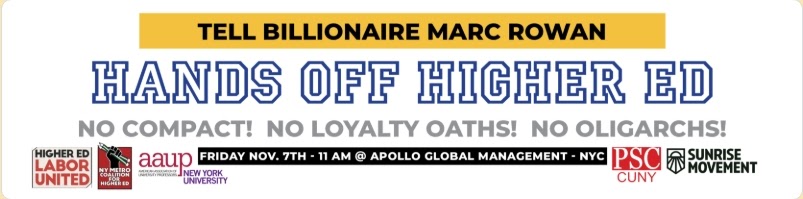
  • BORROWERS AGAINST APOLLO EVENT, FRIDAY NOVEMBER 7TH, NEW YORK CITY (HELU, AAUP, AFT)

    BORROWERS AGAINST APOLLO EVENT, FRIDAY NOVEMBER 7TH, NEW YORK CITY (HELU, AAUP, AFT)

    Higher Ed Unions, Student Unions, and For-Profit College Borrowers Unite Against Trump’s “Higher Education Compact”

    Several higher education unions, student unions, and former students of for-profit colleges are organizing in opposition to the Trump administration’s proposed “higher education compact”—a plan heavily shaped and promoted by private-equity billionaire Marc Rowan.

    Rowan, the CEO of Apollo Global Management, has played a central role in advancing this proposal. Apollo owns several predatory for-profit institutions, including the University of Phoenix, one of the most notorious offenders in the industry.

    In a recent New York Times op-ed, Rowan took public credit for the compact, writing:

    “The evidence is overwhelming: outrageous costs and prolonged indebtedness for students; poor outcomes, with too many students left unable to find meaningful work after graduating…”

    Yet, under Rowan’s leadership, the University of Phoenix has become the largest source of Borrower Defense claims of any for-profit school, with more than 100,000 pending applications as of July 2025. Borrower Defense is a federal protection that allows students to seek loan forgiveness if their school misled them or violated state or federal law.

    The University of Phoenix has faced multiple law enforcement investigations for deceptive recruiting tactics that targeted veterans, service members, and working adults nationwide. The school’s misconduct led to a $191 million settlement with the Federal Trade Commission for falsely claiming partnerships with major employers. More recently, the university attempted to portray itself as a public institution while seeking to sell to two states—both of which ultimately rejected the deal after public backlash.

    While Rowan’s personal fortune exceeds $7 billion, borrowers continue to shoulder crushing debt from degrees that delivered little to no value. His leadership has fueled a system that profits from student harm—and now, through this compact, he is setting his sights on reshaping major public universities.

    We refuse to stay silent. Borrowers, students, and educators are standing together to demand accountability and defend higher education from predatory perpetrators.

    Source link

  • Older (Desperate) Folks Targeted for Online Robocolleges

    Older (Desperate) Folks Targeted for Online Robocolleges

    In recent years, the profile of student loan borrowers in the United States has shifted dramatically. While student debt is often associated with young adults entering the workforce, a rapidly growing number of older Americans—those aged 50 and above—are carrying significant student loan balances, revealing a troubling new dimension of the nation’s student debt crisis.

    As of mid-2025, approximately 7.8 million Americans aged 50 and older hold federal student loan debt, representing about 6% of adults in this age group. Many have borrowed not only for their own education but also to finance their children’s or grandchildren’s schooling. Others have returned to college later in life, seeking new skills or credentials to remain competitive. Yet, these borrowers often face unique challenges that have been exacerbated by the rise of so-called “robocolleges.”

    Robocolleges are online institutions that aggressively market to older adults, promising flexible schedules and quick credentials that can lead to better job prospects. However, many of these institutions have come under scrutiny for their low graduation rates, high tuition costs, and poor outcomes for students. Unlike traditional colleges, robocolleges often rely heavily on automated systems and minimal personal support, leaving vulnerable older learners with little guidance about loan obligations or realistic career prospects.

    These institutions have played a significant role in trapping many older Americans in unsustainable debt. Borrowers are lured by the promise of upward mobility but frequently end up with degrees that hold limited value in the labor market. The high cost of attendance combined with aggressive recruitment tactics has led many to accumulate tens of thousands of dollars in student loan debt with few prospects for repayment.

    Among older borrowers—6.2 million between 50 and 61 years old, and 2.8 million aged 62 or older—the average federal student loan balance for the 50–61 cohort is around $47,000, the highest among all age groups. Around 8% are delinquent on their loans, with median delinquent balances near $11,500. For those over 62, approximately 452,000 are in default and face the threat of Social Security benefit garnishment, though recent government actions have temporarily paused such garnishments.

    The debt explosion among older Americans has been dramatic: over the past two decades, the number of borrowers aged 60 and above has increased sixfold, with total debt rising nearly twentyfold. Robocolleges, with their predatory recruitment and inadequate educational outcomes, are a central piece of this puzzle, helping to drive up borrowing without delivering commensurate value.

    This growing crisis underscores the urgent need for policy reforms tailored to the realities faced by older borrowers. There must be greater transparency and accountability from robocolleges, stronger consumer protections, and expanded debt relief options that reflect the challenges of late-in-life borrowing. Additionally, educational counseling and financial literacy support designed specifically for older students are crucial.

    The student debt crisis in America is no longer only about young adults trying to start their careers—it increasingly jeopardizes the financial security and dignity of older generations. As robocolleges continue to trap vulnerable older learners in cycles of debt, the urgency for reform becomes even clearer.

    The Higher Education Inquirer will continue to investigate and report on this evolving crisis, amplifying the voices of those caught in the crosshairs of an expanding student debt epidemic.

    Source link

  • Layoffs at Southern New Hampshire University

    Layoffs at Southern New Hampshire University

    Southern New Hampshire University (SNHU), long hailed as a leader in online education and a symbol of institutional reinvention, laid off approximately 60 employees on June 27, 2025. The move came without warning to staff, according to an anonymous source close to the situation.

    Employees reportedly received a generic email from Lisa Marsh Ryerson, SNHU’s newly installed president, delivering the news of their termination. There was no video call, no face-to-face meeting, and no meaningful explanation beyond the cold language of corporate HR.

    “There was no sincerity,” the source said. “No real communication. Just a robotic email. No opportunity for questions, no acknowledgment of people’s service.”

    The layoffs have sent shockwaves through the university’s workforce—many of whom had believed that SNHU’s image as a student-centered and employee-friendly institution translated into job security. That assumption, it appears, was misplaced.

    SNHU, which once garnered praise from the Obama administration for its innovative online learning model, has undergone significant changes in recent years. Under the leadership of former president Paul LeBlanc, the university expanded its online programs rapidly and became one of the largest nonprofit providers of online degrees in the United States. But as the market for online education becomes increasingly competitive and enrollment pressures mount across the country, even big players like SNHU appear to be tightening their belts.

    What’s striking about this latest round of cuts is not just the numbers—but the tone. At a university that prides itself on personalization and student engagement, employees describe the layoff process as abrupt, impersonal, and dehumanizing.

    “They preach empathy to students,” the source noted. “But when it came to their own staff, there was none.”

    It’s unclear which departments or roles were affected. SNHU has yet to issue a public statement, and no mention of the layoffs could be found on the university’s website or social media accounts at the time of publication.

    The layoffs at SNHU follow broader trends in the higher education sector, where institutions—both public and private—are increasingly resorting to staff reductions amid enrollment declines, demographic shifts, and uncertain funding landscapes. But even in this context, the lack of transparency and empathy stands out.

    The Higher Education Inquirer will continue to monitor developments at Southern New Hampshire University and invites current and former employees to share their experiences confidentially.

    Source link

  • Lead Generators Still Lurking for Bodies

    Lead Generators Still Lurking for Bodies

    Predatory lead generators are still lurking the internet, looking for their next victims.  These ads continue to sell subprime online degrees from robocolleges like Purdue Global, Colorado Tech, Berkley College, Full Sail, Walden University, and Liberty University Online.  After you provide your name and number, they’ll be calling you up.  But these programs may be of questionable value. Some may lead to a lifetime of debt.  Buyer beware.  

    This ad and lead generator is originating from TriAd Media Solutions of Nutley, New Jersey.  

    Down the rabbit hole…

    Source link

  • Walden University President Michael Betz Cashing In

    Walden University President Michael Betz Cashing In

    Walden University President Michael Betz has sold $380,000 worth of Adtalem shares. Walden is one of America’s largest robocolleges, proving online education to tens of thousands of folks in psychology, social work, nursing, education, business, and criminal justice each year.  

    Adtalem, formerly known as DeVry Education, is Walden’s parent company.  Adtalem also owns the Chamberlain College of Nursing and medical schools in the Carribean.  Walden and Adtalem have been profitable despite mediocre results for worker/consumers, a disproportionate number are women and people of color.  

    In 2024, Walden settled a case for $28M that claimed the school systematically deceived black and female students.   

    Source link