This article is an update to our June 2025 Higher Education Inquirer report, Tech Titans, Ideologues, and the Future of American Higher Education. Since that report, the landscape of higher education has evolved dramatically. New developments — the increasing influence of billionaire philanthropists like Larry Ellison, private-equity figures such as Marc Rowan, and the shocking assassination of Charlie Kirk — have intensified the pressures on traditional colleges and universities. This update examines how these forces intersect with ideology, governance, financial power, and institutional vulnerability to reshape the future of American higher education.
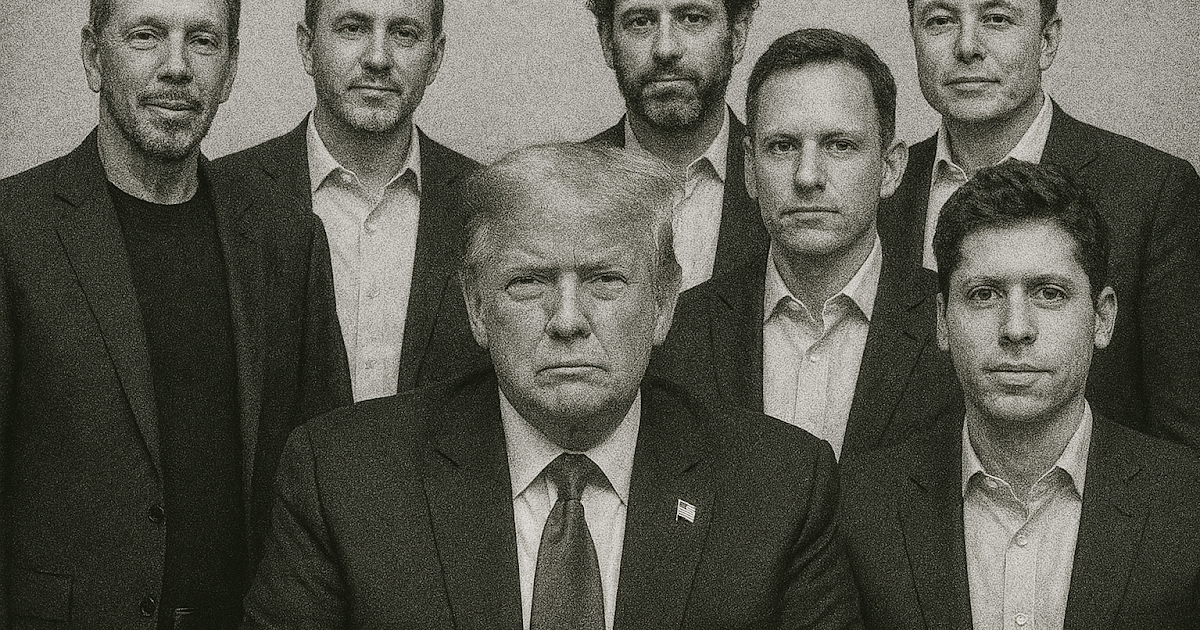
American higher education is under pressure from multiple directions, including financial strain, declining enrollment, political hostility, and technological disruption. Yet perhaps the greatest challenge comes from powerful outsiders who are actively reshaping how education is perceived, delivered, and valued. Figures such as Donald Trump, Elon Musk, Peter Thiel, Sam Altman, Alex Karp, Charlie Kirk, Larry Ellison, and Marc Rowan are steering resources, ideology, and policy in ways that threaten traditional universities’ missions. Each brings a distinct ideology and strategy, but their combined influence represents an existential pressure on the system.
Larry Ellison, the billionaire founder of Oracle, has pledged to give away nearly all his fortune and already directs hundreds of millions toward research, medicine, and education-related causes. Through the Ellison Institute of Technology, he funds overseas campuses and scholarship programs at institutions like the University of Oxford. Ellison represents a “disruptor” who does not challenge degrees outright but reshapes the allocation of educational resources toward elite, globally networked research.
The University of Phoenix cyberbreach is more than another entry in the long list of attacks on higher education. It is the clearest evidence yet of how private equity, aging enterprise software, and institutional neglect have converged to create a catastrophic cybersecurity landscape across American colleges and universities. What happened in the summer of 2025 was not an unavoidable act of foreign aggression. It was the culmination of years of cost-cutting, inadequate oversight, and a misplaced faith in legacy vendors that no longer control their own risks.
The story begins with the Russian-speaking Clop cyber-extortion group, one of the most sophisticated data-theft organizations operating today. In early August, Clop quietly began exploiting a previously unknown vulnerability in Oracle’s E-Business Suite, a platform widely used for payroll, procurement, student employment, vendor relations, and financial aid administration. Oracle’s EBS system, decades old and deeply embedded across higher education, was never designed for modern threat environments. As soon as Clop identified the flaw—later assigned CVE-2025-61882—the group launched a coordinated campaign that compromised dozens of major institutions before Oracle even acknowledged the problem.
Among the most heavily affected institutions was the University of Phoenix. Attackers gained access to administrative systems and exfiltrated highly sensitive data: names, Social Security numbers, bank accounts, routing numbers, vendor records, and financial-aid-related information belonging to students, faculty, staff, and contractors. The breach took place in August, but Phoenix did not disclose the incident until November 21, and only after Clop publicly listed the university on its extortion site. Even after forced disclosure, Phoenix offered only vague assurances about “unauthorized access” and refused to provide concrete numbers or a full accounting of what had been stolen.
Phoenix was not alone. Harvard University confirmed that Clop had stolen more than a terabyte of data from its Oracle systems. Dartmouth College acknowledged that personal and financial information for more than a thousand individuals had been accessed, though the total is almost certainly much higher. At the University of Pennsylvania, administrators said only that unauthorized access had occurred, declining to detail the scale. What links these incidents is not prestige, geography, or mission. It is dependency on Oracle’s aging administrative software and a sector-wide failure to adapt to a threat environment dominated by globally coordinated cybercrime operations.
Marc Rowan, co-founder and CEO of Apollo Global Management, has leveraged private-equity wealth to influence higher education governance. He gave $50 million to Penn’s Wharton School, funding faculty and research initiatives and has recently pushed alumni to withhold donations over issues of campus policy and antisemitism. Rowan also helped shape the Trump administration’s Compact for Academic Excellence, linking federal funding to compliance with ideologically driven standards. He exemplifies how private wealth can steer university governance and policy, reshaping priorities on a national scale. Together, Ellison and Rowan illustrate the twin dynamics of power and influence destabilizing higher education: immense private wealth, and the ambition to reshape institutions according to their own vision.
With these powerful outsiders shaping the landscape, traditional universities increasingly face pressures to prioritize elite, donor-driven projects over broad public missions. Private funding favors high-prestige initiatives over public-access education, and large contributors can dictate leadership and policy directions. University priorities shift toward profitable or ideologically aligned projects, creating a two-tier system in which elite, insulated institutions grow while public universities struggle to compete, widening disparities in access and quality.
The stakes of this upheaval have become tragically tangible. The assassination of Charlie Kirk in 2025 was a horrific reminder that conflicts over ideology, money, and influence are not abstract. Violence against public figures engaged in higher education policy and advocacy underscores the intensity of polarization and the human costs of these struggles. Such events cast a shadow over campuses, donor boards, and political advocacy alike, highlighting that the battle over the future of education is contested not only in boardrooms and legislatures but in life and death.
Students face shrinking access to affordable, publicly supported higher education, particularly those without means or connections to elite institutions. Faculty may encounter restrictions on academic freedom and institutional autonomy, as donor preferences and political pressures increasingly shape hiring, curriculum, and governance. Society risks losing the traditional public mission of universities — fostering critical thinking, civic engagement, and broad social mobility — as education becomes more commodified, prioritizing elite outcomes over the public good.
Building on our June 2025 report, this update underscores the accelerating influence of tech titans, ideologues, and billionaire philanthropists. Figures such as Ellison and Rowan are reshaping not just funding streams but governance structures, while the assassination of Charlie Kirk painfully illustrates the human stakes involved. Traditional colleges face a stark choice: maintain their public mission — democratic access, critical inquiry, and civic purpose — or retreat into survival mode, prioritizing donor dollars, corporate partnerships, and prestige. The pressures highlighted in June are not only continuing but intensifying, and the consequences — for students, faculty, and society — remain profound.
Sources
Fortune: Larry Ellison pledges nearly all fortune (fortune.com)
Times Higher Education: Ellison funds Oxford scholars (timeshighereducation.com)
Almanac UPenn: Rowan gift to Wharton (almanac.upenn.edu)
Inquirer: Rowan donor pressure at Penn (inquirer.com)
Inquirer: Rowan and Trump’s Compact (inquirer.com)
Higher Education Inquirer original article (highereducationinquirer.org)