Category: School Closures

  • Minneapolis School Board Signals Potential School Closures – The 74

    Minneapolis School Board Signals Potential School Closures – The 74


    Get stories like this delivered straight to your inbox. Sign up for The 74 Newsletter

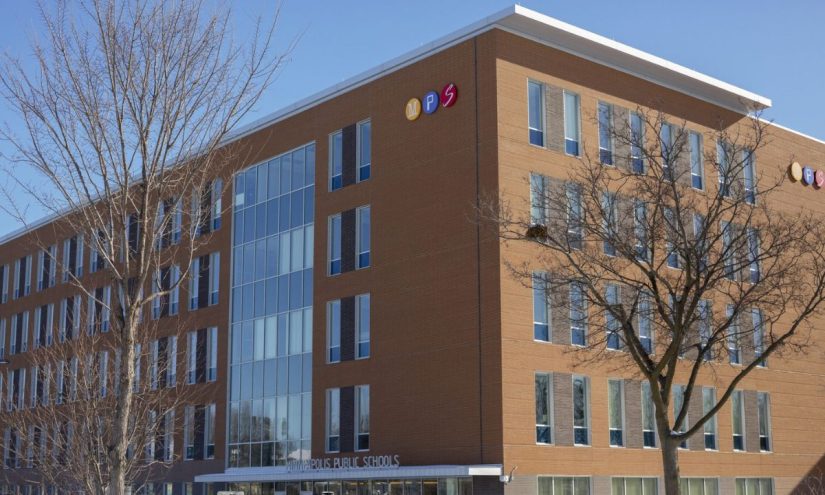
    The Minneapolis school board has formally asked Superintendent Dr. Lisa Sayles-Adams for information that could lead to school closures. They passed a resolution to the effect at a recent meeting.

    The board first drafted the directive —which asks for an initial report to the board by April 2026 — at two day-long meetings in June and August. The planning follows years of discussion about closing schools in a district with 29,000 students but the capacity for 42,000 and thus a bevy of half-empty schools.

    Even as enrollment declines at a school building, the fixed expenses for building staff — like principals, secretaries, nurses, librarians, culinary workers, custodians and social workers — stay the same or go up. With so many buildings below capacity, a big portion of each Minneapolis student’s funding has to go toward covering these fixed building-level costs, draining money away from instruction and extracurricular activities.

    The board resolution comprises topics for district administrators to investigate, including efficient use of current buildings, potential changes to magnet programs, and ways to increase enrollment in the district.

    Years-long discussion about the financial burden of operating small enrollment schools

    The process for downsizing the district’s footprint has been long and circuitous.

    In October 2022, the district prepared a comprehensive financial assessment forecasting that without significant cost cutting, the district would end up draining its reserves, while expenses would exceed revenues by the end of fiscal year 2026. The district has avoided that fate by cutting services and raising class sizes, but it is still unable to balance its budget without relying on reserves and other one-time funds.

    The 2022 memo did not prescribe closing schools, but it did present an analysis showing enrollment growth alone could not overcome the district’s structural inefficiencies resulting from operating many schools with small enrollments. At the time of the analysis, Anoka-Hennepin was operating 37 school buildings while enrolling about 37,000 students. Minneapolis was operating 61 buildings while enrolling about 29,000 students. Minneapolis had about half as many students per building as Anoka-Hennepin.

    The board first publicly discussed reducing the number of schools in March 2023, when then-board Chair Sharon El-Amin asked Rochelle Cox, the then-interim superintendent, to develop a draft plan for “school transformation.” Neither Cox nor the board took action.

    Two months before current Superintendent Dr. Lisa Sayles-Adams started at the district in early 2024, the School Board passed a “transformation resolution” that directed the district to do an accounting of physical space but stopped short of calling for a timeline on school closures.

    Sayle-Adams promised to tackle “right-sizing” the district after passing a budget in June 2024, because, she said, the community asked her to address the issue.

    Low enrollment schools require more funding per student for building-level staff

    The district is contending with rising costs and operating a significant number of small buildings, as well as buildings operating below capacity. Given the rising fixed costs of operating these buildings, that leaves less money for everything else, from class size reduction to teacher pay and programs commonly found in most school districts like world languages, art, music and athletics.

    Across the district, as building-level enrollment has declined, students have lost access to services like academic support if they’re struggling; staff to address student behavior; and community liaisons to help parents connect with schools. Small elementary schools have difficulty funding full-time positions for electives like art, music and gym, while hiring part-time staff for these positions is challenging. Some elementary students have gone without these electives, or only have music or art for part of the school year.

    Enrollment declines at middle and high schools have meant fewer elective options, like world languages, dance, theater and orchestra, as well as extracurriculars. Students also lose access to advanced coursework — like AP or IB classes — when there are too few students in the school who want to enroll. Many of the district’s high schools are now sharing athletic teams because individual schools lack enough students and funding to support a robust athletics program.

    The decline in services drives some families to schools outside the district that have the services and programs they desire, compounding the enrollment declines.

    Declines in enrollment mitigated by new-to-country students

    Minneapolis Public Schools lost about 15% of its enrollment in the wake of the COVID-19 pandemic, due to a combination of factors including implementing a controversial plan redrawing school boundaries, and keeping its schools closed longer during the pandemic than any other Minnesota district, which was followed in March 2022 by a three week educator strike.

    The district has enjoyed a small enrollment increase both last year and this year. Although the district does not track the immigration status of students, the increase has been attributed almost entirely to students newly arrived to the United States from Central America. Since the 2021-22 school year, English learner students have increased from 17% of the district’s students to 23% in the 2024-25 school year, according to Minnesota Department of Education data.

    This year, the district expects to spend at least $17 million more on English learner services than it receives in funding from state and federal sources. Although the Legislature increased state aid for English learners during the 2023 legislative session, the district’s funding is insufficient to cover the cost of providing the intensive services needed by students with the lowest levels of English proficiency.

    Many of the newcomer students are also unhoused, which has led to growing costs for the district to transport students from shelters outside district boundaries, as required under the federal McKinney-Vento law. The state has started to pay the cost of this transportation under a law passed in 2023.

    It is not clear whether changes to federal immigration policy will impact the district’s ability to continue to rely on newcomers to stabilize or grow enrollment in the future.

    Future enrollment expected to decline, limiting district’s funding

    Hazel Reinhardt, a demographer hired by the district, says enrollment is likely to continue to decline in the coming years because of lower birth rates, fewer families choosing to raise children in the city, and the state’s favorable laws around charter schools and open enrollment, allowing parents to send their children to St. Paul or suburban schools.

    Reinhardt told the board in June that once parents leave for charter and private schools or open enrollment options, “precious few” districts are able to bring them back.

    Most of the district’s funding is based on enrollment, so declining enrollment has created a ballooning fiscal crisis. Growing costs for both labor and services have outpaced increases in state and local funding.

    The district continues to cut services, increase class sizes and pull from its dwindling reserve funds to balance its annual budget. The district is expected to use $25 million from its reserves this school year after using $85 million from reserves last school year.

    The district’s enrollment woes and related financial distress are not unique to Minneapolis, with similar challenges facing large urban districts like Oakland, San Francisco, Denver, Seattle and Portland. Denver and Oakland have closed a small number of schools in recent years, but not enough to stabilize district finances. And school boards in Seattle and San Francisco have walked away from closure plans after significant public pressure, leaving both districts with growing budget deficits.

    Minnesota Reformer is part of States Newsroom, a nonprofit news network supported by grants and a coalition of donors as a 501c(3) public charity. Minnesota Reformer maintains editorial independence. Contact Editor J. Patrick Coolican for questions: [email protected].


    Did you use this article in your work?

    We’d love to hear how The 74’s reporting is helping educators, researchers, and policymakers. Tell us how

    Source link

  • As Enrollment Falls, Fewer Schools Close – The 74

    As Enrollment Falls, Fewer Schools Close – The 74

    The headlines are seemingly everywhere:

    Jackson Public Schools board votes to close 13 school buildings.”

    Denver Public Schools to close 7 schools, cut grades at 3 others despite heavy resistance.”

    The list is out: These are the SFUSD schools facing closure.” 

    Such reports can leave the impression that districts are rapidly closing schools in response to declining enrollment and families leaving for charters, private schools and homeschooling. 

    But the data tells a different story. 

    School closures have actually declined over the past decade, a period of financial instability that only increased in the aftermath of the pandemic, according to research from the Brookings Institution. 

    The analysis, shared exclusively with The 74, shows that in 2014-15, the closure rate — the share of schools nationwide that were open one year and closed the next — was 1.3%. In 2023-24, the rate was just .8%, up from .7% the year before.

    “I think it’s important for people to realize how rare school closures are,” said Sofoklis Goulas, a Brookings fellow and the study’s author. 

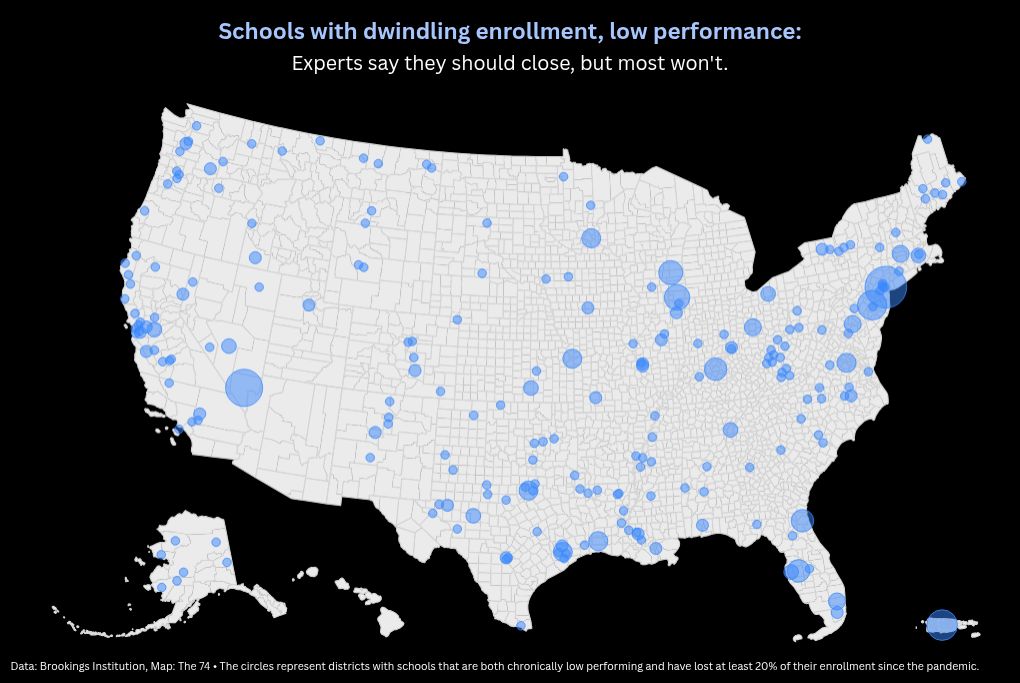
    Last fall, his research showed how schools that have lost at least 20% of their enrollment since the pandemic are more likely to be low-performing. The Clark County Public Schools, which includes Las Vegas, had the most schools on the list — 19 — but isn’t currently considering closures. In Philadelphia, with 12 schools in that category, district leaders are just beginning to discuss closures.

    When it released Goulas’s initial report, leaders of the conservative Thomas B. Fordham Institute argued that low-performing schools should be the first to close. But efforts to do so are often met with pushback from families, teachers and advocacy groups who argue that shutting down schools unfairly harms poor and minority students and contributes to neighborhood blight. Their pleas often push district leaders to retreat. Working in advocates’ favor, experts say, is the fact that many big district leaders are untested and have never had to navigate the emotionally charged waters of closing schools.

    “Closing a neighborhood school is probably one of the most difficult decisions a district’s board makes,” said Michael Fine, CEO of the Fiscal Crisis and Management Assistance Team, a California state agency that provides financial oversight to districts. “They are going to avoid that decision as long as they can and at all costs.” 

    Such examples aren’t hard to find:

    • Just weeks after announcing closures, the San Francisco district halted plans to shutter any schools this fall.
    • In September, outgoing Chicago Public Schools CEO Pedro Martinez pledged to put off school closures for another two years, even though state law allows the city to take action sooner. The district is in the process of absorbing five charter schools to keep them from closing. 
    • In October, Pittsburgh Public Schools recommended closing 14 schools; several others were set to be relocated and reconfigured. About a month later, Superintendent Wayne Walters hit pause, saying the district needed more “thoughtful planning” and community input.
    • Last May, the Seattle Public Schools announced it would shutter 20 elementary schools next school year in response to a $100 million-plus budget deficit. They later increased the number to 21. By October, the list had dwindled to four schools. Just before Thanksgiving, Superintendent Brent Jones withdrew the plan entirely. 

    “This decision allows us to clarify the process, deepen our understanding of the potential impacts, and thoughtfully determine our next steps,” Jones wrote to families. While the plan would have saved the district $5.5 million, he said, “These savings should not come at the cost of dividing our community.”

    map visualization

    Graham Hill Elementary in Seattle, which fifth grader Wren Alexander has attended since kindergarten, was initially on the list. The Title I school sits on top of a hill in a desirable area overlooking Lake Washington. But it also draws students from the lower-income, highly diverse Brighton Park neighborhood.

    Among Wren’s neighbors are students from Ethiopia, Vietnam and Guatemala. Wren, who moves on to middle school this fall, said she looks forward to visiting her former teachers and cried when she heard Graham Hill might close. She wanted her younger brother and sister to develop the same warm connection she had.

    “I don’t think I would be who I am if I didn’t go to the school,” she said.

    Wren Alexander and her little sister Nico, outside Graham Hill. (Courtesy of Tricia Alexander)

    Tricia Alexander, her mother, was among those who opposed the closures, participating in rallies outside the district’s administration building and before board meetings.

    “We were really loud,” said Alexander, who’s also part of Billion Dollar Bake Sale, an effort to advocate for more state education funding. She said there was “no real evidence” that closing schools would have solved the district’s budget woes. “In no way would kids win.”

    It’s a view shared by many school finance experts, who note that the bulk of school funding is tied up in salaries, not facility costs. Districts may save some money from closing schools, but unless coupled with staff reductions, it’s often not enough to make up for large budget shortfalls.  

    ‘So bad at this’

    If enrollment doesn’t pick up, experts say, leaders who delay closures will have to confront the same issues a year later or — perhaps even more likely — pass the problems on to their successors. 

    “If there continues to be fewer and fewer children …then that doesn’t get better,” said Brian Eschbacher, an enrollment consultant.  

    One Chicago high school, for example, had just 33 students last year. In Los Angeles, the nation’s second-largest district, 34 elementary schools have fewer than 200 students and 29 of those are using less than half of the building, according to a recent report. The share of U.S. students being educated outside of traditional schools also continues to increase, according to a forthcoming analysis Goulas conducted with researchers at Yale University. 

    “We don’t see a trajectory of enrollment recovery,” he said. “Things actually got worse in the most recently released data batch.”

    But such conditions haven’t stopped advocacy groups from campaigning against closures. One of them, the left-leaning Advancement Project, has joined with local groups in Denver and Pittsburgh to make a case against closures nationally. 

    “All children deserve to have a local, neighborhood public school in which they and their families have a say,” said Jessica Alcantara, senior attorney for the group’s Opportunity to Learn program. “It’s not just that school closures are hard on families. They harm the full education ecosystem that makes up a school — students, families, school staff and whole communities.”   

    Last May, Alcantara and other Advancement Project staff urged the U.S. Department of Education to treat school closures as a civil rights issue. Nine of the 10 schools the Denver district planned to close in 2022 had a majority Black or Hispanic student population. 

    The advocates argued that in cases of enrollment loss, run-down facilities and empty classrooms, there are alternatives to closing schools. They encourage communities to push for renovations and urge district leaders to use vacant spaces for STEM, arts or other programs that might attract families. Opponents of closures also say that districts sometimes underestimate how much of a building is used for non-classroom purposes like special education services, early-childhood programs and mental health. 

    Eschbacher’s assessment of why districts often back down from closing schools is more blunt. 

    “Districts are so bad at this,” he said. “If you just do a few things wrong, it could sink the whole effort.”

    For one, leaders often target schools with under 300 students for closure, appealing to parents that they can’t afford to staff them with arts programs, a school nurse or a librarian. 

    But those explanations sometimes fall flat.

    “Parents always say, ‘I wanted a small school. I know my teachers and they know my kid. And it’s right down the street,’” Eschbacher said. If they didn’t like their school, he added, they would have likely would have chosen a charter or some other option. 

    District officials also run into trouble if they try to spin the data. When Seattle officials talked about “right-sizing” the district, they pointed to the loss of 4,900 students since 2019-20. 

    But Albert Wong, a parent in the district and a lifelong Seattle resident, knew there was more to the story. Not only is the current enrollment higher than it was from 2000 to 2011, the pandemic-related decline seems to have leveled off. In a commentary, he argued that officials presented misleading data “to make current enrollment look exceptionally bad.”

    Graham Hill Elementary, fifth-grader Wren’s school, actually saw a slight increase in enrollment this year, including a new class for preschoolers with disabilities. And while Pittsburgh schools are projected to lose another 5,000 students over the next six years, enrollment this year held steady at about 18,400.

    To Eschbacher, the “burden of proof is always on the district” to make an airtight case for why students would be better off in larger schools. He has applauded the Denver-area Jeffco Public Schools, which has closed 21 schools since 2021, for having state demographers, not just district officials, explain population trends to families at community meetings.

    ‘It wasn’t realistic’

    Walters, Pittsburgh’s superintendent, can easily rattle off reasons why the district should rethink how it uses its buildings. Early last year, local news reports showed that almost half of the district’s schools were less than 50% full. 

    “We’ve lost about a fourth of our population, but we have not changed anything to our footprint,” he said. 

    Meanwhile, the average age of the district’s buildings is 90 years old, and many lack air-conditioning, forcing some schools to send students home in sweltering weather.

    But a consulting group’s proposal showed that Black and low-income students and those with disabilities would be disproportionately affected by the changes. Several advocacy groups drew attention to those disparities, calling  the effort “rushed.” 

    412 Justice, an advocacy group, is among the community organizations pushing for alternatives to school closures in Pittsburgh. (412 Justice)

    Walters agreed and put the plan on hold last fall, saying he lacked “robust” responses to parents’ tough questions about how schools would change for their kids.

    “It doesn’t mean that we don’t see a path forward,” he said. “But it wasn’t realistic that we would have those questions answered within the timeline that we’ve been given.”

    In March, parents pushed for another delay, causing the school board to postpone a vote on the next phase in the closure process.

    As the Jeffco district demonstrates, some school systems are following through with closures. The school board in nearby Denver unanimously voted in November to close seven schools and downsize three more. 

    But that’s after community protests pushed the district to put the brakes on a plan to close 19 schools in 2021. Advocates argued that families in low-income areas, who had been heavily impacted by the pandemic, would be most affected. Then the district only closed three in 2023, and now board members are considering a pause on closures for three years.

    School boards closing a dozen or more schools are often catching up with work their predecessors let pile up, said Goulas of Brookings. 

    “Closing a single school allows for easier placement of students and minimizes the political cost and community stress,” he said. “When a district releases a long list of schools to close, it likely indicates that they waited for conditions to improve, but this didn’t happen.”

    Angel Gober, executive director of 412 Justice — one of 16 organizations that called on the Pittsburgh district to drop its plan — acknowledged that their fight isn’t over.

    “I think we got a temporary blessing from God,” she said. But she wants the district to explore a host of alternatives, like community schools and corporate support, before it shutters and sells off buildings. “We do have very old infrastructure, and that is an equity issue. But can we try five things before we make a drastic decision to close schools for forever?”


    Get stories like these delivered straight to your inbox. Sign up for The 74 Newsletter


    Source link