
Category: School Year Abroad

  • When young people ask big questions and seek answers

    When young people ask big questions and seek answers

    Cliffrene Haffner attended the African Leadership Academy (ALA) in South Africa during the Covid-19 pandemic. Her university applications were stalling and she felt stressed and anxious.

    “Life felt unstable, as if I were hanging by a thin thread,” Haffner said. But it was at ALA that she discovered News Decoder.

    “Joining News Decoder helped me rebuild my voice,” she wrote. “It created a place to write honestly and with purpose whilst supporting others in telling their stories. At a time when the world felt numb and disconnected, we used storytelling to bring back hope on campus by sharing our fears, thoughts and expectations.”

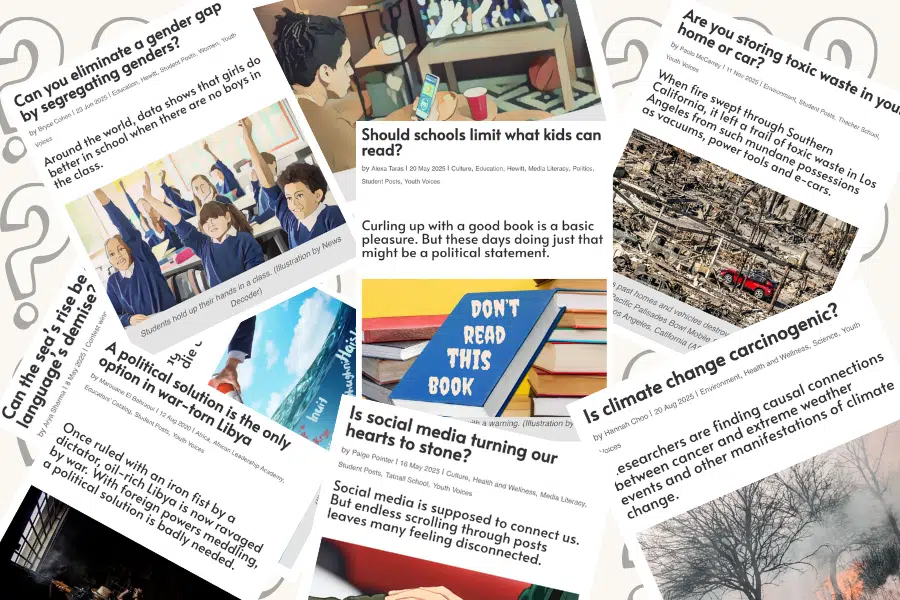
    At News Decoder, students work with professional editors and news correspondents to explore complicated, global topics. They have the opportunity to report and write news stories, research and present findings in global webinars with students from other countries, produce podcasts and sit in on live video roundtables with experts and their peers across the globe.

    Many get their articles published on News Decoder’s global news site.

    A different way of seeing the world

    Out of these experiential learning activities, they take away important skills valuable in their later careers, whatever those careers might be: How to communicate clearly, how to recognize multiple perspectives, how to cut through jargon and propaganda and separate facts from opinion and speculation.

    One milestone for many of these is our Pitch, Report, Draft and Revise process, which we call PRDR. In it, students pitch a story topic to News Decoder with a plan on how to research and report it. We ask them to identify different perspectives on problems they want to explore and experts they can reach out to for information and context.

    Then we guide them through a process of introspection, if the story is a personal reflection on their own experience, or a process of reporting and interviewing. News Decoder doesn’t promise students that their stories will get published at the end of the process. They have to work for that — revising their drafts until the finished story is clear and relevant to a global audience.

    One student who went through the process was Joshua Glazer, now a student at Emory University in the United States. Glazer came to News Decoder in high school as an exchange student in Spain with School Year Abroad.

    “I think the skills that I got out of that went on to really change the course of my education and how I view the world,” Glazer said. “Because when you step into the world of journalism you learn a different way of seeing the world.”

    Recognizing our biases

    Glazer learned that for journalism, he had to be less opinionated. “You have to really approach things kind of as they are in the world,” Glazer said. “And that is hard to do. That is not an easy skill that we can do as humans because we inherently have biases.”

    He said it challenged him to look inwards and recognize his biases and counter them with evidence.

    “So I think those skills have really changed the course of how I view having an argument with somebody because all of a sudden, you know, when you have an argument with someone, it’s all opinion,” he said.

    For Haffner, who is now a business administration student at Ritsumeikan Asia Pacific University in Japan, News Decoder reshaped how she and her peers understood storytelling.

    “It taught us to let go of rigid biases and to make authenticity the centre of our work,” Haffner said. “Students from different backgrounds found a space where their voices were heard, respected and valued. Our stories formed a shared map, each one opening a new room to explore, each voice strengthening the collective journey we were on. In that chaotic period, we created something meaningful together. Something bigger than us.”

    Working through the complexity of a topic

    Marouane El Bahraoui, a research intern at The Carter Center in the U.S. state of Georgia, also discovered News Decoder at the African Leadership Academy. At the time, he was interested in writing about the effectiveness of the Arab Maghreb Union — an economic bloc of five North African countries. He grew up in Morocco but didn’t want to approach the topic from a purely Moroccan perspective.

    “It was like a very raw idea,” he said.

    He pitched the story and worked with both News Decoder Founder Nelson Graves and correspondent Tom Heneghan to refine the idea. They guided him in the reporting and writing process.

    “One aspect that I liked a lot from my research was the people that I had the chance to talk to,” he said. “It was during Covid and I was just at home and I’m talking to, you know, professors in U.S. universities, I’m talking to UN officials, experts working in think tanks in D.C. and I was thinking oh those people are just so far, you can’t even reach them. And then you have a conversation with them and they’re just normal people.”

    He also found writing the story daunting. “It was a little bit overwhelming for me at the time,” he said. “You know, you’re not writing like an academic essay.”

    Graves encouraged him to write in a straightforward manner. In school, he had been taught to write in a beautiful way to impress.

    “From News Decoder, something I learned is to always keep the audience in mind who you are speaking to, who are you writing to,” he said.

    He took away the importance of letting readers make their own conclusions. “You’re not writing to tell the reader what to think,” he said. “You are writing to give them ideas and arguments, facts and leave the thinking for them.”
    Source link

  • The one thing that unites French voters

    The one thing that unites French voters

    French President Emmanuel Macron’s grip on stability, progress and voter approval seems to be slipping.

    His party lost its absolute majority in the National Assembly and, following snap elections in the summer of 2024, its relative majority as well. Now, he faces a budget crisis, voter pushback and a geopolitical crisis involving Europe, the United States and Russia.

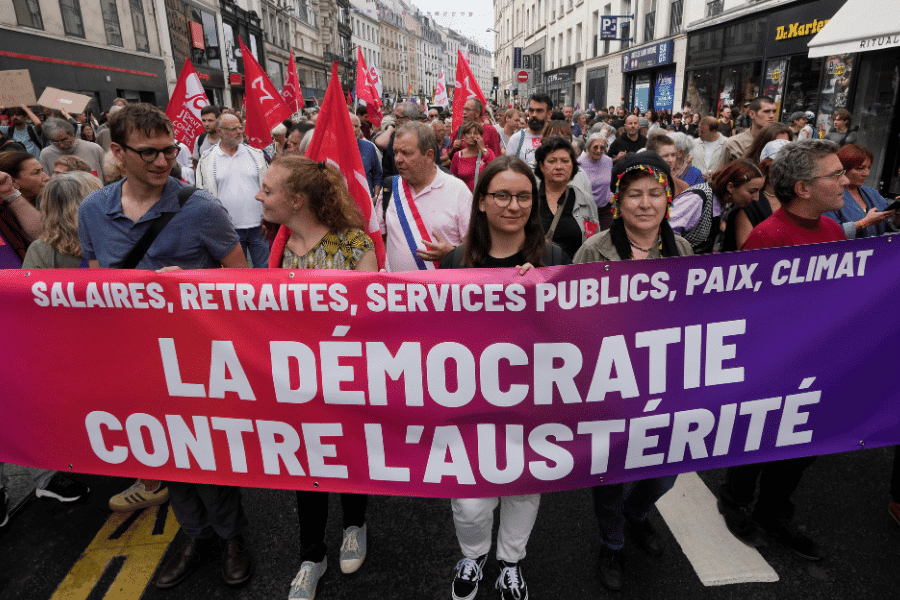
    Macron had once hoped to bridge France’s political divides and reinvigorate its economy but is now mired in political quicksand and many French voters feel helpless. That’s what I discovered while interviewing people on the street in Rennes, France, where I’m spending a year studying abroad and trying to make sense of French politics.

    One elderly woman I spoke to described what was happening as a catastrophe. “It’s embarrassing,” she said. “All we can do is wait for the next presidential election.”

    My interviews aligned with a November 2024 IPSOS survey, which found that 74% of respondents lack confidence in the presidency, while an overwhelming 86% distrust political parties. Trust in the National Assembly has plummeted as well, with 74% of respondents expressing no faith in the institution.

    What voters say

    People are frustrated. A middle-aged man told me: “Macron has lost his authority. France is unstable, gridlocked and hostile.”

    Back in September, Macron appointed Michel Barnier as prime minister in an attempt to stabilize his government but it backfired. By December, Barnier’s government had collapsed after losing a no-confidence vote, ousting him and his ministers and triggering yet another governmental reset.

    The vote came in response to Barnier’s use of Article 49.3 of the French Constitution, which allows the executive to pass a budget without parliamentary approval.

    It wasn’t until February 2025 that lawmakers finally agreed on a budget — one met with widespread discontent over spending cuts and reallocations. Now, many French citizens are asking: What’s next for the Republic?

    A law student I spoke with who goes to the University of Rennes expressed uncertainty about the country’s future. “I’m scared because we’re walking back on progress,” he said.

    A nation disunited

    Political divisions seem to be deepening, amplified by social media.

    A political science student at Rennes 2 University noted that people seem unable to talk to each other. “It’s harder than ever to have conversations with people who disagree with us,” the student said. “We don’t just see differing opinions, we see them as attacks on who we are.”

    Another student said that at university, now, you find yourself attacked or excluded if you don’t agree.

    This polarization was evident in the most recent European elections. The far-right Rassemblement National secured 31.5% of the vote — a 40-year record for any French party in a European election. Their campaign focused on hard-line immigration policies, crime reduction and tax cuts on fossil fuels.

    Despite shared dissatisfaction, French citizens are divided on the changes they seek. One university student emphasized the need for a more equitable education system.

    “We’ve made strides in accessibility, but students are locked into career paths too early,” she said. “My younger brother, for example, always dreamed of becoming a pilot. But because his undiagnosed ADHD hurt his test scores, he was placed in a vocational high school instead of a general one. Now he’s studying to be an air steward.”

    Some want a strong government.

    A retired woman expressed concern over global instability. “Russia’s invasion of Ukraine is terrifying,” she said. “And with Trump distancing the U.S. from the EU, I worry our military isn’t strong enough. France and the EU need to invest in defense.”

    To put what I found on the streets into perspective, I spoke with Alistair Lyon, a News Decoder correspondent and former reporter with the Reuters international news service who lives in France.

    He highlighted the long-term consequences of the gridlock in French politics. “In a time when France faces huge challenges like a budget deficit and a major geopolitical crisis involving the U.S., Europe and Russia, now is not a great time to have a political stalemate,” Lyon said.

    He expects the stalemate to continue until the 2027 presidential election, given Macron’s loss of both absolute and relative majorities in the National Assembly.

    He pointed to two major sources of division: growing disillusionment with politicians and resistance to reform. Many French voters feel politically homeless, fueling a cycle where reforms are met with fierce backlash, ultimately deterring further change.

    Disinformation breeds distrust.

    Compounding the problem is the erosion of independent journalism.

    “You have to be very careful reading the news,” Lyon said. “Journalists that remain anchored to traditional values of accuracy and impartiality are becoming few and far between.”

    In France, billionaire and right-wing proponent Vincent Bolloré has bought up news and media outlets, raising concerns about bias and misinformation. In a way, Lyon said, the media is fueling the fires of divisions in new ways because now the press is controlled and owned by people with vested political interests.

    France finds itself at a crossroads. Uncertainty, frustration and political polarization are creating more gloom than ever.

    Whether stability can be restored depends on Macron, the parliament and their willingness to compromise. If cooperation remains minimal, France may continue down a path of deepening division, one with consequences far beyond its borders.


    Three questions to consider:

    1. Why has French President Emmanuel Macron lost significant support from voters?

    2. What is one thing voters are in France want from their government?

    3. As a citizen of your country, what do you expect your government to do for you?


    Source link

  • The universal language of football

    The universal language of football

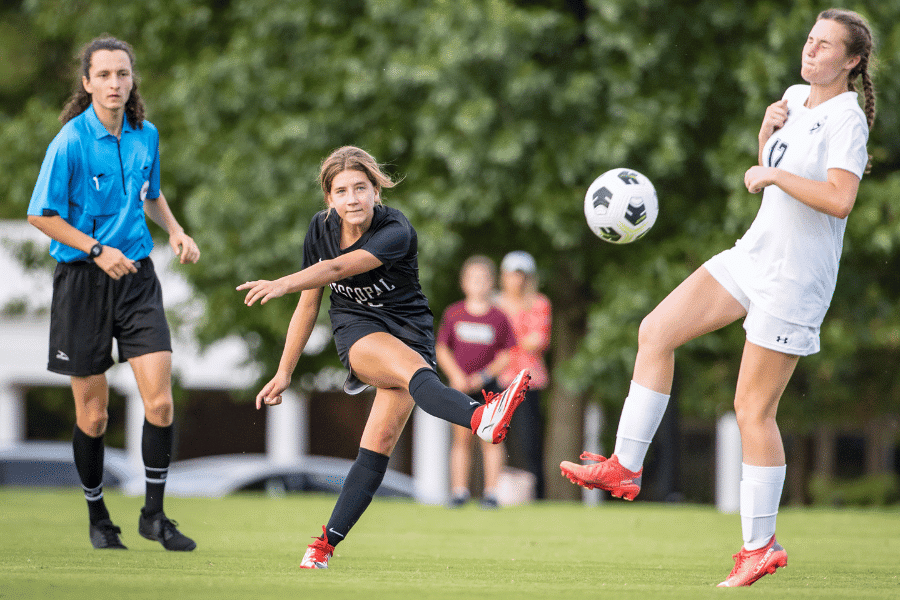
    We were split into two teams scrimmaging against each other. The boys I play with are competitive so there was the usual light trash talking, jersey pulling and agile foot skills. 

    We were playing friendly rules with no corner kicks. My teammate, Gugu, was fouled in the makeshift goalie box and dramatically fell to the ground yelling for a penalty kick. 

    None of us expected the coach to listen to him, but surprisingly he gave it to our team on the condition that I take the kick. All the players lined up around the box as I prepared to shoot, choosing to aim for the bottom right corner. 

    Two things you should know: First this is in Italy and I’m an American teenager who speaks little Italian. Second, I’m the only girl on the team.

    The coach blew the whistle. I confidently ran, kicking the ball with all my strength. It went soaring over the crossbar into the fence behind. I wanted to crawl into a hole and hide. 

    A lifelong love of sports

    Sports have been a part of my life for as long as I can remember. As soon as I learned to walk, my parents introduced me to swimming (after all, 71% of earth’s surface is water). They had me learn tennis to hone my hand-eye coordination, ballet to cultivate “grace” and finally soccer to channel my boundless energy. 

    Ballet was the first to go. I was asked to leave for being too much of a distraction (it’s not my fault the class was boring and repetitive). Swimming followed when the early practices and relentless cycle of toxic comparison drained it of joy. Tennis, while never officially abandoned, became more of a casual hobby, a skill I maintained with occasional matches. 

    But soccer? Soccer was different. It endured. Not just for me, but for my siblings as well. My older brother and younger siblings all share a similar love for the sport.

    My football career began at six years old with my recreational team, Purple Thunder, where the post-game refreshments — orange slices and chocolate milk — mattered more than the outcome of the game. 

    Next came Academy, where I was paired with a “special buddy” (one of the older kids) to help me focus and follow directions. By eight, I advanced to the competitive world of travel soccer — a commitment that has defined half of my life. Over the past eight years, I’ve played on various teams, with different coaches, in several leagues and have witnessed the growing intensity of competition as more pressure is placed on each player.

    Soccer bridges divides across borders.

    Soccer has taken me across the country and around the world. I’ve played soccer in Denmark, Sweden and Germany against local girls’ teams in those countries. Soccer is now a cornerstone of my identity.

    When the external factors of my life changed as I grew and I matured, soccer remained the one constant. 

    During the pandemic, I found solace in dribbling by myself in my basement and backyard. When I moved to boarding school, leaving behind my family and home, my high school soccer team became my anchor. 

    Despite all the stress I endured through these changes, my love for the game only deepened as I experienced the unique camaraderie of a team composed of players from all over the world, united by our shared passion for soccer and desire to win. 

    I cried when my favorite coach left for another job, cried again, then confronted a different coach who left me off the roster for games. I cried when a teammate lost her brother. 

    Sports transcends the field.

    Soccer is more than a game. It’s an art, an outlet. And a team is more than just a group of players: it’s a community, a support system that celebrates your successes and lifts you up when you fall. In those eight years, I believed I had encountered every type of soccer environment imaginable — until I arrived in Italy. 

    So I could play here, the extracurricular coordinator at my study abroad school called on Gianni, a host parent who works for the local soccer club, Viterbese. 

    Equal parts nervous and excited, I met Gianni and told him about my soccer experience — travel for eight years, high school varsity for two — and what I’m looking for — consistent, high level practices to keep me in shape. 

    He suggests two teams I could play with, but both are boys’ teams, and I choose one. We decide I will go to the team’s practice on Monday and he even offers me a ride. 

    The second he leaves, my spiraling begins as my brain conjures up all the worst possible scenarios. Monday arrives and I can’t decide whether to be filled with dread or excited to finally play. 

    At the field, the boys are already huddled with the coach. Now I’ll stand out even more. I get my cleats on and join the circle, suffering through an awkward introduction with the coach, then we begin.

    It’s been four months now since that moment, and I’ve gone to every practice I could. I was nervous at first, especially after Gianni stopped coming and I was left to navigate it on my own. But during the drills on the first day, I quickly realized I’d been overthinking it. They weren’t a team of young Messis and Ronaldos, just regular teenage boys. 

    There are many ways to communicate.

    While I’d played against teams that didn’t speak English before, practicing alongside them and becoming part of their team was an entirely new experience. 

    Learning a new language is a year-long journey, and I take it one day at a time. So while I’ve built up a solid repertoire of Italian words and calcio (soccer) vocabulary, I’ve discovered other ways to communicate — through the game itself.

    Words aren’t always necessary to understand my teammates’ personalities. I can learn plenty from how they play. Whether they prefer to dribble or pass, take the shot or let someone else score, arrive early to practice, talk over the coach, yell at teammates or tug on someone’s jersey, these small choices on the field speak volumes about a person’s true character. 

    Playing soccer here has been living proof that actions truly speak louder than words and that sports have a unique ability to connect people. As a 16-year-old girl from Northern Virginia, I’ve formed a connection with 15-year-old Italian boys from a small city north of Rome. 

    It’s also a reminder that no matter how experienced or “well-versed” you think you are in a passion, there are always more opportunities to grow — if you’re willing to take the leap. I’ve embarrassed myself countless times, as I did trying to make that penalty shot after Gugu was fouled. I’ve lost the ball, missed shots, stumbled over Italian. I once even forgot my cleats. 

    But despite the awkward moments, I wouldn’t trade this experience for anything.


    Three questions to consider:

    1. How did the author manage to communicate with her teammates without knowing the language they spoke?
    2. What does the author mean by soccer being more than a sport?
    3. What sport or hobby are you passionate about and are there people who share that passion?


    Source link