Category: school

  • Leading (again) in uncertainty

    Leading (again) in uncertainty

    Key points:

    • Change has become the norm in our high-speed world
    • How school leaders can manage and control emotions
    • Em-pathy, not un-pathy, in school leadership
    • For more news on navigating change, visit eSN’s Educational Leadership hub

    We are again in uncertain times. We again find ourselves dealing with sudden changes and uncertainty. We seem to be in a state of constant change and ambiguity. The causes are different, but the feelings–and often our immediate reactions to these events–are the same.

    More News from eSchool News

    Teachers are superheroes. Every day, they rise to the challenge, pouring their hearts into shaping the future. They stay late to grade papers and show up early to tutor struggling students.

    In today’s evolving educational landscape, effective student assessment goes beyond multiple-choice tests and letter grades. According to a recent study, over 60 percent of educators believe traditional assessments fail to fully measure student understanding.

    Holden, my 21-month-old, has fallen in love.  His early morning snack and “couch time” includes a dose of “Tiger!”  This is toddler for, “Mom, turn on Daniel Tiger’s Neighborhood.”

    The COVID-19 pandemic left an indelible mark on K-12 education, placing immense pressure on teachers as they adapted, literally overnight, to new methods of instruction.

    Spring brings not only showers and flowers, but it also brings the opportunity to interview for new education positions. Preparing for an interview involves several key steps that can significantly impact the outcome.

    STEM careers are on the rise. According to the U.S. Bureau of Labor Statistics, employment in STEM occupations is expected to grow by 10.4 percent from 2023 to 2033, compared to just 3.6 percent for non-STEM occupations.

    The U.S. Department of Education is giving state education agencies 10 days to certify that their schools do not engage in any practices that the administration believes illegally promote diversity, equity, and inclusion.

    COVID had already killed thousands of people in other countries and was spreading in the United States when a top federal health official said schools should prepare to offer “internet-based teleschooling” in case they had to close for a period of time.

    More than half of educators (62 percent) are already making use of AI at school, with more than one-quarter using it daily for work purposes, according to a Twinkl survey of more than 3,500 U.S. teachers.

    Many math tasks involve reading, writing, speaking, and listening. These language demands can be particularly challenging for students whose primary language is not English.

    Want to share a great resource? Let us know at [email protected].

    Source link

  • Understanding why students cheat and use AI: Insights for meaningful assessments

    Understanding why students cheat and use AI: Insights for meaningful assessments

    Key points:

    • Educators should build a classroom culture that values learning over compliance
    • 5 practical ways to integrate AI into high school science
    • A new era for teachers as AI disrupts instruction
    • For more news on AI and assessments, visit eSN’s Digital Learning hub

    In recent years, the rise of AI technologies and the increasing pressures placed on students have made academic dishonesty a growing concern. Students, especially in the middle and high school years, have more opportunities than ever to cheat using AI tools, such as writing assistants or even text generators. While AI itself isn’t inherently problematic, its use in cheating can hinder students’ learning and development.

    More News from eSchool News

    Many math tasks involve reading, writing, speaking, and listening. These language demands can be particularly challenging for students whose primary language is not English.

    As a career and technical education (CTE) instructor, I see firsthand how career-focused education provides students with the tools to transition smoothly from high school to college and careers.

    As technology trainers, we support teachers’ and administrators’ technology platform needs, training, and support in our district. We do in-class demos and share as much as we can with them, and we also send out a weekly newsletter.

    Math is a fundamental part of K-12 education, but students often face significant challenges in mastering increasingly challenging math concepts.

    Throughout my education, I have always been frustrated by busy work–the kind of homework that felt like an obligatory exercise rather than a meaningful learning experience.

    During the pandemic, thousands of school systems used emergency relief aid to buy laptops, Chromebooks, and other digital devices for students to use in remote learning.

    Education today looks dramatically different from classrooms of just a decade ago. Interactive technologies and multimedia tools now replace traditional textbooks and lectures, creating more dynamic and engaging learning environments.

    There is significant evidence of the connection between physical movement and learning.  Some colleges and universities encourage using standing or treadmill desks while studying, as well as taking breaks to exercise.

    This story was originally published by Chalkbeat. Sign up for their newsletters at ckbe.at/newsletters. In recent weeks, we’ve seen federal and state governments issue stop-work orders, withdraw contracts, and terminate…

    English/language arts and science teachers were almost twice as likely to say they use AI tools compared to math teachers or elementary teachers of all subjects, according to a February 2025 survey from the RAND Corporation.

    Want to share a great resource? Let us know at [email protected].

    Source link

  • 6 ways tech simplifies school communication and engagement

    6 ways tech simplifies school communication and engagement

    Key points:

    • Streamlining school communication empowers all district stakeholders
    • The dos and don’ts of parent-educator communication
    • Female district leaders target back-to-school priorities
    • For more on school communication, visit eSN’s Educational Leadership hub

    As technology trainers, we support teachers’ and administrators’ technology platform needs, training, and support in our district. We do in-class demos and share as much as we can with them, and we also send out a weekly newsletter. We coordinate a lot of different training sessions across our many different platforms, and support principals during staff meetings and on professional development days.  

    More News from eSchool News

    Many math tasks involve reading, writing, speaking, and listening. These language demands can be particularly challenging for students whose primary language is not English.

    As a career and technical education (CTE) instructor, I see firsthand how career-focused education provides students with the tools to transition smoothly from high school to college and careers.

    In recent years, the rise of AI technologies and the increasing pressures placed on students have made academic dishonesty a growing concern. Students, especially in the middle and high school years, have more opportunities than ever to cheat using AI tools.

    Math is a fundamental part of K-12 education, but students often face significant challenges in mastering increasingly challenging math concepts.

    Throughout my education, I have always been frustrated by busy work–the kind of homework that felt like an obligatory exercise rather than a meaningful learning experience.

    During the pandemic, thousands of school systems used emergency relief aid to buy laptops, Chromebooks, and other digital devices for students to use in remote learning.

    Education today looks dramatically different from classrooms of just a decade ago. Interactive technologies and multimedia tools now replace traditional textbooks and lectures, creating more dynamic and engaging learning environments.

    There is significant evidence of the connection between physical movement and learning.  Some colleges and universities encourage using standing or treadmill desks while studying, as well as taking breaks to exercise.

    This story was originally published by Chalkbeat. Sign up for their newsletters at ckbe.at/newsletters. In recent weeks, we’ve seen federal and state governments issue stop-work orders, withdraw contracts, and terminate…

    English/language arts and science teachers were almost twice as likely to say they use AI tools compared to math teachers or elementary teachers of all subjects, according to a February 2025 survey from the RAND Corporation.

    Want to share a great resource? Let us know at [email protected].

    Source link

  • Almost 2,000 Schools and Districts Choose Lexia® English Language Development™ to Support Emergent Bilingual Students’ English Language Acquisition

    Almost 2,000 Schools and Districts Choose Lexia® English Language Development™ to Support Emergent Bilingual Students’ English Language Acquisition

    BOSTON (March 31, 2025) – In recent months, almost 2,000 schools and districts have purchased or renewed licenses for Lexia English Language Development (Lexia English) from Lexia, a Cambium Learning Group brand. Using powerful speech recognition technology, the program supports students in grades K-6 to build their linguistic confidence in academic English.

    “More than 162,000 students and 77,000 educators at 7,400 schools used the program during the 2024 school year. In addition, those students practiced academic conversations 4.3 million times in the program,” said Lexia President, Nick Gaehde. “The numbers show just how much students and educators have needed access to a culturally responsive language learning solution.”

    One of those educators who used the program is Lynmara Colón, the director of Student Opportunity and Multilingual Services at Prince William County Schools in Virginia. After a pilot, the district has allowed individual middle and elementary schools to purchase Lexia English during the 2024-2025 school year. Prince William County Schools serves more than 20,000 English learners who speak 140 languages. “We are the 10th most diverse district in the nation,” Colón said. “But when I try to find tools for diverse students, there’s not a lot that meets the specific needs of the student population we serve.”

    Colón noted that the program had boosted student growth to the point of reducing her worries about providing staff with a high-quality tool focused on helping Emergent Bilingual students. She expressed appreciation for the way the program helps her forecast and make sense of language acquisition data. “With Lexia, I can have visibility into how they’re doing with language comprehension,” she said. “I always know to expect the best from our Lexia partners. I have high expectations, and they never disappoint.”

    Lexia English’s approach to English language learning is to empower emergent bilinguals by honoring their heritage languages and offering culturally responsive, adaptive learning pathways to foster academic and linguistic growth. Seventeen characters with diverse backgrounds help students practice speaking skills by engaging with content in academic subjects such as math, science, social studies, and general knowledge.

    Gaehde concluded, “With Lexia English, educators can celebrate multilingualism in the classroom, providing students with the tools to succeed in both English language development and overall academic achievement.”

    About Lexia

    Lexia®, a Cambium Learning® Group brand, is transforming literacy education, driving change in 1 of every 3 school districts across the United States. For more than 40 years, Lexia has been a thought leader in literacy education, delivering award-winning, research-based solutions grounded in the science of reading. With a full spectrum of offerings, including professional learning, curriculum, and embedded assessment tools, Lexia provides educators with Structured Literacy solutions that are proven effective and designed to drive meaningful literacy outcomes. By empowering educators with unparalleled ease of use and the knowledge and tools they need, Lexia helps more students unlock their potential to read, write, and speak with confidence. For more information, visit lexialearning.com.

    About Cambium Learning Group

    Cambium Learning Group is the education essentials company, providing award-winning education technology and services for K-12 educators and students. With an intentional collection of respected global brands, Cambium serves as a leader, helping millions of educators and students feel more seen, valued, and supported every day. In everything it does, the company focuses on the elements that are most essential to the success of education, delivering simpler, more certain solutions that make a meaningful difference right now.

    To learn more, visit www.cambiumlearning.com or follow Cambium on Facebook, LinkedIn, and X. The Cambium family of brands includes: Cambium Assessment®, Lexia®, Learning A-Z®, ExploreLearning®, and Time4Learning®.

    eSchool News Staff
    Latest posts by eSchool News Staff (see all)


    Source link

  • Florida Virtual School Partners with University of Florida and Concord Consortium to Launch ‘Artificial Intelligence in Math’ Online Certification for Middle, High School Students 

    Florida Virtual School Partners with University of Florida and Concord Consortium to Launch ‘Artificial Intelligence in Math’ Online Certification for Middle, High School Students 

    ORLANDO, Fla. — Florida Virtual School (FLVS) is partnering with the University of Florida (UF) and the Concord Consortium to introduce a groundbreaking year-long “Artificial Intelligence (AI) in Math” supplemental certification for FLVS middle and high school students enrolled in the school’s Flex option. FLVS instructors who teach Algebra 1 will lead this innovative program, teaching the online courses while also supplementing students’ learning with activities that build students’ understanding of math and AI concepts. FLVS students enrolled in Algebra 1 who elect to earn the certification will begin April 7. 

    The certification will introduce students to the foundational principles of AI that intersect with core math topics while offering insights into real-world applications, ethical considerations, and career opportunities in AI-related fields. By merging 21st-century technology with education, the program aims to boost students’ math skills, cultivate positive attitudes toward mathematics, and expose them to the rapidly evolving AI landscape.

    “As a leader in online education for more than 27 years, Florida Virtual School is committed to being at the forefront of educational innovation,” said Dr. Louis Algaze, president and CEO of Florida Virtual School. “By partnering with the University of Florida and the Concord Consortium, we are equipping our students with essential math skills and the knowledge to navigate and succeed in an AI-enhanced world.”

    The certification also includes a collaborative feedback loop between FLVS teachers and UF and Concord Consortium researchers. Teachers will provide critical insights into the online course structure and student outcomes, helping to refine and improve the certification’s effectiveness for future online learners.

    “AI is revolutionizing industries worldwide, creating new opportunities,” said Jie Chao, project director at the Concord Consortium. “Our partnership with FLVS allows us to offer robust AI learning opportunities to students with limited access to such resources, bridging the educational gaps and preparing young people for an AI-powered future.”

    FLVS teachers will also complete 40 hours of online professional development as part of the program. The training will include learning about specialized learning technologies designed to help visualize abstract math concepts and create interactive AI model explorations to ensure students engage with the AI development process in meaningful and dynamic ways.

    FLVS Flex students who are either currently enrolled or are interested in taking Algebra 1 can now sign up for the “AI in Math” certification by filling out this survey. Students who complete the program as part of their FLVS math class will receive enrichment credit and the AI Literacy certificate issued by UF and the Concord Consortium.  

    About Florida Virtual School (FLVS) 

    At Florida Virtual School (FLVS), the student is at the center of every decision we make. For 27 years, our certified online teachers have worked one-on-one with students to understand their needs and ensure their success – with FLVS students completing 8.1 million semester courses since the school’s inception. As a fully accredited statewide public school district, Florida students in grades Kindergarten through 12 can enroll tuition-free in full-time and part-time online education options. With more than 200 effective and comprehensive courses, and over 80 fun and exciting clubs, FLVS provides families with a safe, reliable, and flexible education in a supportive environment. As a leading online education provider, FLVS also offers comprehensive digital learning solutions to school districts, from online courses that result in high student performance outcomes, to easy-to-use online platforms, staff training, and support. To learn more, visit  our website.

    eSchool News Staff
    Latest posts by eSchool News Staff (see all)

    Source link

  • Product Enhancements from Discovery Education Foster Improved Engagement and Personalization

    Product Enhancements from Discovery Education Foster Improved Engagement and Personalization

    Charlotte, NC — Discovery Education, the creators of essential K-12 learning solutions used in classrooms around the world, today announced a host of exciting product updates during a special virtual event led by the company’s Chief Product Officer Pete Weir. Based on feedback from the company’s school-based partners, these updates make teaching and learning even more relevant, engaging, and personalized for users of Discovery Education products.

    Among the enhancements made to Discovery Education Experience, the essential companion for engaged K-12 classrooms that inspires teachers and motivates students, are:  teachers and motivates students, are:

    • Improved Personalized Recommendations for Teachers: With thousands of resources in Experience, there is something for every classroom. The new Core Curriculum Complements feature in Experience automatically surfaces engaging resources handpicked to enhance school systems’ core curriculum, simplifying lesson planning and ensuring tight alignment with district priorities. Additionally, Experience now offers educators Personalized Content Recommendations. These content suggestions made to individual teachers are based on their unique profiles and preferences, or what is frequently used by other educators like them.
    • An Enhanced AI-Powered Assessment Tool: Originally launched in 2024, this tool is the first in a new suite of AI-powered teaching tools currently under development, and it empowers educators to create high-quality assessments using vetted resources right from within Experience. Educators can now more easily customize assessments according to reading level, question type, Bloom’s Taxonomy, and more – ensuring optimal learning experiences for students. Educators can also review and tailor the questions and, once ready, export those questions into a variety of formats.
    • A New Career Exploration Tool for All Discovery Education Experience Users: Career Connect – the award-winning tool that connects K-12 classrooms with real industry professionals – is now accessible to all Discovery Education Experience users. With this new feature, classrooms using Experience can directly connect to the professionals, innovations, and skills of today’s workforce. Furthermore, Experience is now delivering a variety of new career pathway resources, virtual field trips, and career profiles – building career awareness, inviting exploration, and helping students prepare for their future.
    • A newly enhanced Instructional Strategy Library: To elevate instruction and better support teachers, Discovery Education has enhanced its one-stop-spot for strategies supporting more engaging, efficient, and effective teaching. The improved Instructional Strategy Library streamlines the way educators find and use popular, research-backed instructional strategies and professional learning supports and provides connected model lessons and activities.

    Also announced today were a host of improvements to DreamBox Math by Discovery Education. DreamBox Math offers adaptive, engaging, and scaffolded lessons that adjust in real time to personalize learning so that students can build confidence and skills at their own pace. Among the new improvements to DreamBox Math are:

    • Major Lesson Updates: Based on teacher feedback, Discovery Education’s expert curriculum team has updated DreamBox Math’s most popular lessons to make them easier for students to start, play, and complete successfully. Students will now encounter lessons with updated scaffolding, enhanced visuals, greater interactivity, and added context to ground mathematical concepts in the curriculum and the world they live in.
    • A New Look for Middle School: Middle school students will encounter a more vibrantly colored and upgraded user interface featuring a reorganized Lesson Chooser whose intuitive design makes it easy to identify teacher-assigned lessons from their personalized lesson options. Additional updates will follow throughout the year.
    • New Interactive Curriculum Guide: Discovery Education has strengthened the link between DreamBox Math and school systems’ core instruction with an Interactive Curriculum Guide. Educators can now explore the breadth and scope of DreamBox content by grade and standard to locate, preview, and play lessons, increasing familiarity with lessons, and enhancing targeted instruction. The DreamBox Math team will continue to make updates to standards and curriculum alignments throughout the year.

    To watch a replay of today’s special event in its entirety, and to learn about additional updates to Discovery Education’s suite of K-12 solutions, visit this link.

    “Discovery Education understands teachers’ sense of urgency about closing the achievement gaps highlighted by recent NAEP scores,” said Pete Weir, Discovery Education’s Chief Product Officer. “In response, we accelerated the development and deployment of what has traditionally been our ‘Back-to-School’ product enhancements. The stakes for our students have never been higher, and Discovery Education is dedicated to putting the highest-quality, most effective resources into teachers and students’ hands as soon as possible.”

    For more information about Discovery Education’s award-winning digital resources and professional learning solutions, visit www.discoveryeducation.com, and stay connected with Discovery Education on social media through X, LinkedIn, Instagram, TikTok, and Facebook.    

    eSchool News Staff
    Latest posts by eSchool News Staff (see all)


    Source link

  • Top female district leaders share do’s and don’ts of climbing the professional ladder in 2025

    Top female district leaders share do’s and don’ts of climbing the professional ladder in 2025

    Key points:

    Professional growth is often at the top of New Year’s Resolution lists. As educators and education leaders plan for the year ahead, we asked some of the nation’s top female school district leaders to give fellow women educators the do’s and don’ts of climbing the professional ladder. Here’s what they said.

    Do: Believe in yourself.

    Though women make up 76 percent of teachers in K-12 school settings, just a small percentage of women hold the most senior role in a district. But the climb to leadership isn’t an easy one; women in educational leadership report a range of biases–from interpersonal slights to structural inequities–that make it difficult to attain and persist in top positions.

    Professional groups like Women Leading Ed are working to change that by highlighting long standing gender gaps and calling for policies and practices to improve conditions at all levels. Female education leaders are also working to rewrite the narrative around what’s possible for women educators and encouraging their peers.

    Among those education leaders is Shanie Keelean, deputy superintendent of Rush-Henrietta Central School District in New York. When asked to share advice to her peers, she said, “You just have to continually push yourself forward and believe in yourself. So very often women, if they don’t check all the boxes, they decide not to go for something. And you don’t have to check all the boxes. Nobody knows everything in every job. You learn things as you go. Passion and energy go a long way in being really committed.”

    Nerlande Anselme, superintendent of Rome City School District in New York, agreed: “We have directors in this field, we have coordinators in this field, we have psychologists who are doing amazing work, but they will dim themselves and figure that they cannot get to the top. Don’t dim your light.”

    Don’t: Keep your career goals a secret.

    When you decide to pursue a leadership position, don’t keep it a secret. While it may feel “taboo” to announce your intentions or desires, it’s actually an important first step to achieving a leadership role, said Kathleen Skeals, superintendent of North Colonie Central School District in New York.

    “Once people know you’re interested, then people start to mentor you and help you grow into the next step in your career,” Skeals said.

    Kyla Johnson-Trammell, superintendent of Oakland Unified School District in California, echoed: “Make your curiosity and your ambition known. You’ll be pleasantly surprised how that will be received by many of the folks that you work for.”

    Do: Find a strong mentor.

    A strong mentor can make all the difference in the climb to the top, leaders agreed.

    “Seek out a leader you respect and ask for a time where you could have a conversation about exploring some possibilities and what the future might bring to you,” said Mary-Anne Sheppard, executive director of leadership development for Norwalk Public Schools in Connecticut.

    It’s especially helpful to connect with someone in a position that you want to be in, said Melanie Kay-Wyatt, superintendent of Alexandria City Public Schools in Virginia. “Find someone who’s in the role you want to be in, who has a similar work ethic and a life that you have, so they can help you,” she said.

    Don’t: Be afraid to ask questions.

    “Start asking a lot of questions,” said Keelean. She suggested shadowing a mentor for a day or asking for their help in creating a career map or plan.

    And don’t be afraid to take risks, added Johnson-Trammell. “Could you get me 15 minutes with the superintendent or the chief academic officer?”

    Do: Build your skill set and network.

    “Increase your impact by developing relational skills and leadership skills,” said Rachel Alex, executive director of leadership development of Aldine Independent School District in Texas.

    And cultivate a network, said Heather Sanchez, chief of schools for Bellevue School District in Washington. “We can’t do it alone. Find that network, cultivate that network.”

    Don’t: Give up.

    “People are always going to tell you no, but that does not stop you,” said Kimberley James. “Continue to live beyond the noise and the distractions and stay focused on what it is that you want to accomplish for our students.”

    “I would say to any woman aspiring to any level of leadership that first of all, never sell yourself short,” said Sanchez. “You have it in you.”

    Interviews were conducted as part of the Visionary Voices video series. Responses have been edited for clarity and brevity.

    Latest posts by eSchool Media Contributors (see all)

    Source link

  • Students Explore STEM with Engineers

    Students Explore STEM with Engineers

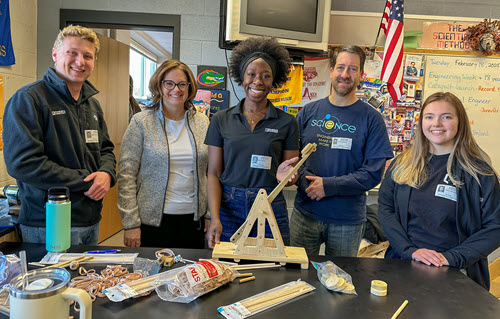
    Middletown, PA – Phoenix Contact engineers head back into the classroom this week to teach sixth-grade science class at Middletown Area Middle School in Middletown, Pa. The classes are part of Phoenix Contact’s National Engineers Week celebration.

    Phoenix Contact has worked with the school every February since 2007. The engineers lead hands-on lessons that make science fun. The goal is to inspire young people to consider careers in science, technology, engineering, and math (STEM).

    The lessons include:

    • Building catapults
    • Racing cookie tins down ramps
    • Building an electric motor
    • Learning about static electricity with the Van de Graaff generator

    “Our engineering team created this outreach program many years ago, and the partnership with Middletown Area School District has stood the test of time,” said Patty Marrero, interim vice president of human relations at Phoenix Contact. “National Engineers Week is a special time for them to share their passion for technology with students. It’s also our chance to thank our engineers for the creativity and innovations that drive our company forward.”

    About Phoenix Contact

    Phoenix Contact is a global market leader based in Germany. Since 1923, Phoenix Contact has created products to connect, distribute, and control power and data flows. Our products are found in nearly all industrial settings, but we have a strong focus on the energy, infrastructure, process, factory automation, and e-mobility markets. Sustainability and responsibility guide every action we take, and we’re proud to work with our customers to empower a smart and sustainable world for future generations. Our global network includes 22,000 employees in 100+ countries. Phoenix Contact USA has headquarters near Harrisburg, Pa., and employs more than 1,100 people across the U.S.

    For more information about Phoenix Contact or its products, visit www.phoenixcontact.com, call technical service at 800-322-3225, or email [email protected].

    eSchool News Staff
    Latest posts by eSchool News Staff (see all)

    Source link

  • Embracing a growth mindset when reviewing student data

    Embracing a growth mindset when reviewing student data

    Key points:

    In the words of Carol Dweck, “Becoming is better than being.” As novice sixth grade math and English teachers, we’ve learned to approach our mid-year benchmark assessments not as final judgments but as tools for reflection and growth. Many of our students entered the school year below grade level, and while achieving grade-level mastery is challenging, a growth mindset allows us to see their potential, celebrate progress, and plan for further successes amongst our students. This perspective transforms data analysis into an empowering process; data is a tool for improvement amongst our students rather than a measure of failure.

    A growth mindset is the belief that abilities grow through effort and persistence. This mindset shapes how we view data. Instead of focusing on what students can’t do, we emphasize what they can achieve. For us, this means turning gaps into opportunities for growth and modeling optimism and resilience for our students. When reviewing data, we don’t dwell on weaknesses. We set small and achievable goals to help students move forward to build confidence and momentum.

    Celebrating progress is vital. Even small wins (i.e., moving from a kindergarten grade-level to a 1st– or 2nd-grade level, significant growth in one domain, etc.) are causes for recognition. Highlighting these successes motivates students and shows them that effort leads to results.

    Involving students in the process is also advantageous. At student-led conferences, our students presented their data via slideshows that they created after they reviewed their growth, identified their strengths, and generated next steps with their teachers. This allowed them to feel and have tremendous ownership over their learning. In addition, interdisciplinary collaboration at our weekly professional learning communities (PLCs) has strengthened this process. To support our students who struggle in English and math, we work together to address overlapping challenges (i.e., teaching math vocabulary, chunking word-problems, etc.) to ensure students build skills in connected and meaningful ways.

    We also address the social-emotional side of learning. Many students come to us with fixed mindsets by believing they’re just “bad at math” or “not good readers.” We counter this by celebrating effort, by normalizing struggle, and by creating a safe and supportive environment where mistakes are part of learning. Progress is often slow, but it’s real. Students may not reach grade-level standards in one year, but gains in confidence, skills, and mindset set the stage for future success, as evidenced by our students’ mid-year benchmark results. We emphasize the concept of having a “growth mindset,” because in the words of Denzel Washington, “The road to success is always under construction.” By embracing growth and seeing potential in every student, improvement, resilience, and hope will allow for a brighter future.

    Latest posts by eSchool Media Contributors (see all)

    Source link

  • A virtual reality, AI-boosted system helps students with autism improve social skills

    A virtual reality, AI-boosted system helps students with autism improve social skills

    Key points:

    This article and the accompanying image originally appeared on the KU News site and are reposted here with permission.

    For more than a decade, University of Kansas researchers have been developing a virtual reality system to help students with disabilities, especially those with autism spectrum disorder, to learn, practice and improve social skills they need in a typical school day. Now, the KU research team has secured funding to add artificial intelligence components to the system to give those students an extended reality, or XR, experience to sharpen social interactions in a more natural setting.

    The U.S. Office of Special Education Programs has awarded a five-year, $2.5 million grant to researchers within KU’s School of Education & Human Sciences to develop Increasing Knowledge and Natural Opportunities With Social Emotional Competence, or iKNOW. The system will build on previous work and provide students and teachers with an immersive, authentic experience blending extended reality and real-world elements of artificial intelligence.

    iKNOW will expand the capabilities of VOISS, Virtual reality Opportunity to Integrate Social Skills, a KU-developed VR system that has proven successful and statistically valid in helping students with disabilities improve social skills. That system contains 140 unique learning scenarios meant to teach knowledge and understanding of 183 social skills in virtual school environments such as a classroom, hallway, cafeteria or bus that students and teachers can use via multiple platforms such as iPad, Chromebooks or Oculus VR headsets. The system also helps students use social skills such as receptive or expressive communication across multiple environments, not simply in the isolation of a classroom.

    IKNOW will combine the VR aspects of VOISS with AI features such as large language models to enhance the systems’ capabilities and allow more natural interactions than listening to prerecorded narratives and responding by pushing buttons. The new system will allow user-initiated speaking responses that can accurately transcribe spoken language in real-time. AI technology of iKNOW will also be able to generate appropriate video responses to avatars students interact with, audio analysis of user responses, integration of in-time images and graphics with instruction to boost students’ contextual understanding.

    “Avatars in iKNOW can have certain reactions and behaviors based on what we want them to do. They can model the practices we want students to see,” said Amber Rowland, assistant research professor in the Center for Research on Learning, part of KU’s Life Span Institute and one of the grant’s co principal investigators. “The system will harness AI to make sure students have more natural interactions and put them in the role of the ‘human in the loop’ by allowing them to speak, and it will respond like a normal conversation.”

    The spoken responses will not only be more natural and relatable to everyday situations, but the contextual understanding cues will help students better know why a certain response is preferred. Rowland said when students were presented with multiple choices in previous versions, they often would know which answer was correct but indicated that’s not how they would have responded in real life.

    IKNOW will also provide a real-time student progress monitoring system, telling them, educators and families how long students spoke, how frequently they spoke, number of keywords used, where students may have struggled in the system and other data to help enhance understanding.

    All avatar voices that iKNOW users encounter are provided by real middle school students, educators and administrators. This helps enhance the natural environment of the system without the shortcomings of students practicing social skills with classmates in supervised sessions. For example, users do not have to worry what the people they are practicing with are thinking about them while they are learning. They can practice the social skills that they need until they are comfortable moving from the XR environment to real life.

    “It will leverage our ability to take something off of teachers’ plates and provide tools for students to learn these skills in multiple environments. Right now, the closest we can come to that is training peers. But that puts students with disabilities in a different box by saying, ‘You don’t know how to do this,’” said Maggie Mosher, assistant research professor in KU’s Achievement & Assessment Institute, a co-principal investigator for the grant.

    Mosher, a KU graduate who completed her doctoral dissertation comparing VOISS to other social skills interventions, found the system was statistically significant and valid in improving social skills and knowledge across multiple domains. Her study, which also found the system to be acceptable, appropriate and feasible, was published in high-impact journals Computers & Education and Issues and Trends in Learning Technologies.

    The grant supporting iKNOW is one of four OSEP Innovation and Development grants intended to spur innovation in educational technology. The research team, including principal investigator Sean Smith, professor of special education; Amber Rowland, associate research professor in the Center for Research on Learning and the Achievement & Assessment Institute; Maggie Mosher, assistant research professor in AAI; and Bruce Frey, professor in educational psychology, will present their work on the project at the annual I/ITSEC conference, the world’s largest modeling, simulation and training event. It is sponsored by the National Training & Simulation Association, which promotes international and interdisciplinary cooperation within the fields of modeling and simulation, training, education and analysis and is affiliated with the National Defense Industrial Association.

    The research team has implemented VOISS, available on the Apple Store and Google Play, at schools across the country. Anyone interested in learning more can find information, demonstrations and videos at the iKNOW site and can contact developers to use the system at the site’s “work with us” page.

    IKNOW will add resources for teachers and families who want to implement the system at a website called iKNOW TOOLS (Teaching Occasions and Opportunities for Learning Supports) to support generalization of social skills across real-world settings.

    “By combining our research-based social emotional virtual reality work (VOISS) with the increasing power and flexibility of AI, iKNOW will further personalize the learning experience for individuals with disabilities along with the struggling classmates,” Smith said. “Our hope and expectation is that iKNOW will further engage students to develop the essential social emotional skills to then apply in the real world to improve their overall learning outcomes.”

    Latest posts by eSchool Media Contributors (see all)

    Source link