Get stories like this delivered straight to your inbox. Sign up for The 74 Newsletter
This story was originally reported by Chabeli Carrazana of The 19th.
Two years ago, Nicolle Orozco Forero walked into an in-home day care in Seattle, Washington, looking for a job. She was barely 22, a whole five feet tall — if that. But she was calm, focused. Her presence struck the owner, Stephanie Wishon, because it’s not easy to find qualified staff who can work with children with disabilities.
Orozco Forero had experience working with kids who had autism back in Colombia, so Wishon had her come in for a trial run and hired her after the first day. The children, who needed someone who had love and care to give in abundance, gravitated toward her. She was good at the hardest stuff. She changed diapers and outfits the moment they were soiled. She was vigilant; her kids stayed pristine. And she got them to do the things they wouldn’t do for other people, like say “ah” when it was time to get their teeth brushed or sit still long enough for her to twist a braid down their back.
Some people just have that way about them.
And people like Orozco Forero are exceptionally rare. Already, the staffing shortage in child care is near crisis levels. It’s far worse for children with disabilities — about a third of those families say they face significant difficulty finding care for their kids, partly because there are too few people with the ability, expertise or desire to work with their children. Immigrant women like Orozco Forero have been helping to fill that void. They now make up 20 percent of all child care workers.
At home, Orozco Forero was also caring for her own young boys, one of whom started to show symptoms of a serious illness over the past two years that doctors have not yet been able to diagnose. She took some time off to care for him last year, before returning to the kids at Wishon’s day care.
Her work has kept an already precarious safety net together. Without women like Orozco Forero, families who have nowhere else to turn for care have to make difficult decisions about how to survive and keep their children safe. Without her, the safety net snaps.
And that’s exactly what happened on June 18, the day she was detained.
It was supposed to be a routine meeting with U.S. Immigration and Customs Enforcement (ICE). Orozco Forero and her husband had been to all their monthly meetings for the past year and change, since their asylum charge was denied in April 2024.
The family — Orozco Forero; her husband, Juan Sebastian Moreno Acosta; and their two sons, Juan David, 7, and Daniel, 5 — fled Colombia two years ago. Moreno Acosta, a street vendor, had been persecuted by gangs who target vendors for money.
After arriving in the United States, they sought the help of a lawyer with their asylum claim, but when they couldn’t pay his full fee ahead of their hearing, he pulled out. They represented themselves in court and lost the case. With no knowledge of the U.S. court system, they didn’t know they had 30 days to appeal the ruling, either. Ever since, ICE has been monitoring them, requiring they wear a wrist tracker and meet with an immigration officer once a month, sometimes more, according to a family member. (The 19th is not naming the family member to protect their identity.) It’s unclear why ICE has allowed them to stay in the country all this time, though it’s not necessarily uncommon; ICE typically prioritized immigrants with felonies for deportation.
Orozco Forero had seen the reports of illegal immigrants being rounded up at their immigration appointments. President Donald Trump’s mass deportation effort has led to the detention of about 30,000 migrants with no criminal record, like Orozco Forero, who now make up about half of those detained. Her husband does have a misdemeanor reckless driving conviction for driving under the influence of alcohol on his record, but he completed a court-mandated alcohol course for that and has no other convictions.
Still, Orozco Forero wasn’t worried when she headed to her appointment on the morning of June 18. If ICE planned to detain her, Orozco Forero thought, they would have asked her to come with the boys, right?
And she had been doing everything right: She’d gone to all her appointments, taken documentation to show she was going to school at Green River Community College taking courses in English and early childhood education. She had completed a child care internship that trained her to open her own licensed in-home day care. Her licensure approval was set to arrive any moment, likely that same week, and the day care was just about ready to go.
But that morning, her family was still wary, asking her to share her location just in case.
Shortly after 10 a.m., Orozco Forero texted her family member: “They are going to deport us”
“Nicolle what happened? Nicolle answer me,” they texted back. “What do I do?”
“I can’t speak I feel like I’m going to faint,” Orozco Forero replied. And then: “I’m sorry it wasn’t what we expected.”
Two-and-a-half hours west, on the coast of Washington in a town called Southbend, Wishon was frantic. Orozco Forero had texted her, too. ICE was asking for the boys.
In two years, Wishon had grown incredibly close to Orozco Forero, who had cared for her own kids. After her family moved to the coast, Wishon rented out her house in Seattle to Orozco Forero, whose boys were excited to have a home with a yard.
Wishon’s husband, Gabriel, hopped into his truck and headed to Seattle. Wishon, meanwhile, got on the phone with the Orozco Forero family’s ICE agent and every lawyer she could. They were going to take them into detention at a facility 2,200 miles away in Texas, a facility that was reopened earlier this year by the Trump administration to detain families. Wishon wanted to find a lawyer who could stop the deportation order, and she wanted to make sure the boys would be reunited with their parents if they took them to meet the ICE agent.
And that was especially important, not just because they were young children, but because Juan David is still sick.
For the past year, he’s been seeking treatment at Seattle Children’s Hospital for an illness that is turning his urine muddy. So far, doctors have determined he’s losing red blood cells and protein through his urine, indicating a possible kidney issue, but they haven’t yet zeroed in on what is causing the problem. They likely need a kidney biopsy to be sure.
“Given the complexity of his case, it is essential that Juan remain in the United States for continued testing and treatment,” his nephrologist Jordan Symons wrote in a March letter to ICE. “We kindly request that you consider this medical necessity in your review of his immigration status and grant him the ability to stay in the United States until his treatment and evaluation are completed.”
Juan David’s care team has been monitoring him closely to ensure his red blood cell and protein levels never drop too low. His condition could become serious quickly.
“You can die from that,” said Sarah Kasnick, a physician’s assistant who is familiar with his case. Kasnick is also a foster parent, and Orozco Forero provided care for her family.
When Gabriel Wishon arrived to pick up the boys, they were confused and disoriented. Where were their parents? Why was everyone crying? They didn’t want to go to Colombia, they told him on the drive. They wanted to stay in the United States.
Around 5:30 p.m. that evening, he met with the ICE agent, who had waited past her work hours for them to arrive.
“Bye boys, you are going to see your parents right now. They are right inside,” Wishon told them. He watched them walk in carrying two stuffed animals, a Super Mario doll and Chase, the popular cartoon dog dressed as a police officer.
The families Orozco Forero cares for are now in a free fall.
Jessica Cocson, whose son has been in Orozco Forero’s care for more than a year, described her in a character letter to ICE as a “blessing to us in ways I struggle to fully express.”
Orozco Forero and her husband “support working families, provide quality childcare, and demonstrate compassion and commitment every day,” Cocson wrote. “It is heartbreaking to think that someone who gives so much and asks so little could be forced to leave.”
Tamia Riley, whose two sons with autism were also in Orozco Forero’s care, said losing her was like watching “a father walking out the door.”
“These people, these day care providers, sitters, they are a form of family members for me and my children,” Riley said.
Now, the day care she was set to open lays empty. Inside, the walls are plastered with posters listing colors and sight words. There are cushioned mats on the floor and play stations. Tables with tiny chairs. A tall pink dollhouse. High chairs and a pack and play for the babies. Outside, two play houses, a ball pit, toys to ride on and little picnic tables set across an artificial turf. But no children to enjoy any of it.
Big Dreams Day Care she was going to call it, for the dreams she wanted the kids in her care to strive for, and the ones that were finally coming to fruition for her.
Orozco Forero’s detention has rattled child care workers across the country. In Texas, workers represented by the Service Employees International Union have been rallying in her name. U.S. Rep. Joaquin Castro, a Texas Democrat, spoke in support of the family’s release at a rally on June 29 in San Antonio. And a group of union workers is attempting to deliver supplies to the family. It’s an effort Orozco Forero knows little about; she only has limited communication with those on the outside.
Tricia Schroeder, the president of the Seattle-based SEIU chapter that represents care workers, said that, for years unions like hers have been working to improve quality, access and affordability in child care, a system in such deep crisis it’s been called by the Treasury Department “a textbook example of a broken market.”
Immigrant women like Orozco Forero were part of that effort to improve access, doing jobs few Americans want to take on.
“Detaining child care providers, especially those who care for kids with special needs, just deepens the crisis in early learning,” Schroeder said.
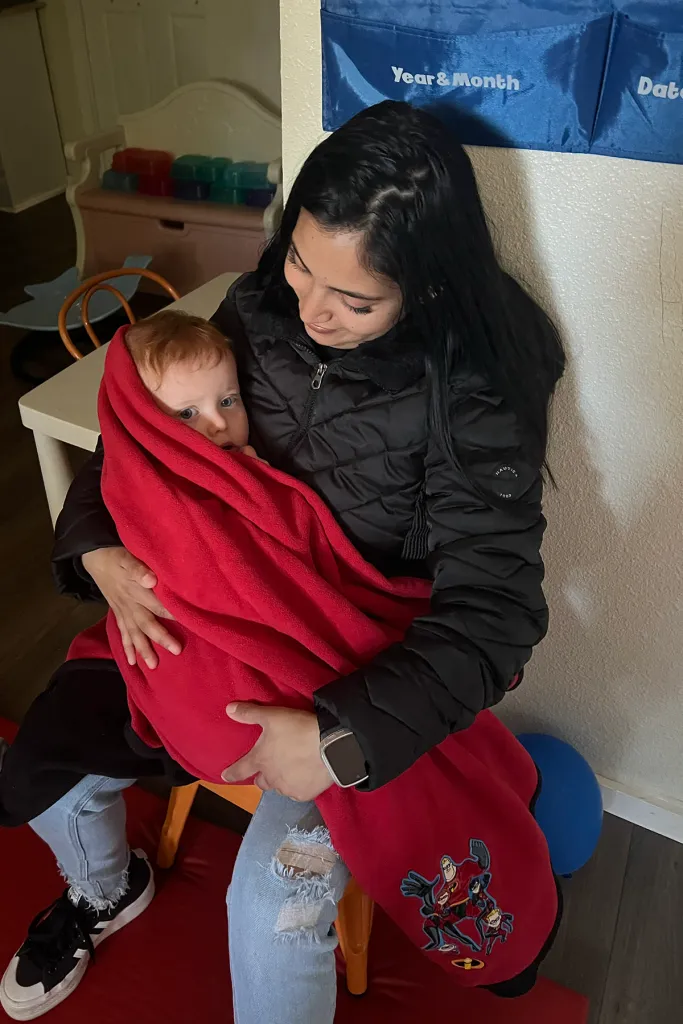
Orozco Forero was also the connective tissue that kept families employed. Her loss has rippled across industries.
Kasnick, the foster parent, said one of the children in her care had been tentatively set to start at Orozco Forero’s day care as soon as it opened. Orozco Forero had been the only provider who would take the child, who has autism and is nonverbal.
Orozco Forero had cared for the girl at Wishon’s day care as if she was her own, even taking her in once when the child’s care had fallen through and no foster family in the entire county would take her in because of the complexity of her needs. The girl arrived at Orozco Forero’s house at midnight on a weekend “with no clothing, toys, medication or any of her belongings … this did not [deter] Nicolle and Sebastian instead they immediately went and purchased all the things” the child needed, a social worker wrote in a letter to ICE. Kasnick said Orozco Forero was even considering becoming a foster parent.
Without her, Kasnick is out of options: She quit her job as a physician’s assistant to care for the child after Orozco Forero was detained.
“There are now 44 patients a day who don’t have anyone to provide their health care, and I can’t go to work because Nicolle’s day care didn’t open,” Kasnick said.
In the weeks since, Kasnick has had an overwhelming feeling of helplessness, she said. How could this happen to someone who gave back so much?
“The security of knowing that you can be in your home one day and in a prison the next week, and you didn’t do anything except exist?” she said. “It makes you feel like there’s no good left in the world.”
Orozco Forero’s family has now been in ICE detention for nearly a month awaiting a bond hearing that could buy them time in the United States. Orozco Forero and the boys are together; her husband is in the same facility but separated from them.
Juan David hasn’t been eating. It took three weeks for him to receive medical care, Orozco Forero told her attorney, James Costo.
Costo has been working to get the details of why ICE allowed the family to stay in the country with monitoring after they lost their asylum case last year. There has been an order for their deportation since then, but ICE never attempted to deport them until the Trump administration ramped up efforts. The number of immigrants without criminal convictions who have been detained has doubled since May.
The process to fight an asylum claim and appeal a denial is complicated — there are court deadlines, documents that need to be submitted and translated.
“They think maybe they can do it themselves and go in and say what happened but they are not understanding the whole legal process,” Costo said. “The system isn’t made for things to be easy.”
Costo is hopeful a judge will allow them to stay in the country temporarily as Juan David seeks care. They have almost no family left in Colombia, and no way to obtain care for him there, their family said. If they can stay, then perhaps Orozco Forero could try to obtain a work visa as a domestic worker.
He has gathered letters of support from numerous people whose lives the Orozco Forero family touched, and Wishon set up a GoFundMe to cover her legal expenses.
In the letters, Juan David’s first grade teachers call him an exceptional student who went from one of the lowest reading levels in the class — 10 words a minute — to one of the highest at 70 words a minute.
“He shows the qualities of a model citizen at a young age — dependable, ethical, and hard-working,” wrote his teacher, Carla Trujillo.
They were all on their way to shaping a better future, Wishon wrote in hers. The couple “worked tirelessly to build a better life for their children and to open their own licensed child care business. In all my years of employing and mentoring caregivers, I have rarely met a couple as responsible, driven, and capable as Nicolle and Sebastian.”
“This family is not a threat,” she concluded. “They are an asset.”

Get stories like these delivered straight to your inbox. Sign up for The 74 Newsletter