Category: SNAP

  • 1.1 Million College Students – The 74

    1.1 Million College Students – The 74


    Get stories like this delivered straight to your inbox. Sign up for The 74 Newsletter

    Maia Jackson should have been cranking out a research paper for her communications class. Instead, she found herself queuing up at a food pantry to secure groceries for her household amid the nation’s longest government shutdown. 

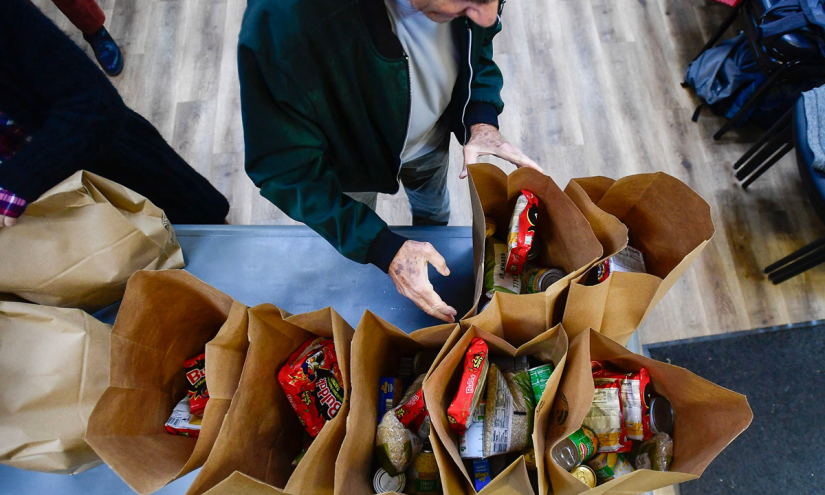
    “I walked out with a shopping cart full of food,” the 25-year-old college senior said. “I could barely carry it all. I got cereal. I got some frozen meat, hamburger buns. I got a bag of black beans, and then I got a bag of rice.”

    Finding a package of chicken strips, a dish she knew her picky 2-year-old daughter would actually eat, almost made her cry, Jackson said. She expects the combination of perishable, bagged and canned foods to last them a month. By then, she hopes her Supplemental Nutrition Assistance Program (SNAP) payments — widely known as food stamps — will have resumed.

    On November 1, SNAP benefits ground to a halt during the federal budget impasse that began a month earlier, with President Donald Trump’s administration refusing to fully fund these payments, a matter now tied up in court. Even as the Senate has reached a framework deal that leaves lawmakers and the White House a step closer to ending the shutdown, the disruption in benefits has revealed how fragile the social safety net is for vulnerable Americans. That includes single parents and young adults experiencing food insecurity, a problem that occurs when people lack regular access to the nourishment needed to sustain their health. 

    An estimated 1.1 million college students rely on SNAP, including parents like Jackson, who attends North Dakota State University (NDSU) in Fargo. For such students, a delayed SNAP payment isn’t a mere hiccup, but a serious setback that can imperil their education, their health and stability for their children, experts contend.

    “It’s such a distraction for me as a single mom in school,” Jackson said. “I don’t have any bandwidth to give to trying to find food at pantries.”

    She tried to minimize the time she spent at the food pantry last week by making an appointment first, but she was still one of a couple of dozen people in line. The visit prevented her from completing her research paper by its due date, which will likely result in her grade being docked. Jackson, who has so far maintained a 4.0 grade point average, isn’t happy about that prospect, but with her family members an hour away and her child’s father mostly out of the picture, she had to prioritize food over her education.


    No college student should have to choose between a basic need and school, said Deborah Martin, a senior policy associate for The Institute for College Access & Success, a nonprofit that advocates for college access and affordability. 

    “A lot of students have to make these daily tough decisions where they’re wondering, ‘Where am I going to get my next meal from?’ instead of focusing on homework, on classwork,” Martin said. “We know that when students have these unmet basic needs such as food insecurity, they’re more likely to struggle academically, less likely to persist from semester to semester, and in some cases, may even drop out of college altogether.”

    Roughly 60 percent of college students are women. For the most marginalized students, the risk of quitting school due to food insecurity may be even greater. The Government Accountability Office (GAO), a nonpartisan federal agency that provides fact-based information to Congress, reported last year that about 80 percent of food-insecure students are nontraditional — meaning their parents don’t financially support them, they didn’t begin college immediately after high school or they are caring for dependents. Moreover, the 2023-2024 Student Basic Needs Survey Report from the Hope Center, a research center at Temple University focused on the food, housing and health of college students, found that around three-quarters of parenting, Black and Indigenous students experience insecurity related to a basic need

    Most of these students, the GAO discovered, do not sign up for services like SNAP, and those who do may hesitate to discuss their food insecurity. As a mom and a slightly older student who works part-time, Jackson has felt largely alone on campus as SNAP benefits have paused. Her classmates don’t appear to share her anxiety over the shutdown, if they know about it at all. 

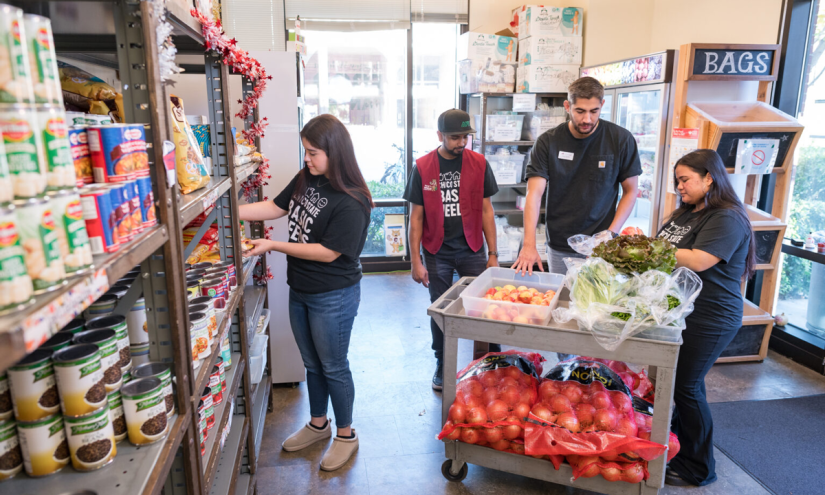
    A woman shops at the Feeding South Florida food pantry on October 27, 2025 in Pembroke Park, Florida.
    (Joe Raedle/Getty Images)

    “A lot of the kids that I’m in class with, they’re not in the same circumstance,” Jackson said. “It’s weird to see a lot of people just carrying on as usual.”

    Since most of her classmates — about an even percentage of NDSU students are women and men — are childfree and on the school meal plan, she doesn’t want to be a “downer” by bringing up her difficulties. For the same reason, she didn’t explain to her professor why her paper was late. “I didn’t want to tell him, ‘Oh, I couldn’t write it because I was standing in the food pantry line’ because it just sounds so sad,” she said. “What’s he supposed to say? I don’t want him to feel bad for me. I don’t want to be pitied.”

    But faking normal could come at a high cost for college students who don’t reach out for help. Martin fears these young adults will resort to using high-interest payment plans or acquire credit card debt just to afford groceries.

    “The longer that students and other SNAP participants don’t receive their funds, this is just more days that students are going to have to make these difficult decisions,” she said.


    Some college administrators are taking action. When the shutdown began, Compton College President and CEO Keith Curry contacted Everytable, a food company that offers inexpensive made-from-scratch meals via carryout storefronts and a delivery service. The college, about 18 miles southeast of downtown Los Angeles, has partnered with Everytable for seven years to provide all students — approximately 6,000 of whom attend full time — with one nutritious free meal on weekdays. 

    The federal government crisis prompted Curry and Everytable CEO Sam Polk to scale up that program so SNAP-recipient and economically disadvantaged students didn’t suffer during the shutdown.

    “We need to do something. Can we split the cost?” Curry recalled asking Polk. “I think if we double the meals, at least they get another meal for the day.”

    On November 5, Compton College’s most underprivileged students began getting two free meals per day, or 10 per week. The need for such an intervention there is substantial: A 2025 basic needs survey of students found that 81 percent of them experience at least one form of insecurity related to a basic need. That includes signs of food insecurity such as skipping meals, reducing meal sizes or fearing they will run out of food. Most Compton College students are moderately food insecure, the survey revealed, indicating persistent hardship. Women make up 61 percent of the student body.

    “Right now, students have other stress, and what we’re doing to them is adding more stress,” Curry said of the shutdown. “They still want to do well in classes, but now they don’t have food.” 

    Together, Compton College and Everytable have the resources to supply students with 10 weekly meals for a month, Curry said. The students are deeply grateful for the additional provisions, according to Dee Garrett, who oversees Everytable’s operation at the college.

    “What better way to start your studies than with a stomach that’s full?” Garrett asked. “You don’t have to think about, ‘Oh, my God, my stomach. I can’t concentrate or focus.’”

    Asked what impact he hopes the scaled-up program makes, Curry said he’s more interested in letting students know they’re not alone.  

    “It’s not about the impact. It’s about our students knowing that we were there for them during this time,” he said. “In our community, when students need us most, we have to step up and be there for them, and they’re never going to forget that.”

    Martin applauds the efforts of colleges and K-12 schools, which have connected students and their families to food banks, to curb food insecurity during the shutdown. But she also advocates for long-term policies to ensure students have enough food to eat. That includes the Enhance Access to SNAP Act, proposed legislation to remove the barriers that prevent economically disadvantaged college students from utilizing benefits generally — not just during the current crisis. 

    However, Martin continued, “the most important thing that we can do right now in this moment is for these SNAP benefits to be fully funded and for them to go out to students as soon as possible.”


    Back in Fargo, Jackson has refocused her attention on her coursework now that she has a month’s worth of food. Still, she worries about the people who couldn’t make it to a pantry or that the government will cut other social services she needs. She currently earns $400 monthly working part time as an academic journal editor. The job, which she performs remotely, allows her to attend school and be her daughter’s primary caretaker when the toddler is not in day care. 

    “If they cut child care, if they cut these programs I rely on, I would have to drop out of school,” Jackson said. “But I’m trying to give my daughter a better life than that.”

    Jackson is majoring in university studies with a pre-law emphasis, a dramatic shift from her life before motherhood when she dropped out of school and struggled with addiction. Getting pregnant inspired her to undergo a transformation, which she largely credits to the Jeremiah Program. The national nonprofit provides single mothers with support for college, child care and housing, and it recently started a campaign to raise $190,000 to cover essential needs for families who have lost SNAP and other benefits because of the shutdown. The organization estimates that single-parent families represent nearly a third of families in the United States, with 80 percent of those headed by mothers.  

    Jackson has been deeply disturbed to see the misperceptions that abound about mothers like herself. She’s encountered online commenters who have characterized SNAP recipients as “welfare queens.”

    If she could confront such individuals in person, Jackson would emphasize how much value mothers add to society. “And on top of it… we are all in school and working, too,” she said. “The insinuation is that we’re just scammers, freeloaders, when, in reality, I’m working very hard every day to hopefully not need these supports.”

    This story was originally reported by Nadra Nittle of The 19th. Meet Nadra and read more of their reporting on gender, politics and policy.


    Did you use this article in your work?

    We’d love to hear how The 74’s reporting is helping educators, researchers, and policymakers. Tell us how

    Source link

  • SNAP ends Saturday, mass mutual aid NOW (Debt Collective)

    SNAP ends Saturday, mass mutual aid NOW (Debt Collective)

    One month ago, Republicans chose to shut down the government rather than protect our healthcare. Now, by refusing to process SNAP benefits for November, they’ve put 42 million working families at risk of going hungry or being forced deeper into debt just to put food on the table.


    Most of us aren’t in debt because we live beyond our means — we’re in debt because we’ve been denied the means to live. This is especially true for SNAP recipients, most of whom are workers being paid starvation wages by greedy employers, or tenants being squeezed every month by predatory landlords. SNAP is a lifeline for people trapped in an economic system that’s designed to work against us, which is exactly why they’re trying to destroy it. 


    Authoritarianism thrives on silence and complicity. We refuse to give in. This weekend, organizers across the country are mobilizing a mass effort to connect people with existing mutual aid networks. If you are on SNAP and are not sure where to look for help, get plugged into your local mutual aid network to get your needs met and organize to help others meet theirs.

    Source link

  • Judges Rule Trump Can’t Completely Stop SNAP Aid – The 74

    Judges Rule Trump Can’t Completely Stop SNAP Aid – The 74


    Get stories like this delivered straight to your inbox. Sign up for The 74 Newsletter

    Two federal judges on Friday ruled against President Donald Trump’s move to suspend food stamp benefits starting November 1 amid the month-long government shutdown, with each noting contingency funding is available. 

    It’s unclear if the Trump administration plans an appeal or how quickly food assistance can flow to the 42 million Americans who rely on the Supplemental Nutrition Assistance Program. Sixteen million of them are children, putting pressure on schools to address their needs.

    U.S. District Judge John McConnell of Rhode Island ordered the U.S. Department of Agriculture to distribute the funds in a timely manner using contingency money. 

    “SNAP benefits have never, until now, been terminated,” McConnell said, as reported in The Hill. “And the United States has in fact admitted that the contingency funds are appropriately used during a shutdown, and that occurred in 2019.”

    In a separate ruling, U.S. District Judge Indira Talwani of Massachusetts gave the Trump administration until Monday to decide whether it will provide at least some food stamp benefits to recipients. She indicated the suspension of SNAP benefits is contrary to law. 

    She found fault with the defendants’ assertion that the U.S Department of Agriculture is prohibited from funding SNAP because Congress has not enacted new appropriations for the current fiscal year.

    “To the contrary, defendants are statutorily mandated to use the previously appropriated SNAP contingency reserve when necessary and also have discretion to use other previously appropriated funds,” she wrote. 

    Despite the judges’ rulings, many advocates say some kids will go hungry in November because the process for obtaining the aid consists of multiple steps — some of which have already been missed for those who receive help at the start of every month. 

    On October 28, more than 20 states, the District of Columbia, and three governors sued the USDA for suspending November’s SNAP benefits. They called the move unprecedented and illegal.

    “SNAP is one of our nation’s most effective tools to fight hunger, and the USDA has the money to keep it running,” New York Attorney General Letitia James, long embroiled in her own legal battle with the president, said in a statement. “There is no excuse for this administration to abandon families who rely on SNAP, or food stamps, as a lifeline. The federal government must do its job to protect families.”

    Gina Plata-Nino, interim director for SNAP at the Food Research & Action Center, said her organization encouraged the USDA to tap into its contingency and reserve funds to save children and families from going hungry. By missing this opportunity, at least some recipients will likely miss their allotment. 

    Plata-Nino said states were directed by federal officials on Oct. 10 to stop reporting critical data — a list of household eligibility and food stamp allocation — information they send directly to electronic benefit transfer contractors, who are key in distributing the aid. 

    “Even in the best-case scenario, if the judge says, ‘We rule in your favor and we demand that this happens right now’, and the Trump administration doesn’t appeal…the process of getting benefits into recipients’ accounts would take time,” she said. 

    Arlen Benjamin-Gomez, executive director of EdTrust New York, a statewide education policy and advocacy organization, said it’s clear that serious damage has already been done to what is an essential program. 

    “We know from what has happened so far with this administration that when they make announcements like this, it does have a direct impact on programs and the ability to sustain them,” she said. “For example, there was an announcement of federal cuts to Head Start very early on in the administration, and the program actually shut down. It’s still recovering. So, we can’t predict the chaos that is spread by this most recent effort to cut benefits.”

    Benjamin-Gomez praised New York for declaring a state of emergency on the matter: Gov. Kathy Hochul is committing an additional $65 million in new state funds for emergency food aid to support state food banks. But not all states will do the same.  

    Ian Coon, spokesperson for Alliance for Education, an independent, local education fund that supports Seattle Public Schools, said his organization has already earmarked funding to bridge the gap for those in need. 

    He said the Alliance decided in late October to fund $150,000 in gift cards to area food stores for families in crisis. He said school staff will help identify children in need and offer the assistance of $25, $50 or $100. The $150,000 comes from a reserve fund.  

    “We are fully aware it’s not a long-term solution, but we needed to do something,” Coon said. 

    Carolyn Vega, associate director of policy analysis for Share Our Strength, which runs No Kid Hungry, said her organization also does not predict an abrupt or smooth end to the suffering of American families who rely on these benefits. 

    “We are not holding our breath for the money to start flowing today,” she said. “Kids can’t wait: Families have to eat every single day. We know from our extensive work with schools that teachers already see kids show up to school hungry on Monday mornings. We can only imagine how much worse that would be if a family came in and were expecting to see benefits on Saturday and they did not. It’s an unbelievable strain for food banks. We know that schools will be an important resource for many families, but they can’t fill in the gap.”

    In fiscal year 2023, nearly 80% of SNAP households included either a child, an elderly person or a nonelderly individual with a disability, according to the USDA. About 39% of SNAP participants were children that year. 

    A statement on the federal agency’s website blames Senate Democrats for the shutdown. 

    “They can continue to hold out for healthcare for illegal aliens and gender mutilation procedures or reopen the government so mothers, babies, and the most vulnerable among us can receive critical nutrition assistance,” the statement read

    The department declined to comment on the judges’ rulings.


    Did you use this article in your work?

    We’d love to hear how The 74’s reporting is helping educators, researchers, and policymakers. Tell us how
    Source link

  • New Food Security Threats 5 Years After COVID-Era Effort to Feed All Kids – The 74

    New Food Security Threats 5 Years After COVID-Era Effort to Feed All Kids – The 74

    A multi-pronged attack on food aid by Republican lawmakers could mean more of the nation’s children will go hungry — both at home and at school.

    The U.S. Department of Agriculture recently cut two federal programs that provided roughly $1 billion in funding for the purchase of food by schools and food banks. 

    And the Community Eligibility Provision, which reimburses tens of thousands of schools that provide free breakfast and lunch to all students, may tighten its requirements, potentially pushing some 12 million kids out of the program.

    These moves come at the same time the House Republican budget plan calls for deep cuts to the Supplemental Nutrition Assistance Program, or SNAP. The program fed more than 42 million low-income people per month nationwide in 2023. In 2022, 40% were younger than 18.  

    This recent shift reflects a stark reversal of earlier, nationwide efforts to keep families fed during the pandemic. Many districts, such as Baltimore, organized grab-and-go meals sites days after schools were shuttered in March 2020 with no identification or personal information required. Those initiatives led to the nation’s food insecurity rate dropping to a 20-year low when it reached 10.2% in 2021, down from a 14.9% high a decade earlier, according to the USDA.

    It has since crept back up to 13.5% and now, five years after schools utilized USDA waivers to deliver meals in innovative ways, they are bracing for what could be massive cuts from the federal government.

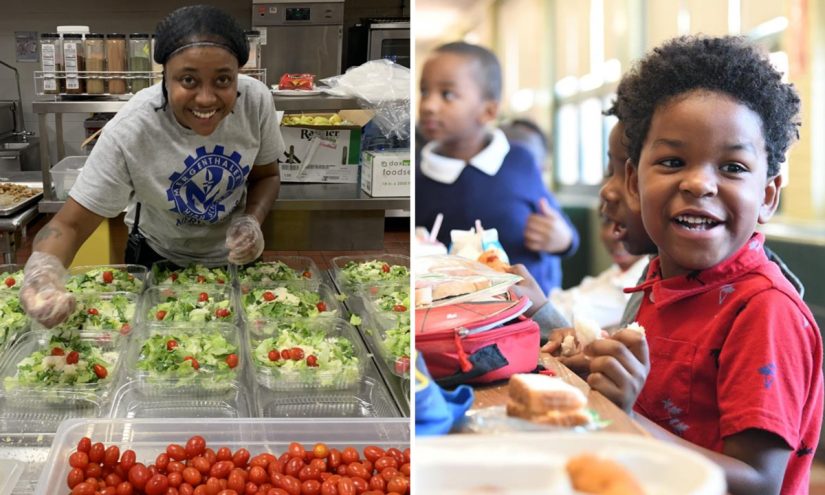
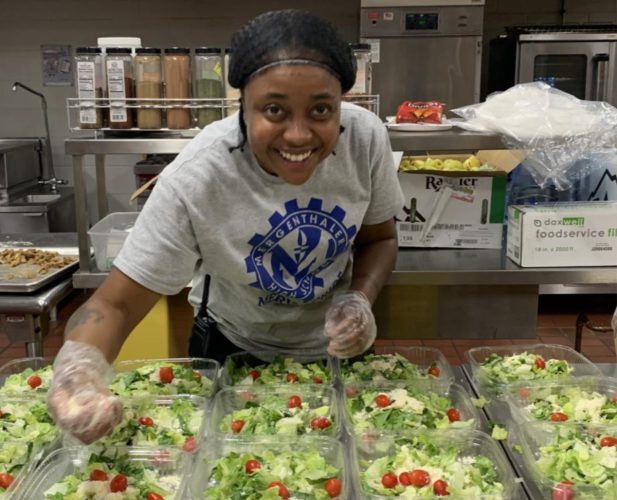
    Latoya Roberson, manager at Mergenthaler Vocational-Technical High School in Baltimore (Baltimore City Public Schools) 

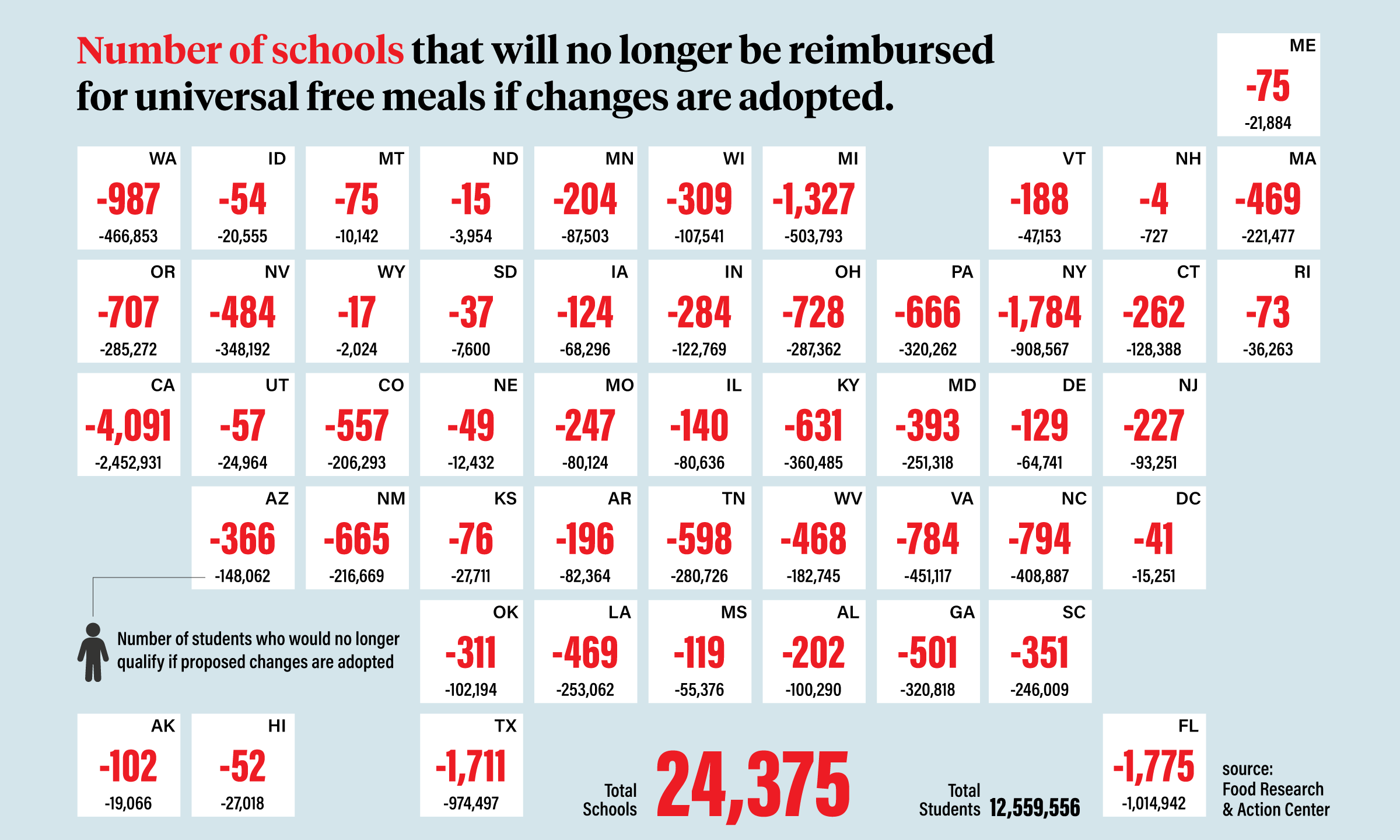
    Elizabeth A. Marchetta, executive director of food and nutrition services for Baltimore City Public Schools, said 31 campuses — serving 19,000 children — would lose out on free breakfast and lunch if the Community Eligibility Provision changes go through. They are among 393 schools and 251,318 children statewide who would be shut out. 

    “It would be devastating,” Marchetta said. “These are critical funds. If we are not being reimbursed for all of the meals we’re serving … the money has to come from somewhere else in the school district, so that is really not great.”

    Nearly 48,000 schools in more than 7,700 districts benefited from the Community Eligibility Provision in the 2023-24 school year. The program reimburses schools that provide universal free meals based on the percentage of their students who automatically qualify for free and reduced-price lunch because their families receive other types of assistance, like SNAP. 

    In 2023, after the COVID-era policy ended where any student could receive a free school meal regardless of income, President Biden lowered the percentage of high-need students required for a school to qualify from 40% to 25%, greatly expanding participation. 

    House GOP Budget Committee Chairman Jodey Arrington now seeks to raise the rate to 60%. The budget proposal would also require all students applying for free and reduced-price meals to submit documentation verifying their family income.

    School meal debt, a barometer of food insecurity among students, is already on the rise. It will almost certainly increase if universal school meals disappear for students whose families make too much to qualify for free and reduced-price lunch but too little to afford to buy meals at school. At the same time, kids who are eligible for free and reduced-price meals could lose that benefit if the required paperwork becomes harder. 

    In the fall of 2023, across 808 school districts, the median amount of school meal debt was $5,495. By the fall of 2024, that amount reached $6,900 across 766 districts, a 25% increase, according to the School Nutrition Association.

    It was just $2,000 a decade earlier. A trio of Democratic senators is pushing to erase the $262 million annual debt total, with Pennsylvania Sen. John Fetterman saying in 2023, “‘School lunch debt’ is a term so absurd that it shouldn’t even exist. That’s why I’m proud to introduce this bill to cancel the nation’s student meal debt and stop humiliating kids and penalizing hunger.”

    Research shows students benefit mightily from free meals: those who attend schools that adopted the Community Eligibility Provision saw lower rates of obesity compared to those who did not. Free in-school meals are also credited for boosting attendance among low-income children, improving classroom behavior and lowering suspensions.

    Joel Berg, CEO of Hunger Free America. 

    Joel Berg, the CEO of Hunger Free America, said further cuts will greatly harm the poorest students. 

    “Over the last few years, things have gone from bad to worse,” he said. “We were all raised seeing Frank Capra movies, where, in the end everything works out. But that’s not how the real world works. In the real world, when the economy gets a cold, poor people get cancer.”

    Hunger Free America found the number of Americans who didn’t have enough to eat over two one-week periods increased by 55.2% between August-September 2021 and August-September 2024. The states with the highest rates of food insecure children were Texas at 23.8%, Oklahoma at 23.2% and Nebraska at 22.6%. Georgia and Arkansas both came in at 22.4%. 

    The USDA slashed the $660 million Local Food for Schools Cooperative Agreement Program for 2025 — it allowed states to purchase local foods, including fresh fruits and vegetables, for distribution to schools and child care institutions — and $500 million from the Local Food Purchase Assistance Cooperative Agreement Program, which supported food banks nationwide. 

    Diane Pratt-Heavner, director of media relations for the School Nutrition Association, said that as families struggle with the high cost of groceries, the government should be doing more — not less — to bolster school meals and other food aid programs. 

    “We’re urging Congress not only to protect the federal Community Eligibility Provision, but to expand it,” Pratt-Heavner said. “Ideally, all students should have access to free school breakfast and lunch as part of their education.” 

    SNAP benefits stood at $4.80 per person per day through 2020 before jumping to more than $6 per person per day after they were adjusted for rising food and other costs. Even then, the higher amount was not enough to cover the cost of a moderately priced meal in most locations. 

    Republicans in Congress seek to cut the program by $230 billion over the next nine years, possibly by returning to the pre-pandemic allotment of $4.80 and/or expanding work-related requirements, said Salaam Bhatti, SNAP director at the Food Research & Action Center

    Another possibility, he said, is that SNAP costs could be pushed onto states — including those that can’t afford them. 

    “This would be an unfunded mandate,” Bhatti said. “States would have to take away from their discretionary spending to offset the cost and if it is not a mandate, then states in rural America and in the South that don’t have the budgets just won’t do it.” 

    Food-related funding decreases come as the child tax credit, created to help parents offset the cost of raising children, is also facing uncertainty, said Megan Curran, the director of policy at the Center on Poverty and Social Policy at Columbia University.

    The American Rescue Plan increased the amount of the child tax credit from $2,000 to $3,600 for qualifying children under age 6, and $3,000 for those under age 18. Many taxpayers received monthly advance payments in the second half of 2021, instead of waiting until tax filing season to receive the full benefits. The move cut child poverty nearly in half. The expanded child tax credit was allowed to lapse post-pandemic and now even the $2,000 credit could revert back to just $1,000

    All food-related and tax benefit cuts — plus the unknowns of Trump-era tariffs — will leave some Americans particularly vulnerable, Curran said. 

    “It’s shaping up to be a very precarious time for families,” she said, “especially families with children.”


    Get stories like these delivered straight to your inbox. Sign up for The 74 Newsletter


    Source link