Category: Social Media

  • Disinformation and the decline of democracy

    Disinformation and the decline of democracy

    The unprecedented mob assault on the U.S. Capitol on January 6 represents perhaps the most stunning collision yet between the world of online disinformation and reality.

    The supporters of U.S. President Donald Trump who broke into Congress did so in the belief that the U.S. election was stolen from them after weeks of consuming unproven narratives about “ballot dumps,” manipulated voting machines and Democrat big-city corruption. Some — including the woman who was shot dead — were driven by the discredited QAnon conspiracy theory that represents Democratic Party elites as a pedophile ring and Trump as the savior.

    It’s tempting to hope that disinformation and its corrosive effects on democracy may have reached a high-water mark with the events of January 6 and the end of Trump’s presidency. But trends in technology and society’s increasing separation into social media echo chambers suggest that worse may be to come.

    Imagine for a moment if video of the Capitol riot had been manipulated to replace the faces of Trump supporters with those of known protestors for antifa, a left-wing, anti-fascist and anti-racist political movement. This would have bolstered the unproven story that has emerged about a “false flag” operation. Or imagine if thousands of different stories written by artificial intelligence software and pedaling that version of events had flooded social media and been picked up by news organizations in the hours after the assault.

    That technology not only exists. It’s getting more sophisticated and easier to access by the day.

    Trust in democracy is eroding.

    Deepfake, or synthetic, videos are starting to seep from pornography — where they’ve mostly been concentrated — into the world of politics. A deepfake of former President Barack Obama using an expletive to describe Trump has garnered over eight million views on YouTube since it was released in 2018.

    Most anyone familiar with Obama’s appearance and speaking style can tell there’s something amiss with that video. But two years is an eternity in AI-driven technology and many experts believe it will soon be impossible for the human eye and ear to spot the best deepfakes.

    A deepfake specialist was hailed early last year for using freely available software to “de-age” Robert DeNiro and Joe Pesci in the movie “The Irishman,” producing a result that many critics considered superior to the work of the visual-effects supervisor in the actual film.

    In recent years, the sense of shared, objective reality and trust in institutions have already come under strain as social media bubbles hasten the spread of fake news and conspiracy theories. The worry is that deepfakes and other AI-generated content will supercharge this trend in coming years.

    “This is disastrous to any liberal democratic model because in a world where anything can be faked, everyone becomes a target,” Nina Schick, the author of “Deepfakes — The Coming Infopocalypse,” told U.S. author Sam Harris in a recent podcast.

    “But even more than that, if anything can be faked … everything can also be denied. So the very basis of what is reality starts to become corroded.”

    Governments must do more to combat disinformation.

    Illustrating her point is reaction to Trump’s video statement released a day after the storming of Congress. While some of his followers online saw it as a betrayal, others reassured themselves by saying it was a deepfake.

    On the text side, the advent of GPT-3 — an AI program that can produce articles indistinguishable from those written by humans — has potentially powerful implications for disinformation. Writing bots could be programmed to produce fake articles or spew political and racial hatred at a volume that could overwhelm text based on facts and moderation.

    Society has been grappling with written fake news for years and photographs have long been easily manipulated through software. But convincingly faked videos and AI-generated stories seem to many to represent a deeper, more viral threat to reality-based discourse.

    It’s clear that there’s no silver-bullet solution to the disinformation problem. Social media platforms like Facebook have a major role to play and are developing their own AI technology to better detect fake content. While fakers are likely to keep evolving to stay ahead, stricter policing and quicker action by online platforms can at least limit the impact of false videos and stories.

    Governments are coming under pressure to push Big Tech into taking a harder line against fake news, including through regulation. Authorities can devote more funding to digital media literacy programs in schools and elsewhere to help individuals become more alert and proficient in identifying suspect content.

    When it comes down to it, the real power of fake news hinges on those who believe it and spread it.


    Questions to consider:

    1. How can technology be used to spread fake news?

    2. Why is disinformation potentially harmful to democracy?

    3. How do you think the rise of AI technology will affect the type of information people consume?

    Source link

  • A week of media literacy across the globe

    A week of media literacy across the globe

    From 24 to 31 October, the world marks Global Media and Information Literacy Week, an annual event first launched by UNESCO in 2011 as a way for organizations around the world to share ideas and explore innovative ways to promote media and information literacy for all. This year’s theme is Minds Over AI — MIL in Digital Spaces. 

    To join in the global conversation, over the next week News Decoder will present a series of articles that look at media literacy in different ways.

    Today, we give you links to articles we’ve published over the past year on topics that range from fact-checking and information verification to the power of social media and the good and bad of artificial intelligence. 

    Source link

  • How unis can do more on social media – Campus Review

    How unis can do more on social media – Campus Review

    Too many universities overlook the richness of the human stories that define them, relying instead on polished marketing campaigns and generic social media content to attract the next generation of students.

    Please login below to view content or subscribe now.

    Membership Login

    Source link

  • A decade getting teens to do something many avoid: Think

    A decade getting teens to do something many avoid: Think

    TikTok reels, attention grabbing headlines and AI that spits out instant answers. The way teens engage with the world today often lacks depth. 

    But at this age, where the teen brain is rapidly developing, deeper thinking — dubbed by psychologists as transcendent thinking — is vital not just for self-reflection and problem solving, but also self-esteem and better relationships in adulthood. 

    Many of us spend a lot of time in what researchers call “surface-level” thinking — reacting to what’s in front of us. Transcendent thinking, though, is when we go beyond concept descriptions, to wrestle with questions like, What does this say about justice? How do systems work? Where do I fit in all this? 

    “Young people get so much information fed to them through social media, influencers and podcasts and AI, and this is such a passive way of learning,” said Marcy Burstiner, News Decoder’s educational news director. “Dangerous, really, if they aren’t critically thinking about the information they are getting.”

    That’s why for 10 years News Decoder has used the lens of journalism to engage students in the process of learning. Through our educational programs, students are encouraged to ask big questions, identify problems they see around them and talk to people to get their questions answered — classmates, neighbours, family and experts. In doing this, they find out information themselves. 

    Spoon-fed learning

    This is more important than ever as the internet transforms from a place where people would lose themselves as they “surfed,” stumbling upon all kinds of new and interesting information along the way, into a place where an AI bot does that for them and spits out summarized results. 

    For 10 years, we’ve been asking teens to find real people to interview, to compare their different perspectives and from that to come up with their own original thoughts about complex topics where there isn’t a clear right and wrong, where there are layers of inequity. 

    Student Jack McConnel at The Tatnall School in the United States did this when he interviewed his state’s congressional representative, Sarah McBride, the nation’s first transgender representative in Congress.

    Through the research he did, and after interviewing McBride, McConnel came to the conclusion that voters in his district didn’t elect her because of gender identity, but because McBride pledged to help solve the more mundane issues they cared most about — protecting consumers from getting scammed, for example, or helping farmers to lower food prices. Gender identity wasn’t their most important concern.

    Students, like McConnel, who work with News Decoder often start with a “pitch” — a proposal for a news story. In the pitch, we have them ask a big question that their story will answer. McConnel’s asked three: “What role does identity play in our elected officials? Has this fixation from both sides made congressional and senatorial positions simply for show? Does it matter more who the person is or what the person does, and have we lost sight of what matters about our politicians?”

    Through his research and his one-to-one interview with McBride, he was able to answer all those questions. 

    Beyond facts

    Hannah Choo is a student at an international school in South Korea, and is working with News Decoder as a summer intern. As part of her work, she creates video content for social media based on articles published on News Decoder.

    Choo has found that through engaging with these stories, she’s forming a deeper connection with the issues the stories explore. She said the challenge is to go beyond merely summarizing the information. The goal is to connect with an audience. 

    “And that puts me in a position where I need to really focus on why this issue matters and why I should care,” Choo said. “And that gives a lot more of a sense of purpose.” 

    Choo remembers talking to a biology graduate student, who told her about apoptosis, a process whereby cells die off — a way our bodies get rid of unneeded cells. Alone, this concept feels meaningless, even dry. 

    But the grad student told Choo that when we’re initially formed in the womb, we have paddle-shaped hands with a webbing of skin connecting the fingers and toes. This webbing disappears as we form, due to this apoptosis. Choo remembers looking at her own hands in fascination.

    “And so later, when I actually got to learn biology and learn about the cell cycle, it was a lot easier for me to engage with the topic,” Choo said. “I wasn’t just studying science but I was studying my own body.” 

    From deep thinking to deeper relationships

    A five-year study, published in 2024 in the journal Scientific Reports, followed 65 teenagers aged 14-18 to see how transcendent thinking shapes their brains, and how this further shapes their lives.  

    The teens were shown emotionally rich mini-documentaries featuring real stories of adolescents around the globe — a method that triggers transcendent thinking. They then talked through what the stories meant: how they felt, why they mattered, and what bigger ideas they raised. 

    They found that teens who engaged in this deeper style of thinking showed stronger connections over time between two key brain networks — those involved in self-reflection and big-picture thought, and focus and problem solving. 

    Crucially, they also found that these teens went on to have a clearer sense of identity in late adolescence, which later linked to greater self-esteem and better relationships in young adulthood.

    One way News Decoder helps young people understand deeper meanings and broader implications is by having them look at societal problems and possible solutions. 

    Searching out solutions

    At News Decoder we ask students to identify a problem in their community and then see if they can find people working to solve that problem. 

    “In the process they see at first that a lot of problems seem to have no solution or the solutions are so far off,” Burstiner said. “But all the complications that prevent solutions are like protective layers around the problem. They are like the levels you need to surmount in a video game.”

    If a teen has the patience and persistence to work through those complications they can not only see the solutions but they can see what is preventing those solutions, Burstiner said. 

    One News Decoder student in India wondered what might happen when climate change causes massive migration. 

    “In exploring the topic she hit on the idea of lost languages — that a language is what often ties a community together and connects generations. But if a community is forced to disperse and the people end up integrating into other lands, the language that connected them could die out,” Burstiner said.

    Connecting dots 

    Another student at The Tatnall School played soccer, and began thinking about how much it cost his family for him to play at a competitive level. “In exploring this he realized how much of competitive sports is elitist and how much more difficult it is for someone to go into professional sports if they are poor,” Burstiner said. 

    When students conduct interviews with people who understand these topics in-depth or who are affected by these issues, they can further connect their sense of self with these stories. 

    Choo, during her internship, pitched a story about cancer, because a close family member was undergoing cancer treatment. She asked this question: “How does climate change affect the quality of healthcare for cancer patients?”  

    In doing the research, uncovering connections and conducting interviews, she connected the often-abstract issue of climate change to her own life. 

    “This was the first time I could really connect climate change to my own life and my own loved ones,” Choo said.

    Source link

  • What really shapes the future of AI in education?

    What really shapes the future of AI in education?

    This post originally appeared on the Christensen Institute’s blog and is reposted here with permission.

    Key points:

    A few weeks ago, MIT’s Media Lab put out a study on how AI affects the brain. The study ignited a firestorm of posts and comments on social media, given its provocative finding that students who relied on ChatGPT for writing tasks showed lower brain engagement on EEG scans, hinting that offloading thinking to AI can literally dull our neural activity. For anyone who has used AI, it’s not hard to see how AI systems can become learning crutches that encourage mental laziness.

    But I don’t think a simple “AI harms learning” conclusion tells the whole story. In this blog post (adapted from a recent series of posts I shared on LinkedIn), I want to add to the conversation by tackling the potential impact of AI in education from four angles. I’ll explore how AI’s unique adaptability can reshape rigid systems, how it both fights and fuels misinformation, how AI can be both good and bad depending on how it is used, and why its funding model may ultimately determine whether AI serves learners or short-circuits their growth.

    What if the most transformative aspect of AI for schools isn’t its intelligence, but its adaptability?

    Most technologies make us adjust to them. We have to learn how they work and adapt our behavior. Industrial machines, enterprise software, even a basic thermostat—they all come with instructions and patterns we need to learn and follow.

    Education highlights this dynamic in a different way. How does education’s “factory model” work when students don’t come to school as standardized raw inputs? In many ways, schools expect students to conform to the requirements of the system—show up on time, sharpen your pencil before class, sit quietly while the teacher is talking, raise your hand if you want to speak. Those social norms are expectations we place on students so that standardized education can work. But as anyone who has tried to manage a group of six-year-olds knows, a class of students is full of complicated humans who never fully conform to what the system expects. So, teachers serve as the malleable middle layer. They adapt standardized systems to make them work for real students. Without that human adaptability, the system would collapse.

    Same thing in manufacturing. Edgar Schein notes that engineers aim to design systems that run themselves. But operators know systems never work perfectly. Their job—and often their sense of professional identity—is about having the expertise to adapt and adjust when things inevitably go off-script. Human adaptability in the face of rigid systems keeps everything running.

    So, how does this relate to AI? AI breaks the mold of most machines and systems humans have designed and dealt with throughout history. It doesn’t just follow its algorithm and expect us to learn how to use it. It adapts to us, like how teachers or factory operators adapt to the realities of the world to compensate for the rigidity of standardized systems.

    You don’t need a coding background or a manual. You just speak to it. (I literally hit the voice-to-text button and talk to it like I’m explaining something to a person.) Messy, natural human language—the age-old human-to-human interface that our brains are wired to pick up on as infants—has become the interface for large language models. In other words, what makes today’s AI models amazing is their ability to use our interface, rather than asking us to learn theirs.

    For me, the early hype about “prompt engineering” never really made sense. It assumed that success with AI required becoming an AI whisperer who knew how to speak AI’s language. But in my experience, working well with AI is less about learning special ways to talk to AI and more about just being a clear communicator, just like a good teacher or a good manager.

    Now imagine this: what if AI becomes the new malleable middle layer across all kinds of systems? Not just a tool, but an adaptive bridge that makes other rigid, standardized systems work well together. If AI can make interoperability nearly frictionless—adapting to each system and context, rather than forcing people to adapt to it—that could be transformative. It’s not hard to see how this shift might ripple far beyond technology into how we organize institutions, deliver services, and design learning experiences.

    Consider two concrete examples of how this might transform schools. First, our current system heavily relies on the written word as the medium for assessing students’ learning. To be clear, writing is an important skill that students need to develop to help them navigate the world beyond school. Yet at the same time, schools’ heavy reliance on writing as the medium for demonstrating learning creates barriers for students with learning disabilities, neurodivergent learners, or English language learners—all of whom may have a deep understanding but struggle to express it through writing in English. AI could serve as that adaptive layer, allowing students to demonstrate their knowledge and receive feedback through speech, visual representations, or even their native language, while still ensuring rigorous assessment of their actual understanding.

    Second, it’s obvious that students don’t all learn at the same pace—yet we’ve forced learning to happen at a uniform timeline because individualized pacing quickly becomes completely unmanageable when teachers are on their own to cover material and provide feedback to their students. So instead, everyone spends the same number of weeks on each unit of content and then moves to the next course or grade level together, regardless of individual readiness. Here again, AI could serve as that adaptive layer for keeping track of students’ individual learning progressions and then serving up customized feedback, explanations, and practice opportunities based on students’ individual needs.

    Third, success in school isn’t just about academics—it’s about knowing how to navigate the system itself. Students need to know how to approach teachers for help, track announcements for tryouts and auditions, fill out paperwork for course selections, and advocate for themselves to get into the classes they want. These navigation skills become even more critical for college applications and financial aid. But there are huge inequities here because much of this knowledge comes from social capital—having parents or peers who already understand how the system works. AI could help level the playing field by serving as that adaptive coaching layer, guiding any student through the bureaucratic maze rather than expecting them to figure it out on their own or rely on family connections to decode the system.

    Can AI help solve the problem of misinformation?

    Most people I talk to are skeptical of the idea in this subhead—and understandably so.

    We’ve all seen the headlines: deep fakes, hallucinated facts, bots that churn out clickbait. AI, many argue, will supercharge misinformation, not solve it. Others worry that overreliance on AI could make people less critical and more passive, outsourcing their thinking instead of sharpening it.

    But what if that’s not the whole story?

    Here’s what gives me hope: AI’s ability to spot falsehoods and surface truth at scale might be one of its most powerful—and underappreciated—capabilities.

    First, consider what makes misinformation so destructive. It’s not just that people believe wrong facts. It’s that people build vastly different mental models of what’s true and real. They lose any shared basis for reasoning through disagreements. Once that happens, dialogue breaks down. Facts don’t matter because facts aren’t shared.

    Traditionally, countering misinformation has required human judgment and painstaking research, both time-consuming and limited in scale. But AI changes the equation.

    Unlike any single person, a large language model (LLM) can draw from an enormous base of facts, concepts, and contextual knowledge. LLMs know far more facts from their training data than any person can learn in a lifetime. And when paired with tools like a web browser or citation database, they can investigate claims, check sources, and explain discrepancies.

    Imagine reading a social media post and getting a sidebar summary—courtesy of AI—that flags misleading statistics, offers missing context, and links to credible sources. Not months later, not buried in the comments—instantly, as the content appears. The technology to do this already exists.

    Of course, AI is not perfect as a fact-checker. When large language models generate text, they aren’t producing precise queries of facts; they’re making probabilistic guesses at what the right response should be based on their training, and sometimes those guesses are wrong. (Just like human experts, they also generate answers by drawing on their expertise, and they sometimes get things wrong.) AI also has its own blind spots and biases based on the biases it inherits from its training data. 

    But in many ways, both hallucinations and biases in AI are easier to detect and address than the false statements and biases that come from millions of human minds across the internet. AI’s decision rules can be audited. Its output can be tested. Its propensity to hallucinate can be curtailed. That makes it a promising foundation for improving trust, at least compared to the murky, decentralized mess of misinformation we’re living in now.

    This doesn’t mean AI will eliminate misinformation. But it could dramatically increase the accessibility of accurate information, and reduce the friction it takes to verify what’s true. Of course, most platforms don’t yet include built-in AI fact-checking, and even if they did, that approach would raise important concerns. Do we trust the sources that those companies prioritize? The rules their systems follow? The incentives that guide how their tools are designed? But beyond questions of trust, there’s a deeper concern: when AI passively flags errors or supplies corrections, it risks turning users into passive recipients of “answers” rather than active seekers of truth. Learning requires effort. It’s not just about having the right information—it’s about asking good questions, thinking critically, and grappling with ideas. That’s why I think one of the most important things to teach young people about how to use AI is to treat it as a tool for interrogating the information and ideas they encounter, both online and from AI itself. Just like we teach students to proofread their writing or double-check their math, we should help them develop habits of mind that use AI to spark their own inquiry—to question claims, explore perspectives, and dig deeper into the truth. 

    Still, this focuses on just one side of the story. As powerful as AI may be for fact-checking, it will inevitably be used to generate deepfakes and spin persuasive falsehoods.

    AI isn’t just good or bad—it’s both. The future of education depends on how we use it.

    Much of the commentary around AI takes a strong stance: either it’s an incredible force for progress or it’s a terrifying threat to humanity. These bold perspectives make for compelling headlines and persuasive arguments. But in reality, the world is messy. And most transformative innovations—AI included—cut both ways.

    History is full of examples of technologies that have advanced society in profound ways while also creating new risks and challenges. The Industrial Revolution made it possible to mass-produce goods that have dramatically improved the quality of life for billions. It has also fueled pollution and environmental degradation. The internet connects communities, opens access to knowledge, and accelerates scientific progress—but it also fuels misinformation, addiction, and division. Nuclear energy can power cities—or obliterate them.

    AI is no different. It will do amazing things. It will do terrible things. The question isn’t whether AI will be good or bad for humanity—it’s how the choices of its users and developers will determine the directions it takes. 

    Because I work in education, I’ve been especially focused on the impact of AI on learning. AI can make learning more engaging, more personalized, and more accessible. It can explain concepts in multiple ways, adapt to your level, provide feedback, generate practice exercises, or summarize key points. It’s like having a teaching assistant on demand to accelerate your learning.

    But it can also short-circuit the learning process. Why wrestle with a hard problem when AI will just give you the answer? Why wrestle with an idea when you can ask AI to write the essay for you? And even when students have every intention of learning, AI can create the illusion of learning while leaving understanding shallow.

    This double-edged dynamic isn’t limited to learning. It’s also apparent in the world of work. AI is already making it easier for individuals to take on entrepreneurial projects that would have previously required whole teams. A startup no longer needs to hire a designer to create its logo, a marketer to build its brand assets, or an editor to write its press releases. In the near future, you may not even need to know how to code to build a software product. AI can help individuals turn ideas into action with far fewer barriers. And for those who feel overwhelmed by the idea of starting something new, AI can coach them through it, step by step. We may be on the front end of a boom in entrepreneurship unlocked by AI.

    At the same time, however, AI is displacing many of the entry-level knowledge jobs that people have historically relied on to get their careers started. Tasks like drafting memos, doing basic research, or managing spreadsheets—once done by junior staff—can increasingly be handled by AI. That shift is making it harder for new graduates to break into the workforce and develop their skills on the job.

    One way to mitigate these challenges is to build AI tools that are designed to support learning, not circumvent it. For example, Khan Academy’s Khanmigo helps students think critically about the material they’re learning rather than just giving them answers. It encourages ideation, offers feedback, and prompts deeper understanding—serving as a thoughtful coach, not a shortcut. But the deeper issue AI brings into focus is that our education system often treats learning as a means to an end—a set of hoops to jump through on the way to a diploma. To truly prepare students for a world shaped by AI, we need to rethink that approach. First, we should focus less on teaching only the skills AI can already do well. And second, we should make learning more about pursuing goals students care about—goals that require curiosity, critical thinking, and perseverance. Rather than training students to follow a prescribed path, we should be helping them learn how to chart their own. That’s especially important in a world where career paths are becoming less predictable, and opportunities often require the kind of initiative and adaptability we associate with entrepreneurs.

    In short, AI is just the latest technological double-edged sword. It can support learning, or short-circuit it. Boost entrepreneurship—or displace entry-level jobs. The key isn’t to declare AI good or bad, but to recognize that it’s both, and then to be intentional about how we shape its trajectory. 

    That trajectory won’t be determined by technical capabilities alone. Who pays for AI, and what they pay it to do, will influence whether it evolves to support human learning, expertise, and connection, or to exploit our attention, take our jobs, and replace our relationships.

    What actually determines whether AI helps or harms?

    When people talk about the opportunities and risks of artificial intelligence, the conversation tends to focus on the technology’s capabilities—what it might be able to do, what it might replace, what breakthroughs lie ahead. But just focusing on what the technology does—both good and bad—doesn’t tell the whole story. The business model behind a technology influences how it evolves.

    For example, when advertisers are the paying customer, as they are for many social media platforms, products tend to evolve to maximize user engagement and time-on-platform. That’s how we ended up with doomscrolling—endless content feeds optimized to occupy our attention so companies can show us more ads, often at the expense of our well-being.

    That incentive could be particularly dangerous with AI. If you combine superhuman persuasion tools with an incentive to monopolize users’ attention, the results will be deeply manipulative. And this gets at a concern my colleague Julia Freeland Fisher has been raising: What happens if AI systems start to displace human connection? If AI becomes your go-to for friendship or emotional support, it risks crowding out the real relationships in your life.

    Whether or not AI ends up undermining human relationships depends a lot on how it’s paid for. An AI built to hold your attention and keep you coming back might try to be your best friend. But an AI built to help you solve problems in the real world will behave differently. That kind of AI might say, “Hey, we’ve been talking for a while—why not go try out some of the things we’ve discussed?” or “Sounds like it’s time to take a break and connect with someone you care about.”

    Some decisions made by the major AI companies seem encouraging. Sam Altman, OpenAI’s CEO, has said that adopting ads would be a last resort. “I’m not saying OpenAI would never consider ads, but I don’t like them in general, and I think that ads-plus-AI is sort of uniquely unsettling to me.” Instead, most AI developers like OpenAI and Anthropic have turned to user subscriptions, an incentive structure that doesn’t steer as hard toward addictiveness. OpenAI is also exploring AI-centric hardware as a business model—another experiment that seems more promising for user wellbeing.

    So far, we’ve been talking about the directions AI will take as companies develop their technologies for individual consumers, but there’s another angle worth considering: how AI gets adopted into the workplace. One of the big concerns is that AI will be used to replace people, not necessarily because it does the job better, but because it’s cheaper. That decision often comes down to incentives. Right now, businesses pay a lot in payroll taxes and benefits for every employee, but they get tax breaks when they invest in software and machines. So, from a purely financial standpoint, replacing people with technology can look like a smart move. In the book, The Once and Future Worker, Oren Cass discusses this problem and suggests flipping that script—taxing capital more and labor less—so companies aren’t nudged toward cutting jobs just to save money. That change wouldn’t stop companies from using AI, but it would encourage them to deploy it in ways that complement, rather than replace, human workers.

    Currently, while AI companies operate without sustainable business models, they’re buoyed by investor funding. Investors are willing to bankroll companies with little or no revenue today because they see the potential for massive profits in the future. But that investor model creates pressure to grow rapidly and acquire as many users as possible, since scale is often a key metric of success in venture-backed tech. That drive for rapid growth can push companies to prioritize user acquisition over thoughtful product development, potentially at the expense of safety, ethics, or long-term consequences. 

    Given these realities, what can parents and educators do? First, they can be discerning customers. There are many AI tools available, and the choices they make matter. Rather than simply opting for what’s most entertaining or immediately useful, they can support companies whose business models and design choices reflect a concern for users’ well-being and societal impact.

    Second, they can be vocal. Journalists, educators, and parents all have platforms—whether formal or informal—to raise questions, share concerns, and express what they hope to see from AI companies. Public dialogue helps shape media narratives, which in turn shape both market forces and policy decisions.

    Third, they can advocate for smart, balanced regulation. As I noted above, AI shouldn’t be regulated as if it’s either all good or all bad. But reasonable guardrails can ensure that AI is developed and used in ways that serve the public good. Just as the customers and investors in a company’s value network influence its priorities, so too can policymakers play a constructive role as value network actors by creating smart policies that promote general welfare when market incentives fall short.

    In sum, a company’s value network—who its investors are, who pays for its products, and what they hire those products to do—determines what companies optimize for. And in AI, that choice might shape not just how the technology evolves, but how it impacts our lives, our relationships, and our society.

    Latest posts by eSchool Media Contributors (see all)

    Source link

  • Sharing is good, except when it isn’t

    Sharing is good, except when it isn’t

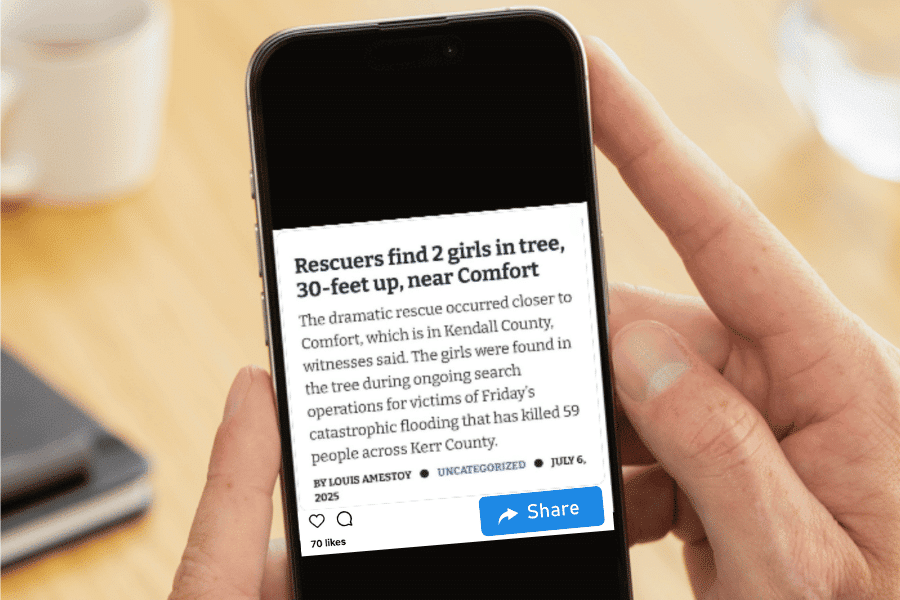
    In the wake of the floods in the U.S. state of Texas earlier this month news circulated on social media of two girls being rescued. One of the first posts sharing the story included a screenshot of a post to social media that read:

    Rescuers find 2 girls in tree, 30-feet up, near Comfort

    The dramatic rescue occurred closer to Comfort, which is in Kendall County, witnesses said. The girls were found in the tree during ongoing search operations for victims of Friday’s catastrophic flooding that has killed 59 people across Kerr County.

    A Facebook search of the post’s keywords returned dozens of identical or similarly-worded posts retelling the harrowing rescue. Other versions of the story were also shared across social media platforms like Instagram Threads, as well as in now-deleted articles across various news outlets

    But the story was fabricated. 

    It was a prime example of a type of misinformation known as “copypasta.” 

    Inciting fear

    Social media posts that utilize copypasta — a portmanteau of “copy” and “paste” — are often used to incite fear or evoke emotions, prompting users to like and share the content. These posts are used for various reasons, whether to polarize different political groups further or to attract a broader audience and spread misinformation. 

    Alex Kasprak is an investigative journalist who reported for the digital fact-checking website Snopes for nearly a decade. In his experience, Kasprak says copypasta plays a central role in online misinformation. (For more on Snopes’ take on copypasta, head to this link.) 

    “The simplest way to put it, is that copypasta is a text that you see that is identical or nearly identical posted either with somebody’s name as an author or without it in an identical form on multiple posts such that it’s clear that whoever is posting it copied it from somewhere else,” said Kasprak. 

    “What you end up getting in that sort of phenomenon is a game of telephone.”  

    Copypasta serves as a new-age version of chainmail, seen in the early days of email, which promised good luck for forwarding a message or foretold misinformation if you let the email sit in an inbox. 

    Lacking credibility

    In the case of copypasta, social media users are encouraged to comment, share or tag their friends in a post to boost engagement. Such emotion-evoking messages can serve as an entry point into more polarizing content, which is often rife with false information. 

    To identify copypasta, look for signs of vague or generic information that lacks a credible source or call to action. The way a post is written can also serve as an indication that it may be a copy-and-paste text. 

    “With copypasta, everything generally kind of travels forward, including errors in grammar or mistranslations,” Kasprak said. “If there are weird sentences that just kind of end or don’t fully make grammatical sense, that is an indicator that the tone of the message doesn’t match.”

    If the post is shared by someone that you know on your feed, but the tone is different than how they usually post or talk, the content likely originated from another source — credible or not, Kasprak said. 

    In addition to spreading false information, copypasta can be used as part of bigger campaigns to push particular sentiments or ideologies. For example, back in 2017, U.S. government officials found evidence that Russian “trolls” took to social media and also deployed social media campaigns to connect certain users to various organizations or movements.

    Danger to the infosphere

    During these online campaigns, nefarious actors meddled in the election by posting emotional content to get users to engage, gradually bringing them down a digital rabbit hole of more polarizing issues.

    Kasprak adds that copypasta content also harms the “infosphere,” or public knowledge otherwise rooted in fact. When copypasta becomes widespread and is presented as a “pseudofact,” people begin to cite it as common knowledge. A commonly held belief that many people cite as fact, for example, is that a mother bird will abandon its offspring if a human touches it. Experts agree that this notion is not true. 

    Another tactic behind those who post copypasta is to poison AI models in a similar way that fake news websites do. When enough content on the internet makes a particular claim, AI technologies may focus on this noise and refer to it as fact. In this way, AI programs are “trained” to focus and “believe” those posts over other sources of information.

    Emotion-evoking posts may also fall into the copypasta category if they are not rooted in unbiased facts. If emotional language used in the post immediately sparks anger, sadness or another strong emotion, it may be a fake post. 

    “In general, the big thing to watch out for is if something fits perfectly into your notion of how the world works,” said Kasprak. Posts that validate a person’s view of the world or evoke strong emotions in a positive or negative way are more likely to be a red flag. 

    Kasprak advises users to check their biases when reading potential copypasta content; if something makes you angry or sad, double-check its source and legitimacy. 

    “Pause if you feel strongly about wanting to share something, because those posts are the ones where the risk of copypasta is higher,” said Kasprak. When he comes across a post he believes to be copypasta, Kasprak says that he tries to “tear apart” the argument, primarily if it supports his beliefs, until it dissolves. 

    “Check your blind spots and be vigilant in checking your work,” said Kasprak. 

    When in doubt, don’t share.


    Questions to consider:

    1. What is meant by “copypasta”?

    2. How can something false become part of commonly believed?

    3. Can you remember the last thing you reposted on social media? What kind of things do you share with your network?


    Source link

  • Is social media turning our hearts to stone?

    Is social media turning our hearts to stone?

    As global digital participation grows, our ability to connect emotionally may be shifting. Social media has connected people across continents, but it also reshapes how we perceive and respond to others’ emotions, especially among youth. 

    Empathy is the ability to understand and share another’s feelings, helping to build connections and support. It’s about stepping into someone else’s shoes, listening and making them feel understood.

    While platforms like Instagram, TikTok and X offer tools for global connection, they may also be changing the way we experience empathy.

    Social media’s strength lies in its speed and reach. Instant sharing allows users to engage with people from different backgrounds, participate in global conversations and discover social causes. But it also comes with downsides. 

    “People aren’t doing research for themselves,” says Marc Scott, the diversity, equity and community coordinator at the Tatnall School, the private high school that I attend in the U.S. state of Delaware. “They see one thing and take it for fact.”

    Communicating in a two-dimensional world

    That kind of surface-level engagement can harm emotional understanding. The lack of facial expressions, body language and tone — key elements of in-person conversation — makes it harder to gauge emotion online. This often leads to misunderstandings, or worse, emotional detachment.

    In a world where users often post only curated highlights, online personas may appear more polished than real life. “Someone can have a large following,” Scott said. “But that’s just one person. They don’t represent the whole group.” 

    Tijen Pyle teaches advanced placement psychology at the Tatnall School. He pointed out how social media can amplify global polarization. 

    “When you’re in a group with similar ideas, you tend to feel stronger about those opinions,” he said. “Social media algorithms cater your content to your interests and you only see what you agree with.” 

    This selective exposure limits empathy by reducing understanding of differing perspectives. The disconnect can reinforce stereotypes and limit meaningful emotional connection.

    Over exposure to media

    Compounding the problem is “compassion fatigue” — when constant exposure to suffering online dulls our emotional response. Videos of crisis after crisis can overwhelm users, turning tragedy into background noise in an endless scroll.

    A widely cited study published in the journal Psychiatric Science in 2013 examined the effects of exposure to media related to the 9/11 attacks and the Iraq War. The study led by Roxanne Cohen Silver, found that vicariously experienced events, such as watching graphic media images, can lead to collective trauma.

    Yet not all emotional connection is lost. Online spaces have also created powerful support systems — from mental health communities to social justice movements. These spaces offer users a chance to share personal stories, uplift one another and build solidarity across borders. “It depends on how you use it,” Scott said.

    Many experts agree that digital empathy must be cultivated intentionally. According to a 2025 Pew Research Center study, nearly half of U.S. teens believe that social media platforms have a mostly negative effect on people their age, a significant increase from 32% in 2022. This growing concern underscores the complex nature of online interactions, where the potential for connection coexists with the risk of unkindness and emotional detachment. ​

    So how do we preserve empathy in a digital world? It starts with awareness. Engaging critically with content, seeking out diverse viewpoints and taking breaks from the algorithm can help. “Social media can expand your perspectives — but it can also trap you in a single mindset,” Scott said. 

    I initially started thinking about this topic when I was having the same conversations with different people and feeling a sense of ignorance. It wasn’t that they didn’t care — it was like they didn’t know how to care. 

    The way they responded to serious topics felt cold or disconnected, almost like they were watching a video instead of talking to a real person. 

    That made me wonder: has social media changed the way we understand and react to emotions?

    Ultimately, social media isn’t inherently good or bad for empathy. It’s a tool. And like any tool, its impact depends on how we use it. If we use it thoughtfully, we can ensure empathy continues to grow, even in a world dominated by screens.


    Questions to consider:

    1. What is empathy and why is it important?

    2. How can too much time spent on social media dull our emotional response?

    2. How do you know if you have spent too much time on social media? 


    Source link

  • Why social media hasn’t ruined our democracy (yet)

    Why social media hasn’t ruined our democracy (yet)

    “The algorithm won’t push posts that aren’t dramatic enough,” Keller said. “If I want something to go viral, I need to communicate differently.”

    Popularity and popular elections

    Effects of algorithms can be seen all around the world. In Romania, the 2024 presidential election was annulled due to alleged disinformation on social media platforms. During the 2022 national election campaign in the Philippines, social media played a significant role in the rapid spread of disinformation narratives.

    In Germany, social media significantly influenced the 10% increase in votes in the recent election for the far right party Alternative for Germany(AfD) compared to 2021. A notable factor was Elon Musk’s promotion of the AfD on Twitter.

    In Switzerland, direct democracy allows citizens to vote directly on laws and policies. This system is a core part of its governance, with frequent referendums and initiatives shaping political decisions.

    On average, there are 3-4 national votes per year, which could make the direct democracy even more susceptible to social media than other types of democracies, as people get to vote on smaller issues than presidential elections, which only happen once every four years. This makes the political processes more inclusive.

    As online campaigns grow more popular, social media can play a larger role in votes. However, Switzerland still relies heavily on traditional media sources for political news consumption. A recent report by research and consulting firm Publicom AG found that 58% of voters form their opinions through radio, TV or print media. Most of these are neutral and based on the information given by the national news agency SRG. That means there is less polarization.

    A generational change

    By contrast, only 16% actively turn to social media to establish a viewpoint. However, these numbers may be misleading. The popularity of social media has been on the rise; for instance, in 2017, just 12% of the population sourced their news from these platforms. It is also important to note that the study groups all voters into one category.

    When focusing specifically on the younger demographic, aged 15–29, the shift is more pronounced. In this age group, social media usage for news has increased by 11 percentage points since 2020, now reaching 40%.

    Despite the significant engagement of young people with news through social media, Switzerland’s democratic system remains largely unaffected. Keller said that the average voter in the country is approximately 55.

    While the influence of social media in Switzerland right now may only be marginal, this could change in the future, once these younger generations, which heavily rely on social media for news, enter the political landscape.

    Many of the students we go to school with acknowledged that social media shapes their beliefs. “It depends on how reliable the source is,” said one 16-year old who we spoke to. “But if a lot of people say the same thing and if I also hear it on multiple platforms, then I’ll probably start believing it too.”

    Positive aspects of social media

    A repeated theme seemed to be, appropriately, repetition. Our schoolmates seem to equate repetition with credibility.  “I think it could [influence my beliefs], if I see the same information multiple times across multiple platforms,” said one student, aged 15.

    Another said that he would question the information he sees but ultimately he would end up believing it. “If I see 10 posts about the CDU [German political party], for example, and they are all positive, I think about what their arguments are, and if they make sense, then yeah, I think I’d believe it,” he said.

    So even though it might not be necessary to implement additional regulations regarding the usage of social media in political campaigns right now, it might become necessary in the future as social media continues to grow in importance.

    Social media in the political process isn’t all about misinformation. It can also provide a platform for people to discuss political issues, regardless of their party. Keller sees social media as an opportunity.

    “I’m more of an optimist than a pessimist,” Keller said.

    For example, Keller said, if he wanted to start a referendum campaign, he could post about that and find other people to help organize it. That also allows people the opportunity to communicate directly with politicians.

    “Nowadays a lot of them are on social media platforms,” he said. “You can tell them your opinion directly … and sometimes they even reply.”


    For more about the power of repetition in news coverage check out this News Decoder Top Tip.


    Three questions to consider: 

    1. How can a single social media post affect an election?
    2. What do the authors mean by politicians becoming “personalities”?
    3. In what ways are you influenced by what you read or see on social media?


    Source link

  • Real World Support

    Real World Support

    As students navigate an increasingly complex world defined by artificial intelligence, social media, and rapid technological change, the need for essential life skills has never been greater. A new curriculum called The Edge immerses students in real-life, complex scenarios that challenge them to think critically, collaborate effectively, and apply social-emotional learning (SEL) to everyday situations. Hear how educators are using these next-generation strategies in classrooms today.

    The computer-generated transcript is below:

    Kevin Hogan,
    Content Director, eSchool News
    This episode is brought to you by ascend now. Ascend now is an online education platform focused on providing personalized, academic and beyond academic coaching and mentoring to students aged 7 to 17. With a particular emphasis on fostering entrepreneurial skills and mindset by integrating entrepreneurship education into their curriculum. Aiming to normalize kid entrepreneurs through tailored programs and personalized learning paths. OK. Hello and welcome to this special edition of Innovations in Education, the podcast that explores how tech can enable districts to improve teaching and learning in their classrooms. I’m Kevin Hogan, content director for eSchool News. And I’m glad you found us. Believe it or not, it’s been five years this month that the world and schools shut down due to the COVID pandemic. Since then, so much has changed from student behavior to the way that schools respond to that behavior. Many through the use of social emotional learning, or SEL techniques. I had the pleasure to speak with Jesse Bushman. Jesse is the senior director of SEL at. Fayette Valley Community School District in Iowa about their efforts by using a new program called the. We also spoke with the creator of that curriculum, Devi Sahny. She’s the CEO and founder of Ascend now, now designed in collaboration with educators and aligned with the Castle Framework. The. The first curriculum to meet educators demands for high quality instructional materials for SEL and life skills readiness. The curriculum helps students cultivate communication, problem solving and self-awareness, as well as essential life skills like entrepreneurs. Negotiation, financial literacy and networking to boost their academic abilities. I think you’ll find their insights valuable. Have a listen. OK. Devi, Jesse, thanks so much for joining me today. Really appreciate it.

    Devi Sahny
    CEO and Founder, Ascend Now & The Edge
    I’m happy to be here. Thanks for having us.

    Kevin Hogan
    And as I was mentioning right before we started the recording here, I guess it’s hard to believe, but it’s five years ago to this month, it was actually Friday the 13th. Believe it or not that Jesse, I mean I know a lot of school districts, that’s when we. Into this great. Beta test in education with remote learning and COVID. Years. So tired of talking about it. However, it is still really kind of with us in the way that it has changed education and especially with the work that Jesse you do and Devi that you do that really took one of those acronyms I’ve always heard in education SEL, which was kind of like a nice to have probably for districts who might be kind of more well off than others. That would introduce that to where social emotional learning became front and Center for everybody in this. Group trauma together districts have spread apart. If they had the luxuries or the privileges to be able to set up remote right away. Most of the, if I recall correctly, in my conversations, most of those conversations involved around social emotional learning. You OK at home? How are you doing at home? People those first few months. No more worried about standardized testing, right? Everybody was worried. Just kind of keeping it all together. Jesse, we can get. Let me talk about that time for you in. In your district, in what you were doing in what SEL mean back then. And what does it mean? And Devi, I promise we’ll get into the news of the edge and how this all comes part and parcel.

    Jessie Bushman
    Senior Director SEL,
    North Fayette Valley Community School District,
    Yeah. You’re totally correct. At that time it was like scary. We’re all learning to adjust. The kids were learning to adjust to and as educators. That was our most important thing was to tune in with the kids. Sure, they were safe. Check in on how they were doing and as staff we did that together as well, so we would check in on each other. A lot of our first meetings were just talking about how everybody was doing. So coming back, it did change a lot of things kids were. And teachers were. So as a school, we had to change things.

    Kevin Hogan
    Yeah. And Devi, let’s get into the news a little. I mean, just here in January, now you’ve announced this new curriculum called The Edge. How have the past few years informed the work and the ultimate release of this new service? You’re providing.

    Devi Sahny
    Yeah. And and just to answer that first part of the question about COVID, I think COVID certainly transformed education for K12. In a lot of ways, I think in one way teachers overnight had to have this accelerated adoption of technology, some that was super helpful and integrated really easily and others that may have perhaps even. Slow down learning. I think teachers out of all stakeholders during Covic with the heroes, because overnight they had to change their delivery and immediately adapt. And I think that’s in a very entrepreneurial thing. One of the other big changes we saw through Covic was this increased emphasis on social emotional learning. Think there was a report. Brookings stating that nearly 40% of teachers report students struggling more with depression and anxiety than before. COVID and over 80% of those teachers still have students that are struggling with depression and anxiety. So I think the overemphasis of technology combined with an entirely new world landscape reframed this focus of, hey, we should maybe turn back the pendulum and focus on the important skills. And with AI and technology, everything is advancing. But certain skills like networking and grit and resilience and communication, they still remain incredibly important. And one of the reasons we decided to create the edge is we felt that students in their middle and high school years did not really feel those skills were learnable. They thought I’m either born with strong public speaking skills or I’m not. I’m either born. With a learning mentality and a strong mentality or I’m not and we wanted to break that belief and provide them with student friendly resources, but I think yeah, COVID certainly changed a lot and I think now more than ever SEL is critical the amount of times we hear. Teacher saying we don’t have time for essay and I always. Well, that’s actually going to reframe and support your your students to be ready for. But even the teachers need SEL. I mean, Jesse and I were just talking about one of her students who I think Jesse was saying, like, found purpose through essay.

    Jessie Bushman
    Yeah, we had a great conversation when we were working on a lesson. It would just like the light bulb went off, he and he said. Now have a purpose like. There’s a reason, like I understand why I need to learn this, because this is my future. And so it wasn’t just another thing to teach. At that moment, for him, this was like I need to learn this. Is life.

    Kevin Hogan
    Yeah, it seems to me with both you’re talking about two is the change in student behavior right? Of the experiences of the of the past couple years. One of the net positives, if you can call it that or a silver lining, whatever cliche you you wanna use. You’re describing a self-awareness that I still don’t think I have for myself. That said, students of that age and having gone through this experience, are aware of their learning journeys. Aware of where they might need to improve and also don’t kind of shrug it off as. This sort of like, well, that’s just for people with depression. Or that’s just for certain part of the kids in class, maybe who aren’t succeeding like, this really is beneficial for everybody, right?

    Devi Sahny
    Absolutely. And I think that when we talk about soft skills and we talk about Sela, lot of the resources that currently exist remain a bit outdated and they’re not student friendly and a lot of the teachers we’ve spoken to have said we’re using the same curriculum, that’s 50. Older. 30 years old to teach, you know, stress and anxiety, and it’s not as simple as just a deep breath. There’s more to it, and there’s more conversation involved. So one of the things we did when we created this program, the edge is we try to identify what the future skills are. How do we actually figure out what are those skills? And how are they learnt? Are they acquired? So we went on this crazy research experiment where we interviewed different stakeholders. We interviewed 500 educators from different demographics and socio economic backgrounds to ask them what are the scales you wish you could teach in your classroom but don’t have the resources for. Then we interviewed 500 students different ages in middle and high school to understand what skills they wish they could learn, and some really interesting responses. Like networking, which is one of our more. Skill. And then we interviewed about 200 chief learning officers from different Fortune 500 companies to ask them when you teach your employees in these higher Ed programs whether the skills you focus on. Then we cross reference that with HR and recruitment industry to understand what they hire for across sectors, whether that be education, technology, human resources, fin. We came up with a list of about 6000 schools. We then took that. We spoke with OECD World Economic. We’re actually one of the partners and I was at Davos recently in January speaking about this and we looked at the future of jobs report and we took all that data and all that research. To create our own framework which is called the Life readiness playbook by. Edge and this playbook is not necessarily, as you pointed out, Kevin, for students to get ready for an outcome like good grades or a university outcome or a good job, it’s actually just to have them ready for life. And these are skills that are lifelong. You know, I’m constantly working on my listing skills, my stress management skills. And the way that students can consume this content is pretty exciting. Like if a student wants to. Consume the content, grit the skill, grit they can learn from Michael Jordan. Not making his high school basketball team and the cool thing is the video format. It’s funny. Quirky. It’s engaging. But it still has all those learning outcomes tied to it, which is something, frankly, I wish I had when I was in middle high school.

    Kevin Hogan
    Yeah. Jesse, talk a little bit about what that means on a day-to-day basis for our listeners, our readers who are either running districts themselves or their principal of a school or even at the classroom level, I mean. These are great theoretical topics, but what? About science class between 10:30 and 12:30 on a Tuesday. How do these curricula? Do these topics kind of show themselves in the day-to-day of educating students?

    Jessie Bushman
    Well, I’m gonna step. Just one step and kind of explain how we. There. I think that’ll make a little bit more sense looking for something. We just know that we needed something to add for our students and looking for a curriculum we couldn’t find what we needed. They were not rigorous enough. Wasn’t the correct content. Not engaging for our students or didn’t have enough depth as as far as lessons to make it through a school year or to do a 612 model so. Once I saw the edge, the skies parted and I was like, this is exactly what we need. And so once we started teaching those things, we noticed that the students confidence changed. They became more confident in themselves in what they can do, looking forward to their futures. And so we had a lot less behaviors. So those started decreasing because. There was. We’ve also seen absentee change. Kids want to be at school, they want to be engaged. It’s great with our staff as well. Like you said, adults need this too. This is stuff for all of us. It’s been great teaching it because it’s a reminder myself as well on a lot of these skills that you don’t think. Every day.

    Kevin Hogan
    Yeah, especially when you look at again. I hate to go back to COVID, but there really was a significant chasm there in, I would say the soft skills versus the hard skills. But we we kind of focus on the on the reading and and the math scores that go down. I see it from my own kind of COVID kids here to see. Of having a person to person in person conversation with someone if they weren’t in school for 18 months between the time they were an eighth grader up to sophomore, they’re still struggling to recover on how to. Behave in person for for a lot of stuff, right? But maybe Devi, you could talk a little bit. I know that you you had this integrated school framework, you had this educator friendly design that you put these things together. What is your hope terms of turning those soft skilled potentials into real world accomplishments?

    Devi Sahny
    Yeah, I think that in the digital age and like you said, the students that were were most impacted during COVID. Many of them have lost what’s called human skills. Actually hate the term soft skills because I think soft and hard skills, but all human skills, right? Portions of soft skills have pieces of hard scales, etc. We actually focus on both soft and hard. But I would. That turning the pendulum back and saying how can we help these students develop self-confidence, self-awareness, resilience, grit through stories of themselves through activities, through gamified examples that will really take them forward into the real life. It’s funny that you say this because I gave a talk at one of the leading international schools and recently and I asked the students, I think it was about 200. I asked them who here is confident with the skill networking and is confident speaking to people they have never met before in person. And I have 200 students, maybe 3 raise their hands. Then I reframe that question. Said. Who here in this classroom is confident speaking to someone they haven’t met before online? Maybe 30 raised their hand. So there’s this confidence and this comfort with online communication that is so easy for students to accept. It’s interesting. I I I will say that sometimes I’m like that too, right? When I’m in person, meeting changes into zoom, I’m like, yeah. Like I don’t have to like wear anything. Know too too fancy. I can do it in my hoodie. There is a bit of that right and I think there there’s an honesty to that and I think that’s important. But I think the. The fear with this new generation is that the human skills are not getting practised at all. Again, very weird example which I’ll put in quotations. You may want to cut out, but some of our students, one of our students I’m speaking to recently, she’s 19 years old, she said to me, I have a boyfriend. I said, oh, great. Where did you meet him? She said no. We’ve been dating for a year, but I never met him in person.

    Kevin Hogan
    It’s amazing, yeah.

    Devi Sahny
    So it’s like is the world changing that way or is it, you know, the skills or what’s happening, right? But I think you know, Jesse’s been Jesse’s such an inspiring educator for this reason. Jesse’s smart enough to know that teachers themselves also need to work on their SEL. All do. Adults, professors, everyone and so in parallel. If teachers working on their SEL, they’re teaching students SEL. The students are teaching the teachers. And that’s such a beautiful process because. Learning can happen in any sort of. But that’s really our. My hope is to help students to fundamentally figure out who they are, their purpose, like Jesse’s student who figured out what made himself tick. The Edge is designed for students to figure out who they are, what their strengths are, what skills they’d like to work on and for. Kevin, I’ll be honest that the edge is designed as a one stop shop, easy to use resource that helps them use these skills in their classroom with no prep that gives them maybe 10 minutes extra with their, with their kids or their partner. That they don’t have to write a whole Lesson plan or learning sequence, right? And that’s important to us too, because they’re the heroes.

    Jessie Bushman
    That was a huge. Point that I fell in love with when I saw it is these are lessons that I can just pick up. I can pick it up, I can read it, and I can teach it, and it’s not something that’s going to be another thing on. Plate right now I have a lot of things on my plate, so when I’m able to pick it up, the slides are ready for a whole group. Very little needed. It also has the online component. It has all the pieces to it prepped and ready, so it’s not one more thing for me to have to do.

    Kevin Hogan
    Yeah, another aspect I know which is important for districts. Again, when it came to social emotional learning techniques in the past, you might have had that guy, usually a guy on the school board saying. Show me the results. Show me the data. Show me how this is actually been effective and don’t give me the squishy anecdotes. Me the the hard numbers. And I know that with the eggs, there are some real time analytic techniques that are connected with it.

    Devi Sahny
    Absolutely. So you as a teacher or a district can see how your students are performing across every. Personal development, communication, employability, skills, active citizenship and learning, and you can actually get a score to see how your students are progressing on a grade level. Age level. Student level. You can compare that data geographically so you can see what kids. In China or in Asia or Europe are doing compared to your students, at least those of our school partners that are working with us, we work with quite a few international schools too, like International School partnerships, Dulwich College, Xcl Cognita School, some of the American schools and so. Interesting to compare that data with some of the data in the US and to see how students. But overall, we’re seeing that a lot of students are like, wow, I didn’t know I could learn financial literacy. Didn’t know I could learn about. I didn’t know I could learn about entrepreneurship in such a friendly way, so that’s really important to us, but also to feed the schools with unique data to see where the holes and the gaps are, because as schools. Ton of things you have to, you know, kind of take care of chronic absenteeism, teacher retention, you know, school leadership. So many things involved. I mean this is really just designed to see how can we. And we also have a mental health teacher track coming up too, which I’m really excited about because that’s something that can really support the teachers.

    Kevin Hogan
    Yeah. And Jesse, to kind of to go back a little bit, give us a little bit of a day in the. I mean, are these seen as extracurricular activities that happen after the Bell ring in the afternoon or they are they tied into actual classes? Kind of give us the specifics there.

    Jessie Bushman
    Well, the one thing that I love about this curriculum is it’s super. So according to your school, you can adapt it and switch it to. However, it’s going to work best for you. We as a district started off with it in the special Ed program. Actually, and we needed a curriculum there 1st and looking at that then we saw the need like the rest of the kids need this information as well. Looking into putting it into advisory, that portion of time. A lot of times teachers are trying to fill that time with lessons themselves or create these types of lessons. So using it as universal gives the kids the the vocabulary, the information, and then we can use it all the way into special Ed. So it’s an intensive program as well. It’s very. That was huge for me that my students are going to have the same vocabulary from 6:00 to 12:00. In. Ed and special Ed.

    Kevin Hogan
    And it says to me that it’s pretty much teacher driven or educated driven. That fair to say.

    Jessie Bushman
    Yeah, it’s very engaging. All the material is very. And it’s very relevant to the kids. The kids can relate to it. Stuff that’s happening in their lives. The discussions. It’s not just role. It’s great discussions on actual problems in the world and tools that they can actually use right there in the classroom as well, so. They’re discussing things that are happening right around us.

    Kevin Hogan
    Excellent. Now I think we’ve gotten a really good sense of the state of play of where we are with social emotional learning. Now, if you are up in progressive schools or districts like Jesse’s, let’s talk about. Next steps, Devi, where do you see? This is just the edges that’s been launched here in January. What are your hopes to see your services as they continue to evolve over the next several months and and years?

    Devi Sahny
    Yeah. What we’re doing in parallel supporting districts now, 200 schools and total. So we just enter the US, but we already work with seven districts here as well as Georgetown University Summer School and two other summer schools in the process. But my hope really is that as we have all these amazing districts using us to take as much feedback and see how we can make this product as easy to use and helpful for teachers. One of the feedbacks we’ve gotten is we love this so much. You include a teacher mental health track. And mental health videos for teachers to help us do what we’re doing every single day. We have tracks that include entrepreneurship and internships. A lot of employability skills in college and career readiness, but we have two more tracks. Is called AI interpretation and another is graphic design in the making. So what happens in these tracks is the students can reapply the skills they were learning. But through an experience through something a different context where they can basically trans context, apply that skill again. So that’s really cool because at the end of the entrepreneurship track, there’s a Shark Tank for kids where they can compete, and the best business gets funding. Actually, that funding is funded by Ascend. Now, over the past seven years, actually we’ve. We funded student businesses as prize money essentially, and the internship track they can, you know, apply to different companies to apply for internships. So there’s a bit of that, but overall my hope is. Is that we have this next generation of future ready, SCL, smart skill, savvy students across the world that know themselves that find their own edge through essay. Because essay everywhere and to have 30 minutes a week in SEL. I don’t think that’s enough. You know, I really Don. So it’s a. It’s a good start, but we need to do better, so I think valuing the Selma as a society would be something that I would be very interested to see what happens in the next few years.

    Kevin Hogan
    Yeah. And Jesse will leave the last word with you about where your hopes to see this sort of work and how we can kind of continue to evolve and benefit your students.

    Jessie Bushman
    I’m just excited to see what they can do with their futures as we’re learning these skills and you see the light in their eyes and they’re able to you do the challenges and apply the skills that they’re learning in real life. Talking about networking, the challenges to go. And network and come back with three business cards. So we’re putting it right in their. And so when they’re learning, it guided with us, I mean, just excited to see what they’re going to be able to do in the future.

    Kevin Hogan
    Yeah. Well, once again, it’s a difficult topic and you add in COVID. It’s just always a tough conversation, but at the end of it I come out feeling better. Congratulations on your launch. Congratulations on on the work that you’re doing. Jesse at your district glass always seems half full. When I when I sit. With a few educators for 15 or 20 minutes this way, and here the the real work and the real successes you’re having. Thanks again for your time and for your insights.

    Devi Sahny
    Thanks so much Kevin for having us. We really appreciate it and love talking to you.

    Jessie Bushman
    Thank you.

    Kevin Hogan
    And that wraps up the special edition of Innovations in Education, which was brought to you by ascend. Now a US based education startup committed to increasing both college and career readiness for all students. For more information, you can find them on the web at buildmyedge.com.

    Kevin Hogan
    Latest posts by Kevin Hogan (see all)

    Source link

  • How Spokane Public Schools is helping kids engage in real life

    How Spokane Public Schools is helping kids engage in real life

    Key points:

    Social media has connected kids like never before, but what they get in likes and shares, they lose in real, meaningful engagement with their peers and classmates. Lunch hours are spent hunched over smartphones, and after-school time means less sports and more Snapchat.

    The adverse effects of this excessive screen time have significantly impacted students’ social- emotional health. Forty-one percent of teens with the highest social media usage struggle with mental health issues, and between 2010 and 2020, anxiety among adolescents skyrocketed by 106 percent.

    At Spokane Public Schools (SPS), educators and administrators are reversing the side effects of social media by re-connecting with students through school-based extracurricular activities. Through its transformative Engage IRL (Engage in Real Life) initiative, the district is encouraging kids to get off their devices and onto the pickleball court, into the swimming pool, and outside in the fresh air. With more than 300 clubs and sports to choose from, SPS students are happier, healthier, and less likely to reach for their smartphones.

    An innovative approach to student engagement

    Even before the pandemic, SPS saw levels of engagement plummet among the student population, especially in school attendance rates, due in part to an increase in mental health issues caused by social media. Rebuilding classroom connections in the era of phone-based childhoods would require district leaders to think big.

    “The question was not ‘How do we get kids off their phones?’ but ‘How do we get them engaged with each other more often?’” said Ryan Lancaster, executive director of communications for SPS. “Our intent was to get every kid, every day, involved in something positive outside the school day and extend that community learning past the classroom.” 

    To meet the district’s goal of creating a caring and connected community, in 2022, school leaders formed a workgroup of parents, community members, coaches, and teachers to take inventory of current extracurriculars at all district schools and identify gaps in meeting students’ diverse interests and hobbies.

    Engaging with students was a top priority for workgroup members. “The students were excited to be heard,” explained Nikki Otero Lockwood, SPS board president. “A lot of them wanted an art club. They wanted to play board games and learn to knit. No matter their interests, what they really wanted was to be at school and be connected to others.”

    Working with community partners and LaunchNW, an Innovia Foundation initiative focused on helping every child feel a sense of belonging, SPS launched Engage IRL–an ambitious push to turn students’ ideas for fun and fulfillment into real-life, engaging activities.

    Over the past two years, Engage IRL has been the catalyst for increasing access and opportunities for K-12 students to participate in clubs, sports, arts activities, and other community events. From the Math is Cool Club and creative writing classes to wrestling and advanced martial arts, kids can find a full range of activities to join through the Elite IRL website. In addition, five engagement navigators in the district help connect families and students to engagement opportunities through individual IRL Plans and work with local organizations to expand programming.

    “All day, every day, our navigators are working to break down barriers and tackle challenges to make sure nothing gets in the way of what kids want to be involved in and engaged in,” said Stephanie Splater, executive director of athletics and activities for SPS. “For example, when we didn’t have a coach for one of the schools in our middle school football program, our navigators mobilized for really good candidates in a short amount of time just from their personal outreach.”

    In only two years, student engagement in extracurriculars has nearly doubled. Furthermore, according to Lancaster, since the Engage IRL launch, SPS hasn’t experienced a day where it dipped below 90 percent attendance. 

    “That’s an outlier in the past few years for us, for sure, and we think it’s because kids want to be at school. They want to be engaged and be part of all the cool things we’re doing. We’ve had a really great start to the 2024-2025 school year, and Engage IRL has played a huge role.”

    Engage IRL also helped SPS weather student blowback when the district launched a new cell phone policy this year. The policy prohibits cell phone use in elementary and middle school and limits it to lunch and periods between classes for high school students. Because students were already building personal connections with classmates and teachers through Engage IRL, many easily handled social media withdrawal.

    Creating opportunities for all kids

    Key to Engage IRL’s success was ensuring partnerships and programs were centered in equity, allowing every child to participate regardless of ability, financial or transportation constraints, or language barriers.

    Establishing a no-cut policy in athletics by creating additional JV and C teams ensured kids with a passion for sports, but not college-level skills, continued to compete on the court or field. Partnering with Special Olympics also helped SPS build new unified sports programs that gave children with disabilities a chance to play. And engagement navigators are assisting English language learners and their families in finding activities that help them connect with kids in their new country.

    For Otero Lockwood, getting her daughter with autism connected to clubs after years of struggling to find school activities has been life-changing.

    “There are barriers to finding community for some kids,” she shared. “We know kids with disabilities are more likely to be underemployed as adults and not as connected to the community. This is something we have the power to do that will have a lasting impact on the children we serve.”

    Through Engage IRL, SPS has redefined student engagement by expanding access and opportunity to 6,000 students across 58 schools. In just two short years, the district has seen attendance increase, student wellness improve, and dependence on smartphones diminish. By continuing to listen to the needs of students and rallying the community to partner on out-of-school activities, Spokane Public Schools is successfully fostering the face-to-face connections every child needs to thrive.

    Latest posts by eSchool Media Contributors (see all)
    Source link