Category: Software

  • 3 reasons to switch to virtual set design

    3 reasons to switch to virtual set design

    Key points:

    If you’ve attended a professional show or musical recently, chances are you’ve seen virtual set design in action. This approach to stage production has gained so much traction it’s now a staple in the industry. After gaining momentum in professional theater, it has made its way into collegiate performing arts programs and is now emerging in K-12 productions as well.

    Virtual set design offers a modern alternative to traditional physical stage sets, using technology and software to create immersive backdrops and environments. This approach unlocks endless creative possibilities for schools while also providing practical advantages.

    Here, I’ll delve into three key benefits: increasing student engagement and participation, improving efficiency and flexibility in productions, and expanding educational opportunities.

    Increasing student engagement and participation

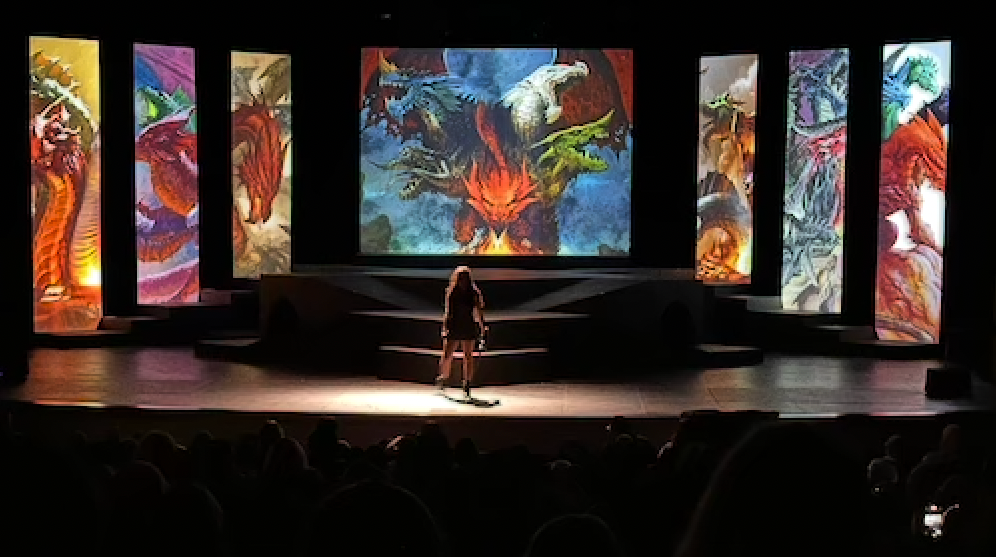
    Incorporating virtual set design into productions gets students excited about learning new skills while enhancing the storytelling of a show. When I first joined Churchill High School in Livonia, Michigan as the performing arts manager, the first show we did was Shrek the Musical, and I knew it would require an elaborate set. While students usually work together to paint the various backdrops that bring the show to life, I wanted to introduce them to collaborating on virtual set design.

    We set up Epson projectors on the fly rail and used them to project images as the show’s backdrops. Positioned at a short angle, the projectors avoided any shadowing on stage. To create a seamless image with both projectors, we utilized edge-blending and projection mapping techniques using just a Mac® laptop and QLab software. Throughout the performance, the projectors transformed the stage with a dozen dynamic backdrops, shifting from a swamp to a castle to a dungeon.

    Students were amazed by the technology and very excited to learn how to integrate it into the set design process. Their enthusiasm created a real buzz around the production, and the community’s feedback on the final results were overwhelmingly positive.

    Improving efficiency and flexibility

    During Shrek the Musical, there were immediate benefits that made it so much easier to put together a show. To start, we saved money by eliminating the need to build multiple physical sets. While we were cutting costs on lumber and materials, we were also solving design challenges and expanding what was possible on stage.

    This approach also saved us valuable time. Preparing the sets in the weeks leading up to the show was faster, and transitions during performances became seamless. Instead of moving bulky scenery between scenes or acts, the stage crew simply switched out projected images making it much more efficient.

    We saw even more advantages in our spring production of She Kills Monsters. Some battle scenes called for 20 or 30 actors to be on stage at once, which would have been difficult to manage with a traditional set. By using virtual production, we broke the stage up with different panels spaced apart and projected designs, creating more space for performers. We were able to save physical space, as well as create a design that helped with stage blocking and made it easier for students to find their spots.

    Since using virtual sets, our productions have become smoother, more efficient, and more creative.

    Expanding educational opportunities

    Beyond the practical benefits, virtual set design also creates valuable learning opportunities for students. Students involved in productions gain exposure to industry-level technology and learn about careers in the arts, audio, and video technology fields. Introducing students to these opportunities before graduating high school can really help prepare them for future success.

    Additionally, in our school’s technical theater courses, students are learning lessons on virtual design and gaining hands-on experiences. As they are learning about potential career paths, they are developing collaboration skills and building transferable skills that directly connect to college and career readiness.

    Looking ahead with virtual set design

    Whether students are interested in graphic design, sound engineering, or visual technology, virtual production brings countless opportunities to them to explore. It allows them to experiment with tools and concepts that connect directly to potential college majors or future careers.

    For schools, incorporating virtual production into high school theater offers more than just impressive shows. It provides a cost-effective, flexible, and innovative approach to storytelling. It is a powerful tool that benefits productions, enriches student learning, and prepares the next generation of artists and innovators.

    Latest posts by eSchool Media Contributors (see all)

    Source link

  • The triple Rs of scholastic esports

    The triple Rs of scholastic esports

    Key points:

    I know what it feels like to stand in front of a classroom that does not have enough. Not enough computers. Not enough up-to-date software and technical tools. Not enough resources to give every student the experience they deserve. When students notice these gaps, they notice more than the missing tools. They begin to question whether their education and, by extension, their potential really matters. That doubt can quietly drain their confidence.

    This is why dependable resources are not simply a bonus in education. They are a lifeline. In my role leading the Scholastic Esports Academy in the Five Carat Choice Program at Palm Beach Lakes High School, I have watched how access to quality equipment and meaningful project-based learning transforms students from the inside out. It is not only about what they learn but about how they begin to see themselves.

    I have been fortunate to develop partnerships with organizations like Cleverlike Studios, changing the game for my students by bringing advanced technology and creativity directly into the classroom. For example, they learned how to create new characters for Minecraft and designed custom esports jerseys for their Minecraft characters. Students were engaged while learning in games they know and love. These experiences allow them to express their creativity and see their ideas come to life while building complex skills such as coding, digital media, and game design.  

    When students make the leap from simple play to design, careers in technology and digital media suddenly seem accessible, even if they have never seen themselves in these fields before. Scholastic esports is an avenue within the educational landscape that merges the captivating realm of the video game industry with project based learning and educational objectives. It capitalizes on students’ existing interests for STEM subjects, including gamification, digital media, robotics, and financial literacy, directing them towards a structured and educational setting.

    In just five years, the Palm Beach Lakes Scholastic Esports Academy has grown from a small club of ten students to more than five hundred, becoming a full CTE academy that operates both during the school day and after school. Through this experience, students are earning four to five industry certifications along their four year pathway. Their success demonstrates what happens when resources are reliable, relatable, and creativity is encouraged. Students are now able to see themselves in real time through 3D models and their own digital designs, creating new characters for Minecraft and customizing their own esports jerseys.

    Recognizing this success, the Pew Foundation invested nearly $500,000 to expand our infrastructure and transform the program from an after school club into a full daytime classroom experience, creating even greater opportunities for growth and student success. Now, when our students walk into the Esports classroom, they enter a space built around their passions. They see powerful gaming computers, professional streaming equipment, and projects that speak their language. Suddenly, the skills they once thought were only for others become reachable. They begin to realize that their love for video games, robotics, and digital media can open doors to real world careers and college opportunities.

    The results speak for themselves:

    • In FY23 Palm Beach Lakes High School used a Pew Grant to launch the esports course and compared outcomes with a matched group of students.
    • Students who participated in esports had significantly lower rates of in-school or out-of-school suspension, with about half as many incidents as their non-esports peers.
    • Absenteeism among esports students was also slightly lower.
    • While GPA and certification pass rates were similar, the behavioral improvements were clear and meaningful.

    These numbers match what I see every day. Students who once struggled to stay engaged now show up early to practice. They stay late to collaborate. They treat each other with a level of respect and teamwork that carries over into their other classes.

    None of this would be possible without reliable and relatable resources that connect directly to students’ interests and experiences. In a Title I school, these tools make learning meaningful by turning abstract ideas into hands-on projects that students can see, touch, and create. Expanding their minds through hands-on learning and project based materials from companies like Cleverlike Studios, our students gain access to educational tools that connect classroom lessons to real world applications. Coding challenges, game design projects, and digital media activities inspire creativity, critical thinking, and collaboration. Most importantly, this work helps students see that their ideas and talents have value and that their creativity can open doors to future opportunities. 

    For many of my students’ resources have always been scarce. But in the Scholastic Esports Academy they find more than equipment. They find opportunity. They discover that their skills have value beyond the game and that their voices and ideas matter. They begin to picture themselves as leaders in technology, media, and STEM fields.

    Student Alyssa Chavez said, “Last year, we completed an assignment to design a jersey for our esports teams to wear on Minecraft. The Esports Jersey assignment was very helpful and even inspiring to me because it helped me learn to adapt and appeal to the suggestions and requirements that a client or partner would want me to apply to a project.   The use of the Blockbench program helped me to understand the importance of knowing how to navigate and use a program to do my best work for certain projects. When making the jersey, I took the elements and colors of our ‘Retro Rams’ branding and applied them to the jersey to create a design that represents unity and teamwork, showcasing the unity of our esports team.”

    This is why I believe scholastic esports is not just about gaming. It is about creating a bridge between curiosity and opportunity. It is about giving students in under-resourced communities the confidence to dream bigger and the tools to make those dreams real.

    The ongoing success of our academy is proof that when education is supported with vision, dedication, and the right resources, students will rise. We have created a space where learning feels real, where creativity thrives, and where confidence is built through experience. Partners like Cleverlike Studios have played a part in this progress by providing educational tools that enhance what we do every day. Together, we are demonstrating that reliable and relatable learning environments not only inspire achievement but also prepare students to succeed beyond the classroom.

    Latest posts by eSchool Media Contributors (see all)

    Source link

  • Otus Wins Gold Stevie® Award for Customer Service Department of the Year

    Otus Wins Gold Stevie® Award for Customer Service Department of the Year

    CHICAGO, IL (GLOBE NEWSWIRE) — Otus, a leading provider of K-12 student data and assessment solutions, has been awarded a prestigious Gold Stevie® Award in the category of Customer Service Department of the Year at the 2025 American Business Awards®. This recognition celebrates the company’s unwavering commitment to supporting educators, students, and families through exceptional service and innovation.

    In addition to the Gold award, Otus also earned two Silver Stevie® Awards: one for Company of the Year – Computer Software – Medium Size, and another honoring Co-founder and President Chris Hull as Technology Executive of the Year.

    “It is an incredible honor to be recognized, but the real win is knowing our work is making a difference for educators and students,” said Hull. “As a former teacher, I know how difficult it can be to juggle everything that is asked of you. At Otus, we focus on building tools that save time, surface meaningful insights, and make student data easier to use—so teachers can focus on what matters most: helping kids grow.”

    The American Business Awards®, now in their 23rd year, are the premier business awards program in the United States, honoring outstanding performances in the workplace across a wide range of industries. The competition receives more than 12,000 nominations every year. Judges selected Otus for its outstanding 98.7% customer satisfaction with chat interactions, and exceptional 89% gross retention in 2024. They also praised the company’s unique blend of technology and human touch, noting its strong focus on educator-led support, onboarding, data-driven product evolution, and professional development.

    “We believe great support starts with understanding the realities educators face every day. Our Client Success team is largely made up of former teachers and school leaders, so we speak the same language. Whether it’s during onboarding, training, or day-to-day communication, we’re here to help districts feel confident and supported. This recognition is a reflection of how seriously we take that responsibility and energizes us to keep raising the bar,” said Phil Collins, Ed.D., Chief Customer Officer at Otus.

    Otus continues to make significant strides in simplifying teaching and learning by offering a unified platform that integrates assessment, data, and instruction—all in one place. Otus has supported over 1 million students nationwide by helping educators make data-informed decisions, monitor progress, and personalize learning. These honors reflect the company’s growth, innovation, and steadfast commitment to helping school communities succeed.

    About Otus

    Otus, an award-winning edtech company, empowers educators to maximize student performance with a comprehensive K-12 assessment, data, and insights solution. Committed to student achievement and educational equity, Otus combines student data with powerful tools that provide educators, administrators, and families with the insights they need to make a difference. Built by teachers for teachers, Otus creates efficiencies in data management, assessment, and progress monitoring to help educators focus on what matters most—student success. Today, Otus partners with school districts nationwide to create informed, data-driven learning environments. Learn more at Otus.com.

    Stay connected with Otus on LinkedIn, Facebook, X, and Instagram.

    eSchool News Staff
    Latest posts by eSchool News Staff (see all)


    Source link