Category: solutions

  • COLUMN: Trump is bullying, blackmailing and threatening colleges, and they are just beginning to fight back

    COLUMN: Trump is bullying, blackmailing and threatening colleges, and they are just beginning to fight back

    Patricia McGuire has always been an outspoken advocate for her students at Trinity Washington University, a small, Catholic institution that serves largely Black and Hispanic women, just a few miles from the White House. She’s also criticized what she calls “the Trump administration’s wholesale assault on freedom of speech and human rights.”

    In her 36 years as president, though, McGuire told me, she has never felt so isolated, a lonely voice challenging an agenda she believes “demands a vigorous and loud response from all of higher education. “

    It got a little bit louder this week, after Harvard University President Alan Garber refused to capitulate to Trump’s demands that it overhaul its operations, hiring and admissions. Trump is now calling on the IRS to rescind Harvard’s tax-exempt status.

    The epic and unprecedented battle with Harvard is part of Trump’s push to remake higher education and attack elite schools, beginning with his insistence that Harvard address allegations of antisemitism, stemming from campus protests related to Israel’s bombardment of Gaza following attacks by Hamas in October 2023.

    Related: Become a lifelong learner. Subscribe to our free weekly newsletter featuring the most important stories in education.

    Garber responded that “no government — regardless of which party is in power — should dictate what private universities can teach, whom they can admit and hire, and which areas of study and inquiry they can pursue” — words that Harvard faculty, students and others in higher education had been urging him to say for weeks. Students and faculty at Brown and Yale are asking their presidents to speak out as well.

    Many hope it is the beginning of a new resistance in higher education. “Harvard’s move gives others permission to come out on the ice a little,” McGuire said. “This is an answer to the tepid and vacillating presidents who said they don’t want to draw attention to themselves.”

    Harvard paved the way for other institutions to stand up to the administration’s demands, Ted Mitchell, president of the American Council on Education, noted in an interview with NPR this week.

    Stanford University President Jonathan Levin immediately backed Harvard, noting that “the way to bring about constructive change is not by destroying the nation’s capacity for scientific research, or through the government taking command of a private institution.”

    Former President Barack Obama on Monday urged others to follow suit.

    A minuscule number of college leaders had spoken out before Harvard’s Garber, including Michael Gavin, president of Delta College, a community college in Michigan; Princeton University’s president, Christopher Eisgruber; Danielle Holley of Mount Holyoke; and SUNY Chancellor John B. King Jr. Of more than 70 prominent higher education leaders who signed a petition circulated Tuesday supporting Garber, only a handful were current college presidents, including Michael Roth of Wesleyan, Susan Poser of Hofstra, Alison Byerly of Carleton, David Fithian of Clark University, Jonathan Holloway of Rutgers University and Laura Walker of Bennington College.

    Speaking out and opposing Trump is not without consequences: The president retaliated against Harvard by freezing $2.2 billion in grants and $60 million in contracts to Harvard.

    Related: For our republic to survive, education leaders must remain firm in the face of authoritarianism

    Many higher ed leaders think it’s going to take a bigger, collective effort fight for everything that U.S. higher education stands for, including those with more influence than Trinity Washington, which has no federal grants and an endowment of just $30 million. It’s also filled with students working their way through school.

    About 15 percent are undocumented and live in constant fear of being deported under Trump policies, McGuire told me. “We need the elites out there because they have the clout and the financial strength the rest of us don’t have,” she said. “Trinity is not on anyone’s radar.”

    Some schools are pushing back against Trump’s immigration policies, hoping to protect their international and undocumented students. Occidental College President Tom Stritikus is among the college presidents who signed an amicus brief this month detailing concerns about the administration’s revocation of student and faculty visas and the arrest and detention of students based on campus advocacy.

    “I think the real concern is the fear and instability that our students are experiencing. It is just heartbreaking to me,” Stritikus told me. He also spoke of the need for “collective action” among colleges and the associations that support them.

    Related: Tracking Trump: His actions to abolish the Education Department, and more

    The fear is real: More than 210 colleges and universities have identified 1,400-plus international students and recent graduates who have had their legal status changed by the State Department, according to Inside Higher Ed. Stritikus said Occidental is providing resources, training sessions and guidance for student and faculty.

    Many students, he said, would like him to do more. “When I’m around students, I’m more optimistic for our future,” Stritikus said. “Our higher education system has been the envy of the world for a very long time. Clearly these threats to institutional autonomy, freedom of expression and the civil rights of our community put all that risk.”

    Back at Trinity Washington, McGuire said she will continue to make calls, talk to other college presidents and encourage them to take a stronger stand.

    “I tell them, you will never regret doing what is right, but if you allow yourself to be co-opted, you will have regret that you caved to a dictator who doesn’t care about you or your institution.”

    Contact Liz Willen at [email protected]

    This story about the future of higher education was produced by The Hechinger Report, a nonprofit, independent news organization focused on inequality and innovation in education. Sign up for the Hechinger newsletter.

    The Hechinger Report provides in-depth, fact-based, unbiased reporting on education that is free to all readers. But that doesn’t mean it’s free to produce. Our work keeps educators and the public informed about pressing issues at schools and on campuses throughout the country. We tell the whole story, even when the details are inconvenient. Help us keep doing that.

    Join us today.

    Source link

  • In a world of tech, human-led efforts may be the best school safety tool

    In a world of tech, human-led efforts may be the best school safety tool

    The Education Reporting Collaborative, a coalition of eight newsrooms, is investigating the unintended consequences of AI-powered surveillance at schools. Members of the Collaborative are AL.com, The Associated Press, The Christian Science Monitor, The Dallas Morning News, The Hechinger Report, Idaho Education News, The Post and Courier in South Carolina, and The Seattle Times.

    RIGBY, Idaho — Four years ago, a sixth grader in Rigby, Idaho, shot and injured two peers and a custodian at a middle school. The tragedy prompted school officials to reimagine what threat prevention looks like in the approximately 6,500-student district.

    Now, student-run Hope Squads in Rigby schools uplift peers with homemade cards and assemblies. Volunteer fathers patrol hallways as part of Dads on Duty. A team of district staff, counselors, social workers and probation officers gathers to discuss and support struggling students. Thanks to a new cellphone ban, students are off screens and talking to each other. The positive results of these combined efforts have been measurable.

    “We’ve helped change … lives,”said Brianna Vasquez, a senior at Rigby Highand member of her school’s Hope Squad. “I’ve had friends who have been pulled out of the hole of depression and suicidal thoughts because of [the Hope Squad].”

    School shootings like Rigby’s have driven America’s educatorstotry to prevent similar harm. Many districts in the U.S. have turned to technology — especially digital surveillance — as the antidote. Not everyone is sold on that approach, as there can be issues, including with privacy and security.Without broad agreement on which strategies do work best, some districts are trying a braided approach — using a combination of technology, on-the-ground threat assessment teams, and other mental health supports.

    “If you’re sitting in the shoes of a district leader, taking a multi-pronged approach is probably very sensible,” said Jennifer DePaoli, a senior researcher at the Learning Policy Institute, who has studied school safety.

    Related: Schools are surveilling students to prevent gun violence or suicide. The lack of privacy comes at a cost

    In Rigby, educators lean toward human interaction. Artificial intelligence and digital surveillance systems are perhapsless likely to identify who is eating alone at lunch or withdrawing from friends.

    “It’s all about culture,” said Chad Martin, the superintendent of Jefferson County School District in Rigby. “It starts with that — just having a friend, having a group of friends, having a connection somewhere.”

    Rigby school leaders use technology to detect threats, including an app, STOPit, which allows students to anonymously report safety concerns, and surveillance software that monitors students’ keystrokes and looks out for troubling terms. Martin said those are helpful, but must be used in concert with human-led initiatives.

    The district’s version of a threat assessment team, which meets monthly, has been one of the most useful tools, Martin said. In those group conversations, school staff may realize that a student who’s been missing class has a parent who was recently arrested, for example.

    “Everybody has a little piece of information,” Martin said. “So the goal is to put those people in the same room and be able to paint a picture that can help us support kids.”

    Chad Martin, superintendent of Jefferson County School District, said student relationships remain the most powerful tool in keeping school safe. Credit: John Roark

    Although Idaho does not mandate the use of in-school threat assessment teams, 11 states in the U.S. do. In 2024, the National Center for Education Statistics reported that 71 percent of U.S. public schools have a threat assessment team in place.

    A leading model,used by thousands of school districts, is the Comprehensive School Threat Assessment Guidelines (CSTAG). These were developed by forensic clinical psychologist Dewey Cornell after he spent years studying homicides committed by children or teens, including school shootings. He said digital surveillance technology can offer school districts “an illusion of safety and security.”

    With CSTAG, school-based teams use a five-step process when threats emerge. The team includes a school administrator, a counselor or psychologist, a social worker, a staff member focused on special education, and a school resource officer. In serious situations, the group might suspend or move a student elsewhere while conducting mental health screenings,a law enforcement investigation, and development of a safety plan. Ultimately, that plan would be put into effect.

    If implemented correctly, Cornell says, this type of approach is less punitive and more rooted in intervention. Instead of relying only on technology, Cornell and his threat assessment guidelines recommend adding humans who can make decisions with schools as situations emerge. He points to a recent study in Florida, one of the states where threat assessment teams are mandatory. Threats investigated by those teams “resulted in low rates of school removal and very low rates of law enforcement actions,” according to the report authored by Cornell and fellow University of Virginia researchers.

    “If you’re a school counselor and you can work with a troubled kid and help get them on the right track, you’re not just preventing a school shooting, but you’re more likely to be preventing a shooting that would occur somewhere else and maybe years in the future,” he said.

    Threat assessment teams — whether using the CSTAG model or another form — haven’t been immune from scrutiny. Complaints have emerged about them operating without student or parent knowledge, or without staff members to represent children with special needs. Criticism has also included concern about discrimination against Black and Hispanic students.

    DePaoli, from the Learning Policy Institute, says more research is needed to determine whether they successfully identify threats and provide students with appropriate support. She suspects it boils down to implementation.

     “If you are being required to do these, you need to be doing them with so much training and so much support,” she said.

    Related: Do protocols for school safety infringe on disability rights?

    The Jordan School District in Utah uses the CSTAG model. Travis Hamblin, director of student services, credits the “human connection” with strengthening the district’s approach to handling threats and, as a result, boosting student safety and well-being.

    Earlier this school year, the district received an alert through Bark, a digital monitoring tool that scans students’ school-issued Google suite accounts. It flagged a middle schooler’s account, which contained a hand drawn picture of a gun that had been uploaded.

    The notification mobilized the school’s threat assessment team. By using the CSTAG decision-making process, the team determined the student did not intend any harm, Hamblin says.

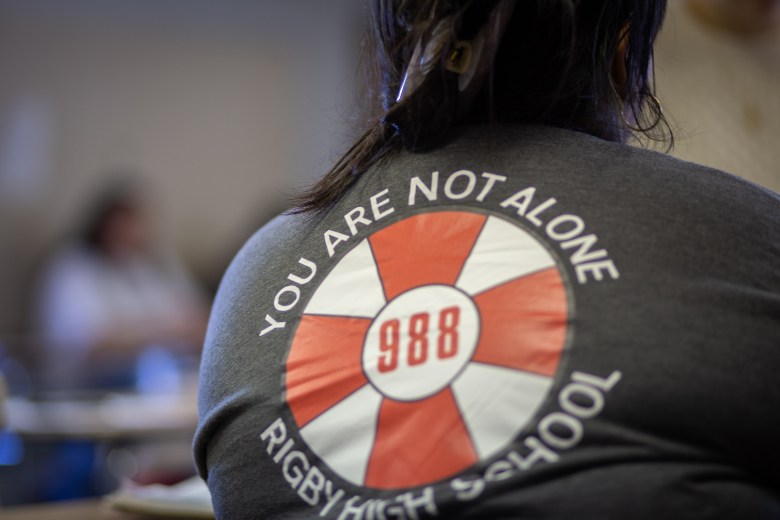
    Rigby High’s Hope Squad — and those like it nationwide — aim to foster connection and reduce the risk of suicide. Credit: John Roark

    The school leaders didn’t unnecessarily escalate the situation, he says. After their assessment, they chalked it up to middle school immaturity and asked the student to avoid such drawings in the future.

    “When you say, ‘Why did you do that?’ And they say, ‘I don’t know.’ That’s the truth, right? That’s the gospel truth,” Hamblin said.

    He shares this example to illustrate how the district marries technology-related monitoring with human-led threat assessment. The district employs someone — a former school administrator and counselor — to field the Bark alerts and communicate with school staff. And administrators from every school in the district have undergone threat assessment training, along with select members of their staff.

    “A digital tool for us is a tool. It’s not the solution,”  Hamblin said. “We believe that people are the solution.”

    Related: Schools are sending more kids to psychiatrists out of fears of campus violence, prompting concern from clinicians

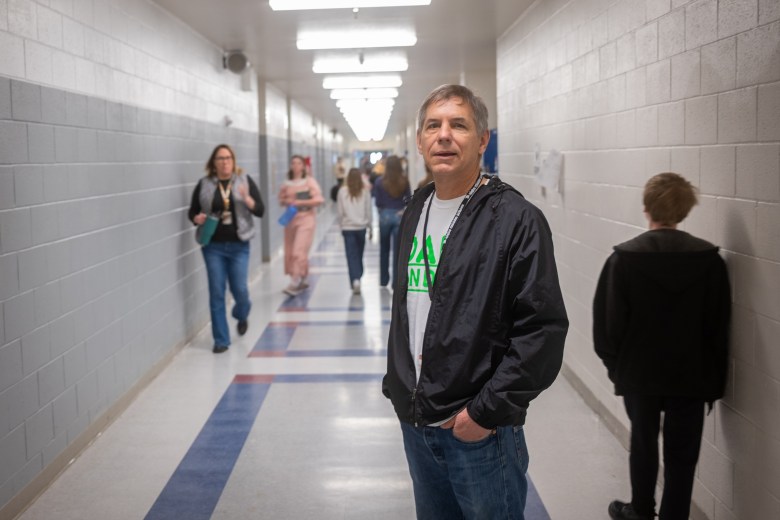
    In Rigby, one of those solution people is Ernie Chavez, whose height makes him stick out in a hallway streaming with middle schoolers. He’s part of Dads on Duty, a program that brings in parents to help monitor and interact with students during passing periods and lunch.

    Throughout the school, students reach out to Chavez for high-fives. On one February afternoon, he was greeted with applause and cheers. “I don’t know what that was about,” he said with a smile.

    Similarly, the district’s Hope Squads, in place since 2021, have become an active presence inside the school.

    The student-led coalitions aim to foster connection and reduce the risk of suicide. Thousands of schools across the United States and in Canada have implemented Hope Squads, but in Rigby, the mission of violence prevention has become personal.

    Ernie Chavez monitors the hallways at Rigby Middle School on Feb. 5 for the Dads on Duty program. Credit: John Roark

    “We refer … students every year to counselors, and those students go from some of the worst moments in their life (to getting help),” Vasquez said. “We build the connection between adults and faculty to the student.”

    Members of the Hope Squad notice peers who seem down or isolated and reach out with a greeting, or sometimes a handmade card.

    “We just reach out and let them know that people in the community are there for them, just to show them that we care and they’re not alone,” said Dallas Waldron, a Rigby High senior and Hope Squad member.

    The groups also plan assemblies and special events, including, for example, a week of activities themed around mental health awareness.

    Emilie Raymond, a sophomore at Rigby High, said the shooting made it clear “that people need to feel included and they need to find that hope.”

    Another change at Rigby schools is a cell phone ban that was put in place this school year.

    Before the ban,students were “sitting in the corners, isolated, staring at a screen,” said Ryan Erikson, Principal at Rigby Middle School. Now, “they’re playing games, they’re goofing off … they’re actually conversing.”

    While Jefferson County School District’s approach to stemming violence is robust, “it’s not perfect,” Martin, the superintendent, said. “It’s still life. That’s just the reality of it, we’re still going to have things come up that we haven’t prepared for or weren’t on our radar. But we address them and just try to do whatever we can to support kids.”

    Carly Flandro is a reporter with Idaho Education News. Jackie Valley is a reporter with The Christian Science Monitor.

    Contact Hechinger managing editor Caroline Preston at 212-870-8965, on Signal at CarolineP.83 or via email at [email protected].

    This story about school threat assessments was produced by the Education Reporting Collaborative, a coalition of eight newsrooms that includes AL.com, The Associated Press, The Christian Science Monitor, The Dallas Morning News, The Hechinger Report, Idaho Education News, The Post and Courier in South Carolina, and The Seattle Times.

    The Hechinger Report provides in-depth, fact-based, unbiased reporting on education that is free to all readers. But that doesn’t mean it’s free to produce. Our work keeps educators and the public informed about pressing issues at schools and on campuses throughout the country. We tell the whole story, even when the details are inconvenient. Help us keep doing that.

    Join us today.

    Source link

  • How to incorporate real-world connections into any subject area

    How to incorporate real-world connections into any subject area

    Key points:

    In my classroom, I frequently encounter students expressing their opinions: “How is this relevant to the real world?” or “Why should I care? I will never use this.” This highlights the need for educators to emphasize real-world applications across all subjects.

    As an educator, I consistently strive to illustrate the practical applications of geography beyond the classroom walls. By incorporating real-world experiences and addressing problems, I aim to engage students and encourage them to devise solutions to these challenges. For instance, when discussing natural resources in geography, I pose a thought-provoking question: “What is something you cannot live without?” As students investigate everyday items, I emphasize that most of these products originate from nature at some point, prompting a discussion on the “true cost” of these goods.

    Throughout the unit, I invite a guest speaker who shares insights about their job duties and provides information related to environmental issues. This interaction helps students connect the dots, understanding that the products they use have origins in distant places, such as the Amazon rainforest. Despite it being thousands of miles away, I challenge students to consider why they should care.

    As students engage in a simulation of the rainforest, they begin to comprehend the alarming reality of its destruction, driven by the increasing demand for precious resources such as medicines, fruits, and beef. By the conclusion of the unit, students will participate in a debate, utilizing their research skills to argue for or against deforestation, exploring its implications for resources and products in relation to their daily lives. This approach not only enhances their understanding of geography but also creates a real-world connection that fosters a sense of responsibility toward the environment.

    Creating a foundation to build upon

    Engaging in academic discussions and navigating through academic content is essential for fostering a critical thinking mentality among students. However, it is often observed that this learning does not progress to deeper levels of thought. Establishing a solid foundation is crucial before advancing toward more meaningful and complex ideas.

    For instance, in our geography unit on urban sprawl, we start by understanding the various components related to urban sprawl. As we delve into the topic, I emphasize the importance of connecting our lessons to the local community. I pose the question: How can we identify an issue within the town of Lexington and address it while ensuring we do not contribute to urban sprawl?  Without a comprehensive foundation, students struggle to elevate their thinking to more sophisticated levels. Therefore, it is imperative to build this groundwork to enable students to engage in higher-order thinking effectively.

    Interdisciplinary approaches

    Incorporating an interdisciplinary approach can significantly enrich the learning process for students. When students recognize the connections between different subjects, they gain a deeper appreciation for the relevance of their education. According to Moser et. al (2019), “Integrative teaching benefits middle-level learners as it potentially increases student engagement, motivation, and achievement. It provides learners with the opportunity to synthesize knowledge by exploring topics and ideas through multiple lenses.” This method emphasizes the importance of making meaningful connections that deepen students’ comprehension. As they engage with the content from different perspectives, students will apply their learning in real-world contexts.

    For instance, principles from science can be linked to literature they are studying in English class. Similarly, concepts from physics can be applied to understand advancements in medical studies. By fostering these connections, students are encouraged to think critically and appreciate the interrelated nature of knowledge.

    Incorporating technology within classrooms

    In today’s digital world, where technology is readily accessible, it is crucial for classroom learning to align with current technological trends and innovations. Educators who do not incorporate technology into their teaching practices are missing an opportunity to enhance student learning experiences. In my class, I have students explore their designated area using Google Earth, which we previously outlined. Each student selected a specific region to concentrate on during their analysis. This process involves identifying areas that require improvement and discussing how it can benefit the community. Additionally, we examine how these changes can help limit urban sprawl and reduce traffic congestion.

    We have moved beyond the era of relying solely on paper copies and worksheets; the focus now is on adapting to change and providing the best opportunities for students to express themselves and expand their knowledge. As Levin & Wadmany (2014) observe, “some teachers find that technology encourages greater student-centeredness, greater openness toward multiple perspectives on problems, and greater willingness to experiment in their teaching.” This highlights the necessity for teachers to evolve into facilitators of learning, acting as guides who support students taking ownership of their learning.

    Strategies for implementation

    1. Start with the “why”: Teachers should critically consider the significance of their instructional approaches: Why is this method or content essential for students’ learning? Having a clear vision of the desired learning outcomes enables educators plan effectively and what instructional strategies to use. This intentionality is crucial.

    2. Use authentic materials: Incorporating meaningful text that involves real-world concepts can significantly enhance students’ engagement. For instance, in social studies class discussing renewable energy can lead to academic discussion or projects where students research about local initiatives in their community.

    3. Promote critical thinking: Encourage students to engage in critical thinking by asking open-ended questions, creating opportunities for debates to challenge their ideas, and urging them to articulate and defend their viewpoints.

    4. Encourage collaboration: Students excel in collaborative learning environment, such as group projects and peer reviews where they can engage with their classmates. These activities allow them to learn from each other and view different perspectives.

    5. Provide ongoing feedback: Providing constructive feedback is essential for helping students identify their strengths and areas for improvements. By having planned check-ins, teachers can tailor their instruction to ensure that they are meeting the academic needs of individual students.

    References

    Levin, T., & Wadmany, R. (2006). Teachers’ Beliefs and Practices in Technology-based Classrooms: A Developmental View. Journal of Research on Technology in Education, 39(2), 157–181. https://doi.org/10.1080/15391523.2006.10782478

    Moser, K. M., Ivy, J., & Hopper, P. F. (2019). Rethinking content teaching at the middle level: An interdisciplinary approach. Middle School Journal, 50(2), 17–27. https://doi.org/10.1080/00940771.2019.1576579

    Latest posts by eSchool Media Contributors (see all)

    Source link

  • Product Enhancements from Discovery Education Foster Improved Engagement and Personalization

    Product Enhancements from Discovery Education Foster Improved Engagement and Personalization

    Charlotte, NC — Discovery Education, the creators of essential K-12 learning solutions used in classrooms around the world, today announced a host of exciting product updates during a special virtual event led by the company’s Chief Product Officer Pete Weir. Based on feedback from the company’s school-based partners, these updates make teaching and learning even more relevant, engaging, and personalized for users of Discovery Education products.

    Among the enhancements made to Discovery Education Experience, the essential companion for engaged K-12 classrooms that inspires teachers and motivates students, are:  teachers and motivates students, are:

    • Improved Personalized Recommendations for Teachers: With thousands of resources in Experience, there is something for every classroom. The new Core Curriculum Complements feature in Experience automatically surfaces engaging resources handpicked to enhance school systems’ core curriculum, simplifying lesson planning and ensuring tight alignment with district priorities. Additionally, Experience now offers educators Personalized Content Recommendations. These content suggestions made to individual teachers are based on their unique profiles and preferences, or what is frequently used by other educators like them.
    • An Enhanced AI-Powered Assessment Tool: Originally launched in 2024, this tool is the first in a new suite of AI-powered teaching tools currently under development, and it empowers educators to create high-quality assessments using vetted resources right from within Experience. Educators can now more easily customize assessments according to reading level, question type, Bloom’s Taxonomy, and more – ensuring optimal learning experiences for students. Educators can also review and tailor the questions and, once ready, export those questions into a variety of formats.
    • A New Career Exploration Tool for All Discovery Education Experience Users: Career Connect – the award-winning tool that connects K-12 classrooms with real industry professionals – is now accessible to all Discovery Education Experience users. With this new feature, classrooms using Experience can directly connect to the professionals, innovations, and skills of today’s workforce. Furthermore, Experience is now delivering a variety of new career pathway resources, virtual field trips, and career profiles – building career awareness, inviting exploration, and helping students prepare for their future.
    • A newly enhanced Instructional Strategy Library: To elevate instruction and better support teachers, Discovery Education has enhanced its one-stop-spot for strategies supporting more engaging, efficient, and effective teaching. The improved Instructional Strategy Library streamlines the way educators find and use popular, research-backed instructional strategies and professional learning supports and provides connected model lessons and activities.

    Also announced today were a host of improvements to DreamBox Math by Discovery Education. DreamBox Math offers adaptive, engaging, and scaffolded lessons that adjust in real time to personalize learning so that students can build confidence and skills at their own pace. Among the new improvements to DreamBox Math are:

    • Major Lesson Updates: Based on teacher feedback, Discovery Education’s expert curriculum team has updated DreamBox Math’s most popular lessons to make them easier for students to start, play, and complete successfully. Students will now encounter lessons with updated scaffolding, enhanced visuals, greater interactivity, and added context to ground mathematical concepts in the curriculum and the world they live in.
    • A New Look for Middle School: Middle school students will encounter a more vibrantly colored and upgraded user interface featuring a reorganized Lesson Chooser whose intuitive design makes it easy to identify teacher-assigned lessons from their personalized lesson options. Additional updates will follow throughout the year.
    • New Interactive Curriculum Guide: Discovery Education has strengthened the link between DreamBox Math and school systems’ core instruction with an Interactive Curriculum Guide. Educators can now explore the breadth and scope of DreamBox content by grade and standard to locate, preview, and play lessons, increasing familiarity with lessons, and enhancing targeted instruction. The DreamBox Math team will continue to make updates to standards and curriculum alignments throughout the year.

    To watch a replay of today’s special event in its entirety, and to learn about additional updates to Discovery Education’s suite of K-12 solutions, visit this link.

    “Discovery Education understands teachers’ sense of urgency about closing the achievement gaps highlighted by recent NAEP scores,” said Pete Weir, Discovery Education’s Chief Product Officer. “In response, we accelerated the development and deployment of what has traditionally been our ‘Back-to-School’ product enhancements. The stakes for our students have never been higher, and Discovery Education is dedicated to putting the highest-quality, most effective resources into teachers and students’ hands as soon as possible.”

    For more information about Discovery Education’s award-winning digital resources and professional learning solutions, visit www.discoveryeducation.com, and stay connected with Discovery Education on social media through X, LinkedIn, Instagram, TikTok, and Facebook.    

    eSchool News Staff
    Latest posts by eSchool News Staff (see all)


    Source link

  • OPINION: Here’s why we cannot permit America’s partnership with higher education to weaken or dissolve

    OPINION: Here’s why we cannot permit America’s partnership with higher education to weaken or dissolve

    Abrupt cuts in federal funding for life saving medical research. Confusing and misleading new guidance about campus diversity programs. Cancellation, without due process, of hundreds of millions of dollars in federal grants and contracts held by a major university. Mass layoffs at the Education Department, undermining crucial programs such as federal student aid.

    All of this, and more, in the opening weeks of the second Trump administration.

    The president has made clear that colleges and universities face a moment of unprecedented challenge. The partnership the federal government forged with American higher education long ago, which for generations has paid off spectacularly for our country’s civic health, economic well-being and national security, appears in the eyes of many to be suddenly vulnerable.

    America must not permit this partnership to weaken or dissolve. No nation has ever built up its people by tearing down its schools. Higher education builds America — and together, we will fight to ensure it continues to do so.  

    Related: Tracking Trump: his actions on education    

    Some wonder why more college and university presidents aren’t speaking out. The truth is, many of them fear their institutions could be targeted next.

    They are also juggling immense financial pressures and striving to fulfill commitments to teaching and research.

    But the American Council on Education, which I lead, has always stood up for higher education. We have done it for more than a century, and we are doing it now. We will use every tool possible — including litigation, advocacy and coalition-building — to advance the cause.

    ACE is the major coordinating body for colleges and universities. We represent institutions of all kinds — public and private, large and small, rural and urban — with a mission of helping our members best serve their students and communities.

    Let me be clear: We welcome scrutiny and accountability for the public funds supporting student aid and research. Our institutions are subject to state and federal laws and must not tolerate any form of discrimination, even as they uphold freedom of expression and the right to robust but civil protest. 

    We also know we have much work to do to raise public confidence in higher education and the value of a degree.

    However, we cannot allow unwarranted attacks on higher education to occur without a vigorous and proactive response.

    When the National Institutes of Health announced on Feb. 7 a huge cut in funding that supports medical and health research, ACE joined with the Association of American Universities, the Association of Public and Land-grant Universities and a number of affected universities in a lawsuit to stop this action.

    ACE has almost never been a plaintiff in a lawsuit against the federal government, but the moment demanded it. We are pleased that a federal judge has issued a nationwide preliminary injunction to preserve the NIH funding.

    When the Education Department issued a “Dear Colleague” letter Feb. 14 that raised questions about whether campus programs related to diversity, equity      and inclusion would be permissible under federal law, ACE organized a coalition of more than 70 higher education groups calling for the department to rescind the letter.      

    We raised concerns about the confusion the letter was causing. We pointed out that the majority opinion from Chief Justice John Roberts in the Students for Fair Admissions case acknowledged that diversity-related goals in higher education are “commendable” and “plainly worthy.”    

     We invited the department to engage with the higher education community to promote inclusive and welcoming educational environments for all students, regardless of race or ethnicity or any other factors. We remain eager to work with the department. 

    Related: Fewer scholarships and a new climate of fear follow      the end of affirmative action

    Unfortunately, in recent days the administration has taken further steps we find alarming.

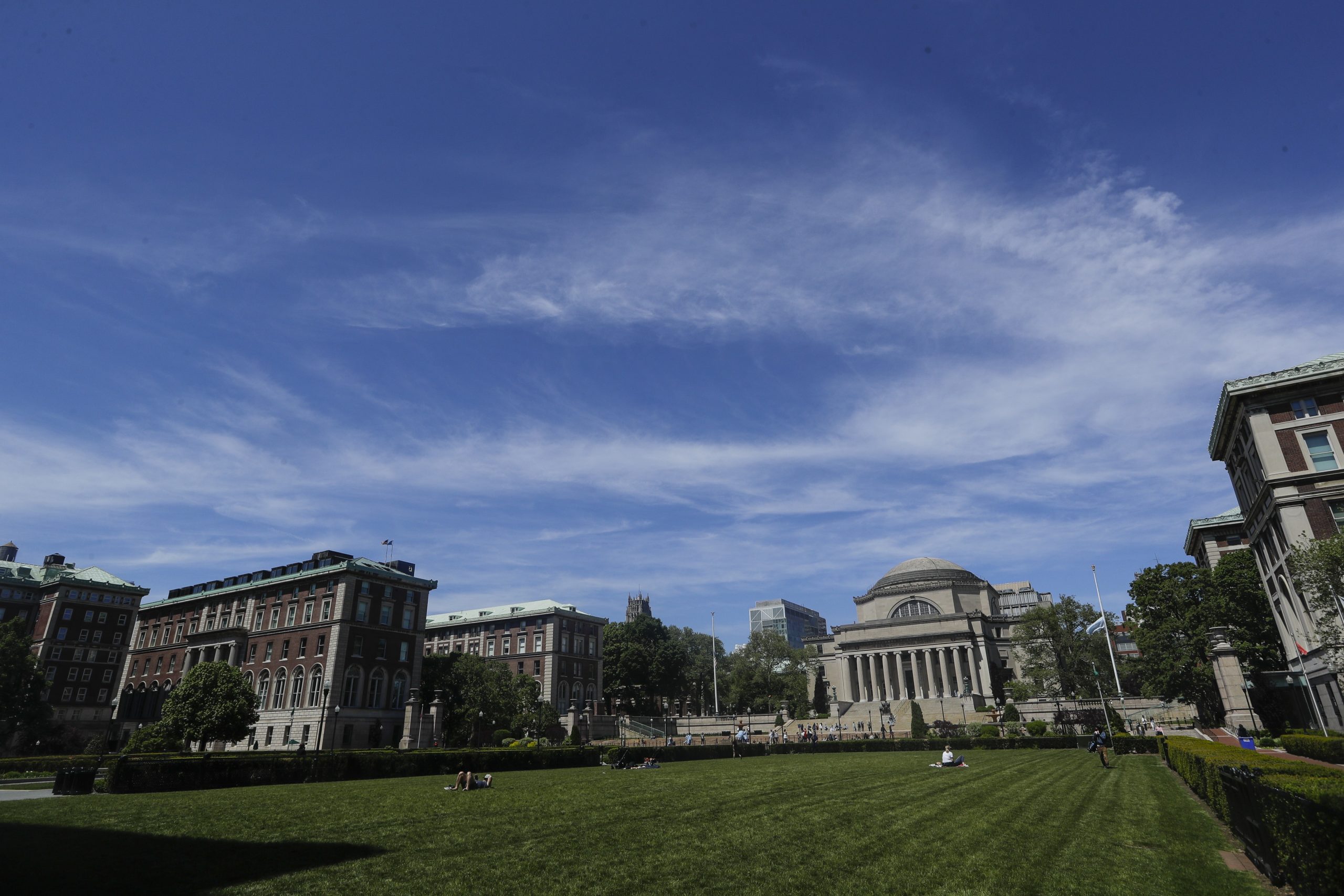
    ACE denounced the arbitrary cancellation of $400 million in federal grants and contracts with Columbia University. Administration officials claimed their action was a response to failures to adequately address antisemitism at Columbia, though it bypassed well-established procedures for investigating such allegations. (The Hechinger Report is an independent unit of Teachers College, Columbia University.)

    Ultimately, this action will eviscerate academic and research activities, to the detriment of students, faculty, medical patients and others.

    Make no mistake: Combating campus antisemitism is a matter of utmost priority for us. Our organization, along with Hillel International and the American Jewish Committee, organized two summits on this topic in 2022 and 2024, fostering important dialogue with dozens of college and university presidents.

    We also are deeply concerned about the letter the Trump administration sent to Columbia late last week that makes certain demands of the university, including a leadership change for one of its academic departments. To my mind, the letter obliterated the boundary between institutional autonomy and federal control. That boundary is essential. Without it, academic freedom is at risk.

    Meanwhile, layoffs and other measures slashing the Education Department’s workforce by as much as half will cause chaos and harm to financial aid and other programs that support millions of students from low- and middle-income families. We strongly urge the administration to change course and Congress to step in if it does not.

    Despite all that has happened in the past several weeks, we want President Trump and his administration to know this: Higher education is here for America, and ready to keep building. Colleges and universities have long worked with the government in countless ways to strengthen our economy, democracy, health and security. We cannot abandon that partnership. We must fortify it. 

    Ted Mitchell is president of the American Council of Education in Washington, D.C.

    Contact the opinion editor at [email protected].

    This story about academic freedom was produced by The Hechinger Report, a nonprofit, independent news organization focused on inequality and innovation in education. Sign up for Hechinger’s weekly newsletter.

    The Hechinger Report provides in-depth, fact-based, unbiased reporting on education that is free to all readers. But that doesn’t mean it’s free to produce. Our work keeps educators and the public informed about pressing issues at schools and on campuses throughout the country. We tell the whole story, even when the details are inconvenient. Help us keep doing that.

    Join us today.

    Source link

  • OPINION: The demographic cliff in higher education should be seen as an opportunity, not a crisis

    OPINION: The demographic cliff in higher education should be seen as an opportunity, not a crisis

    This spring, the number of high school graduates in the United States is expected to hit its peak. Starting in the fall, enrollment will likely enter a period of decline that could last a decade or more.

    This looming “demographic cliff” has been on the minds of education leaders for nearly two decades, dating back to the start of the Great Recession. A raft of college closures over the past five years, exacerbated by the pandemic, has for many observers been the canary in the coal mine.

    In the years to come, schools at all levels — reliant on per-pupil funding for K-12 and on tuition dollars for colleges and universities — will begin feeling the squeeze.

    The question now is whether to treat the cliff as a crisis or an opportunity.

    Related: Interested in innovations in the field of higher education? Subscribe to our free biweekly Higher Education newsletter.

    As they prepare for enrollment shortfalls, superintendents and college presidents are primarily focused on crisis management. With good reason, they’re spending the bulk of their time on the hard short-term decisions of cutting programs and personnel to meet looming budget shortfalls.

    In the precious few years before the situation becomes even more dire, the question is whether schools should just continue bracing for impact — or if they can think bigger in ways that could be transformative not just for the landscape of education, but for the economy more broadly. In my view, they should think about what it would look like to make a moment of crisis a real opportunity.

    Here are some ideas about how that could happen. The first involves blurring the lines between high school and college.

    Colleges today feel immense pressure because there aren’t enough high school graduates. High schools feel similar pressure because there are fewer young people around to enroll each year — not to mention the chronic absenteeism and disengagement that has persisted since the pandemic.

    What if the two worked more closely together — in ways that helped high schools keep students engaged while enabling colleges to reach a broader range of students?

    In many states, this is already happening. At last count, 2.5 million high schoolers took at least one dual-enrollment course from a college or university. But it’s not enough to just create tighter connections between one educational experience and another. Today’s students — and today’s economy — also demand clearer pathways from education to careers. It makes sense to blur the lines between high schools, colleges and work.

    So imagine taking these changes even further — to a world in which instead of jumping from high school to college, students in their late teens entered entirely new institutions that paid them for work-based learning experiences that would lead them to a degree and eventually a career.

    That’s a lofty goal. But it’s the kind of big thinking that both high schools and colleges may need to reinvent themselves for the country’s shifting demographics.

    Colleges have an opportunity right now to double down on creating and expanding job-relevant programs — and to think even bigger about who they serve. That could include expanding opportunities for adult learners who have gained skills outside the classroom through credit for prior learning and competency-based learning. It could also mean speeding up the development of industry-relevant coursework to better align with the needs of the labor market and leaning into short-form training programs to upskill incumbent workers.

    Related: The number of 18-year-olds is about to drop sharply, packing a wallop for colleges — and the economy

    Not every student is ready to invest four years of time and money to earn a bachelor’s degree. But they shouldn’t have to be — and colleges have a chance to expand their offerings in ways that give students more pathways into today’s fast-changing economy and further education if they so choose.

    Part of the problem with the current trajectory from high school to college is that the wrong things get incentivized. Both K-12 schools and colleges get money and support based on the number of students they enroll and (sometimes) the number of people who graduate — not on how well they do at helping people gain the skills to effectively participate in the economy.

    That’s not anyone’s fault. But it often boils down to a matter of policy. Which means that changing policy can create new incentives to tighten the connections between high school, college and work.

    States like Colorado are already taking the lead on this shift. Colorado’s “Big Blur” task force put out a report with recommendations on how to integrate learning and work, including by creating a statewide data system to track the outcomes of educational programs and updating the state’s accountability systems to better reflect “the importance of learners graduating ready for jobs and additional training.”

    If schools and policymakers stay the course in the decade to come, they already know what’s ahead: declining enrollment, decreased funding and the exacerbation of all the challenges that they’ve already begun to face in recent years.

    It’s not the job of the education system to turn the tide of demographic change. But the system does have a unique, and urgent, opportunity to respond to this changing landscape in ways that benefit not only students but the economy as a whole. The question now is whether education leaders and policymakers can seize that opportunity before it’s too late.

    Joel Vargas is vice-president of education practice at Jobs for the Future.

    Contact the opinion editor at [email protected].

    This story about demographic cliff in higher education was produced by The Hechinger Report, a nonprofit, independent news organization focused on inequality and innovation in education. Sign up for Hechinger’s weekly newsletter.

    The Hechinger Report provides in-depth, fact-based, unbiased reporting on education that is free to all readers. But that doesn’t mean it’s free to produce. Our work keeps educators and the public informed about pressing issues at schools and on campuses throughout the country. We tell the whole story, even when the details are inconvenient. Help us keep doing that.

    Join us today.

    Source link

  • How Trump is disrupting efforts by schools and colleges to combat climate change

    How Trump is disrupting efforts by schools and colleges to combat climate change

    This week I dug into how the Trump administration’s anti-climate blitz is hampering schools’ and colleges’ ability to green their operations, plus a new report on the California wildfires’ impact on students. Thank you for reading, and reply to this email to be in touch. — Caroline Preston

    LeeAnn Kittle helps oversee the Denver public school district’s work to reduce carbon emissions by 90 percent by 2050.

    In January, her job got a lot tougher. 

    Denver expected to receive tax credits via the Inflation Reduction Act for an additional 25 electric school buses. President Donald Trump attempted to freeze clean energy funds through the IRA in his first days in office. Kittle, the district’s executive director of sustainability, also considered applying for tax credit-like payments for energy-efficient heat pumps for the district’s older buildings that lack air conditioning. And she’d intended to apply this spring for a nearly $12 million grant through Renew America’s Schools, a Department of Energy program to help schools become more energy efficient. Staff working on that program have left and its future is uncertain.  

    “I think we’re all in shock,” said Kittle. “It’s like someone put us in a snow globe and shook us up, and now we’re asked to stand straight. And it’s like I don’t know how to stand straight right now.”

    Since January, the Trump administration has launched a broadside against efforts to reduce gases that cause climate change, including by freezing clean energy spending, slashing environmental staff and research, scrubbing the words “climate change” from websites, and rethinking decades of science showing the harms of global warming to human health and the planet. Experts and education leaders say those actions — some of which have been challenged in court — are disrupting, but not extinguishing, efforts by schools and colleges to curtail their emissions and reduce their toll on the planet.

    Related: Want to read more about how climate change is shaping education? Subscribe to our free newsletter.

    At the start of the year, the State University of New York was awarded $15 million to buy 350 electric vehicle charging stations. “We have yet to see the dollars,” said its chancellor, John B. King Jr. A webinar on the Department of Transportation grant program, which is funded by the bipartisan infrastructure act, was canceled. “It’s been radio silence,” said Carter Strickland, the SUNY chief sustainability officer. 

    The SUNY system, which owns a staggering 40 percent of New York State’s public buildings, had also planned to apply for IRA payments for a variety of projects to electrify campuses, reduce pollution and improve energy efficiency. In November, it applied for approximately $1.45 million for an Oneonta campus project that uses geothermal wells to provide heating and cooling. It still expects to get that money since the project is complete and the IRA remains law, but it can no longer count on payments for newer projects, King said. 

    “What the IRA did was turbocharged everything and gave many more players the ability to see themselves as part of a clean energy economy,” said Timothy Carter, president of Second Nature, a group that supports climate work in higher education. But the confusion that the Trump administration has sowed — even though the IRA has not been repealed — means both K-12 and higher education institutions are reconsidering clean energy projects. 

    There’s no count of how many colleges have sought funding through the IRA and bipartisan infrastructure act-funded programs, said Carter, but the work is spread across red and blue states, and some education systems have dozens of projects under construction. The University of California system, for example, filed applications for more than 70 projects, including a $1 billion project to replace UC Davis’s leaky and inefficient heating and cooling system and a project at UC Berkeley to phase out an old power plant and replace it with a microgrid. 

    “We remain hopeful that funding will be provided per the program provisions,” David Phillips, associate vice president for capital programs at the University of California, wrote in an email. 

    Sara Ross, co-founder of Undaunted K12, which helps school districts green their operations, said her group tells school leaders that for now, “energy tax credits are still the law of the land.” 

    But she expects those credits could be eliminated in the new tax bill that Congress is negotiating this year. 

    In the past, entities that begin construction on projects before any changes in a new law go into effect have been grandfathered in and still received that money, she said. “No promises,” Ross said, but historically that’s how such tax credit scenarios have worked. She said some school districts are speeding up projects to beat that possible deadline, while others are abandoning them.

    There is some political movement to preserve clean energy tax credits. Roughly 85 percent of the private-sector dollars that have gone into clean energy projects are in GOP-led districts, according to a report last year. Some GOP lawmakers have advocated for maintaining that funding, which has contributed to a surge in renewable energy jobs.  

    Steven Bloom, assistant vice president of government relations with the American Council on Education, said that gives supporters of the IRA some hope. But he said that many higher education institutions are facing so much pain and uncertainty from other Trump administration actions, like the National Institutes of Health’s plan to slash overhead payments and investigations into alleged antisemitism, that unfortunately “climate investments may get pushed down the ladder of priorities in the near term.” 

    Related: How colleges can become ‘living labs’ for combating climate change

    Another important vehicle for greening schools, the Renew America’s Schools grant program, was started in 2022 with $500 million for school districts. Many of the Department of Energy staff working on that effort have left, Ross said, and some school districts have not heard back about the status of funding for their projects.    

    In Massachusetts, the Lowell school district won a prize through the Renew America program that could unlock up to $15 million to help the district improve its aged facilities. The district’s facilities for the most part lack air conditioning and schools have been closed on occasion due to high temperatures.

    Katherine Moses, the city of Lowell’s sustainability director, wrote in an email that the district had so far pocketed $300,000 that it is using for energy audits to identify inefficiencies and lay the groundwork for a larger investment. It’s unclear what could happen beyond that and if the district will receive more money. She said Lowell is proceeding according to the requirements of the grant “until we hear otherwise from DOE.” 

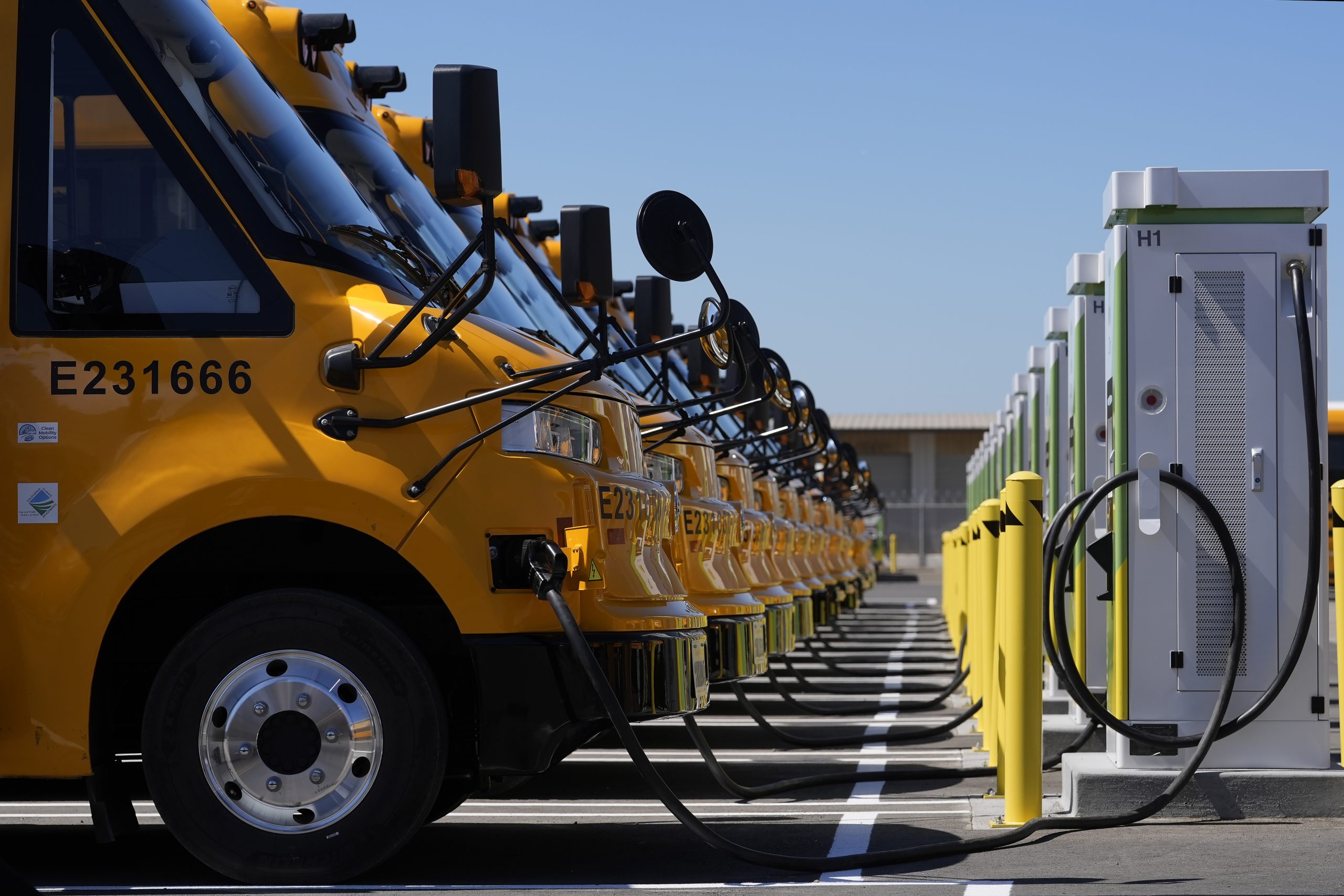
    More than 3,400 school districts have applied for money through programs created under the bipartisan infrastructure law and the IRA to electrify school buses. After a federal judge ruled against the administration’s freeze on clean energy spending, grants through those programs appear to have been unfrozen and districts have been able to access payments, said Sue Gander, director of the electric school bus initiative with the nonprofit World Resources Institute. 

    But rebates for electric buses are still stalled, she said. Districts are submitting forms to receive rebates, she said, “but there’s no communication coming back to them through the system about the status of their award or any indication that any payment that may have been requested is being provided.”  

    The Transportation and Energy departments and the Environmental Protection Agency, which runs the Clean School Bus Program, did not respond by deadline to requests for comment for this article.  

    King, of SUNY, noted that climate change is already negatively affecting young people and contributing to worsening disasters like floods and fires. For some faculty, staff and students, the backtracking from climate action at the federal level is stirring disappointment and fear, he said. “There is this very intense frustration that as a society we are stopping efforts to deal with what is truly an existential threat.” 

    Contact Caroline Preston at 212-870-8965, on Signal at CPreston.83 or via email at [email protected]

    This story about clean energy was produced by The Hechinger Report, a nonprofit, independent news organization focused on inequality and innovation in education. Sign up for our climate and education newsletter.

    What I’m reading:

    My colleague Neal Morton traveled to northwest Colorado for a story on how phasing out coal-powered plants affects school budgets and career prospects for graduates. School districts haven’t done enough to plan for those changes or prepare students for alternate careers, he writes, and renewable energy projects are not popping up fast enough to smooth the financial pain.  

    Some 725,000 students at more than 1,000 schools faced school closures during the California wildfires in January, according to a new report from Undaunted K12 and EdTrust. The fire had a disproportionate impact on students living in poverty and from underrepresented backgrounds, the report says: Three-quarters of the affected students came from low-income households, and 66 percent were Hispanic. 

    The U.S. Coast Guard Academy removed the words “climate change” from its curriculum, reports Inside Climate News. The academy falls under the purview of the Department of Homeland Security, whose new director, Kristi Noem, issued a directive in February to “eliminate all climate change activities and the use of climate change terminology in DHS policies and programs.”

    Schools with satisfactory heating systems reduce student absences by 3 percent and suspensions by 6 percent, and record a 5 percent increase in math scores, according to a study by researchers at the University at Albany, State University of New York. Schools with satisfactory cooling systems see an increase of 3 percent in reading scores. 

    Contact editor Caroline Preston at 212-870-8965, on Signal at CPreston.83 or via email at [email protected].

    This story about clean energy was produced by The Hechinger Report, a nonprofit, independent news organization focused on inequality and innovation in education. Sign up for our climate and education newsletter.

    The Hechinger Report provides in-depth, fact-based, unbiased reporting on education that is free to all readers. But that doesn’t mean it’s free to produce. Our work keeps educators and the public informed about pressing issues at schools and on campuses throughout the country. We tell the whole story, even when the details are inconvenient. Help us keep doing that.

    Join us today.

    Source link

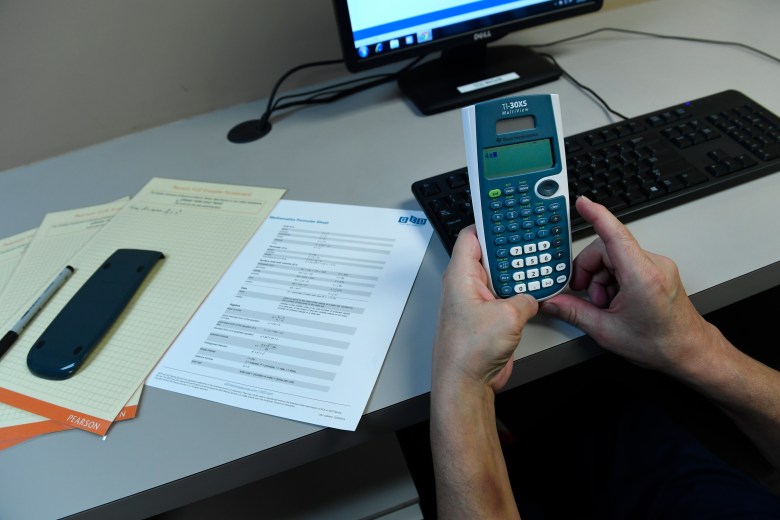
  • Math can be a path to success after prison

    Math can be a path to success after prison

    Hancy Maxis spent 17 years incarcerated in New York prisons. He knew that he needed to have a plan for when he got out.

    “Once I am back in New York City, once I am back in the economy, how will I be marketable?” he said. “For me, math was that pathway.”

    In 2015, Maxis completed a bachelor’s degree in math through the Bard Prison Initiative, an accredited college-in-prison program. He wrote his senior project about how to use game theory to advance health care equity, after observing the disjointed care his mom received when she was diagnosed with breast cancer. (She’s now recovered.)

    When he was released in 2018, Maxis immediately applied for a master’s program at Columbia University’s Mailman School of Public Health. He graduated and now works as the assistant director of operations at Montefiore Medical Center in the Bronx. He helped guide the hospital’s response to Covid.

    Maxis is one of many people I’ve spoken to in recent years while reporting on the role that learning math can play in the lives of those who are incarcerated. Math literacy often contributes to economic success: A 2021 study of more than 5,500 adults found that participants made $4,062 more per year for each correct answer on an eight-question math test.

    While there don’t appear to be any studies specifically on the effect of math education for people in prison, a pile of research shows that prison education programs lower recidivism rates among participants and increase their chances of employment after they’re released.

    Hancy Maxis spent 17 years incarcerated in New York prisons. He now works as the assistant director of operations at Montefiore Medical Center in the Bronx. Credit: Yunuen Bonaparte for The Hechinger Report

    Plus, math — and education in general — can be empowering. A 2022 study found that women in prison education programs reported higher self-esteem, a greater sense of belonging and more hope for the future than women who had never been incarcerated and had not completed post-secondary education.

    Yet many people who enter prison have limited math skills and have had poor relationships with math in school. More than half (52 percent) of those incarcerated in U.S. prisons lack basic numeracy skills, such as the ability to do multiplication with larger numbers, long division or interpret simple graphs, according to the most recent numbers from the National Center for Educational Statistics. The absence of these basic skills is even more pronounced among Black and Hispanic people in prison, who make up more than half of those incarcerated in federal prisons.

    In my reporting, I discovered that there are few programs offering math instruction in prison, and those that do exist typically include few participants. Bard’s highly competitive program, for example, is supported primarily through private donations, and is limited to seven of New York’s 42 prisons. The recent expansion of federal Pell Grants to individuals who are incarcerated presents an opportunity for more people in prison to get these basic skills and better their chances for employment after release.

    Alyssa Knight, executive director of the Freedom Education Project Puget Sound, which she co-founded while incarcerated, said that for years, educational opportunities in prison were created primarily by people who were incarcerated, who wrote to professors and educators to ask if they might send materials or teach inside the prison. But public recognition of the value of prison education, including math, is rising, and the Pell Grant expansion and state-level legislation have made it easier for colleges to set up programs for people serving time. Now, Knight said, “Colleges are seeking prisons.”

    Related: Interested in innovations in higher education? Subscribe to our free biweekly higher education newsletter.

    Jeffrey Abramowitz understands firsthand how math can help someone after prison. After completing a five-year stint in a federal prison, his first post-prison job was teaching math to adults who were preparing to take the GED exam.

    Fast forward nearly a decade, and Abramowitz is now the CEO of The Petey Greene Program, an organization that provides one-on-one tutoring, educational supports and programs in reading, writing and now math, to help people in prison and who have left prison receive the necessary education requirements for a high school diploma, college acceptance or career credentials.

    The average Petey Greene student’s math skills are at a fourth- or fifth-grade level, according to Abramowitz, which is in line with the average for “justice-impacted” learners; the students tend to struggle with basic math such as addition and multiplication.

    “You can’t be successful within most industries without being able to read, write and do basic math,” Abramowitz said. “We’re starting to see more blended programs that help people find a career pathway when they come home — and the center of all this is math and reading.”

    Abramowitz and his team noticed this lack of math skills particularly among students  in vocational training programs, such as carpentry, heating and cooling and commercial driving. To qualify to work in these fields, these students often need to pass a licensing test, requiring math and reading knowledge.

    The nonprofit offers “integrated education training” to help  students learn the relevant math for their professions. For instance, a carpentry teacher will teach students how to use a saw in or near a classroom where a math teacher explains fractions and how they relate to the measurements needed to cut a piece of wood.

    “They may be able to do the task fine, but they can’t pass the test because they don’t know the math,” Abramowitz said.

    Math helped Paul Morton after he left prison, he told me. When he began his 10.5 years in prison, he only could do GED-level math. After coming across an introductory physics book in the third year of his time in prison, he realized he didn’t have the math skills needed for the science described in it.

    He asked his family to send him math textbooks and, over the seven years until his release, taught himself algebra and calculus.

    The recent expansion of federal Pell Grants to individuals who are incarcerated presents an opportunity for more people in prison to get these basic skills and better their chances for employment after release. Credit: Helen H. Richardson/The Denver Post via Getty Images

    “I relentlessly spent six hours on one problem one day,” he said. “I was determined to do it, to get it right.”

    I met Morton through the organization the Prison Mathematics Project, which helped him develop his math knowledge inside prison by connecting him with an outside mathematician. After his release from a New York prison in 2023, he moved to Rochester, New York, and is hoping to take the actuarial exam, which requires a lot of math. He continues to study differential equations on his own.

    Related: It used to be a notoriously violent prison. Now it’s home to a first-of-its-kind higher education program

    The Prison Mathematics Project delivers math materials and programs to people in prison, and connects them with mathematicians as mentors. (It also brings math professors, educators and enthusiasts to meet program participants through “Pi Day” events; I attended one such event in 2023 when I produced a podcast episode about the program, and the organization paid for my travel and accommodations.)

    The organization was started in 2015 by Christopher Havens, who was then incarcerated at Washington State Penitentiary in Walla Walla. Havens’ interest in math puzzles, and then in algebra, calculus and other areas of mathematics, was ignited early in his 25-year- term when a prison volunteer slid some sudoku puzzles under his door.

    “I had noticed all these changes happening inside of me,” Havens told me. “My whole life, I was searching for that beauty through drugs and social acceptance … When I found real beauty [in math], it got me to practice introspection.”

    As he fell in love with math, he started corresponding with mathematicians to help him solve problems, and talking to other men at the prison to get them interested too. He created a network of math resources for people in prisons, which became the Prison Mathematics Project.

    The group’s website says it helps people in prison use math to help with “rebuilding their lives both during and after their incarceration.”

    Related: How Danielle Metz got an education after incarceration

    But Ben Jeffers, its executive director, has noticed that the message doesn’t connect with everyone in prison. Among the 299 Prison Mathematics Project participants on whom the program has data, the majority — 56 percent — are white, he told me, while 25 percent are Black, 10 percent are Hispanic, 2 percent are Asian and 6 percent are another race or identity. Ninety-three percent of project participants are male.

    Yet just 30 percent of the U.S. prison population is white, while 35 percent of those incarcerated are Black, 31 percent are Hispanic and 4 percent are of other races, according to the United State Sentencing Commission. (The racial makeup of the program’s 18 female participants at women’s facilities is much more in line with that of the prison population at large.)

    “[It’s] the same issues that you have like in any classroom in higher education,” said Jeffers, who is finishing his master’s in math in Italy. “At the university level and beyond, every single class is majority white male.”

    He noted that anxiety about math tends to be more acute among women and people of any gender who are Black, Hispanic, or from other underrepresented groups, and may keep them from signing up for the program. 

    Sherry Smith understands that kind of anxiety. She didn’t even want to step foot into a math class. When she arrived at Southern Maine Women’s Reentry Center in December 2021, she was 51, had left high school when she was 16, and had only attended two weeks of a ninth grade math class.

    “I was embarrassed that I had dropped out,” she said. “I hated to disclose that to people.”

    Related: ‘Revolutionary’ housing: How colleges aim to support a growing number of formerly incarcerated students 

    Smith decided to enroll in the prison’s GED program because she could do the classes one-on-one with a friendly and patient teacher. “It was my time,” she said. “Nobody else was listening, I could ask any question I needed.”

    In just five months, Smith completed her GED math class. She said she cried on her last day. Since 2022, she’s been pursuing an associate’s degree in human services — from prison — through a remote program with Washington County Community College.

    In Washington, Prison Mathematics Project founder Havens is finishing his sentence and continuing to study math. (Havens has been granted a clemency hearing and may be released as early as this year.) Since 2020, he has published four academic papers: three in math and one in sociology. He works remotely from prison as a staff research associate in cryptography at the University of California, Los Angeles, and wrote a math textbook about continued fractions.

    Havens is still involved in the Prison Mathematics Project, but handed leadership of the program over to Jeffers in October 2023. Now run from outside the prison, it is easier for the program to bring resources and mentorship to incarcerated students.

    “For 25 years of my life, I can learn something that I wouldn’t have the opportunity to learn in any other circumstances,” Havens said. “So I decided that I would, for the rest of my life, study mathematics.”

    Contact editor Caroline Preston at 212-870-8965 or [email protected].

    This story about math in prison was produced by The Hechinger Report, a nonprofit, independent news organization focused on inequality and innovation in education. Sign up for the Hechinger higher education newsletter.

    The Hechinger Report provides in-depth, fact-based, unbiased reporting on education that is free to all readers. But that doesn’t mean it’s free to produce. Our work keeps educators and the public informed about pressing issues at schools and on campuses throughout the country. We tell the whole story, even when the details are inconvenient. Help us keep doing that.

    Join us today.

    Source link

  • Trade union partnerships hold promise for high school students

    Trade union partnerships hold promise for high school students

    DANVERS, Mass. — It’s a rainy fall day in New England, but that doesn’t stop a group of students at Essex Tech North Shore Agricultural & Technical High School from donning work boots and hard hats and getting to work building a vegetable wash station on campus. This afternoon, they are installing wire mesh and prepping for a concrete pour under the watchful eye of Laborers’ Local 22 member Chris Moore, their teacher. “Hard hat hair don’t care,” reads the sticker on the hat worn by a young woman in the program.

    The construction craft laborers track at Essex Tech, which Moore helps lead, is one of only a few high school-based programs in Massachusetts co-sponsored by a trade union. Students are initiated in union norms and expectations early on. Two Essex Tech teachers in the program are Local 22 members, with the New England Laborers’ Training Academy, which runs the laborers’ apprenticeship, paying Moore’s salary. As seniors, students can attend union meetings. And after graduation, many of them go straight into a union apprenticeship, fast tracked to a journeyman’s license. For all these reasons, Owen Paniagua, a 16-year-old junior, described the program as “a golden ticket to job security,” noting that he has learned everything from carpentry and concrete work to excavation and masonry.

    “We feel as laborers that we should be in the schools,” said Lou Mandarini Jr., the retired business manager of Local 22 who now helps run the union’s school partnerships. “This is where your workforce is … If you treat young kids with respect, once they buy into your program, they are dead loyal.”

    Students in the construction craft laborer program gather around Dave Collins, masonry head, before leaving to work on a project at Essex North Shore Agricultural & Technical High School in Danvers, Mass. Credit: Sophie Park for The Hechinger Report

    In several states, including Massachusetts, Maryland and Louisiana, trade union leaders have forged similar, groundbreaking partnerships with high school CTE programs in recent years, ponying up their own resources for the efforts. There’s also been an uptick in training alliances between trade unions and community colleges. In a 2023 brief, AFL-CIO leadership encouraged these partnerships. “No one knows better how to do a job than someone who does the job,” the brief stated.

    Whether more unions decide to embrace this advice likely will play a large role in determining the long-term health and vibrancy of both career and technical high schools, and the trades themselves.

    Related: A lot goes on in classrooms from kindergarten to high school. Keep up with our free weekly newsletter on K-12 education.

    Twin trends are fueling some of the efforts: rapidly declining trade union membership, particularly in the Midwestern states; and up to $850 billion in infrastructure investment under the Biden administration (though some of that is in limbo because of an executive order from President Donald Trump), including designated funding for partnerships between education and labor.

    Yet progress has been piecemeal and halting. And it’s too early to tell whether isolated partnerships across the country will translate into widespread change, said Taylor White, the director of postsecondary pathways for youth at the Center on Education and Labor at the think tank New America. “Schools and unions speak very different languages,” she noted. The same, she added, is true of employers and schools.

    The longstanding dearth of partnerships says a lot about the history of America’s trade unions, which traditionally have operated as insular, sometimes parochial institutions, preferring to maintain tight control over their membership pipeline, and their training. In some communities, such as Milwaukee, that insularity kept unions predominantly white and male for generations. “Historically a lot of the high-paying skilled trades were handed down from father to son,” said Lauren Baker, a former education director in the printers’ union who also led Milwaukee Public Schools’ career and technical education program between 2002 and 2012. “That kept the trades looking a certain way.”

    Mandarini, the retired union leader, said that in the past, “old timers didn’t help the young people.” But increasingly, he said, he hopes that mentality will become an anomaly.

    Owen Paniagua, 16, and Isabella Gonzalez, 17, both juniors in the Construction Craft Laborer program at Essex North Shore Agricultural & Technical High School, pose for a portrait at Essex Tech in Danvers, Mass. The Essex Tech program’s partnership with the laborers’ union helps to foster job prospects for graduating students. Credit: Sophie Park for The Hechinger Report

    For decades, many vocational school students have been held back by a lack of meaningful partnerships with both unions and employers at their schools, often leaving them without relevant training or clear pathways into jobs. “There’s skepticism from unions and employers that high school kids are ready for real training and real work,” said White, of New America.

    There’s also been a longstanding desire on the part of many unions to maintain tight control over who can access often coveted apprentice slots.

    Until recent years, most trade union apprenticeships in the Milwaukee area had admissions criteria that shut out many women, low-income, and Black and Hispanic city residents. “They were such closed communities, and it was a long process of breaking down some of those walls,” Baker said.

    Related: Apprenticeships are a trending alternative to college but there’s a hitch

    Back in the mid-1990s, Baker was the first woman to run a printing apprenticeship program for the union. In part to open up the field to as diverse a pool as possible, Baker abolished a requirement that apprentices had to be high school graduates. “Pretty much all a high school diploma told me was that they sat in a chair for four years,” she said, pointing out that many of the apprentices came from the academic bottom of their graduation classes. “I caught holy hell from the apprenticeship community for doing that,” she said.

    While the SATs and other college entrance exams have at times been accused of being biased toward privileged white students, Baker said some of the apprenticeship admissions exams were challenging for anyone who hadn’t grown up in the home of someone already working in a specific trade. A question might presume that an applicant had experience helping fix their family’s car, for instance, something that young men were far more likely to have done — and those growing up in urban areas, where fewer households own cars, were far less likely to have done.

    For decades, those tests contributed to keeping the construction trade unions, in particular, predominantly white and male. Only two of 16 Milwaukee area construction unions enrolled at least 20 percent Black apprentices in 2007, according to a report from researchers at the University of Wisconsin-Milwaukee. Two of the unions, glazing and tile setters, had no Black apprentices in a city where, at that time, nearly 40 percent of the residents were Black.

    Much of that bias and insularity continues in some Boston-area construction trade unions, said Travis Watson, who serves as a commissioner of the Boston Employment Commission and has critiqued some of the unions for their lack of racial diversity, citing specific practices that make it harder for prospective Black members to get a foothold. “If you look at every big downtown project in Boston, there are very few Black people who are working on union construction projects,” he said. 

    Some of the local unions have made changes to their admissions process to become more accessible to applicants from diverse backgrounds, said Danyson Tavares, who worked for several years in leadership positions at YouthBuild Boston, a pre-apprenticeship program that helps prepare young people of color in the city for jobs in the construction and design industries. But other unions might take applications only once a year or remain secretive about their standards and curriculum. “The electrical union is the one we really want to have more relationships with, there’s such a demand for that workforce,” Tavares said. “We’ve slowly started to penetrate but it’s a lot more work than I expected.” 

    One 25-year-old who recently finished his pre-apprenticeship in carpentry at YouthBuild said he got an interview with the union but was turned down for an apprenticeship for reasons that he said weren’t entirely clear. “I kind of felt like I wouldn’t get in,” said Keyshawn Kavanaugh. He found a non-union job easily at a company that he likes a lot, but he acknowledges that “the union is the best place to work,” at least from the standpoint of benefits and pension.

    In Milwaukee, Baker said she’s seen some positive changes since she ran the printers apprenticeship, with more local unions developing inclusive and transparent admissions. “The trades themselves began to realize that they needed to look beyond their natural base in order to fill jobs,” she said. “It became more apparent that there is a vast opportunity out there with women and people of color.”

    Related: States bet big on career education but struggle to show it works

    The idea that Massachusetts laborers should invest time and money in local schools originated over 20 years ago, when Mandarini and other Local 22 leaders decided they were neglecting a potential asset: kids. Mandarini proposed a pilot partnership to the vocational school in Medford, Massachusetts, just outside of Boston, which started in 2002. It wasn’t easy at first. “How do you adapt to a public school?” he said. “There was a lot of learning that we had to do on both ends.”

    The union had to fight against a perception that a four-year college degree was the only path to a stable, rewarding career, Mandarini said. It helped with recruiting to explain to prospective students that, at that time, union laborers could expect to retire with an annuity of about $1.2 million, he added. (In Massachusetts, laborers typically earn between $90,000 and $100,000 annually, and that annuity is now more than $2 million, Mandarini said.)

    A school bus sits in a parking lot at Essex North Shore Agricultural & Technical High School in Danvers, Mass. Credit: Sophie Park for The Hechinger Report

    Over the years, the partnership model has spread to eight career and technical schools in Massachusetts. At some, the union pays a teacher’s salary, and at others it does not, Mandarini said. “We want to be in every vocational school in Massachusetts,” he said, “and hopefully every vocational school in New England. That’s where our workforce is coming from.”

    In rural western Louisiana, it was a private company that encouraged a local trade union to partner with public high schools. The company, CapturePoint, which sells carbon storage services, reached out in March 2023 to the local branch of the United Association of Journeymen and Apprentices of the Plumbing and Pipefitting Industry, asking if the union would help build out a new career and technical track at the Vernon Parish School District.

    To make it happen, the company paid for the electricity, classroom equipment and furniture to help turn an old woodworking shop at one of the district’s high schools into an updated welding shop. CapturePoint also took on several ongoing costs, paying for  student transportation — the students can come from nine different high schools — and some administrative expenses. The union paid for some reconstruction and all the tools, and provided an instructor. The school offers the space and enrolls 30 students, who can skip their first year of apprenticeship if they join the union after graduating, thereby starting at a higher pay rate. “All of us have skin in the game,” said Lance Albin, who led the partnership for the union.

    At high schools with trade union partnerships, there’s no shortage of interested students. Isabella Gonzalez, 17, creator of the “hard hat hair don’t care” sticker, said she hopes to move straight into an apprenticeship with Local 22 when she graduates in a year and a half. Aspiring laborers learn more diverse skills than students in related tracks like plumbing and electrical, she said, opening up the possibility of a greater variety of work.

    That day last fall, juniors in the program practiced using a compactor to prep the ground for installation of a patio floor, part of the final stages in rebuilding a large cottage on campus. The construction students have been involved in the project since they poured the cement for the foundation in the summer of 2020, wearing masks during the pandemic’s early days, even outdoors.

    By afternoon, the students had transitioned to another work in progress: the vegetable wash station by the greenhouse, where they needed to install enough wire mesh and rebar to do the concrete pour early the next week. “Put your hard hat on and help out,” their teacher Moore reminded a group of students holding back as the rain hardened. “No … statues here.”

    Students in the Construction Craft Laborers program at Essex North Shore Agricultural & Technical High School lay mesh while working on a greenhouse washing station at Essex Tech in Danvers, Mass. Credit: Sophie Park for The Hechinger Report

    Students say the partnership with Local 22 provides them increased career security and the confidence that they are learning relevant, up-to-date skills: Moore until recently worked part time in the field, including on Boston’s project to restore the tunnel to the city’s Logan Airport. 

    Paniagua, the 16-year-old student in the program, said he can command a higher pay rate than most of his peers at a part-time carpentry and landscaping job because of the expertise he has gained in the Essex Tech program. He’s used the extra money to buy two new trucks. The union partnership has also allowed him to make more thoughtful, informed choices about career steps, he added. Leaning on his teachers as mentors, Paniagua said he decided to continue studying at a specialized welding school in Wyoming after graduation to maximize his future earning potential. “We know what we want to do here and get on it,” Paniagua said, noting that it’s a stark contrast to some of his friends who are conflicted about the value of a four-year college degree. “We’re not lost,” he said, “or wasting money.”

    Former President Joe Biden was exceptionally supportive of the labor movement, and specifically of partnerships between unions and schools. Some labor experts expect some of that support might continue in the new Trump administration. “We’re seeing indications of a Trump administration that might not be as hostile to unions as you might think,” said Shalin Jyotishi, founder and managing director of the Future of Work and Innovation Economy Initiative at New America. He cited Trump nominee Lori Chavez-DeRemer, opposed by many in the business community, for Labor secretary, and the president’s support of the longshoremen’s union over their anti-automation stance.

    In any event, “these bottoms-up innovations are already happening locally,” Jyotishi said. “Federal decisions can help or hurt … odds of success, but the proof-of-concept is already out of the bag.”

    Related: For some students, certificate programs offer a speedy path to a job

    A bigger question mark may be whether there is the will to expand capacity significantly on the ground. Some of the existing programs have not yet reached students in the most underserved communities who could potentially benefit most from a fast track into a union apprenticeship.

    In Massachusetts, for instance, many of the high schools the laborers work with have become increasingly selective in admissions. Students from low-income homes were 30 percent less likely to be accepted at the state’s vocational schools in 2023 and 2024 than those from wealthier households, according to an analysis by the Boston Globe. Similar disparities existed for students receiving special education services and English learners.

    The laborers have yet to expand their partnership model to Boston’s Madison Park Technical Vocational High School, where nearly all of the students are Black or Hispanic, about 85 percent come from low-income households, and 92 percent are identified as “high needs” — an umbrella term in Massachusetts that includes students with disabilities, English learners and low-income students, among other groups.

    Madison Park, part of the city’s public school district, has some partnerships and many strong programs and instructors, said Bobby Jenkins, an alum and long-time advocate of the school. But the chronic turnover of both superintendents and school leaders in recent years has hindered progress in undertaking some more ambitious partnerships. 

    Isabella Gonzalez, 17, a junior in the Construction Craft Laborers program at Essex North Shore Agricultural & Technical High School, compacts gravel at the Larkin Cottage, a project site at Essex Tech in Danvers, Mass. Credit: Sophie Park for The Hechinger Report

    Mandarini agreed that political and bureaucratic obstacles have made it more challenging to partner with Madison Park. But the union has made it a priority and is in promising talks with city officials about partnering with the school when a proposed new facility might be completed.

    “When I was part of the building trades, I used to say, ‘I don’t understand why you aren’t taking more kids, especially in the city of Boston,’” Mandarini said. “Every single trade should be in (Madison Park).’”

    For now, that attitude has not spread to all union leaders. It will take a cultural shift from trade union groups to expand their school partnerships beyond scattered, boutique programs. Among other things, they will need to prioritize flexibility and the learning and growth of young people more than they are accustomed to, said White, of New America.

    She noted that many union leaders seem aware that they have a pipeline and recruitment issue but remain unsure what to do about it. More school-based partnerships could help not only with that challenge but also with reenergizing and selling unions to future generations of workers — and voters, White added. “All of the polling suggests that young people are pretty pro-union,” she said. “There’s a missed opportunity on the part of unions if they don’t capitalize on that.”

    Contact editor Nirvi Shah at 212-678-3445 or [email protected].  

    Reporting on this story was supported by the Higher Ed Media Fellowship, where Carr was a fellow in 2024. This year, Carr has a fellowship from New America to report on early childhood issues.

    This story about trade unions was produced by The Hechinger Report, a nonprofit, independent news organization focused on inequality and innovation in education. Sign up for the Hechinger newsletter.

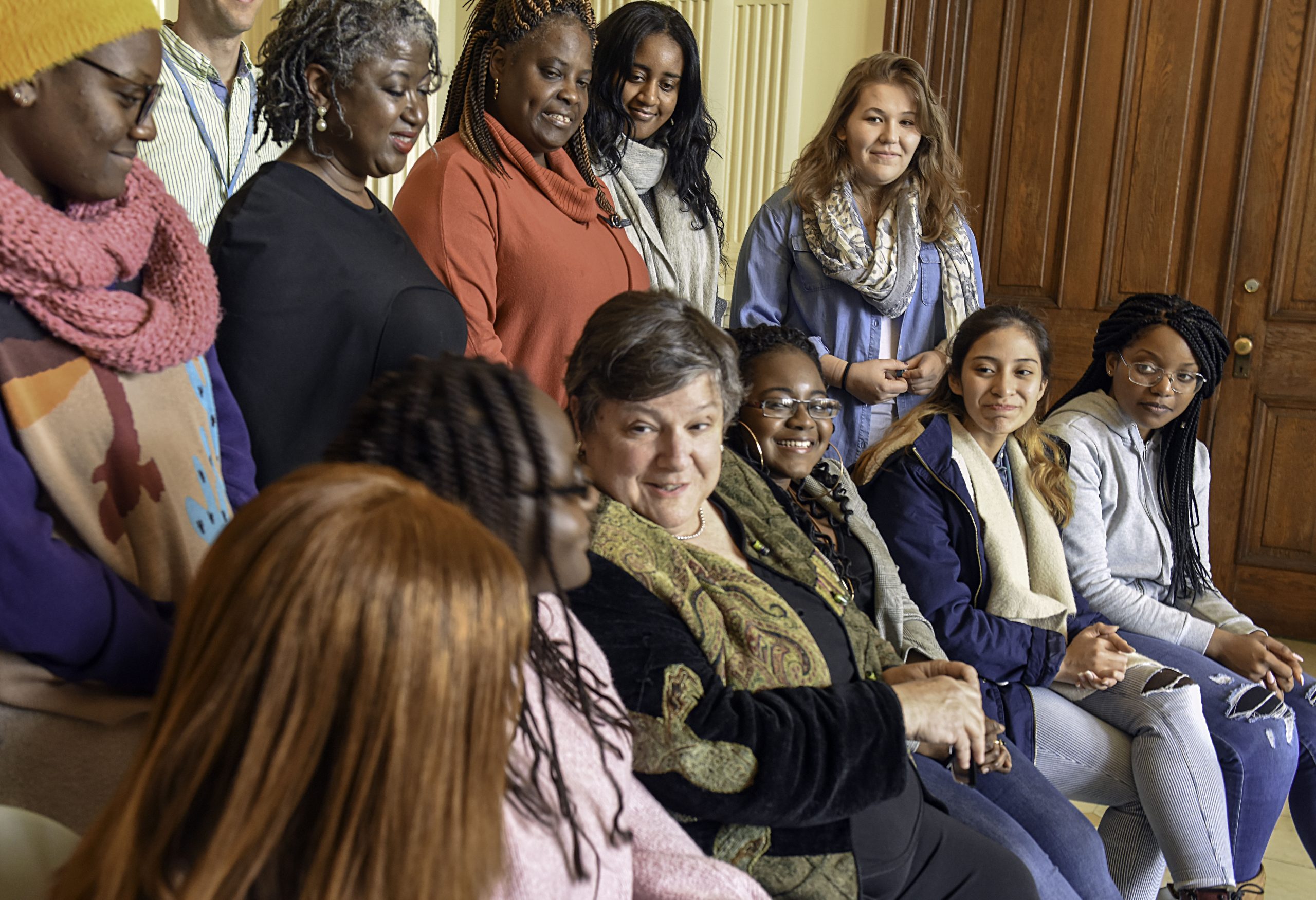
    The Hechinger Report provides in-depth, fact-based, unbiased reporting on education that is free to all readers. But that doesn’t mean it’s free to produce. Our work keeps educators and the public informed about pressing issues at schools and on campuses throughout the country. We tell the whole story, even when the details are inconvenient. Help us keep doing that.

    Join us today.

    Source link

  • Universities need a ‘Trump response plan’

    Universities need a ‘Trump response plan’

    Hi, everyone. This week I’m bringing you a dispatch from the Higher Education Climate Leadership Summit, hosted by the group Second Nature, where the Trump administration’s efforts to undo environmental action were very much top of mind. Thanks for reading. — Caroline Preston

    WASHINGTON — Federal dollars for clean energy are disappearing. Environmental offices across the federal government are being dismantled. Universities are facing decisions about whether to scrub the words “climate change” from their projects in order to keep them funded.

    Only a few weeks into Donald Trump’s second term, his attacks on climate action are already hindering universities’ efforts to curb their carbon emissions and minimize their harm to the planet, according to speakers at a conference I attended earlier this week hosted by the nonprofit group Second Nature.

    Going forward, every higher ed institution needs “a Trump response plan,” said Gregory Washington, president of George Mason University, in Fairfax, Virginia.

    Hundreds of college sustainability officers, university presidents, clean energy engineers, environmental researchers and others gathered for the event at a hotel blocks from the White House, where Trump has signed orders to “unleash” fossil fuels, sought to freeze clean energy funding, and overseen the removal of language on climate change from government websites.

    Some takeaways from the conference:

    Related: Want to read more about how climate change is shaping education? Subscribe to our free newsletter.

    Universities need a plan to navigate the Trump administration. Colleges and universities should form rapid response teams to confront political threats, speakers said, and also find safety in numbers and advocate through coalitions. Institutions may also have to pick their battles and let some work go, said Washington. “They have a playbook,” said Shalanda Baker, the University of Michigan’s vice provost for sustainability and climate action, referring to the political actors trying to undo diversity, equity and inclusion, environmental justice and related work. “Let’s create a playbook — and let’s continue the work.”

    Climate action is shifting. With a federal government hostile to climate action, higher ed can focus on making change alongside state and local governments instead. Universities can also partner with different types of organizations — health care systems, cultural institutions, businesses and others — to make progress. They might also consider forming alliances with institutions overseas.

    Debates are raging about whether to avoid “trigger words” like “climate change.” Some speakers, including George Mason’s Washington, talked about how, with certain audiences, universities should avoid language that the administration objects to, including “climate change” and “zero carbon.” “It has to be about saying the right things to the right people so you can salvage and maintain the programs you have and continue to move forward on your mission,” he said. Others disagreed, arguing that changing the language in a proposal wouldn’t stop government staff from investigating the work programs actually do. “We have a clock over our heads. We need to stand in the work, and call it what it is, which is that we are trying to avert catastrophic climate change,” said Baker of the University of Michigan.

    The threats are very real, not hypothetical. Dana R. Fisher, director of the Center for Environment, Community and Equity at American University, talked about how she was told in the last few days by people reviewing a government-funded project that unless she changed its focus from climate action to disaster recovery, it might not have a future. She noted that the American Climate Corps, a Biden-era program to deploy people into jobs related to fighting climate change, blinked out of existence after Trump took office. “We need to be realistic about what persistence and resistance looks like in channels like these if external forces will be shutting our work down,” said Fisher. She added, “The question I have for all of you is what are our universities going to do to protect us? Do I change the entirety of my website? What do I do about all the people funded for these grants who are now at risk of losing their jobs and their health care?”

    Universities are complicit in climate change. Several speakers noted that universities have done far too little for too long on climate change, and their financial ties to fossil fuel companies are one reason. Jennie Stephens, professor of climate justice at the National University of Ireland Maynooth, said that universities’ complicity in climate change was one reason why she left U.S. academia for an institution overseas. “The fossil fuel industry and profit-seeking interests have captured academia,” she said, adding that as a result there aren’t research centers designed to help society move away from fossil fuels. She added, “We need to reclaim and restructure these institutions for bigger change.”

    Related: How universities can become ‘living labs’ for climate action

    Students are tired of university inaction. “A lot of students are frustrated right now,” said Sydney Collins, a 2023 graduate of the University of Connecticut who is now a sustainability coordinator there. “A lot of students say it’s been bad and we’ve been terrified and you haven’t been listening. … And how dare you look at us now and say there’s nothing we can do. You haven’t been doing that work previously.” Fisher, of American University, said that anxiety, not anger, can motivate people to action, and that many people were outraged right now. To make change, she said, people need to think about “insider” and “outsider” strategies, and how students can sometimes be effective “outsider” voices pushing universities to change.

    Still, campus climate action has accelerated, even in red states. The event celebrated higher education institutions that have had success in reducing their emissions and fighting climate change. Among those recognized was Central Community College in Hastings, Nebraska. One of its seven centers and campuses runs entirely on wind energy, another entirely on solar. In 2019, the college started a wind, solar and battery storage program to prepare students for jobs in those industries. The program has a 100 percent job placement rate, with students graduating into jobs that typically pay between $28 to $32 an hour, according to Taylor Schneider, the college’s energy technology instructor. Ben Newton, the college’s environmental sustainability director, said the college has had success in maintaining support for the program even in a state where opposition to wind energy is widespread because people see the financial and employment benefits. Newton said he’s accustomed to tailoring his messages for different audiences — for example, describing the specifics of climate science in a sustainability class he teaches and focusing more on resilience in the face of extreme weather events with administrators and others.

    Higher ed needs new ways of measuring climate action. Second Nature, which encourages universities to make commitments to carbon neutrality, has been working to update those commitments to take into account different areas of work (like governance and education) and establish that neutrality is a milestone not an end point. That’s a step in the right direction, say some observers. “I don’t think it takes a lot of thought in the climate space to realize we can’t solve the climate crisis by paying everyone else to reduce their emissions,” said Alexander Barron, an associate professor of environmental science and policy at Smith College, who has argued that under the existing climate commitment model universities rely too heavily on purchasing offsets to meet their climate goals. 

    Going beyond neutrality requires all-in approaches. University officials talked about their strategies for moving beyond net neutrality and further reducing carbon emissions. Tavey Capps, executive director of climate and sustainability at Duke University, described the university’s efforts to ensure that all 10 of its schools — the divinity school, the law school, the business school and others — are engaged in and committed to climate action. Aaron Durnbaugh, director of sustainability with Loyola University of Chicago, talked about how climate action aligned with the Jesuit institution’s social justice mission. “We’re thinking about how we can ensure that more money goes back into communities,” he said, noting that the university had had some success by partnering on a solar project that provided unionized jobs for residents of nearby counties. “What does a Catholic heat pump look like? What does an equitable electric vehicle purchase look like?”

    While many in attendance were reeling at the pace of the Trump administration’s anti-clean energy blitz, they also noted that there would be more to come. “They are just getting started,” said Fisher of American University.

    “We have to stand in this moment,” said the University of Michigan’s Baker. “We have to be the tip of the spear and be courageous. I have a good job, but I’m willing to put myself out there.”

    She added: “There are no safe harbors.” 

    Contact editor Caroline Preston at 212-870-8965 or [email protected]

    This story about climate action was produced by The Hechinger Report, a nonprofit, independent news organization focused on inequality and innovation in education. Sign up for the Hechinger newsletter on climate and education.

    The Hechinger Report provides in-depth, fact-based, unbiased reporting on education that is free to all readers. But that doesn’t mean it’s free to produce. Our work keeps educators and the public informed about pressing issues at schools and on campuses throughout the country. We tell the whole story, even when the details are inconvenient. Help us keep doing that.

    Join us today.

    Source link