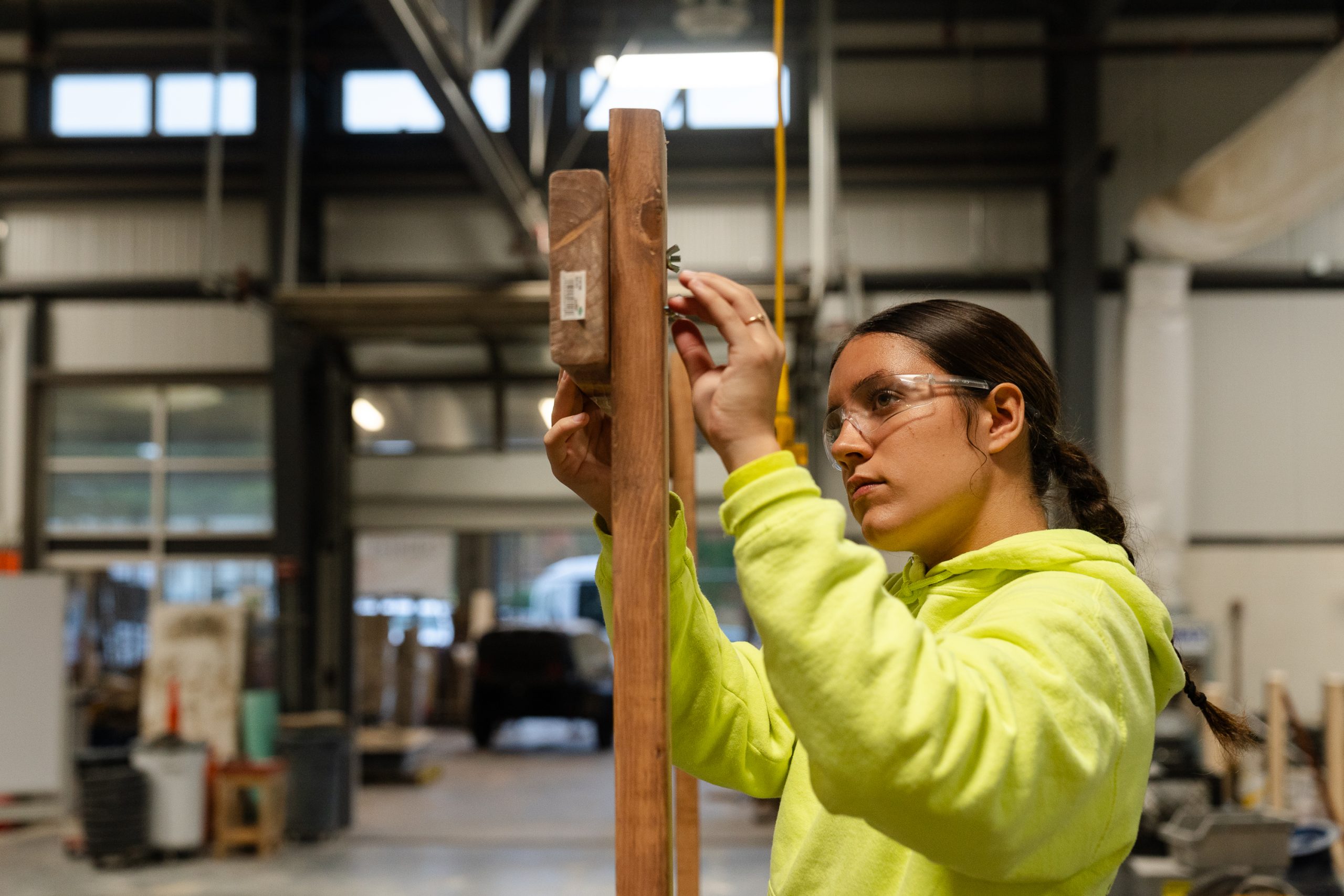
DANVERS, Mass. — It’s a rainy fall day in New England, but that doesn’t stop a group of students at Essex Tech North Shore Agricultural & Technical High School from donning work boots and hard hats and getting to work building a vegetable wash station on campus. This afternoon, they are installing wire mesh and prepping for a concrete pour under the watchful eye of Laborers’ Local 22 member Chris Moore, their teacher. “Hard hat hair don’t care,” reads the sticker on the hat worn by a young woman in the program.
The construction craft laborers track at Essex Tech, which Moore helps lead, is one of only a few high school-based programs in Massachusetts co-sponsored by a trade union. Students are initiated in union norms and expectations early on. Two Essex Tech teachers in the program are Local 22 members, with the New England Laborers’ Training Academy, which runs the laborers’ apprenticeship, paying Moore’s salary. As seniors, students can attend union meetings. And after graduation, many of them go straight into a union apprenticeship, fast tracked to a journeyman’s license. For all these reasons, Owen Paniagua, a 16-year-old junior, described the program as “a golden ticket to job security,” noting that he has learned everything from carpentry and concrete work to excavation and masonry.
“We feel as laborers that we should be in the schools,” said Lou Mandarini Jr., the retired business manager of Local 22 who now helps run the union’s school partnerships. “This is where your workforce is … If you treat young kids with respect, once they buy into your program, they are dead loyal.”
In several states, including Massachusetts, Maryland and Louisiana, trade union leaders have forged similar, groundbreaking partnerships with high school CTE programs in recent years, ponying up their own resources for the efforts. There’s also been an uptick in training alliances between trade unions and community colleges. In a 2023 brief, AFL-CIO leadership encouraged these partnerships. “No one knows better how to do a job than someone who does the job,” the brief stated.
Whether more unions decide to embrace this advice likely will play a large role in determining the long-term health and vibrancy of both career and technical high schools, and the trades themselves.
Related: A lot goes on in classrooms from kindergarten to high school. Keep up with our free weekly newsletter on K-12 education.
Twin trends are fueling some of the efforts: rapidly declining trade union membership, particularly in the Midwestern states; and up to $850 billion in infrastructure investment under the Biden administration (though some of that is in limbo because of an executive order from President Donald Trump), including designated funding for partnerships between education and labor.
Yet progress has been piecemeal and halting. And it’s too early to tell whether isolated partnerships across the country will translate into widespread change, said Taylor White, the director of postsecondary pathways for youth at the Center on Education and Labor at the think tank New America. “Schools and unions speak very different languages,” she noted. The same, she added, is true of employers and schools.
The longstanding dearth of partnerships says a lot about the history of America’s trade unions, which traditionally have operated as insular, sometimes parochial institutions, preferring to maintain tight control over their membership pipeline, and their training. In some communities, such as Milwaukee, that insularity kept unions predominantly white and male for generations. “Historically a lot of the high-paying skilled trades were handed down from father to son,” said Lauren Baker, a former education director in the printers’ union who also led Milwaukee Public Schools’ career and technical education program between 2002 and 2012. “That kept the trades looking a certain way.”
Mandarini, the retired union leader, said that in the past, “old timers didn’t help the young people.” But increasingly, he said, he hopes that mentality will become an anomaly.

For decades, many vocational school students have been held back by a lack of meaningful partnerships with both unions and employers at their schools, often leaving them without relevant training or clear pathways into jobs. “There’s skepticism from unions and employers that high school kids are ready for real training and real work,” said White, of New America.
There’s also been a longstanding desire on the part of many unions to maintain tight control over who can access often coveted apprentice slots.
Until recent years, most trade union apprenticeships in the Milwaukee area had admissions criteria that shut out many women, low-income, and Black and Hispanic city residents. “They were such closed communities, and it was a long process of breaking down some of those walls,” Baker said.
Related: Apprenticeships are a trending alternative to college but there’s a hitch
Back in the mid-1990s, Baker was the first woman to run a printing apprenticeship program for the union. In part to open up the field to as diverse a pool as possible, Baker abolished a requirement that apprentices had to be high school graduates. “Pretty much all a high school diploma told me was that they sat in a chair for four years,” she said, pointing out that many of the apprentices came from the academic bottom of their graduation classes. “I caught holy hell from the apprenticeship community for doing that,” she said.
While the SATs and other college entrance exams have at times been accused of being biased toward privileged white students, Baker said some of the apprenticeship admissions exams were challenging for anyone who hadn’t grown up in the home of someone already working in a specific trade. A question might presume that an applicant had experience helping fix their family’s car, for instance, something that young men were far more likely to have done — and those growing up in urban areas, where fewer households own cars, were far less likely to have done.
For decades, those tests contributed to keeping the construction trade unions, in particular, predominantly white and male. Only two of 16 Milwaukee area construction unions enrolled at least 20 percent Black apprentices in 2007, according to a report from researchers at the University of Wisconsin-Milwaukee. Two of the unions, glazing and tile setters, had no Black apprentices in a city where, at that time, nearly 40 percent of the residents were Black.
Much of that bias and insularity continues in some Boston-area construction trade unions, said Travis Watson, who serves as a commissioner of the Boston Employment Commission and has critiqued some of the unions for their lack of racial diversity, citing specific practices that make it harder for prospective Black members to get a foothold. “If you look at every big downtown project in Boston, there are very few Black people who are working on union construction projects,” he said.
Some of the local unions have made changes to their admissions process to become more accessible to applicants from diverse backgrounds, said Danyson Tavares, who worked for several years in leadership positions at YouthBuild Boston, a pre-apprenticeship program that helps prepare young people of color in the city for jobs in the construction and design industries. But other unions might take applications only once a year or remain secretive about their standards and curriculum. “The electrical union is the one we really want to have more relationships with, there’s such a demand for that workforce,” Tavares said. “We’ve slowly started to penetrate but it’s a lot more work than I expected.”
One 25-year-old who recently finished his pre-apprenticeship in carpentry at YouthBuild said he got an interview with the union but was turned down for an apprenticeship for reasons that he said weren’t entirely clear. “I kind of felt like I wouldn’t get in,” said Keyshawn Kavanaugh. He found a non-union job easily at a company that he likes a lot, but he acknowledges that “the union is the best place to work,” at least from the standpoint of benefits and pension.
In Milwaukee, Baker said she’s seen some positive changes since she ran the printers apprenticeship, with more local unions developing inclusive and transparent admissions. “The trades themselves began to realize that they needed to look beyond their natural base in order to fill jobs,” she said. “It became more apparent that there is a vast opportunity out there with women and people of color.”
Related: States bet big on career education but struggle to show it works
The idea that Massachusetts laborers should invest time and money in local schools originated over 20 years ago, when Mandarini and other Local 22 leaders decided they were neglecting a potential asset: kids. Mandarini proposed a pilot partnership to the vocational school in Medford, Massachusetts, just outside of Boston, which started in 2002. It wasn’t easy at first. “How do you adapt to a public school?” he said. “There was a lot of learning that we had to do on both ends.”
The union had to fight against a perception that a four-year college degree was the only path to a stable, rewarding career, Mandarini said. It helped with recruiting to explain to prospective students that, at that time, union laborers could expect to retire with an annuity of about $1.2 million, he added. (In Massachusetts, laborers typically earn between $90,000 and $100,000 annually, and that annuity is now more than $2 million, Mandarini said.)

Over the years, the partnership model has spread to eight career and technical schools in Massachusetts. At some, the union pays a teacher’s salary, and at others it does not, Mandarini said. “We want to be in every vocational school in Massachusetts,” he said, “and hopefully every vocational school in New England. That’s where our workforce is coming from.”
In rural western Louisiana, it was a private company that encouraged a local trade union to partner with public high schools. The company, CapturePoint, which sells carbon storage services, reached out in March 2023 to the local branch of the United Association of Journeymen and Apprentices of the Plumbing and Pipefitting Industry, asking if the union would help build out a new career and technical track at the Vernon Parish School District.
To make it happen, the company paid for the electricity, classroom equipment and furniture to help turn an old woodworking shop at one of the district’s high schools into an updated welding shop. CapturePoint also took on several ongoing costs, paying for student transportation — the students can come from nine different high schools — and some administrative expenses. The union paid for some reconstruction and all the tools, and provided an instructor. The school offers the space and enrolls 30 students, who can skip their first year of apprenticeship if they join the union after graduating, thereby starting at a higher pay rate. “All of us have skin in the game,” said Lance Albin, who led the partnership for the union.
At high schools with trade union partnerships, there’s no shortage of interested students. Isabella Gonzalez, 17, creator of the “hard hat hair don’t care” sticker, said she hopes to move straight into an apprenticeship with Local 22 when she graduates in a year and a half. Aspiring laborers learn more diverse skills than students in related tracks like plumbing and electrical, she said, opening up the possibility of a greater variety of work.
That day last fall, juniors in the program practiced using a compactor to prep the ground for installation of a patio floor, part of the final stages in rebuilding a large cottage on campus. The construction students have been involved in the project since they poured the cement for the foundation in the summer of 2020, wearing masks during the pandemic’s early days, even outdoors.
By afternoon, the students had transitioned to another work in progress: the vegetable wash station by the greenhouse, where they needed to install enough wire mesh and rebar to do the concrete pour early the next week. “Put your hard hat on and help out,” their teacher Moore reminded a group of students holding back as the rain hardened. “No … statues here.”
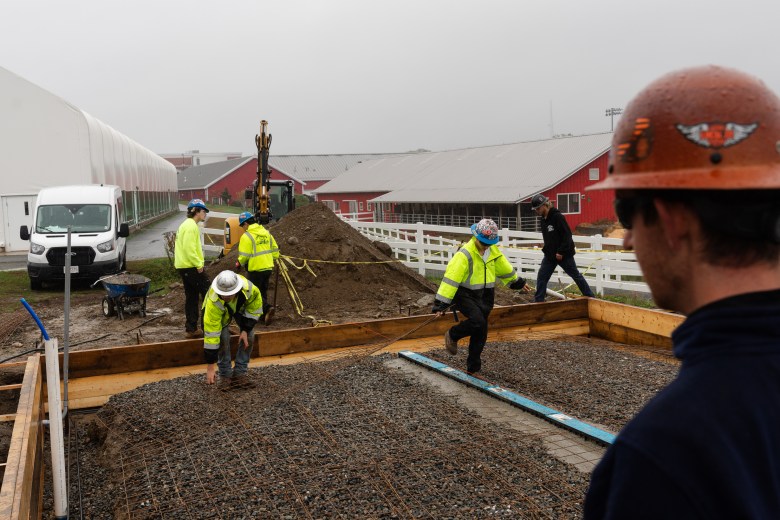
Students say the partnership with Local 22 provides them increased career security and the confidence that they are learning relevant, up-to-date skills: Moore until recently worked part time in the field, including on Boston’s project to restore the tunnel to the city’s Logan Airport.
Paniagua, the 16-year-old student in the program, said he can command a higher pay rate than most of his peers at a part-time carpentry and landscaping job because of the expertise he has gained in the Essex Tech program. He’s used the extra money to buy two new trucks. The union partnership has also allowed him to make more thoughtful, informed choices about career steps, he added. Leaning on his teachers as mentors, Paniagua said he decided to continue studying at a specialized welding school in Wyoming after graduation to maximize his future earning potential. “We know what we want to do here and get on it,” Paniagua said, noting that it’s a stark contrast to some of his friends who are conflicted about the value of a four-year college degree. “We’re not lost,” he said, “or wasting money.”
Former President Joe Biden was exceptionally supportive of the labor movement, and specifically of partnerships between unions and schools. Some labor experts expect some of that support might continue in the new Trump administration. “We’re seeing indications of a Trump administration that might not be as hostile to unions as you might think,” said Shalin Jyotishi, founder and managing director of the Future of Work and Innovation Economy Initiative at New America. He cited Trump nominee Lori Chavez-DeRemer, opposed by many in the business community, for Labor secretary, and the president’s support of the longshoremen’s union over their anti-automation stance.
In any event, “these bottoms-up innovations are already happening locally,” Jyotishi said. “Federal decisions can help or hurt … odds of success, but the proof-of-concept is already out of the bag.”
Related: For some students, certificate programs offer a speedy path to a job
A bigger question mark may be whether there is the will to expand capacity significantly on the ground. Some of the existing programs have not yet reached students in the most underserved communities who could potentially benefit most from a fast track into a union apprenticeship.
In Massachusetts, for instance, many of the high schools the laborers work with have become increasingly selective in admissions. Students from low-income homes were 30 percent less likely to be accepted at the state’s vocational schools in 2023 and 2024 than those from wealthier households, according to an analysis by the Boston Globe. Similar disparities existed for students receiving special education services and English learners.
The laborers have yet to expand their partnership model to Boston’s Madison Park Technical Vocational High School, where nearly all of the students are Black or Hispanic, about 85 percent come from low-income households, and 92 percent are identified as “high needs” — an umbrella term in Massachusetts that includes students with disabilities, English learners and low-income students, among other groups.
Madison Park, part of the city’s public school district, has some partnerships and many strong programs and instructors, said Bobby Jenkins, an alum and long-time advocate of the school. But the chronic turnover of both superintendents and school leaders in recent years has hindered progress in undertaking some more ambitious partnerships.

Mandarini agreed that political and bureaucratic obstacles have made it more challenging to partner with Madison Park. But the union has made it a priority and is in promising talks with city officials about partnering with the school when a proposed new facility might be completed.
“When I was part of the building trades, I used to say, ‘I don’t understand why you aren’t taking more kids, especially in the city of Boston,’” Mandarini said. “Every single trade should be in (Madison Park).’”
For now, that attitude has not spread to all union leaders. It will take a cultural shift from trade union groups to expand their school partnerships beyond scattered, boutique programs. Among other things, they will need to prioritize flexibility and the learning and growth of young people more than they are accustomed to, said White, of New America.
She noted that many union leaders seem aware that they have a pipeline and recruitment issue but remain unsure what to do about it. More school-based partnerships could help not only with that challenge but also with reenergizing and selling unions to future generations of workers — and voters, White added. “All of the polling suggests that young people are pretty pro-union,” she said. “There’s a missed opportunity on the part of unions if they don’t capitalize on that.”
Contact editor Nirvi Shah at 212-678-3445 or [email protected].
Reporting on this story was supported by the Higher Ed Media Fellowship, where Carr was a fellow in 2024. This year, Carr has a fellowship from New America to report on early childhood issues.
This story about trade unions was produced by The Hechinger Report, a nonprofit, independent news organization focused on inequality and innovation in education. Sign up for the Hechinger newsletter.