Category: South America

  • Ousting Venezuela’s leader was high on Trump’s to-do list

    Ousting Venezuela’s leader was high on Trump’s to-do list

    When a little known politician recently declared himself interim president of Venezuela and called for fresh elections, opponents of the sitting president, Nicolás Maduro, saw a bright future for a country mired in misery and hunger.

    But ousting Maduro has proved more difficult than expected. Optimistic assumptions have collided with a reality once summed up by the late Chinese leader Mao Zedong: “Political power grows out of the barrel of a gun.”

    Juan Guaidó, the youthful opposition figure who declared himself president on January 23, has been recognized as Venezuela’s legitimate leader by the United States and almost 50 other countries. But Maduro is still in power, backed by the country’s military and paramilitary forces. Maduro’s international backers include China, Russia, Turkey, Iran, Cuba, Bolivia and Nicaragua.

    What Guaidó and Washington administration officials had in mind sounded optimistic but not impossible.

    After Guaidó emerged as undisputed leader of an opposition long weakened by internal feuds, he brought out tens of thousands of demonstrators who denounced a government they blame for an economic collapse that has resulted in severe shortages of basic goods and services.

    Humanitarian aid and presidential power

    Displays of public anger week after week, or so the thinking went, would convince Maduro to step aside in favor of his 35-year-old challenger. A key test of the dueling presidents’ power — and the military’s ultimate loyalty — hinged on the delivery of humanitarian aid flown in by U.S. military planes in mid-February to the city of Cúcuta on Venezuela’s border with Colombia.

    Maduro said the aid was a precursor to a U.S. military invasion, blocked border crossings and dispatched troops to block convoys of trucks or people carrying supplies. In the scenario envisaged by Guaidó, the troops would refuse to intercept desperately needed aid and instead defect en masse.

    That did not happen.

    Instead, things have gone from bad to worse since the failed aid delivery. Tons of food, medicine and medical supplies remain boxed in warehouses on the Colombian side of the border.

    In March, a week-long power cut across all of Venezuela’s 23 states brought more hardship. With electricity out, scarce food rotted in refrigerators and water pumping stations stopped.

    No early end to the suffering

    One heart-breaking video showed people rushing to catch water in buckets and plastic bottles from a leak in a drainage pipe feeding into a sewer.

    Maduro blamed the blackout on saboteurs using cyber attacks and electromagnetic waves to cripple the power system, operations in an “electric war” waged by the United States.

    The opposition pointed to lack of maintenance and an infrastructure that has been crumbling for years.

    In the wake of the longest blackout in Venezuela’s history, Guaidó launched a second round of protests, but the crowds have been noticeably thinner than in the early stage of the contest between the rival presidents.

    Hopes for an early end of the country’s agony appear to be fading in Venezuela. Not so in Washington, judging from bullish statements by President Donald Trump and his secretary of state, Michael Pompeo. Trump told an enthusiastic crowd of Venezuelan exiles and Cuban-Americans in Miami last month that what he called “the ugly alliance” between the Maduro government and Cuba was coming to a rapid end.

    Soon after, Pompeo told a television interviewer he was confident that Maduro’s “days are numbered.”

    Bullish statements from Washington

    When huge crowds jammed the streets of Caracas and other cities to cheer Guaidó, some U.S. administration officials thought Maduro would soon be on the way out. That he has managed to hang on despite popular anger, international condemnation and painful American sanctions has come as a surprise to many.

    Now, the bullish statements from Trump and Pompeo bring to mind American predictions during Barack Obama’s administration concerning Syrian dictator Bashar al-Assad when he faced mass demonstrations, international condemnation and U.S. sanctions.

    In Syria, peaceful protests morphed into civil war in the summer of 2011, and the Obama team’s point man on the Middle Eastern country described Assad as “a dead man walking.” Eight years later, having prevailed in the war with the help of Russia and Iran, Syria lies in ruins, but Assad looks secure in power.

    Shortly before taking office, Trump promised that he would avoid intervention in foreign conflicts and “stop racing to topple foreign regimes.” He has largely stuck to that pledge but is making Venezuela an exception, with repeated assertions that “all options are on the table” — a Washington euphemism for military action.

    There’s no single explanation for Trump’s untypical focus on Venezuela. But it is worth noting that he made his toughest speech on the subject in Florida and that he is running for re-election in 2020. Hawkish rhetoric on Venezuela and Cuba plays well with the large Venezuelan-American and Cuban-American communities in that state.

    Florida, the country’s third most populous state, is of key importance in presidential elections. It is a so-called swing state that can go to either of the presidential candidates, often by very narrow margins.


    QUESTIONS TO CONSIDER:

    1. Can you think of a country where a long-entrenched leader recently bowed to the demands of demonstrators?

    2. Why do you think China, Russia and several other countries are standing by Maduro?

    3. The United States has a history of intervention in Latin America. Can you name some cases?
     

    Source link

  • A Historical Pattern of Force, Profit, and Human Cost

    A Historical Pattern of Force, Profit, and Human Cost

    From the mid‑19th century to today, U.S. interventions in Latin America and the Caribbean have consistently combined military force, political influence, and economic pressure. Across this long arc, millions of lives have been shaped—often shattered—by policies that prioritize strategic advantage over human flourishing. Today’s geopolitical tensions with Venezuela are the latest flashpoint in a historical pattern that rewards elites while exacting profound human costs.

    Note on Timing: This article is intentionally posted on Christmas Day 2025, a day traditionally associated with peace, goodwill, and reflection, to underscore the contrast between those ideals and the ongoing human toll of U.S. militarism and intervention abroad. The symbolic timing is a reminder that while many celebrate, others suffer the consequences of policies driven by power, profit, and geopolitics.


    A Critical Warning for Students and Young People

    As Higher Education Inquirer has repeatedly argued, the United States’ military footprint—its wars, recruitment programs, and entanglements with higher education—has deep consequences not just abroad but at home. ROTC programs and military enlistment are often marketed as pathways to education and economic stability, but they also funnel young people into systems with long‑term obligations, moral hazards, and psychological risk. Prospective enlistees and their families should think twice before committing to military pathways that may bind them to morally questionable conflicts and institutional control.

    Moreover, U.S. higher education has become deeply entwined with kleptocracy, militarism, and colonialism, supporting war economies and benefiting from federal research contracts with defense and intelligence partners that obscure the real human costs of empire. These warnings are especially salient in the context of Venezuela and similar interventions, where human toll and geopolitical stakes demand deeper scrutiny.


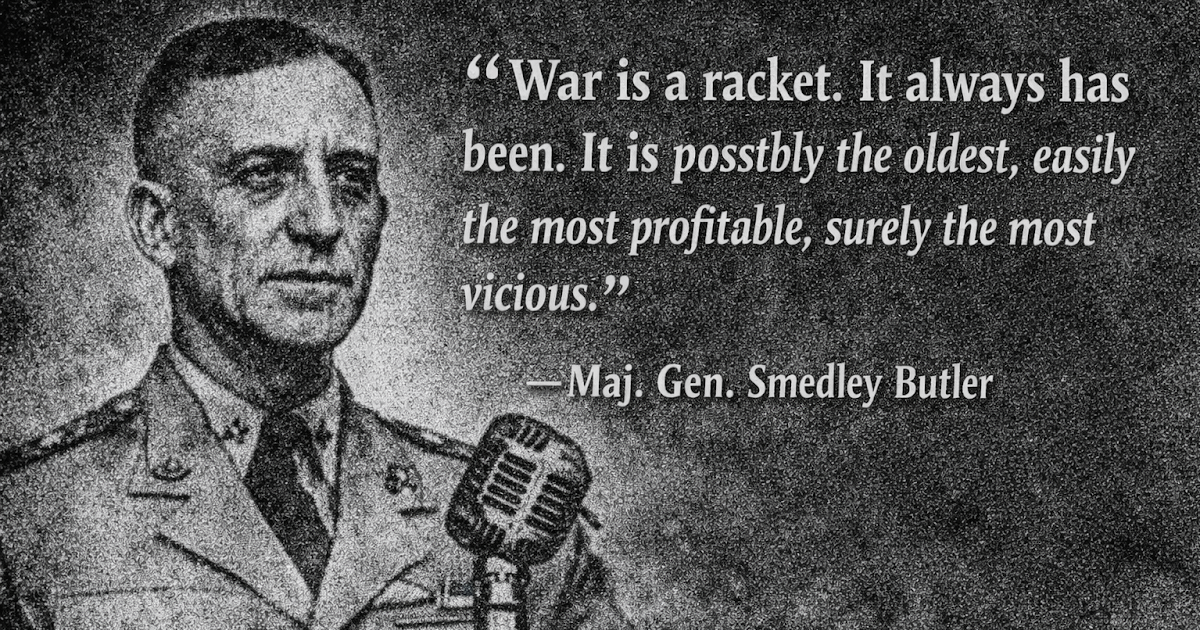
    Smedley Butler: War Is a Racket and the Business Plot

    Major General Smedley D. Butler, among the most decorated U.S. Marines, became one of the U.S. military’s most outspoken critics. In his 1935 War Is a Racket, Butler rejected romantic notions of military glory and exposed the economic motives behind many interventions:

    War is a racket. It always has been. It is possibly the oldest, easily the most profitable, surely the most vicious.

    I spent 33 years and four months in active military service… being a high‑class muscle man for Big Business, for Wall Street and for the bankers. In short, I was a racketeer for capitalism.

    Only a small inside group knows what it is about. It is conducted for the benefit of the very few at the expense of the masses.

    Butler’s warnings were not abstract. In 1933, he was approached to lead a coup against President Franklin D. Roosevelt, known as the Business Plot, which he publicly exposed. His testimony before Congress revealed how elite interests sought to use military power to overthrow democratic government, an episode that underscores his critique of war as a tool for entrenched interests at the expense of ordinary people.


    Historical Interventions and Their Toll

    Below is a timeline of major U.S. interventions in the Americas, with estimated deaths, showing the human cost of policies that often served strategic or economic interests over humanitarian ones:

    Period Location Event / Nature of Intervention Estimated Deaths
    1846–1848 Mexico Mexican-American War: Territorial conquest ~25,000 Mexicans
    1898 Cuba/P.R. Spanish-American War: U.S. seized P.R.; Cuba protectorate ~15,000–60,000 (90% disease)
    1914 Mexico Occupation of Veracruz: U.S. port seizure ~300 Mexicans
    1915–1934 Haiti Military Occupation: Suppression of rebellions ~3,000–15,000
    1916–1924 Dominican Rep. Marine Occupation: Control of customs/finance ~4,000
    1954 Guatemala Op. PBSuccess: CIA coup against Árbenz; led to civil war 150,000–250,000*
    1965 Dominican Rep. Op. Power Pack: U.S. intervention during civil war ~3,000
    1973–1990 Chile U.S.-backed Coup/Regime: Pinochet dictatorship 3,000–28,000*
    1975–1983 S. America Operation Condor: CIA-supported intelligence network ~60,000*
    1976–1983 Argentina Dirty War: U.S.-supported military junta and coup ~30,000*
    1979–1992 El Salvador Civil War: Massive military aid to govt forces 35,000–75,000*
    1981–1990 Nicaragua Iran-Contra Affair: Covert support for Contras ~30,000–50,000*
    1989 Panama Operation Just Cause: Invasion to remove Noriega 500–3,000
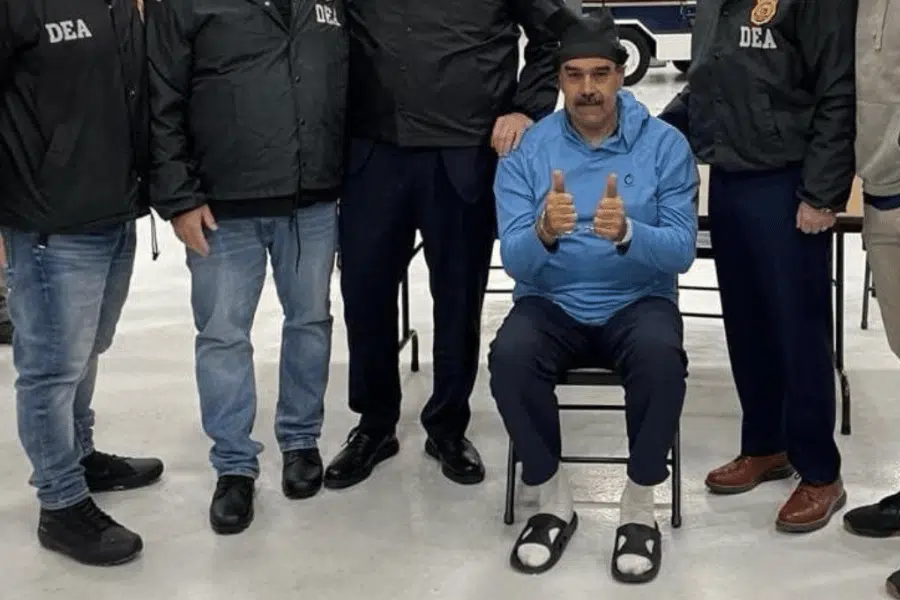
    2025 Venezuela Naval Blockade: Active maritime strikes and standoff 100+ (to date)

    *Estimates include civilian casualties and deaths indirectly caused by U.S.-supported interventions.


    Venezuela and the Global Politics of Intervention

    Venezuela’s 2025 crisis is the latest in a long history of U.S. pressure in the hemisphere. A naval blockade—accompanied by maritime strikes and political isolation—has already produced more than 100 confirmed deaths. Historically, interventions like this have often prioritized U.S. strategic or economic interests over local welfare.

    The situation is further complicated by global geopolitics. Former President Donald Trump, who recently pardoned key figures involved in controversial interventions, including Iran‑Contra actors, also maintains strategic ties with China and Russia, highlighting how interventions are entangled with global power plays that affect universities, recruitment pipelines, and domestic politics alike.


    A Call to Rethink Intervention and Recruitment

    Smedley Butler’s critique remains urgent: to “smash the racket,” profit must be removed from war, military force should be strictly defensive, and decisions about war must rest with those who bear its consequences. From Mexico to Venezuela—and including covert operations like Iran‑Contra—the historical record shows how interventions serve a narrow elite while imposing massive human costs.

    HEI’s warnings underscore that higher education, ROTC programs, and military recruitment pipelines are not neutral pathways but deeply embedded parts of systems that reproduce extraction, militarism, and inequality. Students, educators, and families must critically evaluate the incentives and promises of military pathways and demand institutions that serve learning, opportunity, and justice rather than empire.


    Sources

    1. Butler, Smedley D. War Is a Racket. Round Table Press, 1935.

    2. U.S. Congressional Record and Butler testimony on the Business Plot, 1934.

    3. Kinzer, Stephen. Overthrow: America’s Century of Regime Change from Hawaii to Iraq.

    4. Scott, Peter Dale. Cocaine Politics: Drugs, Armies, and the CIA in Central America.

    5. Reporting on Trump pardons, Iran‑Contra participants, and global alliances (2020–2025).

    6. Higher Education Inquirer, “Kleptocracy, Militarism, Colonialism: A Counterrecruiting Call for Students and Families,” December 7, 2025. (link)

    7. Higher Education Inquirer, “The Hidden Costs of ROTC — and the Military Path,” November 28, 2025. (link)

    8. Historical records on U.S. interventions: Mexican‑American War, Spanish‑American War, Guatemala (1954), Chile (1973), Argentina (1976–1983), El Salvador, Nicaragua, Panama, Venezuela (2025).

    Source link

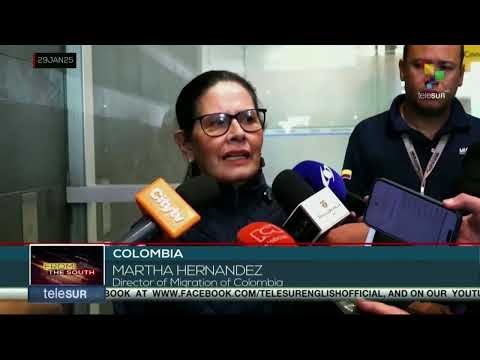
  • Colombia, first nationals deported under the Donald Trump administration arrived (TeleSur English)

    Colombia, first nationals deported under the Donald Trump administration arrived (TeleSur English)

    The first flights carrying migrants deported from the United States to Colombia. The Colombian government confirmed on Tuesday that two planes
    carrying migrants had landed. Some were reportedly shackled. A total of 201 migrants: 110 sent from
    California and 90 from Texas were on board. Among the deportees were two pregnant women and more than 20 children. The cost to US taxpayers is estimated to be $100,000 to $700,000 per flight. The long-term costs and consequences of this program with Latin America, like many others over the last century, have not been estimated. 

    Source link