Get stories like this delivered straight to your inbox. Sign up for The 74 Newsletter
South Dakota is the fourth state in the country to commit to President Donald Trump’s federal education tax credit program, Republican Gov. Larry Rhoden announced Friday in Sioux Falls.
Under the program, South Dakotans who owe federal income taxes can either send up to $1,700 to the federal government, or they can donate that $1,700 to a government-recognized scholarship granting organization to public, private or homeschool entities in the state. The program starts in 2027.
Nebraska’s Republican Gov. Jim Pillen announced the state’s commitment in September. Republican governors for North Carolina and Tennessee announced their commitment this summer. Oregon, New Mexico and Wisconsin officials said they do not intend to opt into the program. Some critics nationally have questioned whether there will be proper guardrails, accountability and “quality control” in place.
Rhoden called the imminent program a “winning situation” for South Dakota taxpayers.
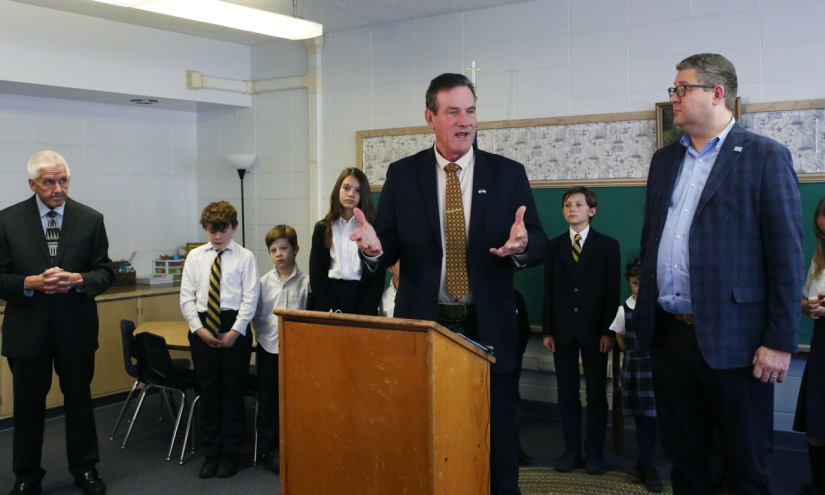
“I’d just as soon give those dollars to a private school than Uncle Sam,” Rhoden said at the announcement, standing in front of a row of students attending the St. Joseph Academy. “I think they know how to spend it a little wiser than the federal government.”
Rhoden added that the federal tax credit will “pair well” with South Dakota’s existing tax credit program, which allows insurance companies to donate up to a total of $5 million to a private school scholarship program for students whose families have low incomes.
The program will further support the state’s growing alternative instruction movement, Rhoden said, including homeschooling and microschools popping up throughout the state. Alternative instruction enrollment has nearly tripled in South Dakota in the last decade, making up about 7% of school-age children in the state.
Sara Hofflander, founder of St. Joseph Academy, said the school is “grateful” for the potential extra funding, though she plans to “approach everything cautiously.”
“Running an independent school obviously requires a heavy commitment from families,” Hoffman said, adding that the extra funding would “lift some of that burden, so we can focus more on the needs of our students.”
Historically, “school choice” efforts in the state have met resistance from the public school industry.
Advocates vehemently fought former Gov. Kristi Noem’s effort to introduce Education Savings Accounts, which would have provided public funding for private education and homeschool options during the last legislative session, calling the failed effort an attack on public education. Those same advocates referred to the state’s education tax credit program as “backdoor school voucher program.”
But Rob Monson, executive director for the School Administrators of South Dakota, said the program will benefit public and private education. South Dakotans can direct their tax credit dollars to organizations representing public schools in the state. The funding could be spent on not only tuition and fees for private schools, but tutoring, special needs services for students with disabilities, transportation (such as busing), afterschool care and computers.
“That’s a huge win for taxpayers of South Dakota, but also every form of education across the state,” Monson said.
South Dakota Education Secretary Joe Graves said the program will support education innovations and a “robust competitive system.”
Graves told lawmakers on Thursday, while presenting lackluster test scores to a committee, that “innovation” would be key to improving student outcomes, especially for Native American students and children living in “education deserts.”
“We’re not doing well enough, and we need to do better,” Graves said at Friday’s announcement.
If more students attend private or alternative schooling options, that would mean less state funding for public schools because of decreased student enrollment. Monson told South Dakota Searchlight that state revenues could be impacted by participation in the tax credit program, since it would remove federal tax dollars used to support other programs or go toward states. The federal government would still be obligated to fund some federal education programs, Monson added.
The scholarship funds would be available to families whose household incomes do not exceed 300% of their area’s median gross income. The U.S. Department of Treasury is expected to issue proposed rules detailing the program’s operation.
Graves said he assumes there will be reporting “at some level” of how the funds are spent.
South Dakota Searchlight is part of States Newsroom, a nonprofit news network supported by grants and a coalition of donors as a 501c(3) public charity. South Dakota Searchlight maintains editorial independence. Contact Editor Seth Tupper for questions: [email protected].
Did you use this article in your work?
We’d love to hear how The 74’s reporting is helping educators, researchers, and policymakers. Tell us how