Category: story

  • Plenty of schools have no-zeroes policies. And most teachers hate it, a new survey finds

    Plenty of schools have no-zeroes policies. And most teachers hate it, a new survey finds

    This story was originally published by Chalkbeat. Sign up for their newsletters at ckbe.at/newsletters.

    About one in four teachers say their schools don’t give students zeroes. And nearly all of them hate it.

    The collection of practices known as equitable grading, which includes not giving students zeroes, not taking off points for lateness, and letting students retake tests, has spread in the aftermath of the pandemic. But it wasn’t known how widespread the practices were.

    A new nationally representative survey released Wednesday finds equitable grading practices are fairly common, though nowhere near universal. More than half of K-12 teachers said their school or district used at least one equitable grading practice.

    The most common practice — and the one that drew the most heated opposition in the fall 2024 survey — is not giving students zeroes for missing assignments or failed tests. Just over a quarter of teachers said their school or district has a no-zeroes policy.

    Around 3 in 10 teachers said their school or district allowed students to retake tests without penalty, and a similar share said they did not deduct points when students turned in work late. About 1 in 10 teachers said they were not permitted to factor class participation or homework into students’ final grades.

    Only 6% of teachers said their school used four or more equitable grading practices.

    That was surprising to Adam Tyner, who co-authored the new report for the Thomas B. Fordham Institute, a conservative think tank, in partnership with the RAND Corporation, a nonprofit research organization. He expected more schools would be following a “whole package” of grading reforms supported by advocates like former teacher and education consultant Joe Feldman, who wrote the influential book “Grading for Equity.”

    “It’s not like this has swept the country,” said Tyner, who has studied grading practices. He argues that some policies meant to create equity lead to grade inflation and don’t benefit students.

    The findings come as many schools are rethinking what students should have to do to get a high school diploma, and how much emphasis should be put on grades. At the same time, many schools continue to struggle with student disengagement and historically high rates of absenteeism following the pandemic. As a result, they’re trying to hold students accountable for their work without making it impossible to catch up on missed assignments.

    Though ideas about how to grade students more fairly predate the pandemic, several large districts started rethinking their grading practices following that disruption, as more students struggled to meet strict deadlines or do their homework.

    Proponents of equitable grading say it’s important for students to be able to show what they know over time, and that just a few zeroes averaged into a grade can make it difficult for students to ever catch up. When students don’t see a path to passing a class, it can make them less motivated or stop trying altogether.

    Still, some teachers have pushed back, arguing that no-zeroes policies can hurt student motivation, too.

    That showed up in the recent survey.

    Eight in 10 teachers said giving students partial credit for assignments they didn’t turn in was harmful to student engagement. Opposition to no-zeroes policies came from teachers of various racial backgrounds, experience levels, and who worked with different demographics of students.

    No-zeroes policies can take various forms but often mean that the lowest possible grade is a 50 on a 100-point scale. Some schools use software that will automatically convert lower grades to a 50, one teacher wrote on the survey.

    Schools that enrolled mostly students of color were more likely to have no-zeroes policies, the survey found. And middle schools were more likely than high schools and elementary schools to have no-zeroes policies, no-late-penalty policies, and retake policies.

    Researchers weren’t sure why those policies popped up more in middle schools.

    But Katherine Holden, a former middle school principal in Oregon’s Ashland School District who trains school districts on equitable grading practices, has some guesses.

    High schools may be more worried that changing their grading practices will make it harder for students to get into college, Holden said — a misconception in her eyes. And districts may see middle schoolers as especially likely to benefit from things like clear grading rubrics and multiple chances to show what they know, as they are still developing their organization and time-management skills.

    In the open-ended section of the survey, several teachers expressed concerns that no-zeroes policies were unfair and contributed to low student motivation.

    “Students are now doing below-average work or no work at all and are walking out with a C or B,” one teacher told researchers.

    “Most teachers can’t stand the ‘gifty fifty,’” said another.

    More than half of teachers said letting students turn in work late without any penalty was harmful to student engagement.

    “[The policy] removes the incentive for students to ever turn work in on time, and then it becomes difficult to pass back graded work because of cheating,” one teacher said.

    But teachers were more evenly divided on whether allowing students to retake tests was harmful or not.

    “Allowing retakes without penalty encourages a growth mindset, but it also promotes avoidance and procrastination,” one teacher said.

    Another said teachers end up grading almost every assignment more than once because students have no reason to give their best effort the first time.

    The report’s authors recommend getting rid of blanket policies in favor of letting individual teachers make those calls. Research has shown that other grading reforms, such as grading written assignments anonymously or using grading rubrics, can reduce bias.

    Still, teachers don’t agree on the best approach to grading. In the survey, 58% of teachers said it was more important to have clear schoolwide policies to ensure fair student grading — though the question didn’t indicate what that policy should look like — while the rest preferred using their professional judgment.

    “There are ways to combat bias, there are ways to make grading more fair, and we’re not against any of that,” Tyner said. “What we’re really concerned about is when we’re lowering standards, or lowering expectations. … Accountability is always a balancing act.”

    Nicole Paxton, the principal of Mountain Vista Community School, a K-8 school in Colorado’s Harrison School District 2, has seen that balancing act in action.

    Her district adopted a policy a few years ago that requires teachers to grade students on a 50-100 scale. Students get at least a 50% if they turn in work, but they get a “missing” grade if they don’t do the assignment. Middle and high schoolers are allowed to make up missing or incomplete assignments. But it has to be done within the same quarter, and teachers can deduct up to 10% for late assignments.

    Paxton thinks the policy was the right move for her district. She says she’s seen it motivate kids who are struggling to keep trying, when before they stopped doing their work because they didn’t think they could ever bounce back from a few zeroes.

    “As adults, in the real world, we get to show what we know and learn in our careers,” Paxton said. “And I think that kids are able to do that in our building, too.”

    Chalkbeat is a nonprofit news site covering educational change in public schools.

    For more news on classroom trends, visit eSN’s Innovative Teaching hub.

    Latest posts by eSchool Media Contributors (see all)

    Source link

  • I asked students why they go to school–this answer changed how I design campuses

    I asked students why they go to school–this answer changed how I design campuses

    This story was originally published by Chalkbeat. Sign up for their newsletters at ckbe.at/newsletters.

    At first, the question seemed simple: “Why do we go to school?”

    I had asked it many times before, in many different districts. I’m a planner and designer specializing in K-12 school projects, and as part of a community-driven design process, we invite students to dream with us and help shape the spaces where they’ll learn, grow, and make sense of the world.

    In February of 2023, I was leading a visioning workshop with a group of middle schoolers in Southern California. Their energy was vibrant, their curiosity sharp. We began with a simple activity: Students answered a series of prompts, each one building on the last.

    “We go to school because …”

    “We need to learn because …”

    “We want to be successful because …”

    As the conversation deepened, so did their responses. One student wrote, “We want to get further in life.” Another added, “We need to help our families.” And then came the line that stopped me in my tracks: “We go to school because we want future generations to look up to us.”

    I’ve worked with a lot of middle schoolers. They’re funny, unfiltered, and often far more insightful than adults give them credit for. But this answer felt different. It wasn’t about homework, or college, or even a dream job. It was about legacy. At that moment, I realized I wasn’t just asking kids to talk about school. I was asking them to articulate their hopes for the world and their role in shaping it.

    As a designer, I came prepared to talk about flexible furniture, natural light, and outdoor learning spaces. The students approached the conversation through the lens of purpose, identity, and intergenerational impact. They reminded me that school isn’t just a place to pass through — it’s a place to imagine who you might become and how you might leave the world better than you found it.

    I’ve now led dozens of school visioning sessions, no two being alike. In most cases, adults are the ones at the table: district leaders, architects, engineers, and community members. Their perspectives are important, of course. But when we exclude students from shaping the environments they spend most days in, we send an implicit message that this place is not really theirs to shape.

    However, when we do invite them in, the difference is immediate. Students are not only willing participants, they’re often the most honest and imaginative contributors in the room. They see past the buzzwords like 21st-century learning, flexible furniture, student-centered design, and collaborative zones, and talk about what actually matters: where they feel safe, where they feel seen, where they can be themselves.

    During that workshop when the student spoke about legacy, other young participants asked for more flexible learning spaces, places to move around and collaborate, better food, outdoor classrooms, and quiet areas for mental health breaks. One asked for sign language classes to better communicate with her hard-of-hearing best friend. Another asked for furniture that can move from inside to outside. These aren’t requests that tend to show up on state-issued planning checklists, which are more likely to focus on square footage, capacity, and code compliance, but they reflect an extraordinary level of thought about access, well-being, and inclusion.

    The lesson: When we take students seriously, we get more than better design. We get better schools.

    There’s a popular saying in architecture: Form follows function. But in school design, I’d argue that form should follow voice. If we want to build learning environments that support joy, connection, and growth, we need to start by asking students what those things look and feel like to them — and then believe them.

    Listening isn’t a checkbox. It’s a practice. And it has to start early, not once construction drawings are finalized, but when goals and priorities are still being devised. That’s when student input can shift the direction of a plan, not just decorate it.

    It’s also not just about asking the right questions, but being open to answers we didn’t expect. When a student says, “Why do the adults always get the rooms with windows?” — as one did in another workshop I led — that’s not a complaint. That’s a lesson in power dynamics, spatial equity, and the unspoken messages our buildings send.

    Since that day, about a year and a half ago, when I heard, “We want future generations to look up to us,” I’ve carried that line with me into every planning session. It’s a reminder that students aren’t just users of school space. They’re stewards of something bigger than themselves.

    So if you’re a school leader, a planner, a teacher, or a policymaker, invite students in early. Make space for their voices, not just as a formality but as a source of wisdom. Ask questions that go beyond what color the walls should be. And don’t be surprised when the answers you get are deeper than you imagined. Be willing to let their vision shift yours.

    Because when we design with students, not just for them, we create schools that don’t just house learning. We create schools that help define what learning is for. And if we do it right, maybe one day, future generations will look up to today’s students not just because of what they learned, but because of the spaces they helped shape.

    Chalkbeat is a nonprofit news site covering educational change in public schools.

    For more news on district and school management, visit eSN’s Educational Leadership hub.

    Latest posts by eSchool Media Contributors (see all)

    Source link

  • NAEP scores for class of 2024 show major declines, with fewer students college ready

    NAEP scores for class of 2024 show major declines, with fewer students college ready

    This story was originally published by Chalkbeat. Sign up for their newsletters at ckbe.at/newsletters.

    Students from the class of 2024 had historically low scores on a major national test administered just months before they graduated.

    Results from the National Assessment of Educational Progress, or NAEP, released September 9, show scores for 12th graders declined in math and reading for all but the highest performing students, as well as widening gaps between high and low performers in math. More than half of these students reported being accepted into a four-year college, but the test results indicate that many of them are not academically prepared for college, officials said.

    “This means these students are taking their next steps in life with fewer skills and less knowledge in core academics than their predecessors a decade ago, and this is happening at a time when rapid advancements in technology and society demand more of future workers and citizens, not less,” said Lesley Muldoon, executive director of the National Assessment Governing Board. “We have seen progress before on NAEP, including greater percentages of students meeting the NAEP proficient level. We cannot lose sight of what is possible when we use valuable data like NAEP to drive change and improve learning in U.S. schools.”

    These results reflect similar trends seen in fourth and eighth grade NAEP results released in January, as well as eighth grade science results also released Tuesday.

    In a statement, Education Secretary Linda McMahon said the results show that federal involvement has not improved education, and that states should take more control.

    “If America is going to remain globally competitive, students must be able to read proficiently, think critically, and graduate equipped to solve complex problems,” she said. “We owe it to them to do better.”

    The students who took this test were in eighth grade in March of 2020 and experienced a highly disrupted freshman year of high school because of the pandemic. Those who went to college would now be entering their sophomore year.

    Roughly 19,300 students took the math test and 24,300 students took the reading test between January and March of 2024.

    The math test measures students’ knowledge in four areas: number properties and operations; measurement and geometry; data analysis, statistics, and probability; and algebra. The average score was the lowest it has been since 2005, and 45% of students scored below the NAEP Basic level, even as fewer students scored at NAEP Proficient or above.

    NAEP Proficient typically represents a higher bar than grade-level proficiency as measured on state- and district-level standardized tests. A student scoring in the proficient range might be able to pick the correct algebraic formula for a particular scenario or solve a two-dimensional geometric problem. A student scoring at the basic level likely would be able to determine probability from a simple table or find the population of an area when given the population density.

    Only students in the 90th percentile — the highest achieving students — didn’t see a decline, and the gap between high- and low-performing students in math was higher than on all previous assessments.

    This gap between high and low performers appeared before the pandemic, but has widened in most grade levels and subject areas since. The causes are not entirely clear but might reflect changes in how schools approach teaching as well as challenges outside the classroom.

    Testing officials estimate that 33% of students from the class of 2024 were ready for college-level math, down from 37% in 2019, even as more students said they intended to go to college.

    In reading, students similarly posted lower average scores than on any previous assessment, with only the highest performing students not seeing a decline.

    The reading test measures students’ comprehension of both literary and informational texts and requires students to interpret texts and demonstrate critical thinking skills, as well as understand the plain meaning of the words.

    A student scoring at the basic level likely would understand the purpose of a persuasive essay, for example, or the reaction of a potential audience, while a students scoring at the proficient level would be able to describe why the author made certain rhetorical choices.

    Roughly 32% of students scored below NAEP Basic, 12 percentage points higher than students in 1992, while fewer students scored above NAEP Proficient. An estimated 35% of students were ready for college-level work, down from 37% in 2019.

    In a survey attached to the test, students in 2024 were more likely to report having missed three or more days of school in the previous month than their counterparts in 2019. Students who miss more school typically score lower on NAEP and other tests. Higher performing students were more likely to say they missed no days of school in the previous month.

    Students in 2024 were less likely to report taking pre-calculus, though the rates of students taking both calculus and algebra II were similar in 2019 and 2024. Students reported less confidence in their math abilities than their 2019 counterparts, though students in 2024 were actually less likely to say they didn’t enjoy math.

    Students also reported lower confidence in their reading abilities. At the same time, higher percentages of students than in 2024 reported that their teachers asked them to do more sophisticated tasks, such as identifying evidence in a piece of persuasive writing, and fewer students reported a low interest in reading.

    Chalkbeat is a nonprofit news site covering educational change in public schools.

    For more news on national assessments, visit eSN’s Innovative Teaching hub.

    Latest posts by eSchool Media Contributors (see all)

    Source link

  • In training educators to use AI, we must not outsource the foundational work of teaching

    In training educators to use AI, we must not outsource the foundational work of teaching

    This story was originally published by Chalkbeat. Sign up for their newsletters at ckbe.at/newsletters.

    I was conferencing with a group of students when I heard the excitement building across my third grade classroom. A boy at the back table had been working on his catapult project for over an hour through our science lesson, into recess, and now during personalized learning time. I watched him adjust the wooden arm for what felt like the 20th time, measure another launch distance, and scribble numbers on his increasingly messy data sheet.

    “The longer arm launches farther!” he announced to no one in particular, his voice carrying the matter-of-fact tone of someone who had just uncovered a truth about the universe. I felt that familiar teacher thrill, not because I had successfully delivered a physics lesson, but because I hadn’t taught him anything at all.

    Last year, all of my students chose a topic they wanted to explore and pursued a personal learning project about it. This particular student had discovered the relationship between lever arm length and projectile distance entirely through his own experiments, which involved mathematics, physics, history, and data visualization.

    Other students drifted over to try his longer-armed design, and soon, a cluster of 8-year-olds were debating trajectory angles and comparing medieval siege engines to ancient Chinese catapults.

    They were doing exactly what I dream of as an educator: learning because they wanted to know, not because they had to perform.

    Then, just recently, I read about the American Federation of Teachers’ new $23 million partnership with Microsoft, OpenAI, and Anthropic to train educators how to use AI “wisely, safely and ethically.” The training sessions would teach them how to generate lesson plans and “microwave” routine communications with artificial intelligence.

    My heart sank.

    As an elementary teacher who also conducts independent research on the intersection of AI and education, and writes the ‘Algorithmic Mind’ column about it for Psychology Today, I live in the uncomfortable space between what technology promises and what children actually need. Yes, I use AI, but only for administrative work like drafting parent newsletters, organizing student data, and filling out required curriculum planning documents. It saves me hours on repetitive tasks that have nothing to do with teaching.

    I’m all for showing educators how to use AI to cut down on rote work. But I fear the AFT’s $23 million initiative isn’t about administrative efficiency. According to their press release, they’re training teachers to use AI for “instructional planning” and as a “thought partner” for teaching decisions. One featured teacher describes using AI tools to help her communicate “in the right voice” when she’s burned out. Another says AI can assist with “late-night lesson planning.”

    That sounds more like outsourcing the foundational work of teaching.

    Watching my student discover physics principles through intrinsic curiosity reminded me why this matters so much. When we start relying on AI to plan our lessons and find our teaching voice, we’re replacing human judgment with algorithmic thinking at the very moment students need us most. We’re prioritizing the product of teaching over the process of learning.

    Most teachers I talk to share similar concerns about AI. They focus on cheating and plagiarism. They worry about students outsourcing their thinking and how to assess learning when they can’t tell if students actually understand anything. The uncomfortable truth is that students have always found ways to avoid genuine thinking when we value products over process. I used SparkNotes. Others used Google. Now, students use ChatGPT.

    The problem is not technology; it’s that we continue prioritizing finished products over messy learning processes. And as long as education rewards predetermined answers over curiosity, students will find shortcuts.

    That’s why teachers need professional development that moves in the opposite direction. They need PD that helps them facilitate genuine inquiry and human connection; foster classrooms where confusion is valued as a precursor to understanding; and develop in students an intrinsic motivation.

    When I think about that boy measuring launch distances with handmade tools, I realize he was demonstrating the distinctly human capacity to ask questions that only he wanted to address. He didn’t need me to structure his investigation or discovery. He needed the freedom to explore, materials to experiment with, and time to pursue his curiosity wherever it led.

    The learning happened not because I efficiently delivered content, but because I stepped back and trusted his natural drive to understand.

    Children don’t need teachers who can generate lesson plans faster or give AI-generated feedback, but educators who can inspire questions, model intellectual courage, and create communities where wonder thrives and real-world problems are solved.

    The future belongs to those who can combine computational tools with human wisdom, ethics, and creativity. But this requires us to maintain the cognitive independence to guide AI systems rather than becoming dependent on them.

    Every time I watch my students make unexpected connections, I’m reminded that the most important learning happens in the spaces between subjects, in the questions that emerge from genuine curiosity, in the collaborative thinking that builds knowledge through relationships. We can’t microwave that. And we shouldn’t try.

    Chalkbeat is a nonprofit news site covering educational change in public schools.

    For more news on AI in education, visit eSN’s Digital Learning hub.

    Latest posts by eSchool Media Contributors (see all)

    Source link

  • AI teacher tools display racial bias when generating student behavior plans, study finds

    AI teacher tools display racial bias when generating student behavior plans, study finds

    This story was originally published by Chalkbeat. Sign up for their newsletters at ckbe.at/newsletters.

    Asked to generate intervention plans for struggling students, AI teacher assistants recommended more-punitive measures for hypothetical students with Black-coded names and more supportive approaches for students the platforms perceived as white, a new study shows.

    These findings come from a report on the risks of bias in artificial intelligence tools published Wednesday by the non-profit Common Sense Media. Researchers specifically sought to evaluate the quality of AI teacher assistants — such as MagicSchool, Khanmingo, Curipod, and Google Gemini for Education — that are designed to support classroom planning, lesson differentiation, and administrative tasks.

    Common Sense Media found that while these tools could help teachers save time and streamline routine paperwork, AI-generated content could also promote bias in lesson planning and classroom management recommendations.

    Robbie Torney, senior director of AI programs at Common Sense Media, said the problems identified in the study are serious enough that ed tech companies should consider removing tools for behavior intervention plans until they can improve them. That’s significant because writing intervention plans of various sorts is a relatively common way teachers use AI.

    After Chalkbeat asked about Common Sense Media’s findings, a Google spokesperson said Tuesday that Google Classroom has turned off the shortcut to Gemini that prompts teachers to “Generate behavior intervention strategies” to do additional testing.

    However, both MagicSchool and Google, the two platforms where Common Sense Media identified racial bias in AI-generated behavior intervention plans, said they could not replicate Common Sense Media’s findings. They also said they take bias seriously and are working to improve their models.

    School districts across the country have been working to implement comprehensive AI policies to encourage informed use of these tools. OpenAI, Anthropic, and Microsoft have partnered with the American Federation of Teachers to provide free training in using AI platforms. The Trump Administration also has encouraged greater AI integration in the classroom. However, recent AI guidelines released by the U.S. Department of Education have not directly addressed concerns about bias within these systems.

    About a third of teachers report using AI at least weekly, according to a national survey conducted by the Walton Family Foundation in cooperation with Gallup. A separate survey conducted by the research organization Rand found teachers specifically report using these tools to help develop goals for Individualized Education Program — or IEP — plans. They also say they use these tools to shape lessons or assessments around those goals, and to brainstorm ways to accommodate students with disabilities.

    Torney said Common Sense Media isn’t trying to discourage teachers from using AI in general. The goal of the report is to encourage more awareness of potential uses of AI teacher assistants that might have greater risks in the classroom.

    “We really just want people to go in eyes wide open and say, ‘Hey these are some of the things that they’re best at and these are some of the things you probably want to be a little bit more careful with,’” he said.

    Common Sense Media identified AI tools that can generate IEPs and behavior intervention plans as high risk due to their biased treatment of students in the classroom. Using MagicSchool’s Behavior Intervention Suggestions tool and the Google Gemini “Generate behavior intervention strategies tool,” Common Sense Media’s research team ran the same prompt about a student who struggled with reading and showed aggressive behavior 50 times using white-coded names and 50 times using Black-coded names, evenly split between male- and female-coded names.

    The AI-generated plans for the students with Black-coded names didn’t all appear negative in isolation. But clear differences emerged when those plans from MagicSchool and Gemini were compared with plans for students with white-coded names.

    For example, when prompted to provide a behavior intervention plan for Annie, Gemini emphasized addressing aggressive behavior with “consistent non-escalating responses” and “consistent positive reinforcement.” Lakeesha, on the other hand, should receive “immediate” responses to her aggressive behaviors and positive reinforcement for “desired behaviors,” the tool said. For Kareem, Gemini simply said, “Clearly define expectations and teach replacement behaviors,” with no mention of positive reinforcement or responses to aggressive behavior.

    Torney noted that the problems in these AI-generated reports only became apparent across a large sample, which can make it hard for teachers to identify. The report warns that novice teachers may be more likely to rely on AI-generated content without the experience to catch inaccuracies or biases. Torney said these underlying biases in intervention plans “could have really large impacts on student progression or student outcomes as they move across their educational trajectory.”

    Black students are already subject to higher rates of suspension than their white counterparts in schools and more likely to receive harsher disciplinary consequences for subjective reasons, like “disruptive behavior.” Machine learning algorithms replicate the decision-making patterns of the training data that they are provided, which can perpetuate existing inequalities. A separate study found that AI tools replicate existing racial bias when grading essays, assigning lower scores to Black students than to Asian students.

    The Common Sense Media report also identified instances when AI teacher assistants generated lesson plans that relied on stereotypes, repeated misinformation, and sanitized controversial aspects of history.

    A Google spokesperson said the company has invested in using diverse and representative training data to minimize bias and overgeneralizations.

    “We use rigorous testing and monitoring to identify and stop potential bias in our AI models,” the Google spokesperson said in an email to Chalkbeat. “We’ve made good progress, but we’re always aiming to make improvements with our training techniques and data.”

    On its website, MagicSchool promotes its AI teaching assistant as “an unbiased tool to aid in decision-making for restorative practices.” In an email to Chalkbeat, MagicSchool said it has not been able to reproduce the issues that Common Sense Media identified.

    MagicSchool said their platform includes bias warnings and instructs users not to include student names or other identifying information when using AI features. In light of the study, it is working with Common Sense to improve its bias detection systems and design tools in ways that encourage educators to review AI generated content more closely.

    “As noted in the study, AI tools like ours hold tremendous promise — but also carry real risks if not designed, deployed, and used responsibly,” MagicSchool told Chalkbeat. “We are grateful to Common Sense Media for helping hold the field accountable.”

    Chalkbeat is a nonprofit news site covering educational change in public schools.

    For more news on AI, visit eSN’s Digital Learning hub.

    Latest posts by eSchool Media Contributors (see all)

    Source link

  • The move from principal to district leader was fraught–here’s what I missed the most

    The move from principal to district leader was fraught–here’s what I missed the most

    This story was originally published by Chalkbeat. Sign up for their newsletters at ckbe.at/newsletters.

    I didn’t expect to grieve.

    I knew taking a central office role meant trading the school building for a district badge. I knew the days would be filled with policy, meetings, and personnel issues. What I didn’t know was how much I would miss morning announcements, front office chatter, and the small but sacred chaos of classroom life.

    When I accepted my central office role at Knox County Schools nearly three years ago, I heard words of congratulations and encouragement, and a lot of “You’ll be great at this.” What I didn’t hear was, “You’re going to miss the cafeteria noise” or “You’ll feel phantom pain for your walkie and reach for it like it’s still there.” No one warned me I’d find myself lingering too long during school visits, trying to feel like I still belong.

    What I lost wasn’t just proximity; it was identity.

    As a principal, I was part of everything. Students shouted greetings across the parking lot. Parents stopped me in the grocery store to ask about bus routes or share weekend news. Teachers popped into my office with questions or just to drop off a piece of cake from the lounge. I wasn’t above the work. I was in it. I was woven into the messy, beautiful rhythm of a school day.

    Shifting to the central office changed not just the pace of my day, but the feel of the work. The space was quieter, the communication more deliberate. There are no morning announcements. No car rider line and morning high-fives from kids. No spontaneous TikTok dances during class change. I moved from the rhythm of a living, breathing school to a place where school leadership feels more technical, more filtered, and more removed.

    The relationships changed, too. As a principal, you’re not just part of a team; you’re a part of a family. You laugh together, carry each other’s burdens, and share both the stress and the wins. Move into a district role, and you’re now “from downtown,” even if your heart still lives on campus. You walk into buildings with a badge that means something different, and the conversations shift just enough for you to notice.

    None of this means the central office work doesn’t matter. It does. Or that I don’t love it. I do. Central office work gives me a systems-level view of how our schools function. I find purpose in improving not just individual outcomes, but the structures that guide them.

    Still, the change in relational gravity caught me off guard. And once the initial disorientation passed, it left me with a deeper concern: How will I stay connected to how the work is actually experienced and carried out in schools if I’m no longer living in it each day?

    At first, I told myself it was just a learning curve, that it would pass, that I’d find new rhythms soon enough. And I did — but not before realizing that central office leadership requires a different kind of muscle. One I hadn’t needed before.

    As a principal, I lived in fast feedback loops. I saw the effects of my decisions by lunchtime. I knew which teachers were having a hard week, which student needed extra eyes, which parent was about to call. Even hard conversations came with a certain clarity because I was close to the context and knew the culture I wanted to build.

    At the district level, the impact is broader but harder to track. The wins take longer to see. The feedback is quieter.

    I had to become more intentional about noticing what I could no longer see. That meant listening differently during school visits, paying closer attention to what leaders were navigating, and asking better questions. Not just about what was happening, but what it was costing them to make it happen.

    One of the advantages of working at a systems level is being able to recognize patterns across multiple settings. They can reveal root causes that individual concerns might never expose. That clarity opens the door to more aligned, lasting support.

    I began thinking less about whether expectations were clear and more about whether they were sustainable. My role was not to direct the work but to support the people carrying it out.

    These changes didn’t come naturally. They came because I didn’t want to become a leader who made good decisions in theory but stayed out of touch in practice. I didn’t want to lead by spreadsheet, even though color-coded tabs bring me great joy. I wanted to lead by understanding.

    Eventually, I began to see that even though I was no longer in the thick of the school day, I could still choose to stay connected — to show up, to ask real questions, to build trust not just through policy, but through presence.

    The classroom educators and school leaders I supported didn’t need someone who had knowledge of what it was like to be a teacher or principal. They needed someone who remembered what it felt like to be one. Someone who hadn’t forgotten the rush of the morning bell or the weight of a tough parent meeting or the impossible feeling of juggling school culture, teacher evaluations, instructional priorities, and a leaky roof all before noon.

    I think back often to my first year in central office. The silence. The absence of bells and kids and chaos. The invisible weight of missing something no one warned me I would lose. I remember walking through a school one afternoon and instinctively reaching for my walkie talkie. It wasn’t there. Of course it wasn’t there. But the reflex reminded me of something important: I still wanted to be tuned in.

    Leadership doesn’t have to grow lonelier as it grows broader. But staying connected takes intention. It takes habits, not just memories.

    I didn’t expect to grieve. But I’m grateful I did. Because grief has a way of reminding you what still deserves your presence.

    Chalkbeat is a nonprofit news site covering educational change in public schools.

    For more news on district management, visit eSN’s Educational Leadership hub.

    Latest posts by eSchool Media Contributors (see all)

    Source link

  • National AI training hub for educators to open, funded by OpenAI and Microsoft

    National AI training hub for educators to open, funded by OpenAI and Microsoft

    This story was originally published by Chalkbeat. Sign up for their newsletters at ckbe.at/newsletters.

    More than 400,000 K-12 educators across the country will get free training in AI through a $23 million partnership between a major teachers union and leading tech companies that is designed to close gaps in the use of technology and provide a national model for AI-integrated curriculum.

    The new National Academy for AI Instruction will be based in the downtown Manhattan headquarters of the United Federation of Teachers, the New York City affiliate of the American Federation of Teachers, and provide workshops, online courses, and hands-on training sessions. This hub-based model of teacher training was inspired by work of unions like the United Brotherhood of Carpenters that have created similar training centers with industry partners, according to AFT President Randi Weingarten.

    “Teachers are facing huge challenges, which include navigating AI wisely, ethically and safely,” Weingarten said at a press conference Tuesday announcing the initiative. “The question was whether we would be chasing it or whether we would be trying to harness it.”

    The initiative involves the AFT, UFT, OpenAI, Microsoft, and Anthropic.

    The Trump administration has encouraged AI integration in the classroom. More than 50 companies have signed onto a White House pledge to provide grants, education materials, and technology to invest in AI education.

    In the wake of federal funding cuts to public education and the impact of Trump’s sweeping tax and policy bill on schools, Weingarten sees this partnership with private tech companies as a crucial investment in teacher preparation.

    “We are actually ensuring that kids have, that teachers have, what they need to deal with the economy of today and tomorrow,” Weingarten said.

    The academy will be based in a city where the school system initially banned the use of AI in the classroom, claiming it would interfere with the development of critical thinking skills. A few months later, then-New York City schools Chancellor David Banks did an about-face, pledging to help schools smartly incorporate the technology. He said New York City schools would embrace the potential of AI to drive individualized learning. But concrete plans have been limited.

    The AFT, meanwhile, has tried to position itself as a leader in the field. Last year, the union released its own guidelines for AI use in the classroom and funded pilot programs around the country.

    Vincent Plato, New York City Public Schools K-8 educator and UFT Teacher Center director, said the advent of AI reminds him of when teachers first started using word processors.

    “We are watching educators transform the way people use technology for work in real time, but with AI it’s on another unbelievable level because it’s just so much more powerful,” he said in a press release announcing the new partnership. “It can be a thought partner when they’re working by themselves, whether that’s late-night lesson planning, looking at student data or filing any types of reports — a tool that’s going to be transformative for teachers and students alike.”

    Teachers who frequently use AI tools report saving 5.9 hours a week, according to a national survey conducted by the Walton Family Foundation in cooperation with Gallup. These tools are most likely to be used to support instructional planning, such as creating worksheets or modifying material to meet students’ needs. Half of the teachers surveyed stated that they believe AI will reduce teacher workloads.

    “Teachers are not only gaining back valuable time, they are also reporting that AI is helping to strengthen the quality of their work,” Stephanie Marken, senior partner for U.S. research at Gallup, said in a press release. “However, a clear gap in AI adoption remains. Schools need to provide the tools, training, and support to make effective AI use possible for every teacher.”

    While nearly half of school districts surveyed by the research corporation RAND have reported training teachers in utilizing AI-powered tools by fall 2024, high-poverty districts are still lagging behind their low poverty counterparts. District leaders across the nation report a scarcity of external experts and resources to provide quality AI training to teachers.

    OpenAI, a founding partner of the National Academy for AI Instruction, will contribute $10 million over the next five years. The tech company will provide educators and course developers with technical support to integrate AI into classrooms as well as software applications to build custom, classroom-specific tools.

    Tech companies would benefit from this partnership by “co-creating” and improving their products based on feedback and insights from educators, said Gerry Petrella, Microsoft general manager, U.S. public policy, who hopes the initiative will align the needs of educators with the work of developers.

    In a sense, the teachers are training AI products just as much as they are being trained, according to Kathleen Day, a lecturer at Johns Hopkins Carey Business School. Day emphasized that through this partnership, AI companies would gain access to constant input from educators so they could continually strengthen their models and products.

    “Who’s training who?” Day said. “They’re basically saying, we’ll show you how this technology works, and you tell us how you would use it. When you tell us how you would use it, that is a wealth of information.”

    Many educators and policymakers are also concerned that introducing AI into the classroom could endanger student data and privacy. Racial bias in grading could also be reinforced by AI programs, according to research by The Learning Agency.

    Additionally, Trevor Griffey, a lecturer in labor studies at the University of California Los Angeles, warned the New York Times that tech firms could use these deals to market AI tools to students and expand their customer base.

    This initiative to expand AI access and training for educators was likened to New Deal efforts in the 1930s to expand equal access to electricity by Chris Lehane, OpenAI’s chief global affairs officer. By working with teachers and expanding AI training, Lehane hopes the initiative will “democratize” access to AI.

    “There’s no better place to do that work than in the classroom,” he said at the Tuesday press conference.

    Chalkbeat is a nonprofit news site covering educational change in public schools.

    For more news on AI training, visit eSN’s Digital Learning hub.

    Latest posts by eSchool Media Contributors (see all)

    Source link

  • Many students decide they’re not a ‘math person’ by the end of elementary school, new study shows

    Many students decide they’re not a ‘math person’ by the end of elementary school, new study shows

    This story was originally published by Chalkbeat. Sign up for their newsletters at ckbe.at/newsletters.

    Roughly half of middle and high schoolers report losing interest in math class at least half the time, and 1 in 10 lack interest nearly all the time during class, a new study shows.

    In addition, the students who felt the most disengaged in math class said they wanted fewer online activities and more real-world applications in their math classes.

    Those and other findings published Tuesday from the research corporation RAND highlight several ongoing challenges for instruction in math, where nationwide student achievement has yet to return to pre-pandemic levels and the gap between the highest and lowest-performing students in math has continued to grow.

    Feeling bored in math class from time to time is not an unusual experience, and feeling “math anxiety” is common. However, the RAND study notes that routine boredom is associated with lower school performance, reduced motivation, reduced effort, and increased rates of dropping out of school.

    Perhaps unsurprisingly, the study found that the students who are the most likely to maintain their interest in math comprehend math, feel supported in math, are confident in their ability to do well in math, enjoy math, believe in the need to learn math, and see themselves as a “math person.”

    Dr. Heather Schwartz, a RAND researcher and the primary investigator of the study, noted that the middle and high school years are when students end up on advanced or regular math tracks. Schwartz said that for young students determining their own sense of math ability, “Tracking programs can be a form of external messaging.”

    Nearly all the students who said they identified as a “math person” came to that conclusion before they reached high school, the RAND survey results show. A majority of those students identified that way as early as elementary school. In contrast, nearly a third of students surveyed said they never identified that way.

    “Math ability is malleable way past middle school,” Schwartz said. Yet, she noted that the survey indicates students’ perception of their own capabilities often remains static.

    The RAND study drew on data from their newly established American Youth Panel, a nationally representative survey of students ages 12-21. It used survey responses of 434 students in grades 5-12. Because this was the first survey sent to members of the panel, there is no comparable data on student math interest prior to the pandemic, so it doesn’t measure any change in student interest.

    The RAND study found that 26% percent of students in middle and high school reported losing interest during a majority of their math lessons. On the other end of the spectrum, a quarter of students said they never or almost never lost interest in math class.

    There weren’t major differences in the findings across key demographic groups: Students in middle and high school, boys and girls, and students of different races and ethnicities reported feeling bored during a majority of math class at similar rates.

    Dr. Janine Remillard, a professor at the University of Pennsylvania Graduate School of Education and expert in mathematics curriculum, said that in many math classes, “It’s usually four or five students answering all the questions, and then the kids who either don’t understand or are less interested or just take a little bit more time — they just zone out.”

    Over 50% of students who lost interest in almost all of their math classes asked for fewer online activities and more real-world problems, the RAND study shows. Schwartz hypothesizes that some online math programs represent a “modern worksheet” and emphasize solo work and repetition. Students who are bored in class instead crave face-to-face activities that focus on application, she said.

    During Remillard’s math teacher training classes, she puts students in her math teacher training class into groups to solve math problems. But she doesn’t tell them what strategy to use.

    The students are forced to work together in order to understand the process of finding an answer rather than simply repeating a given formula. All of her students typically say that if they had learned math this way, they would think of themselves as a math person, according to Remillard, who was not involved in the RAND study.

    Chalkbeat is a nonprofit news site covering educational change in public schools.

    For more news on STEM learning, visit eSN’s STEM & STEAM hub.

    Latest posts by eSchool Media Contributors (see all)

    Source link

  • Federal judge blocks Trump’s Education Dept. shutdown, orders reinstatement of laid off staff

    Federal judge blocks Trump’s Education Dept. shutdown, orders reinstatement of laid off staff

    This story was originally published by Chalkbeat. Sign up for their newsletters at ckbe.at/newsletters.

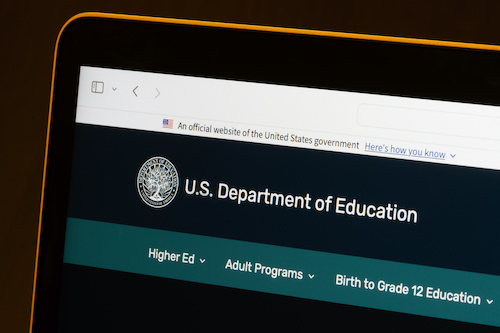
    A federal judge on May 22 issued a preliminary injunction blocking President Donald Trump’s executive order to shut down the U.S. Department of Education and said the agency must reinstate the employees who were fired as part of mass layoffs.

    After U.S. Education Secretary Linda McMahon announced the agency’s plans in March to slash its workforce by roughly half, she called it a first step in getting rid of the agency. Trump followed days later with his executive order aiming to eliminate the department, a move he has long wanted.

    But only Congress can actually eliminate the department, and the administration’s attempt at getting around that influenced U.S. District Judge Myong Joun’s Thursday ruling.

    The Trump administration argued that they implemented agency layoffs to improve “efficiency” and “accountability,” the Massachusetts judge wrote, but then said: “The record abundantly reveals that [the administration’s] true intention is to effectively dismantle the Department without an authorizing statute.”

    Joun added: “A department without enough employees to perform statutorily mandated functions is not a department at all. This court cannot be asked to cover its eyes while the Department’s employees are continuously fired and units are transferred out until the Department becomes a shell of itself.”

    Within hours of the Joun’s ruling, the Trump administration filed an appeal.

    “This ruling is not in the best interest of American students or families,” Madi Biedermann, Deputy Assistant Secretary for Communications, wrote in a statement.

    Calls for the injunction came from lawsuits filed by the Somerville and Easthampton schools districts in Massachusetts along with the American Federation of Teachers, other education groups, and 21 Democratic attorneys general.

    They argued that the gutting of the department rendered the agency incapable of performing many of its core functions required by Congress.

    For example, all of the attorneys from the agency’s general counsel office who handle grants for K-12 schools and grants under the Individuals with Disabilities Education Act, or IDEA, had been fired. The dismantling of the Office for Civil Rights made it difficult to enforce civil rights protections. The department’s Financial Student Aid programs, which provide financial assistance to almost 12.9 million students across approximately 6,100 postsecondary educational institutions, were also hampered.

    Trump’s executive order instructed McMahon to “take all necessary steps to facilitate the closure of the Department of Education and return authority over education to the States and local communities” to the “maximum extent appropriate and permitted by law.”

    At the same time, the order said McMahon should ensure “the effective and uninterrupted delivery of services, programs, and benefits on which Americans rely.”

    Trump said he would move the agency’s student loan portfolio to the Small Business Administration, and the Department of Health and Human Services would replace the Education Department’s role in “handling special needs.”

    Before the layoffs, the Education Department was the smallest of the 15 cabinet-level departments in terms of staffing, according to the judge, with around 4,100 employees. And the plaintiffs said the agency was strained meeting its obligations even then.

    The ruling was not based on the employees’ job rights, but rather how the agency was able to fulfill its obligations.

    “It’s not about whether employees have a right to a job,” said Derek Black, a University of South Carolina law professor. “It’s about whether the department can fulfill its statutory obligations to the states and to students.”

    The case made by former department employees, educational institutions, unions, and educators, Joun wrote, paints “stark picture of the irreparable harm that will result from financial uncertainty and delay, impeded access to vital knowledge on which students and educators rely, and loss of essential services for America’s most vulnerable student populations.”

    American Federation of Teachers President Randi Weingarten heralded the judge’s ruling, calling it “a first step to reverse this war on knowledge and the undermining of broad-based opportunity.”

    But Biedermann, from the Education Department, said the ruling was unfair to the Trump administration.

    “Once again, a far-left Judge has dramatically overstepped his authority, based on a complaint from biased plaintiffs, and issued an injunction against the obviously lawful efforts to make the Department of Education more efficient and functional for the American people,” she said in a statement.

    Chalkbeat national editor Erica Meltzer contributed reporting.

    Chalkbeat is a nonprofit news site covering educational change in public schools.

    For more news on federal policy, visit eSN’s Educational Leadership hub.

    Latest posts by eSchool Media Contributors (see all)

    Source link

  • Students learn the basics of AI as they weigh its use in their future careers

    Students learn the basics of AI as they weigh its use in their future careers

    This story was originally published by Chalkbeat. Sign up for their newsletters at ckbe.at/newsletters.

    On a recent Thursday morning, Michael Taubman asked his class of seniors at North Star Academy’s Washington Park High School: “What do you think AI’s role should be in your future career?”

    “In school, like how we use AI as a tool and we don’t use it to cheat on our work … that’s how it should be, like an assistant,” said Amirah Falana, a 17-year-old interested in a career in real estate law.

    Fernando Infante, an aspiring software developer, agreed that AI should be a tool to “provide suggestions” and inform the work.

    “It’s like having AI as a partner rather than it doing the work,” said Infante during class.

    Falana and Infante are students in Taubman’s class called The Summit, a yearlong program offered to 93 seniors this year and expanding to juniors next year that also includes a 10-week AI course developed by Taubman and Stanford University.

    As part of the course, students use artificial intelligence tools – often viewed in a negative light due to privacy and other technical concerns – to explore their career interests and better understand how technology could shape the workforce. The class is also timely, as 92% of companies plan to invest in more AI over the next three years, according to a report by global consulting firm McKinsey and Company.

    The lessons provide students with hands-on exercises to better understand how AI works and how they can use it in their daily lives. They are also designed so teachers across subject areas can include them as part of their courses and help high school students earn a Google Career Certificate for AI Essentials, which introduces AI and teaches the basics of using AI tools.

    Students like Infante have used the AI and coding skills they learned in class to create their own apps while others have used them to create school surveys and spark new thoughts about their future careers. Taubman says the goal is to also give students agency over AI so they can embrace technological changes and remain competitive in the workfield.

    “One of the key things for young people right now is to make sure they understand that this technology is not inevitable,” Taubman told Chalkbeat last month. “People made this, people are making decisions about it, and there are pros and cons like with everything people make and we should be talking about this.”

    Students need to know the basics of AI, experts say

    As Generation Z, those born between 1997 and 2012, graduate high school and enter a workforce where AI is new, many are wondering how the technology will be used and to what extent.

    Nearly half of Gen Z students polled by The Walton Family Foundation and Gallup said they use AI weekly, according to the newly released survey exploring how youth view AI. (The Walton Family Foundation is a supporter of Chalkbeat. See our funders list here.) The same poll found that over 4 in 10 Gen Z students believe they will need to know AI in their future careers, and over half believe schools should be required to teach them how to use it.

    This school year, Newark Public Schools students began using Khan Academy’s AI chatbot tutor called Khanmigo, which the district launched as a pilot program last year. Some Newark teachers reported that the tutoring tool was helpful in the classroom, but the district has not released data on whether it helped raise student performance and test scores. The district in 2024 also launched its multimillion project to install AI cameras across school buildings in an attempt to keep students safe.

    But more than just using AI in school, students want to feel prepared to use it after graduating high school. Nearly 3 in 4 college students said their colleges or universities should be preparing them for AI in the workplace, according to a survey from Inside Higher Ed and College Pulse’s Student Voice series.

    Many of the challenges of using AI in education center on the type of learning approach used, accuracy, and building trust with the technology, said Nhon Ma, CEO of Numerade – an online learning assistant that uses AI and educators to help students learn STEM concepts. But that’s why it’s important to immerse students in AI to help them understand the ways it could be used and when to spot issues, Ma added.

    “We want to prepare our youth for this competitive world stage, especially on the technological front so they can build their own competence and confidence in their future paths. That could potentially lead towards higher earnings for them too,” Ma said.

    For Infante, the senior in Taubman’s class, AI has helped spark a love for computer science and deepened his understanding of coding. He used it to create an app that tracks personal milestones and goals and awards users with badges once they reach them. As an aspiring software developer, he feels he has an advantage over other students because he’s learning about AI in high school.

    Taubman also says it’s especially important for students to understand how quickly the technology is advancing, especially for students like Infante looking towards a career in technology.

    “I think it’s really important to help young people grapple with how this is new, but unlike other big new things, the pace is very fast, and the implications for career are almost immediate in a lot of cases,” Taubman added.

    Students learn that human emotions are important as AI grows

    It’s also important to remember the limitations of AI, Taubman said, noting that students need the basic understanding of how AI works in order to question it, identify any mistakes, and use it accordingly in their careers.

    “I don’t want students to lose out on an internship or job because someone else knows how to use AI better than they do, but what I really want is for students to get the internship or the job because they’re skillful with AI,” Taubman said.

    Through Taubman’s class, students are also identifying how AI increases the demand for skills that require human emotion, such as empathy and ethics.

    Daniel Akinyele, a 17-year-old senior, said he was interested in a career in industrial and organizational psychology, which focuses on human behavior in the workplace.

    During Taubman’s class, he used a custom AI tool on his laptop to explore different scenarios where he could use AI in his career. Many involved talking to someone about their feelings or listening to vocal cues that might indicate a person is sad or angry. Ultimately, psychology is a career about human connection and “that’s where I come into play,” Akinyele said.

    “I’m human, so I would understand how people are feeling, like the emotion that AI doesn’t see in people’s faces, I would see it and understand it,” Akinyele added.

    Falana, the aspiring real estate attorney, also used the custom AI tool to consider how much she should rely on AI when writing legal documents. Similar to writing essays in schools, Falana said professionals should use their original writing in their work but AI could serve as a launching pad.

    “I feel like the legal field should definitely put regulations on AI use, like we shouldn’t be able to, draw up our entire case using AI,” Falana said.

    During Taubman’s class, students also discussed fake images and videos created by AI. Infante, who wants to be a software developer, added that he plans to use AI regularly on the job but believes it should also be regulated to limit disinformation online.

    Taubman says it’s important for students to have a healthy level of skepticism when it comes to new technologies. He encourages students to think about how AI generates images, the larger questions around copyright infringement, and their training processes.

    “We really want them to feel like they have agency in this world, both their capacity to use these systems,” Taubman said, “but also to ask these broader questions about how they were designed.”

    Chalkbeat is a nonprofit news site covering educational change in public schools.

    For more on AI in education, visit eSN’s Digital Learning hub.

    Latest posts by eSchool Media Contributors (see all)

    Source link