Category: storytelling

  • Can you picture your story on a big screen?

    Can you picture your story on a big screen?

    Some people would rather watch movies than read news articles.

    The thing is, an awful lot of movies came out of news articles. Consider the entire Fast & Furious movie franchise, starring Vin Diesel and my personal movie favorite Michelle Rodriguez (shout out!). It revolves around people who race souped up cars on city streets.

    The idea of the first movie started with an article by journalist Ken Li, after he saw someone steal a car in New York and that spurred him to investigate the underground world of street racing. Someone at Universal Studios saw the article and bought the rights to it. 

    Or consider the Tom Cruise movie Top Gun, about a cocky U.S. Navy pilot. The idea for that came from a story in California magazine about Navy pilots.

    How can all this help an aspiring journalist? Well, thinking about your news story as the movie that might be commissioned from it is a way of seeing the story. So how do you go about doing that?

    Visualize your story

    First, think of the characters in your story. Who are the central actors involved? Who is the Vin Diesel or Tom Cruise in your story? 

    Who does the problem you are exploring affect? Who is causing it or standing in the way of solutions? Who are the people trying to solve or mitigate the problem? In journalism, the basic story structure is Who, What, Where, When and Why. The characters are the Who of the story. 

    The most compelling movies (and news stories) revolve around conflict: What are the stakes? In Fast & Furious, one of the main conflicts is the role of Brian O’Connor, who starts out as an FBI agent investigating the car racers and then becomes loyal to them. 

    Movie scripts revolve around turning points: What could change the course? What steps are being taken to solve or mitigate the problem you are exploring? What are people or corporations or governments or organizations doing that could worsen the situation? This is the What of the story. 

    Then think about the setting: Where is the crisis playing out? The original Fast & Furious took place in Los Angeles. Top Gun took place at a naval base in San Diego, California. This is the Where of the story. 

    Finally, what drives your story is the motivation of the characters: Why do they take the actions they do? 

    In Top Gun, Tom Cruise’s character is motivated by the death of his friend Goose to be the best pilot he can be. In Fast & Furious, Vin Diesel is motivated by the death of Michelle Rodriguez’s character to seek justice. 

    Actions and motivations

    Death is a common motivation in movies — the killing of John Wick’s dog triggered one of the most successful movie franchises out there. But for non-fiction news stories, there can be all kinds of motivations: parents wanting to get their kids into good schools, communities wanting to fight crime in their neighborhoods, governments wanting to end homelessness. 

    In news stories this is the Why of the story. Why does some corporation build a plant in your community? Why does some NGO oppose a development proposal? What’s their reason and motivation?

    So now try this: Think of a problem around you that you want to explore. It could be about anything from climate change, to mental health or inequities in sports or education. Start by noting down the Who (actors), What (what’s at stake), When, Where (setting) and Why (the motivations of the characters). Then turn this into a few paragraphs as if you’re writing for a news site. 

    Start with a hook: It should be something interesting or important. Why is this a big story? Why should people care? Then summarize in one paragraph the whole story. What’s the overall problem? Where is it happening and when, how did it start, what is causing it and who is it affecting? 

    Next, slowly work through each of those elements — the who, what, where, when, how and why. There is the meat of your story. Finally, talk about what’s next. What are the solutions or mitigations happening or proposed?

    Who knows? You might get your story published and down the line a Hollywood or Bollywood producer calls you up. Now, isn’t that motivation to write a news story? Just make sure you have a good agent.


    Questions to consider:

    1. How can seeing your story as a movie help you report and write it?

    2. If your life played out as a movie, what would be the central theme?

    3. Think about the most important thing you are doing these days. What motivates you to do it?


    Source link

  • Cross platforms to reach a wider audience

    Cross platforms to reach a wider audience

    In telling the story across different platforms, the important thing is to think about who you tell the story to. Imagine talking to them in person. You wouldn’t drone on with facts and data, you would get to what your story is really about.

    The great thing is that in publishing across platforms through different types of media, you don’t need fancy equipment or fancy sound or video editing techniques.

    Instead, the people who know how to do all that often go out of their way to make things look more raw, because raw looks more authentic and authentic is what many media consumers value.

    You can even use an AI program to help you create images, but make sure you tell your audience that you did that. In telling true stories you don’t want to mislead or misinform.

    Source link

  • To write about what’s new, look to the past

    To write about what’s new, look to the past

    To help explain what’s happening out there now, it helps to delve into the past. 

    That’s because, for one thing, something similar probably happened before and how that ended might help you anticipate what will happen next.

    News story after news story about U.S. President Donald Trump, for instance, talks about things being unprecedented. But did you know that in the 1850s in the United States there was a political party called the Know Nothing party. It was xenophobic and a spreader of conspiracy theories. According to the writer Lorraine Boissoneault, it was anti-immigration and called for mandatory Bible readings in schools. 

    “At its height in the 1850s, the Know Nothing party, originally called the American Party, included more than 100 elected congressmen, eight governors, a controlling share of half-a-dozen state legislatures from Massachusetts to California and thousands of local politicians,” Boissoneault wrote. 

    It is important to delve into history when doing a news story because things don’t just happen. Stuff led up to what is happening now. There are causes, and causes of causes. There might be a whole link of events that led up to the calamity that is now, or the explosion that happened or the political turmoil you find yourself in. 

    Put events into context.

    A little history in a story brings depth and context. It makes the whole story more interesting and helps people better understand what is happening now. News Decoder correspondent Gene Gibbons helped us understand the constitutional crisis the United States finds itself under Trump by looking back at a previous crisis in the 1970s under President Richard Nixon. 

    Correspondent Bernd Debusmann knew he couldn’t really explain the significance of the antipathy Trump now has for the European Union without explaining why the EU was formed in the first place. That meant going back to the aftermath of World War Two. 

    Correspondent Barry Moody helped us appreciate the triumphant win in a rugby game in South Africa by delving into the long history of apartheid and showing how rugby fit into that. 

    But how do you add some history? Well, you find yourself a historian. Every town has one, whether that person carries a title or not. A historian is simply someone who keeps track of past events and often documents them by collecting news stories or photographs, or by keeping journals. They might be the caretaker of archives of one kind or another. 

    You can also seek out professional historians. They can be found in university history departments, libraries and historical societies. Some are super specialized. I once saw a great documentary about a portrait of a woman believed to be painted by Leonardo de Vinci, and to prove it, the owner found a hair historian who found that the hairstyle of the woman was specific to a short time in history in a very small geographical area of Italy. 

    If you were doing a story about technology and wanted to include a bit of history you could contact the Society for the History of Technology. There are historians of politics, war, fashion, movies, food and architecture. 

    You can also just ask about the history of a place or event when you interview experts on what is happening now. You can’t really call yourself an expert on any topic if you don’t know its history. 

    So when you ask about what just happened, ask about what happened a decade or two ago, or more. Ask how things came to be the way they are. Maybe if we all understood the history of our times, history wouldn’t have to repeat itself. 


    Questions to consider:

    1. How can history add context to a news story?

    2. Where might you find a historian?

    3. If you were doing a story about your town, where would you find someone knowledgeable about its history?


    Source link

  • What stories can teach us about the world

    What stories can teach us about the world

    In a time of widespread misinformation, disinformation, fake news and outright lies throughout the world, many people are wondering what the truth really is and how to find it.

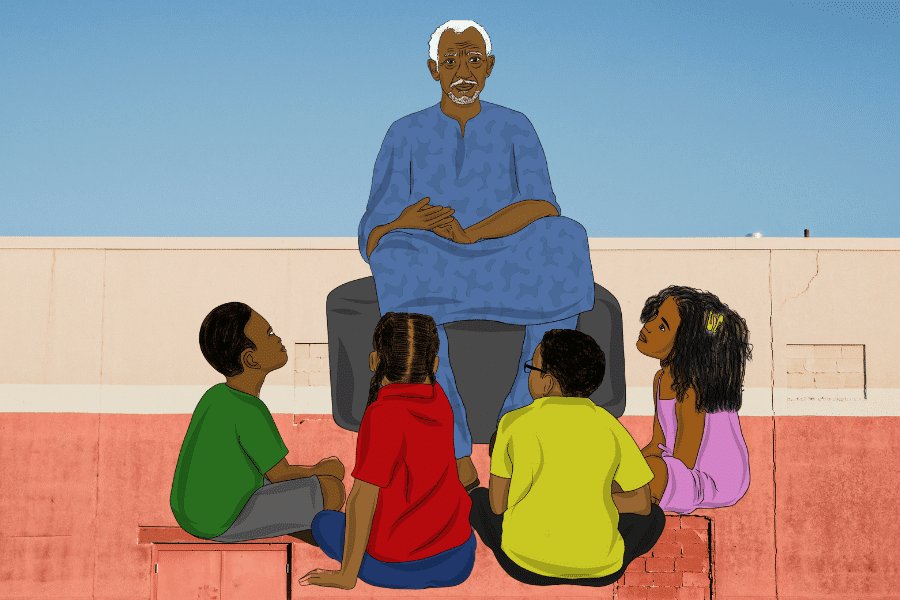
    In Africa, it is embedded in the power of story.

    “The oral tradition has always been a hallmark of West African culture for generations long before colonization, and so storytellers have been the truth tellers,” said Dr. Geremie Sawadogo, a World Bank talent manager and storyteller, who, as a child growing up in Burkina Faso, would gather with his family to listen to story hour on national radio every Tuesday evening.

    David Thuku, an executive coach and storyteller in Nairobi, Kenya, agreed. “Stories are a very structured system of managing life and giving knowledge about such things as governance, values, laws, social sciences and medicine. Medicine men, for example, would tell people which plants to use for different illnesses,” Thuku said.

    “They also taught us morals and our code of acceptable behaviours,” Sawadago added. For many, they are a form of timeless, universal truth.

    African stories can come in many different forms: two- to three-hour speeches, long monologues, oral renditions, poems, sayings, proverbs, fables, folklore tales, visual language, songs and even dance.

    Source link

  • The Power of Students’ Stories – Faculty Focus

    The Power of Students’ Stories – Faculty Focus

    Source link

  • The Power of Students’ Stories – Faculty Focus

    The Power of Students’ Stories – Faculty Focus

    Source link

  • Revolutionizing storytelling with AI: Empowering ELLs

    Revolutionizing storytelling with AI: Empowering ELLs

    Key points:

    Imagine this: You assign your students a writing prompt, and while some eagerly begin crafting their stories, others stare at the blank page, muttering, “I have nothing to write,” or “I can’t think of a story.” For English Language Learners (ELLs), this scenario is even more daunting due to limited vocabulary or fear of making mistakes. In fact, studies show that a lack of confidence and linguistic resources often prevents ELLs from fully engaging in creative writing, despite their rich cultural and personal experiences.

    As educators, we constantly seek ways to help students overcome these barriers. Enter artificial intelligence (AI)–a powerful tool that transforms storytelling into an accessible and engaging experience for every student. By integrating AI into storytelling, we can empower students to generate ideas, build confidence, and create compelling narratives, all while developing their language skills.

    Getting started: Using AI to spark creativity

    A simple and engaging way to introduce AI in storytelling is by using a writing prompt and generating an example story opening with ChatGPT. For instance, you might ask: “Write the opening to a mysterious story about an abandoned lighthouse.”

    ChatGPT could respond: “The wind howled through the cracks of the abandoned lighthouse, carrying whispers of secrets long forgotten. The light, extinguished for decades, seemed to flicker faintly as if trying to tell a story no one had yet heard.”

    Students can take this opening and continue the story in their own words, expanding the scene, introducing new characters, or creating a plot twist. This method not only sparks creativity but also provides ELLs with a scaffold, building their confidence to dive into storytelling.

    To bring their stories to life, students can use AI image generators like DALL-E or tools like Canva to create visuals matching their narratives. For example, they could create an eerie image of the abandoned lighthouse with flickering light and stormy skies. This connection between words and visuals reinforces comprehension and engages students in the storytelling process.

    The final step is sharing stories and visuals with the class. Presenting their work allows students to practice speaking, gain confidence, and showcase their creativity.

    How AI enhances storytelling

    AI tools offer unique opportunities to support ELLs in their storytelling journey. When
    students struggle to come up with ideas, tools like ChatGPT can provide engaging prompts and vivid descriptions to spark creativity. For example, a student might request a description of a magical forest and receive a response like: “A forest bathed in golden sunlight, where trees tower like ancient guardians and the air shimmers with tiny, glowing orbs.” Such detailed imagery can inspire students to dive into their stories with greater confidence.

    In addition to idea generation, AI tools help expand students’ vocabulary. ELLs can use AI to explore synonyms or alternative ways to describe scenes, enriching their language repertoire.

    For instance, if a student wants to avoid repeating the word “beautiful,” the AI might suggest options like “stunning,” “captivating,” or “breathtaking,” enabling more nuanced and expressive writing.

    Visual storytelling is another area where AI shines. Tools like DALL-E or Adobe Express allow students to create images that align with their narratives, making their stories come to life. For example, a student writing about a mysterious glowing orb could generate a corresponding image, blending creative thinking with visual artistry.

    Once students have drafted their stories, AI-based writing assistants like Grammarly can help refine their grammar, spelling, and sentence structure. This process encourages independence and self-correction, teaching students to identify and address their mistakes while improving the overall clarity and polish of their work.

    Interactive platforms like Twine take storytelling to a new level by enabling students to create “choose your own adventure” narratives. For example, students might create a mystery where readers decide whether to follow a shadowy figure or stay hidden, leading to different outcomes. This fosters critical thinking and collaboration as students craft branching storylines and engage in problem-solving to connect various plot points.

    Classroom example: AI in action

    In a Grade 8 ESL classroom, students were given the prompt: “Write about a strange object you find buried in your backyard.” After brainstorming ideas with ChatGPT, one student created a story about a glowing orb that transported them to another dimension. They used DALL-E to generate an image of the orb, and Twine to develop a branching narrative where the reader decides whether to touch the orb or call for help. The result was an immersive storytelling experience that combined creativity with critical thinking.

    By incorporating AI tools, students not only created more engaging stories but also developed their language skills in a meaningful and enjoyable way.

    Making storytelling accessible and engaging

    Using AI in storytelling doesn’t just overcome barriers; it transforms the experience for students. Visual elements and interactivity keep learners engaged, while tools for grammar and vocabulary improvement build confidence. For ELLs, AI provides scaffolding and encouragement to take creative risks and express themselves authentically.

    Guiding responsible AI use

    While AI opens doors to creativity, teaching students to use these tools responsibly is
    essential.

    Students need to understand the concept of AI “hallucinations,” where AI generates
    inaccurate or entirely fabricated information. For instance, an AI might describe a historical event inaccurately or create a fictional fact that seems plausible. Educators should teach students to verify AI-generated information with reliable sources.

    Equally important is teaching students how to craft clear and specific prompts. For example, instead of asking, “What happens in a story?” they might ask, “Can you suggest a story idea about a character who solves a mystery in a small town?”

    Modeling this process helps students see how precise wording yields better results.
    Encouraging critical thinking is also crucial. Teachers can create opportunities for students to analyze AI-generated content by asking: “Does this make sense? Is it accurate? Can I verify it elsewhere?” Such discussions help students see AI as a helpful tool, but not an infallible one.

    Students should also learn that AI is a partner in creativity, not a replacement for their
    original thinking. They must guide the AI, evaluate its outputs, and make creative decisions to ensure their work remains authentically theirs. Additionally, students should be encouraged to credit AI-generated content appropriately to foster ethical use.

    Conclusion

    Storytelling is a cornerstone of language learning, offering ELLs opportunities to build
    vocabulary, practice grammar, and express their ideas. With AI, the storytelling process becomes more accessible, engaging, and impactful. From generating prompts to creating visuals and refining drafts, AI supports students in overcoming challenges and discovering the joy of storytelling.

    By integrating AI tools responsibly, educators empower every student to find their voice and share their unique stories with confidence. In the intersection of creativity and technology, AI has the potential to revolutionize the way we teach and learn storytelling

    Latest posts by eSchool Media Contributors (see all)

    Source link