Category: Strategy + Consulting

  • How a Napkin Sketch Can Unlock Higher Ed Innovation at Your Institution

    How a Napkin Sketch Can Unlock Higher Ed Innovation at Your Institution

    In higher education, it’s easy to feel stuck.

    You know something isn’t working — maybe enrollment processes are clunky, or student support services feel disconnected. You’ve tried new tools, updated systems, created initiatives to create change, and added staff, but the problem persists.  It’s like there’s a giant boulder in your way, and no matter how hard you push, it doesn’t budge.

    It turns out, you don’t need a bulldozer – just a napkin sketch to start building momentum to move the boulder standing in the way.

    It’s a surprisingly simple concept, using visual design thinking exercises to help colleges and universities get unstuck. Not with more tech, or a fancy AI solution, but with more clarity to understand how things work today to create a framework for change tomorrow.

    Because real innovation in higher education doesn’t come from software or a technology — it starts with understanding the systems and the processes you already have so you can visualize what they could be.

    What is a napkin sketch?

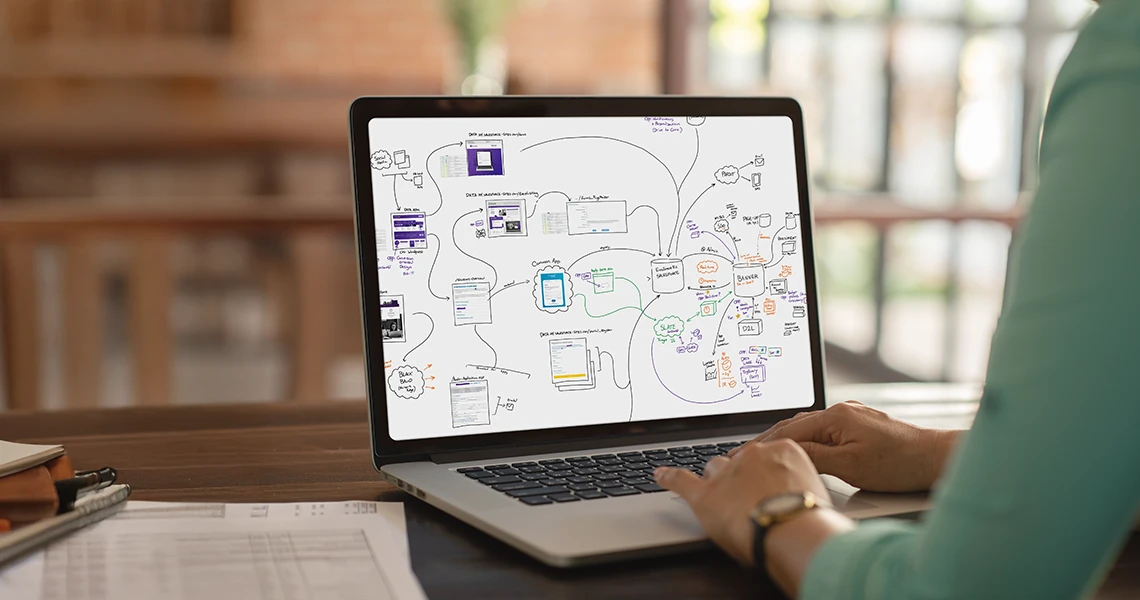
    The napkin sketch is exactly what it sounds like: a back-of-the-napkin-style drawing that quickly maps out how a particular process actually works in your institution so it can be reimagined.

    It’s low-tech, but high-impact.

    Think of it as building a gameboard for players to play. Like a Monopoly board, everyone knows the players, the rules, and the steps. It makes the choices that need to be made for each player’s turn clear.  When these choices are laid out visually, it becomes much easier to pinpoint where the real opportunities (and challenges) are.

    What does the napkin sketch exercise entail?

    I usually start these sessions by asking one simple questions with a key follow-up

    • What’s the opportunity for ‘impact’? (What are you trying to accomplish?)
    • What’s preventing progress?

    Then we get to work. Together, we sketch out the entire process: from first interaction to the final outcome. We account for every step, system, and stakeholder that’s involved. We highlight the costs, the tools and technology handoffs, potential delays, and where things might be falling through the cracks.

    We typically conduct the sketch in a virtual drawing space, where we can collaborate in real time to map out the full process. It’s not about polished visuals — it’s about building a shared understanding of how things operate today.

    And in about 60-90 minutes, we always have at least one person in the group say out loud “I didn’t realize that’s how it actually works.” And another will inevitably ask “You’re going to send us this napkin sketch, right? I want to print it out.”

    Ready for a Smarter Way Forward?

    Higher ed is hard — but you don’t have to figure it out alone. We can help you transform challenges into opportunities.

    What can the napkin sketch reveal?

    In our experience working with hundreds of institutions of all shapes and sizes, we’ve found that many face surprisingly similar challenges. This exercise consistently shines a light on hidden opportunities, creating a blueprint for change.

    Common things we uncover include:

    • Manual, repetitive tasks that could be automated or streamlined
    • Workarounds that have become permanent fixtures without anyone questioning them
    • Disconnects between departments, systems, or technologies
    • Operational silos that prevent teams from seeing the full picture or collaborating effectively
    • Missed opportunities to better track, analyze, or act on data
    • Unclear ownership of key steps in the process

    In short, the napkin sketch helps institutions see what’s really going on — and what needs to change to move forward.

    Why does it work?

    Higher ed innovation often stalls because teams are too close to the problem or too deep in their own silo to see the bigger picture. The napkin sketch breaks through that by creating a space for everyone involved to step back and collaborate.

    Here’s why it’s effective:

    • It’s fast — most sessions take an hour or two.
    • It’s visual — helping teams align quickly and clearly.
    • It’s collaborative — bringing together voices from across departments.
    • It’s actionable — revealing next steps that are grounded in reality.

    Most importantly, it shifts the focus away from jumping to solutions and toward understanding the system. Once you understand the system, smart solutions become much more obvious — and effective.

    Real examples of the napkin sketch in action

    Whether it’s enrollment workflows, transcript processing, student communications, or data handoffs between systems or teams, the napkin sketch exercise can help untangle a wide variety of operational challenges. No two institutions are exactly alike, but many face similar complexities — manual processes, siloed teams, and unclear ownership that stall progress.

    Here are a few discoveries we uncovered in recent napkin sketch sessions I’ve led:

    • One institution realized how many steps were involved in processing transcripts — with staff toggling between platforms, uploading the same file in multiple places, and doing manual comparisons. Once the process was mapped, we explored how AI could handle the course match evaluations — saving hours of staff time each week.
    • Another team sketched out their enrollment outreach process and discovered they were sending multiple conflicting messages to students at the same time. The sketch helped them realign their communications and reduce student confusion.
    • A third school wanted to integrate a new tool into their tech stack, but the sketch revealed that the underlying workflow was broken — and that no tool would help until the foundational process was improved.

    In each case, the aha moment didn’t come from buying something new — it came from clearly seeing what was already happening so it could be improved upon.

    What could your napkin sketch uncover?

    If you’re wrestling with outdated processes, disconnected systems, or unclear handoffs — you’re not alone. Many institutions are trying to drive higher ed innovation with limited resources and overwhelming complexity.

    But you don’t need to have all the answers right now. You just need a clearer view of the problem so you can develop a thoughtful solution.

    That’s what the napkin sketch offers: a simple, collaborative way to map your reality, uncover opportunity, and take a smarter next step forward.

    Let’s sketch it out — and see what we find!

    Ready to uncover what’s holding you back?

    Reach out to schedule your own session and take the first step toward smarter solutions.

    Source link

  • Do More with Less: 7 Strategic Advantages of Shared Services in Higher Education

    Do More with Less: 7 Strategic Advantages of Shared Services in Higher Education

    College administrators wear many hats to ensure their institutions thrive. Stakeholders expect them to be visionaries, budget stewards, tech experts, and student champions. However, wearing too many hats can hinder the ability to meet more strategic and forward-thinking institutional demands, effectively diluting leadership capacity and outcomes. 

    How can administrators remove some of those hats without losing control or spending more? 

    How can they guide their institutions to achieve better outcomes with fewer resources?  

    At the 2024 Collegis Education Summit, keynote speaker Dr. John Smith-Coppes, president of Joyce University, shared his advice for achieving higher ed excellence amid market paradigms, shifting learner expectations, and capacity constraints.

    “Embrace your institutional superpower and then partner for expertise. You have to know what you are really good at, but also where you might need help. Having the bravery to objectively look at the brutal facts can take you from good to great. Keep this in mind: Your institution is perfectly designed to get the outcomes it’s getting.”

    -Dr. John Smith-Coppes, President of Joyce University

    Dr. Smith-Coppes is right. If you’re not getting the results you want, you have to shine a light on the operation and consider what adjustments or changes will better position your institution for desired outcomes.

    To echo Dr. Smith-Coppes and answer the earlier questions, working with a strategic partner who has deep expertise in higher education shared services and can manage certain responsibilities more efficiently can get your institution closer to turning aspiration into reality. A true partnership is not about simply outsourcing tasks. Rather, it’s a strategic way to gain access to specialized knowledge, proven methodologies, and scalable resources, all while enabling administrators to focus on their core areas of expertise.

    Mounting challenges facing higher ed leaders

    When I talk to administrators, the conversation inevitably turns to the challenge of doing more with less. They consistently grapple with four key issues:

    • Budget Cuts: Funding is uncertain or shrinking, forcing them to rethink the allocation of resources.
    • Advancing Technology: Technology is rapidly evolving, leaving administrators to scramble after the next advancement or emerging capability.
    • Socioeconomic Pressures: With some questioning the value of postsecondary education, relevant programs with affordable tuition have never been more critical.
    • Employee Turnover: Retaining top talent is difficult, leaving critical gaps.

    But none of these issues surprise us. On the contrary, Collegis Education has partnered with numerous public and private institutions of varying sizes and levels of brand recognition to address these challenges, uncovering advantageous pathways toward more sustainable and fruitful operations.

    The results speak for themselves. Administrators gain more time to leverage their core strengths to elevate their institution’s mission and educational outcomes while actualizing a variety of clear benefits. Here is what Collegis Education continues to deliver for our shared-service partners.

    Seven ways shared services in higher education deliver results

    Institutions that leverage shared services experience benefits in a variety of key areas. Explore some of the most significant advantages:

    1. Improved financial stability

    Predictability and optimization are the key words here. With our solutions for technology management, enrollment management, and student services, institutions know exactly what to budget every year. At the same time, we find cost savings by getting a better return on technology investments, strategically decommissioning redundancies, and renegotiating contracts.

    2. Enhanced operational efficiency

    Is there a better way to reach an institution’s goals more efficiently? More often than not, the answer is yes. We help bring these opportunities to the surface by fully assessing the school’s infrastructure, technology, processes, and other operating procedures. This assessment denotes areas of excellence and points of failure as well as identifies where lag or waste exists. With these insights, we can identify and prioritize emerging opportunities to drive improvement. All this informs a multiyear roadmap that guides higher ed leaders on how to thoughtfully implement changes that engage key stakeholders to accelerate the change management cycle.

    3. Objective perspective & best practices

    We bring a unique perspective to our recommendations based on our work with other schools while protecting each school’s anonymity and uniqueness. This helps give you a baseline of how your school performs when compared to similar ones. Are you leading or lagging? As an unbiased third party, we offer fresh ideas backed by the knowledge of the results they have produced. It’s a great way to eliminate the “but this is how we’ve always done it” objection and gain buy-in from internal staff.

    4. Risk mitigation & accountability

    There’s rarely a higher ed situation we haven’t already dealt with at another institution. Our partners benefit from this experience, allowing them to proactively avoid operational and technical risks. They also benefit tremendously from having a partner who holds themselves accountable to quantifiable outcomes measured by agreed-upon service level agreements (SLAs). Together, these provide a lot of peace of mind when it comes to issues like cybersecurity, compliance, disaster recovery, and business continuity.

    5. Specialized expertise without the overhead

    Hiring and retaining experienced staff is challenging enough. Finding people with skill sets to leverage evolving technology capabilities like artificial intelligence (AI) is a whole other story. That’s why our partners rely on Collegis to provide the expertise that’s hard to find. We’re software-agnostic and implement solutions that are in the school’s best interest from a financial, operational, and strategic perspective without the need for full-time employees to manage them.

    6. Data-enabled decision making with full transparency

    Data at most institutions is stored in siloes, with limited stewardship and governance over its quality and consistency. However, many of the “data” solutions in the market today are complicated and difficult to implement and support.

    This is why we built Connected Core, a scalable higher education industry cloud solution that integrates siloed data sets, systems, and applications to enable institutional intelligence. This proven approach and methodology for collecting, connecting, and activating institutional data eliminates data doubt and gives leaders the confidence to make quickly make strategic decisions with confidence.

    7. Focus on core mission & educational outcomes

    By outsourcing some functions, administrators can redirect resources and energy to what truly matters: student success. By reducing the number of hats they wear, leaders can instead focus on using the tools they have on hand to manage strategic initiatives that drive institutional growth.

    Strategic delegation to yield better outcomes

    Some leaders fear losing control through outsourcing, and rightfully so. Too many vendors tout “partnership” when, in fact, they are trying to build an unhealthy dependency that is not mutually beneficial.

    That’s just not us. It fundamentally goes against our values and who we are as a company.

    Our partnerships are built on collaboration and shared governance. Institutions set priorities, and all actions follow clear assessments, implementation plans, and progress reviews. Our partners gain greater control over technology, enrollment, and budgets. Control isn’t lost, but visibility and accountability are gained.

    Shared-services models allow administrators to confidently offload specific responsibilities. Leveraging external expertise amplifies your internal strengths and empowers your leaders to focus on building and maintaining a thriving campus community.

    But the first step is starting the conversation with the right partner.

    Innovation Starts Here

    Higher ed is evolving — don’t get left behind. Explore how Collegis can help your institution thrive.

    Source link

  • Employer Perceptions of Higher Ed Partnerships

    Employer Perceptions of Higher Ed Partnerships

    Facing challenges in enrollment, retention, or tech integration? Seeking growth in new markets? Our strategic insights pave a clear path for overcoming obstacles and driving success in higher education.

    Unlock the transformative potential within your institution – partner with us to turn today’s roadblocks into tomorrow’s achievements. Let’s chat.

    Source link

  • The Effect of Employer Understanding and Engagement on Non-Degree Credentials

    The Effect of Employer Understanding and Engagement on Non-Degree Credentials

    The Effect of Employer Understanding and Engagement on Non-Degree Credentials Report

    HoMore than 500 employers share their perceptions

    As the workforce evolves, many employers are considering the relevance and use of alternative credentials for upskilling or reskilling employees. This reimagining of workforce education provides an opportunity for higher ed leaders to partner with employers on microcredential programs that drive a funnel of enrollments.

    Collegis teamed up with UPCEA to survey more than 500 employers about their perceptions of microcredentials and interest in partnering with colleges and universities on these non-degree programs.

    Download the report to receive insights on:

    What incentivizes employers to work with higher ed institutions

    Employer valuation of alternative credentials

    Employer use of alternative credentials in lieu of degrees in the hiring process

    Download Now

    MktoForms2.loadForm(“//087-TII-060.mktoweb.com”, “087-TII-060”, 1548);

    Additional Resources

    The post The Effect of Employer Understanding and Engagement on Non-Degree Credentials appeared first on Collegis Education.

    Source link

  • Making Higher Ed’s Back Office More Efficient and Student-Centric

    Making Higher Ed’s Back Office More Efficient and Student-Centric

    Facing challenges in enrollment, retention, or tech integration? Seeking growth in new markets? Our strategic insights pave a clear path for overcoming obstacles and driving success in higher education.

    Unlock the transformative potential within your institution – partner with us to turn today’s roadblocks into tomorrow’s achievements. Let’s chat.

    Source link

  • Rethinking Your Student Population

    Rethinking Your Student Population

    Rethink your student population whitepaper

    Adult learners are higher ed’s future

    Reskilling, upskilling and lifelong learning are creating a big opportunity for higher education to become the go-to resource for career-minded adults. But not all adult learners are alike. In this report, we break them down into four types of adult learners (Career Advancer, Career Builder, Discerning Academic and Hesitant Learner).

    Download the white paper with the following insights for each persona:

    • Top motivations
    • Recruitment strategies
    • Program optimization recommendations

    Collegis Education surveyed 1,000 adult learners interested in pursuing degrees for this white paper, Rethink Your Student Population. Discover who makes up the majority of the adult learner market and how to target your outreach to grow your enrollment in this untapped population.

    Also, get key takeaways in our infographic The Adult Learners You’re Ignoring.

    Download Now

    MktoForms2.loadForm(“//087-TII-060.mktoweb.com”, “087-TII-060”, 1789);

    Additional Resources

    The post Rethinking Your Student Population appeared first on Collegis Education.

    Source link

  • How To Use AI To Build Toward Impact In Higher Ed [Webinar]

    How To Use AI To Build Toward Impact In Higher Ed [Webinar]

    AI is the latest buzzword in higher ed, but without a clear strategy and solid data, institutions risk overinvesting in additional products, platforms, and applications they can’t fully support or operationalize. Instead, take a step back and ask, “What’s the impact I want to achieve, and how can AI fit or support my broader goals?”

    In this webinar, AI Jumpstart Kit: How to Build Toward IMPACT with AI in Higher Ed, Collegis Education’s AVP of Analytics & Technology Solutions, Dan Antonson, and Senior Director of Strategy and Innovation, Wes Catlett-Miller, will guide attendees through an interactive discussion about how to approach key use cases with AI in higher education. We’ll whiteboard out what an AI-enabled institution can look like, how it all works, and live demo actual AI initiatives Collegis has deployed for its partners.

    No clunky PowerPoint slides. Just a clear path for approaching AI enablement.

    What you’ll walk away with:
    • A thorough understanding of how AI fits into the broader ecosystem (add-ons vs. platform)
    • A model for making decisions on when to build and when to buy
    • A clear understanding of the role tech and data play in AI enablement
    Who should attend:
    • Presidents + Provosts
    • CFOs + COOs + CMOs
    • Enrollment + Marketing leaders

    Source link

  • 2025 Higher Education Trends: What to Watch & How You Can Plan

    2025 Higher Education Trends: What to Watch & How You Can Plan

    Higher education is experiencing transformative shifts as institutions respond to societal, economic, and technological changes. This year is set to bring new opportunities and challenges. We’re always keeping a pulse on the industry and where it’s headed so we can stay proactive and prepared –– ready to support our partners through whatever conditions they’re facing.

    10 most impactful higher ed trends for 2025

    To help institutions stay ahead, we asked our team of experts to share their predictions for this year’s most impactful trends in higher education. From AI and digital transformation to new enrollment strategies, these insights highlight what’s shaping the future of higher ed— and how institutions can adapt.

    1. Increased mergers and consolidations

    The pace of mergers and consolidations among smaller colleges is expected to accelerate in 2025, according to Collegis Education CEO Kim Fahey. With financial pressures and declining enrollment, many institutions will view mergers as a strategic alternative to closure. But these transitions are anything but simple.

    “Mergers involve unique technology requirements and complex data management challenges,” Fahey explains. Successfully integrating applications, systems, and hardware requires expert guidance. Higher ed leaders will look to partner with experienced organizations to help navigate these intricacies.

    2. Heightened focus on data privacy and security

    The information security landscape is becoming increasingly intricate. With 21 comprehensive state privacy laws, alongside European Union (EU) regulations, federal rules, and Title IV requirements, compliance challenges are mounting.

    “Smaller schools often lack the experience and qualifications to manage these threats,” notes Dr. Jason Nairn, CISSP, Collegis VP of Information Technology. Cyberattacks, like phishing and social engineering, are relentless. In 2025, institutions must prioritize more robust cybersecurity measures, leveraging external partnerships and security tools to protect sensitive data.

    3. Acceleration of digital transformation

    Cloud migration will take center stage as institutions transition away from outdated, on-campus systems. While many schools still rely on highly customized platforms, which limits their ability to adopt or migrate to more modern technology, the adaptability and scalability of cloud platforms are simply too compelling to ignore.

    Furthermore, technology infrastructures must be sufficiently modernized in order to capitalize on emerging tech innovations in AI and predictive analysis. This process can’t happen overnight –– it’s an evolution, according to Fahey.

    “Cloud migrations take 18+ months, so schools need to act now,” she emphasizes. An institution-wide commitment to digital transformation will not only modernize operations but also position institutions to stay competitive in an increasingly tech-driven environment.

    4. Adoption of shared services models

    Financial constraints will push smaller schools toward shared services and consortium models to access the technology and expertise they need at a manageable scale. These models allow institutions to pool resources and reduce costs but require significant change management, according to Jeff Certain, VP of Solution Development at Collegis.

    “This will require schools to standardize and make some concessions,” Certain explains. “This could pose a challenge, but they may not have an option.” Institutions must embrace these shifts to remain sustainable while navigating limited budgets.

    5. Growth in career-focused and flexible education

    Programs aligning with workforce needs will gain momentum in 2025. Alternative credentials like microcredentials and certificates will become more prominent, offering shorter, career-oriented pathways for learners.

    “Institutions will increasingly recognize and credit learning outside the classroom, exploring more direct pathways into the workforce,” predicts Dr. Tracy Chapman, Chief Academic Officer for Collegis. This reflects growing demand for flexible, career-focused education that meets student and employer expectations.

    6. Ed tech consolidation and market impact

    It is not just colleges and universities facing consolidation. Ed tech companies and services providers are also reshaping the landscape with their own mergers and acquisitions. While these changes may offer schools more comprehensive solutions, they may not necessarily align with institutional objectives.

    “Some recent acquisitions have led to poorer customer experiences,” Fahey observes. Institutions must carefully evaluate new partnerships to ensure they will deliver meaningful improvements.

    7. Higher Focus on Retention

    With the “enrollment cliff” looming, institutions must double down on maintaining their existing student base as a key to sustainability. Purposeful and cost-effective retention strategies will play a pivotal role in maintaining financial health, as retaining current students is often more cost-effective than recruiting new ones.

    “Retention strategies build stronger, more loyal communities,” says Patrick Green, VP of Enrollment Strategy. Forward-looking schools have perceived the importance of fostering a sense of belonging across the student lifecycle and are providing robust support networks that improve student persistence and satisfaction.

    8. Rise of value-focused marketing

    Students and families are increasingly demanding clear ROI from their education. As a result, institutions will need to demonstrate how their programs lead directly to employment and career advancement.

    “Building relationships with regional industries and showcasing job placement rates will be essential,” advises Tanya Pankratz, AVP of Marketing at Collegis. Marketing efforts will need to start highlighting tangible outcomes (e.g., alumni success stories, job placement rates, and employer partnerships) to win over prospective students.

    9. Expanded role of AI and emerging technologies

    AI and other emerging technologies will revolutionize higher education operations. From enrollment management and personalized marketing to virtual campus tours using augmented reality (AR) and virtual reality (VR), technology has the means to dramatically enhance the student experience –– or wreak technical havoc if data, platforms and tools are misaligned.

    “AI-driven tools make personalization more accessible, but the strategy remains critical,” notes Dan Antonson, AVP of Data and Analytics. Institutions must invest in data infrastructure to fully harness these advancements in order to build and maintain a competitive edge.

    10. Proliferation of strategic partnerships

    Higher ed institutions are increasingly recognizing that they don’t need to own the entire value chain. In 2025, strategic partnerships will play a more prominent role.

    “Institutions will double down on their core mission of education and seek out partners to support other critical functions,” Dr. Chapman explains. These partnerships provide access to technology, expertise, and resources, allowing schools to focus on what they do best — educating students.

    Opportunities on the horizon for higher ed

    As evident in this compilation of higher ed trends, the landscape is set for significant change in 2025 and beyond. Institutions that proactively address these trends will be well-positioned to navigate challenges and seize opportunities. By embracing digital transformation, fostering strategic partnerships, and adopting value-driven approaches, schools can ensure long-term success in an evolving marketplace.

    Excited about the opportunities that lie ahead? Collegis Education has the experience and expertise to guide you through any twists and turns you may face. We’ll help you stay on the leading edge instead of chasing trends. Connect with us and let’s start creating solutions together.

    Innovation Starts Here

    Higher ed is evolving — don’t get left behind. Explore how Collegis can help your institution thrive.

    Source link

  • Top 8 Disruptive Trends Shaping Higher Ed in 2025

    Top 8 Disruptive Trends Shaping Higher Ed in 2025

    The coming year promises to be transformative for higher education as institutions find new ways to manage enrollment targets, operating costs, and shifting student expectations. Several existing and emerging trends have the potential to alter the higher ed landscape as we know it in 2025.

    Disruption isn’t necessarily a bad thing. It often leads to innovation and more efficient ways to meet the needs of students, faculty, and administrators. The good news is we have the tools and the know-how to address these challenges head-on. Institutions focused on building foundational capabilities in the coming months are best positioned to leverage technology effectively and position themselves for continued success.

    Here are the trends I predict will significantly impact higher ed this year and what we can do to take advantage of them.

    1. More Urgent Digital Transformation Plans
      Institutions need access to valid, reliable, and meaningful data to operate effectively. Thousands of schools still rely on proprietary, on-premise student information systems (SIS) with fragmented data sources, which limits their ability to make data-enabled decisions. Given that migrating to cloud-based solutions can take 18+ months, it’s important for schools to start the process now. Although the process is difficult given the significant change management associated with large cloud migrations, it will enable them to operate more efficiently and compete more effectively. I anticipate we’ll see SIS cloud migrations at the top of the priority lists at many institutions.
    2. Heightened Focus on Cybersecurity
      Cyber attackers have targeted higher education for years because they know they are a rich source of student and institutional data and the digital infrastructures at most schools are outdated. Hackers continue to find new ways to access networks and data, especially as the number of connected devices and applications swells. Institutions need to stay vigilant to cyber threats while also complying with various data privacy laws. I count 18 states with privacy regulations in addition to U.S. federal and European Union requirements. It’s an extremely complex situation only made more difficult by the shortage of cybersecurity professionals, especially at smaller schools. In 2025, institutions will focus on automating network security protocols and finding outside resources to augment their security capabilities.
    3. Expanded Use of Shared Services
      Smaller schools need access to the same technology and technical expertise as larger schools, just on a reduced scale with a more limited budget. I anticipate that smaller schools will seek strategic partners to manage critical IT and other specialized services to support data access, reliability, and usability. It’s a smart way to reduce costs while maintaining essential day-to-day services, enhancing security protocols, and being prepared for technology advancements.
    4. Continuation of Mergers and Acquisitions
      Financial pressures and the threat of closures will continue to drive acquisitions of some smaller schools. Mergers create significant challenges to combine the data, applications, and systems of the two institutions. However, the benefits to both sides are worth it in streamlining operations, retaining existing students, and growing enrollment. Given the breadth and depth of our functional and technical expertise, we can help schools to navigate the challenges and drive positive results.
    5. Adoption of Data-Enabled Technologies
      As institutions embrace digital transformation, they build out the foundation needed to take advantage of data-enabled technologies such as artificial intelligence (AI). With the initial hype of AI behind us, I anticipate in 2025 that schools will start to deploy AI-enabled solutions that feed off rich data sources to personalize recruitment efforts, improve retention, invigorate online classes, and predict demand for course offerings, as a few examples.
    6. Refinement of Enrollment and Retention Strategies
      The declining number of high school graduates and international enrollments continues to intensify the effort to recruit and retain students. I expect to see schools expand how they leverage data to personalize recruitment campaigns, target secondary audiences (such as adult learners and transfer students), and nurture existing students. The success of this strategy relies heavily on having the right infrastructure in place to support centralized data access, emerging technologies, and analytic tools.
    7. Shift to Career-Focused and Flexible Learning Opportunities
      Like changing recruitment and retention methods, institutions will continue to adapt their academic programs to meet the evolving needs of the workforce. They will highlight outcomes based on data about job placement rates, alumni success stories, and collaborations with area businesses to illustrate tangible benefits. They will evaluate current course offerings and pivot when it makes sense to expand hybrid learning models, professional development programs, and skill-based credentials. This effort may involve launching new programs in high-demand fields, such as data science and cybersecurity, or retooling existing programs to incorporate emerging technologies.
    8. Consolidation of Ed-tech Solution Providers
      Many higher education software and service providers have discussed how they could combine forces to serve colleges and universities better. I think we’ll see M&A activity pick up over the next two years. These consolidations will further the need for institutions to standardize business processes and accelerate cloud migrations as legacy systems will eventually become unsupported.

    I’m excited about the positive impact these eight trends might make in 2025. Higher education institutions that prioritize foundational improvements by aligning their data, technology, and talent are best suited to successfully address mounting challenges like demographic shifts and affordability concerns.

    I can’t wait to see how schools that adopt AI and predictive analytics are able to improve decision-making and enhance student experiences. However, the real breakthrough will come from integrating systems and breaking down data silos. Institutions that invest in building these foundational capabilities will be better positioned to leverage emerging technologies, drive measurable outcomes, and fulfill their mission to support lifelong learners.

    — Kim Fahey, CEO Collegis Education

    Innovation Starts Here

    Higher ed is evolving — don’t get left behind. Explore how Collegis can help your institution thrive.

    Source link

  • 2025 UPCEA Annual Conference – Collegis Education

    2025 UPCEA Annual Conference – Collegis Education

    Higher education is evolving, and institutions need innovative strategies to keep up with shifting learner expectations. That’s why Collegis Education is excited to attend the 2025 UPCEA Annual Conference, the premier event for leaders in professional, continuing, and online education. This conference brings together experts and decision-makers to explore the latest trends, technologies, and strategies that are transforming higher ed.

    Why Attend the 2025 UPCEA Annual Conference?

    This conference is a must-attend event for higher ed leaders looking to stay ahead of the curve in online learning, workforce development, and digital transformation. Key themes include:

    • Data-Driven Decision-Making – Leveraging analytics to improve student outcomes and enrollment strategies.
    • Technology & Digital Transformation – Implementing scalable solutions to enhance the student experience.
    • Workforce-Aligned Learning – Creating programs that meet the evolving needs of students and employers.
    • Marketing & Enrollment Growth – Adapting strategies to attract, engage, and retain today’s learners.

    Collegis Education brings the expertise and proven strategies to help institutions overcome enrollment challenges, optimize operations, and drive sustainable growth.

    Where to Find Us

    Our team will be on-site, ready to connect and discuss how Collegis can help your institution navigate the complexities of online education, marketing, and student success.

    Want to meet up? Let’s schedule a time to chat! Contact us to book a meeting.

    We look forward to seeing you in Denver!

    Source link