Category: Student Aid

  • That Was The Quarter That Was, Summer 2025

    That Was The Quarter That Was, Summer 2025

    Welcome to TWTQTW for June-September. Things were a little slow in July, but with back to school happening in most of the Northern Hemisphere sometime between last August and late September, the stories began pouring in. 

    You might think that “back to school” would deliver up lots of stories about enrolment trends, but you’d mostly be wrong. While few countries are as bad as Canada when it comes to up-to date enrolment data, it’s a rare country that can give you good enrolment information in September. What you tend to get are what I call “mood” pieces looking backwards and forwards on long-term trends: this is particularly true in places like South Korea, where short-term trends are not bad (international students are backfilling domestic losses nicely for the moment) but the long-term looks pretty awful. Taiwan, whose demographic crisis is well known, saw a decline of about 7% in new enrolments, but there were also some shock declines in various parts of the world: Portugal, Denmark, and – most surprisingly – Pakistan

    Another perennial back-to-school story has to do with tuition fees. Lots of stories here. Ghana announced a new “No Fees Stress” policy in which first-year students could get their fees refunded. No doubt it’s a policy which students will enjoy, but this policy seems awfully close in inspiration to New Zealand’s First Year Free policy which famously had no effect whatsoever on access. But, elsewhere, tuition policy seems to be moving in the other direction. In China, rising fees at top universities sparked fears of an access gap and, in Iran, the decision of Islamic Azad University (a sort-of private institution that educates about a quarter of all Iranian youth) to continue raising tuition (partly in response to annual inflation rates now over 40%) has led to widespread dissatisfaction. Finally, tuition rose sharply in Bulgaria after the Higher Education Act was amended to link fees to government spending (i.e. more government spending, more fees). After student protests, the government moved to cut tuition by 25% from its new level, but this still left tuition substantially above where it was the year before.

    On the related issue of Student Aid, three countries stood out. The first was Kazakhstan, where the government increased domestic student grants increased by 61% but also announced a cut in the government’s famous study-abroad scheme which sends high-potential youth to highly-ranked foreign universities. 

    Perhaps the most stunning change occurred in Chile, where two existing student aid programs were replaced by a new system called the Fondo para la Educación Superior (FES), which is arguably unique in the world. The idea is to replace the existing system of student loans with a graduate tax: students who obtain funds through the FES will be required to pay a contribution of 10% of marginal income over about US$515/week for a period of twenty years. In substance, it is a lot like the Yale Tuition Postponement Plan, which has never been replicated at a national level because of the heavy burden placed on high income earners. A team from UCL in London analyzed the plan and suggested that it will be largely self-supporting – but only because high-earning graduates in professional fields will pay in far more than they receive, thus creating a question of potential self-selection out of the program.

    In Colombia, Congress passed a law mandating ICETEX (the country’s student loan agency which mostly services students at private universities) to lower interest rates, offer generous loan forgiveness and adopt an income-contingent repayment system. However, almost simultaneously, the Government of Gustavo Petro actually raised student loan interest rates because it could no longer afford to subsidize them. This story has a ways to run, I think.

    On to the world government cutbacks. In the Netherlands, given the fall of the Schoof government and the call for elections this month, universities might reasonably have expected to avoid trouble in a budget delivered by a caretaker government. Unfortunately, that wasn’t the case: instead, the 2026 imposed significant new cuts on the sector. In Argentina, Congress passed a law that would see higher education spending rise to 1% of GDP (roughly double the current rate). President Milei vetoed the law, but Congress overturned President Milei’s veto. In theory, that means a huge increase in university funding. But given the increasing likelihood of a new economic collapse in Argentina, it’s anyone’s guess how fulfilling this law is going to work out.

    One important debate that keeps popping up in growing higher education systems is the trade-off between quality and quantity with respect to institutions: that is, to focus money on a small number of high-quality institutions or a large number of, well, mediocre ones. Back in August, the Nigerian President, under pressure from the National Assembly to open hundreds of new universities to meet growing demand, announced a seven-year moratorium on the formation of new federal universities (I will eat several articles of clothing if there are no new federal universities before 2032). Conversely, in Peru, a rambunctious Congress passed laws to create 22 new universities in the face of Presidential reluctance to spread funds too thinly. 

    The newson Graduate Outcomes is not very good, particularly in Asia. In South Korea, youth employment rates are lower than they have been in a quarter-century, and the unemployment rate among bachelor’s grads is now higher than for middle-school grads. This is leading many to delay graduation. The situation in Singapore is not quite as serious but is still bad enough to make undergraduates fight for spots in elite “business cubs”. In China, the government was sufficiently worried about the employment prospects of the spring 2025 graduating class that it ordered some unprecedented measures to find them jobs, but while youth employment stayed low (that is, about 14%) at the start of the summer, the rate was back up to 19% by August. Some think these high levels of unemployment are changing Chinese society for good. Over in North America, the situation is not quite as dire, but the sudden inability of computer science graduates to find jobs seems deeply unfair to a generation that was told “just learn how to code”. 

    Withrespect to Research Funding and Policy, the most gobsmacking news came from Switzerland where the federal government decided to slash the budget of the Swiss National Science Foundation (SNSF) by 20%. In Australia, the group handling the Government’s Strategic Examination of Research and Development released six more “issue” papers which, amongst other things, suggested forcing institutions to choose particular areas of specialization in areas of government “priority”, a suggestion which was echoed in the UK both by the new head of UK Research and Innovation and the President of Universities UK.     

    But, of course, in terms of the politicization of research, very little can match the United States. In July, President Trump issued an Executive Order which explicitly handed oversight of research grants at the many agencies which fund extramural research to political appointees who would vet projects to ensure that they were in line with Trump administration priorities. Then, on the 1st of October (technically not Q3, but it’s too big a story to omit), the White House floated the idea of a “compact” with universities, under which institutions would agree to a number of conditions including shutting down departments that “punish, belittle” or “spark violence against conservative ideas” in return for various types of funding. Descriptions of the compact from academics ranged from “rotten” to “extortion”. At the time of writing, none of the nine institutions to which this had initially been floated had given the government an answer.

    And that was the quarter that was.
     

    Source link

  • Student Aid in Canada: The Long View

    Student Aid in Canada: The Long View

    Note: this is a short version of a paper which has just appeared in issue 72:4 the Canadian Tax Journal. How short? I’m trying for under 1000 words. Let’s see how I do.

    Canadian student aid programs existed in scattered forms since just after World War I but became a “national program” when the Dominion-Canadian Student Aid Program (DCSAP) was created in 1939. Under this program, the Government of Canada provided block cash grants to provinces who administered their own scholarship programs which provided aid based on some combination of need and merit. The actual details of the program varied significantly from one province to another; at the time, the government of Canada did not place much importance on “national programs” with common elements.

    In 1964, this DCSAP was replaced by the Canada Student Loans Program (CSLP)—recently re-named the Canada Student Financial Assistance Program (CSFAP). This has always been a joint federal-provincial enterprise. But where the earlier program was a block grant, this program would be a single national entity run more or less consistently across all provinces, albeit with provincial governments still in place as responsible administrative agencies able to supplement the plan as they wished. Some provinces would opt out of this program and received compensation to run their own solo programs (Quebec at the program’s birth, the Northwest Territories in 1984 and Nunavut in 1999). The others, for the most part, built grant programs that kicked in once a student had exhausted their Canada Student Loan eligibility.

    Meanwhile, a complimentary student aid program grew up in the tax system, mainly because it was a way to give money to students that didn’t involve negotiations with provinces. Tuition fees plus a monthly education amount were made into a tax deduction in 1961 and then converted to a tax credit in 1987. Registered Education Savings Plans (RESPs), which are basically tax-free growth savings accounts, showed up in 1971.

    Although the CSLP was made somewhat more generous over time in order to keep up with rising student costs, program rules went largely unchanged between 1964 and 1993. Then, during the extremely short Kim Campbell government, a new system came into being. The federal government decided to make loans much larger, but also to force provinces in participating provinces to start cost-sharing in a different manner—basically, they had to step up from a student’s first dollar of need instead of just taking students with high need. Since this was the era of stupidly high deficits, provinces responded to these additional responsibilities by cutting the generosity of their programs, transforming from pure grants to forgivable loans. For the rest of the decade, student debt rose—in some cases quite quickly: in total loans issued doubled between 1993 and 1997.

    And then, everything went into reverse.

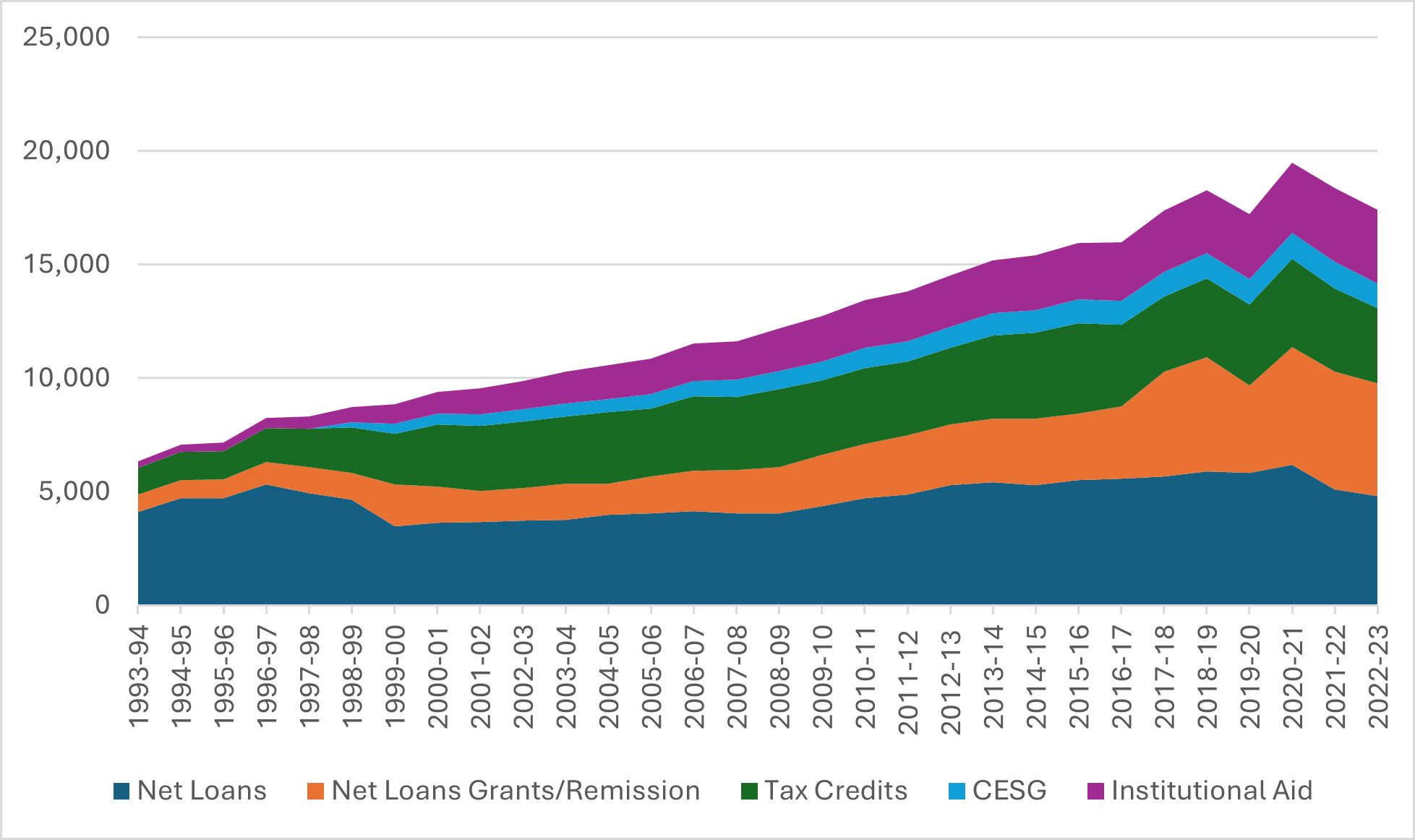
    In a series of federal budgets between 1996 and 2000, billions of dollars were thrown into grants, tax credits and a new program called “Canada Education Savings Grants,” which were a form of matching grant for contributions to RESPs. Grants and total aid rose; loans issued fell by a third, mainly between 1997 and 2001 (a recovering economy helped quite a bit). Tax expenditures soared, which due to a rule change allowing tax credits to be carried forward meant either students got to keep more of their work income or got to reduce their taxes once they started working.

    Since this period of rapid change at the turn of the century, student aid has doubled in real terms. And nearly all of that has been an increase in non-repayable aid. Institutional scholarships? Tripled. Education scholarships? Quadrupled. Loans? They are up, too, but there the story is a bit more complicated.

    Figure 1: Student Aid by Source, Canada, 1993-94 to 2022-23, in thousands of constant $2022

    For the period from about 2000 to 2015, all forms of aid were increasing at about inflation plus 3%. Then, in 2016, we entered another period of rapid change. The Governments of Canada and Ontario eliminated a bunch of tax credits and re-invested the money into grants. Briefly, this led to targeted free tuition in Ontario, before the Ford government took an axe to the system. Then, COVID hit and the CSFAP doubled grants. Briefly, in 2020-21, total student aid exceeded $23 billion/year (the figure above does not include the $4 billion per year paid out through the Canada Emergency Student Benefit), with less than 30% of it made up of loans.

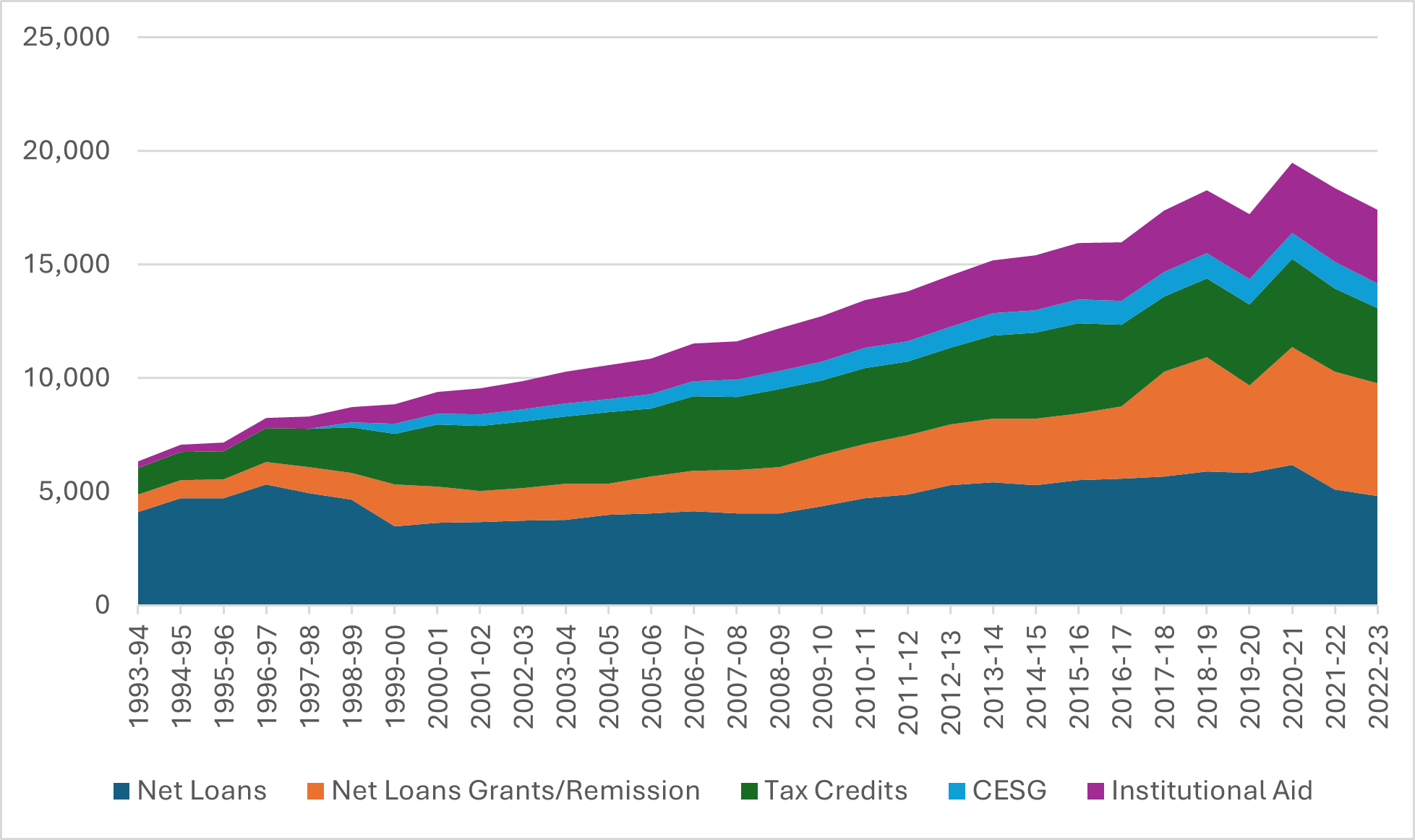
    One important thing to understand about all this is that while the system became much larger and much less loan-based, something else was going on, too. It was becoming much more federal. Over the past three decades, provincial outlays have risen about 30% in real terms; meanwhile, federal ones have quadrupled. In the early 1990s, the system was about 45-55 federal-provincial; now, it’s about 70-30 federal. It’s a stunning example of “uploading” of responsibilities in an area of shared-jurisdiction.

    Figure 2: Government Student Aid by Source, Figure 1: Student Aid by Source, Canada, 1993-94 to 2022-23, in thousands of constant $2022

    So there you go: a century of Canadian student aid in less than 850 words. Hope you enjoyed it.

    Source link

  • Student Debt by Ethnicity | HESA

    Student Debt by Ethnicity | HESA

    Hi all. Just a quick one today, this time on some data I recently got from StatsCan.

    We know a fair a bit about student debt in Canada, especially with respect to distribution by gender, type of institution, province, etc. (Chapter 6 of The State of Postsecondary Education in Canada is just chock full of this kind of data if you’re minded to take a deeper dive). But to my knowledge no one has ever pulled and published the data on debt by ethnicity, even though this data has been collected for quite some time through the National Graduates Survey (NGS). So I ordered the data, and here’s what I discovered.

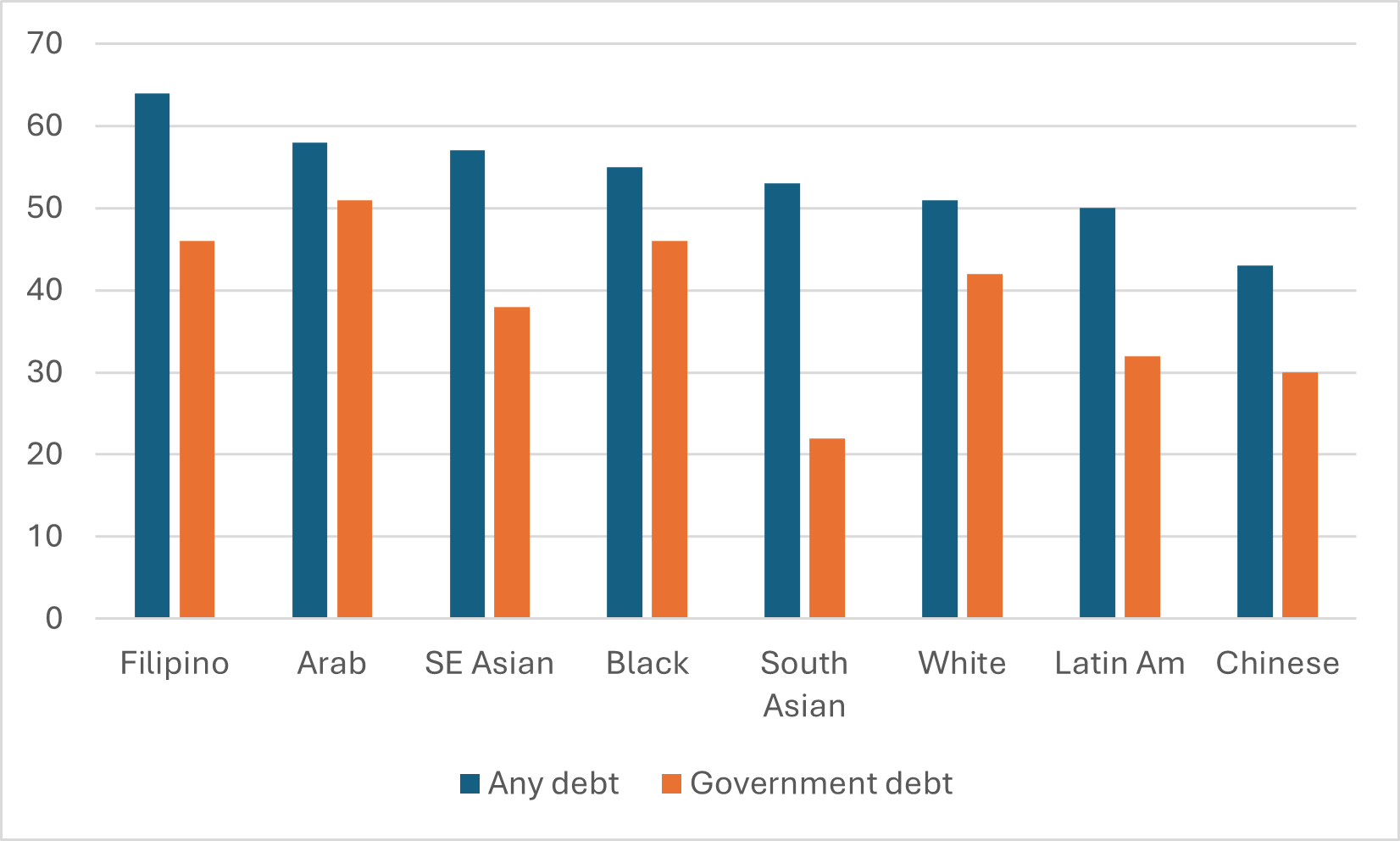
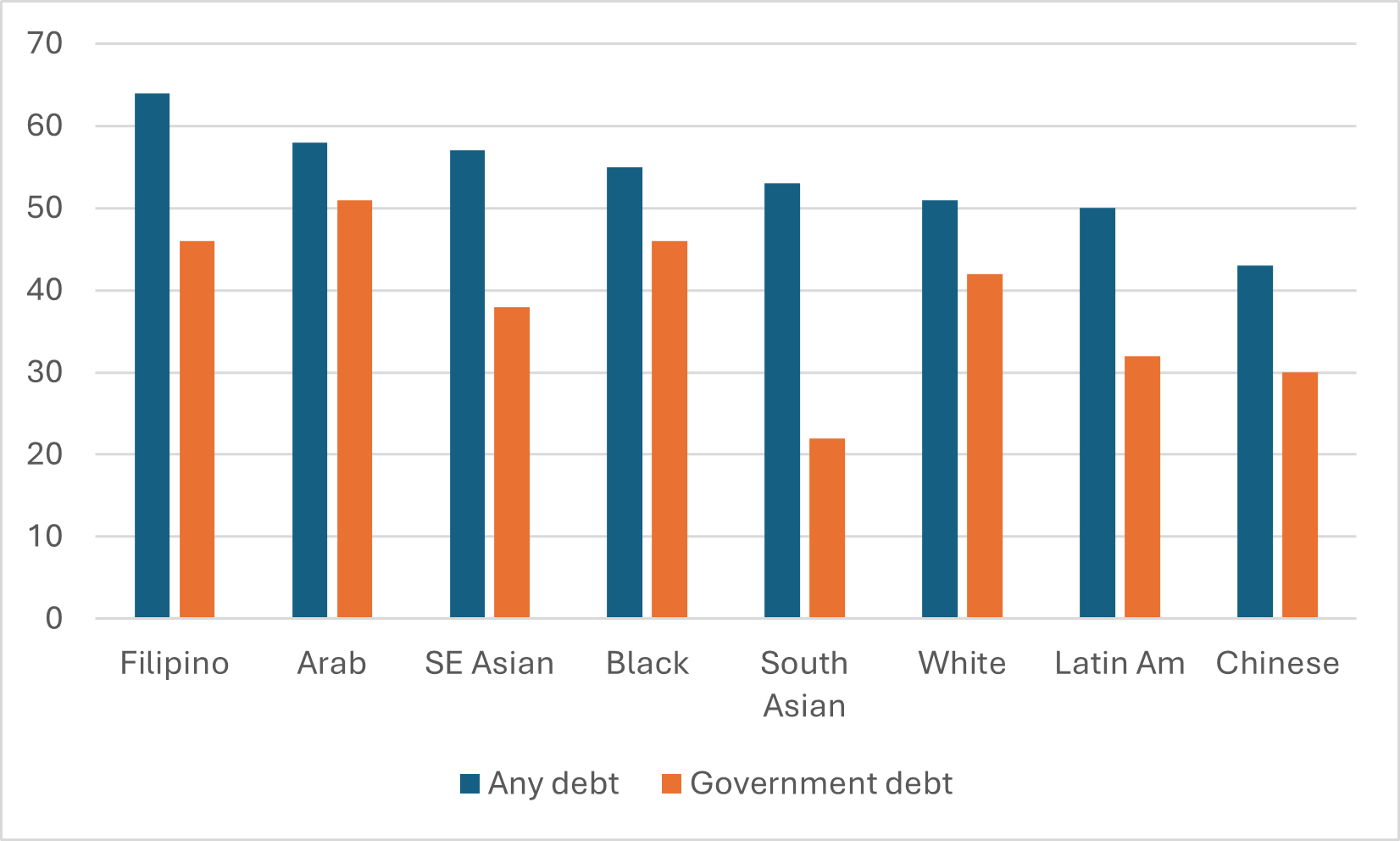
    Figure 1 shows incidence of borrowing for the graduating class of 2020, combined for all graduates of universities and graduates, for the eight largest ethnicities covered by the NGS (and before anyone asks, “indigeneity” is not considered an ethnicity so anyone indicating an indigenous ethnicity is unfortunately excluded from this data… there’s more below on the challenges of getting additional data). And the picture it shows is…a bit complex.

    Figure 1: Incidence of Borrowing, College and University Graduates Combined, Class of 2020

    If you just look at the data on government loan programs (the orange bars), we see that only Arab students have borrowing rates in excess of 1 in 2. But for certain ethnicities, the borrowing rate is much lower. For Latin American and Chinese students, the borrowing rate is below 1 in 3, and among South Asian students the borrowing rate is barely 1 in 5. Evidence of big differences in attitudes towards borrowing!

    Except…well when you add in borrowing from private sources (e.g. from banks and family) so as to take a look at overall rates of borrowing incidence, the differences in borrowing rates are a lot narrower. Briefly, Asian and Latin American students borrow a lot more money from private sources (mainly family) than do Arab students, whites, and Blacks. These probably come with slightly easier repayment terms, but it’s hard to know for sure. An area almost certainly worthy of further research.

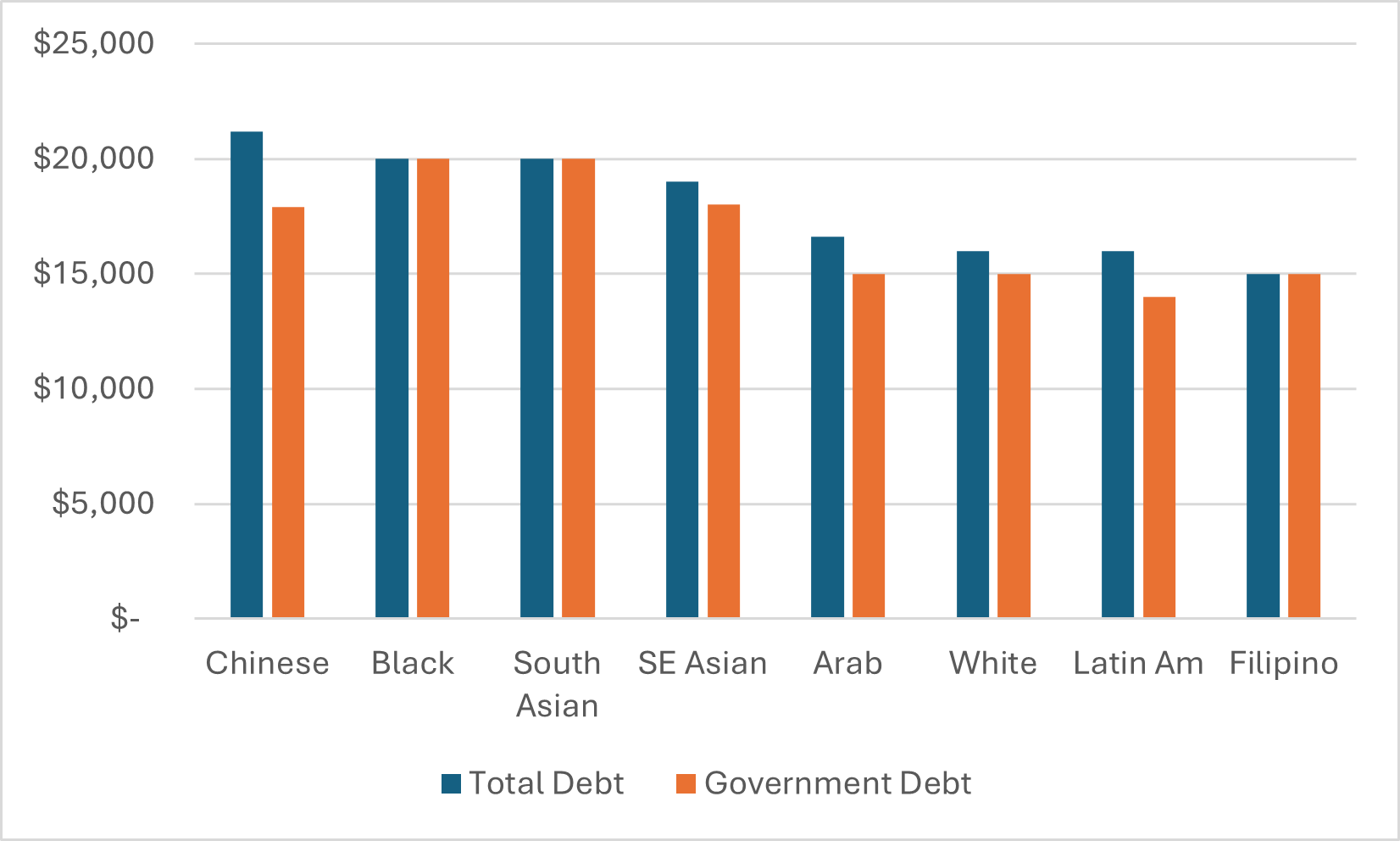
    There is a similarly nuanced picture when we look at median levels of indebtedness among graduates who had debt. This is shown below in Figure 2.

    Figure 2: Median Borrowing, College and University Graduates Combined, Class of 2020

    Now, there isn’t a huge amount of difference in exiting debt levels by ethnicity: the gap is only about $6,000 between the lowest total debt levels (Filipinos) and the highest (Chinese). But part of the problem here is that we can’t distinguish the reason for the various debt levels. Based on what we know about ethnic patterns of postsecondary education, we can probably guess that Filipino students have low debt levels not because they are especially wealthy and can afford to go to post-secondary without financial assistance. But rather because they are more likely to go to college and this spend less time, on average, in school paying fees and accumulating debt. Similarly, Chinese students don’t have the highest debt because they have low incomes; they have higher debt because they are the ethnic group the most likely to attend university and spend more time paying (higher) fees.

    (Could we get the data separately for universities and colleges to clear up the confound? Yes, we could. But it cost me $3K just to get this data. Drilling down a level adds costs, as would getting data based on indigenous identity, and this is a free email, and so for the moment what we have above will have to do. If anyone wants to pitch in a couple of grand to do more drilling-down, let me know and I would be happy to coordinate some data liberation).

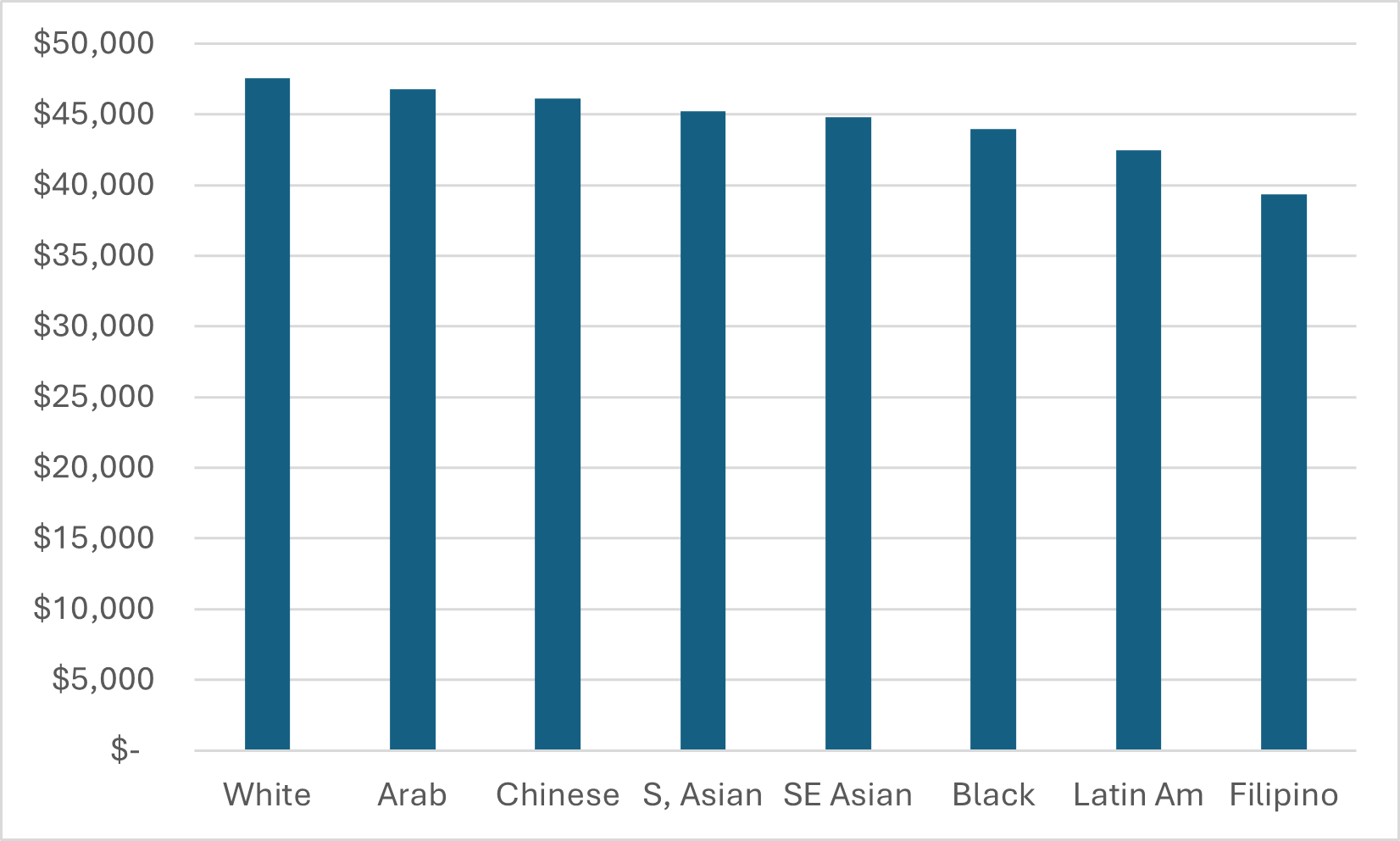
    It is also possible to use NGS data to look at post-graduate income by debt. I obtained the data by in fairly large ranges (e.g. $0-20K, $20-60K, etc.), but it’s possible on the basis of that to estimate roughly what median incomes are (put it this way: the exact numbers are not exactly right, but the ordinal rank of income of the various ethnicities are probably accurate). My estimations of median 2023 income of 2020 graduates—which includes those graduates who are not in the labour market full-time, if you’re wondering why the numbers look a little low—are shown below in Figure 3.

    Figure 3: Estimate Median 2023 Income, College and University Graduates Combined, Class of 2020

    Are there differences in income here? Yes, but they aren’t huge. Most ethnic groups have median post-graduate incomes between $44 and $46,000. The two lowest-earning groups (Latin Americans and Filipinos) re both disproportionately enrolled in community colleges, which is part of what is going on in this data (if you want disaggregated data, see above).

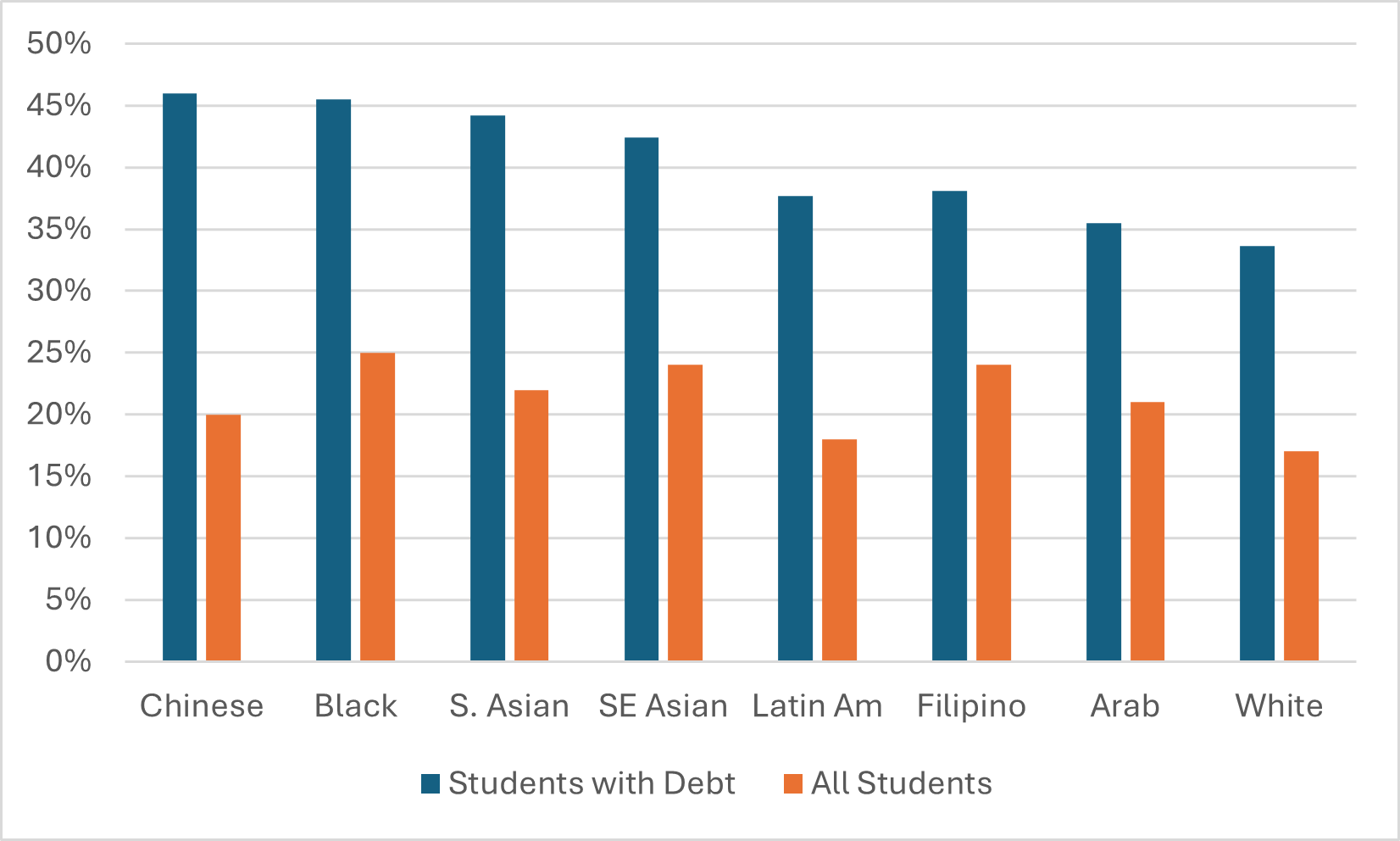
    Now, the data from the previous graphs can be combined to look at debt-to-income ratios, both for students with debt, and all students (that is, including those that do not borrow). This is shown below in Figure 4.

    Figure 4: Estimated Median 2023 Debt-to-Income Ratios, College and University Graduates Combined, Class of 2020

    If you’re just dividing indebtedness by income (the blue bars), you get a picture that looks a lot like Figure 2 in debt, because differences in income are pretty small. But if you are looking at debt-to-income ratios across all students (including those that do not borrow) you get a very different picture because as we saw in Figure 1, there are some pretty significant differences in overall borrowing rates. So, for instance, Chinese students go from having the worst debt-to-income ratio on one measure to being middle of the pack on another because they have relatively low incidence of borrowing; similarly, students of Latin American origin go from being middle-of-the-pack to nearly the lowest debt-to-income ratios because they are a lot less likely to borrow than others. Black students end up having among the highest debt-to-income ratios not because they earn significantly less than other graduates, but because both the incidence and amount of their borrowing is relatively high.

    But I think the story to go with here is that while there are differences between ethnic groups in terms of borrowing, debt, and repayment ratios, and that it’s worth trying to do something to narrow them, the difference in these rates is not enormous. Overall, it appears that as a country we are achieving reasonably good things here, with the caveat that if this data were disaggregated by university/ college, the story might not be quite as promising.

    And so ends the first-ever analysis of student debt and repayment by ethnic background. Hope you found it moderately enlightening.

    Source link