Category: student finance

  • The future of financial hardship support needs to be flexible

    The future of financial hardship support needs to be flexible

    The government’s recent white paper on Post-16 Education and Skills places flexibility and choice at the centre of the future student experience.

    When it comes to students, the government wants universities and colleges to adapt to a much wider range of demographics and to further embrace diversity – while continuing to break down the barriers to opportunity for students from all backgrounds.

    One of the ways to strengthen opportunity is through the additional forms of financial support (via bursaries, scholarships and special-case funds) that higher education institutions provide for those students most at risk of dropping out, or those simply denied opportunity in the first place.

    When it comes to this funding, the sector needs to work much harder in supporting a more varied set of future students, whilst making better use of data to design support packages, and adapting to the real-time user requirements for this type of funding.

    Beyond the post-school model

    The majority model of financial support is still designed primarily for a post-school entrant market (in line with access and participation plans) but we now need to evolve this for a much broader range of working students, part-time students, later life students and so on – based on the white paper’s steer for different student demographics and for more support for students from lower income backgrounds. This will require more agility. It will also require a closer and more strategic, data driven approach to the timing, delivery and use of such student funding.

    Universities will increasingly be expected to meet the needs of a more diverse and complex learner population, one that is typically older, more financially stretched, and balancing work, family, caring responsibilities, and study. While the student body is evolving at pace, and there are encouraging signs of greater flexibility and adaptability across the sector, as highlighted in The Shape of Student Financial Support in 2025, there is also clear recognition that more progress is needed.

    In our work with universities (designed to strengthen the effective delivery and impact of student financial support) we refer to this sea-change in funding as enabling both more optionality (for the funders) and greater agency (for the beneficiaries). Too much of the sector’s current model still assumes the profile and rhythms of the traditional 18-year-old school leaver. Policy momentum is pushing us firmly beyond this, and institutions will need to rethink not just how much financial support they provide, but how, when and in what form it is provided, and crucially, who it is designed for.

    A new student majority

    Commuter students, part-time learners, those studying while working full-time, and individuals returning to education later in life are no longer outliers. They are becoming a significant and growing segment of the student population, and the white paper’s direction of travel signals that this growth will continue.

    These learners typically have different cost profiles, different pressures, and different expectations around support. Rent and food costs matter, of course, but so do childcare, caring responsibilities, travel to placements and campus, and the financial instability that often comes with shift-based or zero-hours work. Their support needs do not fall neatly around term dates.

    A modern student support system must reflect that reality.

    Beyond the “once-a-year” mindset

    One of the strongest messages emerging from our work with universities is that timing of support is as critical as the pound value that support. Students increasingly need support that works with the grain of real life, not against it. That means agility: funds that can be released quickly during a crisis; support that can be drawn down in a way that helps with budgeting; and options that reflect different lifestyles, responsibilities, and individuals preferences around how they manage their finances.

    For mature learners, the notion of a predictable “start of term” pressure point is often irrelevant. Housing, employment and family commitments create fluctuating financial pinch-points throughout the year. A forward-looking and agile hardship and support model must therefore allow universities to intervene dynamically, reacting to student need rather than institutional calendar.

    Across the more than 40 institutions we partner with, we see a growing shift toward more targeted, purpose-led and flexible support. Although institutions are facing significant financial constraints, they are adapting, often rapidly, to ensure funding reaches the right students in a way that genuinely makes a difference.

    We are seeing:

    • A move toward more tailored interventions, with universities reshaping bursaries and hardship schemes around specific learner profiles, including mature and commuter students.
    • Increased use of real-time payment mechanisms, enabling rapid support when a financial shock threatens continuation.
    • Greater use of data to understand how different types of students use support, and what interventions are most likely to prevent financial distress, disengagement or withdrawal.
    • Growing recognition that support must be designed around lived experience, responsive to trends and feedback, not just institutional tradition.

    This shift is encouraging, but the system as a whole is not yet optimised for the demographic change that the White Paper anticipates.

    Where policy meets practice: recommendations for a modernised support model

    To prepare for a more diverse learner population, the sector will need to reimagine its support architecture. From our work with universities and our ongoing analysis of funding patterns, several recommendations emerge:

    We should build support models around life-stage, not simply level of study. Mature and non-traditional learners experience costs and vulnerabilities that differ from the archetypal school-leaver. Support schemes should explicitly recognise this, particularly around childcare, travel, digital access, and household stability.

    There is a need to shift from fixed-cycle payments to flexible, real-time support. Financial crises rarely occur conveniently during scheduled disbursement windows. Universities need mechanisms that allow for rapid, secure, and dignified disbursement of funds whenever needed.

    It is time to explore hybrid support models that blend cash, credit and vouchers. Different pressures require different tools. Cash support is essential in alleviating hardship. Credit and voucher mechanisms can help direct funds toward participation, learning, and targeting food poverty. Mature learners often benefit from a mixture of both.

    We must make data central to decision-making. With financial pressure mounting across the sector, institutions must allocate limited resources with precision. Data on spending patterns, draw-down behaviour and student feedback can inform more effective and equitable holistic support strategies.

    We should co-design support with the students who rely on it. There is no substitute for listening to those living the experience. Mature and non-traditional students frequently report that support systems “aren’t designed for people like me”. Bringing their voices into design and evaluation will be vital.

    A financial support system fit for the future

    The white paper’s direction is clear: widening participation will no longer be defined simply by access for school leavers from underrepresented groups. It will increasingly require a system capable of supporting learners from every life stage, people retraining, upskilling, switching careers, balancing caring responsibilities, or returning to education for the first time in decades.

    This transition will require institutions to be flexible, evidence-led, and prepared to evolve their traditional models of support. Our latest annual report provides one lens on how this evolution is taking place, and where further change is needed. But the wider policy moment demands more than reflection: it demands intentional redesign.

    If universities are to deliver opportunity for all, as the white paper sets out, they will need financial support systems that reflect the real, diverse, year-round lives of today’s and tomorrow’s students. Flexibility is no longer a helpful addition; it is the foundation on which effective, equitable support must be built.

    Source link

  • For students, the costs of failure are far too high

    For students, the costs of failure are far too high

    Back in May, I argued that the UK’s “pace miracle” – the system that produces the youngest, fastest-completing graduates in Europe – is damaging students’ learning and health.

    Our system’s efficiency, I suggested, comes at the cost of pressure, exhaustion, and a creeping normalisation of distress.

    But what happens when students fall behind in that miracle? What happens when someone breaks the rhythm that the entire funding and regulatory framework assumes to be normal?

    For our work with SUs, Mack Marshall and I have been looking in detail at the rules and funding that surround “retrieval”.

    From what we can see, UK higher education doesn’t just expect rapid completion – it punishes deviation from it.

    When students stumble, the architecture designed to retrieve them from failure taxes disadvantage and rewards privilege.

    The illusion of generosity

    Pretty much every university we’ve looked at has policies designed to look fair. There is almost always a promise of one reassessment opportunity, and increasingly a public line about not charging resit fees. On paper, that sounds humane – but in practice, the design is economically brutal.

    When a student fails a module and resits within the same academic year, the direct cost may be zero. But there’s no maintenance support for any extra study they need to do. And if that student is placed on reassessment-only status for the following year – allowed to resit assessments without attending teaching – they become ineligible for maintenance funding for much, much longer.

    That means no support for rent, bills, or food for months. The student who can rely on family help revises in comfort. The student who can’t works full-time through summer and fails again, or drops out entirely.

    The sector calls the resit “free” and congratulates itself on removing barriers. But the barrier was never the invoice – it was the maintenance cliff.

    This is not a marginal anomaly – it’s the structural product of the same system that glorifies pace. It’s a logic that insists most degrees must be achieved within three years – one that also dictates that recovery from failure must happen outside the funded frame.

    To understand what happens to students who fail, students need to navigate a maze of regulations, finance policies, visa rules, and handbooks – each written in its own dialect of compliance.

    Students from professional families likely know where to look and what questions to ask. They have the vocabulary, the contacts, the confidence, while first-generation students rarely do. They may well discover “compensation” rules only after exam boards meet, and learn about extenuating circumstances after the deadline passes.

    The result is an information economy that mirrors the class system. The retrieval framework may be universal, but its navigation costs are socially distributed.

    The poverty penalty v pedagogy

    When students pass a module on reassessment, their mark is often capped at the pass threshold – 40 per cent for undergraduates, maybe 50 per cent for postgraduates. The principle sounds rigorous, but the reality is punitive.

    A student who failed once because they were caring for a parent, working nights, or suffering mental ill-health can never escape the academic scar tissue unless it’s a complex and approved mit-circs application. The capping rule converts a temporary difficulty into a permanent credential penalty.

    It is the same ideology that underpins the pace miracle – a meritocracy of difficulty that romanticises struggle and treats rest as weakness. Only it is encoded in assessment policy rather than culture.

    For international students, the same logic takes on a bureaucratic form. Those who fail a single module often face a choice between reassessment-only status – which ends their visa – or repeating with attendance purely to remain sponsored.

    Repeating with attendance can cost thousands of pounds in tuition and visa fees. Many have no realistic option but to pay. The system enforces what looks like a market choice – but is in practice compulsion.

    The Lifelong Learning Entitlement – fix or mirage

    In England at least, the forthcoming Lifelong Learning Entitlement (LLE) ought to usher in flexibility. Funding will finally be linked to credits rather than years. Students will be able to study, pause, and return across their lifetimes. In theory, that should dismantle the rigid three-year cage.

    But in practice, everything will depend on how universities classify students, and how they’re allowed to resit. If reassessment-only learners are still coded as “not in attendance”, they still fall outside maintenance entitlement. The policy will have modernised the vocabulary of exclusion without addressing its cause.

    And even when students do qualify, the LLE’s promise of proportional maintenance means something subtle but serious – flexibility is offered as additional debt, not as forgiveness. Students who fall behind because of illness or bereavement will borrow more, not owe less.

    Unless maintenance is reconceived as a right to recovery rather than a privilege of progression, the LLE risks becoming a faster, more efficient version of the same trap.

    Across Europe, completion frameworks are slower and more forgiving. Some countries permit students a decade to complete a bachelor’s degree without financial penalty. Temporary setbacks don’t trigger existential crises – because variations in time are built into the design.

    As I referenced here, the HEDOCE project found that students in systems with longer completion horizons are less likely to drop out entirely and more likely to recover from setbacks. Those systems treat time as a pedagogical resource, not an efficiency problem.

    In contrast, our compressed model leaves no room for error. Once you stumble, the treadmill doesn’t slow down – it throws you off.

    Beyond efficiency

    Our systems for “retrieval” are not an isolated bureaucracy. They’re the endpoint of a philosophy – the same one I explored in the “pace miracle” piece. Both the speed and the punishment are symptoms of a culture that prizes output over understanding, and throughput over humanity.

    When the system is calibrated around efficiency, every deviation becomes failure, and every failure becomes costly. The student who needs time is framed as wasteful – and the institution that supports them risks financial loss.

    I suspect that is why academic pressure now appears so often in mental health reviews. The structure of funding itself generates the anxiety we later medicalise – what looks like individual struggle is really systemic design.

    If we genuinely wanted a system that supports learning rather than policing pace, we would start by aligning time, funding, and compassion.

    Maintenance support would continue for students on reassessment-only status. Resit marks would reflect achievement, not past misfortune. Compensation and extenuating circumstances policies would be clear, accessible, and generous.

    And more profoundly, universities would stop treating recovery as inefficiency. Every student who fails and returns would be evidence of persistence, not profligacy.

    In England, the LLE could be a turning point – a framework that finally recognises learning as cyclical and non-linear. Or it could simply re-brand the same cruelty in the language of flexibility.

    When I wrote about the UK’s “pace miracle”, I argued that we have built a higher education system that prizes speed and punishes delay – a model that achieves impressive completion rates at the cost of wellbeing, mastery, and fairness.

    Our retrieval systems are the mirror image of that miracle. One governs what happens when students move too slowly during the race – the other governs what happens when they fall altogether. Both reveal the same problem – UK HE mistakes motion for progress, and speed for success.

    A humane higher education system would not just help students recover from failure – it would stop treating recovery as failure in the first place.

    Until then, our miracle of efficiency will continue to hide a quiet cruelty. The students least able to afford failure will remain those the system punishes most heavily – not because they lacked talent or effort, but because we built a structure that makes time itself the privilege they can rarely get a loan for.

    Source link

  • Grants return, the levy stays

    Grants return, the levy stays

    Speaking at the Labour Party conference, Secretary of State for Education Bridget Phillipson announced the (limited) return of student maintenance grants by the end of this Parliament:

    I am announcing that this Labour government will introduce new targeted maintenance grants for students who need them most. Their time at college or university should be spent learning or training, not working every hour god sends.

    As further details emerged, it became clear that these would be specifically targeted to students from low-income households who were studying courses within the same list of “government priority” subject areas mentioned in plans for the lifelong learning entitlement. As a reminder these are:

    • computing
    • engineering
    • architecture, building & planning (excluding landscape gardening)
    • physics & astronomy
    • mathematical sciences
    • nursing & midwifery
    • allied health
    • chemistry
    • economics
    • health & social care

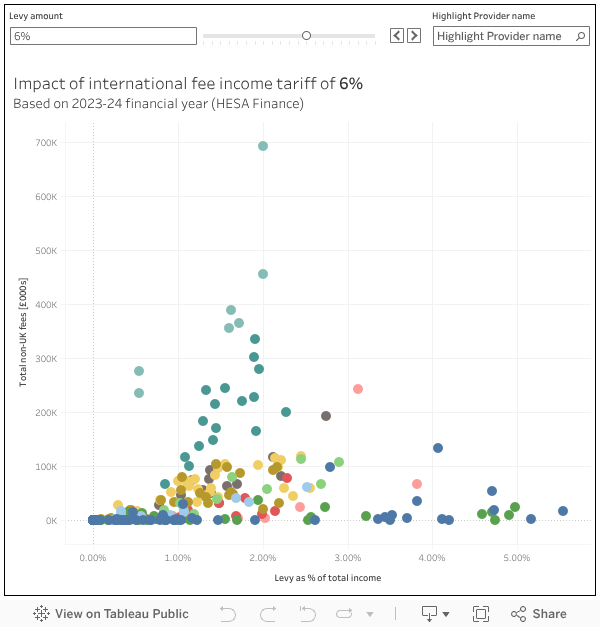
    These additional grants will be funded with income from the proposed levy on international student fees, of which little is known outside of the fact that the immigration white paper’s annex contained modelling of its effects were it to be set at six per cent of international student fee income. The international student levy will apply to England only.

    There will be further details on the way the new grants will work, and on the detail of the levy, in the Autumn Statement on 26 November. This is what we know so far – everything else is based on speculation.

    Eligibility

    A whole range of questions surround the announcement.

    How disadvantaged will a student have to be – and will it be based on family income in the same way that the current system is? Imagine if entitlement was set at below the current threshold for the maximum loan – disadvantaged enough to get the full loan, not enough for a grant.

    If it’s set anywhere near the current threshold – £25,000 residual family income since 2007 – there’s a lot of “disadvantage” going on above that figure. If it’s set above that figure, that will beg the question – why assume a parental contribution in the main loan part of the scheme?

    Will it be on top of, or simply displace some of the existing loan? If it’s the latter, that won’t help with day to day costs, and as the Augar review noted – those from the most disadvantaged backgrounds are least likely to pay back in full anyway, which would make the “grant” more of a debt-relief scam.

    The distribution in the apparent hypothecation will be fascinating. It does mean that international students studying at English universities will be funding grants for English domiciled students wherever they are studying. Will devolved nations now follow suit?

    If international student recruitment falls, will that mean that the amount of money available for disadvantaged student grants falls too or is the Treasury willing to agree a fixed amount for the grants that doesn’t change?

    Restricting grants to those on the lowest incomes does mean that the government intends to relieve student poverty for some but not others, based on course choice. Will that shift behaviour – on the part of students and universities – in problematic ways?

    With the LLE on the way, will grants be chunked up and down by credit? See Jim’s piece from the weekend on the problematic incentives that this would create.

    The hypothecation also raises real moral questions about international student hardship being exacerbated to fund home student hardship relief – if, as many will do, universities put fees up to cover the cost of the levy. The possibility of real resentment from international students, who already know they’re propping up the costs of lower and subsidised fees, is significant.

    For LLE modular tuition fee funding, under OfS quality proposals Bronze/Requires improvement universities will have to apply for their students to access it – they will need to demonstrate that there is a rationale for them doing IS-8 courses. Will that apply for these grants too?

    Phillipson’s speech also referenced work– students’ time at college or university should be “spent learning or training, not working every hour god sends”. By coincidence, Jim worked up some numbers on how much “work” the current loan scheme funds earlier. Whether we’ll get numbers from Phillipson on what she thinks “every hour god sends” means in practice, and how many hours she thinks students should be learning or training for, remains to be seen.

    We might also assume that the grant won’t be increased for those in London, and reduced for studying at home in the way that the maintenance loan is now. And if this is all we’re going to get in the way of student finance reform, all of the other myriad problems with the system may not get touched either.

    The levy

    There’s a certain redistributive logic in using tuition fee income from very prestigious universities to support learners at FE colleges or local providers, though it is unlikely that university senior managers will see it in quite those terms.

    A six per cent levy on international fee income in England for the 2023–24 financial year would have yielded around £620m, with half of that coming from the 20 English providers in the Russell Group. Of course, this doesn’t mean that half of all international students are at the Russell Group – it means that they are able to charge higher tuition fees to the international students they do recruit.

    [Full screen]

    Of course, the levy applies to all providers – and, as we saw back when the idea was first floated there are some outside of the Russell Group that see significant parts of their income come from international fees, and would see their overall financial sustainability adversely affected by the levy. In the main these tend to be smaller specialist providers, but there are some larger modern universities too. Some universities don’t even have undergraduate students, but will still see their fees top-sliced to fund undergraduate-level grants elsewhere.

    [Full screen]

    There has been a concerted lobbying effort by various university groups aimed at getting the government to abandon the levy plan – as it appears that this effort has failed you would expect the conversations to turn to ensuring the levy is not introduced at six per cent as the Home Office previously modelled, or mitigating its impact for some or all providers. Certainly, as Phillipson chose the same speech to remind us she had taken “the decisive steps we needed on university finances” it would feel like it is not her intention to add to the woes of higher education providers that are genuinely struggling.

    DfE has said that the new grants will be “fully funded” by an international student levy. It’s worth noting that this is not the same as saying that all the levy money will go towards the grants.The tie between the grants and the levy is politically rather astute – it will be very difficult for Labour backbenchers to argue against grants for students on low income, even if they are committed to making arguments in the interests of their local university. But legislatively, establishing a ring fence that ensures the levy only pays for these grants will be very difficult – other parts of government will have their eye on this new income, and the Treasury is famously very resistant to ringfencing money that comes in.

    It also opens up the idea of the government specifically taxing higher education with targeted levies. It is notable that there has been no indication that the levy will be charged on private school fees, or fees paid to English language colleges, where these are paid by non-resident students. DfE itself suggests that £980m of international fees go to schools, and a further £850m goes to English language training – why leave a certain percentage of that on the table when it can be used to support disadvantaged young people in skills training?

    What would it achieve?

    In the end, even grants at the maximum level of £3,000 a year that were recommended by the Augar review wouldn’t have made much difference to student poverty, and there’s been a lot of inflation since.

    And a part of the idea of the levy was to reduce (albeit slightly) the number of study visas granted – if you recall, the Home Office report emerged in a month that everyone became concerned about students claiming asylum. If that part of the plan works (if that was ever really the plan, rather than a fortunate coincidence) then surely there would be less money to play with for maintenance – and any future government that attempts to reduce international higher education recruitment would be accused of taking the grants away from working class students on priority courses?

    The real value in the reintroduction of the grant is that it is politically totemic for Labour. But if it encourages more disadvantaged students to go into HE because of a perception of better affordability when they will still struggle, there will be both a financial and political cost in the long term.

    Source link

  • Second-generation student borrowers | SRHE Blog

    Second-generation student borrowers | SRHE Blog

    by Ariane de Gayardon

    Since the 1980s, massification, policy shifts, and changing ideas about who benefits from higher education have led to the expansion of national student loan schemes globally. For instance, student loans were introduced in England in 1990 and generalized in 1998. Australia introduced income-contingent student loans in the late 1980s. While federal student loans were introduced in the US in 1958, their number and the amount of individual student loan debt ramped up in the 1990s.

    A lot of academic research has analysed this trend, evaluating the effect of student loans on access, retention, success, the student experience, and even graduate outcomes. Yet, this research is based on the choices and experiences of first-generation student borrowers and might not apply to current and future students.

    First-generation borrowers enter higher education with parents who have either not been to higher education, or who have a tertiary degree that pre-dates the expansion of student loans. The parents of first-generation borrowers therefore did not take up loans to pay for their higher education and had no associated repayment burden in adulthood. Any cost associated with these parents’ studies will likely have been shouldered by their families or through grants.

    Second-generation borrowers are the offspring of first-generation borrowers. Their parents took out student loans to pay for their own higher education. The choices made by second-generation borrowers when it comes to higher education and its funding could significantly differ from first-generation borrowers, because they are impacted by their parents’ own experience with student loans.

    Parents and parental experience indeed play an important role in children’s higher education choices and financial decisions. On the one hand, parents can provide financial or in-kind support for higher education. This is most evident in the design of student funding policies which often integrate parental income and financial contributions. In many countries, eligibility for financial aid is means-tested and based on family income (Williams & Usher, 2022). Examples include the US where an Expected Family Contribution is calculated upon assessment of financial need, or Germany where the financial aid system is based on a legal obligation for parents to contribute to their children’s study costs. Indeed, evidence shows that parents do contribute to students’ income. In Europe, family contributions make up nearly half of students’ income (Hauschildt et al, 2018). But the role of parents also extends to decisions about student loans: parents tend to try and shield their children from student debt, helping them financially when possible or encouraging cost-saving behaviour (West et al, 2015).

    On the other hand, parents transmit financial values to their children, which might play a role in their higher education decisions. Family financial socialization theory states that children learn their financial attitudes and behaviour from their parents, through direct teaching and via family interactions and relationships (Gudmunson & Danes, 2011). Studies indeed show the intergenerational transmission of social norms and economic preferences (Maccoby, 1992), including attitudes towards general debt (Almenberg et al, 2021). Continuity of financial values over generations has been observed in the specific case of higher education. Parents who received parental financial support for their own studies are more likely to contribute toward their children’s studies (Steelman & Powell, 1991). For some students, negative parental experiences with general debt can lead to extreme student debt aversion (Zerquera et al,2016).

    As countries globally rely increasingly on student loans to fund higher education, many more students will become second-generation borrowers. Because their parents had to repay their own student debt, the family’s financial assets may be depleted, potentially leading to reduced levels of parental financial support for higher education. This is likely to be even worse for students whose parents are still repaying their loans. In addition, parental experiences of student debt could influence the advice they give their children with regard to higher education financial decisions. As a result, this new generation of student borrowers will face challenges that their predecessors did not, fuelled by the transmitted experience of student loans from their parents (Figure 1).

    Figure 1 – Parental influence on second-generation borrowers

    As the share of second-generation borrowers in the student body increases, the need to understand the decision-making process of these students when it comes to (financial) higher education choices is essential. Although the challenges faced by borrowers will emerge at different times and with varying intensity across countries — depending in part on loan repayment formats — we have an opportunity now to be ahead of the curve. By researching this new generation of student borrowers and their parents, we can better assess their financial dilemmas and the support they need, providing further evidence to design future-proof equitable student funding policies.

    Ariane de Gayardon is Assistant Professor of Higher Education at the Center for Higher Education Policy Studies (CHEPS) based at the University of Twente in the Netherlands.

    Author: SRHE News Blog

    An international learned society, concerned with supporting research and researchers into Higher Education

    Source link

  • Higher education should lift students out of poverty – not trap them within it

    Higher education should lift students out of poverty – not trap them within it

    As a former student who benefited from welfare payments, I’ve long been consumed with the educational struggle of students on free school meals (FSM) —the official marker we have of relative poverty.

    That’s why I found recent newspaper headlines in autumn 2024 celebrating “record numbers” of poorer students entering university so troubling. On the face of it, this sounded like welcome progress. But this “record” in fact reflected a grim reality: rising numbers of pupils qualifying for free school meals in a growing bulge of 18-year-olds in the population.

    The government’s framing of the latest university admissions figures as good news was unwittingly celebrating rising levels of poverty. A pupil is eligible for free school meals (FSM) if their parent or guardian receives benefits or earns an annual gross income of £16,190 or less. As of January 2024, a quarter (24.6 per cent) of school pupils in England were on FSM – up from 18 per cent in 2018. This rapid rise meant that in the 2022–23 university intake, around 57,000 FSM students were enrolled (alongside 300,000 non-FSM students).

    The 2022–23 academic year will be remembered for an ignominious distinction – the university progression rate for FSM students declined for the first time since records began in 2005–06. The gap in degree enrolment between FSM and non-FSM students widened to a record-breaking 20.8 percentage points (29 per cent versus 49.8 per cent). A meagre 6.1 per cent of FSM pupils secured places at the UK’s most selective universities.

    These statistics are a damning indictment of our collective failure to uphold the principle that university should be open to all, regardless of background.

    Heating and eating

    This year’s Blackbullion Student Money & Wellbeing Survey, now in its fifth year, brings with it more alarming data, shining a harsh light on the lived realities of these university students. The findings are based on 1200 students, surveyed across the UK. This year they are also categorised by measures of disadvantage, including whether students have been eligible for FSM at any point during their school years.

    Almost three-quarters (72.94 per cent) of FSM students said they’d been too hungry to study or concentrate, compared with 47.32 per cent of their non-FSM peers. Nearly seven in ten (67.82 per cent) said they’d been too cold to focus, avoiding heating their homes because they couldn’t afford it (compared with 42.39 per cent of non-FSM students). They are also much more likely to report not being able to study because they are unable to purchase books. Just under half worry that work commitments get in the way of their study. More than eight in ten worry their final degree grade will be harmed by their lack of money.

    These latest findings lay bare the inequities that scar our higher education system—a system that should lift students out of poverty, not trap them within it. As someone who benefitted from a full maintenance grant during my own time at university, these reports of hunger, cold, and financial stress are heartbreaking. I know what a lifeline financial support can be. My termly cheques were a godsend, enabling me to focus on my studies without having to worry about affording the next meal or keeping the heater on in my room. Shorn of basic support, it’s been little surprise to me that recent waves of FSM students have been far less likely to complete their degrees compared with their better-off counterparts.

    Failure to maintain

    It’s time to reintroduce maintenance grants for FSM students in England as part of the new financial arrangements for universities being considered by the Labour government. The removal of grants in 2016 has meant that FSM students are graduating with the largest loan debts. This could understandably be putting many off applying to higher education in the first place.

    At the same time, maintenance loans should increase with inflation, building on the 3.1 per cent rise already announced for 2025–26, going some way to help all students facing immediate hardship while at university. This would be a fair settlement and mirror similar arrangements in Scotland.

    As education officials brace themselves for the toughest of government spending reviews, I don’t underestimate how hard it will be to fund such a reform. But to fail in this task would be a national travesty, betraying not only these students but also the very principle that a university education should be accessible to all, no matter their background or economic circumstances.

    Source link