Category: Student Finance & Loans

  • Some thoughts on fairness and student loans

    Some thoughts on fairness and student loans

    With the Comprehensive Spending Review due next Wednesday, I thought it might be worth making some general points about student loans (in anticipation of potential changes to repayment thresholds and other parameters).

    I do not think student loans are a good vehicle for redistributive measures.

    As I told a couple of parliamentary committees in 2017, the current redistributive aspects are an accidental function of the decision to lower the financial reporting discount rate for student loans from RPI plus 2.2 percent to RPI plus 0.7. Such a downwards revision elevates the value of future cash repayments and in this case it meant that the payments projected to be received from higher earners began to exceed the value of the initial cash outlay.

    The caveat here: in the eyes of government. That is the government’s discount rate, not necessarily yours. One of the reasons I favour zero real interest rates over other options is that it simplifies considerations of the future value of payments made from the individual borrower’s perspective.

    Originally, student loans were proposed as a way to eliminate a middle class subsidy – free tuition – and have now become embedded as a way to fund mass, but not universal, provision.

    I believe that if you are concerned about redistribution, then it is best to concentrate on the broader tax system, rather than focusing solely on the progressivity or otherwise of student loans. You can see from the original designs for the 2012 changes that the idea of the higher interest rates were meant to make the loan scheme mimic a proportionate graduate tax and eliminate the interest rate subsidy enjoyed by higher earners on older loans. The original choice of “post-2012” student loan interest rates of RPI + 0 to 3 percentage points was meant to match roughly the old discount rate of RPI plus 2.2%. Again, see my submission to the Treasury select committee for more detail.

    I will just set out a few illustrative examples here as to why some of the debates about fairness in relation to repayment terms need a broader lens.

    It is often observed that two graduates on the same salaries are left with different disposable incomes, if one has benefited from their parents, say, paying their tuition fees and costs of living during study so that they don’t lose 9 per cent of their salary over the repayment threshold (just under £20,000 per year for pre-2012 loans; just over £27,000 for post-2012 loans).

    That’s clearly the case.

    But the parents had to pay c. £50,000 upfront to gain that benefit for their child. And it is by no means certain that option is the best use of such available money. Only a minority of borrowers go on to repay the equivalent of what they borrowed using the government’s discount rate, and as an individual you should probably have a higher discount rate than the government. You also forego the built-in death and disability insurance in student loans.

    Payment upfront is therefore a gamble, one where the odds differ markedly for men and women. (See analyses by London Economics and Institute for Fiscal Affairs for the breakdowns on the different percentages of men and women who do pay the equivalent of more than they borrowed.)

    If a family has the £50,000 spare (certainly don’t borrow it from elsewhere), then the following options are likely more sensible:

    • pledge to cover your child’s rent until the £50,000 runs out: this allows student to avoid taking on excessive paid work during study and will boost their disposable income afterwards;
    • provide the £50,000 as a deposit towards a house purchase;
    • even put the £50,000 in a pot to cover the student loan repayments as they arise;
    • etc.

    In two of those cases, you’ll have a useful contingency fund too.

    All strike me as better options than eschewing the government-subsidised loan scheme.

    Moreover, those three options remain in the event of a graduate tax or the abolition of tuition fees.

    That fundamental unfairness – family wealth – isn’t addressed by changing the HE funding system. (I write as someone who helped craft the HE pledges in Labour’s 2015 and 2017 manifestos).

    In many ways, the government prefers people to pay upfront because it reduces the immediate cash demand.  From that perspective, upfront payment works as a form of voluntary wealth taxation (at least in the short-run). Arguably, those who pay upfront have been taxed at the beginning and are gambling on outcomes that mean that future “rebates” exceed the original payment for their children.

    Perhaps this line of reasoning opens up debates about means-testing fees and emphasises the need to restore maintenance grants … but really it points to harder problems regarding the taxation of intergenerational transfers and disposable wealth.

    I am not a certified financial advisor so comments above are simply my opinions. You should not base investment decisions on them.
    Source link

  • The misleadingly named Student Loans Company

    The misleadingly named Student Loans Company

    Why that title?

    Well, the name seems to mislead people into thinking that the provider of student finance is a private institution, potentially making profit out of students, when it is in fact publicly owned.

    There are 20 shares in the SLC: 17 are owned by the Department for Education (which has responsibility for English-domiciled students) and another three, each of those owned by one of the devolved administrations.

    When you want to see what’s going on with student loans you look at government accounts: national, departmental or those of devolved administrations.

    OK. So what’s the point of mentioning this factoid?

    I believe that the misunderstanding about the publicly-owned nature of the SLC contributes to thinking that leads to other confusions, such as those surrounding function of the interest rate in student loans and what the effect of reducing them would be.

    Here’s a former Higher Education minister getting into a pickle in an article that even has the title, “Student Finance? It’s the interest rate, stupid”.

    Let’s leave aside the misunderstandings about the recent ONS accounting changes and concentrate on the claim that reducing interest rates would “address the size of the debt owed itself”.

    The government is looking to reduce public debt, but lowering interest rates would only do this in the long-run, if the loan balances eventually written off were written off by making a payment to a private company to clear those balances.

    As it is, reducing interest rates on loans mean that higher earners will pay back less than they would otherwise and government debt would be higher in nominal terms (all else being equal). (I do support reducing interest rates on student loans, but for different reasons).

    There is probably another confusion here regarding the Janus-faced nature of student debt: it is an asset for government (it is owed to government) and a liability for borrowers. The outstanding balances on borrowers’ accounts are not the same as the associated government debt.

    When the government thinks about public debt in relation to student loans, it is thinking about the borrowing it had to take on in order to create the student loans.

    Imagine that I borrow £10 in the bond markets to lend you £10 for your studies: I have a debt to the markets and an asset, what you owe me. The interest on the former and the latter are not the same and the terms of repayment on the latter are income-contingent so I don’t expect to get sufficient repayments back from you to cover my debt to the markets.

    Student loans are not self-sustaining. It requires a public subsidy – any announcements about loans in the spending review at the end of the month will be about how much subsidy the government is prepared to offer.

    Source link

  • Student loans: what counts as expenditure in national accounts

    Student loans: what counts as expenditure in national accounts

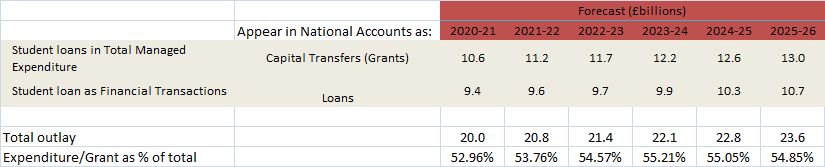
    Economic & Fiscal Outlook, Office for Budgetary Responsibility (March 2021), adapted from Tables 3.14 & 3.26

    I have constructed the table above from forecasts for Total Managed Expenditure and Financial Transactions taken from the Office for Budgetary Responsibility’s latest publication (it accompanied Wednesday’s Budget).

    It shows how newly issued student loans are now split into two components for the purposes of presentation in the National Accounts. The portion of loans that are expected to be repaid are classed as “financial transactions”, while the portion expected to be written off is recorded as capital expenditure. The latter scores in “public sector investment”, which was adopted as a new fiscal target prior to the pandemic (net investment cannot exceed 3% of national income), though the rules are currently under review.

    We can see that student loan outlay is expected to reach £20billion in the year to March 2021, rising to £23.6billion in five years’ time.
    The majority of new outlay is now expected to be written off and that share rises over the forecast period.
    By 2025/26 repayments on all existing loans are projected to re000000000000000ach nearly £5billion per year. (This figure has improved since the sale programme for post-2012 loans was abandoned, since the treasury now gets the receipts that would have gone to private purchasers).

    As mentioned in recent posts on here, the Department for Education only currently has an allocation of £4billion to cover the capital transfer / grant element of new loans and so it has to be granted large additional budgetary supplements each year. This situation has dragged on as the planned spending review has been postponed. We can now expect developments in the Autumn.


    Source link

  • New contingent liability recorded against student loan sales

    New contingent liability recorded against student loan sales

    Last week’s Supplementary Estimates contained another note of interest for student loans.

    Under “Note K: Contingent Liabilities” (p. 90) we find that a fifth contingent liability has been added to those associated with the now abandoned sale of student loans.

    The sale of student loans necessitated warranties and indemnities to secure interest and obtain value
    for money from investors. These contingent liabilities are in respect of:

    e) New EU Securitisation Regulations (Possible CL [contingent liability] in due course). UKGI [UK Government and Investment] are seeking legal counsel to review the implications of new EU securitisation reporting requirements from 2019. Credit granting criteria are being assessed for student loans which may generate legal challenge and we will continue to work with UKGI to update as more information and analysis becomes available.

    If any reader can explain what the issues may be here, I would be very grateful.

    The original four contingent liabilities are discussed here. These, along with the fifth, are still classed as “unquantifiable”.
    There were also issues around whether the Special Purpose Vehicles for the securitisations were sufficiently independent of government so as to constitute a genuine sale (and thereby transfer the loans off the government’s balance sheet).

    The wording above though suggests that the lack of “credit” checks on student loans may be the issue.


    Source link

  • DfE gets over £13.5billion extra for 2020/21 loan impairments

    DfE gets over £13.5billion extra for 2020/21 loan impairments

    The UK government published its “supplementary estimates” for 2020/21 yesterday. These allocate additional budgetary resources to departments.

    Education has been given an extra £13.531 billion to cover the estimated losses on student loans issued in the year (April 2020-March 2021) and the likely downwards revisions to the value of already existing loans. The department had an original allowance of roughly £4billion, but was determined by the last comprehensive spending review and had not been revised since Theresa May’s decision to increase the loan repayment threshold in 2017.

    Last year, an additional £12billion was granted and most was used. (These allocations are not additional cash, but the formal recognition that the cash issued in the form of loans is going to generate much lower returns than originally anticipated).

    The estimated non-repayment on new loans was thought to be in the region of 55%. That is, for every £ loaned, the treasury expected the equivalent of c. 45p in return: in 2019/20, £17.6billion of new loans were issued, but only around £8billion in net present value is projected to be repaid. (Note that this percentage figure – “the RAB” – is often confused with a measure of how many borrowers ultimately clear their loan balances, i.e. those who repay the equivalent of 100p or more).

    When the new higher fees came in, the loss on loans was projected to be in the region of 30p in the £. That is, 70p would be repaid. A raft of policy changes and modelling errors along with the impact of austerity on graduate earnings has dramatically increased the costs; recent accounting changes have meant that those costs now show up in the headline figures that count. (The loan scheme was never designed to be self-financing, but no one set out to develop a scheme with this current level of subsidy. The £4billion in the original budget for 2020/21 reflects the much earlier aim of “incentivising” the department responsible for loans to get the estimated non-repayment closer to 30-35%).

    The pandemic has made things a lot worse for earnings and livelihoods. But the HE sector has in recent months also been positioned to take a hit when the chancellor looks to review spending in the Autumn. The obvious place to look is initial outlay and so I would expect to a clamp down on undergraduate fee levels (without any offsetting increase in tuition grant).


    Source link

  • DfE committed to £200m of contracts for loan sale that’s not proceeding

    DfE committed to £200m of contracts for loan sale that’s not proceeding

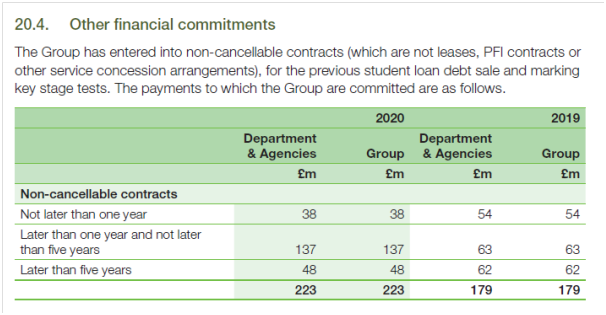
    Page 221 of the Department for Education’s 2019/20 financial statement contains the note reproduced above.

    The sale programme for “pre-2012” student loans was cancelled in March. But DfE looks like it will be paying out over £30million per year for the next few years to financiers anyway. Total liabilities are booked above at over £220million.


    Source link

  • £11 billion of “Supplements” used for loans

    £11 billion of “Supplements” used for loans

    Given the relative absence of higher education from yesterday’s Autumn Statement, I turned my attention to the Department for Education’s 2019/20 annual accounts, which were published earlier this month.

    Regarding student loans, we have been in something of a hiatus since 2018, when Theresa May announced an review of post-18 funding and commissioned the Augar panel, which reported last summer. Although there were suggestions that we might get a long overdue response to the latter yesterday, we will probably have to wait now until the Budget next March, when the government will hope to have a better sense of its spending commitments.

    That leaves student loan finance in limbo with the small, nominal budget allocation for loan write-offs shored up by large “Supplementary Estimates” provided by parliament each February.

    This is in spite of an apparent “target RAB” of 36% and a budgeting process hanging over from 2014, when the old department for Business, Innovation and Skills (BIS) had responsibility for loans and was being “incentivised” to reduce the cost of the loan scheme. You can see both of these features still stipulated in the latest Consolidated Budgeting Guidance, but they represent zombie policy with little to no bearing on events.

    Why so? Well, DfE was given an extra £12billion plus back in February to supplement 2019/20’s budget for “non-cash RDEL” (mostly student loan “impairments”) of £4.7billion per year. (Student loans are “impaired” because the loans are worth less in estimated repayments than the cash advanced.) The supplement produces a total that is more than triple the original allocation.

    And… DfE managed to spend nearly £16billion of that last year. The accounts report an “underspend” of £1.1bn against that total.

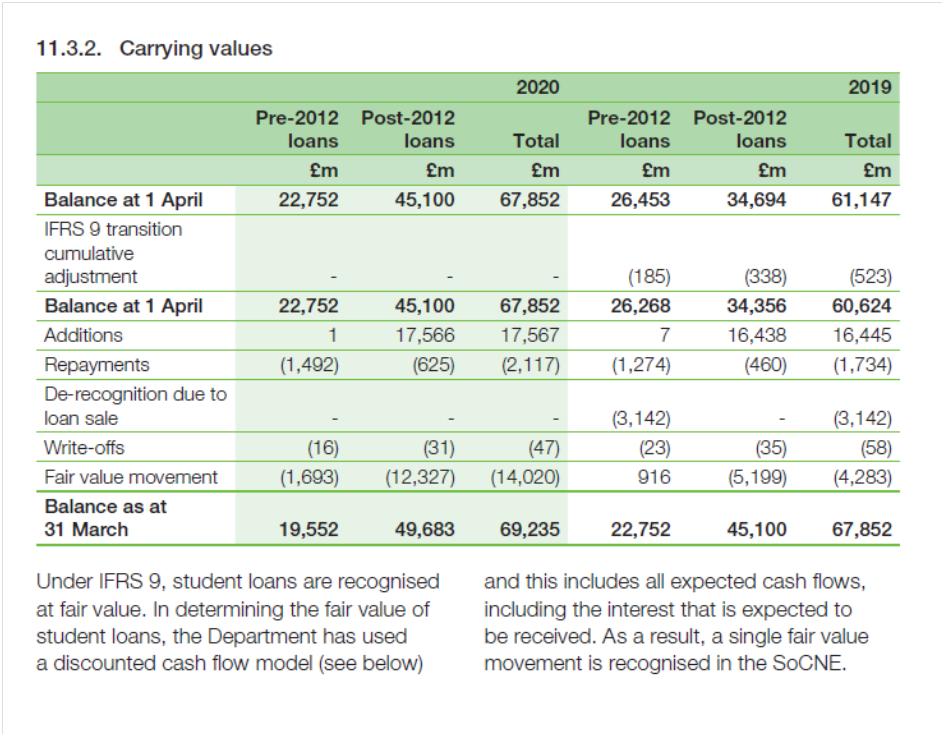
    As can be seen from the table below, “Fair Value movement” for student loans amounted to a non-cash cost of over £14billion.

    £17.6billion of new loans were issued, a net increase of £15billion once repayments of over £2billion are considered, but the new impairments on post-2012 loans increased by £12.3billion; for “pre-2012” loans the stock remaining at year-end lost nearly £1.7bn when revalued.

    Although the nominal value (“face value”) of outstanding post-2012 loan balances is nearly £105billion, those loans are thought to be worth less than £50bn.

    The increases in impairments break down into a RAB charge and a stock charge.

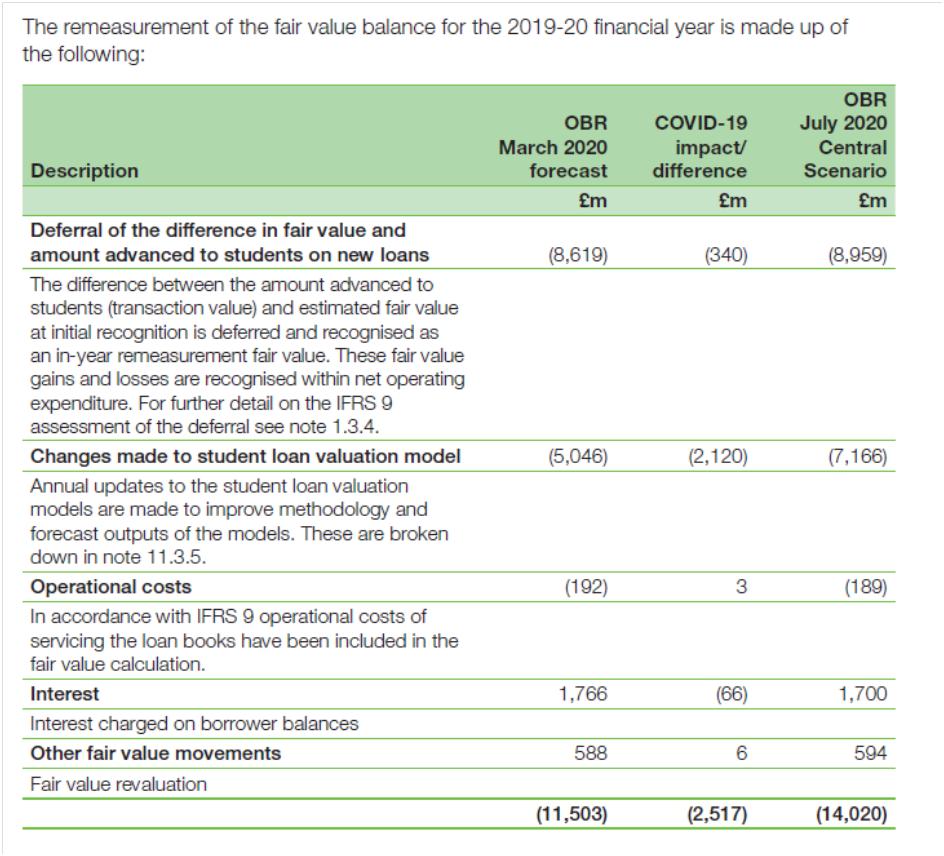
    The RAB charge is the estimated impairment on new loans issued. That came to nearly £9billion, reflecting the latest understanding that only 47% of the £17billion+ of annual undergraduate loan outlay is now expected to be repaid in net present value terms. Ie, the RAB charge is 53%, well above the official target of 36%.

    The other £7billion was a write down on loans issued in previous years and is based on changes made to the model used to estimate loan repayments. Only £2.1billion of that downwards revaluation is attributable to Covid (the loans were revalued in July).

    The accounts make available a further breakdown of the modelling changes.

    The implications seem clear: HE is due a day of reckoning. From a financial perspective, the strongest measures would control outlay rather than boosting repayments. In cash terms, the former has immediate impact on finances, whereas the latter spreads the effect over decades and is politically difficult at this time.

    Tuition fees are to be frozen again in 2021/22 and we should expect this to continue. Announcements in FE suggest that the government would also like students to switch away from longer, more expensive HE courses. More radically, I would expect the government to be reviewing the Augar suggestions of tuition fee reductions and caps on places for certain courses (Recommendation 3.7).1  

    Back at the Conservative Party Conference, Rishi Sunak warned of “hard choices” to come and promised to “balance the books”:

    “Over the medium term getting our borrowing and debt back under control. We have a sacred responsibility to future generations to leave the public finances strong, and through careful management of our economy, this Conservative government will always balance the books. If instead we argue there is no limit on what we can spend, that we can simply borrow our way out of any hole, what is the point in us?”

    That final question invites some alternative answers, but the Spending Review’s focus on Further Education reinforces the idea that HE will be the required to balance the increased spending on the former.

    1 “We therefore invite the government to consider the case for encouraging the OfS to stipulate in exceptional circumstances a limit to the numbers an HEI could enrol on a specific course, or group of courses. It would be critical for the OfS to be transparent about the grounds and process for such an intervention and we can offer no more than a broad indication of what these circumstances might be. Where there is persistent evidence of poor value for students in terms of employment and earnings and for the public in terms of loan repayments, the OfS would have the regulatory  authority to place a limit, for a fixed period, on the numbers eligible for financial support who could be admitted to the course. The institution in question would remain free to recruit to all other courses without restriction. Such a cap system would clearly target the institutions that are offering poor value, rather than altering the entry criteria for individual students.”

    p. 102, Independent Panel Report to the Review of post-18 Education & Funding

    Source link