Decisions Class are streamlined R and R submissions.
Post-class denials MUST ask the DOE for a reconsideration, which allows you to add additional evidence.
Orginial Post:
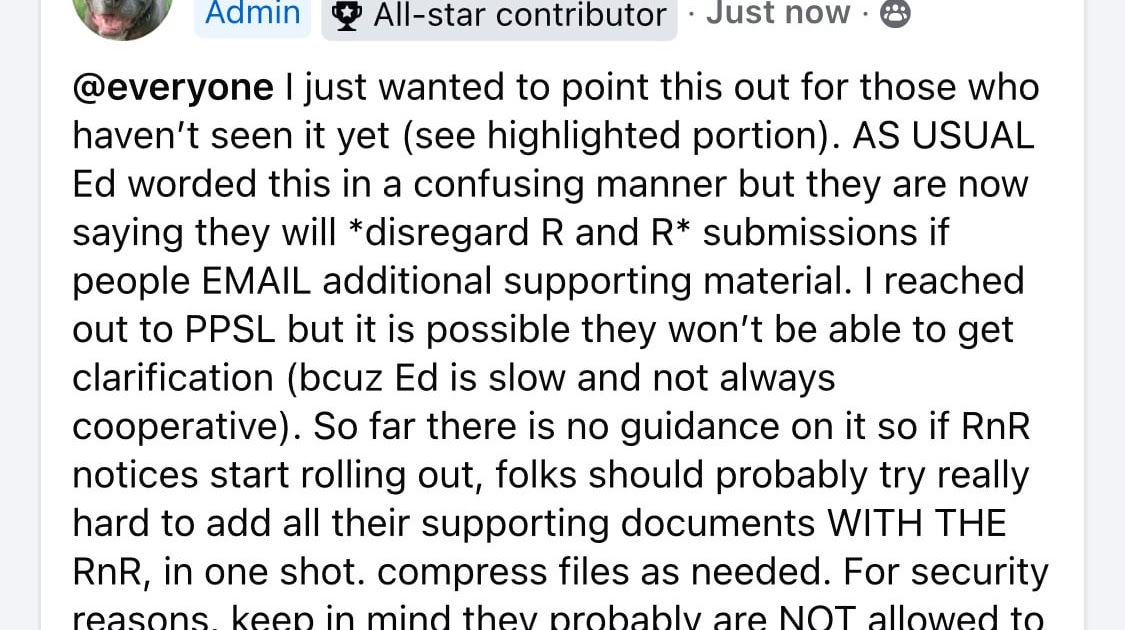
For REVISE and RESUBMITS (R and R) notices, the DOE is now saying that they WILL “disregard R and R*”* submissions if you EMAIL additional supporting documents or material. You CANNOT email the R and R back.
You MUST submit a NEW BDTR APPLICATION and INCLUDE your previous BDTR application number which can be fund on the Denial letter.
The DOE states, “If you email supplemental information to the DOE or attempt to update your existing application, you will be treated as having failed to Revise and Resubmit”.
ALSO, If you are still trying to add more evidence to your BDTR application this late in the game, you may want to wait for the decision letter to come out. We are reaching Group 5 Decision deadline, and Post-Class is 6 months after that. If you feel uneasy about your evidence, START collecting it now!
Follow all DIRECTIONS on anything you get from the DOE relating to BDTR (except demanding payment, they can pound sand LOL).
Day 2 of the U.S. Department of Education (ED)’s Neg Reg aimed at weaponizing Public Service Loan Forgiveness (PSLF) was… just as damning as Day 1. Here’s the recap:
Session Summary:
The session got SPICY right off the bat. ED began the day by presenting their newly revised language. Here are some key moments:
Abby Shafroth, legal aid negotiator, stated CLEARLY for the record that this Neg Reg is not about protecting PSLF; it’s about the Department of Education (ED) using it as a tool to coerce nonprofits and universities to further the Trump Administration’s own goals. The government’s response was not convincing. Watch her remarks here.
Betsy Mayotte, the negotiator representing consumers, brought more fire: “When reading the statute of PSLF, I don’t see where the Education Secretary has the authority to remove employer eligibility definition from a 501(c)(3) or government organization…but my understanding of the regulations and executive order is that they cannot be contrary to the statute. There are no ifs, ands, or buts under government or 501(c)(3).” Watch the exchange here.
In a heated discussion on ED’s proposal to exclude public service workers who provide gender-affirming care to transgender minors, Abby further flagged that no one in the room had any medical expertise, so no one had qualifications to weigh in on medical definitions like “chemical and surgical castration.”
The non-federal negotiators held a caucus to talk about large employers that fall under a single federal Employer Identification Number. They are CONCERNED that the extreme breadth of this rule could potentially cut out thousands of workers only because a subset of people work on issues disfavored by this Administration—all without any right to appeal. Negotiators plan to submit language that would allow employers to appeal a decision to revoke PSLF eligibility by ED.
Borrowers and other experts and advocates came in HOT with public commenttoday—calling out ED for using this rulemaking to unlawfully engage in viewpoint discrimination and leave borrowers drowning in debt, unable to keep food on their tables, or provide for their families.
Missing From the Table:
Today, our legal director, Winston Berkman-Breen, who was excluded from the committee (but still gave powerful public comment yesterday!) has some thoughts on what was missing from the conversation:
For two days now, negotiators have raised legitimate questions and important concerns about the Secretary of Education’s authority to disqualify certain government and 501(c)(3) employers from PSLF. And for two days now, ED’s neg reg staff—inlcuding the moderator!—have engaged in bad faith negotiations.
Jacob, ED’s attorney, asserted that the Secretary has broad authority in its administration of the PSLF program—true, but only to an extent. The Secretary cannot narrow the program beyond the basic requirements set by Congress. When pushed for specific authority, Tamy—the federal negotiator—simply declined.
It doesn’t stop there—ED representatives sidestepped, dismissed, or outright ignored negotiators’ questions and concerns. That’s because this isn’t a negotiation—it’s an exercise in gaslighting. ED is proposing action that exceeds the Secretary’s statutory authority and likely violates the U.S. Constitution—all the while telling negotiators to fall in line.
The kicker? By pushing this proposal, ED itself is engaged in an activity with “substantial illegal purpose.” Let that sink in.
Public Comment Mic Drops:
And Satra D. Taylor, a student loan borrower, Black woman, and SBPC fellow, who was also not selected by ED to negotiate, shared more thoughts during public comment:
“I am disheartened and frustrated by what I have witnessed over the last few days… It has become clear that this Administration is intent on… making college once again exclusive to white, male, and wealthy individuals. These political attacks, disguised as rulemaking, are inequitable and target communities from historically marginalized backgrounds. The PSLF program has provided a vital incentive for Americans interested in serving our country and local communities, regardless of their political affiliation. The Department’s efforts to engage in rulemaking and to change PSLF eligibility are directly related to the goal of Trump’s Executive Order and exceed the Administration’s authority…”
Back in March, President Trump announced an executive order to revoke Public Service Loan Forgiveness (PSLF) eligibility from public service workers employed at organizations engaged in work opposed by his administration—a blatantly illegal attempt to use public service workers as pawns in his right-wing political project to destroy civil society.
Shortly after, the U.S. Department of Education (ED) announced its plans for a Negotiated Rulemaking (Neg Reg) process to put these dangerous policies into the PSLF regulations. Today marked Day 1 of the only 3-day committee session for this Neg Reg—and ED has already doubled down on this campaign to weaponize debt to silence speech that does not align with President Trump’s MAGA playbook:
ED’s first draft of regulatory language, to put it bluntly, serves Trump’s fascist agenda. It empowers Secretary McMahon to block all government workers with student debt, including first responders, social workers, and teachers, from receiving PSLF in retaliation if she decides that a local or state government policy conflicts with her extreme, right-wing views on immigration, civil rights, or free speech. More on that here.
ED excluded borrowers and key experts from the rulemaking committee.
Despite overwhelming public demand for stronger borrower protections, discussions focused on weaponizing and restricting critical relief programs like PSLF.
Session Summary:
The day started off on a bad foot. Abby Shafroth, alternate negotiator for the Consumers, Legal Aid, and Civil Rights seat, requested to add a seat dedicated to civil rights because the proposed changes to PSLF directly affect the ability of marginalized communities to access higher education. Civil rights advocates Chavis Jones and Jaylon Herbin were present and ready to join the table—but ED denied the request.
After this inaugural miscarriage of justice, most of the day was spent running through definitions outlined in ED’s proposed language. Does ED actually have the authority to exclude certain groups from PSLF when Congress has already specially outlined some but not others? Hint: they don’t. Who would be excluded from PSLF based on “illegal activities”? Would military members be excluded if the military were found in violation of state tort laws? If a city’s Health Department were specifically found guilty of substantial illegal activity, would all workers employed by that entire city be disqualified?
Put plainly: ED did not have sufficient answers for these questions. At times, ED chastised negotiators for asking questions at “inappropriate times.” Other times, ED assured folks that everything would become clear once the Notice of Proposed Rulemaking language was issued. ED also refused to provide any examples of application of, or answer any “hypothetical” questions about their proposal. In our opinion, if you’re going to put forth a prospective rulemaking to decide the fate of millions of people, you should at the very least be able to explain how it would work.
Missing From the Table:
ED refused to seat Satra D. Taylor, a student loan borrower, Black woman, and SBPC fellow, who wants to know:
“Why didn’t ED include anyone who would be most affected by these policy changes to negotiate—not a single public service worker, civil rights advocate, first responder, social worker, or teacher? Also, what is ED’s legal authority to propose these regulations in the first place? Congress defined in law that government and 501(c)(3) non-profit employers are categorically eligible for PSLF, and yet ED’s current proposal would exclude government and non-profit employers that it determines no longer engage in public service. This is a foundational issue for the Neg Reg, and ED refused to provide a clear answer.”
Public Comment Mic Drops:
Our legal director, Winston Berkman-Breen (also excluded from the committee), called out ED during the public comment period:
“Although this is not a serious proposal, it is a dangerous one. If the Administration has true concerns about whether employers across the country are engaged in unlawful activity, its law enforcement offices could conduct thorough investigations and then allow courts to determine the merits of those allegations. Instead, it has proposed letting the Secretary of Education police American society.”
Rachel
Oglesby most recently served as America First Policy Institute’s Chief
State Action Officer & Director, Center for the American Worker. In
this role, she worked to advance policies that promote worker freedom,
create opportunities outside of a four-year college degree, and provide
workers with the necessary skills to succeed in the modern economy, as
well as leading all of AFPI’s state policy development and advocacy
work. She previously worked as Chief of Policy and Deputy Chief of Staff
for Governor Kristi Noem in South Dakota, overseeing the implementation
of the Governor’s pro-freedom agenda across all policy areas and state
government agencies. Oglesby holds a master’s degree in public policy
from George Mason University and earned her bachelor’s degree in
philosophy from Wake Forest University.
Jonathan Pidluzny – Deputy Chief of Staff for Policy and Programs
Jonathan
Pidluzny most recently served as Director of the Higher Education
Reform Initiative at the America First Policy Institute. Prior to that,
he was Vice President of Academic Affairs at the American Council of
Trustees and Alumni, where his work focused on academic freedom and
general education. Jonathan began his career in higher education
teaching political science at Morehead State University, where he was an
associate professor, program coordinator, and faculty regent from
2017-2019. He received his Ph.D from Boston College and holds a
bachelor’s degree and master’s degree from the University of Alberta.
Chase Forrester – Deputy Chief of Staff for Operations
Virginia
“Chase” Forrester most recently served as the Chief Events Officer at America First Policy Institute, where she oversaw the planning and
execution of 80+ high-profile events annually for AFPI’s 22 policy
centers, featuring former Cabinet Officials and other distinguished
speakers. Chase previously served as Operations Manager on the
Trump-Pence 2020 presidential campaign, where she spearheaded all event
operations for the Vice President of the United States and the Second
Family. Chase worked for the National Republican Senatorial Committee
during the Senate run-off races in Georgia and as a fundraiser for
Members of Congress. Chase graduated from Clemson University with a
bachelor’s degree in political science and a double-minor in Spanish and
legal studies.
Steve Warzoha – White House Liaison
Steve
Warzoha joins the U.S. Department of Education after most recently
serving on the Trump-Vance Transition Team. A native of Greenwich, CT,
he is a former local legislator who served on the Education Committee
and as Vice Chairman of both the Budget Overview and Transportation
Committees. He is also an elected leader of the Greenwich Republican
Town Committee. Steve has run and served in senior positions on numerous
local, state, and federal campaigns. Steve comes from a family of
educators and public servants and is a proud product of Greenwich Public
Schools and an Eagle Scout.
Tom Wheeler – Principal Deputy General Counsel
Tom
Wheeler’s prior federal service includes as the Acting Assistant
Attorney General for Civil Rights at the U.S. Department of Justice, a
Senior Advisor to the White House Federal Commission on School Safety,
and as a Senior Advisor/Counsel to the Secretary of Education. He has
also been asked to serve on many Boards and Commissions, including as
Chair of the Hate Crimes Sub-Committee for the Federal Violent Crime
Reduction Task Force, a member of the Department of Justice’s Regulatory
Reform Task Force, and as an advisor to the White House Coronavirus
Task Force, where he worked with the CDC and HHS to develop guidelines
for the safe reopening of schools and guidelines for law enforcement and
jails/prisons. Prior to rejoining the U.S. Department of Education, Tom
was a partner at an AM-100 law firm, where he represented federal,
state, and local public entities including educational institutions and
law enforcement agencies in regulatory, administrative, trial, and
appellate matters in local, state and federal venues. He is a frequent
author and speaker in the areas of civil rights, free speech, and
Constitutional issues, improving law enforcement, and school safety.
Craig Trainor – Deputy Assistant Secretary for Policy, Office for Civil Rights
Craig
Trainor most recently served as Senior Special Counsel with the U.S.
House of Representatives Committee on the Judiciary under Chairman Jim
Jordan (R-OH), where Mr. Trainor investigated and conducted oversight of
the U.S. Department of Justice, including its Civil Rights Division,
the FBI, the Biden-Harris White House, and the Intelligence Community
for civil rights and liberties abuses. He also worked as primary counsel
on the House Judiciary’s Subcommittee on the Constitution and Limited
Government’s investigation into the suppression of free speech and
antisemitic harassment on college and university campuses, resulting in
the House passing the Antisemitism Awareness Act of 2023. Previously, he
served as Senior Litigation Counsel with the America First Policy
Institute under former Florida Attorney General Pam Bondi, Of Counsel
with the Fairness Center, and had his own civil rights and criminal
defense law practice in New York City for over a decade. Upon graduating
from the Catholic University of America, Columbus School of Law, he
clerked for Chief Judge Frederick J. Scullin, Jr., U.S. District Court
for the Northern District of New York. Mr. Trainor is admitted to
practice law in the state of New York, the U.S. District Court for the
Southern and Eastern Districts of New York, and the U.S. Supreme Court.
Madi Biedermann – Deputy Assistant Secretary, Office of Communications and Outreach
Madi
Biedermann is an experienced education policy and communications
professional with experience spanning both federal and state government
and policy advocacy organizations. She most recently worked as the Chief
Operating Officer at P2 Public Affairs. Prior to that, she served as an Assistant Secretary of Education for Governor Glenn Youngkin and worked
as a Special Assistant and Presidential Management Fellow at the Office
of Management and Budget in the first Trump Administration. Madi
received her bachelor’s degree and master of public administration from
the University of Southern California.
Candice Jackson – Deputy General Counsel
Candice
Jackson returns to the U.S. Department of Education to serve as Deputy
General Counsel. Candice served in the first Trump Administration as
Acting Assistant Secretary for Civil Rights, and Deputy General Counsel,
from 2017-2021. For the last few years, Candice has practiced law in
Washington State and California and consulted with groups and
individuals challenging the harmful effects of the concept of “gender
identity” in laws and policies in schools, employment, and public
accommodations. Candice is mom to girl-boy twins Madelyn and Zachary,
age 11.
Joshua Kleinfeld – Deputy General Counsel
Joshua
Kleinfeld is the Allison & Dorothy Rouse Professor of Law and
Director of the Boyden Gray Center for the Study of the Administrative
State at George Mason University’s Scalia School of Law. He writes and
teaches about constitutional law, criminal law, and statutory
interpretation, focusing in all fields on whether democratic ideals are
realized in governmental practice. As a scholar and public intellectual,
he has published work in the Harvard, Stanford, and University of
Chicago Law Reviews, among other venues. As a practicing lawyer, he has
clerked on the D.C. Circuit, Fourth Circuit, and Supreme Court of
Israel, represented major corporations accused of billion-dollar
wrongdoing, and, on a pro bono basis, represented children accused of
homicide. As an academic, he was a tenured full professor at
Northwestern Law School before lateraling to Scalia Law School. He holds
a J.D. in law from Yale Law School, a Ph.D. in philosophy from the
Goethe University of Frankfurt, and a B.A. in philosophy from Yale
College.
Hannah Ruth Earl – Director, Center for Faith-Based and Neighborhood Partnerships
Hannah
Ruth Earl is the former executive director of America’s Future, where
she cultivated communities of freedom-minded young professionals and
local leaders. She previously co-produced award-winning feature films as
director of talent and creative development at the Moving Picture
Institute. A native of Tennessee, she holds a master of arts in religion
from Yale Divinity School.