Category: student loans

  • How a Managed Meltdown Enables Unauthorized Asset Sales

    How a Managed Meltdown Enables Unauthorized Asset Sales

    The federal student loan portfolio, totaling roughly $1.6 to $1.7 trillion, is not merely an accounting entry. It is one of the largest consumer credit systems in the world and functions simultaneously as a public policy tool, a long-term revenue stream, a data infrastructure, and a political liability. It shapes who can access higher education, how risk is distributed across generations, and how the federal government exerts leverage over the postsecondary sector. Precisely because of its scale and visibility, the portfolio is uniquely vulnerable to narrative reframing.

    That vulnerability was not accidental. It was constructed over decades through a series of policy decisions that stripped borrowers of normal consumer protections while preserving the financial attractiveness of student debt as an asset. Chief among these decisions was the gradual removal of bankruptcy protections for student loans. By rendering student debt effectively nondischargeable except under the narrow and punitive “undue hardship” standard, lawmakers transformed education loans into a uniquely durable financial instrument. Unlike mortgages, credit cards, or medical debt, student loans could follow borrowers for life, enforced through wage garnishment, tax refund seizure, and Social Security offsets.

    This transformation made student loans exceptionally attractive for securitization. Student Loan Asset-Backed Securities, or SLABS, flourished precisely because the underlying loans were shielded from traditional credit risk. Investors could rely not on educational outcomes or borrower prosperity, but on the legal certainty that the debt would remain collectible. Even during economic downturns, SLABS were marketed as relatively stable instruments, insulated from the discharge risks that plagued other forms of consumer credit.

    Private banks once dominated this market. Sallie Mae, originally a government-sponsored enterprise, became a central player in both originating and securitizing student loans, while Navient emerged as a major servicer and asset manager. Yet as Higher Education Inquirer documented in early 2025, banks ultimately lost control of student lending. Rising defaults, public outrage, state enforcement actions, and mounting evidence of predatory practices made the sector politically radioactive. The federal government stepped in not as a reformer, but as a backstop, absorbing the portfolio and stabilizing a system private finance could no longer manage without reputational and regulatory risk.

    That history reveals a recurring pattern. When student lending fails in private hands, it becomes public. When the public system is allowed to fail, it becomes ripe for re-privatization.

    A portfolio does not need to collapse to be declared unmanageable. It only needs to appear dysfunctional enough to justify extraordinary intervention.

    The post-pandemic repayment restart, persistent servicing failures, legal challenges to income-driven repayment plans, and widespread borrower confusion have all contributed to a growing narrative of systemic breakdown. Servicers such as Maximus, operating under the Aidvantage brand, MOHELA, and others have struggled to process payments accurately, manage forgiveness programs, and provide reliable customer service. These failures are often framed as bureaucratic incompetence rather than as predictable consequences of outsourcing public functions to private contractors whose incentives are misaligned with borrower welfare.

    Navient’s exit from federal servicing did not mark a retreat from the student loan ecosystem so much as a repositioning, as it continued to benefit from private loan portfolios and legacy SLABS exposure. Sallie Mae, rebranded and fully privatized, remains deeply embedded in the private student loan market, which continues to rely on the same nondischargeability framework that props up federal lending.

    Crucially, these servicing failures cannot be separated from the earlier elimination of bankruptcy as a safety valve. In normal credit markets, distress is resolved through restructuring or discharge. In student lending, distress accumulates. Borrowers remain trapped, servicers remain paid, and policymakers are confronted with a swelling mass of unresolved debt that can be labeled a crisis at any politically convenient moment.

    Under pyrrhic defeat theory, such a crisis is not merely tolerated. It is useful.

    Once the federal portfolio is framed as broken beyond repair, the range of acceptable solutions expands. What would be politically impossible in a stable system becomes plausible in an emergency. Asset transfers, securitization of federal loans, expansion of SLABS-like instruments backed by government guarantees, or long-term conveyance of servicing and collection rights can be presented as pragmatic fixes rather than ideological choices.

    A Trump administration would be particularly well positioned to exploit this dynamic. Skeptical of debt relief, hostile to administrative governance, and ideologically aligned with privatization, such an administration could recast the portfolio as a failed public experiment inherited from predecessors. In that framing, selling or offloading the portfolio is not an abdication of responsibility but an act of fiscal discipline.

    Importantly, this need not take the form of an explicit, congressionally authorized sale. Risk can be shifted through securitization. Revenue streams can be monetized. Servicing authority can be extended indefinitely to private firms. Data control can migrate outside public oversight. Over time, these steps amount to de facto privatization, even if the loans remain nominally federal. The infrastructure, incentives, and profits move outward, while the political blame remains with the state.

    This is where earlier McKinsey & Company studies reenter the conversation. Long before the current turmoil, McKinsey analyses identified high servicing costs, fragmented contractor oversight, weak borrower segmentation, and low political returns on administrative complexity. While framed as efficiency critiques, these studies implicitly favored market-oriented restructuring. In a crisis environment, such recommendations become blueprints for divestment.

    The danger of a pyrrhic defeat strategy is that it delivers a short-term political win at the cost of long-term public capacity. Selling or functionally privatizing the student loan portfolio may improve fiscal optics, but it permanently weakens democratic control over higher education finance. Borrowers, already stripped of bankruptcy protections, lose what remains of public accountability. Policymakers lose leverage over tuition inflation and institutional behavior. The federal government relinquishes a powerful counter-cyclical tool. What remains is a debt regime optimized for extraction, enforced by servicers, securitized for investors, and detached from educational outcomes.

    The defeat is real. It is borne by students, families, and future generations. The victory belongs to those who acquire distressed public assets and those who benefit ideologically from shrinking the public sphere.

    Pyrrhic defeat theory reminds us that collapse is not always accidental. In the case of the federal student loan portfolio, what appears to be dysfunction or incompetence may instead be strategic surrender: a willingness to let a public system deteriorate so that it can be sold off, securitized, or outsourced under the banner of necessity. If that happens, it will not be remembered as a policy error, but as a deliberate transfer of public wealth and power—made possible by decades of legal engineering that began when bankruptcy protection was taken away and ended with student debt transformed into a permanent financial asset.


    Sources

    Higher Education Inquirer. “When Banks Lost Control of Student Loan Lending.” January 2025.

    https://www.highereducationinquirer.org/2025/01/when-banks-lost-control-of-student-loan.html

    U.S. Department of Education, Federal Student Aid. FY 2024 Annual Agency Performance Report. January 13, 2025.

    U.S. Department of Education, Federal Student Aid. Federal Student Loan Portfolio Data and Statistics, various years.

    Government Accountability Office. Student Loans: Key Weaknesses in Servicing and Oversight, multiple reports.

    Congressional Budget Office. The Federal Student Loan Portfolio: Budgetary Costs and Policy Options.

    U.S. Congress. Bankruptcy Abuse Prevention and Consumer Protection Act of 2005 and prior amendments affecting student loan dischargeability.

    Pardo, Rafael I., and Michelle R. Lacey. “The Real Student-Loan Scandal: Undue Hardship Discharge Litigation.” American Bankruptcy Law Journal.

    Financial Crisis Inquiry Commission materials on asset-backed securities and consumer credit markets.

    McKinsey & Company. Student Loan Servicing, Portfolio Optimization, and Risk Management Analyses, prepared for federal agencies and financial institutions, 2010s–early 2020s.

    Higher Education Inquirer archives on SLABS, servicers, privatization, deregulation, and student loan policy.

    Source link

  • How to Find a Cosigner for a Student Loan

    How to Find a Cosigner for a Student Loan


    If you applied for a private student loan and were notified that you need to apply with a cosigner, you’re not alone. Over 90% of private student loans include a cosigner, which is an individual — usually a parent or guardian — who is willing to take equal responsibility for the loan alongside you, the primary borrower.

    Why do I need a cosigner?

    To assess your ability to repay your student loan, private lenders typically require a credit and income check. Given that most student loan borrowers are fresh out of high school or in their early twenties, many do not have sufficient credit history, or if they do, their credit score is low.

    Credit history is built over time through credit cards, mortgages, car loans, etc., and many students have not yet encountered these responsibilities. As a result, student borrowers are often prompted to apply with a cosigner, who has an established income and a history of repaying debts on time.

    Who can be a cosigner?

    When considering who can cosign your loan, the most important trait is reliability and good credit. This will not only help you secure your loan, but possibly lower your interest rate, as well.

    A lower interest rate can make a big difference in the amount of money you’ll owe, overall.

    How can I find a cosigner?

    When thinking about how to find a cosigner, consider this question: “Who do I know will be sitting at my graduation, cheering me on as I walk across the stage to receive my diploma?”

    By starting here, you will identify individuals who are invested in your success and achievement. Parents and guardians are a great place to start. Aunts, uncles, grandparents, or older siblings can also be good options.

    Once you identify the person who can be a cosigner, gather and organize all of the information about the loan in preparation for any questions your cosigner might have.

    Here are a few they might ask:

    • Why are you applying for this loan?
    • How much are you applying for?
    • Who is the lender?
    • Why do you need a cosigner?

    When approaching someone to cosign your loan, be sure to communicate that you intend to be trustworthy and repay your loan on time. Your cosigner is equally responsible for your loan, so any missed payments by you will also negatively affect their credit history.

    If they ask why you’re applying for this loan, it would be a good idea to show them your school of choice, the cost of attendance, and any other financial aid you’ve already received, and the remaining balance you need the loan to cover. This will keep your cosigner informed and will help them understand why the loan is necessary. Opening up about your finances to a person you trust could be helpful — they may be able to offer advice on how to best navigate repaying the loan and life beyond college.

    At College Ave, we can provide you with an email that you can send directly to your cosigner. This email contains useful information about applying for a student loan as a cosigner, but we recommend first having an in-person discussion with the individual you plan to ask.

    Why Undergraduates and Graduates May Need Cosigners

    Private lenders, like College Ave, rely on credit scores, proof of income, repayment history, and other factors to determine whether a borrower is eligible for a loan and will be able to repay it.

    Undergraduate students usually have little to no credit history and limited income. This makes it hard for a lender to assess if they’ll be able to repay their loan on their own. A cosigner can improve odds of getting an application approved, secure a lower interest rate, and more favorable terms. Cosigning a loan also enables the undergrad to establish and build their credit history.

    Graduate students may also need or want a cosigner to secure a private student loan for the same reasons listed above — improved approval odds, favorable rates and terms, etc. Though graduate students are older, they may still have limited credit and/or high existing debt from undergrad loans or other living expenses.

    Remember, you might need a cosigner for other things too—like renting an apartment. That same person could be a great option to help cosign your undergraduate or graduate private student loan.

    How do I know if my cosigner will qualify?

    At College Ave, we offer a credit pre-qualification tool that will tell you if your credit qualifies for a loan and what interest rates you can expect. This can be filled out prior to applying. After asking your cosigner, it is a good idea to have that individual use the pre-qualification tool, too, to see if their credit qualifies.

    For more information on cosigners, check out: What is a Private Student Loan Cosigner?

    Source link

  • AI-Fueled Fraud in Higher Education

    AI-Fueled Fraud in Higher Education

    Colleges across the United States are facing an alarming increase in “ghost students”—fraudulent applicants who infiltrate online enrollment systems, collect financial aid, and vanish before delivering any academic engagement. The problem, fueled by advances in artificial intelligence and weaknesses in identity verification processes, is undermining trust, misdirecting resources, and placing real students at risk.

    What Is a Ghost Student?

    A ghost student is not simply someone who drops out. These are fully fabricated identities—sometimes based on stolen personal information, sometimes entirely synthetic—created to fraudulently enroll in colleges. Fraudsters use AI tools to generate admissions essays, forge transcripts, and even produce deepfake images and videos for identity verification.

    Once enrolled, ghost students typically sign up for online courses, complete minimal coursework to stay active long enough to qualify for financial aid, and then disappear once funds are disbursed.

    Scope and Impact

    The scale of the problem is significant and growing:

    • California community colleges flagged approximately 460,000 suspicious applications in a single year—nearly 20% of the total—resulting in more than $11 million in fraudulent aid disbursements.

    • The College of Southern Nevada reported losing $7.4 million to ghost student fraud in one semester.

    • At Century College in Minnesota, instructors discovered that roughly 15% of students in a single course were fake enrollees.

    • California’s overall community college system reported over $13 million in financial aid losses in a single year due to such schemes—a 74% increase from the previous year.

    The consequences extend beyond financial loss. Course seats are blocked from legitimate students. Faculty spend hours identifying and reporting ghost students. Institutional data becomes unreliable. Most importantly, public trust in higher education systems is eroded.

    Why Now?

    Several developments have enabled this rise in fraud:

    1. The shift to online learning during the pandemic decreased opportunities for in-person identity verification.

    2. AI tools—such as large language models, AI voice generators, and synthetic video platforms—allow fraudsters to create highly convincing fake identities at scale.

    3. Open-access policies at many institutions, particularly community colleges, allow applications to be submitted with minimal verification.

    4. Budget cuts and staff shortages have left many colleges without the resources to identify and remove fake students in a timely manner.

    How Institutions Are Responding

    Colleges and universities are implementing multiple strategies to fight back:

    Identity Verification Tools

    Some institutions now require government-issued IDs matched with biometric verification—such as real-time selfies with liveness detection—to confirm applicants’ identities.

    Faculty-Led Screening

    Instructors are being encouraged to require early student engagement via Zoom, video introductions, or synchronous activities to confirm that enrolled students are real individuals.

    Policy and Federal Support

    The U.S. Department of Education will soon require live ID verification for flagged FAFSA applicants. Some states, such as California, are considering application fees or more robust identity checks at the enrollment stage.

    AI-Driven Pattern Detection

    Tools like LightLeap.AI and ID.me are helping institutions track unusual behaviors such as duplicate IP addresses, linguistic patterns, and inconsistent documentation to detect fraud attempts.

    Recommendations for HEIs

    To mitigate the risk of ghost student infiltration, higher education institutions should:

    • Implement digital identity verification systems before enrollment or aid disbursement.

    • Train faculty and staff to recognize and report suspicious activity early in the semester.

    • Deploy AI tools to detect patterns in application and login data.

    • Foster collaboration across institutions to share data on emerging fraud trends.

    • Communicate transparently with students about new verification procedures and the reasons behind them.

    Why It Matters

    Ghost student fraud is more than a financial threat—it is a systemic risk to educational access, operational efficiency, and institutional credibility. With AI-enabled fraud growing in sophistication, higher education must act decisively to safeguard the integrity of enrollment, instruction, and student support systems.


    Sources

    Source link

  • In Bid to Close Education Department, President Trump Looks to Rehouse Student Loans, Special Education Programs – The 74

    In Bid to Close Education Department, President Trump Looks to Rehouse Student Loans, Special Education Programs – The 74

    President Donald Trump said Friday that the U.S. Small Business Administration would handle the student loan portfolio for the slated-for-elimination Education Department, and that the Department of Health and Human Services would handle special education services and nutrition programs.

    The announcement — which raises myriad questions over the logistics to carry out these transfers of authority — came a day after Trump signed a sweeping executive order that directs Education Secretary Linda McMahon to “take all necessary steps to facilitate the closure” of the department to the extent she is permitted to by law.

    “I do want to say that I’ve decided that the SBA, the Small Business Administration, headed by Kelly Loeffler — terrific person — will handle all of the student loan portfolio,” Trump said Friday morning.

    The White House did not provide advance notice of the announcement, which Trump made at the opening of an Oval Office appearance with Defense Secretary Pete Hegseth.

    The Education Department manages student loans for millions of Americans, with a portfolio of more than $1.6 trillion, according to the White House.

    In his executive order, Trump said the federal student aid program is “roughly the size of one of the Nation’s largest banks, Wells Fargo,” adding that “although Wells Fargo has more than 200,000 employees, the Department of Education has fewer than 1,500 in its Office of Federal Student Aid.”

    ‘Everything else’ to HHS

    Meanwhile, Trump also said that the Department of Health and Human Services “will be handling special needs and all of the nutrition programs and everything else.”

    It is unclear what nutrition programs Trump was referencing, as the U.S. Department of Agriculture manages school meal and other major nutrition programs.

    One of the Education Department’s core functions includes supporting students with special needs. The department is also tasked with carrying out the federal guarantee of a free public education for children with disabilities Congress approved in the Individuals with Disabilities Education Act, or IDEA.

    Trump added that the transfers will “work out very well.”

    “Those two elements will be taken out of the Department of Education,” he said Friday. “And then all we have to do is get the students to get guidance from the people that love them and cherish them, including their parents, by the way, who will be totally involved in their education, along with the boards and the governors and the states.”

    Trump’s Thursday order also directs McMahon to “return authority over education to the States and local communities while ensuring the effective and uninterrupted delivery of services, programs, and benefits on which Americans rely.”

    SBA, HHS heads welcome extra programs

    Asked for clarification on the announcement, a White House spokesperson on Friday referred States Newsroom to comments from White House press secretary Karoline Leavitt and heads of the Small Business Administration and Health and Human Services Department.

    Leavitt noted the move was consistent with Trump’s promise to return education policy decisions to states.

    “President Trump is doing everything within his executive authority to dismantle the Department of Education and return education back to the states while safeguarding critical functions for students and families such as student loans, special needs programs, and nutrition programs,” Leavitt said. “The President has always said Congress has a role to play in this effort, and we expect them to help the President deliver.”

    Loeffler and HHS Secretary Robert F. Kennedy Jr. said their agencies were prepared to take on the Education Department programs.

    “As the government’s largest guarantor of business loans, the SBA stands ready to deploy its resources and expertise on behalf of America’s taxpayers and students,” Loeffler said.

    Kennedy, on the social media platform X, said his department was “fully prepared to take on the responsibility of supporting individuals with special needs and overseeing nutrition programs that were run by @usedgov.”

    The Education Department directed States Newsroom to McMahon’s remarks on Fox News on Friday, where she said the department was discussing with other federal agencies where its programs may end up, noting she had a “good conversation” with Loeffler and that the two are “going to work on the strategic plan together.” 

    Maine Morning Star is part of States Newsroom, a nonprofit news network supported by grants and a coalition of donors as a 501c(3) public charity. Maine Morning Star maintains editorial independence. Contact Editor Lauren McCauley for questions: [email protected].


    Get stories like these delivered straight to your inbox. Sign up for The 74 Newsletter

    Source link

  • Universities that expand access have graduates who take longer to repay their loans

    Universities that expand access have graduates who take longer to repay their loans

    I’ll admit that the Neil O’Brien-powered analysis of graduate repayments in The Times recently annoyed me a little.

    There’s nothing worse than somebody attempting to answer a fascinating question with inappropriate data (and if you want to read how bad it is I did a quick piece at the time). But it occurred to me that there is a way to address the issue of whether graduate repayments of student loans do see meaningful differences by provider, and think about what may be causing this phenomenon.

    What I present here is the kind of thing that you could probably refine a little if you were, say, shadow education minister and had access to some numerate researchers to support you. I want to be clear up top is that, with public data and a cavalier use of averages and medians, this can only be described as indicative and should be used appropriately and with care (yes, this means you Neil).

    My findings

    There is a difference in full time undergraduate loan repayment rates over the first five years after graduation by provider in England when you look at the cohort that graduated in 2016-17 (the most recent cohort for which public data over five years is available).

    This has a notable and visible relationship with the proportion of former students in that cohort from POLAR4 quintile 1 (from areas in the lowest 20 per cent of areas).

    Though it is not possible to draw a direct conclusion, it appears that subject of study and gender will also have an impact on repayments.

    There is also a relationship between the average amount borrowed per student and the proportion of the cohort at a provider from POLAR4 Q1.

    The combination of higher average borrowing and lower average earnings makes remaining loan balances (before interest) after five years look worse in providers with a higher proportion of students from disadvantaged backgrounds..

    On the face of it, these are not new findings. We know that pre-application background has an impact on post-graduation success – it is a phenomenon that has been documented numerous times, and the main basis for complaints about the use of progression data as a proxy for the quality of education available at a provider. Likewise, we know that salary differences by gender and by industry (which has a close but not direct link to subject of study).

    Methodology

    The Longitudinal Educational Outcomes dataset currently offers a choice of three cohorts where median salaries are available one, three, and five years after graduation. I’ve chosen to look at the most recent available cohort, which graduated in 2016-17.

    Thinking about the five years between graduation and the last available data point, I’ve assumed that median salaries for year 2 are the same as year 1, and that salaries for year 4 are the same as year 3. I can then take 9 per cent of earnings above the relevant threshold as the average repayment – taking two year ones, two year threes, and a year five gives me an average total repayment over five years.

    The relevant threshold is whatever the Department for Education says was the repayment threshold for Plan 1 (all these loans would have been linked to to Plan 1 repayments) for the year in question.

    How much do students borrow? There is a variation by provider – here we turn to the Student Loans Company 2016 cycle release of Support for Students in Higher Education (England). This provides details of all the full time undergraduate fee and maintenance loans provided to students that year by provider – we can divide the total value of loans by the total number of students to get the average loan amount per student. There’s two problems with this – I want to look at a single cohort, and this gives me an average for all students at the provider that year. In the interests of speed I’ve just multiplied this average by three (for a three year full time undergraduate course) and assumed the year of study differentials net out somehow. It’s not ideal, but there’s not really another straightforward way of doing it.

    We’ve not plotted all of the available data – the focus is on English providers, specifically English higher education institutions (filtering out smaller providers where averages are less reliably). And we don’t show the University of Plymouth (yet), there is a problem with the SLC data somewhere.

    Data

    This first visualisation gives you a choice of X and Y axis as follows:

    • POLAR % – the proportion of students in the cohort from POLAR4 Q1
    • Three year borrowing – the average total borrowing per student, assuming a three year course
    • Repayment 5YAG – the average total amount repaid, five years after graduation
    • Balance 5YAG – the average amount borrowed minus the average total repayments over five years

    You can highlight providers of interest using the highlighter box – the size of the blobs represents the size of the cohort.

    [Full screen]

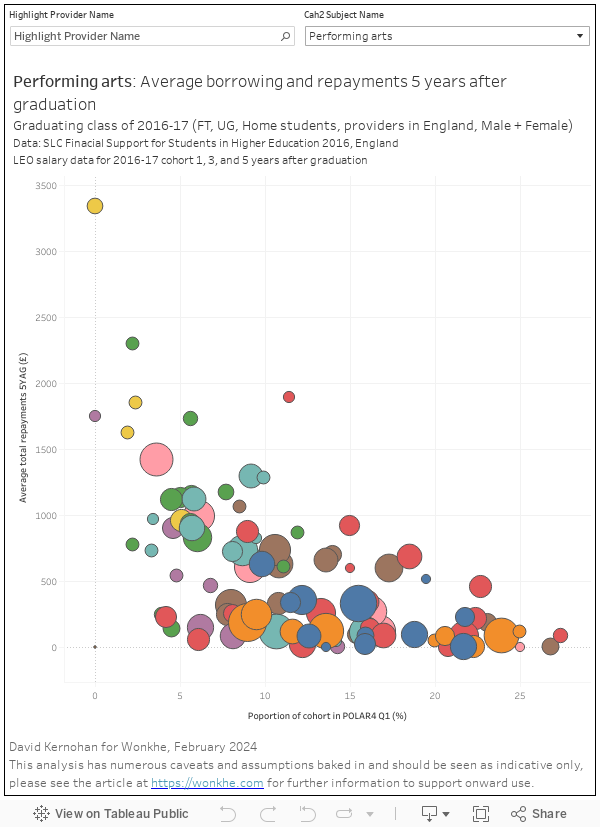
    Of course, we don’t get data on student borrowing by provider and subject – but we can still calculate repayments on that basis. Here’s a look at average repayments over five years by CAH2 subject (box on the top right to choose) – I’ve plotted against the proportion of the cohort from POLAR4 Q1 because that curve is impressively persistent.

    [Full screen]

    For all of the reasons – and short cuts! – above I want to emphasise again that this is indicative data – there are loads of assumptions here. I’m comfortable with this analysis being used to talk about general trends, but you should not use this for any form of regulation or parliamentary question.

    The question it prompts, for me, is whether it is fair to assume that providers with a bigger proportion of non-traditional students will be less effective at teaching. Graduate outcome measures may offer some clues, but there are a lot of caveats to any analysis that relies solely on that aspect.

    Source link

  • Second-generation student borrowers | SRHE Blog

    Second-generation student borrowers | SRHE Blog

    by Ariane de Gayardon

    Since the 1980s, massification, policy shifts, and changing ideas about who benefits from higher education have led to the expansion of national student loan schemes globally. For instance, student loans were introduced in England in 1990 and generalized in 1998. Australia introduced income-contingent student loans in the late 1980s. While federal student loans were introduced in the US in 1958, their number and the amount of individual student loan debt ramped up in the 1990s.

    A lot of academic research has analysed this trend, evaluating the effect of student loans on access, retention, success, the student experience, and even graduate outcomes. Yet, this research is based on the choices and experiences of first-generation student borrowers and might not apply to current and future students.

    First-generation borrowers enter higher education with parents who have either not been to higher education, or who have a tertiary degree that pre-dates the expansion of student loans. The parents of first-generation borrowers therefore did not take up loans to pay for their higher education and had no associated repayment burden in adulthood. Any cost associated with these parents’ studies will likely have been shouldered by their families or through grants.

    Second-generation borrowers are the offspring of first-generation borrowers. Their parents took out student loans to pay for their own higher education. The choices made by second-generation borrowers when it comes to higher education and its funding could significantly differ from first-generation borrowers, because they are impacted by their parents’ own experience with student loans.

    Parents and parental experience indeed play an important role in children’s higher education choices and financial decisions. On the one hand, parents can provide financial or in-kind support for higher education. This is most evident in the design of student funding policies which often integrate parental income and financial contributions. In many countries, eligibility for financial aid is means-tested and based on family income (Williams & Usher, 2022). Examples include the US where an Expected Family Contribution is calculated upon assessment of financial need, or Germany where the financial aid system is based on a legal obligation for parents to contribute to their children’s study costs. Indeed, evidence shows that parents do contribute to students’ income. In Europe, family contributions make up nearly half of students’ income (Hauschildt et al, 2018). But the role of parents also extends to decisions about student loans: parents tend to try and shield their children from student debt, helping them financially when possible or encouraging cost-saving behaviour (West et al, 2015).

    On the other hand, parents transmit financial values to their children, which might play a role in their higher education decisions. Family financial socialization theory states that children learn their financial attitudes and behaviour from their parents, through direct teaching and via family interactions and relationships (Gudmunson & Danes, 2011). Studies indeed show the intergenerational transmission of social norms and economic preferences (Maccoby, 1992), including attitudes towards general debt (Almenberg et al, 2021). Continuity of financial values over generations has been observed in the specific case of higher education. Parents who received parental financial support for their own studies are more likely to contribute toward their children’s studies (Steelman & Powell, 1991). For some students, negative parental experiences with general debt can lead to extreme student debt aversion (Zerquera et al,2016).

    As countries globally rely increasingly on student loans to fund higher education, many more students will become second-generation borrowers. Because their parents had to repay their own student debt, the family’s financial assets may be depleted, potentially leading to reduced levels of parental financial support for higher education. This is likely to be even worse for students whose parents are still repaying their loans. In addition, parental experiences of student debt could influence the advice they give their children with regard to higher education financial decisions. As a result, this new generation of student borrowers will face challenges that their predecessors did not, fuelled by the transmitted experience of student loans from their parents (Figure 1).

    Figure 1 – Parental influence on second-generation borrowers

    As the share of second-generation borrowers in the student body increases, the need to understand the decision-making process of these students when it comes to (financial) higher education choices is essential. Although the challenges faced by borrowers will emerge at different times and with varying intensity across countries — depending in part on loan repayment formats — we have an opportunity now to be ahead of the curve. By researching this new generation of student borrowers and their parents, we can better assess their financial dilemmas and the support they need, providing further evidence to design future-proof equitable student funding policies.

    Ariane de Gayardon is Assistant Professor of Higher Education at the Center for Higher Education Policy Studies (CHEPS) based at the University of Twente in the Netherlands.

    Author: SRHE News Blog

    An international learned society, concerned with supporting research and researchers into Higher Education

    Source link

  • Student Debt by Ethnicity | HESA

    Student Debt by Ethnicity | HESA

    Hi all. Just a quick one today, this time on some data I recently got from StatsCan.

    We know a fair a bit about student debt in Canada, especially with respect to distribution by gender, type of institution, province, etc. (Chapter 6 of The State of Postsecondary Education in Canada is just chock full of this kind of data if you’re minded to take a deeper dive). But to my knowledge no one has ever pulled and published the data on debt by ethnicity, even though this data has been collected for quite some time through the National Graduates Survey (NGS). So I ordered the data, and here’s what I discovered.

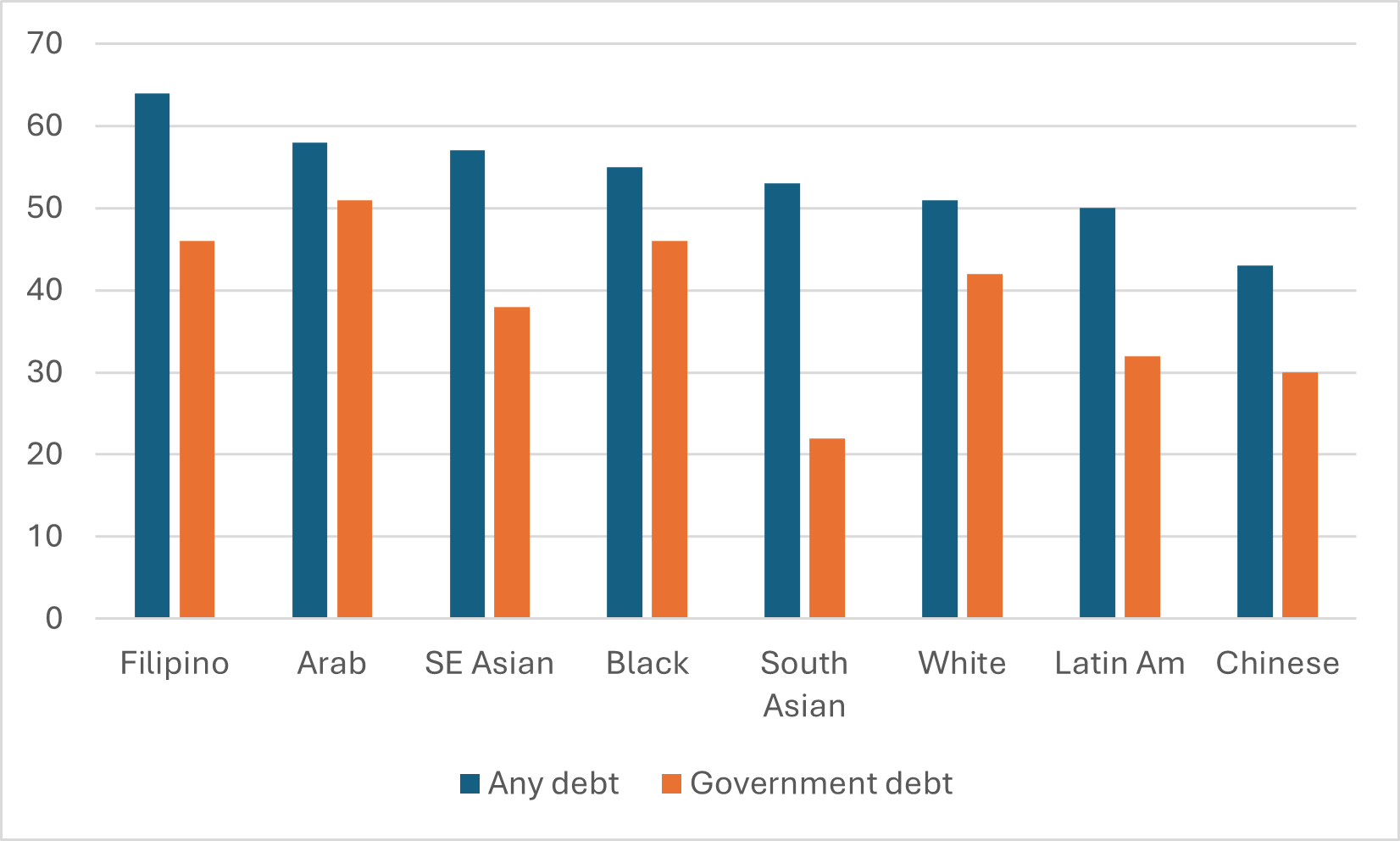
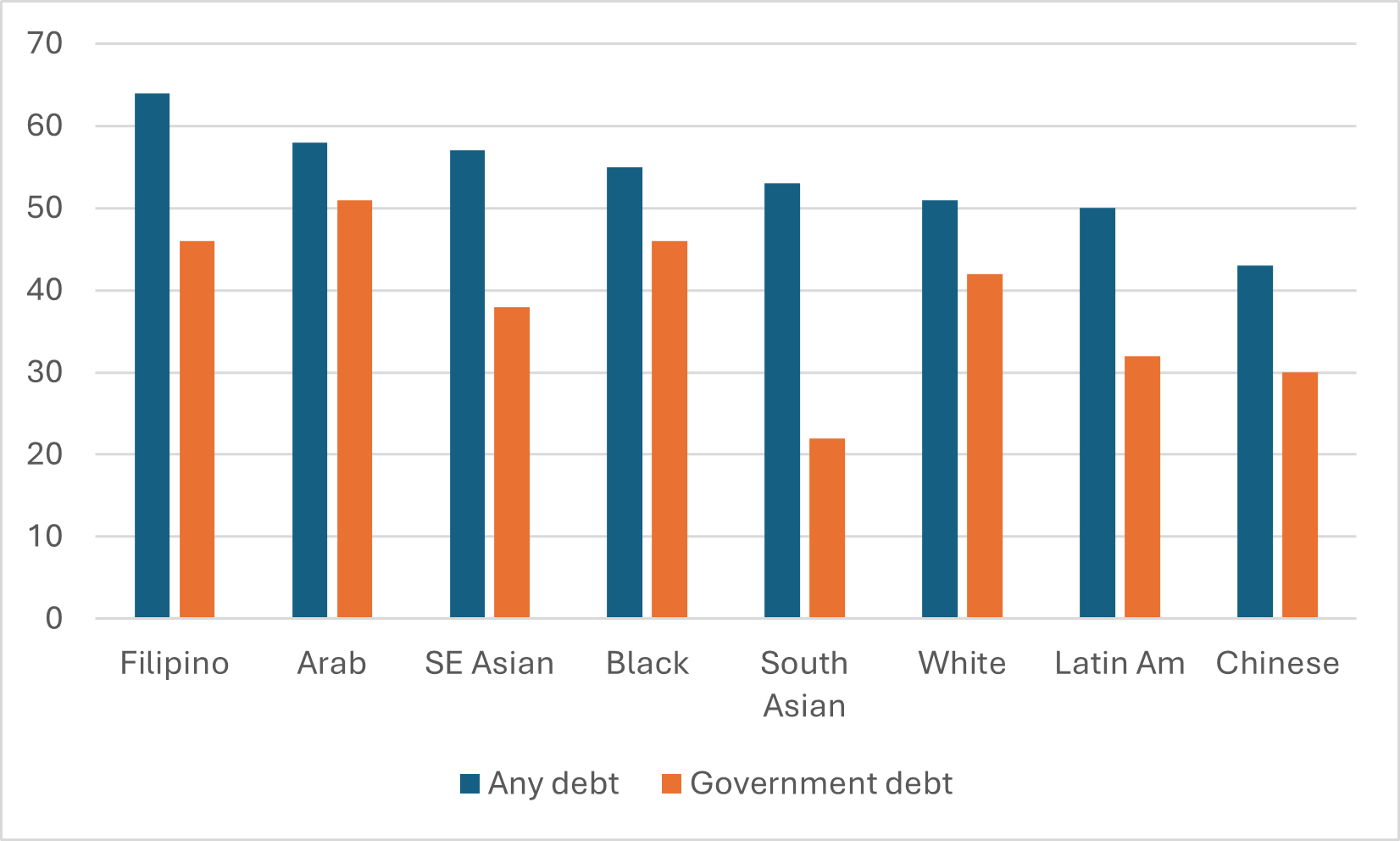
    Figure 1 shows incidence of borrowing for the graduating class of 2020, combined for all graduates of universities and graduates, for the eight largest ethnicities covered by the NGS (and before anyone asks, “indigeneity” is not considered an ethnicity so anyone indicating an indigenous ethnicity is unfortunately excluded from this data… there’s more below on the challenges of getting additional data). And the picture it shows is…a bit complex.

    Figure 1: Incidence of Borrowing, College and University Graduates Combined, Class of 2020

    If you just look at the data on government loan programs (the orange bars), we see that only Arab students have borrowing rates in excess of 1 in 2. But for certain ethnicities, the borrowing rate is much lower. For Latin American and Chinese students, the borrowing rate is below 1 in 3, and among South Asian students the borrowing rate is barely 1 in 5. Evidence of big differences in attitudes towards borrowing!

    Except…well when you add in borrowing from private sources (e.g. from banks and family) so as to take a look at overall rates of borrowing incidence, the differences in borrowing rates are a lot narrower. Briefly, Asian and Latin American students borrow a lot more money from private sources (mainly family) than do Arab students, whites, and Blacks. These probably come with slightly easier repayment terms, but it’s hard to know for sure. An area almost certainly worthy of further research.

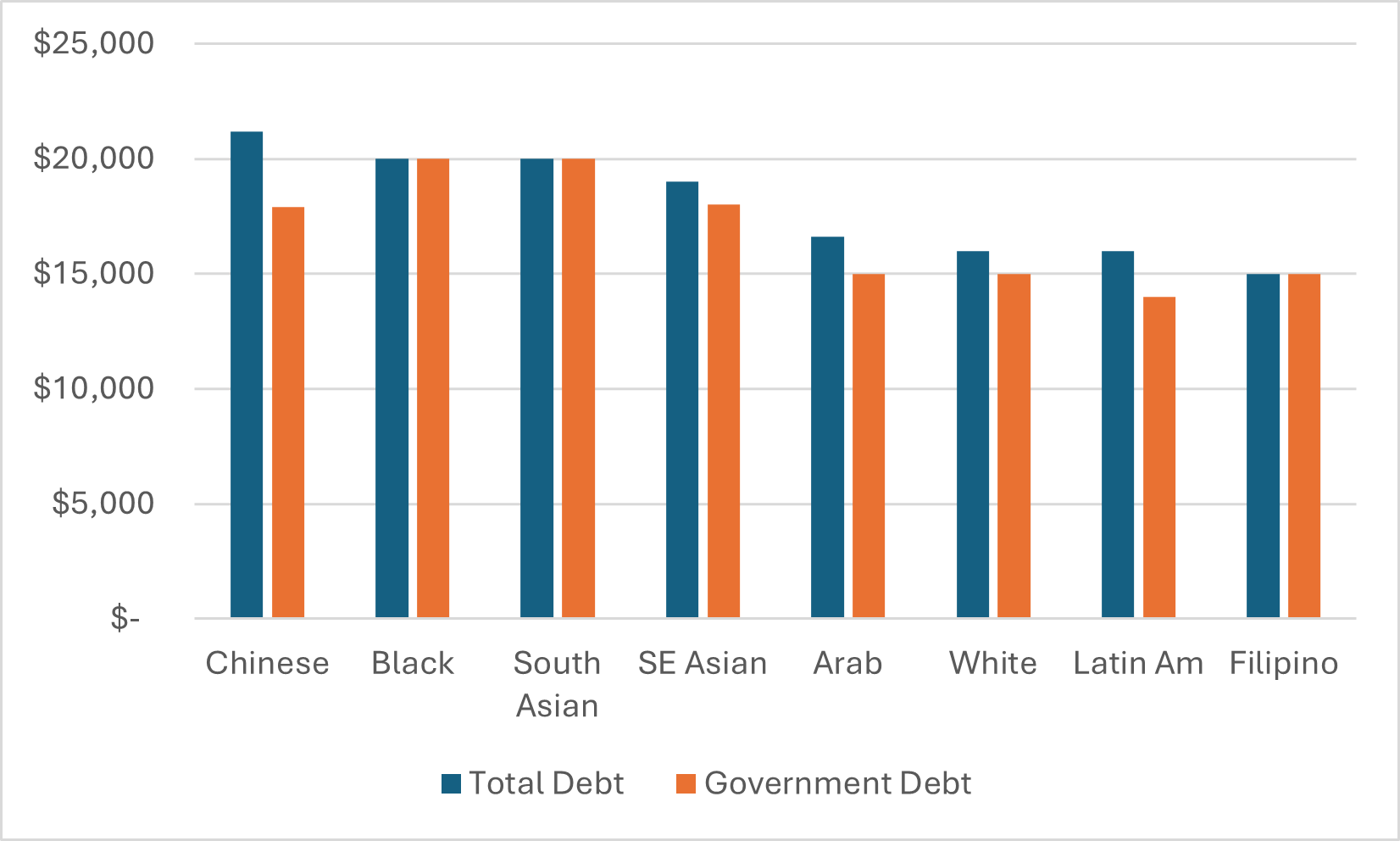
    There is a similarly nuanced picture when we look at median levels of indebtedness among graduates who had debt. This is shown below in Figure 2.

    Figure 2: Median Borrowing, College and University Graduates Combined, Class of 2020

    Now, there isn’t a huge amount of difference in exiting debt levels by ethnicity: the gap is only about $6,000 between the lowest total debt levels (Filipinos) and the highest (Chinese). But part of the problem here is that we can’t distinguish the reason for the various debt levels. Based on what we know about ethnic patterns of postsecondary education, we can probably guess that Filipino students have low debt levels not because they are especially wealthy and can afford to go to post-secondary without financial assistance. But rather because they are more likely to go to college and this spend less time, on average, in school paying fees and accumulating debt. Similarly, Chinese students don’t have the highest debt because they have low incomes; they have higher debt because they are the ethnic group the most likely to attend university and spend more time paying (higher) fees.

    (Could we get the data separately for universities and colleges to clear up the confound? Yes, we could. But it cost me $3K just to get this data. Drilling down a level adds costs, as would getting data based on indigenous identity, and this is a free email, and so for the moment what we have above will have to do. If anyone wants to pitch in a couple of grand to do more drilling-down, let me know and I would be happy to coordinate some data liberation).

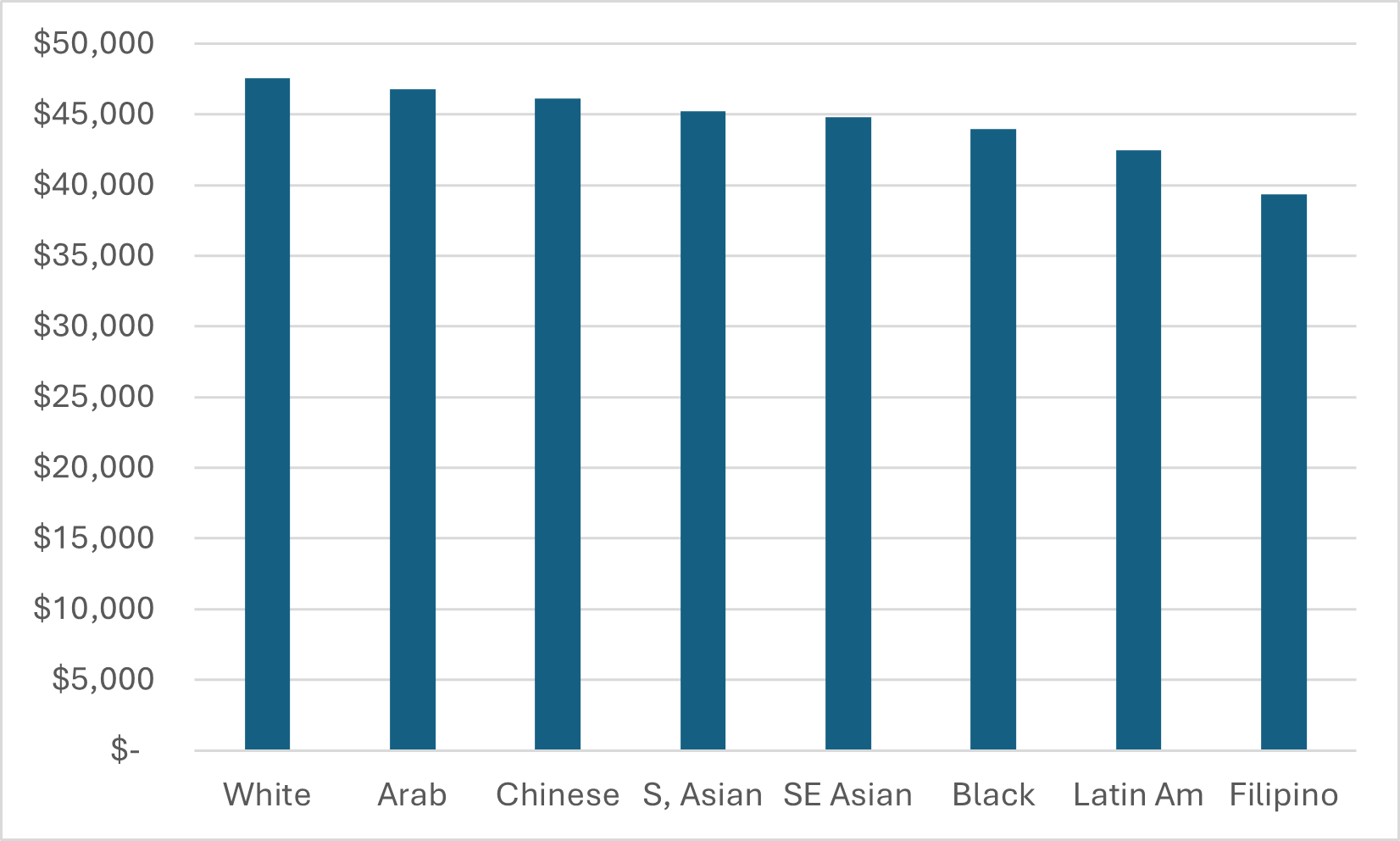
    It is also possible to use NGS data to look at post-graduate income by debt. I obtained the data by in fairly large ranges (e.g. $0-20K, $20-60K, etc.), but it’s possible on the basis of that to estimate roughly what median incomes are (put it this way: the exact numbers are not exactly right, but the ordinal rank of income of the various ethnicities are probably accurate). My estimations of median 2023 income of 2020 graduates—which includes those graduates who are not in the labour market full-time, if you’re wondering why the numbers look a little low—are shown below in Figure 3.

    Figure 3: Estimate Median 2023 Income, College and University Graduates Combined, Class of 2020

    Are there differences in income here? Yes, but they aren’t huge. Most ethnic groups have median post-graduate incomes between $44 and $46,000. The two lowest-earning groups (Latin Americans and Filipinos) re both disproportionately enrolled in community colleges, which is part of what is going on in this data (if you want disaggregated data, see above).

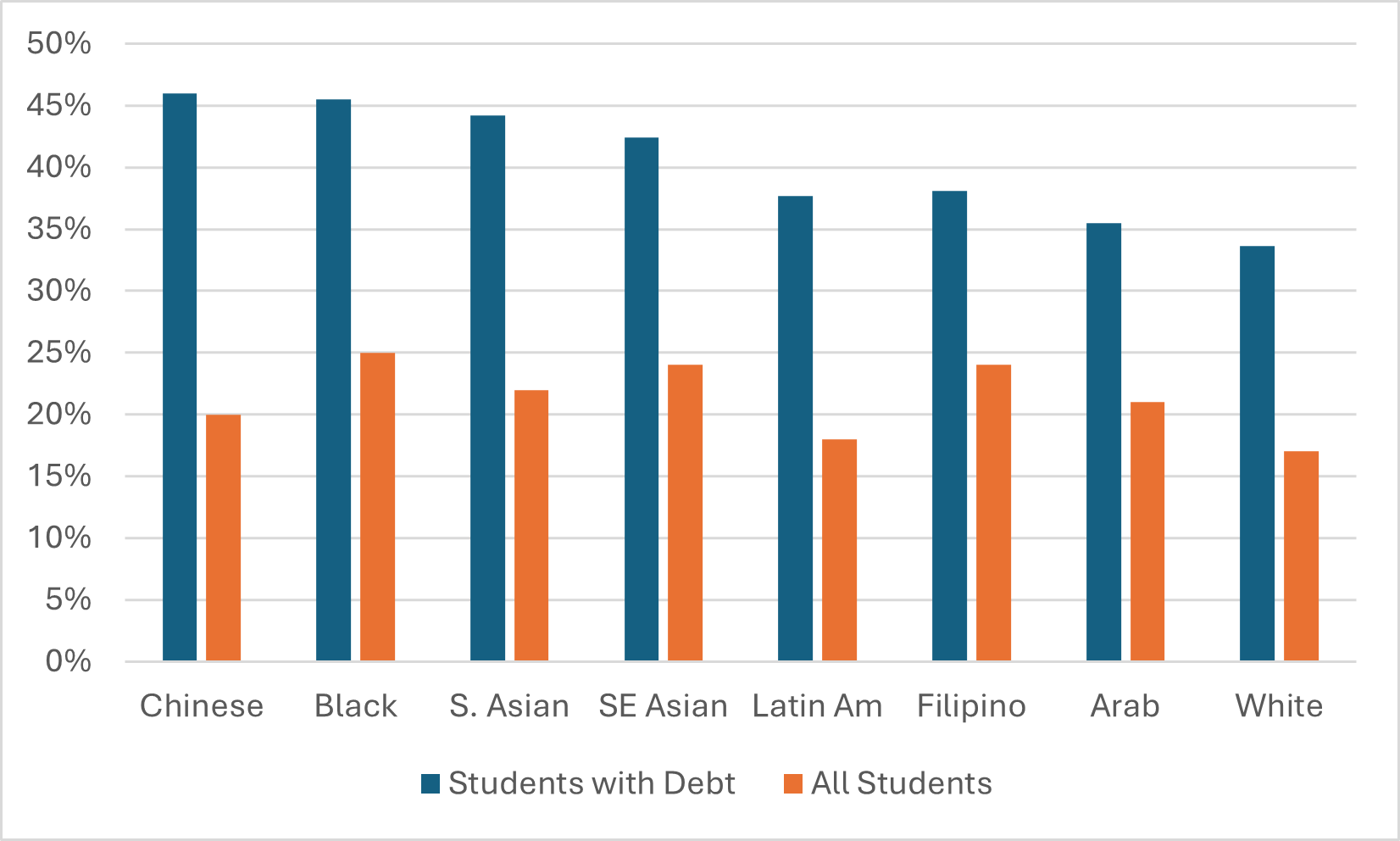
    Now, the data from the previous graphs can be combined to look at debt-to-income ratios, both for students with debt, and all students (that is, including those that do not borrow). This is shown below in Figure 4.

    Figure 4: Estimated Median 2023 Debt-to-Income Ratios, College and University Graduates Combined, Class of 2020

    If you’re just dividing indebtedness by income (the blue bars), you get a picture that looks a lot like Figure 2 in debt, because differences in income are pretty small. But if you are looking at debt-to-income ratios across all students (including those that do not borrow) you get a very different picture because as we saw in Figure 1, there are some pretty significant differences in overall borrowing rates. So, for instance, Chinese students go from having the worst debt-to-income ratio on one measure to being middle of the pack on another because they have relatively low incidence of borrowing; similarly, students of Latin American origin go from being middle-of-the-pack to nearly the lowest debt-to-income ratios because they are a lot less likely to borrow than others. Black students end up having among the highest debt-to-income ratios not because they earn significantly less than other graduates, but because both the incidence and amount of their borrowing is relatively high.

    But I think the story to go with here is that while there are differences between ethnic groups in terms of borrowing, debt, and repayment ratios, and that it’s worth trying to do something to narrow them, the difference in these rates is not enormous. Overall, it appears that as a country we are achieving reasonably good things here, with the caveat that if this data were disaggregated by university/ college, the story might not be quite as promising.

    And so ends the first-ever analysis of student debt and repayment by ethnic background. Hope you found it moderately enlightening.

    Source link

  • Public Service Loan Forgiveness: Help Employees Achieve Their Financial Goals

    Public Service Loan Forgiveness: Help Employees Achieve Their Financial Goals

    by Julie Burrell | September 17, 2024

    The Public Service Loan Forgiveness (PSLF) program can offer significant financial relief to higher ed employees, but many don’t know they qualify for this benefit. PSLF is open to most full-time higher ed employees of nonprofit colleges and universities who have direct federal student loans.

    HR can spread the word to current employees and use loan forgiveness as part of a retention and recruitment strategy. The average amount of individual loan forgiveness under the PSLF is $70,000, which makes the PSLF an especially attractive benefit to potential employees.

    Here’s what you need to know about who qualifies for PSLF, how to offer a free webinar on PSLF to your employees, and what steps you can take to ensure eligible employees enroll.

    What is PSLF?

    Public Service Loan Forgiveness forgives the balance of direct federal student loans after 120 qualifying payments made by the borrower if they work for a qualifying employer (after October 1, 2007) and are under a qualifying repayment plan. It’s intended to reward and incentivize public service, like teaching, nonprofit work and work in the public sector. PSLF eligibility isn’t about what job an employee does or what their job description is; it’s about where they work.

    Who qualifies for PSLF?

    Full-time employees of a nonprofit organization or a federal, state, tribal, or local government are eligible. Full-time work is defined as 30 hours or more per week. That means most full-time higher ed employees are eligible for PSLF, including those who may work part time at your institution but are also employed at other qualifying jobs (as is the case with many adjuncts). But the PSLF only applies to direct federal student loans. Borrowers with other federal student loans may be able to consolidate them into a direct federal student loan.

    How do I ensure my institution counts as an eligible employer?

    Use the PSLF Help Tool, which will search the federal employer database. The help tool is also useful to recommend to employees since it’s a step-by-step guide through the enrollment process.

    Six Tips for Getting the Word Out

    1. Partner with Public Service Promise, a nonprofit, nonpartisan organization that offers free webinars led by experts.
    2. Encourage HR staff to apply for PSLF. With firsthand experience, you and your team will be able to speak knowledgeably about the process.
    3. Publicize PSLF as a benefit to your employees, especially those who may not know they can take advantage of this program, including adjuncts and non-exempt and part-time employees.
    4. Include information about PSLF on your benefits websites or portal.
    5. Consider appointing a knowledgeable point person on campus, like a financial aid officer, to help answer employee questions.
    6. Involve non-exempt, adjunct and part-time employees in outreach campaigns. Employees can meet the 30 hours per week requirement with more than one job. So if they have multiple jobs at multiple qualifying employers, employees can add those hours up. And the PSLF instructions include how to calculate hours worked by adjunct faculty. Payments do not need to be consecutive, so even adjuncts without summer appointments can still take advantage of PSLF and start to chip away at the 120 payments.


    Source link

  • Time Is Running Out: Help Your Employees Navigate the Special PSLF Waiver – CUPA-HR

    Time Is Running Out: Help Your Employees Navigate the Special PSLF Waiver – CUPA-HR

    by CUPA-HR | August 24, 2022

    On Oct. 6, 2021, the U.S. Department of Education announced a change to the Public Service Loan Forgiveness (PSLF) program rules for a limited time as a result of the COVID-19 national emergency. Millions of non-profit and government employees have federal student loans and may now be eligible for loan forgiveness or additional credit through the limited PSLF waiver. But they need to act fast. The special waiver expires October 31, 2022.

    Here are several resources for HR professionals who want to get the word out to employees before the opportunity passes.

    Learn More and Get Tips for Educating Employees

    In June, CUPA-HR hosted the webinar, Helping Employees Understand and Navigate the Public Service Loan Forgiveness (PSLF) Program, where Department of Education representative Ashley Harrington shared details about the program and how HR can help guide employees through the necessary processes to achieve loan forgiveness. The recorded webinar is available for viewing any time.

    Explore the Department of Education’s Employer Toolkit

    The Department of Education’s PSLF waiver toolkit is a comprehensive resource that features a PSLF fact sheet, sample social media posts and email templates HR can use to spread the word to campus employees.

    Direct Employees to the Borrower Site

    For a clear explanation of the program and a simple step-by-step process to determine who is eligible for the program, direct employees to the Federal Student Aid website.


    Source link