

As summer wraps up, education marketers everywhere know what’s next? The back-to-school rush. It’s that time when inboxes fill up, campaigns go live, and every message counts. This season isn’t just about new classes or fresh notebooks; it’s the start of a new student recruitment marketing cycle, a chance to re-engage current students, attract new ones, and build momentum for the year ahead.
In a competitive space like higher education, you can’t rely on luck. You need a clear, intentional strategy that speaks directly to your students and stands out in a noisy market. Whether you’re a career college, university, or language school, this is the chance is to set the tone and build lasting connections.
In this playbook, you’ll find practical, proven back-to-school marketing strategies for success. From personalized outreach and short-form video to smart content planning and accessible design, consider this your guide to an A+ marketing season.
Struggling with enrollment?
Our expert digital marketing services can help you attract and enroll more students!
Audit Last Year’s Campaigns and Set SMART Goals
Before launching any new campaign, take a breath and look back. What worked in your student recruitment marketing last year, and what didn’t? Pull up your analytics and dig deep into the data: conversion rates, click-through rates (CTR), engagement metrics, and ROI for every channel. If your online open house had strong attendance but few follow-up applications, ask why. If your email series saw above-average opens, figure out what made it work: was it timing, tone, or topic?
Use these insights to set SMART goals: Specific, Measurable, Achievable, Relevant, and Time-bound. Avoid vague aims like “increase applications.” Instead, go for something concrete, like “increase undergraduate application starts by 15% by the end of Q3.”
Why is it important for schools to audit previous marketing campaigns before launching new ones? Auditing past campaigns helps schools understand their previous recruitment efforts. By analyzing data such as click-through rates, conversion rates, and ROI, institutions can set SMART goals for the new academic year. This ensures resources are directed toward tactics that actually drive inquiries, applications, and enrollments instead of repeating ineffective strategies.
Example: City School District of Albany (NY) The district undertook a comprehensive communications audit with the National School Public Relations Association, reviewing all print and digital outreach. The 2024 audit report identified strengths and challenges and led to specific 2024–25 implementation goals, for example, hiring a new school communications specialist and streamlining internal communication protocols. These SMART goals were directly tied to audit recommendations, ensuring measurable improvements in engagement and consistency.
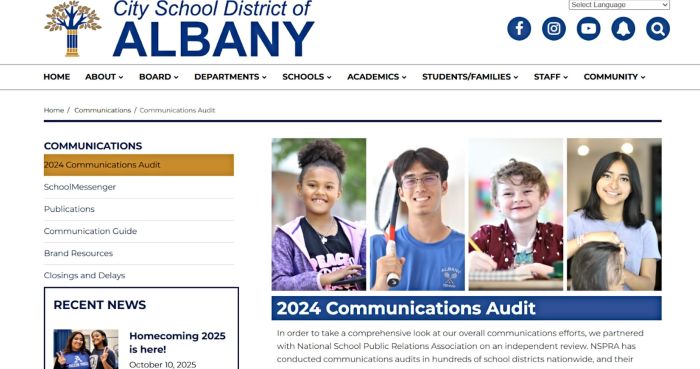
Source: City School District of Albany
Tactical Tip: Create a simple scorecard or dashboard with last year’s metrics and this year’s goals. Track results on a weekly or monthly basis, and adjust tactics as needed. Data-driven agility is your best advantage.
Personalize Your Outreach to Prospective Students
Personalization should already be part of your strategy. Between 70 – 80% of students now expect it from schools. The back-to-school period is the perfect time to show you understand each prospect’s needs.
Start with your CRM data. Segment audiences by program, location, or funnel stage, then tailor messages accordingly. Send unfinished applicants a quick “deadline reminder” email, while offering current students a “Welcome Back” guide. Both feel personal and drive engagement.
Your website can do this too. Dynamic banners or content blocks that change by visitor type make a big impact. Tools like HubSpot, Slate, or Mautic by HEM help automate it all, even inserting names or programs into messages.
Example: University of Idaho. To personalize outreach at scale, U of I introduced AI-driven personalized video messages for prospective students during the 2024 recruitment cycle. Applicants received videos addressing them by name, hometown, and academic interest, creating a one-to-one connection. This individualized approach was added on top of existing personalized print and email campaigns. The results were impressive: emails containing the personalized video links saw a 45% open rate (versus 24% for standard emails), and the university reported higher application and admission rates across all student segments after launching over ten such video campaigns.
How can educational institutions use personalization to improve student engagement? Personalization allows schools to communicate directly to a student’s interests, program choices, and stage in the admissions funnel. Using CRM and marketing automation tools like Mautic by HEM, teams can segment audiences, send customized emails, and display dynamic website content based on visitor data. When prospective students receive tailored messages, like deadline reminders or personalized welcome guides, they’re more likely to respond, apply, and enroll.
Tactical Tip: Gather preferences early through short surveys (“What’s your dream career?”). Feed those insights into your campaigns, and when prospects see content that matches their interests, they’re far more likely to apply or enroll.
Engage Through Video and Social Media Content
Currently your audience is scrolling, and fast. Gen Z and Gen Alpha spend hours on TikTok, Instagram, and YouTube, where video dominates. In fact, video now makes up more than 80% of all internet traffic, so if it’s not central to your strategy, you’re already behind.
Show what campus life feels like. Create short videos that capture move-in day buzz, a lively lab session, or the roar of the first football game. Student testimonials and livestreamed Q&As work especially well because they’re authentic and emotional, two things today’s viewers respond to.
Your social media profiles are your school’s digital storefront. Keep them fresh with “Day in the Life” takeovers, campus challenges, and UGC that shows students’ real experiences. Repost their content (with credit) to build authenticity. Even micro-influencers (popular students or alumni) can amplify your reach organically.
Use social media to build community, too. Create incoming class groups groups on Facebook or Discord where students connect before arriving, or run quick Instagram polls (“What are you most excited about this fall?”) to boost engagement.
Example: University of Minnesota. The university kicked off the 2024 academic year with an energetic “Welcome Back to School 2024” video message from the new president, Dr. Rebecca Cunningham. Shared on the official UMN YouTube channel and social media, the video welcomes students and faculty to campus and sets an enthusiastic tone for the year. This engaging content, featuring the president and campus scenes, was used to boost school spirit online and was widely viewed and shared within the community.
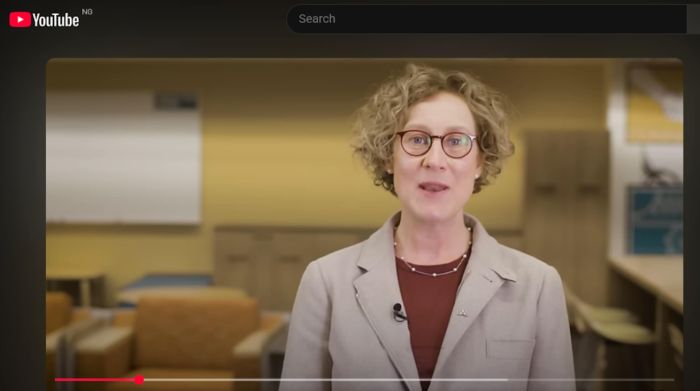
Source: YouTube
What role do video and social media play in back-to-school marketing? Video and social media are now essential tools for reaching Gen Z and Gen Alpha students. Platforms like TikTok, Instagram, and YouTube are where prospective students spend most of their time, making short-form, authentic videos key to capturing attention. Schools can share move-in day highlights, “Day in the Life” student takeovers, or live Q&As to showcase campus life and build emotional connections with their audience before the academic year begins.
Tactical Tip: Format videos for each platform: vertical and under 60 seconds for TikTok or Reels, longer for YouTube. Post “move-in prep” content in August and “welcome week” highlights in September to match student timelines.
Visual Tip: Mix polished and raw footage. A sleek virtual tour pairs perfectly with a student’s unfiltered dorm vlog. That balance between professional and real builds trust and attention.
Plan an Integrated Content Calendar for the Academic Year
When you’re juggling multiple channels, such as email, social media, blogs, print, and events, it’s easy for campaigns to lose focus. A well-structured content calendar keeps everything aligned. It outlines what you’ll publish, when, and where, ensuring every platform supports the same strategy.
Start with a brainstorming session before fall begins. Identify monthly themes that match your recruitment cycle. August could highlight move-in and orientation, September might focus on study tips and student life, and October on deadlines and fall events. Include major dates like FAFSA deadlines, holidays, and open houses so nothing slips through the cracks.
For each theme, plan content across different stages of the funnel. During back-to-school, for instance, pair “slice of campus life” stories for awareness with targeted “why choose us” posts for decision-making prospects.
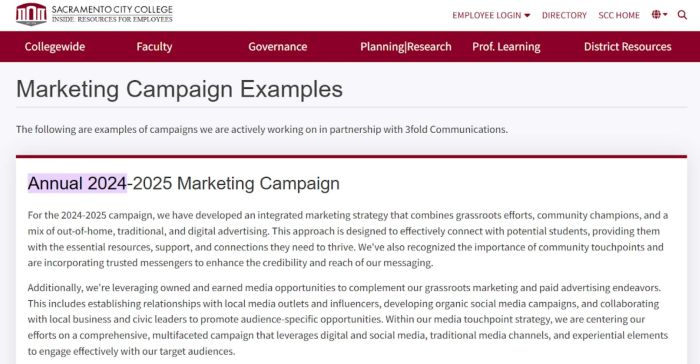
Example: Los Rios Community College District (CA). For the 2024–2025 recruitment cycle, Los Rios (a district of four colleges) developed an integrated marketing content strategy spanning grassroots outreach, traditional media, and digital channels. Their annual marketing campaign plan was managed through a central calendar and included coordinated content across platforms: social media posts, email campaigns, community events, billboards, and more.
Source: Los Rios Community College District
Tactical Tip: Add columns in your calendar for audience, goal, and platform. Tools like Trello, Airtable, or even Google Sheets can help your team stay organized.
Pro Tip: Capture new assets early in the semester. Fresh photos, short videos, and student testimonials from those first lively weeks will fill your content library with authentic, high-energy material you can repurpose all year.
Maximize Reach With Targeted Digital Advertising
Even the strongest content needs help reaching the right audience. Digital advertising ensures your message gets in front of prospective students and their parents at the right time and place.
Begin by defining your audience and selecting the platforms that align with their habits. For high school seniors, Google Ads and Instagram are usually most effective. For local adult learners, Facebook or regional streaming ads may deliver better results. Match your spend to where your audience is most active.
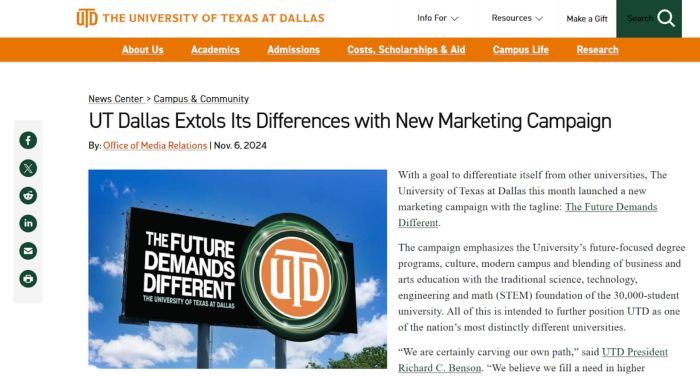
Example: University of Texas at Dallas. In late 2024, UT Dallas launched a new branding campaign, “The Future Demands Different,” which employed highly targeted digital and media advertising to recruit students. The campaign focused heavily on specific geographic markets: primarily North Texas, with select expansion into other Texas cities and neighboring Oklahoma, where the university offers special tuition rates. UTD produced its first-ever broadly distributed TV commercial featuring current students and placed these ads strategically on local television newscasts, streaming platforms, and even during NBA game broadcasts (Dallas Mavericks) to reach its target audience.
Source: University of Texas at Dallas
Next, focus on timing and relevance. Seasonal messages like “Apply by October 15” or “Start your future this fall” create urgency and keep your campaigns connected to the academic calendar. Pair them with engaging, authentic visuals that reflect campus life and excitement for the new year.
Retargeting is another essential tactic. Students who visit your website or start an application are warm leads. Remind them to take the next step with a clear, encouraging ad.
Tactical Tip: Track your campaigns closely. Test headlines, images, and calls to action to see what resonates, and refine your approach as data comes in. Ensure your landing pages are fast, mobile-friendly, and consistent with your ads. That seamless experience is what turns clicks into conversions.
Streamline Marketing with Automation and AI
The back-to-school season can feel like organized chaos, with hundreds of inquiries, events to manage, and deadlines everywhere. That’s why automation and AI are no longer nice-to-haves; they’re essential for keeping communications personal while giving your team room to breathe.
Start with a strong CRM connected to a marketing automation system. Platforms like Mautic by HEM, designed for education marketers, make it easy to automate email campaigns, social posts, and lead nurturing. For example, when a student downloads your course catalog, your system can automatically follow up the next day with a webinar invite. This keeps engagement flowing without constant manual effort.
Email automation is especially effective this time of year. Set up a simple three-step sequence: welcome, tips for applying, and a deadline reminder. Keep your design clean, concise, and mobile-friendly, as most students will read emails on their phones.
AI chatbots are another huge time-saver. Schools like Georgia State University have seen success with their chatbot “Pounce,” which helped reduce summer melt by answering student questions around the clock. You can deploy similar chat tools on your website or Facebook Messenger to guide prospects when staff aren’t available.
AI can also optimize your digital ads, test creative variations, and even suggest the best posting times on social media. Just keep a human eye on the outputs. AI should assist with the creation process, not replace, a real connection.
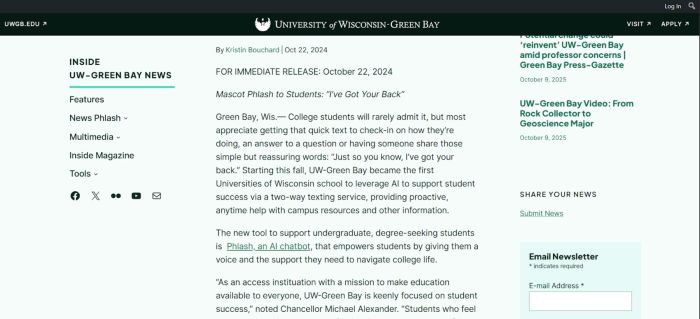
Example: University of Wisconsin–Green Bay. UW–Green Bay became the first in its state system to deploy an AI-driven chatbot for student outreach in Fall 2024. Nicknamed “Phlash,” the bot engages undergraduate students via two-way text messaging, providing 24/7 answers to common questions and proactively checking in on students’ well-being. For example, every 7–10 days, Phlash sends a brief text asking how the student is doing and offers guidance or resources based on their needs. In its first week, 96% of UWGB students opted in to receive messages from Phlash, and over 2,100 student replies were recorded within 24 hours of the first check-in text.
Source: University of Wisconsin–Green Bay
Tactical Tip: Use automation analytics to fine-tune your back-to-school marketing strategies. Track open rates, chatbot inquiries, and ad conversions. If you notice a drop-off, tweak timing or content. Over time, these insights will help you refine your approach and build smarter, more human campaigns.
Ensure Accessible and Inclusive Marketing Materials
When your campaigns are accessible and welcoming to everyone, you reach more prospective students and reflect the values your institution stands for.
Start with accessibility basics. Add descriptive alt text to all images so screen readers can describe visuals to users with vision impairments. Caption every video and provide transcripts. These help not only Deaf or hard-of-hearing students but also anyone watching on mute. Check color contrast, too: combinations like red on green can be hard to read for color-blind users. Use clear fonts, readable sizes, and designs that meet accessibility standards.
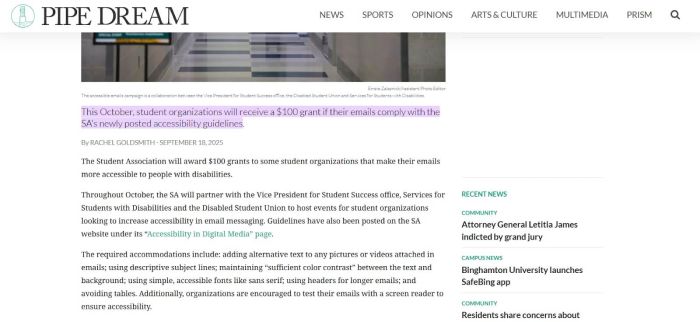
Example: Binghamton University (Student Association). At Binghamton, student leaders launched an “accessible emails” initiative in Fall 2025 to improve the inclusivity of campus communications. The Student Association (SA), in partnership with the campus disability services office, rolled out digital accessibility guidelines and challenged all student organizations to apply them in their back-to-school email newsletters. These guidelines included using alt text on images, high-contrast colors, readable fonts, and captions on videos, and simple adjustments to make emails and social posts readable by screen readers and accessible to those with disabilities. To incentivize adoption, the SA offered $100 grants (via a raffle) to clubs that complied with the new accessibility standards in their October emails.
Source: Binghamton University
Make sure your content works across all devices. Responsive, mobile-friendly emails and web pages prevent frustration and help more users complete inquiry forms or explore programs on their phones.
Representation matters as well. Feature students from diverse backgrounds and experiences, and consider multilingual or culturally inclusive content if you serve international audiences.
Tactical Tip: Run a quick accessibility audit using tools like WAVE or Axe to spot missing tags or low-contrast text. Train your marketing team on simple habits, like using CamelCase in hashtags (#FirstDayAtCampus), that make your content more inclusive. Small changes go a long way toward making every student feel seen and included.
Measure, Adapt, and Refine Your Strategy
Great marketing doesn’t stop at launch; it evolves. Once your back-to-school campaigns are live, monitor results closely and be ready to adjust. Use Google Analytics 4, CRM dashboards, such as HEMs Mautic, and other social insights to see what’s working. Focus on metrics that matter, like inquiries and applications.
Hold quick debriefs with your team after major pushes. Ask what content resonated, which channels drove engagement, and whether event turnout met expectations. Maybe your career-focused posts got strong traction, or your TikTok videos outperformed Facebook. Use that data to refine your next phase of content and budget allocation.
Flexibility is your biggest advantage. Test different formats, refine your messaging, and pivot when something isn’t working. Every campaign teaches you more about your audience.
Example: Park Hill School District (MO). Park Hill’s communications department exemplifies a cycle of measurement and refinement in its marketing strategy. Each year, they collect detailed analytics on communication channels, email open rates, social media engagement, website traffic, and even advertising partnership revenue, and compare them to prior years’ benchmarks. In their 2023–24 report, for instance, the team noted improvements like an increase in the staff newsletter open rate from the mid-40% range up to 52%, and a jump in Facebook reach by 167% year-over-year. They also track outcomes of marketing initiatives (e.g., four years of in-house advertising brought in $148,800 in revenue in 2023–24) to evaluate ROI. These metrics inform mid-course corrections and the setting of new goals.
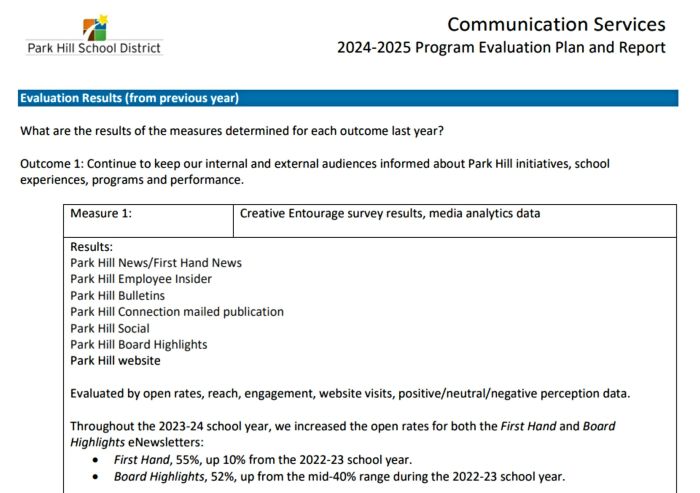
Source: Park Hill School District
Tactical Tip: Keep communication open across teams. Marketing, admissions, and academics should share insights regularly. If your in-house resources are stretched, consider bringing in experts like HEM. Our team offers digital strategy, content, automation, and CRM support so you can scale campaigns efficiently and keep enrollment goals on track. Measure what matters, learn fast, and never stop improving.
Wrapping Up
The back-to-school season sets the tone for the entire year. When you combine strategy with creativity, the results speak for themselves. Reviewing last year’s data, setting SMART goals, personalizing outreach, producing engaging videos, organizing content calendars, and using automation or targeted ads all work together to move the needle. Add accessibility and inclusion, and your marketing becomes not just effective, but meaningful.
At the heart of it all is one principle: keep students front and center. Understand what drives them, where they spend time, and how your institution can meet their goals. That empathy fuels every great campaign.
Effective higher education marketing is a perfect blend of art and analysis. It’s about pairing strong storytelling with measurable outcomes. And when you need a partner to help balance both, Higher Education Marketing (HEM) is here. We specialize in data-driven strategy, automation, SEO, and social campaigns built to amplify your institution’s voice.
The new academic year is full of opportunities. With the right preparation and a willingness to adapt, your marketing can inspire action, drive enrollment, and welcome a new wave of students ready to thrive. Here’s to your most successful back-to-school season yet.
Struggling with enrollment?
Our expert digital marketing services can help you attract and enroll more students!
Frequently Asked Questions
Question: Why is it important for schools to audit previous marketing campaigns before launching new ones?
Answer: Auditing past campaigns helps schools understand their previous recruitment efforts. By analyzing data such as click-through rates, conversion rates, and ROI, institutions can set SMART goals for the new academic year. This ensures resources are directed toward tactics that actually drive inquiries, applications, and enrollments instead of repeating ineffective strategies.
Question: How can educational institutions use personalization to improve student engagement?
Answer: Personalization allows schools to communicate directly to a student’s interests, program choices, and stage in the admissions funnel. Using CRM and marketing automation tools like Mautic by HEM, teams can segment audiences, send customized emails, and display dynamic website content based on visitor data.
Question: What role do video and social media play in back-to-school marketing?
Answer: Video and social media are now essential tools for reaching Gen Z and Gen Alpha students. Platforms like TikTok, Instagram, and YouTube are where prospective students spend most of their time, making short-form, authentic videos key to capturing attention.