Category: Student Success

  • Opinion | The Future of Work Depends on Choices Made in Childhood

    Opinion | The Future of Work Depends on Choices Made in Childhood

    Written by William Canty

    Public debate often treats the future of work as if it were an external force. In reality it is shaped by decisions made early in life. Human capital is formed long before individuals enter the labor market. Once those foundations are set, later interventions have limited effect.

    Foundations matter more than we admit

    International evidence is consistent. Children who reach secondary school without secure literacy and numeracy face reduced prospects in every dimension. They are less likely to complete higher education, less likely to shift between sectors and less likely to command wage growth. Early mastery is not a marginal advantage. It sets the trajectory of adult life.

    Such mastery seldom emerges on its own. It is often supported by a tutor or advisor who brings structure, continuity and interpretation. Their role is not to supply more content but to make learning coherent.

    Context now outweighs content

    Young people confront an abundance of information yet little clarity. They choose subjects without understanding how sectors are evolving. A student who enjoys mathematics might pursue data science, finance, engineering or modelling for the energy transition. One drawn to design might fit in product development, user experience, digital media or creative technology. The link between classroom and career is rarely obvious.

    Guidance from someone with lived experience can close this gap. It helps students recognise how technology alters professional practice and how new industries emerge from the convergence of skills.

    Hybrid skills have become the baseline

    Employers now prioritise a combination of analytical reasoning, creative problem solving, communication and digital fluency. These attributes underpin mobility in an economy shaped by automation and AI. They cannot be taught within a single discipline. They must be developed deliberately, ideally from early adolescence and strengthened through work exposure.

    Failure to cultivate such skills leaves individuals vulnerable to technological change. Success creates resilience across multiple career cycles.

    Families are preparing for uncertainty, not a single profession

    Parents increasingly recognise that traditional assurances are weakening. Admission to a reputable university no longer guarantees a durable career. Degrees hold value, but only when paired with adaptability. The prudent response is to plan for volatility.

    Every student should finish school with a clear framework for the decade ahead. This should include a strengths profile, an understanding of key industries, a realistic view of AI’s impact and a route into early professional experience. Such preparation is not aspirational. It is necessary.

    The policy implication

    Societies that wish to remain competitive must invest in human capital from the earliest years. Schools and universities cannot meet this need alone. Young people require advisors who understand both how learning develops and how labor markets shift. Treating this guidance as optional will leave nations and individuals exposed.

    Those who act early will shape their own economic future. Those who delay will face outcomes shaped by others.

    Source link

  • Data-Driven Student Success & Retention Solutions

    Data-Driven Student Success & Retention Solutions

    Student success in higher education is still measured by one dominant metric: whether students stay. On many campuses, it’s the only metric anyone talks about. Retention matters, of course. It’s the foundation of student success. But it is not the definition of success.

    Families aren’t asking whether a student will stay enrolled. They’re asking whether the investment will pay off. With rising costs, declining public trust, and growing scrutiny of degree value, the conversation has shifted. Students want what every investor wants: a clear, credible return.

    Here’s the piece many campuses overlook—retention and ROI aren’t competing priorities. They are connected. When students see a path to meaningful work, build skills employers need, receive strong academic and professional support, and prepare for a purposeful life, they stay. They finish. And they graduate into careers that validate the investment.

    The institutions that will stand apart in the next decade won’t treat retention as an endpoint. They will show a seamless arc from persistence to career readiness to long-term economic mobility and a thriving life. And the campuses that communicate this value with transparency and conviction will earn the trust of students and families.

    So what should you do about it?

    1. Clarify Accountability for Student Success

    For too long, “student success” has been everyone’s job, and therefore no one’s job. Responsibility is often diffused across student affairs, academic leadership, the provost’s office, advising, and career services, with no single owner empowered to drive an institution-wide strategy.

    Recent research reinforces this gap. In national surveys, fewer than half of student success leaders report that their institution is highly effective at making student success a priority or collecting the data required to measure progress. The fragmentation is real—and costly.

    To deliver on ROI, institutions need a senior, empowered Student Success Leader (VP or Associate Provost level) who:

    • Owns the vision from enrollment through career launch
    • Coordinates cross-campus efforts across academic affairs, student affairs, advising, and career services
    • Aligns outcomes, data, and interventions across the full learner lifecycle
    • Measures, reports, and continuously improves operational and performance outcomes

    Student success is a shared responsibility, but true progress requires an empowered and accountable leader.

    2. Build the Right Data Infrastructure

    A strong ROI story is impossible without strong data. Tracking retention and graduation alone won’t explain value to students or help leadership improve it. Institutions need a data-driven student success strategy that captures outcomes across the full learner lifecycle.

    Essential data includes:

    • Post-graduation earnings and income trajectories
    • Job placement outcomes, including role relevance, time-to-employment, and satisfaction
    • Employer demand and alignment between programs and labor-market needs
    • Experiential learning pathways such as internships, co-ops, research, and apprenticeships
    • Career engagement metrics: mentorship usage, career services engagement, skills gaps
    • Cost, debt, and net price data tied to long-term value
    • Outcomes for non-degree pathways, including certificates, stackable micro-credentials

    Institutions should use this data to inform academic planning, enrollment strategy, employer engagement, advising, and marketing. Without data-driven student retention insights, institutions cannot meaningfully improve outcomes—or communicate their value with confidence.

    3. Create a Holistic Roadmap to Career Readiness

    A forward-looking higher ed ROI strategy requires coordinated effort across curriculum, student supports, employer engagement, and technology. Students need a clear path from classroom learning to career launch, and institutions need a roadmap that makes that path visible and consistent.

    A strong career-readiness framework includes:

    • Curriculum + Competency Alignment: Define the competencies students gain in every program and connect them to real career pathways. Liberal arts institutions, in particular, have an opportunity to better articulate how critical thinking, communication, problem-solving, and adaptability translate into skills employers value.
    • Integrated Professional Development: Career readiness must be embedded across the learner journey, not relegated to a final-semester workshop. This includes employer partnerships, alumni mentorship, experiential learning, resume and interview preparation, digital portfolios, and networking support.
    • Proactive Data and Continuous Improvement: Use predictive data to anticipate student needs, identify risk early, and guide students toward high-value pathways. Advising and support structures should reflect real-time insight, not end-of-term surprises.
    • Leveraging AI for Scalable Career Support: The emergence of AI presents transformative opportunities for institutions to scale personalized career development. Examples include:
      • AI-powered interview simulators that provide real-time feedback
      • Skill-gap analytics that help students understand where they need development
      • Career-exploration engines mapping pathways based on interests, competencies, and market demand
      • AI-enabled advising assistants that extend the reach of human advisors

    When institutions implement these elements cohesively, students receive consistent, individualized support that strengthens persistence, confidence, and long-term career outcomes.

    4. Make Career Readiness a Market Differentiator

    Students and families want clear evidence that an institution can help them launch a career successfully. Recent Gallup findings show that Americans see career-relevant, practical education as the most important change colleges can make to strengthen confidence in higher education. They are looking for visible support, real outcomes, and a system that connects education to employment. In a crowded market with rising expectations, this is no longer optional.

    Institutions should weave their career-readiness strategy into admissions and recruitment by:

    • Showcasing investments in career services, professional development, and employer partnerships
    • Demonstrating the infrastructure that supports learners from day one through career launch
    • Highlighting success stories, alumni career trajectories, and employer relationships
    • Communicating results clearly by sharing employment rates, salary bands, and experiential learning participation

    When institutions share this work consistently, they differentiate their value and give prospective students what they need most—confidence that the investment will lead somewhere.

    Student Success Solutions We Offer

    Carnegie partners with higher ed institutions across the country to strengthen data-driven student success and ROI strategies with support that drives measurable outcomes. We focus on ensuring you are keeping the promises you make to students, all students.

    Our Services Include:

    • Student Success Assessment: Identifies structural gaps, opportunities, and strategic priorities across your advising, data systems, curriculum alignment, and career readiness ecosystem.
    • Strategy Session (1 Hour): A working session with Carnegie’s Student Success team to help leadership teams rapidly assess where they stand—and what steps to take next.

    And looking ahead, one of the key focus areas at the Carnegie Conference in January will be how institutions can design and operationalize an ROI-focused student success strategy. It’s an ideal opportunity for leaders who want to go deeper, compare notes with peers, and leave with a concrete action plan.

    Partner With Us

    In an era where students and families demand clear returns, the institutions who align success and career outcomes now will be the ones who stand out, compete, and thrive. Carnegie is here to help you lead the way.

    FAQ: Student Success, Retention, and ROI

    What data can help predict student dropouts?

    Predictive indicators include early academic performance, LMS engagement, advising frequency, financial stress markers, and participation in support services. Institutions that integrate this data through analytics systems can identify risk earlier and intervene proactively.

    How can institutions improve student success rates?

    A holistic student success strategy should align academic support, advising, career services, and early-warning analytics. Clear institutional ownership and cross-department coordination improve outcomes significantly.

    Which metrics matter most when measuring student ROI?

    Beyond retention and graduation, key ROI metrics include job placement rates, post-graduation earnings, salary growth, employer demand alignment, and debt-to-income outcomes.

    What role does career readiness play in retention and long-term ROI?

    Students who see clear career pathways—supported by internships, mentorship, and employer partnerships—are more likely to persist, graduate, and achieve strong employment outcomes, reinforcing institutional value perception.

    How can AI support scalable student success initiatives?

    AI tools can provide interview simulations, skills assessments, personalized advising prompts, and career exploration pathways at scale. This expands advisor capacity and helps students make informed, confident decisions.

    What services does Carnegie offer to support student success and retention?

    Carnegie provides a Student Success Assessment to identify institutional gaps and opportunities, along with one-hour Strategy Sessions to help leadership teams clarify priorities and build an actionable plan for improving outcomes and ROI.


    Source link

  • One Approach High-Performing Public and Charter Schools Share – And How to Do It – The 74

    One Approach High-Performing Public and Charter Schools Share – And How to Do It – The 74


    Get stories like this delivered straight to your inbox. Sign up for The 74 Newsletter

    US News & World Report released its latest ranking of public elementary schools. The results exposed the key component to student success, even if the topmost schools approached it in vastly different ways.

    For New York City, Lower Lab, an Upper East Side Gifted & Talented school was ranked number one by US News. Also in the top 10 were four citywide G&T programs. Each school exclusively accepts students who have been designated as “gifted.”

    Rounding out the top 10, however, are Success Academy – Bushwick and Success Academy – Bensonhurst, public charter schools that accept students by lottery, while also prioritizing English Language Learners (ELL).

    On the surface, these schools couldn’t be more different. Number one, Lower Lab, has only 13% of students qualifying for Free or Reduced Price Lunch (FRL), and 1% ELLs. Number 10, Success Academy Charter School – Bensonhurst, conversely,  has 65% of its students qualifying for free or reduced price lunch, and 26% who are English language learners. 

    But the selective G&T schools and the unscreened charter schools have one characteristic in common: An expectation that their students can succeed.

    The book, “Science of Learning: 99 Studies That Every Teacher Needs to Know,” describes an experiment where “researchers falsely told teachers some of their students had been identified as potential high achievers. The students were in fact chosen at random.”

    At the end of the year, the “students that were chosen were more likely to make larger gains in their academic performance,” with those “7-8 years old gaining an average of 10 verbal IQ points.”

    This study concluded that “when teachers expected certain children would show greater intellectual development, those children did show greater intellectual development.”

    At the G&T schools, teachers have every reason to believe their students are capable of performing at the highest levels.

    Parents have seen this firsthand.

    “I strongly believe that when teachers are told their students are gifted, they begin to treat them as gifted — and this changes everything,” asserts mom Natalya Tseytlin. “In a gifted classroom, if a student struggles, teachers don’t assume it’s because of laziness or inability; they respond with patience and extra attention. In a regular class, that student might not receive the same support or challenge, because the teacher sees the child as average. 

    Tseytlin said her son started his first grade gifted and talented program with limited English skills. But because his teacher offered consistent support and believed in him, he excelled. 

    “Today he is performing at the same level as his peers,” she said.

    “I don’t think the expectations at (my child’s) G&T school are so high that only gifted kids can meet them,” another parent, who only asked to be identified as M.K. opined. “Regular schools don’t ‘push’ kids enough to reach their potential. Those G&T schools that do push, get results because most kids are capable of this level of learning without being ‘gifted.’ If teachers treat students as capable, students will indeed meet expectations.”

    The belief that all students can perform at a “gifted” level is sacrosanct at Success Academy.

    “Success Academy is Gifted for All,” CEO Eva Moskowitz affirms. “When adult expectations are high, our scholars — mostly low-income, Black and Hispanic — can meet the highest academic standards.”

    The same is true at Harlem Academy, a kindergarten through 8th grade private school for students whose potential might otherwise go unrealized. 

    “It’s tough to decouple the influence of high-quality programming from high expectations,” concedes Head of School Vinny Dotoli, “but authentically challenging students is central to the ethos of our school. When great teachers set ambitious goals and provide the structure and support to reach them, it almost always makes a lasting difference in student achievement.”

    Parents with children in schools where high expectations aren’t the norm would love to see changes. 

    “I have a daughter in a dual language program in East Harlem,” Maria McCune relates. “A neighbor who used to attend our school changed his daughter to a G&T program at another school in East Harlem. He immediately noticed a difference in the quality of instruction and in his daughter’s performance (MUCH improved). I participate in my daughter’s School Leadership Team and I have seen the apathy teachers there exhibit. It is concerning. When I tried to provide feedback about improving the educational experience, teachers/staff often became defensive. It is this that leads me to want to pursue G&T for my daughter.”

    For Tiffany Ma, the solution is obvious. “Our second grader that transferred into G&T writes much neater and does her homework much more happily since she’s in an environment where academics and homework is valued by other classmates and parents. We should expand G&T programs. It’s regular programming that shouldn’t exist.”

    Yet New York City seems headed in the opposite direction. Mayor-Elect Zohran Mamdani has vowed to get rid of elementary school G&T programs  that begin in kindergarten. He would wait until students enter third grade, even though the research referenced above specifically mentioned children 7 and 8 years of age( i.e. second graders), as being the biggest beneficiaries of high expectations. He is against charter schools, as well. 

    This move would lower the academic standards and expectations of all schools, which deeply concerns parents like McCune. She fears “Children like my daughter may be left as collateral damage of an educational experience that falls short of setting them up for significant academic success.”

    The top schools in NYC have repeatedly demonstrated that high expectations are key to helping all students reach their full potential.

    We need more such schools, be they public G&T, charter, or private. And more teachers who believe in all our kids.


    Did you use this article in your work?

    We’d love to hear how The 74’s reporting is helping educators, researchers, and policymakers. Tell us how

    Source link

  • Adult Student Priorities Survey: Understanding Your Adult Learners 

    Adult Student Priorities Survey: Understanding Your Adult Learners 

    The Adult Student Priorities Survey (ASPS) is the instrument in the family of Satisfaction-Priorities Surveys that best captures the experiences of graduate level students and adult learners in undergraduate programs at four-year institutions. The Adult Student Priorities Survey provides the student perspectives for non-traditional populations along with external national benchmarks to inform decision-making for nearly 100 institutions across the country.

    Why the Adult Student Priorities Survey matters

    As a comprehensive survey instrument, the Adult Student Priorities Survey assesses student satisfaction within the context of the level of importance that students place on a variety of experiences, both inside and outside of the classroom. The combination of satisfaction and importance scores provides the identification of institutional strengths (areas of high importance and high satisfaction) and institutional challenges (areas of high importance and low satisfaction). Strengths can be celebrated, and challenges can be addressed by campus leadership to build on the good where possible and to re-enforce other areas where needed.

    With the survey implementation, all currently enrolled students (based on who the institution wants to include) can provide feedback on their experiences with instruction, advising, registration, recruitment/financial aid, support services and how they feel as a student at the institution. The results deliver external benchmarks with other institutions serving adult learners, including data that is specific to graduate programs, and the ability to monitor internal benchmarks when the survey is administered over multiple years. (The national student satisfaction results are published annually). The delivered results also provide the option to analyze subset data for all standard and customizable demographic indicators to understand where targeted initiatives may be required to best serve student populations.

    Connecting ASPS data to student success and retention

    Like the Student Satisfaction Inventory and the Priorities Survey for Online Learners (the other survey instruments in the Satisfaction-Priorities family), the data gathered by the Adult Student Priorities Survey can support multiple initiatives on campus including to inform student success efforts, to provide the student voice for strategic planning, to document priorities for accreditation purposes and to highlight positive messaging for recruitment activities. Student satisfaction has been positively linked with higher individual student retention and higher institutional graduation rates, getting right to the heart of higher education student success.

    Learn more about best practices for administering the online Adult Student Priorities Survey at your institution, which can be done any time during the academic year on the institutions’ timeline.

    Ask for a complimentary consultation with our student success experts

    What is your best approach to increasing student retention and completion? Our experts can help you identify roadblocks to student persistence and maximize student progression. Reach out to set up a time to talk.

    Request now

    Source link

  • Decoding College Student Motivational Data:

    Decoding College Student Motivational Data:

    Two institutions, The College of New Jersey (TCNJ) and SUNY Morrisville, shared their experiences implementing the College Student Inventory (CSI) during a webinar I hosted. Both institutions found the CSI valuable for identifying at-risk students, gauging their willingness to accept help, and connecting students with relevant campus resources. The CSI’s value lies in its ability to identify students at risk, gauge their receptivity to assistance, and facilitate immediate connections to campus resources.  

    The College of New Jersey (TCNJ)

    Jamel T. Johnson, director of the office of mentoring, retention, and success programs, spearheaded a campuswide implementation of the CSI in 2025, building on their previous use within the Educational Opportunity Fund program. Johnson aimed to increase completion rates from approximately 70% to 100%. They achieved a remarkable 93.7% completion rate and are now analyzing the data to inform targeted interventions and partnerships across campus. Johnson’s focus is on understanding the data gleaned from the CSI to inform broader campus initiatives, signaling an ongoing process of implementation and refinement. As Johnson stated, “We’re excited about what we have seen, and we’re excited about where we’re going to be going with the assessment.” 

    The CSI’s Overall Risk Index showed Johnson that there was concern with commuter students. He was able to get this data in front of a team within their student affairs division whose core task is to support commuter students. “We’ve met with them and now they’re deploying different efforts to meet the needs based upon what we have seen.” Johnson is set to administer the Mid-Year Student Assessment (MYSA) and will use the data to help further their efforts for their commuter students.

    When asked, “What types of early intervention strategies have you found to be most effective when guided by?” Johnson used two words “conversation versus correction”. Again, emphasizing that the CSI is not an aptitude test. Johnson did not want correction and score talk to be the first interaction his students had with his staff.

    Johnson emphasized the importance of stakeholders seeing themselves reflected in the data when discussing campus collaboration. When a campus fosters collaboration and effectively utilizes its data, the positive impact on students becomes evident.

    SUNY Morrisville

    Morrisville State University of New York

    Brenda Oursler-White, director of assessment and accreditation and interim dean for the School of Liberal Arts, Science, and Society, implemented the CSI in fall 2023 to improve first-time, full-time student retention rates. There was a significant increase in completion rates, rising from 73% in fall 2024 to 85.3% in fall 2025. Oursler-White attributes this success to student engagement, clear messaging about the benefits of the assessment, and connecting students to resources based on their results.  

    SUNY Morrisville’s success was partly driven by showcasing the tangible benefits of completing the CSI, specifically the increased likelihood of returning for the spring semester compared to those who didn’t participate. Oursler-White stated, “The College Student Inventory isn’t like magic wand, meaning if you complete it, you’re going to be successful. They still have to put in the work.” With a target to improve first-time, full-time student retention rates, she expressed that a key challenge was securing buy-in from faculty, staff, administration, and students.

    When asked, “What types of early intervention strategies have you found to be most effective?” Oursler-White’s response was similar to Johnson’s. She put an emphasis on using the word ranking rather than score and working with the student to interpret their results. The student saw 65% and thought of it as a letter grade. When in reality they were above the national norm and at the 65th percentile. It was important to have clear communication and to allow the student to learn more about themselves while building a relationship and a sense of belonging. Oursler-White took it upon herself to hand out over 600 student reports, meeting within the classroom to work with students hand-in-hand with their results and next steps.

    Boost student success through motivational assessment

    We are grateful to these two campuses for sharing their experiences to assist others with understanding how the data can best be utilized on campus. If you are interested in learning more, download the webinar recording.

    To explore next steps and discover how the College Student Inventory (CSI) can impact retention and student success efforts, ask for a walkthrough or please reach out to me via email.

    Source link

  • The Student Satisfaction Inventory: Data to Capture the Student Experience

    The Student Satisfaction Inventory: Data to Capture the Student Experience

    Student Satisfaction Inventory: Female college student carrying a notebook
    Satisfaction data provides insights across the student experience.

    The Student Satisfaction Inventory (SSI) is the original instrument in the family of Satisfaction-Priorities Survey instruments.  With versions that are appropriate for four-year public/private institutions and two-year community colleges, the Student Satisfaction Inventory provides institutional insight and external national benchmarks to inform decision-making on more than 600 campuses across North America. 

    With its comprehensive approach, the Student Satisfaction Inventory gathers feedback from current students across all class levels to identify not only how satisfied they are, but also what is most important to them. Highly innovative when it first debuted in the mid-1990’s, the approach has now become the standard in understanding institutional strengths (areas of high importance and high satisfaction) and institutional challenges (areas of high importance and low satisfaction).

    With these indicators, college leaders can celebrate what is working on their campus and target resources in areas that have the opportunity for improvement. By administering one survey, on an annual or every-other-year cycle, campuses can gather student feedback across the student experience, including instructional effectiveness, academic advising, registration, recruitment/financial aid, plus campus climate and support services, and track how satisfaction levels increase based on institutional efforts.

    Along with tracking internal benchmarks, the Student Satisfaction Inventory results provide comparisons with a national external norm group of like-type institutions to identify where students are significantly more or less satisfied than students nationally (the national results are published annually). In addition, the provided institutional reporting offers the ability to slice the data by all of the standard and customizable demographic items to provide a clearer approach for targeted initiatives. 

    Like the Adult Student Priorities Survey and the Priorities Survey for Online Learners (the other survey instruments in the Satisfaction-Priorities Surveys family), the data gathered by the Student Satisfaction Inventory can support multiple initiatives on campus, including to inform student success efforts, to provide the student voice for strategic planning, to document priorities for accreditation purposes and to highlight positive messaging for recruitment activities. Student satisfaction has been positively linked with higher individual student retention and higher institutional graduation rates, getting right to the heart of higher education student success. 

    Sandra Hiebert, director of institutional assessment and academic compliance at McPherson College (KS) shares, “We have leveraged what we found in the SSI data to spark adaptive challenge conversations and to facilitate action decisions to directly address student concerns. The process has engaged key components of campus and is helping the student voice to be considered. The data and our subsequent actions were especially helpful for our accreditation process.”

    See how you can strengthen student success with the Student Satisfaction Inventory

    Learn more about best practices for administering the online Student Satisfaction Inventory at your institution, which can be done any time during the academic year on your institution’s timeline.

    Source link

  • Using Motivational and Satisfaction Assessments to Elevate Your KPIs

    Using Motivational and Satisfaction Assessments to Elevate Your KPIs

    In my recent conversations with student success leaders on campuses across the country, I have been hearing more focus on Key Performance Indicators (KPIs). Knowing and tracking appropriate KPIs are essential for gauging a college or university’s success in achieving its objectives. Specific KPIs that matter most will vary based on institutional selectivity, mission, and strategic goals. Some critical KPIs that many institutions track include:

    • enrollment yield
    • net tuition revenue
    • first-year fall to spring persistence
    • second-year return (official retention rate)
    • student learning outcomes
    • student engagement
    • overall student satisfaction
    • graduation rates/time-to-degree (four-year, five-year or six-year)
    • career placement rates
    • alumni giving/engagement rates

    Increasingly, institutions are recognizing the power of data-informed decision-making and leveraging student feedback to drive improvements in key areas and to see the results in their targeted KPIs. Critical components of this approach involve regularly assessing student motivation and student satisfaction.

    Proactively addressing challenges to enhance the student experience

    Motivational and satisfaction assessments provide valuable insights into the student journey, allowing institutions to proactively address challenges and enhance the student experience. These assessments, administered at various points throughout a student’s academic career, can reveal areas of strength and opportunities for improvement, directly impacting a range of KPIs.

    By regularly collecting and analyzing this student feedback, institutions can move beyond reactive problem-solving and instead cultivate a proactive, student-centered approach for continuous improvement. Beyond traditional data points, incorporating the students’ voice provides a richer understanding of the factors influencing student success and retention. The data gathered from these assessments are not only about identifying problems; they uncover the nuances of the student experience and understanding what truly drives engagement and success.

    Improving persistence with targeted interventions

    Understanding student motivation levels, particularly during the critical first and second years, allows for targeted interventions to improve persistence. Early identification of at-risk students, coupled with proactive support, can significantly impact first-year and second-year retention rates. Why stop there?

    Measuring satisfaction with services like advising, instruction, career services, and access to classes can significantly impact student persistence, graduation rates and, ultimately, career readiness. A positive campus climate, characterized by safety, inclusivity, and a strong sense of belonging, fosters student engagement and satisfaction, and student success, which may lead to improved alumni engagement. Furthermore, demonstrating a commitment to student feedback (and acting upon it) can enhance the institution’s reputation and attract prospective students who value a supportive and responsive learning environment.

    Boost student success by tracking the right KPIs

    What KPIs are you regularly tracking and how have you incorporated student feedback data into your efforts and your documented indicators?  If this is an area where you would like to do more, contact me to discuss how student motivation and satisfaction data can best help support your KPI efforts.

    Source link

  • 3 College Student Retention Strategies to Prioritize at This Time of Year

    3 College Student Retention Strategies to Prioritize at This Time of Year

    Retention is not what you do. It is the outcome of what you do.

    It’s that time of year when retention committees, student success professionals, and leadership teams across the country calculate the retention rate for the fall 2024 cohort and compare it with their previous years’ outcomes. Some campuses have undoubtedly stayed the same, others decreased, and some increased, but the overall conversation is usually about how “it” can be done better for the fall 2025 class. 

    Let’s talk about “it” for a minute. Many of you have heard the message that two of our founders, Lee Noel and Randi Levitz, and the student success professionals who have followed in their footsteps, have shared for several decades: Retention is not what you do. “It” is the outcome of what you do. “It” is the result of quality faculty, staff, programs and services. As you consider improvements to your efforts which will impact the fall 2025 entering class and beyond, keep in mind the following three student retention strategies and practices. 

    1. Assess college student retention outcomes completely

    The first strategy RNL recommends is a comprehensive outcomes assessment. All colleges and universities compute a retention rate at this time of year because it has to be submitted via the IPEDS system as part of the federal requirements. But many schools go above and beyond what is required and compute other retention rates to inform planning purposes. For example, at what rates did you retain special populations or students enrolled in programs designed to improve student success? In order to best understand what contributed to the overall retention rate, other outcomes have to be assessed as well. For instance, how many students persisted but didn’t progress (successfully completed their courses)? Before you finalize the college student retention strategies for your fall 2025 students, be sure you know how your 2024 students persisted and progressed so that strategies can be developed for the year ahead. 

    2. Know what worked and what didn’t

    The second strategy we recommend is to consider what worked well during the previous year and what didn’t. Many of us have been in situations where we continue to do the same thing and expect different results, which has been called insanity! (Fun fact, this quote is often attributed to Einstein, but according to Google, was not actually said by him!) A common example would be the academic advising model.  RNL has many years of data which show that academic advising is one of the most important college student retention strategies. But just doing what you have always done may not still be working with today’s college students. Advising is an area which needs constant attention for appropriate improvements. Here are a few questions for you to consider: Does your academic advising model, its standards of practice, and outcomes assessment reveal that your students are academically progressing by taking the courses needed for completion? Can you identify for each of your advisees an expected graduation date (which is one of the expected outcomes of advising)? Establishing rich relationships between advisors and advisees, providing a quality academic advising experience, can ultimately manage and improve the institution’s graduation rate. 

    3. Don’t limit your scope of activity

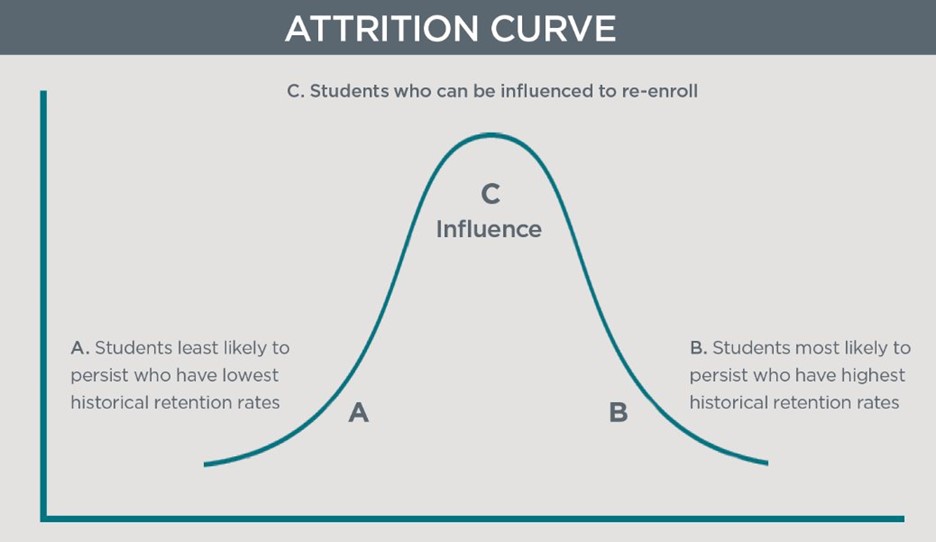
    Once you have assessed the 2024 class outcomes and the quality of your programs and services, RNL encourages you to think differently about how you will develop college student retention strategies that will impact the 2025 class. Each college has an attrition curve, or a distribution of students with their likelihood of being retained. The attrition curve, like any normal distribution, will show which students are least and most likely to retain and will reveal the majority of students under the curve. See the example below:

    The Retention Attrition Curve showing that campuses should focus retention efforts on students who can be influenced to re-enroll. The Retention Attrition Curve showing that campuses should focus retention efforts on students who can be influenced to re-enroll.

    As you consider your current activities, you may find that many of your programs are designed for the students at the tail end of the curve (section A above) or to further support the students who are already likely to persist (section B). Institutions set goals to increase retention rates but then limit the scope of students they are impacting. To have the best return on retention strategies, consider how you can target support to the largest group of students in the middle (section C) who are open to influence on whether they stay or leave, based on what you do or don’t do for them, especially during their first term and their first year at your school. 

    Onward for the year ahead

    RNL congratulates those of you who have achieved your retention goals for the 2024 cohort. You certainly must have done some things right and must have had student retention strategies that were effective. For those of you who are looking for new directions in planning, consider the three practices outlined above. 

    And if you aren’t currently one of the hundreds of institutions already working with RNL, you may want to implement one or more of the RNL student success tools to support your efforts: the RNL motivational survey instruments to identify those students who are most dropout prone and most receptive to assistance, the RNL student retention data analytics to identify the unique factors that contribute to persistence at your institution, and the RNL satisfaction-priorities surveys that inform decision making and resource allocation across your campus population. RNL can provide support in all of these areas along with on-going consulting services to further direct and guide retention practices that can make a difference in your enrollment numbers and the success of both your students and your institution.  Contact me to learn more in any of these areas. 

    Note: Thanks to my former colleague Tim Culver for the original development of this content.

    Ask for a complimentary consultation with our student success experts

    What is your best approach to increasing student retention and completion? Our experts can help you identify roadblocks to student persistence and maximize student progression. Reach out to set up a time to talk.

    Request now

    Source link

  • Working with our places will help us to spread the benefits of higher education more widely

    Working with our places will help us to spread the benefits of higher education more widely

    In the North East of England, fewer than one in three 18 year olds enter higher education, compared to a national average of 37 per cent.

    For higher education institutions, including my own, this is more than a regrettable statistic. It must be a call to action. The Sutton Trust’s Opportunity Index highlights that the North East ranks lowest of all English regions for social mobility prospects, with the poorest students in the region facing some of the most limited chances for progression into higher education and good employment.

    As a country we have undoubtedly made progress in widening participation, but as someone who spends their days thinking about such things, I worry: are we measuring that progress in the right ways? It’s not just about the gateway to university, it’s about the university journey and beyond. Or, to put it in more human terms: are people who previously wouldn’t have gone to university not only getting in, but thriving once they’re in?

    If we carry on measuring widening participation purely by entry stats and graduate salaries, we’ll miss the bigger picture, and what many of us went into higher education to try to achieve: deeper, transformative impact. A university education does more than prepare someone for a job. There is good evidence that links it to longer life expectancy, better health, and greater stability.

    The benefits of university go beyond the individual. Children of university graduates are much more likely to attend university and perform better once there. When a young person from a disadvantaged background earns a degree, it can spark a ripple effect that changes their family’s trajectory for good.

    There’s also a clear economic case for seeing success more broadly. Graduates typically pay more in tax, rely less on welfare services, and are more likely to engage in civic life. In regions like ours, where economic renewal and social mobility are deeply connected, that impact is amplified. A university education doesn’t just boost an individual’s prospects – it helps build stronger, more resilient communities.

    Whole-journey approach

    If we are truly serious about transforming lives and levelling up opportunity, especially in so-called “cold spots” like County Durham, then we need to dig deeper, beyond continuation rates and into attainment and the feeling of belonging. Financial strains, cultural barriers, wellbeing concerns, and more must be recognised and overcome. These are challenges not just for admissions, but across the entire student journey.

    Attainment gaps have a substantial impact, and disadvantaged students can be up to 22.7 months behind advantaged peers by the time they take their GCSEs. GCSE performance is strongly correlated with later life outcomes, including university attendance and employment quality. Early outreach is therefore pivotal in closing these long-standing gaps.

    It’s a challenge we take seriously. We’re not just widening the door – we’re reshaping the whole experience: investing nearly £1.5m in programmes for Key Stage 4 and 5 students, strengthening our foundation programme, and working with Sunderland AFC’s Foundation of Light to create a new health hub in one of our most deprived communities.

    One of the clearest messages of our new access and participation plan is how deeply place and perception are intertwined. Many young people in North East England don’t just lack opportunities – they’re not even sure those opportunities are meant for them. And, sadly, some still perceive Durham to be a place where they wouldn’t belong. Multiple studies show a strong link between a sense of belonging and academic success, particularly for underrepresented groups. So we’re investing in transition support and the Brilliant Club’s Join the Dots programme, which connects incoming students with peer coaches from results day onward.

    What we’re trying to achieve with our strategy cannot and should not be measured solely in continuation rates and degree classifications. Our evaluation strategy includes:

    • Sense of belonging as a core outcome: Building on Durham-led research, we are embedding a validated survey tool into our access and participation work. This tool captures students’ sense of belonging across multiple domains — from college life to academic confidence. These survey findings will help us identify and support groups at higher risk of exclusion.
    • Quasi-experimental design: Where sample sizes allow, we will use matched control groups and multiple regression analysis to compare outcomes between intervention participants and non-participants, tracking progress from outreach through to graduation. Intermediate metrics include not only continuation and attainment but also self-efficacy and engagement.
    • Pre/post measures: Our use of TASO’s validated access and success questionnaire enables pre- and post-intervention analysis of psychosocial outcomes such as academic self-efficacy and expectations of higher education.
    • Theory of change models: These have been developed for each intervention strand and will be regularly updated to ensure our work is aligned with evidence and outcomes over time.

    While our approach is rigorous, we anticipate several challenges. Students from disadvantaged backgrounds face cost-related pressures that may impact belonging and continuation. And persistent concerns about whether students from working-class or Northern backgrounds “belong” at Durham risk undermining recruitment and retention. We aim to confront this through co-designed interventions, but change in perception takes time.

    Co-development is key

    We believe that we can only succeed for the North East by working with others: through Universities for North East England – which includes Durham, Newcastle, Northumbria, Sunderland, and Teesside; and the new Durham Learning Alliance partnership with four local colleges – we must expand educational opportunities and drive economic growth.

    When people see that their goals and dreams are genuinely realisable, they’re far more likely to engage. After all, who are we to define what success should look like for someone else?

    The government’s opportunity mission gives higher education a rare, and much-needed, moment to pause and reset. Let’s not waste it. We’ve got a chance to rethink what success means – not just for universities, but for the people and places we serve. Let’s broaden the conversation beyond who gets through the door. Let’s put co-development at the heart of everything we do. And above all, let’s keep listening – not just to what students need, but to what they hope for. In the end, the real test of progress isn’t just who gets in. It’s who gets on – and how far they go, with us walking alongside them.

    Source link

  • What works for supporting student access and success when there’s no money?

    What works for supporting student access and success when there’s no money?

    In 2021 AdvanceHE published our literature review which set out to demonstrate significant impact in access, retention, attainment and progression from 2016–21.

    Our aim was to help institutional decision making and improve student success outcomes. This literature has helped to develop intervention strategies in Access and Participation Plans. But the HE world has changed since review and publication.

    Recent sector data for England showed that 43 per cent of higher education providers sampled by the Office for Students (OfS) were forecasting a deficit for 2024–25 and concluded that:

    Many institutions have ongoing cost reduction programmes to help underpin their financial sustainability. Some are reducing the number of courses they offer, while others are selling assets that are no longer needed.

    All the while, institutions are, quite rightly, under pressure to maintain and enhance student success.

    The findings of our 2021 review represent a time, not so long ago, when interventions could be designed and tested without the theorising and evaluation now prescribed by OfS. We presented a suite of options to encourage innovation and experimentation. Decision making now feels somewhat different. Many institutions will be asking “what works now, as we find ourselves in a period of financial challenge and uncertainty?”

    Mattering still matters

    The overarching theme of “mattering” (France and Finney 2009, among others) was apparent in the interventions we analysed in the 2021 review. At its simplest, this is interventions or approaches which demonstrate to students that their university cares about them; that they matter. This can be manifest in the interactions they have with staff, with systems and processes, with each other; with the approaches to teaching that are adopted; with the messages (implicit and explicit) that the institution communicates.

    Arguably, a core aspect of mattering is “free” in terms of hard cash – us showing students that we care about them, their experience, and their progress, for staff to have a friendly approach, a regular check in, and meaningful and genuine dialogue with students. Such interactions may well carry an emotional cost however, and how staff are feeling – whether they feel that they matter to the institution – could impact on morale and potentially make this more difficult. We should also be mindful of the gendered labour that can be evident when teaching academics are encouraged to pick up more “pastoral” care of students; in research-intensive institutions, this may be more apparent when a greater proportion of female staff are employed on teaching focused contracts.

    In our original review we found that there were clear relationships between each student outcome area – access, retention, attainment and progression – and some interventions had impact on more than one outcome. Here are five of our examples, within the overarching theme of mattering, which remind the sector of this impact evidence whilst illustrating developments in thinking and implementation.

    Five impactful practices

    Interventions which provide financial aid or assistance to students pre and post entry were evidenced as impactful in the 2016-2021 literature. We remember the necessity of providing financial aid for students during Covid, with the government even providing additional funding for students in need. In the current financial climate, the provision of extra funding may feel like a dream for many institutions. Cost reduction pressures may mean that reducing sizable student support budgets are an easy short-term win to balance the books.

    In fact late last year, Jim Dickinson predicted just this as the first wave APPs referenced a likely decline in financial support. As evaluative data has shown, hardship funding is used by students to fund the cost of living. When money is tight, an alternative approach is to apply targeted aid where there is evidence of known disadvantage. Historically the sector has not been great at targeting, but it has become a necessity. Preventing student withdrawal has never been more important.

    We also noted that early interventions delivered pre-entry and during transition and induction were particularly effective. The sector has positioned early and foundational experiences of students as crucial for many years. When discussions about cost effectiveness look to models of student support, targeting investment in the early years of study, rather than universally applied, could have the highest impact. Continuation metrics (year one to year two retention) again drive this thinking, with discrete interventions being the simplest to evaluate but perhaps the most costly to resource. Billy Wong’s new evidence exploring an online transition module and associated continuation impact is a pertinent example of upfront design costs (creation), low delivery costs (online), and good impact (continuation).

    Another potentially low cost intervention is the design of early “low stakes” assessment opportunities that give students the chance to have early successes and early helpful feedback which, if well designed, can support students feeling that they matter. These types of assessments can support student resilience and increase the likelihood of them continuing their studies, as well as providing the institution with timely learner analytics regarding who may be in need of extra support (a key flag for potential at-risk students being non-completion of assessments). This itself is a cost saving measure as it enables the prioritisation of intervention and resource where the need is likely to be greatest.

    Pedagogically driven interventions were shown in our review to have an impact across student outcome areas. This included the purposeful design of the student’s curriculum to impact on student learning, attainment, and future progression. Many institutions are embarking on large scale curriculum change with an efficiency (and student experience/outcomes) lens. Thinking long term enough to avoid future change, yet attending to short term needs is a constant battle, as is retaining conversations of values and pedagogy.

    How we teach is perhaps one of the most powerful and “cost-free” mechanisms available, given many students may prioritise what time they can spend on campus towards attending taught sessions. An extremely common concern expressed by new (and not so new) lecturers and GTAs when encouraged to interact with students in their teaching is “But what if I get asked a question that I don’t know the answer to?” Without development and support, this fear (along with an understandable assumption that their role is to “transmit” knowledge) often results in a retreat to didactic, content heavy approaches, a safe space for the expert in the room.

    But participative sessions that embed inclusive teaching, relational and compassionate pedagogies, that create a sense of community in the classroom where contributions are valued and encouraged, where students get to know each other and us – all such approaches can show students that they matter and support their experience and their success.

    We also found that interventions which provided personal support and guidance for students impacted positively on student outcomes. One to one support can be impactful but costly. Adaptations in delivery or approach, for example, small group rather than individual sessions and models of peer support are worth exploring in a resource sensitive environment. Embedding personal and academic support within course delivery and operating an effective referral system for students when needed, is another way to get the most out of existing resources.

    Finally, the effective use of learner analytics was a common theme in our review of impact. Certainly, the proactive use of data to support the identification of student need/risk makes good moral and financial sense. However, large scale investment might be necessary to realise longer term financial gains. This might be an extension of existing infrastructure or as Peck, McCarthy and Shaw recently suggested, HE institutions might turn to AI to play a major role in recognising students who are vulnerable or in distress.

    Confronting the hidden costs

    These financial dilemmas may feel uncomfortable; someone ultimately gains less (loses out?) in a targeted approach to enhancing student success. Equality of opportunity and outcome gaps alongside financial transparency should be at the forefront of difficult decisions (use equality legislation on positive action to underpin targeting decisions as needed). Evaluation, and learning from the findings, become even more important in the context of scarce resources. While quick decisions to realise financial savings may seem attractive, a critical eye on the what works evidence base is essential to have long term impact.

    Beyond our AHE review, TASO has a useful evidence toolkit which notes cost alongside assumed impact and the strength of the evidence. As an example, the provision of information, advice and guidance and work experience are cited as low cost (one star), with high-ish impact (two stars). This evidence base only references specific evidence types (namely causal/type three evidence). The series of evidence-based frameworks (such as Student Success, Employability, Inclusive Practice) from AdvanceHE are alternative reference points.

    The caveat to all of the above is that new approaches carry a staff development cost. In fact, all of the “low cost” interventions and approaches cited need investment in the development and support of academic staff. We are often supported by brilliant teams of learning designers and educational developers, but they cannot do all this heavy lifting on their own given the scale of the task ahead. As significant challenges like AI ask us to fundamentally rethink our purpose as educators in higher education, perhaps staff development is what we should be investing in now more than ever?

    Source link