Category: Study permits

  • Canadian sector hits back over plan to cancel study permits in crises

    Canadian sector hits back over plan to cancel study permits in crises

    Immigration Minister Lena Diab told a House of Commons committee last week that the Strengthening Canada’s Immigration System and Borders Act (Bill C-12) would target “people who are going to be committing large-scale fraud”.

    However, an opposition member, Conservative MP Michelle Rempel Garner, rejected the idea that the Liberal government needs sweeping powers to keep the immigration system functioning.

    “That sounds like an authoritarian dictatorship to me,” Rempel Garner said.

    Languages Canada Executive Director Gonzalo Peralta told The PIE News there was a need to define under what conditions Immigration Refugees and Citizenship Canada (IRCC) could cancel student visas.

    “The term ‘public interest’ as grounds for cancelling visas or applications is vague and does not provide the assurances needed to ensure that legitimate students are not inadvertently impacted by the legislation,” Peralta said.

    At the committee meeting, Rempel Garner argued: “It seems like you’re trying to give yourself and your department more powers to correct mistakes in the system that they could have made in screening out potential fraud to begin with.” 

    The term ‘public interest’ as grounds for cancelling visas or applications is vague and does not provide the assurances needed

    In the wake of a large number of fraudulent study permit applications made by unscrupulous education agents, in 2023 the department implemented a system requiring applicants to present a verified letter of acceptance from a designated learning institution in order to obtain a study permit.

    In many cases, the students said they were not aware that their agent was submitting fraudulent documents on their behalf.

    MP Rempel Garner called out the minister for blaming students and other newcomers to Canada. “Why don’t you make the system work instead of punishing the victims of human trafficking,” she demanded at the meeting.

    Larissa Bezo, president of the Canadian Bureau for International Education (CBIE), told The PIE her group supports measures to uphold the integrity of the International Student Program. “However, we do not want to see international students who have been the victims of fraud unfairly punished,” Bezo said.

    Peralta of Languages Canada condemned the Liberal government for failing to consult with the sector about this legislation and other policy changes.

    “In the case of the proposed Bill C-12, a more comprehensive definition is needed of the specific conditions under which IRCC could cancel visas,” Peralta said.

    Canadian immigration policy has hit the headlines over the past week after Prime Minister Mark Carney’s government set out its intention to cut new international study permits by more than 50% in 2026-2028 – going further with enrolment caps that are already causing significant problems for the international education sector.

    Source link

  • Canada’s path forward in international education

    Canada’s path forward in international education

    In my recent article for The PIE, I reflected on how Canada’s international education system has been moving through a period of turbulence and uncertainty, highlighting the compounding effects of the past several years, abrupt policy shifts, uneven communication, and ongoing immigration challenges that have created instability and eroded trust among students, families and global partners. 

    This second piece builds on that discussion. Canada’s international education sector continues to navigate a turbulent period, one that is reshaping how institutions, students, and communities make decisions today and plan for tomorrow.

    Yet within this turbulence lies an opportunity: to chart a clearer, more deliberate path forward that restores confidence and strengthens Canada’s global role. There is no simple fix, but by examining how other countries and Canadian provinces have approached similar challenges, we can begin identifying the building blocks of a more stable, coordinated and sustainable strategy.

    If Canada is to navigate this moment and rebuild stability and credibility, it must move beyond reactive decision-making. What is needed is a clear, long-term framework, one grounded in evidence, predictable investment, and collaboration across governments, institutions, employers and communities. Lessons from Germany, New Zealand and British Columbia demonstrate that more deliberate and sustainable approaches are not only possible, but necessary.

    Lessons from Germany’s model

    Germany provides a compelling example of how international education can be integrated into a broader national economic and demographic strategy. While the contexts differ, Germany’s constitutional division of responsibility for education between the federal government and the Länder is in many ways similar to Canada’s federal–provincial structure, making its approach worth examining. One important distinction is tuition: in most regions, international students pay minimal or no fees, reflecting a long-term view that the real return on investment comes from decades of workforce participation and tax revenue rather than short-term tuition income.

    A 2025 study by the German Economic Institute, commissioned by the German Academic Exchange Service, found that the 79,000 international students who began degree programs in 2022 could generate between €7.36 billion and €26 billion in lifetime net fiscal gains for the public sector coffers. Even under conservative projections, public investment in international students pays for itself within two to five years after graduation. International graduates could offset up to 20% of Germany’s projected GDP slowdown due to demographic change over the next decade.

    While Canada’s policy environment, tuition structures, and labour market integration differ, this illustrates what can be achieved with a coordinated national framework that aligns higher education with workforce needs.

    A key part of this approach is the Campus Initiative for International Talents and the FIT program. These initiatives fund universities to prepare students for academic life, support their integration, and connect them with employers before and after graduation. They also invest in expanded career services, targeted retention programs and partnerships with industry to ensure smoother transitions into the labour market. Critically, this is made possible by predictable, multi-year federal funding, allowing institutions to sustain, refine and scale initiatives over time while sharing lessons across the sector.

    New Zealand’s managed growth approach

    New Zealand offers another instructive model, one that is still in its early stages but marks a shift from previous approaches. Following a period of post-pandemic recovery, the government launched the International Education Going for Growth strategy in 2025, setting a ten-year target to nearly double the sector’s economic contribution by 2034. Rather than relying on abrupt changes, the plan outlines growth from 83,700 in 2024 to 119,000 by 2034 and double the sector’s value from NZ$3.6 billion to NZ$7.2 billion. The plan takes a phased approach, tying growth to quality, sustainability and alignment with workforce needs.

    Recent reforms include increasing in-study work limits from 20 to 25 hours per week, extending work rights to all tertiary exchange and study abroad students, and introducing a six-month post-study work visa for vocational graduates who do not qualify for longer-term rights. The government is also exploring easier access to multi-year visas. These measures aim to strengthen links between study, work experience, and skilled migration, while maintaining education quality and managing community impacts.

    The path forward is about tackling root causes through careful, well-designed policy that extends beyond surface-level fixes

    The strategy recognises the sector’s wider economic, social, cultural, and innovation-related value, and calls for closer coordination between education providers, employers, and industry. It also seeks market diversification beyond China and India, with targets to raise New Zealand’s profile globally and move more prospective students to rank it among their top three choices.

    It’s interesting to see New Zealand’s sector leaders pairing an ambitious growth target with a deliberate, measured pace. Their emphasis on balancing enrolment growth with infrastructure, regional distribution and public support offers important lessons for other countries including Canada as we rethink our own approach to rebuilding and re-imagining international education in a way that is both sustainable and socially supported. While too early to measure outcomes, Going for Growth shows how long-term targets, coordinated reforms and predictable policy can build stability, avoiding the uncertainty that comes with abrupt changes.

    British Columbia’s Approach 

    Closer to home, British Columbia has begun moving toward a more managed approach to international education one that offers useful reference points for other provinces to consider as they navigate similar pressures. The framework is designed to address key challenges: aligning enrolment with institutional and community capacity, encouraging more diversified student markets, connecting recruitment more closely to housing and student supports, and strengthening quality assurance to protect students and institutional reputation. More information on the province’s approach can be found in its Public Post-Secondary International Student Enrolment Guidelines, Education Quality Assurance framework, and requirements for multi-year institutional international education strategies.

    This approach is still evolving, but it signals a shift away from reactive measures toward more deliberate, longer-term planning. The broader takeaway across all three cases – Germany’s coordinated national investment, New Zealand’s managed growth plan, and British Columbia’s emerging provincial framework – is not that any has found the perfect solution, but that more thoughtful, workable approaches are possible even within a federal system like Canada’s. The path forward is less about adding new barriers and complexity, and more about tackling root causes through careful, well-designed policy that extends beyond surface-level fixes.

    A path forward for Canada

    Canada requires a deliberate course correction, one that is precise in its objectives, strategic in its design and anchored in robust evidence. This entails moving beyond reactive decision-making toward a coherent framework that establishes clear long-term goals, calibrates enrolment to institutional and community capacity, and embeds international education as a core pillar of national economic, demographic and innovation strategies.

    Achieving this demands sustained, structured coordination between federal, provincial and institutional partners, underpinned by transparency, reliable data and clearly defined performance metrics.

    As Canada looks ahead, several key aspects should guide the development of a stronger, more sustainable international education strategy:

    1. Transparency & accountability

    • Prioritise transparency by publishing timely, detailed data on study permit allocations, approval rates and processing times to enable evidence-based planning.
    • Streamline compliance processes by redesigning the Provincial Attestation Letter process to remove unnecessary steps while maintaining accountability and integrity.
    • Recognise sector diversity by applying policies that reflect institutional differences in size, mission, and track record, using a risk-based approach to oversight.

    2. Integration & coordination

    • Integrate policy planning across education, immigration and labour market needs so that international students are viewed as future members of Canada’s workforce and communities.
    • Establish a national roundtable that brings together governments, institutions, employers and communities to coordinate talent, skills and immigration strategies (as recommended by many groups across Canada CBIE, UniCan, CICan).

    3. Student success & retention

    • Invest in student success by funding housing, mental health services, and academic supports that benefit both domestic and international learners, while creating clear residency pathways to encourage long-term retention.
    • Adopt multi-year funding models for programs that link education with workforce integration, ensuring stability and continuity, similar to Germany’s FIT program.

    4. Narrative & public confidence

    • Reset the narrative by communicating the shared benefits of international education: sustaining academic programs, expanding opportunities, strengthening research capacity and contributing to Canada’s innovation ecosystem.
    • Build public trust by showing that investments in international education are not a zero-sum trade-off with domestic priorities, but a shared investment in Canada’s prosperity, global competitiveness and community vitality.

    Canada at a crossroads

    Canada is at a crossroads. The past 20 months have exposed the cost of reactive, fragmented policy: instability for students, institutions and communities. The “building the plane while flying it” approach cannot continue. This is also a moment of opportunity. Canada can create a transparent, predictable and collaborative international education system, one that recognises students not as temporary visitors, but as future citizens if they choose to stay, or as global ambassadors for Canada: skilled professionals, community builders and partners in strengthening our place in the world. 

    Germany’s integration of higher education into its national skilled labour strategy and New Zealand’s long-term managed growth plan both demonstrate that it is possible to balance integrity, economic benefit and student success. British Columbia’s recent steps show that proactive, well-planned policy is possible within Canada’s governance structure, and that each province can develop its own approach tailored to its specific context, priorities and capacity

    In a rapidly changing geopolitical environment, how Canada engages globally, attracts and retains talent, and integrates education with long-term national goals will shape its economic and social future. Canada can choose to lead with vision and strategy or watch as others secure the global talent, partnerships and influence that we have allowed to slip away.


    Source link

  • Canada’s study permits plunge by 60% in immigration reset

    Canada’s study permits plunge by 60% in immigration reset

    New IRCC data has revealed plummeting international student arrivals from January to August this year, with stakeholders bracing for further declines as the government pushes forward with efforts to reduce temporary residents in Canada.  

    “The international education sector is rightly concerned that study permit approvals are far below the caps, but the news release makes clear that those concerns are not shared by the Carney government,” Regulated Canadian Immigration Consultant (RCIC) Matthew McDonald told The PIE News

    The figures showed less than 90,000 new international students entered Canada from January to August 2025, making it highly unlikely that Canada will meet its goal of issuing 437,000 study permits this year, as announced in January 2025.  

    While international student arrivals have fallen by 60%, the government has painted the figures as a “story of success” in reducing Canada’s temporary resident population, said McDonald.  

    Taken together, the number of work permit holders and study permit holders decreased by 22% from August 2024 to 2025 – a trend that the IRCC said was “a clear sign the measures we’ve put in place are working”.  

    The drop has brought the total number of study permit holders (including those who hold a work and study permit at the same time) down to 802,425 – 21% less than in 2024 and the lowest level since 2021 during the pandemic. 

    It sets Canada on track to drastically miss the government’s target of issuing a total of 437,000 study permits this year, which was a 10% reduction of the original 2024 cap

    Given the expected shortfall, stakeholders are calling for greater transparency about IRCC’s objectives, highlighting the detrimental impact of the decline on institutions whose budgets were largely guided by the 10% cap.  

    The TR data release is a weather balloon … to see if the Canadian public accepts the message that immigration is now under control in Canada

    Matthew McDonald, RCIC

    The timing of the release less than two weeks ahead of the 2025-2027 Immigration Levels plan has not gone unnoticed by commentators, who are expecting an update to align with the incoming 2025 budget and the shifting vision of Canada’s long-standing openness to immigration. 

    “The temporary resident (TR) data release is a weather balloon, alongside updated processing times, to see if the Canadian public accepts the message that immigration is now under control in Canada,” said McDonald. 

    “The Carney government is concerned about the floor, not the ceiling—i.e., about wrestling down the TR population below 5%,” he added.  

    Currently, the government aims to reach the 5% goal by the end of 2027, with Carney acknowledging it will take several years to reduce TR levels by restricting those coming in and transitioning more temporary residents to permanent residency.  

    Notwithstanding any surprises in the upcoming budget and Immigration Levels Plan, McDonald said he expected the government to “hold their foot” on new study and work permit approvals for several years to come.  

    Ahead of the federal budget announcement, the Canadian Bureau for International Education (CBIE) is urging the government to launch a renewed International Education Strategy to “restore Canada’s global brand to bolster its foreign policy and trade relationships”. 

    The body highlighted the economic contributions of international students who contributed nearly CA$40bn to the country in 2022, boosting local communities and filing labour shortages. 

    What’s more, CBIE emphasised the cultural perspectives international students bring to Canada’s campuses and their importance to the country’s soft power, with students who leave becoming ambassadors for Canada in their home countries.  

    Source link

  • Canada rejects nearly two in three study permit applicants 

    Canada rejects nearly two in three study permit applicants 

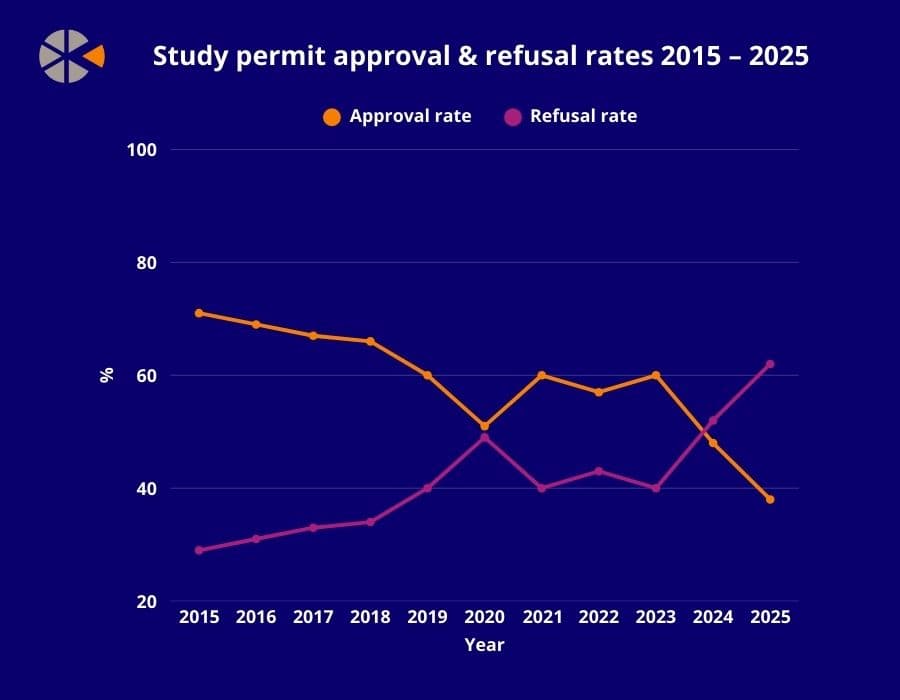
    Government figures obtained by The PIE show 62% of applicants were refused a study permit from January to July this year, with record-high volumes “raising urgent questions about transparency and application readiness,” said ApplyBoard.  

    Despite a decade of relatively stable approval ratings hovering around 60%, rates have plummeted to 38% so far this year, down from 48% in 2024 following the implementation of Canada’s study permit caps. 

    “It’s clear that Immigration, Refugees and Citizenship Canada (IRCC) is applying far greater scrutiny to new applications,” Jonathan Sherman, vice president of sales & partnership at BorderPass told The PIE, pointing to a “fundamental shift” in government processing.


    Data: IRCC

    Indian students – who comprise 40% of Canada’s international student population – have been hardest hit by soaring refusals, with four out of five Indian students receiving rejections in Q2 2025, according to BorderPass.  

    Stakeholders have pointed to a glimmer of hope in overall approval ratings rising modestly this spring, though without a “dramatic shift,” Canada will only reach one fifth of the government’s international student target for the year, Sherman warned.  

    With institutions bracing for severe declines, ApplyBoard analysis has found the most common reason for reason for rejection in 2024 was the perception by IRCC officers that students wouldn’t leave Canada after their studies, cited in over 75% of cases.  

    “While reviewers at IRCC understand that some future students hope to gain work experience in Canada after graduation… the extensive use of this reason last year suggests that many are perceived as having permanent residency as their primary purpose, instead of study,” stated the report

    Financial concerns drove three of the top five refusal reasons, after Canada more than doubled its proof-of-funds requirements from $10,000 in 2023 to $20,635 in 2024.  

    Specifically, in 53% of cases, IRCC officers said they were unconvinced that applicants would leave Canada based on financial assets, alongside doubts about insufficient resources for tuition and living expenses.  

    “While new policy caps played a role, our full-year data points to recurring applicant challenges, particularly around financial readiness and immigration intent that are preventable with the right guidance and documentation,” said ApplyBoard.  

    The report highlighted the continuing decline of unspecified reasons for refusal, following IRCC adding officer decision notes to visa refusal letters last month, which was welcomed as a much-needed step in improving transparency.  

    Other reasons for refusal include the purpose of visit being inconsistent with a temporary stay and having no significant family ties outside Canada.  

    The data comes amid a major immigration crackdown in Canada, with temporary resident targets included in the latest Immigration Levels Plan for the first time, which aims to reduce temporary resident volumes to 5% of the population by the end of 2027 – a year later than the previous government’s target.

    Many are perceived as having permanent residency as their primary purpose, instead of study

    ApplyBoard

    Approval rates are also below average for other temporary resident categories, but none so drastically as study permits, with just under half of all visitor visas approved so far this year, compared to a ten-year average of 64%.  

    After more than 18 months of federal policy turbulence, changing eligibility rules have likely contributed to the rise in study permit rejection rates.  

    Pressure to reduce IRCC backlogs and reach ambitious government targets could also be playing a role, according to immigration lawyers speaking to the Toronto Star. 

    As of July 31, over 40% of Canada’s immigration inventory was in backlog, including 56% of visitor visas, 46% of work visas and 23% of study visas, according to official data.  

    Following a swathe of new IRCC officer hires, Sherman said he expected to see improvements in consistency, though “processing backlogs may get worse before they get better,” he warned.  

    Amid the challenges, educators and advisers are doubling down on what applicants and institutions can do to ensure the best chance of success, with ApplyBoard warning that any incomplete or ineligible documentation can be grounds for refusal.  

    Source link

  • Has Canada reached a “turning point” in study permit approvals?

    Has Canada reached a “turning point” in study permit approvals?

    • After months of high study permit refusal rates, stakeholders welcome a more successful second quarter of 2025.
    • But concerns remain about the overall volume of approvals – especially as students from key market India continue to struggle to secure study permits.
    • Meanwhile, approvals from Ghana surge over 200% compared to Q1 of 2025.

    The IRCC data, compiled by BorderPass, showed that while Canadian study permit applications dipped in Q2 2025, the number of approvals increased by 4,450 – leading to a 10% increase in the overall approval rating. 

    “The encouraging sign is that June saw the highest approval rate of the year at 39%, which could point to a modest improvement in the second half of the year,” Jonathan Sherman, vice-president of sales & partnerships at BorderPass told The PIE News. 

    After record low approval ratings in Q1, stakeholders have welcomed the rise in approvals, though serious concerns remain about overall volumes.  

    “Just 31,580 permits were approved in the first half of 2025. IRCC’s published target for the year is about 300,000, which means at the current pace we will only reach around 20% of the goal unless there is a dramatic shift,” warned Sherman.  

    After Canada’s implementation of the study permit cap in 2024, the approval rate dropped from 67% in 2023 to 45% in 2024. So far in 2025, approvals for new study permits (excluding extensions) are tracking at 31%.  

    One of the most striking trends is India’s continued decline, with data showing study permit approvals falling another 7% in Q2 to just 20%, reflecting a “fundamental shift in how IRCC is assessing these applications”, said Sherman.  

    This stands in sharp contrast to the more than 80% approval rates for Indian students just a few years ago, “reflecting a fundamental shift in how IRCC is assessing these applications”, said Sherman.  

    The widening gap between universities and colleges also stood out in the data, a difference that Sherman said was “reshaping the international education market in Canada”.  

    Among the top 20 institutions by volume, university approvals have dropped from 63% in 2024 to 53% so far in 2025, but colleges have seen a steeper fall from 60% to 28%.  

    Colleges have felt the heaviest impact of federal policy changes, including the study permit cap and the new field of study restrictions for post-graduation work permits.  

    Despite a major win for the college sector in March this year when PGWP eligibility was expanded for degree students at colleges, these institutions have still been the hardest hit by the changes, with many of their programs no longer eligible for a work permit.  

    “That said, colleges that are focusing on programs with clear labour market outcomes such as health, technology, and skilled trades are showing better results,” noted Sherman.  

    “The institutions that carefully vet applicants for immigration quality and program alignment are also proving more resilient,” he advised.  

    At the current pace we will only reach around 20% of IRCC’s published target unless there is a dramatic shift

    Jonathan Sherman, BorderPass

    Alongside students from India, Iranian students also experienced volatility, with the country’s approval rating falling by more than 50% from Q1. In contrast, Ghana saw its approval rating surge by 225% on the previous quarter. 

    The approval rating for Chinese students – who make up Canada’s second largest international student cohort – saw stable growth, surpassing 65% approval, and South Korea remained a consistent top performer with approvals at more than 85%.  

    “Smaller markets like Vietnam, Nepal and Nigeria are also moving – some positively, some unpredictably – creating both new opportunities and risk. For many DLIs, this means rethinking region-based strategies in real time,” advised the BorderPass report

    As well as seeing variations across institution type and source market, a large number of IRCC officers were hired and trained in the first half of 2025, which Sherman said had “introduced some inconsistency in decision making as new processing are applied”. 

    “On this note, we are hearing that processing backlogs may get worse before they get better,” he warned.

    Overall: “It is clear that IRCC is applying far greater scrutiny to new applications,” said Sherman, with the gap between high- and low-performing institutions becoming ever wider.  

    Specifically, by investing in application intelligence, thoroughly reviewing documents, confirming travel readiness and working with legally backed partners, some institutions have seen approval rates more than double the national average, according to Sherman.  

    Source link

  • Over 5k HE job cuts in Canada since study permit caps

    Over 5k HE job cuts in Canada since study permit caps

    • Over 5,000 higher education jobs in Canada have been cut since the government clamped down on study permit numbers – with Ontario, British Columbia and Quebec the hardest hit.
    • The thousands of job cuts tracked by a higher education expert are just those that have been made public, with the possibility that there have been many more.
    • Institutions are also having to consolidate the programs they offer, as billions of dollars worth of budget cuts make their mark.

    More than 5,000 jobs have been lost in the post-secondary education sector in Canada since the federal government first imposed a study permit cap in January 2024, according to research from higher education consultant Ken Steele. Further restrictions – capping study permits at a scant 473,000 – were introduced in September.

    But the cuts collated by Steele are just the ones that have been made public. A number of institutions are not disclosing their drops in employment in teaching and administration.

    With Liberal Mark Carney triumphing in last month’s election, his new government must address worries about jobs disappearing, such as in the auto manufacturing sector, due to US President Donald Trump’s punishing tariffs.

    Slashing jobs in education – due to the government’s own actions – is a huge mistake, Steele said.

    “The unilateral imposition of extreme, abrupt, student visa caps have thrown Canadian higher education into crisis, decimated our reputation abroad and precipitously destroyed one of our major ‘export’ industries,” he told The PIE News.

    For the past year, Steele has been tracking reported job losses at universities and colleges across the country. As expected, programs that relied heavily on international students were forced to make the biggest cuts.

    According to Steele’s data, Mohawk College in Hamilton, Ontario, has eliminated almost 450 positions. The University of Windsor, also in Ontario, has reduced employment by 157 spots.

    The total of 5,267 cuts across the country almost certainly underreports the actual job losses. “Many institutions are keeping quiet about their cuts, including the Ontario private colleges that were partnering with public colleges,” he noted.

    It’s not just jobs that are being slashed. Post-secondary institutions have been forced to eliminate programs and reduce spending.

    Fanshawe College in London, Ontario, appears to lead the way in getting rid of programs. It has suspended 50 fields of study, including advanced live digital media, construction project management and retirement residence management. In all of Canada, Ontario colleges are the top eight for suspending programs, accounting for two-thirds of the 453 cuts.

    The financial hit is significant. “So far, I have tracked CAD$2.2 billion in budget hits at post-secondary schools across the country,” Steele said. This includes last year’s cuts as well as planned reductions for next year.

    If Canada reopened its doors tomorrow, it would likely take until at least 2030 to recover the international enrolment momentum we had just two years ago
    Ken Steele, education consultant

    Ontario was most reliant on international revenues and has been hardest hit by the study permit cap. Steele’s figures suggest that 70% of the cuts have struck that province, with British Columbia and Quebec also suffering. The remaining seven provinces faced more modest losses.

    In Vancouver last month, dozens of staff and faculty at several post-secondary institutions staged a protest of the study permit cap. Taryn Thompson, vice-president of the Vancouver Community College Faculty Association, said there have been 60 layoffs at her school alone, with more expected in the coming months.

    The big question is: Will the new federal government ease the cap? The issue of post-secondary funding was hardly raised at all during the election campaign, overshadowed by concerns about Trump’s threats to annex Canada.

    There’s also the concern about restoring Canada’s reputation following the study permit debacle.

    “If Canada reopened its doors tomorrow, it would likely take until at least 2030 to recover the international enrolment momentum we had just two years ago,” warned Steele.

    Source link

  • Canadian study permit approvals fall far below cap targets

    Canadian study permit approvals fall far below cap targets

    Canadian study permit approvals are on track to fall by 45% in 2024, rather than the 35% planned reduction of last year’s controversial international student caps, new IRCC data analysed by ApplyBoard has revealed.  

    “The caps’ impact was significantly underestimated,” ApplyBoard founder Meti Basiri told The PIE News. “Rapidly introduced policy changes created confusion and had an immense impact on student sentiment and institutional operations.  

    “While aiming to manage student numbers, these changes failed to account for the perspectives of students, and their importance to Canada’s future economy and communities,” he continued.  

    The report reveals the far-reaching impact of Canada’s study permit caps, which were announced in January 2024 and followed by a tumultuous year of policy changes that expanded restrictions and set new rules for post-graduate work permit eligibility, among other changes.  

    For the first 10 months of 2024, Canada’s study permit approval rate hovered just above 50%, resulting in an estimated maximum of 280,000 approvals from K-12 to postgraduate levels. This represents the lowest number of approvals in a non-pandemic year since 2019. 

    Source: IRCC. Disclaimer: Data for 2021-Oct 2024 is sourced from IRCC. Full-year 2024 figures are estimates extrapolated from Jan-Oct 2024 and full-year 2021-2023 IRCC data. Projections may be subject to change based on changing conditions and source data.

    “Even from the early days of the caps, decreased student interest outpaced government estimates,” noted the report, with stakeholders highlighting the reputational damage to Canada as a study destination.  

    “Approvals for capped programs fell by 60%, but even cap-exempt programs declined by 27%. Major source countries like India, Nigeria, and Nepal saw over 50% declines, showing how policies have disrupted demand across all study levels,” said Basiri.  

    Following major PGWP and study permit changes announced by the IRCC in September 2024, four out of five international student counsellors surveyed by ApplyBoard agreed that Canada’s caps had made it a less desirable study destination. 

    Though stakeholders across Canada recognised the need to address fraud and student housing issues, many had urged the federal government to wait until the impact of the initial caps was clear before going ahead with seemingly endless policy changes.  

    At the CBIE conference in November 2024, immigration minister Marc Miller said he “profoundly disagreed” with the prevailing sector view that the caps and subsequent PGWP and permanent residency restrictions had been an “overcorrection”.

    Post-secondary programs, which were the primary focus of the 2024 caps, were hit hardest by the restrictions, with new international enrolments at colleges estimated to have dropped by 60% as a result of the policies.  

    While Canada’s largest source destinations saw major declines, the caps were not felt evenly across sending countries. Senegal, Guinea and Vietnam maintained year-over-year growth, signalling potential sources of diversity for Canada’s cap era.   

    The report also highlighted Ghana’s potential as a source destination, where approval ratings – though declining from last year – remain 175% higher than figures from 2022. 

    Rapidly introduced policy changes created confusion and had an immense impact on student sentiment

    Meti Basiri, ApplyBoard

    The significant drop in study permit approvals was felt across all provinces, but Ontario – which accounted for over half of all study permit approvals in 2023 – and Nova Scotia have seen the largest impact, falling by 55% and 54.5% respectively.

    Notably, the number of study permits processed by the IRCC dropped by a projected 35% in 2024, in line with the government’s targets, but approval rates have not kept pace.

    When setting last year’s targets, minister Miller only had the power to limit the number of applications processed by the IRCC, not the number of study permits that are approved.  

    The initial target of 360,000 approved study permits was based on an estimated approval rate of 60%, resulting in a 605,000 cap on the number of applications processed. 

    Following new policies such as the inclusion of postgraduate programs in the 2025 cap, Basiri said he anticipated that study permit approvals would remain below pre-cap levels.  

    “While overall student numbers may align with IRCC’s targets, the broader impact on institutional readiness and Canada’s reputation will be key areas to watch in 2025,” he added.  

    Source link