Category: StudyPortals

  • Global demand for US master’s degrees plunges by 60%

    Global demand for US master’s degrees plunges by 60%

    The data, collected from January 6 to September 28, aligns closely with the start of Donald Trump’s second presidential term and the ensuing uncertainty around student visas and post-graduation work opportunities. It is based on the search behaviour of over 50 million prospective students on Studyportals.  

    “Prospective international students and their families weigh not only academic reputation but also regulatory stability and post-graduation prospects,” said Studyportals CEO Edwin van Rest: “Right now, those factors are working against institutions.”  

    Studyportals said the steep decline – dropping more than 60% in less than nine months – corresponds to proposed and enacted policy changes impacting student visa duration, Optional Practical Training (OPT) and H-1B work authorisation in the US. 

    Last week, the Trump administration shocked businesses and prospective employees by hiking the H-1B visa fee to $100,000 – over 20 times what employers previously paid. Days later, the government announced proposals to overhaul the visa system in favour of higher-paid workers.  

    Sector leaders have warned that OPT could be the administration’s next target, after a senior US senator called on the homeland security secretary Kristi Noem to stop issuing work authorisations such as OPT to international students.  

    Such a move would have a detrimental impact on student interest in the US, with a recent NAFSA survey suggesting that losing OPT reduces enrolment likelihood from 67% to 48%.  

    Meanwhile, roughly half of current students planning to stay in the US after graduation would abandon those plans if H-1B visas prioritised higher wage earners, the survey indicated.  

    “Prospective students are making go/no-go enrolment decisions, while current students are making stay/leave retention decisions,” said van Rest. 

    “Policy changes ripple through both ends of the pipeline, reducing new inflow and pushing out existing talent already contributing to US research, innovation and competitiveness,” he added.  
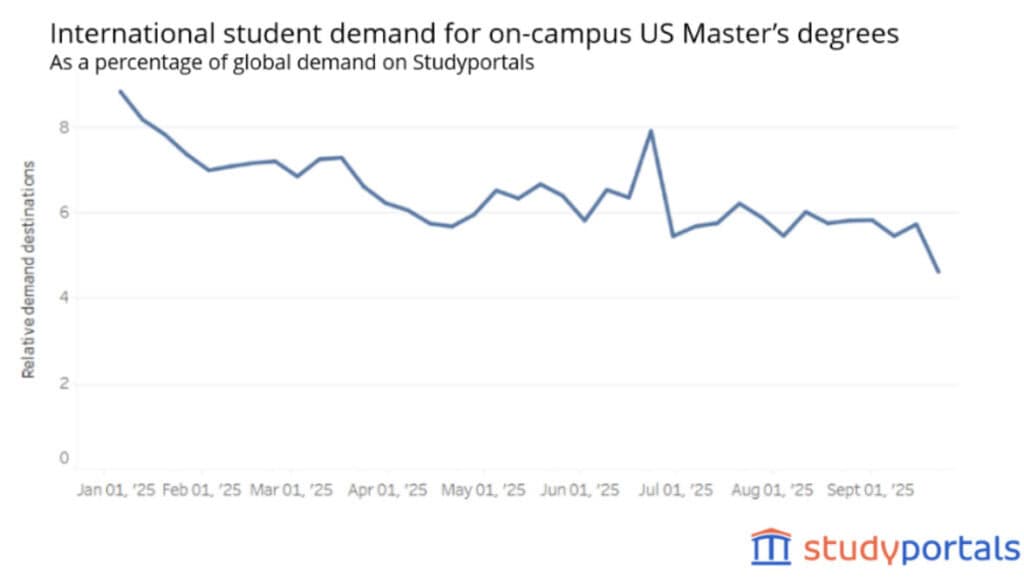
    Data: Studyportals

    The search data revealed a spike in interest at the beginning of July, primarily from Vietnam and Bangladesh, and to a lesser extent India and Pakistan. Experts have suggested the new Jardine-Fulbright Scholarship aimed at empowering future Vietnam leaders could have contributed to the rise.  

    Meanwhile, Iran, Nepal and India have seen the steepest drops in master’s demand, declining more than 60% this year to date compared to last.  

    While federal SEVIS data recorded a 0.8% rise in international student levels this semester, plummeting visa arrivals and anecdotal reports of fewer students on campus suggest the rise was in part due to OPT extensions – individuals who are counted in student totals but who are not enrolled on US campuses or paying tuition fees.  

    Beyond the immediate financial concerns of declining international enrolments for some schools, van Rest warned: “The policies we adopt today will echo for years in global talent flows.”

    The UK and Ireland have gained the most relative market share of international interest on Studyportals – both up 16% compared to the same period in 2024. Australia, Austria, Sweden and Spain all experienced a 12% increase on the previous year.  

    In the US, international students make up over half of all students enrolled in STEM fields and 70% of all full-time graduate enrolments in AI-related disciplines, according to Institute of International Education (IIE) data.  

    The policies we adopt today will echo for years in global talent flows

    Edwin van Rest, Studyportals

    What’s more, universities with higher rates of international enrolment have been found to produce more domestic STEM graduates, likely due to greater investment in these disciplines, National Foundation for American Policy (NFAP) research has shown.  

    Last year, graduate students made up 45% of the overall international student cohort (including OPT), compared to undergraduate which comprised roughly 30%, according to IIE Open Doors data.  

    Universities with higher proportions of overseas students have been found to produce more domestic STEM graduates, likely due to greater investment in these disciplines, National Foundation for American Policy (NFAP) research has shown. 

    The news of plummeting international demand comes as domestic enrolments are declining, with less high school graduates entering college education and an overall demographic shrinking of university-age students.  

    In a recent survey by the American Council on Education (ACE), nearly three quarters of college leaders said they were concerned about enrolment levels this semester, with 65% moderately or extremely worried about immigration restrictions and visa revocations.  
    Source link

  • US takes the lead on student satisfaction, survey finds

    US takes the lead on student satisfaction, survey finds

    Global student satisfaction has remained steady in 2025, but pressures on inclusivity, affordability and the quality of student life are beginning to show, according to the Global Student Satisfaction Awards: Summary Report 2025.

    Studyportals’ 2025 Student Satisfaction survey tracked responses from over 102,000 students around the world, with the US, Belgium and Austria leading the charge in overall satisfaction, ranked at 4.32, 4.29 and 4.28 stars out of five respectively.

    The biannual survey looked at reviews from students of 180 nationalities studying at institutions in 124 countries, recording an average satisfaction score of 4.18 out of 5. While stable compared to 2023 (when the last survey was published), this represents a slight dip of 0.71%.

    Meanwhile Pakistan, France, Ireland and Türkiye saw some of the steepest declines in satisfaction. The UK and India bucked the trend with improved scores, both climbing above the global average.

    Pakistan recorded the most significant drop since 2023’s survey (-11.3%), moving significantly further below the global benchmark. France also fell by -3.2%, Ireland by -2.4%, and Türkiye by -1.2%.

    By contrast, Finland (+3.3%) and the Netherlands (+0.2%) registered modest improvements, though both remain below the global average. The report warns that unless these downward trends are addressed, strong challengers like India and the UK could capture greater student interest.

    Students are more confident about career prospects, but increasingly concerned about diversity and their quality of life
    Edwin van Rest, Studyportals

    The report also tracked other factors such as admissions processes, career development, student diversity and student life.

    Winners were honoured across seven categories at an awards ceremony hosted by Studyportals in collaboration with Uni-Life and IELTS at a fringe event during last week’s European Association for International Education (EAIE) conference in Gothenburg.

    Key indicators revealed a mixed picture. Student diversity (-5.03%) and student life (-4.39%) suffered the largest declines, reflecting growing concerns around integration, housing shortages and rising costs in popular destinations. Admissions processes also weakened (-3.85%), with students calling for clearer communication, smoother transitions and more user-friendly digital systems.

    On the positive side, career development (+1.23%) recorded notable gains, with the US, India and Switzerland leading thanks to stronger links with employers, internships and industry engagement. Online classroom experience, long the weakest category, also improved modestly (+1.30%), particularly in the US, India and South Africa.

    Studyportals said the findings underline shifting student priorities. Employability outcomes and structured cross-cultural experiences are increasingly valued, while inclusivity and transparency remain pressing challenges.

    “These results show where universities are winning student trust, and where they risk losing it,” noted Edwin van Rest, CEO & co-founder of Studyportals. “Students are more confident about career prospects, but increasingly concerned about diversity and their quality of life.”

    Source link

  • Adapting TNE to student needs key, say stakeholders

    Adapting TNE to student needs key, say stakeholders

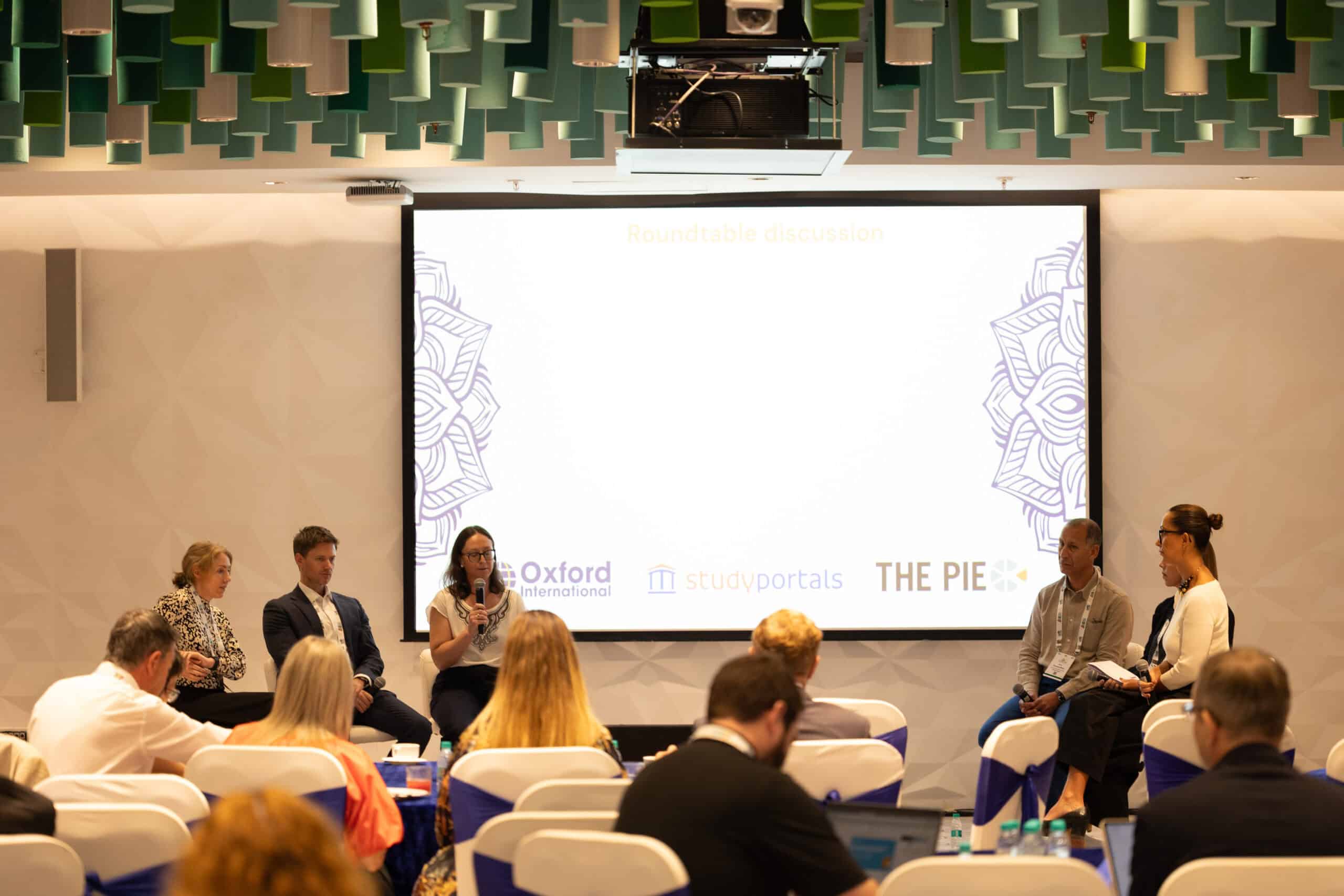
    The PIE News, in partnership with Oxford International Education Group (OIEG) and Studyportals, hosted a briefing where panelists explored university strategies, government collaboration, and financial sustainability for a successful TNE model.

    As international universities compete to establish TNE partnerships in India, the University of Southampton stands out, with its Delhi branch campus set to open in August 2025.

    Kasia Cakala, director of education pathways development at OIEG, which is collaborating with Southampton on the project, noted how education providers must continuously adapt to evolving expectations of the TNE model.

    “Not only do universities have to be mindful of the models they take in this very challenging market, but private providers like us also need to pivot, change, and adapt to support universities in their urgent needs,” stated Cakala at the briefing.

    “With Southampton, the key was defining a proposition that was not only sustainable but also aligned with government priorities and the domestic student ecosystem.”

    Cakala emphasised that as students from countries like India become more savvy, knowing what they need and expecting more from institutions, universities must adopt a “sophisticated market research strategy” to define their proposition, particularly when presenting expansion plans to government bodies.

    Private providers like us need to pivot, change, and adapt to support universities in their urgent needs
    Kasia Cakala, OIEG

    In light of the changing expectations, Carlie Sage, associate director, partnerships, APAC, Studyportals, underscored the importance of understanding student behaviour and market trends in shaping international education strategies.

    “A lot of universities still make decisions without really understanding the environment they’re operating in,” stated Sage. 

     “There’s amazing data out there that can help institutions navigate shifts, understand demand, identify gaps, and see what’s happening in real time.”

    According to Aziz Boussofiane, director, Cormack Consultancy Group, while TNE models need to be financially sustainable, they also need to be beneficial for both the university and the host country in the long run. 

    “For host countries, success (in TNE) means increasing capacity with quality provision – and for universities, it must align with their mission and strategic objectives,” stated Boussofiane, while addressing the audience. 

    “There are different drivers and processes depending on the market, whether it’s India or Nigeria, [and] it’s often about increasing in-country capacity and improving the quality of local providers.”

    While TNE is widely embraced by leading universities in major study destinations, challenges persist in building scalable models due to varying international perceptions of quality and value, which impact recognition, as previously reported by The PIE. 

    According to Daniel Cragg, director of Nous, while TNE is just another challenge for institutions, which are already dealing with academic workforce stress, new pressures from AI, and evolving student needs, the appetite for partnerships has only been rising. 

    “The appetite for collaboration is growing – universities want to share risk, balance success, and be more in-market experts,” said Cragg.

    “In international education, it feels like there’s a black swan event every three to four years. But universities constantly adapt, innovate, and thrive.”

    While universities in the UK and Australia have pushed through major TNE expansions in recent years, institutions in countries like New Zealand, though interested, prioritise strengthening their reputation and research over physical expansion.

    “New Zealand is a small player in TNE, but our partnerships focus on reputation and research rather than bricks-and-mortar expansion overseas,” stated Meredith Smart, international director, Auckland University of Technology

    “There’s a strong connection between our ranking strategy and our partnership strategy – reputation matters.”

    As the New Zealand government aims to boost international recruitment from emerging markets while strengthening educational partnerships in countries like India and Vietnam, institutions like AUT see an opportunity, while also learning from the missteps of their peers.

    “We are in a strong growth focus. The government wants us to grow. They’re desperate to win the next election, and I think they feel that international education can boost the economy,” stated Smart. 

    “New Zealanders love international students, but that could change as numbers rise. We must actively demonstrate the value of internationalisation to our economy, industries, and diplomatic relations.”

    This point was further reiterated by Cragg, who highlighted how working with governments in policymaking is essential. 

    “Working with governments to shape future visa policies is essential to ensuring sustainable international student growth,” he said. 

    “The value of international education extends across different areas of government, not just within universities.”

    Source link