Category: support

  • Next gen learning spaces: UDL in action

    Next gen learning spaces: UDL in action

    Key points:

    By embracing Universal Design for Learning (UDL) principles in purchasing decisions, school leaders can create learning spaces that not only accommodate students with disabilities but enhance the educational experience for all learners while delivering exceptional returns on investment (ROI).

    Strangely enough, the concept of UDL all started with curb cuts. Disability activists in the 1960s were advocating for adding curb cuts at intersections so that users of wheelchairs could cross streets independently. Once curb cuts became commonplace, there was a surprising secondary effect: Curb cuts did not just benefit the lives of those in wheelchairs, they benefited parents with strollers, kids on bikes, older adults using canes, delivery workers with carts, and travelers using rolling suitcases. What had been designed for one specific group ended up accidentally benefiting many others.

    UDL is founded on this idea of the “curb-cut effect.” UDL focuses on designing classrooms and schools to provide multiple ways for students to learn. While the original focus was making the curriculum accessible to multiple types of learners, UDL also informs the physical design of classrooms and schools. Procurement professionals are focusing on furniture and technology purchases that provide flexible, accessible, and supportive environments so that all learners can benefit. Today entire conferences, such as EDspaces, focus on classroom and school design to improve learning outcomes.

    There is now a solid research base indicating that the design of learning spaces is a critical factor in educational success: Learning space design changes can significantly influence student engagement, well-being, and academic achievement. While we focus on obvious benefits for specific types of learners, we often find unexpected ways that all students benefit. Adjustable desks designed for wheelchair users can improve focus and reduce fatigue in many students, especially those with ADHD. Providing captions on videos, first made available for deaf students, benefit ELL and other students struggling to learn to read.

    Applying UDL to school purchasing decisions

    UDL represents a paradigm shift from retrofitting solutions for individual students to proactively designing inclusive environments from the ground up. Strategic purchasing focuses on choosing furniture and tech tools that provide multiple means of engagement that can motivate and support all types of learners.

    Furniture that works for everyone

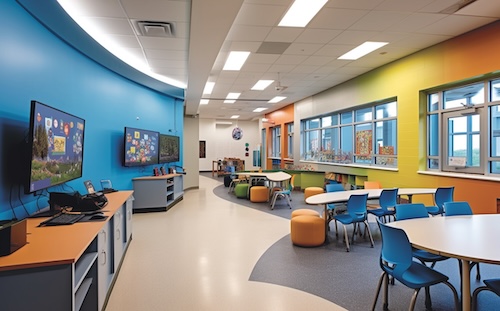
    Modern classroom furniture has evolved far beyond the traditional one-size-fits-all model. Flexible seating options such as stability balls, wobble cushions, and standing desks can transform classroom dynamics. While these options support students with ADHD or sensory processing needs, they also provide choice and movement opportunities that enhance engagement for neurotypical students. Research consistently shows that physical comfort directly correlates with cognitive performance and attention span.

    Modular furniture systems offer exceptional value by adapting to changing needs throughout the school year. Tables and desks that can be easily reconfigured support collaborative learning, individual work, and various teaching methodologies. Storage solutions with clear labeling systems and accessible heights benefit students with visual impairments and executive functioning challenges while helping all students maintain organization and independence.

    Technology that opens doors for all learners

    Assistive technology has evolved from specialized, expensive solutions to mainstream tools that benefit diverse learners. Screen readers like NVDA and JAWS remain essential for students with visual impairments, but their availability also supports students with dyslexia who benefit from auditory reinforcement of text. When procuring software licenses, prioritize platforms with built-in accessibility features rather than purchasing separate assistive tools.

    Voice-to-text technology exemplifies the UDL principle perfectly. While crucial for students with fine motor challenges or dysgraphia, these tools also benefit students who process information verbally, ELL learners practicing pronunciation, and any student working through complex ideas more efficiently through speech than typing.

    Adaptive keyboards and alternative input devices address various physical needs while offering all students options for comfortable, efficient interaction with technology. Consider keyboards with larger keys, customizable layouts, or touchscreen interfaces that can serve multiple purposes across your student population.

    Interactive displays and tablets with built-in accessibility features provide multiple means of engagement and expression. Touch interfaces support students with motor difficulties while offering kinesthetic learning opportunities for all students. When evaluating these technologies, prioritize devices with robust accessibility settings including font size adjustment, color contrast options, and alternative navigation methods.

    Maximizing your procurement impact

    Strategic procurement for UDL requires thinking beyond individual products to consider system-wide compatibility and scalability. Prioritize vendors who demonstrate commitment to accessibility standards and provide comprehensive training on using accessibility features. The most advanced assistive technology becomes worthless without proper implementation and support.

    Conduct needs assessments that go beyond compliance requirements to understand your learning community’s diverse needs. Engage with special education teams, occupational therapists, and technology specialists during the procurement process. Their insights can prevent costly mistakes and identify opportunities for solutions that serve multiple populations.

    Consider total cost of ownership when evaluating options. Adjustable-height desks may cost more initially but can eliminate the need for specialized furniture for individual students. Similarly, mainstream technology with robust accessibility features often costs less than specialized assistive devices while serving broader populations.

    Pilot programs prove invaluable for testing solutions before large-scale implementation. Start with small purchases to evaluate effectiveness, durability, and user satisfaction across diverse learners. Document outcomes to build compelling cases for broader adoption.

    The business case for UDL

    Procurement decisions guided by UDL principles deliver measurable returns on investment. Reduced need for individualized accommodations decreases administrative overhead while improving response times for student needs. Universal solutions eliminate the stigma associated with specialized equipment, promoting inclusive classroom cultures that benefit all learners.


    Latest posts by eSchool Media Contributors (see all)

    Source link

  • Celebrating heritage means honoring students’ languages

    Celebrating heritage means honoring students’ languages

    Key points:

    Every year, Hispanic Heritage Month offers the United States a chance to honor the profound and varied contributions of Latino communities. We celebrate scientists like Ellen Ochoa, the first Latina woman in space, and activists like Dolores Huerta, who fought tirelessly for workers’ rights. We use this month to recognize the cultural richness that Spanish-speaking families bring to our communities, including everything from vibrant festivals to innovative businesses that strengthen our local economies.

    But there’s a paradox at play.

    While we spotlight Hispanic heritage in public spaces, many classrooms across the country require Spanish-speaking students to set aside the very heart of their cultural identity: their language.

    This contradiction is especially personal for me. I moved from Puerto Rico to the mainland United States as an adult in hopes of building a better future for myself and my family. The transition was far from easy. My accent often became a challenge in ways I never expected, because people judged my intelligence or questioned my education based solely on how I spoke. I could communicate effectively, yet my words were filtered through stereotypes.

    Over time, I found deep fulfillment working in a state that recognizes the value of bilingual education. Texas, where I now live, continues to expand biliteracy pathways for students. This commitment honors both home languages and English, opening global opportunities for children while preserving ties to their history, family, and identity.

    That commitment to expanding pathways for English Learners (EL) is urgently needed. Texas is home to more than 1.3 million ELs, which is nearly a quarter of all students in the state, the highest share in the nation. Nationwide, there are more than 5 million ELs comprising nearly 11 percent of the U.S. public school students; about 76 percent of ELs are Spanish speakers. Those figures represent millions of children who walk into classrooms every day carrying the gift of another language. If we are serious about celebrating Hispanic Heritage Month, we must be serious about honoring and cultivating that gift.

    A true celebration of Hispanic heritage requires more than flags and food. It requires acknowledging that students’ home languages are essential to their academic success, not obstacles to overcome. Research consistently shows that bilingualism is a cognitive asset. Those who are exposed to two languages at an early age outperform their monolingual peers on tests of cognitive function in adolescence and adulthood. Students who maintain and develop their native language while learning English perform better academically, not worse. Yet too often, our educational systems operate as if English is the only language that matters.

    One powerful way to shift this mindset is rethinking the materials students encounter every day. High-quality instructional materials should act as both mirrors and windows–mirrors in which students see themselves reflected, and windows through which they explore new perspectives and possibilities. Meeting state academic standards is only part of the equation: Materials must also align with language development standards and reflect the cultural and linguistic diversity of our communities.

    So, what should instructional materials look like if we truly want to honor language as culture?

    • Instructional materials should meet students at varying levels of language proficiency while never lowering expectations for academic rigor.
    • Effective materials include strategies for vocabulary development, visuals that scaffold comprehension, bilingual glossaries, and structured opportunities for academic discourse.
    • Literature and history selections should incorporate and reflect Latino voices and perspectives, not as “add-ons” during heritage month, but as integral elements of the curriculum throughout the year.

    But materials alone are not enough. The process by which schools and districts choose them matters just as much. Curriculum teams and administrators must center EL experiences in every adoption decision. That means intentionally including the voices of bilingual educators, EL specialists, and, especially, parents and families. Their life experiences offer insights into the most effective ways to support students.

    Everyone has a role to play. Teachers should feel empowered to advocate for materials that support bilingual learners; policymakers must ensure funding and policies that prioritize high-quality, linguistically supportive instructional resources; and communities should demand that investments in education align with the linguistic realities of our students.

    Because here is the truth: When we honor students’ languages, we are not only affirming their culture; we are investing in their future. A child who is able to read, write, and think in two languages has an advantage that will serve them for life. They will be better prepared to navigate an interconnected world, and they carry with them the ability to bridge communities.

    This year, let’s move beyond celebrating what Latino communities have already contributed to America and start investing in what they can become when we truly support and honor them year-round. That begins with valuing language as culture–and making sure our classrooms do the same.

    Latest posts by eSchool Media Contributors (see all)

    Source link

  • What educators need to know

    What educators need to know

    Key points:

    Literacy has always been the foundation of learning, but for middle school students, the stakes are especially high. These years mark the critical shift from learning to read to reading to learn.

    When students enter sixth, seventh, or eighth grade still struggling with foundational skills, every subject becomes harder–science labs, social studies texts, even math word problems require reading proficiency. For educators, the challenge is not just addressing gaps but also building the confidence that helps adolescents believe they can succeed.

    The confidence gap

    By middle school, many students are keenly aware when they’re behind their peers in reading. Interventions that feel too elementary can undermine motivation. As Dr. Michelle D. Barrett, Senior Vice President of Research, Policy, and Impact at Edmentum, explained:

    “If you have a student who’s in the middle grades and still has gaps in foundational reading skills, they need to be provided with age-appropriate curriculum and instruction. You can’t give them something that feels babyish–that only discourages them.”

    Designing for engagement

    Research shows that engagement is just as important as instruction, particularly for adolescents. “If students aren’t engaged, if they’re not showing up to school, then you have a real problem,” Barrett said. “It’s about making sure that even if students have gaps, they’re still being supported with curriculum that feels relevant and engaging.”

    To meet that need, digital programs like Edmentum’s Exact Path tailor both design and content to the learner’s age. “A middle schooler doesn’t want the cartoony things our first graders get,” Barrett noted. “That kind of thing really does matter–not just for engagement, but also for their confidence and willingness to keep going.”

    Measuring what works

    Educators also need strong data to target interventions. “It’s all about how you’re differentiating for those students,” Barrett said. “You’ve got to have great assessments, engaging content that’s evidence-based, and a way for students to feel and understand success.”

    Exact Path begins with universal screening, then builds personalized learning paths grounded in research-based reading progressions. More than 60 studies in the past two years have shown consistent results. “When students complete eight skills per semester, we see significant growth across grade levels–whether measured by NWEA MAP, STAR, or state assessments,” Barrett added.

    That growth extends across diverse groups. “In one large urban district, we found the effect sizes for students receiving special education services were twice that of their peers,” Barrett said. “That tells us the program can be a really effective literacy intervention for students most at risk.”

    Layering supports for greater impact

    Barrett emphasized that literacy progress is strongest when multiple supports are combined. “With digital curriculum, students do better. But with a teacher on top of that digital curriculum, they do even better. Add intensive tutoring, and outcomes improve again,” she said.

    Progress monitoring and recognition also help build confidence. “Students are going to persist when they can experience success,” Barrett added. “Celebrating growth, even in small increments, matters for motivation.”

    A shared mission

    While tools like Exact Path provide research-backed support, Barrett stressed that literacy improvement is ultimately a shared responsibility. “District leaders should be asking: How is this program serving students across different backgrounds? Is it working for multilingual learners, students with IEPs, students who are at risk?” she said.

    The broader goal, she emphasized, is preparing students for lifelong learning. “Middle school is such an important time. If we can help students build literacy and confidence there, we’re not just improving test scores–we’re giving them the skills to succeed in every subject, and in life.”

    Laura Ascione
    Latest posts by Laura Ascione (see all)

    Source link

  • Strengthening family engagement to support the science of reading

    Strengthening family engagement to support the science of reading

    Key points:

    While most teachers are eager to implement the science of reading, many lack the time and tools to connect these practices to home-based support, according to a new national survey from Lexia, a Cambium Learning Group brand.

    The 2025 Back-to-School Teacher Survey, with input from more than 1,500 K–12 educators nationwide, points to an opportunity for district leaders to work in concert with teachers to provide families with the science of reading-based literacy resources they need to support student reading success.

    Key insights from the survey include:

    • 60 percent of teachers are either fully trained or interested in learning more about the science of reading
    • Only 15 percent currently provide parents with structured, evidence-based literacy activities
    • 79 percent of teachers cite time constraints and parents’ work schedules as top barriers to family engagement
    • Just 10 percent report that their schools offer comprehensive family literacy programs
    • Teachers overwhelmingly want in-person workshops and video tutorials to help parents support reading at home

    “Teachers know that parental involvement can accelerate literacy and they’re eager for ways to strengthen those connections,” said Lexia President Nick Gaehde. “This data highlights how districts can continue to build on momentum in this new school year by offering scalable, multilingual, and flexible family engagement strategies that align with the science of reading.”

    Teachers also called for:

    • Better technology tools for consistent school-to-home communication
    • Greater multilingual support to serve diverse communities
    • Professional learning that includes family engagement training

    Gaehde concluded, “Lexia’s survey reflects the continued national emphasis on Structured Literacy and shows that equipping families is essential to driving lasting student outcomes. At Lexia we’re committed to partnering with districts and teachers to strengthen the school-to-home connection. By giving educators practical tools and data-driven insights, we help teachers and families work together–ensuring every child has the literacy support they need to thrive.”

    The complete findings are available in a new report, From Classroom to Living Room: Exploring Parental Involvement in K–12 Literacy. District leaders can also download the accompanying infographic, What District Leaders Need To Know: 5 Key Findings About Family Engagement and Literacy,” which highlights the most pressing data points and strategic opportunities for improving school-to-home literacy connections.

    Latest posts by eSchool Media Contributors (see all)

    Source link

  • Post-pandemic, student academic recovery remains elusive

    Post-pandemic, student academic recovery remains elusive

    Key points:

    Five years after the onset of the COVID-19 pandemic, academic recovery has stalled nationwide, and achievement gaps have widened, according to the State of Student Learning 2025 report from from Curriculum Associates.

    The report offers one of the most comprehensive looks at Grades K–8 student performance in reading and mathematics, based on data from close to 14 million students who took the i-Ready Diagnostic assessment in the 2024–2025 school year.

    The report shows that most students have not yet reached pre-pandemic achievement levels, and some are falling even further behind. The report does find some bright spots: Some historically underserved schools, especially majority-Black schools, are seeing modest, positive gains in both reading and mathematics. However, those gains have not yet translated into closing longstanding disparities.

    “This report shows that disrupted schooling due to the pandemic continues to impact student learning, particularly for students who are in early grades, are lower performing, or are from historically underserved communities,” said Kristen Huff, head of measurement at Curriculum Associates. “Academic recovery has never been one-size-fits-all, and these results reaffirm the importance of nuanced, data-informed approaches. Above all, they underscore the vital work educators are doing every day to meet students where they are and help them move forward.”

    Key findings

    • Academic progress has plateaued. Since spring 2023, national achievement has remained flat. While many students are growing at pre-pandemic rates, that growth isn’t closing the gap caused by pandemic disruptions.
    • The achievement gap has grown in many cases. Students who were already behind, particularly those scoring in the bottom 10th percentile, continue to fall behind, while top-performing students have often recovered or surpassed their pre-pandemic levels.
    • Younger students experienced greater learning losses. Even though they were not yet in school during the pandemic, elementary students, especially in Grades K and 1, saw the largest drops in achievement after the pandemic. 
    • Vulnerable populations are experiencing uneven recovery. The report shows widening gaps between the nation’s highest and lowest performers. Across most grades, the differences between higher and lower percentiles have increased over time.

    A data-driven, nationwide look

    The 2025 report examines data through the critical years pre- and post-pandemic, from spring 2019 to spring 2025. Using a nationally representative sample of more than 11.7 million reading and 13.4 million mathematics assessments, the research examines:

    • Grade-level placement: how many students are performing at or below grade level
    • Scale scores by percentile: how learning differs across performance groups
    • Annual growth: whether students are making enough academic progress during the school year to recover lost ground

    The findings reinforce that targeted support is needed to ensure every student can thrive academically, especially younger students, lower-performing students, and historically underserved communities.

    This press release originally appeared online.

    eSchool News Staff
    Latest posts by eSchool News Staff (see all)

    Source link

  • 4 tips to support the literacy needs of middle and high school students

    4 tips to support the literacy needs of middle and high school students

    Key points:

    Today’s middle schoolers continue to struggle post-pandemic to read and write at the level needed to successfully navigate more complex academic content in the upper grades and beyond, according to a new report from NWEA, a K-12 assessment and research organization.

    Based on NWEA’s research, current 8th graders would need close to a full academic year of additional instruction to catch up to their pre-pandemic peers in reading. This trend was reiterated in recent assessment results from the National Assessment on Educational Progress (NAEP), with only 30 percent of eighth-grade students performing at or above the NAEP proficient level.

    While early literacy initiatives have garnered attention in recent years, the fact remains that many students struggle to read and are not prepared for the rigors of middle school. Students quickly find themselves challenged to keep up as they no longer receive explicit, structured reading instruction, even as they are expected to comprehend increasingly complex materials across subjects, like science, history, or English Language Arts.

    The report, Policy recommendations for addressing the middle school reading crisis, is co-authored by Miah Daughtery, EdD, NWEA VP of Academic Advocacy at HMH (NWEA’s parent company), and Chad Aldeman, founder of Read Not Guess.

    “Our current middle and high schoolers were just starting their literacy journey when the pandemic hit, and we cannot lessen the urgency to support them. But, middle school literacy is complex even for students who are reading on grade level. This demands intentional, well-funded, and focused policy leadership that includes support across the K-12 spectrum,” said Daughtery. “Simply put, learning to read is not done when a student exits elementary school; support cannot stop there either.”

    Policymakers and district leaders must adopt a systems-level approach that supports both early learners and the unique literacy needs of middle and high school students.

    The new report provides four components that can be leveraged to make this happen:

    1. Use high-quality, grade-appropriate assessments that provide specific data on the literacy needs of middle schoolers.
    2. Look at flexible scheduling and policies that promote literacy development throughout the entire school day and help districts more effectively use instructional time.
    3. Understand and support the unique literacy needs of middle schoolers across subjects and disciplines from a systems perspective and invest in teacher professional learning in all disciplines, including at the upper grades, within state and district literacy plans.
    4. Curate relationships with external partners, like community organizations and nonprofits, who share similar goals in improving literacy outcomes, and can both support and reinforce literacy development, stretching beyond the school’s hours and resources.
    eSchool News Staff
    Latest posts by eSchool News Staff (see all)

    Source link

  • Adding a trauma-responsive lens for student support

    Adding a trauma-responsive lens for student support

    Key points:

    Across the country, our schools are being taxed beyond their capacity to support educational success. We’ve known for a long time that students need a three-dimensional structure of guidance and encouragement to thrive. That’s why the Multi-Tiered System of Supports (MTSS) framework was created–it’s a prevention framework for early identification of varying student needs and the responses needed to maximize academic success. In theory, an MTSS supports academic, social-emotional, and behavioral needs in equal measure. However, in practice, many schools are struggling to incorporate social-emotional and behavioral components in their MTSS–even as many of their students come to school bearing the effects of adversity, trauma, or crisis.

    This imbalance is leaving millions of children behind.

    Each year, at least 1 in 7 children in the United States experience abuse, violence, natural disasters, or other adverse childhood experiences (ACEs). By age 16, roughly two-thirds of children will have been exposed to at least one traumatic event. This can impair their ability to learn well and contribute to absenteeism, while secondary trauma spirals out from these students to classmates and teachers, multiplying the overall impact. Left unaddressed, the imprint of such events could warp the future of our school and public communities.

    Since COVID-19, schools have reported unprecedented levels of absenteeism and student distress, and supporting trauma-exposed students without training puts more pressure on teachers, who are already burned out and leaving the profession at high rates. Therefore, it is clear to me that creating school-wide networks of trauma-informed adults is essential for fostering supportive learning and growth for students, enhancing educator capacity to nurture trauma-affected learners, and ensuring effective trauma resource management within districts.

    Research has identified a supportive school community as a strong childhood protective factor against the effects of trauma. We should be hopeful about our path forward. But the vision and blueprint for this enhancement of MTSS need to come as soon as possible, and it needs to come from state-level education leaders and school district leaders.

    Gaps in support and expertise

    Consider this scenario: A student who recently experienced a traumatic car accident sits near a window in class, experiencing significant distress or dysregulation without outward signs. A sudden screech of tires outside activates their sympathetic nervous system (the one associated with fight or flight), and the student shuts down, withdrawing into themselves. Their teacher, unaware of the student’s trauma history and unequipped with relevant training, interprets the response as a continuation of past misbehavior or as an academic deficit.

    This sort of misunderstanding takes place in a thousand places every day. I would stress that this isn’t a reflection of bad intentions, but rather a symptom of fragmented systems and knowledge. Even when trauma is recognized, lack of intentional collaboration and training often result in missed opportunities or inconsistent support, which cannot maximize recovery from trauma and may, in fact, hinder it, as research on retraumatization suggests.

    There might be mismatched expectations when teachers send students to the counselor, not knowing that they themselves have a role to play in the healing. In other cases, students may be referred to a school counselor and have a productive support session–but on their way back to class, a seemingly benign statement from a third party can be misconstrued or cause dysregulation, unintentionally undoing the support they’ve received. The solution to all these problems is school-wide training on trauma-informed skills. This way, all educators and staff alike develop a shared knowledge, understanding, language, and responses as they collaborate and connect with students. With the right tools, adults on campus have better trauma-informed strategies to use in their relationships with students and in building a safe and supportive school community.

    The proof is all around us

    Trauma training works synergistically within MTSS: social-emotional and trauma-responsive support allows for better academic outcomes, which work to further reduce behavioral problems, and so on. At the Center for Safe & Resilient Schools and Workplaces, we see this play out often with our school district partners. For example, at Pasadena Unified School District, which was recently ravaged by the Eaton Canyon Fire, trauma-informed best practices and preparations have enabled district leaders to reopen schools with sufficient psychological understanding and interventions along with the needed material support for the 10,000 students who were affected.

    A truly effective MTSS model does not treat trauma as a peripheral concern. It integrates trauma-responsive strategies into every tier of support–from universal practices, to targeted interventions, to intensive mental health services. In that environment, every adult who comes in contact with students has the training to adhere to trauma best practices.

    We are at a juncture where the impact of trauma poses serious risks to the education system, but evidence-based approaches exist to solve the problem. Change from the state level down is the best way to transform school cultures quickly, and I urge state education leaders to take action. Any MTSS plan isn’t complete without a trauma-informed foundation, lens, and programming. And our students–each and every one–deserve nothing less.

    Latest posts by eSchool Media Contributors (see all)

    Source link

  • Counslr Launches in Texas to Increase Access to Mental Health Support for Staff and Students

    Counslr Launches in Texas to Increase Access to Mental Health Support for Staff and Students

    New York, NY –  Counslr, a leading B2B mental health and wellness platform, announced today that it has expanded its footprint into the State of Texas starting with a partnership with Colorado Independent School District (ISD) in Colorado City, TX. This partnership will empower students and staff to prioritize their mental health by enabling them to access unlimited live texting sessions with Counslr’s licensed and vetted mental health support professionals, who are available on-demand, 24/7/365 and also utilize the app’s robust and curated wellness resources. By increasing accessibility to Counslr’s round-the-clock support, Colorado ISD aims to empower those silent sufferers who previously did not or could not access care, whether due to cost, inconvenience, or stigma.

    Texas is facing a critical mental health care crisis, with over 95% of its counties officially designated as Mental Health Professional Shortage Areas. This alarming statistic underscores the severe lack of access to mental health services across the state, particularly in rural, border, and frontier communities. This resource scarcity underscores the urgent need for additional resources and innovative solutions to bridge this critical care gap for school communities.

    “We’re excited to partner with Counslr to bring innovative, accessible mental health resources to our school community,” said Alison Alvarez, Family and Community Engagement Coordinator, of Colorado ISD. “This partnership empowers our 6-12 grade students and staff with the support they need to thrive—both in and out of the classroom.”

    As factors such as academic pressures, social media influence, burnout and world events contribute to an increase in mental health challenges for young people, schools throughout the country are recognizing the growing need to offer more accessible, prevention-focused resources. A recent study found that digital mental health apps like Counslr can play an important role in expanding access to mental health support, especially for school communities. Most users turned to Counslr through on-demand sessions, showing just how valuable it is to have someone available in the moment when support is needed most. Interestingly, more than 80% of sessions happened between 7 PM and 5 AM, a time when traditional counseling services are usually unavailable. This suggests that Counslr helps fill a critical gap, offering students and school community members a reliable way to talk to licensed counselors around the clock. The app was also used for a wide range of concerns, highlighting its potential to meet diverse mental health needs through both immediate and scheduled support.

    “As we expand across the country, we’re proud to partner with new school communities to ensure that every student, regardless of location or background, has access to the mental health support they deserve,” said Josh Liss, Counslr CEO. Adding that, “With most of Counslr’s users being first-time care seekers, we’re excited to help reach those traditionally unreachable, who need help but do not or cannot access it, no matter where they are located.”

    ABOUT COUNSLR

    Counslr is a text-based mental health support application that provides unlimited access to robust wellness resources and live texting sessions with licensed professionals, 24/7/365. Users can access support on-demand within two minutes of opening the app, or by scheduled appointment. Through real-time texting, users enjoy one-on-one, private communication with a licensed counselor that can be conducted anytime, anywhere. Counslr was designed to help individuals deal with life’s day-to-day issues, empowering individuals to address concerns while they are “small” to help ensure that they stay “small”. Counslr partners with organizations of all shapes and sizes (companies, unions, nonprofits, universities/colleges, high schools, etc) so that these entities can provide Counslr’s services to their employees/members/students at no direct cost. For more information, please visit www.counslr.com.

    eSchool News Staff
    Latest posts by eSchool News Staff (see all)

    Source link

  • Solving our literacy crisis starts in the lecture hall

    Solving our literacy crisis starts in the lecture hall

    Key points:

    The recent NAEP scores have confirmed a sobering truth: Our schools remain in the grips of a literacy crisis. Across the country, too many children are struggling to read, and too many teachers are struggling to help them. But why? And how do we fix it?

    There are decades of research involving thousands of students and educators to support a structured literacy approach to teaching literacy. Teacher preparation programs and school districts across the nation have been slow to fully embrace this research base, known as the science of reading. Since 2017, consistent media attention focused on the literacy crisis has created a groundswell of support for learning about the science of reading. Despite this groundswell, too many educators are still entering classrooms without the skills and knowledge they need to teach reading.

    While there is steady progress in teacher preparation programs to move toward the science of reading-aligned practices, the National Council on Teacher Quality’s latest report on the status of teacher preparation programs for teaching reading (2023) still shows that only 28 percent of programs adequately address all five components of reading instruction. Furthermore, according to the report, up to 40 percent of programs still teach multiple practices that run counter to reading research and ultimately impede student learning, such as running records, guided reading, leveled texts, the three cueing systems, etc. This data shows that there is still much work to be done to support the education of the teacher educators responsible for training pre-service teachers.

    The disconnect between theory and practice

    When it comes to literacy instruction, this problem is especially glaring. Teachers spend years learning about teaching methods, reading theories, and child development. They’re often trained in methods that emphasize comprehension and context-based guessing. However, these methods aren’t enough to help students develop the core skills they need to become proficient readers. Phonics–teaching students how to decode words–is a critical part of reading instruction, but it’s often left out of traditional teacher prep programs.

    One primary reason this disconnect happens is that many teacher prep programs still rely on outdated methods. These approaches prioritize reading comprehension strategies that focus on meaning and context, but they don’t teach the foundational skills, like phonics, essential for developing fluent readers.

    Another reason is that teacher prep programs often lag when it comes to incorporating new research on reading. While the science of reading–a body of evidence built from decades of research and studies involving thousands of students and educators about how humans learn to read and the instructional practices that support learning to read–has been gaining deserved traction, it’s not always reflected in the teacher preparation programs many educators go through. As a result, teachers enter classrooms without the knowledge, skills, and up-to-date methods they need to teach reading effectively.

    A way forward: Structured literacy and continuous professional development

    For real progress, education systems must prioritize structured literacy, a research-backed approach to teaching reading that includes explicit, systematic instruction in phonics, decoding, fluency, and comprehension. This method is effective because it provides a clear, step-by-step process that teachers can follow consistently, ensuring that every single student gets the support they need to succeed.

    But simply teaching teachers about structured literacy is not enough. They also need the tools to implement these methods in their classrooms. The goal should be to create training programs that offer both the theoretical knowledge and the hands-on experience teachers need to make a lasting difference. Teachers should graduate from their prep programs not just with a degree but with a practical, actionable plan for teaching reading.

    And just as important, we can’t forget that teacher development doesn’t end once a teacher leaves their prep program. Just like doctors, teachers need to continue learning and growing throughout their careers. Ongoing professional development is critical to helping teachers stay current with the latest research and best practices in literacy instruction. Whether through in-person workshops, online courses, or coaching, teachers should have consistent, high-quality opportunities to grow and sharpen their skills.

    What do teacher educators need?

    In 2020, the American Federation of Teachers published an update to its seminal publication, Teaching Reading is Rocket Science. First published in 2000, this updated edition is a collaboration between the AFT and the Center on Development and Learning. Although some progress has been made over the past 20 years in teaching reading effectively, there are still too many students who have not become proficient readers.

    This report outlines in very specific ways what pre-service and in-service teachers need to know to teach reading effectively across four broad categories:

    1. Knowing the basics of reading psychology and development
    2. Understanding language structure for word recognition and language comprehension
    3. Applying best practices (based on validated research) in all components of reading
    4. Using validated, reliable, efficient assessments to inform classroom teaching

    There should be a fifth category that is directly related to each of the four areas listed above: the knowledge of how to address the specific oral language needs of multilingual learners and speakers of language varieties. Structured, spoken language practice is at the heart of addressing these needs.

    Moving forward: Reimagining teacher training

    Ultimately, fixing the literacy crisis means changing the way we think about teacher preparation and ongoing professional development. We need to create programs that not only teach the theory of reading instruction but also provide teachers with the practical skills they need to apply that knowledge effectively in the classroom. It’s not enough to just teach teachers about phonics and reading theory; they need to know how to teach it, too.

    Literacy instruction must be at the heart of every teacher’s training–whether they teach kindergarten or high school–and ongoing professional development should ensure that teachers have the support they need to continuously improve.

    It’s a big task, but with the right tools, knowledge, and support, we can bridge the gap between theory and practice and finally begin to solve a literacy crisis that has stubbornly endured for far too long.

    Latest posts by eSchool Media Contributors (see all)

    Source link

  • Do we really empower sabbatical offices to be the voice of students?

    Do we really empower sabbatical offices to be the voice of students?

    by Rebecca Turner, Jennie Winter & Nadine Schaefer

    Student voice is firmly embedded within the architecture of universities, with multiple mechanisms existing through which we (as educators) can ‘hear’, and students can ‘leverage’ their voice.  The notion of student voice is widely debated (and critiqued – see Mendes & Hammett, 2023), and whilst relevant to this blog post, it is not what we seek to focus on here. Rather we focus on one of the primary figureheads of student voice within universities – the sabbatical officer – and consider how they are empowered to represent the ‘voice’ of their peers to their university.

    Sabbatical officers are elected by the student body to represent their interests to the wider university community. They are leaders and trustees of their student union – semi autonomous organisations that operate alongside universities to advocate for the student body (Brooks, Byford & Sela 2016).  As elected student representatives, sabbatical officers sit on high-level university committees where student voice is ‘required,’ making the rapid transition from a student in a lecture hall, to a voice for all. Though this is an anticipated move, it is potentially challenging. Becoming a sabbatical officer is the accumulation of a hard-fought election campaign, which commonly builds on several years of working with their students’ union alongside their undergraduate studies (Turner & Winter, 2023).

    In collaboration with the NUS, and with the support of a small grant from the Staff and Educational Development Association (SEDA), we undertook a national survey to develop contemporary insights into the work of elected sabbatical officers. Sabbatical officers were clearly keen to share their experiences as we achieved responses from 59% of student unions affiliated to the NUS. We also undertook interviews with a sample of sabbatical officers (n=4) and permanent student union staff (n=6) who supported them during their time in office. Here we reflect on headlines emerging from this study, to place a brief spotlight on the work of sabbatical officers. 

    What a busy year (or two!)

    Sabbatical officers were often negotiating multiple, potentially competing, demands – as this survey respondent reflected when invited to comment on the main challenges they faced:

    ‘Getting up to speed with the fast-moving world of [being] a sabbatical officer and the many roles I had (sabb, trustee, leader, admin and campaigner)’.

    Sabbatical officers had a long list of responsibilities, including jobs inherited from their predecessor, union and university commitments, as well as the commitments they made through their own manifestos.  Attending university committees to give the student voice took considerable time, with many questioning the value of the time spent in meetings:

    It’s very much the case that you are in a room for two hours where you will be speaking for, I don’t know, two minutes. So sometimes it seems very boring to get involved with those random conversations which have very little to do directly with student experience.’ SO1

    It was a common theme that sabbatical officers were silent during these meetings, waiting for the brief interlude when they were invited to speak. Leading us to question both where their agency as student representatives lay in these committees, and how they could effect change in this space, when their engagement was limited. A concern shared across survey respondents, for example:

    ‘I’m in a huge number of meetings which significantly reduces the amount of time I have to work on manifesto objectives.’

    With a jobs list (and a diary) that echoed that of many Vice Chancellors (though with considerably less experience in HE), sabbatical officers reported engaging in trade-offs for who they worked with, whose voice was heard and opinions sought, to balance the demands of their role.  As this sabbatical officer reflected, this could leave the wider student body questioning their actions:

    ‘[Students] want to see the battle happening.  What they don’t want to see, is me sit for three hours and hash out the middle ground with some members of staff who probably aren’t going to change their mind.’ SO2

    Finding their voice

    Though given a seat at high level tables, respondents did not always feel at ease speaking up, the sentiments of this respondent were repeated many times in our data:

    ‘I think the hardest part is, we are sitting on committees with individuals who have worked here for years.  We’re never going to have that same knowledge, so that makes it quite a challenge um to be able to understand the ins and outs of the university and the institution, and the politics.’ SO3

    We did question whether the expectation to engage in these spaces may further reinforce the inequalities in student leadership highlighted by Brooks et al (2015).  However, sabbatical officers were not working alone. Permanent officers played an important role, helping them, for example, to decode paperwork and plan their contributions. Leadership allies, who may, for example, provide early access to meeting paperwork to aide preparation, or coach sabbatical officers in advance of meetings, assisted sabbatical officers to find their voice:

    I think the university has been really accommodating giving me the heads up on things that I could then have a bit more time to read up on things and to improve my knowledge.’ SO4

    Developing effective support networks was essential; through these networks they gained the knowledge needed to contribute confidently in ‘university’ spaces. However, this took considerable time and resulted in many reprioritising their work. They focused on activities deemed essential (which were many!) with other areas of the work being streamlined to ensure promised commitments could be fulfilled (Turner & Winter, 2023). 

    The time taken for sabbatical officers to get up to speed was discussed at length by those serving a second term, which as this respondent noted, was ‘when the real work got done.’   They had learnt the ropes, and as another Sabbatical Officer (SO) reflected:

    ‘There’s a lot of stuff [to learn] when you come into this role.  I think sabbatical officers do well if they are re-elected because they’ve had to learn a lot.’ SO2

    ‘Knowing the route to achieve my goals’

    Our data captured the committed and driven nature of this (overlooked and overworked) constituent of the HE community. Though working in challenging circumstances, they embraced opportunities to influence policy and practice. Successes were based on the support they received and the strategies they developed to undertake their work. The value of an effective handover from their predecessor cannot be overlooked and permanent student union staff provided much needed continuity and support. Sabbatical officers drew on their student representatives to provide the eyes on the ground and engaged with senior leaders to develop their understanding of how universities work and through these individuals they grew in confidence to speak in front of diverse audiences.  As individuals, many respondents performed their roles with tenacity, approaching their work both pragmatically and innovatively. Yet the time limited nature of this role added pressure and delineated what could be achieved:

    ‘Knowing the route to achieve my goals was difficult because it requires knowing what exactly you want before you’ve even started the job [so that you can] achieve what you want in year.’

    This prompted us to question the sustainability of the sabbatical officer role; realistically who can manage, at this early stage in their career, the breadth of demands placed on them for more than a short period of time?

    Promoting the voice of sabbatical officers?

    As pedagogic researchers, we have a final, curious observation to make regarding the dearth of systematic research into this field of HE. Student unions have a long history; reference is still made to the activism and uprise of the 1960s (Klemenčič 2014). As a community we lament how student voice activities have become the realm of quality assurance, and question whether students have become politically apathetic (Raaper, 2020). The re-positioning of student unions has increased accountability and encouraged partnership working with their affiliated university (Brooks et al, 2016; Squire 2020). This leads us to question how relevant it is to continue to look backwards and talk of how students’ unions used to operate in the past. As the sector becomes increasingly diverse and how students engage with HE becomes more fragmented, we need to play closer attention to students’ unions to ensure they are supported to function effectively and represent the interest of students. 

    Dr Rebecca Turner is an Associate Professor in Educational Development at the University of Plymouth, UK.  Alongside her interest in student voice and representation, Rebecca’s research addresses themes relating to inclusivity, student success and widening participation. 

    Professor Jennie Winter is Dean of Teaching and Learning and Professor of Academic Development at Plymouth Marjon University, a National Teaching Fellow, and a Principal Fellow of the UK Higher Education Academy. She holds numerous external roles, contributes to international pedagogic research, and her work has been utilised by the European Commission and presented globally.

    Dr Nadine Schaefer is an Educational Developer at the University of Plymouth. Her research interests include student voice, student engagement and wider quality assurance issues in HE. Nadine is a Senior Advance HE Fellow (SFHEA).

    Author: SRHE News Blog

    An international learned society, concerned with supporting research and researchers into Higher Education

    Source link