Category: teacher preparation

  • Funding high-quality teacher preparation programs should be the highest priority for policymakers

    Funding high-quality teacher preparation programs should be the highest priority for policymakers

    by Sharif El-Mekki and Heather Kirkpatrick, The Hechinger Report
    November 25, 2025

    By dismantling the Department of Education, the Trump administration claims to be returning control of education to the states. 

    And while states and local school districts are doing their best to understand the new environments they are working in, they have an opportunity amidst the chaos to focus on what is most essential and prioritize how education dollars are spent.  

    That means recruiting and retaining more well-prepared teachers with their new budget autonomy. Myriad factors affect student learning, but research shows that the primary variable within a school’s control is the teacher. Other than parents, teachers are the adults who spend the most time with our children. Good teachers have been shown to singularly motivate students.  

    And that’s why, amidst the chaos of our current education politics, there is great opportunity. 

    Until recently, recruiting, preparing and retaining enough great teachers has not been a priority in policy or funding choices. That has been a mistake, because attracting additional teachers and preparing them to be truly excellent is arguably the single biggest lever policymakers can use to demonstrate their commitment to high-quality public schools. 

    Related: Interested in innovations in higher education? Subscribe to our free biweekly higher education newsletter. 

    Great teachers, especially whole schools full of great teachers, do not just happen. We develop them through quality preparation and meaningful opportunities to practice the profession. When teachers are well-prepared, students thrive. Rigorous teacher preparation translates into stronger instruction, higher K-12 student achievement and a more resilient, equitable education system

    Teachers, like firefighters and police officers, are public servants. We rightly invest public dollars to train firefighters and police officers because their service is essential to the safety and well-being of our communities. Yet teachers — who shape our future through our kids — are too often asked to shoulder the costs of their own preparation. 

    Funding high-quality teacher preparation should be as nonnegotiable as funding other vital public service professions, especially because we face a teacher shortage — particularly in STEM fields, special education and rural and urban schools.  

    This is in no small part because many potential teaching candidates cannot afford the necessary education and credentialing. 

    Our current workforce systems were not built for today’s teaching candidates. They were not designed to support students who are financially vulnerable, part-time or first-generation, or those with caregiving responsibilities.  

    Yet the majority of tomorrow’s education workforce will likely come from these groups, all of whom have faced systemic barriers in accumulating the generational wealth needed to pursue degrees in higher education. 

    Some states have responded to this need by developing strong teacher development pathways. For example, California has committed hundreds of millions to growing the teacher pipeline through targeted residency programs and preparation initiatives, and its policies have enabled it to recruit and support more future teachers, including greater numbers of educators from historically underrepresented communities. 

    Pennsylvania has created more pathways into the education field with expedited credentialing and apprenticeships for high school students, and is investing millions of dollars in stipends for student teachers. 

    It has had success bringing more Black candidates into the teaching profession, which will likely improve student outcomes: Black boys from low-income families who have a Black teacher in third through fifth grades are 18 percent more interested in pursuing college and 29 percent less likely to drop out of high school, research shows. Pennsylvania also passed a senate bill﷟HYPERLINK “https://www.senatorhughes.com/big-win-in-harrisburg-creating-the-teacher-diversity-pipeline/” that paved the way for students who complete high school courses on education and teaching to be eligible for career and technical education credits. 

    At least half a dozen other states also provide various degrees of financial support for would-be teachers, including stipends, tuition assistance and fee waivers for credentialing.  

    One example is a one-year teacher residency program model, which recruits and prepares people in historically underserved communities to earn a mster’s degree and teaching credential.  

    Related: Federal policies risk worsening an already dire rural teacher shortage 

    Opening new pathways to teaching by providing financial support has two dramatic effects. First, when teachers stay in education, these earnings compound over time as alumni become mentor teachers and administrators, earning more each year.  

    Second, these new pathways can also improve student achievement, thanks to policies that support new teachers in rigorous teacher education programs

    For example, the Teaching Academy model, which operates in several states, including Pennsylvania, New York and Michigan, attracts, cultivates and supports high school students on the path to becoming educators, giving schools and districts an opportunity to build robust education programs that serve as strong foundations for meaningful and long-term careers in education, and providing aspiring educators a head start to becoming great teachers. Participants in the program are eligible for college scholarships, professional coaching and retention bonuses.  

    California, Pennsylvania and these other states have begun this work. We hope to encourage other state lawmakers to seize the opportunities arising from recent federal changes and use their power to invest in what matters most to student achievement —teachers and teacher preparation pathways. 

    Sharif El-Mekki is founder & CEO of the Center for Black Educator Development in Pennsylvania. Heather Kirkpatrick is president and CEO Alder Graduate School in California. 

    Contact the opinion editor at [email protected]. 

    This story about teacher preparation programs was produced by The Hechinger Report, a nonprofit, independent news organization focused on inequality and innovation in education. Sign up for Hechinger’s weekly newsletter. 

    This <a target=”_blank” href=”https://hechingerreport.org/opinion-funding-high-quality-teacher-preparation-programs-should-be-the-highest-priority-for-policymakers/”>article</a> first appeared on <a target=”_blank” href=”https://hechingerreport.org”>The Hechinger Report</a> and is republished here under a <a target=”_blank” href=”https://creativecommons.org/licenses/by-nc-nd/4.0/”>Creative Commons Attribution-NonCommercial-NoDerivatives 4.0 International License</a>.<img src=”https://i0.wp.com/hechingerreport.org/wp-content/uploads/2018/06/cropped-favicon.jpg?fit=150%2C150&amp;ssl=1″ style=”width:1em;height:1em;margin-left:10px;”>

    <img id=”republication-tracker-tool-source” src=”https://hechingerreport.org/?republication-pixel=true&post=113500&amp;ga4=G-03KPHXDF3H” style=”width:1px;height:1px;”><script> PARSELY = { autotrack: false, onload: function() { PARSELY.beacon.trackPageView({ url: “https://hechingerreport.org/opinion-funding-high-quality-teacher-preparation-programs-should-be-the-highest-priority-for-policymakers/”, urlref: window.location.href }); } } </script> <script id=”parsely-cfg” src=”//cdn.parsely.com/keys/hechingerreport.org/p.js”></script>


    Source link

  • I didn’t think I needed the help or advice, but a new literacy teaching coach from afar gave me the self-confidence I lacked

    I didn’t think I needed the help or advice, but a new literacy teaching coach from afar gave me the self-confidence I lacked

    by Thomas MacCash, The Hechinger Report
    November 24, 2025

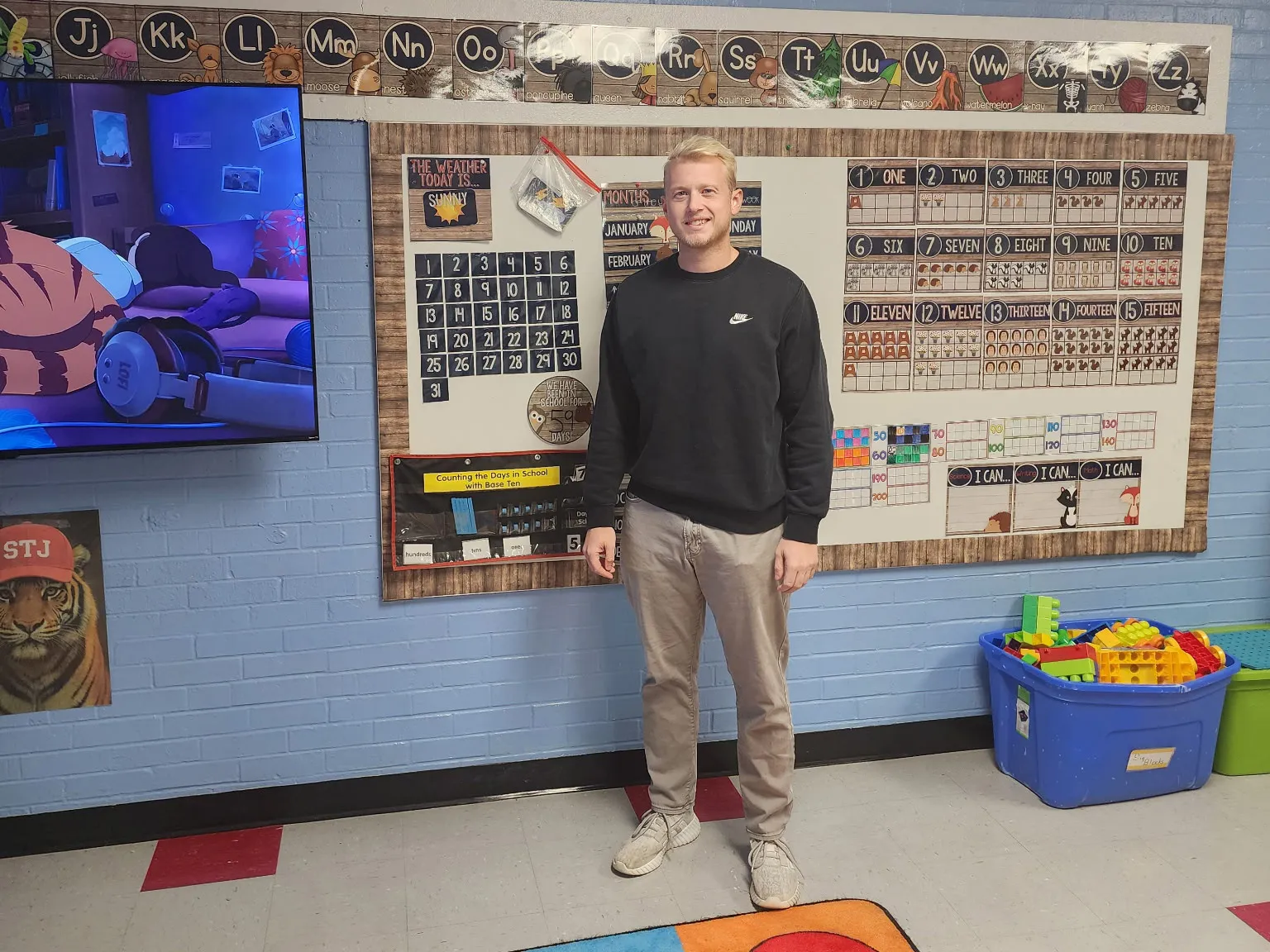
    I was the only guy in my education classes at Missouri State University, and until this year I was the only male out of nearly 100 teachers in my school. My approach to teaching is very different, and more often than not was met with a raised brow rather than a listening ear.  

    I teach kindergarten, and there are so few men in early childhood education that visitors to my classroom tend to treat me like a unicorn. They put me in a box of how I am “supposed” to be as a male in education without knowing the details of my approach to teaching.  

    As a result, I’d grown skeptical about receiving outside help. When someone new came into my classroom to provide unsolicited “support,” my immediate thought was always, “OK, great, what are they going to cook up? What are they trying to sell me?” I’d previously had former high school administrators come into my classroom to offer support, but they didn’t have experience with the curriculum I used or with kindergarten. The guidance was well-intentioned, but not relevant. 

    Related: A lot goes on in classrooms from kindergarten to high school. Keep up with our free weekly newsletter on K-12 education.  

    My entire view of getting help and support changed when Ashley Broadnax, a literacy coach from New Orleans, nearly 700 miles away, came into my class in St. James, Missouri, population 3,900. Ashley works for The New Teacher Project, or TNTP, a nonprofit aiming to increase students’ economic and social mobility. Once a month for a full academic year, she came in to help us transition to a “science of reading” approach, as part of a special pilot program, the Rural Schools Early Literacy Collaborative. 

    I never thought I would love having a literacy coach and their feedback, but I now believe it is something that can work for many teachers. I hope that as Missouri and other states transition to new ways of teaching reading, more coaches will be available for others who could use the support. The state says that over 15,000 teachers may get trained in the science of reading to help build our knowledge of how children learn to read and what type of instruction is most effective.  

    Ashley had used the curriculum herself and was on hand to provide timely support. This was the first time I received relevant feedback from a former teacher who had firsthand experience with the lessons I was leading.  

    It completely changed my approach and my students’ learning. Although I come from a family of teachers — my mom, grandma and brother all taught — I had started teaching two weeks out of college, and I wasn’t familiar with the new reading curriculum and didn’t have a lot of self-confidence. 

    When Ashley came in for the very first visit, I knew working with her was going to be different. Even though she had never been to St. James, she was sensitive to the rural context where I’ve spent all my life. We’re 90 minutes southwest of St. Louis and a little over an hour southeast of Jefferson City, the state capital. In St. James, you may see a person on a horse riding past a Tesla a few times a year. I’ve seen this world of extremes play out in school open houses and in the learning gaps that exist in my kindergarten classroom.  

    Ashley had researched our community and was open to learning more about our nuances and teaching styles. She was also the first coach I’d met who actually had taught kindergarten, so she knew what worked and what didn’t. As a young teacher with a significant number of students with special needs, I really appreciated this.  

    Related: How coaches for teachers could improve reading instruction, close early academic gaps 

    Ashley provided me with a pathway to follow the new curriculum while also maintaining my unique approach to teaching. Everything came from a place of ensuring that teachers have what they need to be successful, rather than an “I know better than you do” attitude. She would let me know “I loved how you did this” and she’d ask, “Can you extend it in this way?” or tell me, “This was great, here’s how you can structure it a bit further.” 

    Not everything she did to help was profound. But her little tips added up. For example, the curriculum we used came with 10 workbooks for each student as well as stacks of literature, and I needed help integrating it into my lessons.  

    I soon noticed a shift in my ability to teach. I was learning specific ways to help students who were on the cusp of catching on, along with those who weren’t getting it at all.  

    Throughout the course of the year, we saw how our students were more quickly achieving proficiency in English language arts. In my school, according to the Missouri Department of Elementary and Secondary Education, the percentage of kindergartners reading on grade level went from 82 percent in the fall to 98 percent in the spring; the percentage of first graders on grade level went from 41 percent to 84 percent.  

    There were similar gains across the other schools in my county participating in the pilot program; one school had all of its kindergarten and first grade students demonstrate growth on reading assessments. Those students, on average, made gains that were more than double typical annual growth, TNTP found. 

    I attribute a great deal of this progress to the support from Ashley and her peers. I know I am a better educator and teacher for my students. Her support has made a change for the better in my grade and classroom. 

    Thomas MacCash is a kindergarten teacher at Lucy Wortham James Elementary in St. James, Missouri.  

    Contact the opinion editor at [email protected].  

    This story about literacy teaching coaches was produced by The Hechinger Report, a nonprofit, independent news organization focused on inequality and innovation in education. Sign up for Hechinger’s weekly newsletter.

    This <a target=”_blank” href=”https://hechingerreport.org/teacher-voice-im-a-new-male-kindergarten-teacher-in-rural-missouri-extra-support-made-a-huge-difference-to-my-class/”>article</a> first appeared on <a target=”_blank” href=”https://hechingerreport.org”>The Hechinger Report</a> and is republished here under a <a target=”_blank” href=”https://creativecommons.org/licenses/by-nc-nd/4.0/”>Creative Commons Attribution-NonCommercial-NoDerivatives 4.0 International License</a>.<img src=”https://i0.wp.com/hechingerreport.org/wp-content/uploads/2018/06/cropped-favicon.jpg?fit=150%2C150&amp;ssl=1″ style=”width:1em;height:1em;margin-left:10px;”>

    <img id=”republication-tracker-tool-source” src=”https://hechingerreport.org/?republication-pixel=true&post=113481&amp;ga4=G-03KPHXDF3H” style=”width:1px;height:1px;”><script> PARSELY = { autotrack: false, onload: function() { PARSELY.beacon.trackPageView({ url: “https://hechingerreport.org/teacher-voice-im-a-new-male-kindergarten-teacher-in-rural-missouri-extra-support-made-a-huge-difference-to-my-class/”, urlref: window.location.href }); } } </script> <script id=”parsely-cfg” src=”//cdn.parsely.com/keys/hechingerreport.org/p.js”></script>

    Source link

  • Tutoring provides a much-needed on-ramp into the teaching profession. School districts should pay attention.

    Tutoring provides a much-needed on-ramp into the teaching profession. School districts should pay attention.

    After graduating from Knox College in Illinois with a bachelor’s degree, Stephanie Martinez-Calderon’s plans were upended by the pandemic. She hadn’t planned on becoming a teacher but found an opportunity to tutor remotely for the year after college. 

    Tutoring helped her build confidence and develop instructional skills, and today she’s a middle school teacher in the Washoe County School District in Nevada. 

    Tutoring can be a powerful training ground for future educators, providing hands-on experience, confidence and a bridge into the classroom. And what might begin as a temporary opportunity can become a career path at a time when teachers are needed more than ever: A recent report noted that nearly one in five K-12 teachers plan to leave teaching or are unsure if they’ll stay. 

    Turnover remains a crisis in many districts, one that can be solved by a ready-made pipeline of young future educators with instructional experience and relationship-building skills they’ve gained from tutoring.  

    Related: A lot goes on in classrooms from kindergarten to high school. Keep up with our free weekly newsletter on K-12 education. 

    How school districts think about tutoring should evolve. Rather than seeing it as a short-term response to pandemic-interrupted learning, they should view it as part of the fabric of school design and future educator development. This requires including tutoring in strategic plans, forming community partnerships and creating a structure to sustain programs that cultivate tutors for careers in education. To fund these programs and pay tutors, districts can redirect Title I funds, use federal work-study and create apprenticeship programs.  

    Starting as a tutor allows aspiring educators to build core teaching skills in a supportive, lower-stakes environment. Tutors learn to navigate student relationships and adapt lessons to individual needs. Without having to manage an entire classroom, they can practice asking questions that get students thinking and selecting problems to help students learn. This early practice eases the transition into teaching. 

    Tutors from Generation Z, born between 1996 and 2012, often bring fresh energy to the profession. As digital natives, they are reimagining how to engage and inspire students, leverage technology and foster creativity and new approaches to learning. 

    They are also the most ethnically and racially diverse generation yet: Many come from backgrounds historically underrepresented in the teaching force; over half of undergraduates identify as first-generation college students. Their engagement broadens the prospects for a more diverse teacher pipeline. 

    Tutor recruiters have noticed that Gen Z workers don’t just want a job — they want roles committed to social impact, professional growth and sustainable work-life balance

    Gen Z’s emphasis on flexibility and remote opportunities is one of the most significant workforce changes since the pandemic. They value mental health, stability and mission-driven work. Part-time, hybrid and wellness benefits help recruit young talent. 

    At our nonprofit, recruiters hear from education candidates that Gen Z appreciates the chance to try out industries, and that tutoring provides them with a window into the world of teaching. 

    Public schools could better meet the evolving needs of young professionals entering education by reimagining tutor roles to include hybrid options, mental health supports and collaborative teaching pathways for professional growth. For instance, a tutor might start off working in a part-time online tutoring role, but after interacting with students virtually and gaining more experience, they may be more excited to take on a full-time teaching role on-site.  

    For school districts, tutoring programs can serve as effective recruitment pipelines. By offering recent graduates a low-barrier entry point into education — one that doesn’t require immediate certification — districts can spark interest in teaching among candidates who may not have previously considered it. 

    Amid ongoing hiring challenges, particularly mid-year vacancies, tutors can offer timely solutions.  

    When tutors step into teaching roles, they bring valuable continuity — familiarity with the students and insight into progress and school culture. This seamless transition supports both student learning and district staffing needs. 

    Related: PROOF POINTS: Taking stock of tutoring 

    The idea that tutoring should be built into future educator pipelines is spreading. For example, since the launch of its Ignite Fellowship in 2020, Teach for America says that 550 of its former tutors have become full-time teachers. The program has proven to be especially effective at drawing in nontraditional candidates — those who may not have initially envisioned themselves in the classroom. In Washington, D.C., the school district launched a tutor-to-teacher apprenticeship program after success with high-impact tutoring. In Texas, teacher residents are required to work as tutors and in other support roles while co-teaching with a mentor. 

    By offering flexible, purpose-driven opportunities, districts can attract Gen Z professionals and give them a meaningful entry point into teaching. And tutoring programs can become more than academic support — they can serve as strategic talent pipelines that strengthen the future of the teaching workforce. 

    Alan Safran is co-founder, CEO and chair of the board of Saga Education; Halley Bowman is senior director of academics. 

    Contact the opinion editor at [email protected]. 

    This story about tutoring was produced by The Hechinger Report, a nonprofit, independent news organization focused on inequality and innovation in education. Sign up for Hechinger’s weekly newsletter.  

    The Hechinger Report provides in-depth, fact-based, unbiased reporting on education that is free to all readers. But that doesn’t mean it’s free to produce. Our work keeps educators and the public informed about pressing issues at schools and on campuses throughout the country. We tell the whole story, even when the details are inconvenient. Help us keep doing that.

    Join us today.

    Source link

  • Child care centers often reject kids with disabilities. Ohio and other states are trying to change that

    Child care centers often reject kids with disabilities. Ohio and other states are trying to change that

    This story about children with disabilities was produced by The Hechinger Report, a nonprofit, independent news organization focused on inequality and innovation in education. Sign up for the Hechinger newsletter.

    COLUMBUS, Ohio — When Selina Likely became director of the Edwards Creative Learning Center six years ago, she knew there was one longstanding practice that she wanted to change. For as long as she had taught at the thriving child care center, it had turned away many children with disabilities such as autism and Down syndrome. The practice was even encoded in the center’s handbook as policy.

    Likely, the parent of a child with a disability, wanted to stop telling families no, but she knew that to do that she and her staff would need more support. “I said, ‘Let’s start getting training and see what we can do.’” 

    Not too long after, her effort received a big boost from a state-funded initiative in Ohio to strengthen child care teachers’ knowledge and confidence in working with young kids with disabilities and developmental delays. That program, Ohio PROMISE, offers free online training for child care workers in everything from the benefits of kids of all abilities learning and playing together to the kinds of classroom materials most helpful to have on hand. It also offers as-needed mentorship and support from trained coaches across the state.  

    Related: Young children have unique needs, and providing the right care can be a challenge. Our free early childhood education newsletter tracks the issues. 

    Child care providers across the country — including large, established centers and tiny home-based programs — struggle to meet the needs of children with disabilities, according to a 2024 report from the U.S. Government Accountability Office. More than a quarter of parents of children with disabilities said they had a lot of difficulty finding appropriate care for their kids. And even those who do find a spot regularly encounter challenges, like having their children excluded from extracurricular activities such as field trips and even academic instruction. 

    “It’s really hard to find child care for this population, we heard that loud and clear,” said Elizabeth Curda, a director on the GAO’s Education, Workforce and Income Security team and a coauthor of the report. Even the most well-resourced centers report that they struggle to meet the needs of children with disabilities, according to Curda. 

    There’s a lot of desire at the grassroots level to change that. Ohio PROMISE and a few other recent initiatives provide models for how to expand the capacity — and the will — of child care centers to serve the more than 2 million U.S. children age 5 or below who have a disability or developmental delay.

    Cards on the walls at Edwards Creative Learning Center display the signs for different letters so students — whether nonverbal or not — can all learn sign language. Credit: Sarah Carr/The Hechinger Report

    In Vermont, for instance, officials hope to soon unveil a free, on-demand training program aimed at helping child care teachers have more inclusive classrooms. And officials in Ohio’s Summit County, home to Akron, report growing interest from other counties in creating programs based on Summit’s more than decade-old model that provides in-person training for child care operators in inclusion of children with disabilities. 

    “We’re helping to create child care centers that feel they can handle whatever comes their way, especially when it comes to significant behavior concerns,” said Yolanda Mahoney, the early childhood center support supervisor for Summit County’s disabilities board.

    The federal government until recently encouraged the creation of such models. In 2023, the federal Department of Education and Department of Health and Human Services issued a joint statement urging states to take steps to support inclusion in early childhood settings, including strengthening training and accountability. 

    Also, a year-old provision of the Child Care and Development Fund, the primary federal funding source for child care, requires that states increase the availability of child care for children with disabilities as a prerequisite for receiving funds. (However, 43 states have received waivers allowing them to delay implementation of that provision.) 

    Under the current president, federal momentum on the issue has largely stalled. While the administration of President Donald Trump hasn’t directly attacked inclusion in the context of special education, the president has criticized the term more broadly — especially when it comes to diversity, equity and inclusion. That can create uncertainty and a chilling effect on advocates of inclusion efforts of all kinds.   

    Funding for some inclusion efforts is also in jeopardy. States rely on Medicaid, which faces nearly $1 trillion in cuts over the next decade, to pay for early intervention programs for children birth to age 3 with developmental delays and disabilities. Trump has also proposed eliminating Preschool Development Grants, which states such as Vermont and Illinois have used to expand support of young children with disabilities. 

    That means over the next few years, progress on inclusion in child care settings could hinge largely on state and local investment. It helps that there’s a “real desire” among providers to enroll more children with disabilities, said Kristen Jones, an assistant director on the GAO’s education, workforce and income security team, who also worked on the report. “But there’s also a concern that currently they can’t do that in a safe way” because of a lack of training and resources.

    Related: For kids with disabilities, child care options are worse than ever

    In Ohio, the idea for Ohio PROMISE came after an appeal in 2022 from Republican Gov. Mike DeWine. He reported that families were coming to him saying they couldn’t find child care for their kids with disabilities. 

    “He said, ‘Come to me with ideas to solve that problem,’” recalled Wendy Grove, a senior adviser in the Ohio Department of Children and Youth who spearheaded development of the program.

    Grove and her colleagues had already been working on a related effort. In 2020, Ohio won a federal grant that included help exploring how well — or not — children with disabilities were being included in child care and early education settings. DeWine liked the idea Grove’s team presented of morphing that work into a state-led effort to strengthen training and support for child care teachers. They also proposed more direct support to families, including the extension of child care vouchers to families with incomes above the poverty level, with a higher reimbursement rate for children with disabilities. 

    The training, which debuted about two years ago, is provided in three levels. Jada Cutchall, a preschool teacher at Imaginative Beginnings, an early learning center just outside of Toledo, recently completed the third tier, which for her included customized coaching. Cutchall’s coach helped her create communication tools for a largely nonverbal student, she said, including a board with pictures children can point to if, for example, they want to go to the bathroom or try a different playground activity. 

    As a result, Cutchall said, she has watched kids with disabilities, including those with speech impairments and autism, engage much more directly with their classmates. “They have the courage to ask their peers to play with them — or at least not distance themselves as much as they usually would,” she said. All of the children in the classroom have benefited, she added, noting that kids without disabilities have taken an interest in learning sign language, strengthening their own communication skills and fostering empathy. 

    Child care programs where one teacher and one administrator have completed some of the training earn a special designation from the state, which may eventually be tied to the opportunity to get extra funding to serve children with disabilities. In Ohio PROMISE’s first year, 1,001 child care centers — about 10 percent of the total number in Ohio — earned that designation, according to Grove.

    For the last six years, Selina Likely has overseen the Edwards Creative Learning Center, where she’s steadily tried to enroll more children with disabilities and developmental delays. Credit: Sarah Carr/The Hechinger Report

    The effort costs a little over $1 million in state dollars each year, with most of that paying for several regional support personnel who work directly with centers as mentors and advisers. Over the last two years, Ohio has seen a 38 percent increase in the number of children in publicly funded centers who qualify for the higher voucher reimbursement rate for children with disabilities, which can be double the size of the standard voucher.

    Grove hopes that ultimately the effort plays a role in narrowing a critical and stubborn gap in the state: about 27 percent of children without disabilities show readiness on state standards for kindergarten; only 14 percent of children with disabilities do. Since so few disabilities exhibited at that age are related to intellectual or cognitive functioning, “we shouldn’t see that gap,” said Grove. “There’s no real reason.”  

    One goal of the new efforts is to reduce the number of young children with disabilities who are expelled from or pushed out of care. Those children are frequently asked to leave for behaviors related to their disability, the GAO report found.

    Several years ago, a child care center in Columbus expelled Meagan Severance’s 18-month-old son for biting a staff member. The boy has several special needs, including some related to attention deficit hyperactivity disorder. Severance brought him to Edwards Creative Learning Center, where not too long after Selina Likely shifted into the role of director. The boy also bit a staff member there — not uncommon behavior for toddlers, especially those with sensory sensitivities and communication challenges. 

    Likely was determined to work with the child, not expel him. “They put in time and effort,” said Severance. “The response wasn’t, ‘He bit someone, he’s gone.’” 

    Likely empathized. Decades earlier, her own daughter had been expelled from a child care center in her hometown of Mansfield, Ohio, for biting.

    “I was so angry and mad at the time — how are you going to kick out a 1-year-old?” she said. The center director didn’t think at all about how to help her child, Likely recalled, instead asking Likely what might be happening at home to make the child want to bite. She said she got no notice or grace period to find a new placement. “That left me in a disheartened place,” she said. “I was like, ‘I still have to go to work.”

    Seventeen years old at the time, she was inspired by the injustice of the situation to quit her job in a factory and apply to be an assistant in a child care program. She’s been in the industry ever since, gradually trying to make more space for children like her daughter, who was later diagnosed with autism.  

    Meagan Severance, a parent and teacher at the Edwards center, has worked in recent years to make her classroom more inclusive for children with all different abilities. Credit: Sarah Carr/The Hechinger Report

    As director, Likely displays the nameplate “chaos coordinator” on her desk. And she’s taken the stance that the center should at least try to work with every kid. She and some of her teachers have completed the first two tiers of the Ohio PROMISE training, as well as some related sessions available from the state. Likely estimates that about 10 percent of the children in her center have a diagnosed disability or developmental delay.

    Liasun Meadows, whose son has Down syndrome, chose Edwards several years ago for her then 1-year-old over another program better known for its work with children with disabilities. She has not been disappointed.

    Parents of kids with disabilities watch their children like a hawk, she said. “There are certain things you notice that you don’t expect others to notice, but they do at Edwards. They’ve been growing and learning alongside him.”  

    Severance, whose son is now 8, works at the center these days, leading the 3-year-old room, which includes two children who are largely nonverbal. She’s made the classroom more inclusive, adding fidget toys for children with sensory issues, rearranging the classroom to create calming areas, providing communication books to nonverbal children so they can more easily express needs and wants, and teaching everyone some sign language. 

    “For a while there was segregation in the classroom” between the kids with disabilities and those without, Severance said. But that’s lessened with the changes. “Inclusion has been good for the kids who are verbal — and nonverbal,” she said.

    Related: Where do kids with disabilities go for child care?  

    As in Ohio, state officials in Vermont turned to online training to help ensure young children with disabilities aren’t denied quality care. The state should soon debut the first parts of a new training program, focusing on outreach to child care administrators and support for neurodivergent children. The state wanted to focus on center leaders first because “directors that are comfortable with inclusion lead programs that are comfortable with inclusion,” said Dawn Rouse, the director of statewide systems in Vermont’s Child Development Division.   

    One tool for supporting and calming children with sensory issues is keeping a healthy supply of fidget toys and Pop-Its on hand. Credit: Sarah Carr/The Hechinger Report

    Vermont also pumped millions of dollars into a separate program, known as the Special Accommodations Grant, that supports young children with disabilities. Since 2009 the state has set aside $300,000 a year that child care centers can tap to provide services for individual children with disabilities. It might help buy specialized equipment for a child with cerebral palsy, for instance, or be used to hire a full- or part-time aide.

    The $300,000 has been maxed out every year, Rouse said. And after the pandemic, the need — and the number of applications — surged.

    As a result, the state allocated some federal American Rescue Plan and Preschool Development Grant dollars to increase spending on the program by about sevenfold — to between $2 million and $2.5 million annually — an amount Rouse still describes as a “Band-Aid.” Without access to the grants, “we see a lot of children being asked to leave programs,” Rouse said. “That’s not good for any child, but for children with specialized developmental needs it’s particularly bad.” 

    Over time, Likely hopes, her Ohio center can play a small role in reducing that instability, although the center hasn’t yet been able to work with all such children it wants to. Likely recalls one toddler with a severe disability who climbed up anything he could. There wasn’t enough money to pay for what the child really needed: a full-time aide. “It’s hard when you know you’ve tried but still have to say no,” she said. “That breaks my heart more than anything.” 

    On one June morning, the center’s teachers acknowledged and celebrated several milestones in its work on inclusion, big and small. One child in the 3-year-old classroom with fine and gross motor challenges was drinking independently from a bottle. The preschool classroom held its first graduation ceremony, translated partly into sign language. All of the kids, no matter their challenges, were set to go on field trips to Dairy Queen and the zoo.

    Likely dreams of someday running a center where about half of the children have a disability or delay. It may be years off, she said, but as with the milestones she sees scores of children at the center reach every day, “There’s a way — if there’s a will.” 

    Sarah Carr is a fellow at New America, focused on reporting on early childhood issues. 

    Contact contributing editor Sarah Carr at [email protected].   

    This story about children with disabilities was produced by The Hechinger Report, a nonprofit, independent news organization focused on inequality and innovation in education. Sign up for the Hechinger newsletter.

    The Hechinger Report provides in-depth, fact-based, unbiased reporting on education that is free to all readers. But that doesn’t mean it’s free to produce. Our work keeps educators and the public informed about pressing issues at schools and on campuses throughout the country. We tell the whole story, even when the details are inconvenient. Help us keep doing that.

    Join us today.

    Source link

  • If we are serious about improving student outcomes, we can’t treat teacher retention as an afterthought

    If we are serious about improving student outcomes, we can’t treat teacher retention as an afterthought

    In the race to help students recover from pandemic-related learning loss, education leaders have overlooked one of the most powerful tools already at their disposal: experienced teachers.

    For decades, a myth has persisted in education policy circles that after their first few years on the job, teachers stop improving. This belief has undercut efforts to retain seasoned educators, with many policymakers and administrators treating veteran teachers as replaceable cogs rather than irreplaceable assets.

    But that myth doesn’t hold up. The evidence tells a different story: Teachers don’t hit a plateau after year five. While their growth may slow, it doesn’t stop. In the right environments — with collaborative colleagues, supportive administrators and stable classroom assignments — teachers can keep getting better well into their second decade in the classroom.

    This insight couldn’t come at a more critical time. As schools work to accelerate post-pandemic learning recovery, especially for the most vulnerable students, they need all the instructional expertise they can muster.

    That means not just recruiting new teachers but keeping their best educators in the classroom and giving them the support they need to thrive.

    Related: A lot goes on in classrooms from kindergarten to high school. Keep up with our free weekly newsletter on K-12 education.

    In a new review of 23 longitudinal studies conducted by the Learning Policy Institute and published by the Thomas B. Fordham Institute, all but one of the studies showed that teachers generally improve significantly during their first five years. The research review also found continued, albeit slower, improvement well into years 6 through 15; several of the studies found improvement into later years of teaching, though at a diminished pace.

    These gains translate into measurable benefits for students: higher test scores, fewer disciplinary issues, reduced absenteeism and increased postsecondary attainment. In North Carolina, for example, students with highly experienced English teachers learned more and were substantially less likely to skip school and more likely to enjoy reading. These effects were strongest for students who were most at risk of falling behind.

    While experience helps all teachers improve, we’re currently failing to build that experience where it’s needed most. Schools serving large populations of low-income Black and Hispanic students are far more likely to be staffed primarily by early career teachers.

    And unfortunately, they’re also more likely to see those teachers leave after just a few years. This churn makes it nearly impossible to build a stable, experienced workforce in high-need schools.

    It also robs novice teachers of the veteran mentors who could help them get better faster and robs students of the opportunity to learn from seasoned educators who have refined their craft over time.

    To fix this, we need to address both sides of the equation: helping teachers improve and keeping them in the classrooms that need them most.

    Research points to several conditions that support continued teacher growth. Beginning teachers are more likely to stay and improve if they have had high-quality preparation and mentoring. Teaching is not a solo sport. Educators who work alongside more experienced peers improve faster, especially in the early years.

    Teachers also improve more when they’re able to teach the same grade level or subject year after year. Unfortunately, those in under-resourced schools are more likely to be shuffled around, undermining their ability to build expertise.

    Perhaps most importantly, schools that have strong leadership and which foster time for collaboration and a culture of professional trust see greater gains in teacher retention over time.

    Teachers who feel supported by their administrators, who collaborate with a team that shares their mission and who aren’t constantly switching subjects or grade levels are far more likely to stay in the profession.

    Pay matters too, especially in high-need schools where working conditions are toughest. But incentives alone aren’t enough. Short-term bonuses can attract teachers, but they won’t keep them if the work environment drives them away.

    Related: One state radically boosted new teacher pay – and upset a lot of teachers

    If we’re serious about improving student outcomes, especially in the wake of the pandemic, we have to stop treating teacher retention as an afterthought. That means retooling our policies to reflect what the research now clearly shows: experience matters, and it can be cultivated.

    Policymakers should invest in high-quality teacher preparation and mentoring programs, particularly in high-need schools. They should create conditions that promote teacher stability and collaboration, such as protected planning time and consistent teaching assignments.

    Principals must be trained not just as managers, but as instructional leaders capable of building strong school cultures. And state and district leaders must consider meaningful financial incentives and other supports to retain experienced teachers in the classrooms that need them most.

    With the right support, teachers can keep getting better. In this moment of learning recovery, a key to success is keeping teachers in schools and consciously supporting their growing effectiveness.

    Linda Darling-Hammond is founding president and chief knowledge officer at the Learning Policy Institute. Michael J. Petrilli is president of the Thomas B. Fordham Institute, a visiting fellow at the Hoover Institution and an executive editor of Education Next.

    Contact the opinion editor at [email protected].

    This story about teacher retention was produced by The Hechinger Report, a nonprofit, independent news organization focused on inequality and innovation in education. Sign up for Hechinger’s weekly newsletter.

    The Hechinger Report provides in-depth, fact-based, unbiased reporting on education that is free to all readers. But that doesn’t mean it’s free to produce. Our work keeps educators and the public informed about pressing issues at schools and on campuses throughout the country. We tell the whole story, even when the details are inconvenient. Help us keep doing that.

    Join us today.

    Source link

  • Doing right by the teachers who do right by the world

    Doing right by the teachers who do right by the world

    Key points:

    • Ethical PD is a call to action for all involved in teacher professional development
    • Key questions that unleash powerful PLCs
    • GenAI and cultural competency: New priorities in teacher preparation
    • For more news on teacher PD, visit eSN’s Educational Leadership hub

    Teachers are superheroes. Every day, they rise to the challenge, pouring their hearts into shaping the future. They stay late to grade papers, show up early to tutor struggling students, and spend their weekends planning lessons that inspire young minds. They do this because they believe in their mission–a mission to change lives, ignite passions, and build a better world.

    More News from eSchool News

    We are again in uncertain times. We again find ourselves dealing with sudden changes and uncertainty. We seem to be in a state of constant change and ambiguity.

    In today’s evolving educational landscape, effective student assessment goes beyond multiple-choice tests and letter grades. According to a recent study, over 60 percent of educators believe traditional assessments fail to fully measure student understanding.

    Holden, my 21-month-old, has fallen in love.  His early morning snack and “couch time” includes a dose of “Tiger!”  This is toddler for, “Mom, turn on Daniel Tiger’s Neighborhood.”

    The COVID-19 pandemic left an indelible mark on K-12 education, placing immense pressure on teachers as they adapted, literally overnight, to new methods of instruction.

    Spring brings not only showers and flowers, but it also brings the opportunity to interview for new education positions. Preparing for an interview involves several key steps that can significantly impact the outcome.

    STEM careers are on the rise. According to the U.S. Bureau of Labor Statistics, employment in STEM occupations is expected to grow by 10.4 percent from 2023 to 2033, compared to just 3.6 percent for non-STEM occupations.

    The U.S. Department of Education is giving state education agencies 10 days to certify that their schools do not engage in any practices that the administration believes illegally promote diversity, equity, and inclusion.

    COVID had already killed thousands of people in other countries and was spreading in the United States when a top federal health official said schools should prepare to offer “internet-based teleschooling” in case they had to close for a period of time.

    More than half of educators (62 percent) are already making use of AI at school, with more than one-quarter using it daily for work purposes, according to a Twinkl survey of more than 3,500 U.S. teachers.

    Many math tasks involve reading, writing, speaking, and listening. These language demands can be particularly challenging for students whose primary language is not English.

    Want to share a great resource? Let us know at [email protected].

    Source link