Category: teaching development

  • Reflective teaching: the “small shifts” that quietly change everything

    Reflective teaching: the “small shifts” that quietly change everything

    by Yetunde Kolajo

    If you’ve ever left a lecture thinking “That didn’t land the way I hoped” (or “That went surprisingly well – why?”), you’ve already stepped into reflective teaching. The question is whether reflection remains a private afterthought … or becomes a deliberate practice that improves teaching in real time and shapes what we do next.

    In Advancing pedagogical excellence through reflective teaching practice and adaptation I explored reflective teaching practice (RTP) in a first-year chemistry context at a New Zealand university, asking a deceptively simple question: How do lecturers’ teaching philosophies shape what they actually do to reflect and adapt their teaching?

    What the study did

    I interviewed eight chemistry lecturers using semi-structured interviews, then used thematic analysis to examine two connected strands: (1) teaching concepts/philosophy and (2) lecturer-student interaction. The paper distinguishes between:

    • Reflective Teaching (RT): the broader ongoing process of critically examining your teaching.
    • Reflective Teaching Practice (RTP): the day-to-day strategies (journals, feedback loops, peer dialogue, etc) that make reflection actionable.

    Reflection is uneven and often unsystematic

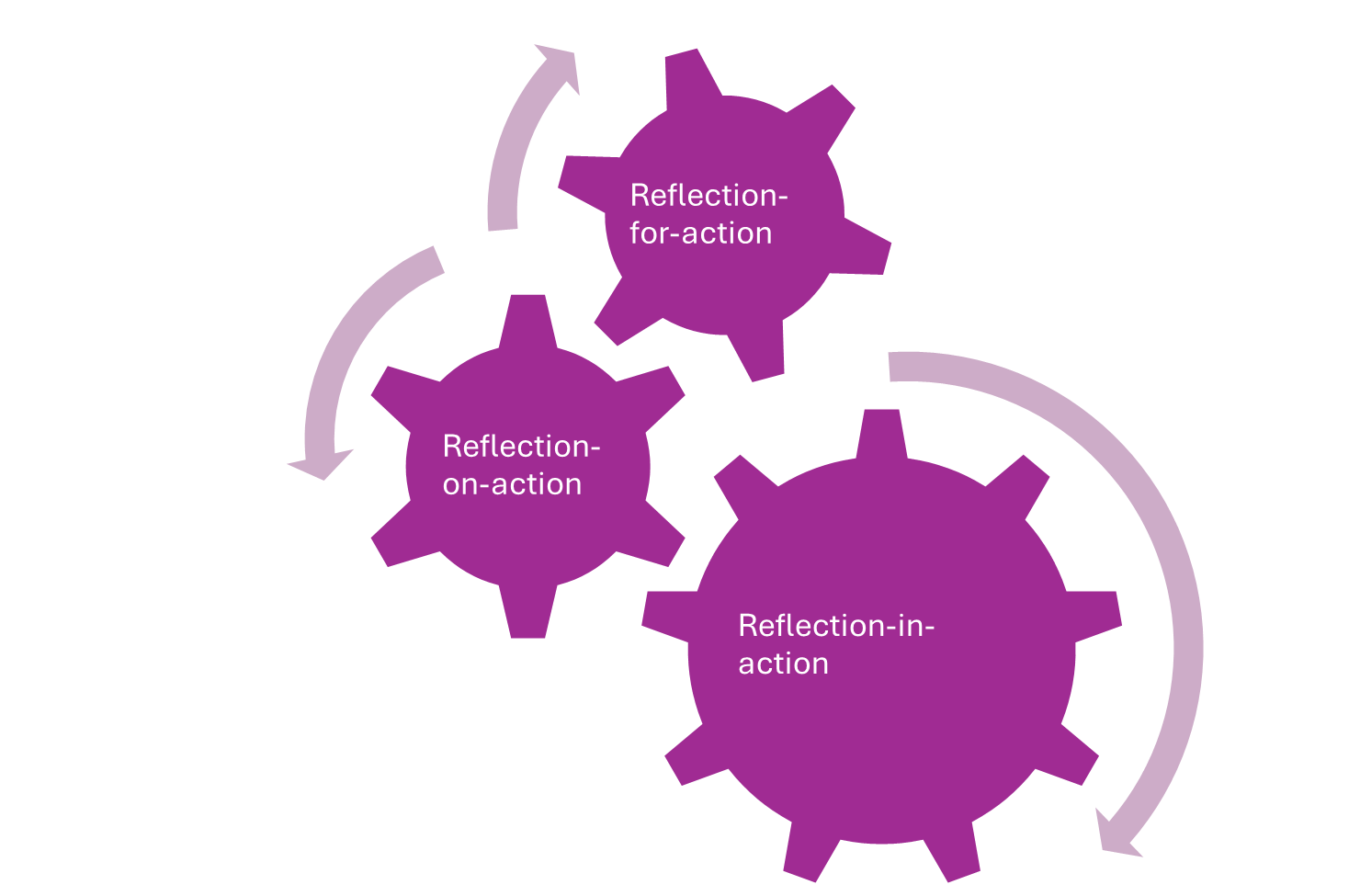
    A striking finding is that not all lecturers consistently engaged in reflective practices, and there wasn’t clear evidence of a shared, structured reflective culture across the teaching team. Some lecturers could articulate a teaching philosophy, but this didn’t always translate into a repeatable reflection cycle (before, during, and after teaching). I  framed this using Dewey and Schön’s well-known reflection stages:

    • Reflection-for-action (before teaching): planning with intention
    • Reflection-in-action (during teaching): adjusting as it happens
    • Reflection-on-action (after teaching): reviewing to improve next time

    Even where lecturers were clearly committed and experienced, reflection could still become fragmented, more like “minor tweaks” than a consistent, evidence-informed practice.

    The real engine of reflection: lecturer-student interaction

    Interaction isn’t just a teaching technique – it’s a reflection tool.

    Student questions, live confusion, moments of silence, a sudden “Ohhh!” – these are data. In the study, the clearest examples of reflection happening during teaching came from lecturers who intentionally built in interaction (eg questioning strategies, pausing for problem-solving).

    One example stands out: Denise’s in-class quiz is described as the only instance that embodied all three reflection components using student responses to gauge understanding, adapting support during the activity, and feeding insights forward into later planning.

    Why this matters right now in UK HE

    UK higher education is navigating increasing diversity in student backgrounds, expectations, and prior learning alongside sharper scrutiny of teaching quality and inclusion. In that context, reflective teaching isn’t “nice-to-have CPD”; it’s a way of ensuring our teaching practices keep pace with learners’ needs, not just disciplinary content.

    The paper doesn’t argue for abandoning lectures. Instead, it shows how reflective practice can help lecturers adapt within lecture-based structures especially through purposeful interaction that shifts students from passive listening toward more active/constructive engagement (drawing on engagement ideas such as ICAP).

    Three “try this tomorrow” reflective moves (small, practical, high impact)

    1. Plan one interaction checkpoint (not ten). Add a single moment where you must learn something from students (a hinge question, poll, mini-problem, or “explain it to a partner”). Use it as reflection-for-action.
    1. Name your in-the-moment adjustment. When you pivot (slow down, re-explain, swap an example), briefly acknowledge it: “I’m noticing this is sticky – let’s try a different route.” That’s reflection-in-action made visible.
    1. End with one evidence-based note to self. Not “Went fine.” Instead: “35% missed X in the quiz – next time: do Y before Z.” That’s reflection-on-action you can actually reuse.

    Questions to spark conversation (for you or your teaching team)

    • Where does your teaching philosophy show up most clearly: content coverage, student confidence, relevance, or interaction?
    • Which “data” do you trust most: NSS/module evaluation, informal comments, in-class responses, attainment patterns and why?

    If your programme is team-taught, what would a shared reflective framework look like in practice (so reflection isn’t isolated and inconsistent)?

    If reflective teaching is the intention, this article is the nudge: make reflection visible, structured, and interaction-led, so adaptation becomes a habit, not a heroic one-off.

    Dr Yetunde Kolajo is a Student Success Research Associate at the University of Kent. Her research examines pedagogical decision-making in higher education, with a focus on students’ learning experiences, critical thinking and decolonising pedagogies. Drawing on reflective teaching practice, she examines how inclusive and reflective teaching frameworks can enhance student success.


    Author: SRHE News Blog

    An international learned society, concerned with supporting research and researchers into Higher Education

    Source link

  • Perspectives on pedagogical innovation | SRHE Blog

    Perspectives on pedagogical innovation | SRHE Blog

    by Kamilya Suleymenova and Emma Thirkell

    The landscape of higher education (HE) in the UK (but also more widely, in Western countries and across the globe) has significantly changed, driven by the massification and the following marketisation of HE studies (Alves & Tomlinson, 2021; Molesworth et al, 2009). The predominance of particular governance structures and schools of thought shape the narrative further (as discussed by Marcia Devlin (2021) in her SRHE blog) and create a deceptively heterogeneous environment, where each prospective student can find their “place”, but all are conditioned to follow a similar narrative.

    New disruptions

    On this backdrop new disruptions appear, of which we want to focus on two specifically for the UK HE. First, the legacy of lockdowns, bringing more flexible working environment and an astonishing pervasiveness of digital tools together with disrupted earlier education and legacy of health, including mental health, concerns, unsettles further already brittle UK HE sector (as illustrated by SRHE blog by Steven Jones (2022). Second, the advent of Generative AI and its implications for teaching, learning, and assessment. Much has been said about these (Lee et al, 2024; O’Dea, 2024) – our learning points from this rapidly growing literature are that i) significant disruption has occurred and ii) something needs to be done to react to this change in context. In other words, while there are many tried and tested theories and methods in teaching and assessment, they need to be reviewed and very likely adapted to keep up with the changing context.

    The change did not occur only in the tools: we argue here that it is not merely a quantitative technical change (eg speed of communication), but a qualitative change, which affected or at least has the potential to affect, the mindset and the behaviour of students (and staff). Together, these factors produce more stressed, more demanding, potentially differently engaged students (sometimes perceived as less engaged), focused on the “added value” of their degrees and their “university experience”, anxious to acquire competences and skills through experiential learning to be in the best position for securing the employment of their choice.

    In this rapidly changing context, the need for pedagogical innovations (PI), or at least the desire and the ability to engage with disruptions in the education process, seems almost inevitable. But how do the staff working in the UK HE, respond to this demand? Are the challenges viewed as opportunities or rather as additional pressures, adding to an evolving workload and requirements to navigate a complex bureaucracy?

    Research focus: understanding the lived experiences of educators

    Our research explores the lived experiences of educators across 13 UK universities, investigating their engagement with PI in the aftermath of the COVID-19 pandemic. By examining how institutional dynamics, personal motivations, and perceived barriers shape decisions surrounding PI, we have developed the initial stages of a conceptual framework, presented at the SRHE International Conference, to guide policies that better support educators and foster sustained PI in teaching. Through 30 interviews with educators, senior staff, and technology-enabled learning (TEL) specialists, we reveal the complex decision-making processes that influence whether and how educators embrace or resist innovation in their teaching practices.

    What drives educators to innovate?

    Our research highlights a multifaceted landscape where educators’ motivations for engaging with PI are shaped by both intrinsic and extrinsic factors. For many, intrinsic motivations, such as a deep-rooted desire to enhance student learning and a personal commitment to pedagogical excellence, act as powerful drivers for innovation. As one educator noted, “I’m always looking for new ideas. Innovation gives me a sense of purpose and connection with my students, making teaching more fulfilling.” This indicates that where academics feel a strong personal commitment to education, and it is rewarded, they are more likely to embrace innovative practices.

    The tension between rhetoric and reality

    However, these motivations are often counterbalanced by extrinsic pressures from the institutional environment, whether perceived or real. Many educators reported feeling that institutional strategies, while rhetorically supportive of PI, were undercut by bureaucratic barriers, a lack of adequate resources, and managerial cultures focused on short-term, measurable outcomes. One academic explained, “Innovation is a buzzword here, but when it comes to implementing anything new, we’re stuck in a system that values research output over teaching innovation. There’s little incentive to invest time in something that doesn’t directly contribute to my publication record.” This highlights the tension between institutional narrative and individual motivations, with many educators perceiving a disconnect between institutional rhetoric purporting to encourage PI and the reality of its implementation.

    Autonomy and trust

    Another key finding concerns the role of autonomy and trust in fostering a culture of innovation. Educators who felt empowered within their departments – where trust was placed in their judgment – were more likely to experiment with new teaching methods. As one TEL specialist remarked, “When leadership trusts us, we feel freer to try new approaches. But when we are micromanaged, the innovation just stops. You’re constantly battling to prove that your idea is worth the time it takes.” This sense of autonomy, closely linked to professional identity, is crucial in determining whether educators feel motivated to innovate or revert to traditional methods.

    The cost of innovation

    However, these ‘empowering’ environments were not universally experienced. Many educators, particularly those in large departments or with heavy teaching loads, reported feeling that the cost of innovation – both in terms of time and energy – was too high. “It’s hard to innovate when you’re overwhelmed with marking, preparation, and administration. It feels like there’s no room to breathe, let alone experiment,” shared an academic. This sense of burnout, compounded by a perception of growing academic bureaucracy, led some to feel that the costs of engaging in PI outweighed the benefits, making it more difficult to justify the time and effort required for innovation.

    A balancing act

    Perhaps not surprisingly, some educators justified their lack of engagement with PI by citing these perceived institutional constraints. As one educator put it, “We’re told to innovate, but the structure just isn’t there to support it. It’s easier to stick with what we know works than to risk failure with something new.” This reflects the cognitive flexibility educators employ when balancing personal motivations with institutional limitations. As per Goffman’s (1959) ‘front’ and ‘back’ stage theory, educators sometimes present a compliant, innovative persona on the ‘front’ stage in order to ‘fit in’ (Nästesjö, 2023), while in the ‘back’ stage, they rationalize their lack of engagement by attributing it to costs and benefits, reconciling their professional image with their lived experiences.

    Reflections

    We are certain that some, if not all, of these quotes will resonate with many of the readers: these trends have been discussed in, for example, Lašáková et al (2017) and Findlow (2008). Our aim is not only to systematise and categorise the individual aspects shared with us by both frustrated and aspiring colleagues, but to focus on an in-depth analysis of their motivations. Based on previous literature and our data, we aim to generalise and develop a theoretical framework through the lens of an interdisciplinary management and economics analysis. The preliminary version of this theoretical framework, presented at the 2024 SRHE Conference, should provide a foundation for shaping institutional policies to develop a sustainable pipeline of innovations, in the full respect of both academic freedom and students’ interests. In other words, we hope that our work will facilitate structural changes to unlock the innovation potential and help institutions to help us to innovate.

    Kamilya Suleymenova is Associate Professor at the Department of Economics, Birmingham Business School, University of Birmingham with interests in assessment and feedback particularly for large cohorts, Generative AI in HE, as well as institutional and behavioural and experimental economics. Now twice a presenter at SRHE International Conference, Kamilya appreciates the constructive feedback of the community.

    Emma Thirkell is an Assistant Professor in Human Resource Management at Newcastle Business School, Northumbria University with interests in pedagogical innovation, experiential learning, and the integration of technology in education. A four-time teaching award winner, she is passionate about bridging academia and practice through innovative curriculum design and leadership in higher education.

    Author: SRHE News Blog

    An international learned society, concerned with supporting research and researchers into Higher Education

    Source link

  • How online learning can help tackle global injustices

    How online learning can help tackle global injustices

    by Sam Spiegel

    How can online learning programmes help tackle systemic global injustices with creative pedagogies? How can universities build effective educational environments and pedagogies to support critical thinking and vigorously challenge contemporary forms of racism, colonialism and inequity?

    These are some of the questions I have reflected on over the past almost 14 years of teaching at the University of Edinburgh. In 2011, I embarked with colleagues at the School of Social and Political Science to develop our school’s first fully online distance learning MSc postgraduate programmes, partnering with an interdisciplinary team spanning the three Colleges  of the University to co-create and co-teach the MSc in Global Challenges. Addressing global development, health and environmental inequalities, with case studies spanning an array of countries, this programme had students from all over the world. The insights and trajectories of our students have been deeply inspirational – many of our students have gone on to do PhDs, work with United Nations organisations, embassies, non-governmental and humanitarian organisations and work in other kinds of practitioner and research careers. In this blog I reflect on the philosophy of the teaching and learning approach we have nurtured – and associated critical conversations about pedagogy.

    We had support from a Principal’s Teaching Award (PTAS) to explore student learning experiences and reflect on our teaching practices, and in 2016 we published an article: ‘Decolonising online development studies? Emancipatory aspirations and critical reflections–a case study’. At the time, it was one of the few critical pedagogy studies to think through ‘international development’ teaching and the risks of replicating colonial logics in online learning modalities (and how to try to counter these). It proposed a critical framework for analysis that took into account barriers to social inclusivity – including the politics of language – that shaped participation dynamics in the programme. It also considered debates regarding critical development course content, rethinking possibilities for bridging counter-hegemonic development scholarship with practice-oriented approaches in a range of social contexts. Our analysis unpacked tensions in tackling intertwined institutional and pedagogic dilemmas for an agenda towards decolonising online development studies, positioning decolonisation as a necessarily unsettling and contested process that calls for greater self-reflexivity.

    Some years ago online learning initiatives were treated with suspicion as a technology craze that could not truly build effective communities of critical learners. This is no longer the case, generally speaking. Our online students have carved out sophisticated learning paths while interacting with ambitious courses – sometimes in live discussions and sometimes in asynchronous discussions that built incredible communities of practice. But there are important online learning-specific pedagogic points to keep in mind, as course instructors craft and adapt approaches to support individual and group learning.

    One is the risk of re-entrenching problematic dynamics of imperial knowledge production, even when intentions are to do exactly the opposite. There is a need to ensure that online learning platforms grapple with colonial legacies and tendencies – including biases that are easily replicable in virtual technology platforms. It is increasingly recognised that ‘decolonising’ is not simply a matter of ‘bringing in’ authors from Global South countries in reading lists. It is also a matter of ensuring that the underpinning pedagogies, assignments, and learning strategies themselves tackle systemic biases that have often shaped the field of ‘international development’ – and doing so from the outset. This may mean inviting students into at-times uncomfortable conversations about ways of understanding histories of dispossession, or ways of thinking about and governing societies; and ensuring that early course activities trouble assumptions – including about what ‘development’ is/means to different people and whose values are prioritised or overlooked. Some students might not normally read the writings of those who fought during liberation wars against colonialism, for example, but might find such readings different and transformative. There are a range of other possibilities, too, from changing the way that case studies are framed – for example, starting with stories of heavily oppressed peoples instead of starting with the technocratic logics of United Nations and government reports.

    Despite global talk of ‘decolonisation,’ there has been a tendency for globally renowned development academics from wealthy countries to dominate reading lists. We have tried in our courses to challenge this – and ensure that activity-focused coursework and online case studies challenge hegemonic assumptions in mainstream policy literature and development discourse. Some of the reflections on our pedagogy were also discussed in a wider influential review article by Shahjahan et al (2022) entitled ‘”Decolonizing” curriculum and pedagogy: A comparative review across disciplines and global higher education contexts’, which notes that ‘decolonization’ has been very differently treated by different educators. Our pedagogy work has also been part of a wider conversation in the scholarly literature on how “precautions need to be taken when incorporating non-Western knowledges into Western universities to avoid mishearing, misrepresenting, exploiting, and decontextualizing them” (Lau and Mendes, 2024; see also Spiegel et al, 2024).

    Relatedly, there is a need to be cautious of ideas about “transfer of knowledge” and instead to embrace values built on reciprocal sharing of knowledge in educational practices (see also Parmentier, 2023). Furthermore, attempts at decolonising development education requires attention to the link between learning strategy and wider institutional practices, including heeding inequities in admissions processes and language barriers in higher education. Our work in developing new online learning pedagogies is just part of the story; we have also been interacting closely with university admissions offices on strengthening approaches to make admissions more inclusive. This has included greater recognition of practitioner qualifications and also, significantly, some modifications in how English language testing requirements were addressed in some of the countries affected. This was especially important in contexts where applicants had demonstrable English language proof, from institutional and/or university experiences, but lived far from test centres and could not afford testing.

    Our article ‘Decolonising Online Development Studies?’ had a question mark in the title, alluding to the ambiguity of interpretation and the uncertainties that may play out over time. It was cited in other PTAS-awarded studies led by other staff members at UoE, supporting further analysis of specific techniques for building online learning communities (see Wood et al, 2021) How these ideas are to be taken forward is an ethically important conversation that relates to the very core of what education seeks to do, requiring ongoing attention to the interplay of values, philosophies, curricula and teaching techniques.

    Dr Sam Spiegel is the director of the Global Challenges MSc programme at the University of Edinburgh, where he serves as the Deputy Director of Research for Knowledge Exchange and Impact at the School of Social and Political Science. He is also a senior lecturer at the Centre of African Studies and has published extensively with colleagues in Zimbabwe and in other regions of the world on migration, displacement, borders, critical pedagogy and social change.

    Author: SRHE News Blog

    An international learned society, concerned with supporting research and researchers into Higher Education

    Source link