The University of Sydney’s (USyd) new artificial intelligence (AI) learning and assessment policy is commonsense for both teachers and students, head of the uni’s AI group has said.
Please login below to view content or subscribe now.
Signage at he University of Sydney campus in Sydney. Picture: Bianca De Marchi
The university arguably leading the sector in its use of artificial intelligence (AI) in assessment tasks has received criticism from some students who have complained they lost marks for not using AI in a test.
Please login below to view content or subscribe now.
We just can’t get away from it. AI continues to take the oxygen out of every edtech conversation. Even the Trump administration, while actively destroying federal involvement in public education, jumped on the bandwagon this week.
Who better to puncture this overused acronym than edtech legend Gary Stager. In this conversation, he offers a pragmatic perspective on AI in education, cutting through both fear and hype. Gary argues that educators should view AI as simply another useful technology rather than something to either fear or blindly embrace. He criticizes the rush to create AI policies and curricula by administrators with limited understanding of the technology, suggesting instead that schools adopt minimal, flexible policies while encouraging hands-on experimentation. Have a listen:
More News from eSchool News
Simply put, AI can do a lot–it can personalize learning, help students expand on ideas for assignments, and reduce time spent on administrative tasks, freeing up educators to spend more time on instruction.
A recent survey found that 88 percent of U.S. parents believe AI is essential to their children’s education, but most aren’t even sure whether the technology is being used in their child’s classroom.
As AI becomes more widespread in education, more than half of high school students (56 percent) polled think it can go a long way in reducing math anxiety, a new global survey shows.
Teachers often seem to have eyes in the back of their heads. They respond to a murmured question in a class full of conversation. They can tell if someone’s skipping class a floor away by reading faces in the room.
While digital literacy has become an aspirational cornerstone of modern education, the exponential growth of data-driven decision-making across industries reveals critical gaps that demand a stronger focus on data literacy.
Teaching K-12 coding without computers may seem like a daunting task, but it can be a powerful way to introduce students to the fundamental concepts of computer science and problem-solving without the distraction of technology.
The most effective way for students to learn career-ready skills in fields such as advanced manufacturing and robotics is by applying these skills in the context of authentic projects and real-world scenarios.
In the Future of Jobs 2025 report, the World Economic Forum predicts that 60 percent of jobs will require upskilling or retraining, or they’ll be threatened. The skills we have today may not keep us secure for long.
Middle and high school counselors juggle overwhelming caseloads, expanded mental health duties, and additional administrative burdens–all of which limit their ability to provide individualized support for students.
When Adrienne Staten’s fellow teachers first started talking about using artificial intelligence tools in their classrooms, Staten was not on board.
The structure and delivery of online programs can have significant impacts on a student’s ability to succeed. After examining success coaching practices at three State University of New York institutions, the authors of new analysis from MDRC offer several policy recommendations to support online learners.
Within each university, there were a variety of approaches to providing help for online students. Analyzing and comparing the programs indicated there are three primary types of support for online learners: coaching communication strategies and technology applications, student engagement, and academic outcomes.
Some of the most effective practices in each category are:
Coaching Strategies
Personalized support from coaches is one of the most effective ways to help students. By minimizing the coach-to-student ratio, institutions can ensure coaches have a manageable workload, enabling them to cater their coaching to fit individual students’ needs.
Tracking student data can help coaches identify needs and tailor support. Performance and outcome metrics, such as grades, course attendance, and credit accumulation, can be used to identify struggling students and guide intervention strategies. Additionally, learning management systems that track student engagement can facilitate personalized communication to fit students’ needs and preferences.
Opportunities for professional development help coaches provide the best support for their students. Institutions should continually provide training opportunities to help inform online pedagogy.
Student Engagement
Centralizing support services improves student access and awareness.A unified, easily accessible platform can ensure that students know about and use available resources.
Building community is especially important—and especially challenging—for asynchronous learners. Faculty can foster connections through synchronous or asynchronous study groups and should be mindful of online students’ varied schedules.
Responsive, innovative communication helps keep students engaged. Timely feedback and meeting students where they are—through tools and communication styles they prefer—can promote sustained engagement.
Academic Outcomes
Faculty need targeted training to effectively adapt courses for online delivery. Professional development can help instructors redesign courses for virtual environments and maintain instructional quality.
Quality standards for course design can improve consistency and effectiveness. Standardized templates and interaction guidelines help ensure that all online courses meet a baseline of student support and instructional quality.
Coaches and faculty can collaborate to provide holistic academic support. Integration of coaching within academic programs strengthens both in- and out-of-classroom support, creating a more cohesive experience for online students.
With an increasing proportion of students participating in online courses, building capacity to support online learners promotes success for all students, especially those who are entirely online. Institutions committed to improving their online programs can dedicate resources to developing and evaluating courses and support systems.
U.S. President Donald Trump has never been a champion of the environment. From gutting climate policies to rolling back crucial environmental protections, the track record of the U.S. president speaks for itself.
But his announcement this month of steep tariffs on a sweeping range of foreign-made goods intended to boost U.S. production may also inadvertently fuel a global shift toward green innovation and a more sustainable future.
During his first term, Trump pulled the United States out of the Paris Agreement, slashed pollution regulations and gave the fossil fuel industry a free pass. One of his most controversial moves was opening up the Arctic National Wildlife Refuge (ANWR) to drilling — a pristine, ecologically-sensitive area home to polar bears, caribou and Indigenous communities that depend on the land.
Now, he’s back — and this time, his weapon of choice is tariffs. The Trump administration has imposed tariffs on all imports from China, Mexico and Canada, as well as on steel, aluminium and cars from around the world.
By targeting key imports like clean energy components and critical minerals, Trump’s latest trade war threatens to derail climate progress, drive up costs for renewable energy and push the United States further into fossil fuel dependence. The damage is real and the consequences could be catastrophic.
Tariffs could hamper climate change efforts.
The implementation of broad tariffs is poised to significantly hinder efforts against climate change and weaken environmental legislation. Here’s how:
Disruption of clean energy supply chains: The tariffs, particularly those targeting imports from China like steel, aluminium and lithium directly affect the availability and cost of clean technology components. For instance, the United States imports a substantial amount of lithium batteries from China — $1.9 billion worth in December 2024 alone. Increased tariffs on these imports could raise costs for renewable energy projects and electric vehicles, slowing the transition to cleaner energy sources.
The energy sector is already grappling with shortages of essential parts. New tariffs exacerbate this issue, making it more challenging to procure necessary components for renewable energy infrastructure. This could delay projects and increase reliance on fossil fuels, counteracting efforts to reduce greenhouse gas emissions.
Strain on environmental initiatives: The stock market’s negative reaction to the tariff announcements, with the Dow Jones dropping nearly 1,700 points and erasing approximately $3.1 trillion in market value, indicates broader economic instability. Such financial turmoil can lead to reduced funding and support for environmental programs, as both public and private sectors may prioritize immediate economic concerns over long-term environmental goals.
As Trump imposes tariffs, his administration is also rolling back environmental protections. His Environmental Protection Agency is now questioning a key 2009 ruling that classifies greenhouse gases like carbon dioxide as harmful to human health. If the courts overturn it, this could weaken U.S. climate laws and make it harder to fight climate change.
Unintended consequences
While Trump’s tariffs largely threaten climate progress in the United States, they could have unintended environmental benefits elsewhere.
Boosting green manufacturing in other countries: If U.S. tariffs make Chinese solar panels, batteries and EV components more expensive, other countries — especially in Europe, India and Latin America — may ramp up their own clean energy production. China itself may increase investment and focus on domestic EV adoption, hydrogen technology or battery recycling.
This could lead to a more diversified and resilient global supply chain for renewable technologies, while also strengthening domestic energy resilience by encouraging countries to develop and secure their own clean energy resources, reducing reliance on foreign imports.
Strengthening regional trade alliances for green tech: With the imposing trade barriers, countries looking to avoid tariffs might strengthen regional partnerships, such as the EU-India green energy collaboration or China’s push to supply African and Latin American markets with solar and wind technology. This could decentralize the clean energy economy, reducing reliance on any single country.
Reducing export-driven deforestation: If tariffs make U.S. imports of commodities like beef, palm oil and timber more expensive, countries that export these products (e.g., Brazil, Indonesia) may face declining demand. Less demand equals less incentive to clear forests for agriculture.
On the other hand, the EU Deforestation Regulation (EUDR), adopted in June 2023, aims to block imports of commodities linked to deforestation unless they can be verified as deforestation-free. The EU is a huge consumer of these commodities.
With two major markets (U.S. and EU) becoming less profitable for deforestation-linked goods, exporters might change their practices to comply with stricter regulations. This could encourage more sustainable supply chains.
However, this would depend on whether other countries, like China, pick up the slack and implement EUDR-like regulations.
Backing off petroleum
If trade wars escalate and tariffs disrupt global markets, long-term investments in fossil fuel projects could become riskier due to economic uncertainty. Tariffs on fossil fuel-related goods — like equipment, machinery or raw materials — can increase production costs for oil and gas companies.
As the cost of extraction, refining and transportation rises, companies could face shrinking profit margins, making fossil fuel investments less appealing. This, and shifting focus to clean energy, might push investors toward renewables, which are increasingly seen as more stable and future-proof.
There’s a catch: These benefits depend on how other countries respond. If the U.S. tariffs cause economic slowdowns, some nations might double down on fossil fuels to stabilize their economies. So while tariffs could have some green silver linings, they’re more of a chaotic wildcard than a deliberate climate strategy.
While the tariffs imposed by the Trump administration present significant challenges to global climate efforts, they also create opportunities for positive change. The disruptions in the clean energy supply chain, economic instability and rollbacks of environmental protections are certainly concerning. However, the unintended side effects of these actions might just catalyze a shift in global energy dynamics.
In the long run, this “chaotic wildcard” could make fossil fuel investments riskier and accelerate the global pivot toward renewables. Countries and industries could be forced to innovate and adapt faster than expected.
While the path ahead may seem uncertain, there’s a silver lining: resilience, innovation and adaptability are key to overcoming these challenges. As the world adjusts to these new realities, the opportunity to cultivate a cleaner, more sustainable future is within reach — if leaders recognize this moment and take bold action to seize it.
So, while the road ahead may be bumpy, there is still reason to hope and act.
Questions to consider:
1. How can governments turn the economic disruptions caused by tariffs into opportunities for advancing clean energy and climate goals?
2. How can a decentralization of green energy technology be a good thing?
3. How can government intervention combined with market forces, like the rising cost of fossil fuels, accelerate the transition to renewable energy?
If Bill Schluter had his way, cellphones would be banned five days a week. Schluter is head of Tatnall Upper School, a private high school in the U.S. state of Delaware. He wants cellphones out of school.
As increasing numbers of young people seem tied to their phones, researchers have found correlations between cellphone use and cases of depression, anxiety, cyberbullying and decreasing attention span.
A 2019 study by the nonprofit organization Common Sense found that 84% of teenagers in the United States already possess a cellphone.
Psychologist Jean Twenge, in her 2017 book “iGen“, wrote that increased phone use by teenagers directly correlates to a recent increase in adolescent anxiety, depression and inability to focus.
Teens themselves, though, think cellphones have a place in the classroom — if used responsibly and with permission.
“I noticed people use them a lot in math class when they forget their calculator,” said Tatnall student Camille Johnson. “If their math teacher allows them to pull out their phone just for the calculator portion, they use it for that as long as you know they’re not being silly and going on other apps. We had a physics lab the other day where we were needing to use it to record our lab.”
Social media replaces human connections
Research also suggests that a hybrid class model that integrates technology into classwork, such as Teach to One or Google Classroom, leads to successful test scores as it personalizes the learning journey.
Twenge found that phones hinder teenagers’ ability to socially engage with each other. Schulter agreed. “Your ability to talk to each other, hear each other and have productive conversations is lessened with cellphones,” he said.
Twenge also found that the recent rise of technological advancements of cellphones and the COVID-19 pandemic encouraged teenagers to shut themselves in and only engage with their devices, as social media has replaced other forms of entertainment such as magazines and books. This leads to a wired, smartphone-dominant society, causing a significant spike in teenage mental health problems.
A June 2024 Pew Research Center survey shows that 72% of public school teachers report that phones are a major distraction in class and make learning less effective. And a March 2024 report from Thorn, a nonprofit organization that works to fight online sexual abuse of children and teens, emphasized a disturbing increase in the creation and distribution of AI-generated child pornography.
The report said that with its ease of use, almost anyone can generate intimate deepfake images of others, whether it be of someone they know or a stranger. Child predators or children interested in their peers can create these pictures with the click of a button.
These images are commonly used in “sextortion”, a form of extortion in which the creator or owner of the photos threatens to publicly release them if the victim refuses their demands.
Abuse of technology
Schluter recalled a story about a local and reputable school in which a male student used AI to superimpose nude pictures of his female classmates from the shoulder up to distribute online, resulting in chaos among the school board. “Board members of the school have resigned and everybody’s at each other’s throats,” he said.
In recent years, schools have responded to the cell phone issue. In many states across the country, such as California, New York, Maine and Pennsylvania, school districts have been able to limit the usage of cell phones among students, whether that be a phone-free day or an outright ban.
My high school, The Tatnall School, has implemented phone-free Wednesdays into the school week, forbidding students from having a cellphone in sight anytime during the day.
Schluter said that another local high school has banned smartphones five days a week.
“They started right off the school year with having a couple days in the school year, and then within a month, they had gone to a cellphone free policy at the school in its entirety, and it’s working great from all sources,” he said.
Resistance to phone bans
Many students, and parents, aren’t entirely on board with banning phones, even one day a week. “It just so happens that every single Wednesday, I’m like, oh my gosh, I need to do something really quick, and I can’t have my phone,” Johnson said.
She admitted that without a phone people learn to be more present in the moment. “But I don’t believe in completely banning them,” she said.
Other students noted that the cellphone policy has caused some problems. Some use their phones as keys to their cars, for example, and having their phones confiscated makes that difficult. Some students have have seen teachers collecting phones from students even when they were simply outdoors during lunch.
Many parents are concerned that smartphone bans limit communication between them and their children, fearing they cannot contact them during an emergency. With a disturbing number of recent school shootings, this fear is understandable. To dampen parents’ worries, school faculty assure them that communication between parent and child will most likely be unnecessary if school safety precautions are followed.
“If we’re cellphone free, the school would, if we do a good job of maintaining our safety precautions for the school, we would be a safe environment,” Schluter said.
Finding a happy medium
Naturally, parents still worry for their child’s safety and desire to keep constant contact, even if it’s a simple text that tells them that their child is safe.
While many educators and some parents believe that phones only impair learning and have no place in a productive academic environment, others argue that the correct classroom model can allow cellphones to enhance education.
Consider online programs such as Duolingo or Google Classroom. These apps prove that technology can be effectively integrated into lesson plans to teach new skills while indulging the attachment young people have to phones and capturing their attention, a precious resource. If teachers worry about students using their cellphones for non-academic purposes, they can employ programs to restrict access to certain websites or apps.
So what is the best best course of action to solve this problem? While the issues related to cellphones prove problematic, many believe that phones aren’t necessarily the root cause. The spike in cellphone usage may merely be an effect of the issues often associated with them.
“Cellphones may be a symptom and not the cause of the shift, but the two are very interrelated,” Schluter said.
Bans are only as effective as their enforcement and only encourage some teens to find ways around the bans. And despite teachers’ efforts to hold students responsible for their actions, this is also not a guaranteed fix.
Perhaps the best solution is a happy medium. Schools can allow teachers to create their own classroom phone policies and punish as they see fit. Or they can limit cell phone use while establishing specific areas or periods when people can be on their phones.
No matter which solution is most effective, technology is improving, and social media and smartphones are on track to become increasingly prevalent in our lives.
“High school education has changed in huge ways in the past 30 or 40 years, and cellphones have been have been part of that,” Schluter said. “But I’m curious to know, not how we get back to the way things were in the 1990s necessarily, but to an atmosphere where students are more engaged.”
Three questions to consider:
1. Why do many schools trying to ban students’ use of phones?
2. In what ways can phones by used responsibly in a class?
The Education Reporting Collaborative, a coalition of eight newsrooms, is investigating the unintended consequences of AI-powered surveillance at schools. Members of the Collaborative are AL.com, The Associated Press, The Christian Science Monitor, The Dallas Morning News, The Hechinger Report, Idaho Education News, The Post and Courier in South Carolina, and The Seattle Times.
RIGBY, Idaho — Four years ago, a sixth grader in Rigby, Idaho, shot and injured two peers and a custodian at a middle school. The tragedy prompted school officials to reimagine what threat prevention looks like in the approximately 6,500-student district.
Now, student-run Hope Squads in Rigby schools uplift peers with homemade cards and assemblies. Volunteer fathers patrol hallways as part of Dads on Duty. A team of district staff, counselors, social workers and probation officers gathers to discuss and support struggling students. Thanks to a new cellphone ban, students are off screens and talking to each other. The positive results of these combined efforts have been measurable.
“We’ve helped change … lives,”said Brianna Vasquez, a senior at Rigby Highand member of her school’s Hope Squad. “I’ve had friends who have been pulled out of the hole of depression and suicidal thoughts because of [the Hope Squad].”
School shootings like Rigby’s have driven America’s educatorstotry to prevent similar harm. Many districts in the U.S. have turned to technology — especially digital surveillance — as the antidote. Not everyone is sold on that approach, as there can be issues, including with privacy and security.Without broad agreement on which strategies do work best, some districts are trying a braided approach — using a combination of technology, on-the-ground threat assessment teams, and other mental health supports.
“If you’re sitting in the shoes of a district leader, taking a multi-pronged approach is probably very sensible,” said Jennifer DePaoli, a senior researcher at the Learning Policy Institute, who has studied school safety.
In Rigby, educators lean toward human interaction. Artificial intelligence and digital surveillance systems are perhapsless likely to identify who is eating alone at lunch or withdrawing from friends.
“It’s all about culture,” said Chad Martin, the superintendent of Jefferson County School District in Rigby. “It starts with that — just having a friend, having a group of friends, having a connection somewhere.”
Rigby school leaders use technology to detect threats, including an app, STOPit, which allows students to anonymously report safety concerns, and surveillance software that monitors students’ keystrokes and looks out for troubling terms. Martin said those are helpful, but must be used in concert with human-led initiatives.
The district’s version of a threat assessment team, which meets monthly, has been one of the most useful tools, Martin said. In those group conversations, school staff may realize that a student who’s been missing class has a parent who was recently arrested, for example.
“Everybody has a little piece of information,” Martin said. “So the goal is to put those people in the same room and be able to paint a picture that can help us support kids.”
Chad Martin, superintendent of Jefferson County School District, said student relationships remain the most powerful tool in keeping school safe. Credit: John Roark
A leading model,used by thousands of school districts, is the Comprehensive School Threat Assessment Guidelines (CSTAG). These were developed by forensic clinical psychologist Dewey Cornell after he spent years studying homicides committed by children or teens, including school shootings. He said digital surveillance technology can offer school districts “an illusion of safety and security.”
With CSTAG, school-based teams use a five-step process when threats emerge. The team includes a school administrator, a counselor or psychologist, a social worker, a staff member focused on special education, and a school resource officer. In serious situations, the group might suspend or move a student elsewhere while conducting mental health screenings,a law enforcement investigation, and development of a safety plan. Ultimately, that plan would be put into effect.
If implemented correctly, Cornell says, this type of approach is less punitive and more rooted in intervention. Instead of relying only on technology, Cornell and his threat assessment guidelines recommend adding humans who can make decisions with schools as situations emerge. He points to a recent study in Florida, one of the states where threat assessment teams are mandatory. Threats investigated by those teams “resulted in low rates of school removal and very low rates of law enforcement actions,” according to the report authored by Cornell and fellow University of Virginia researchers.
“If you’re a school counselor and you can work with a troubled kid and help get them on the right track, you’re not just preventing a school shooting, but you’re more likely to be preventing a shooting that would occur somewhere else and maybe years in the future,” he said.
Threat assessment teams — whether using the CSTAG model or another form — haven’t been immune from scrutiny. Complaints have emerged about them operating without student or parent knowledge, or without staff members to represent children with special needs. Criticism has also included concern about discrimination against Black and Hispanic students.
DePaoli, from the Learning Policy Institute, says more research is needed to determine whether they successfully identify threats and provide students with appropriate support. She suspects it boils down to implementation.
“If you are being required to do these, you need to be doing them with so much training and so much support,” she said.
The Jordan School District in Utah uses the CSTAG model. Travis Hamblin, director of student services, credits the “human connection” with strengthening the district’s approach to handling threats and, as a result, boosting student safety and well-being.
Earlier this school year, the district received an alert through Bark, a digital monitoring tool that scans students’ school-issued Google suite accounts. It flagged a middle schooler’s account, which contained a hand drawn picture of a gun that had been uploaded.
The notification mobilized the school’s threat assessment team. By using the CSTAG decision-making process, the team determined the student did not intend any harm, Hamblin says.
Rigby High’s Hope Squad — and those like it nationwide — aim to foster connection and reduce the risk of suicide. Credit: John Roark
The school leaders didn’t unnecessarily escalate the situation, he says. After their assessment, they chalked it up to middle school immaturity and asked the student to avoid such drawings in the future.
“When you say, ‘Why did you do that?’ And they say, ‘I don’t know.’ That’s the truth, right? That’s the gospel truth,” Hamblin said.
He shares this example to illustrate how the district marries technology-related monitoring with human-led threat assessment. The district employs someone — a former school administrator and counselor — to field the Bark alerts and communicate with school staff. And administrators from every school in the district have undergone threat assessment training, along with select members of their staff.
“A digital tool for us is a tool. It’s not the solution,” Hamblin said. “We believe that people are the solution.”
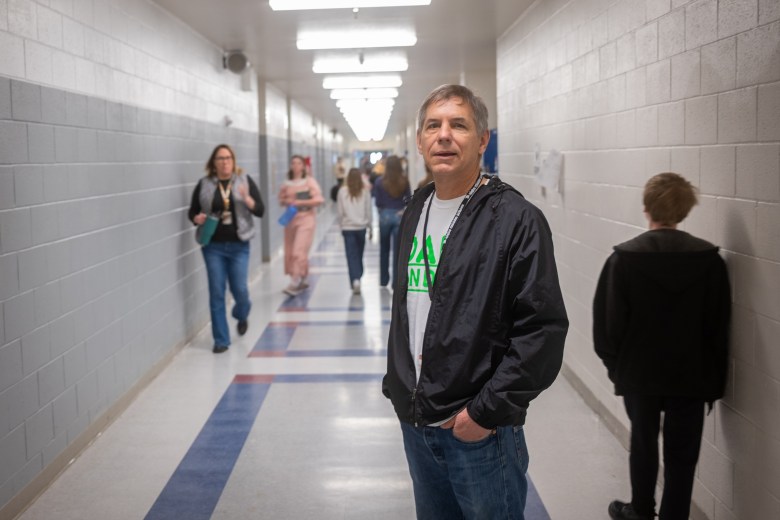
In Rigby, one of those solution people is Ernie Chavez, whose height makes him stick out in a hallway streaming with middle schoolers. He’s part of Dads on Duty, a program that brings in parents to help monitor and interact with students during passing periods and lunch.
Throughout the school, students reach out to Chavez for high-fives. On one February afternoon, he was greeted with applause and cheers. “I don’t know what that was about,” he said with a smile.
Similarly, the district’s Hope Squads, in place since 2021, have become an active presence inside the school.
The student-led coalitions aim to foster connection and reduce the risk of suicide. Thousands of schools across the United States and in Canada have implemented Hope Squads, but in Rigby, the mission of violence prevention has become personal.
Ernie Chavez monitors the hallways at Rigby Middle School on Feb. 5 for the Dads on Duty program. Credit: John Roark
“We refer … students every year to counselors, and those students go from some of the worst moments in their life (to getting help),” Vasquez said. “We build the connection between adults and faculty to the student.”
Members of the Hope Squad notice peers who seem down or isolated and reach out with a greeting, or sometimes a handmade card.
“We just reach out and let them know that people in the community are there for them, just to show them that we care and they’re not alone,” said Dallas Waldron, a Rigby High senior and Hope Squad member.
The groups also plan assemblies and special events, including, for example, a week of activities themed around mental health awareness.
Emilie Raymond, a sophomore at Rigby High, said the shooting made it clear “that people need to feel included and they need to find that hope.”
Another change at Rigby schools is a cell phone ban that was put in place this school year.
Before the ban,students were “sitting in the corners, isolated, staring at a screen,” said Ryan Erikson, Principal at Rigby Middle School. Now, “they’re playing games, they’re goofing off … they’re actually conversing.”
While Jefferson County School District’s approach to stemming violence is robust, “it’s not perfect,” Martin, the superintendent, said. “It’s still life. That’s just the reality of it, we’re still going to have things come up that we haven’t prepared for or weren’t on our radar. But we address them and just try to do whatever we can to support kids.”
Carly Flandro is a reporter with Idaho Education News. Jackie Valley is a reporter with The Christian Science Monitor.
Contact Hechinger managing editor Caroline Preston at 212-870-8965, on Signal at CarolineP.83 or via email at preston@hechingerreport.org.
This story about school threat assessments was produced by the Education Reporting Collaborative, a coalition of eight newsrooms that includes AL.com, The Associated Press, The Christian Science Monitor, The Dallas Morning News, The Hechinger Report, Idaho Education News, The Post and Courier in South Carolina, and The Seattle Times.
The Hechinger Report provides in-depth, fact-based, unbiased reporting on education that is free to all readers. But that doesn’t mean it’s free to produce. Our work keeps educators and the public informed about pressing issues at schools and on campuses throughout the country. We tell the whole story, even when the details are inconvenient. Help us keep doing that.
Our recent study (Zhou et al, 2025) surveyed 595 undergraduate students across the UK to examine the evolving digital divide across all forms of digital technologies. Although higher education is expected to narrow this divide and build students’ digital confidence, our findings revealed the opposite. We found that the gap in digital confidence and skills between widening participation (WP) and non-WP students widened progressively throughout the undergraduate journey. While students reported peak confidence in Year 2, this was followed by a notable decline in Year 3, when the digital divide became most pronounced. This drop coincides with a critical period when students begin applying their digital skills in real-world contexts, such as job applications and final-year projects.
Based on our study (Zhou et al, 2025), while universities offer a wide range of support such as laptop loans, free access to remote systems, extracurricular digital skills training, and targeted funding to WP students, WP students often do not make use of these resources. The core issue lies not in the absence of support, but in its uptake. WP students are often excluded from the peer networks and digital communities where emerging technologies are introduced, shared, and discussed. From a Connectivist perspective (Siemens, 2005), this lack of connection to digital, social, and institutional networks limits their awareness, confidence, and ability to engage meaningfully with available digital tools.
Building on these findings, this blog asks a timely question: as Generative Artificial Intelligence (GenAI) becomes embedded in higher education, will it help bridge this divide or deepen it further?
GenAI may widen the digital divide — without proper strategies
While the digital divide in higher education is already well-documented in relation to general technologies, the emergence of GenAI introduces new risks that may further widen this gap (Cachat-Rosset & Klarsfeld, 2023). This matters because students who are GenAI-literate often experience better academic performance (Sun & Zhou, 2024), making the divide not just about access but also about academic outcomes.
Unlike traditional digital tools, GenAI often demands more advanced infrastructure — including powerful devices, high-speed internet, and in many cases, paid subscriptions to unlock full functionality. WP students, who already face barriers to accessing basic digital infrastructure, are likely to be disproportionately excluded. This divide is not only student-level but also institutional. A few well-funded universities are able to subscribe to GenAI platforms such as ChatGPT, invest in specialised GenAI tools, and secure campus-wide licenses. In contrast, many institutions, particularly those under financial pressure, cannot afford such investments. These disparities risk creating a new cross-sector digital divide, where students’ access to emerging technologies depends not only on their background, but also on the resources of the university they attend.
In addition, the adoption of GenAI currently occurs primarily through informal channels via peers, online communities, or individual experimentation rather than structured teaching (Shailendra et al, 2024). WP students, who may lack access to these digital and social learning networks (Krstić et al, 2021), are therefore less likely to become aware of new GenAI tools, let alone develop the confidence and skills to use them effectively. Even when they do engage with GenAI, students may experience uncertainty, confusion, or fear about using it appropriately especially in the absence of clear guidance around academic integrity, ethical use, or institutional policy. This ambiguity can lead to increased anxiety and stress, contributing to wider concerns around mental health in GenAI learning environments.
Another concern is the risk of impersonal learning environments (Berei & Pusztai, 2022). When GenAI are implemented without inclusive design, the experience can feel detached and isolating, particularly for WP students, who often already feel marginalised. While GenAI tools may streamline administrative and learning processes, they can also weaken the sense of connection and belonging that is essential for student engagement and success.
GenAI can narrow the divide — with the right strategies
Although WP students are often excluded from digital networks, which Connectivism highlights as essential for learning (Goldie, 2016), GenAI, if used thoughtfully, can help reconnect them by offering personalised support, reducing geographic barriers, and expanding access to educational resources.
To achieve this, we propose five key strategies:
Invest in infrastructure and access: Universities must ensure that all students have the tools to participate in the AI-enabled classroom including access to devices, core software, and free versions of widely used GenAI platforms. While there is a growing variety of GenAI tools on the market, institutions facing financial pressures must prioritise tools that are both widely used and demonstrably effective. The goal is not to adopt everything, but to ensure that all students have equitable access to the essentials.
Rethink training with inclusion in mind: GenAI literacy training must go beyond traditional models. It should reflect Equality, Diversity and Inclusion principles recognising the different starting points students bring and offering flexible, practical formats. Micro-credentials on platforms like LinkedIn Learning or university-branded short courses can provide just-in-time, accessible learning opportunities. These resources are available anytime and from anywhere, enabling students who were previously excluded such as those in rural or under-resourced areas to access learning on their own terms.
Build digital communities and peer networks: Social connection is a key enabler of learning (Siemens, 2005). Institutions should foster GenAI learning communities where students can exchange ideas, offer peer support, and normalise experimentation. Mental readiness is just as important as technical skill and being part of a supportive network can reduce anxiety and stigma around GenAI use.
Design inclusive GenAI policies and ensure ongoing evaluation: Institutions must establish clear, inclusive policies around GenAI use that balance innovation with ethics (Schofield & Zhang, 2024). These policies should be communicated transparently and reviewed regularly, informed by diverse student feedback and ongoing evaluation of impact.
Adopt a human-centred approach to GenAI integration: Following UNESCO’s human-centred approach to AI in education (UNESCO, 2024; 2025), GenAI should be used to enhance, not replace the human elements of teaching and learning. While GenAI can support personalisation and reduce administrative burdens, the presence of academic and pastoral staff remains essential. By freeing staff from routine tasks, GenAI can enable them to focus more fully on this high-impact, relational work, such as mentoring, guidance, and personalised support that WP students often benefit from most.
Conclusion
Generative AI alone will not determine the future of equity in higher education, our actions will. Without intentional, inclusive strategies, GenAI risks amplifying existing digital inequalities, further disadvantaging WP students. However, by proactively addressing access barriers, delivering inclusive and flexible training, building supportive digital communities, embedding ethical policies, and preserving meaningful human interaction, GenAI can become a powerful tool for inclusion. The digital divide doesn’t close itself; institutions must embed equity into every stage of GenAI adoption. The time to act is not once systems are already in place, it is now.
Dr Lei Fang is a Senior Lecturer in Digital Transformation at Queen Mary University of London. Her research interests include AI literacy, digital technology adoption, the application of AI in higher education, and risk management. lei.fang@qmul.ac.uk
Professor Xue Zhou is a Professor in AI in Business Education at the University of Leicester. Her research interests fall in the areas of digital literacy, digital technology adoption, cross-cultural adjustment and online professionalism. xue.zhou@le.ac.uk
Universities will need to prove to future students why university degrees are worth it in an artificial intelligence (AI) knowledge economy, speakers at Sydney’s latest generative AI meeting said.
Please login below to view content or subscribe now.