Category: Tennessee

  • Penny Schwinn Drops Out of the Running for Ed Department’s Deputy Role – The 74

    Penny Schwinn Drops Out of the Running for Ed Department’s Deputy Role – The 74

    Updated

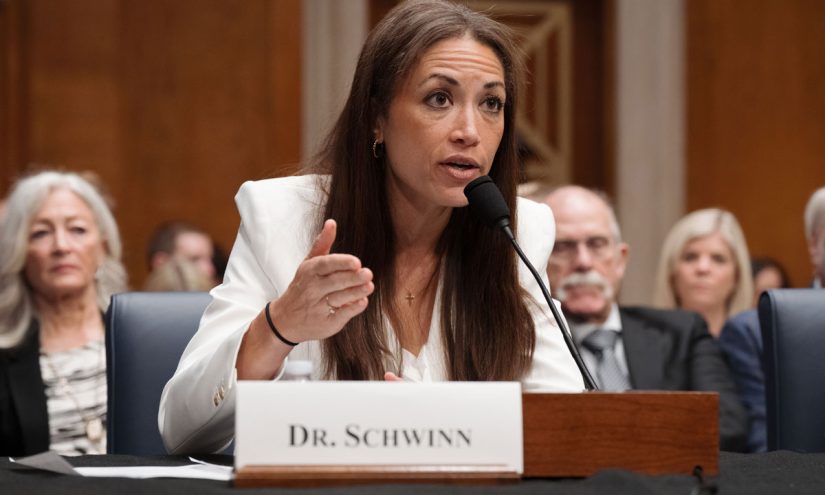
    Penny Schwinn, in line to serve as second in command of the U.S. Department of Education, has withdrawn from the nomination, Education Secretary Linda McMahon announced Thursday.

    Instead, the former Tennessee education commissioner will take on a different role for the department.

    “I am grateful to Dr. Schwinn for her commitment to serving students, families, and educators across the nation,” McMahon said in a statement. “Penny is a brilliant education mind and I look forward to continuing working with her as my chief strategist to make education great again.”

    Schwinn, in a statement, said she gave the decision “thoughtful consideration” and said she will  “remain committed to protecting kids, raising achievement and expanding opportunity  —  my lifelong mission and north star.”

    Considered a champion for improving reading outcomes and high-dosage tutoring, Schwinn was among President Donald Trump’s early picks for department posts. Many perceived her as a more bipartisan choice than others joining the administration, but among Tennessee conservatives, many who felt she was too liberal, opposition to her nomination was strong.

    The timing of Schwinn’s withdrawal couldn’t be worse, according to some conservatives. 

    “Her decision to remove herself from consideration to become deputy secretary hurts students, educators, and the Trump administration,” said Jim Blew, co-founder of the Defense of Freedom Institute, a think tank. “Secretary McMahon has been charged by Congress and the president with huge tasks under the One Big Beautiful Bill and several urgent executive orders.”

    As head of the Education Department, McMahon is striving to turn more authority over education to the states. It’s now unclear who will step into the deputy position and take the lead on the state’s requests for more flexibility over education funding. At least two states, Iowa and Oklahoma, have already submitted requests for block grants, and Indiana is currently gathering comments from the public in preparation for a similar proposal. Kirsten Baesler, North Dakota’s long-time education chief, is currently awaiting confirmation to be assistant secretary for elementary and secondary education at the department. In February, she joined 11 other GOP chiefs in asking McMahon for greater freedom to direct education funds toward state-level needs.

    Controversies and questions over Schwinn’s conservative qualifications have followed her for years. Far-right groups, including Moms for Liberty, said her past support for equity initiatives, like hiring more teachers of color, was evidence that she was not a good fit for an administration determined to eliminate such programs. Others remained angry over Schwinn’s pandemic-era plan to conduct “well-being” home visits. Even though she scrapped the plan, parents and members of the legislature considered it an example of government overreach.

    More recently, Steve Gill, a conservative commentator in Tennessee, reported that while she was deputy superintendent of the Texas Education Agency, Schwinn recommended individuals who advocate for comprehensive sex education, including abortion rights, to advise the state on health curriculum. 

    Gill told The 74 he shared his TriStar Daily article about her stance on these issues with Tennessee Sens. Marsha Blackburn and Bill Hagerty, as well as the state’s congressional delegation. Blackburn, who is expected to run for governor next year, was considered a possible no vote for Schwinn.

    According to Gill, Blackburn’s office “has been working tirelessly behind the scenes with the White House, Secretary Linda McMahon and Majority Leader [John] Thune to block the confirmation.”

    But Madi Biedermann, spokeswoman for the department, said the agency “strongly disagrees with that characterization.”

    Republican Sen. Marsha Blackburn from Tennessee was expected to vote no on Penny Schwinn’s confirmation. (Anna Moneymaker/Getty Images)

    Blew said it’s unfortunate that politics got in the way, noting that Schwinn’s experience in both blue and red states would have brought valuable expertise to the Ed Department role. In addition to her jobs in Tennessee and Texas, Schwinn founded a charter school in Sacramento and also served in the Delaware Department of Education.

    “It’s sad that a handful of demagogues are standing in the way of giving Secretary McMahon the team she needs to succeed,” he said.

    Others praised Schwinn’s record of prioritizing the science of reading in Tennessee schools and directing COVID relief funds toward tutoring.

    “This is a setback for all who want to see Washington slashing red tape, advancing literacy and fighting for common sense values,” said Rick Hess, director of education policy studies at the conservative American Enterprise Institute.

    For some critics, Schwinn’s business ventures since leaving the top spot in Tennessee two years ago raised questions as she waited to appear before the Senate education committee. 

    In June, a day ahead of her joint hearing with three other nominees, The 74 reported that shortly after Trump tapped her for the job, she registered a new education consulting business in Florida, New Horizon BluePrint Group, with a longtime colleague. Before Schwinn filed ethics paperwork with the federal government, her sister replaced her as a manager on the business. 

    When a reporter from The 74 asked questions about the new project, Donald Fennoy, her colleague and a former superintendent of the Palm Beach County School District, dissolved the business.

    Ethics experts say candidates for an administration post often distance themselves from new business entanglements to avoid any appearance of a conflict, but Schwinn has faced accusations of poor judgment before.

    While she was in Texas, the state agency signed a $4.4 million no-bid contract in 2017 with a software company where she had a “professional relationship” with a subcontractor, according to a state audit. And in Tennessee, the education agency made an $8 million deal in 2021 with TNTP, a teacher training organization where her husband Paul Schwinn was employed at the time. Lawmakers considered the deal a “huge conflict.

    “Ethics was a crucial concern,” said J.C. Bowman, executive director and CEO of Professional Educators of Tennessee, a non-union organization. He was among those who sent letters to the Senate, asking them to remove her from consideration. “Her personal business interests and possible conflicts could potentially influence educational decisions in ways that many found difficult to overlook.”

    Clarification: An earlier version of this story mischaracterized the role Penny Schwinn will take on in lieu of serving as the deputy education secretary. Schwinn will be taking on an advisory role at the Education Department.


    Get stories like these delivered straight to your inbox. Sign up for The 74 Newsletter

    Source link

  • Ideology, Outcomes, and a Shift in Higher Ed Oversight

    Ideology, Outcomes, and a Shift in Higher Ed Oversight

    In a bold move that could upend the structure of higher education oversight in the United States, Florida Governor Ron DeSantis announced the creation of the Commission for Public Higher Education (CPHE)—a multi-state effort to challenge what he and his allies call the “activist-controlled accreditation monopoly.” The CPHE includes six Republican-led states: Florida, Georgia, North Carolina, South Carolina, Tennessee, and Texas.

    Positioned as a new accrediting entity with a focus on “student outcomes, transparency, and ideological independence,” the CPHE represents a growing backlash against traditional regional accreditors like the Southern Association of Colleges and Schools Commission on Colleges (SACSCOC). According to DeSantis and CPHE proponents, these longstanding organizations have prioritized diversity, equity, and inclusion (DEI) and other perceived progressive mandates over academic quality, workforce readiness, and measurable outcomes.

    The Political Context

    Governor DeSantis has made higher education a central battleground in his broader cultural agenda, particularly since his administration launched efforts to eliminate DEI offices, weaken tenure protections, and reshape public university boards. The CPHE fits neatly into that larger campaign—what DeSantis calls “reclaiming higher education.”

    “We’re breaking the stranglehold of the accreditation cartel,” DeSantis said in Boca Raton. “Florida is leading the way in building an education system based on results, not ideology.”

    The effort is being coordinated with support from public university systems across the South, including the University of South Carolina and the University Systems of Georgia and Texas. University of South Carolina Board Chair Thad Westbrook praised the new accreditor’s “outcomes-based” framework, stating it will “benefit students while making accreditation more efficient.”

    A Threat to the Federal Gatekeeping System?

    Accreditation in the U.S. plays a crucial gatekeeping role: it determines whether institutions are eligible to receive federal student aid, including Pell Grants and federally backed student loans. For CPHE to have any real impact, it must eventually be recognized by the U.S. Department of Education.

    That recognition is far from guaranteed. The process requires years of documentation, reviews, and approvals—and federal education officials may view CPHE’s openly political roots as problematic. Critics argue the consortium is more about ideological conformity than educational quality.

    Risks and Ramifications

    While the CPHE claims to offer a “rigorous” and “transparent” alternative to traditional accreditation, skeptics—including some education policy analysts and faculty advocates—warn that the real motive is political control over higher education institutions. By tying accreditation to a specific ideological framework, opponents fear that academic freedom, faculty governance, and research independence could be undermined.

    There are also practical concerns. Should CPHE institutions lose recognition by federal agencies or face lawsuits over inconsistent standards, students could suffer the consequences—especially those relying on financial aid or seeking degrees with recognized accreditation.

    Moreover, CPHE’s narrow focus on “student outcomes” often means post-graduate earnings or job placement, metrics that oversimplify complex educational goals and ignore broader social and civic benefits of higher education.

    A Test of Federalism in Higher Ed

    This development marks an escalation in the state-federal tug-of-war over higher education. With the U.S. Supreme Court increasingly supportive of state autonomy, and with Congress gridlocked, states like Florida are testing how far they can go in reshaping public education under a conservative vision.

    The CPHE may become a flashpoint in the national debate over what public universities are for—and who gets to decide. Whether this initiative results in meaningful improvement or becomes another chapter in the politicization of higher education remains to be seen.

    Source link

  • ‘Economically Reckless’ Businesses Slam Bill to Bar Immigrant Kids From School – The 74

    ‘Economically Reckless’ Businesses Slam Bill to Bar Immigrant Kids From School – The 74


    Get stories like this delivered straight to your inbox. Sign up for The 74 Newsletter

    More than two dozen Chattanooga business owners are condemning a bill to require student immigration background checks in Tennessee’s public schools as “economically reckless.”

    The Tennessee Small Business Alliance represents restaurants, real estate firms, retail stores and other local employers operating within the district represented by Sen. Bo Watson.

    Watson, a Republican, is cosponsoring the legislation to require proof of legal residence to enroll in public K-12 and charter schools.  The bill would also give public schools the option of charging tuition to the families of children unable to prove they legally reside in the United States – or to deny them the right to a public education altogether.

    House Leader William Lamberth of Gallatin is a co-sponsor of the bill, which has drawn significant — but not unanimous — support from fellow Tennessee Republicans. Lamberth’s version of the bill differs from Watson’s in that it would make it optional — rather than mandatory — to check students’ immigration status in all of Tennessee’s more than 1700 public schools.

    The bill, one of the most controversial being considered during the 2025 Legislative session, has significant momentum as the Legislature winds down for the year even as it has drawn raucous protests at times.  The legislation will next be debated on Monday in a House committee.

    A statement released by the business alliance described the legislation as a “political stunt that’s cruel, economically reckless, and completely out of step with local values.”

    Citing estimates compiled by the nonprofit advocacy organization, American Immigration Council, the statement noted that more than 430,000 immigrants in Tennessee paid $4.4 billion in taxes – more than $10,000 per immigrant.

    Watson, in an emailed statement from Chattanooga public relations firm Waterhouse Public Relations, said his bill “raises important questions about the financial responsibility of educating undocumented students in Tennessee—questions that have long gone unaddressed.”

    The statement said the Supreme Court’s 1982 decision in Plyler v. Doe, which established the right to a public school education for all children regardless of immigration status, has “never been re-examined in the context of today’s challenges.” The statement said Watson is committed to a “transparent, fact-driven discussion about how Tennessee allocates its educational resources and how federal mandates impact our state’s budget and priorities.”

    Watson has previously also said the legislation was prompted, in part, by the rising costs of English-language instruction in the state’s public schools.

    Democrats have criticized that argument as based on inaccurate assumptions that English language learners lack legal immigration status.

    Kelly Fitzgerald, founder of a Chattanooga co-working business and one of 27 employers that signed onto the statement of condemnation, criticized lawmakers.

    “Do our representatives believe that undocumented children — who had no say in their immigration status — should be denied a public education, even though their families already pay taxes that fund our schools?” said Fitzgerald, whose own children attend Hamilton County Public schools

    “My children are receiving a great education in our public schools, and I want every child to have the same rights and opportunities as mine do,” she said.

    “In my opinion, this is not something our legislators should be spending their resources on when there are much larger issues at hand in the current environment,” she said. “We should leave children out of the conversation.”

    Tennessee Lookout is part of States Newsroom, a nonprofit news network supported by grants and a coalition of donors as a 501c(3) public charity. Tennessee Lookout maintains editorial independence. Contact Editor Holly McCall for questions: [email protected].


    Get stories like these delivered straight to your inbox. Sign up for The 74 Newsletter

    Source link

  • Federal Judge Blocks Department of Education’s Title IX Guidance – CUPA-HR

    Federal Judge Blocks Department of Education’s Title IX Guidance – CUPA-HR

    by CUPA-HR | July 27, 2022

    On July 15, a federal judge from the U.S. District Court of the Eastern District of Tennessee issued a preliminary injunction blocking enforcement of the Department of Education’s Title IX guidance that prohibits discrimination on the basis of gender identity and sexual orientation. Specifically, the ruling blocks enforcement of a June 2021 Notice of Interpretation issued by the department’s Office for Civil Rights (OCR) in light of the Supreme Court’s 2020 decision in Bostock v. Clayton County and President Biden’s Executive Order, “Guaranteeing an Educational Environment Free from Discrimination on the Basis of Sex, Including Sexual Orientation and Gender Identity.”

    Twenty Republican-controlled states, led by their attorneys general, were listed as plaintiffs on the case, arguing that the department’s guidance should not be enforced by the agency as it did not go through the notice-and-comment rulemaking process and is not codified law. They claimed that the department’s enforcement of the guidance also puts states at risk of losing significant federal funding if they do not comply with the guidance. The Eastern District of Tennessee judge ruled in favor of the plaintiffs, issuing the preliminary injunction while stating that the guidance interferes with states’ abilities to enforce their own laws that prohibit transgender students from participating on sports teams or using restrooms that align with their gender identity.

    As it currently stands, the injunction applies only to the 20 states listed as plaintiffs in the case, potentially impacting the policies of colleges and universities in those states. Notably, the injunction does not impact the recently issued Title IX proposed regulations that are currently undergoing a 60-day notice-and-comment period. If the Title IX regulations are codified into law, however, they may face similar legal challenges.

    CUPA-HR will continue to monitor this issue and keep members apprised of any developments related to Title IX.


    Source link