Category: The Social Academic Podcast

  • Art and Design to Share Your Research Story with the Public Health Resonance Project

    Art and Design to Share Your Research Story with the Public Health Resonance Project

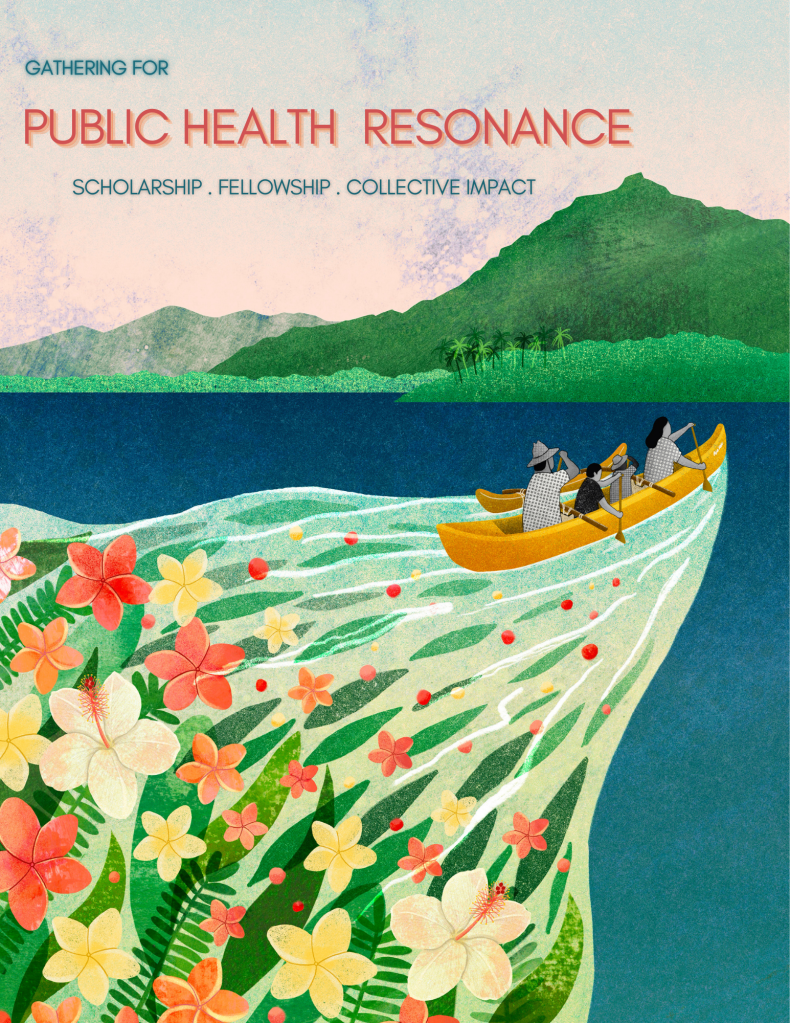
    The Public Health Resonance Project at the University of Hawaiʻi at Mānoa collaborated with a talented artist to create illustrations to better share their research. Have you incorporated art into your research communications?

    The Public Health Resonance Project at the University of Hawai‘i at Mānoa “amplifies unique attributes and deep connections across regionally and culturally relevant physical activities for health promotion and community wellness, locally and globally.”

    Art and illustration can enhance how you share your research. Collaboration between the Public Health Resonance Project and a talented artist included feedback from the whole team to ensure the illustrations were culturally relevant to the research. “It was necessary.”

    This episode features

    • Dr. Tetine Sentell, co-lead of the Project and Chin Sik & Hyun Sook Chung Endowed Chair in Public Health Studies at the University of Hawaiʻi Mānoa
    • Esme Yokooji, a graduate student in Public Health and social media coordinator for the Project
    • Sunnu Rebecca Choi, an award-winning illustrator, printmaker, and artist

    The episode on Art and Design to Share Your Research Story felt so special. It’s the 1st time these collaborators have all come together on video 🎧🎙️✨

    I love that I got to design their website and bring us together for this conversation. We talk about the research, art, and share 3 beautiful new illustrations with you.

    There’s many ways to be more visual with your research such as data visualization, illustration, comics, science art, photography, video. I love that the PH Resonance Project found an artistic partner in Sunnu Rebecca Choi.

    I hope this video inspires you. Save this post for later. You may not have 32m 5s to watch or listen today. But save it even if you just have a hint of ‘I want art for my research’ and you’re unsure how you’ll get there.

    A dream I have is that more research groups, labs, and centers invest in collaborating with talented artists like Rebecca. These partnerships can help people around the world engage with (and share) research that’s meaningful to them. And also I love art.

    Omg if this post (or the video) inspires you to reach out to an artist about working together? Please share it with me, I would love that! 🥹

    Before we dive into the interview, I have a quick story to share with you about recording. Or, you can skip right to the interview.

    My computer crashed right in the middle of our recording 💻😱

    I’m freaking out. My desktop computer light is blinking red at me like a danger sign. When I try to cycle the computer on the fan goes crazy.

    The podcast episode going live today? There was a moment there I thought it wasn’t gonna happen. When I finally made it back on, maybe 10 minutes later, I was delighted to find my guest happily chatting away. When I went back to watch the recording, they were so cute. “Oops! Looks like our host has dropped off,” and then right back to their conversation about art and research.

    We were able to complete our recording. But this episode needed a bit more.

    We had high resolution art to share. There was a story in there that needed attention to bring out 🎨✨️

    And thank goodness I sought help. I soon learned my own audio/video? Parts of my solo video were unusable. Super lagged.

    Luckily, I have a talented husband I’ve been teaming up with for his professor dad’s art focused YouTube channel. I love that Matthew can help.

    The video is finally ready for you. Thank you!

    Technical problems may happen 💯

    Have you worried about something going wrong with your computer too? Things may go wrong with tech, but I hope it doesn’t for you! 🫶

    Every time something goes wrong, I get anxious about my own unsurity of what comes next. People are often kind and understanding. When I’m the one experiencing technical issues, it feels like a huge deal and inconvenience to people. I have to remind myself: When I’m on the other side of that? I always understand. It’s super relatable. I can’t envision myself getting mad, angry, or hurt but someone else’s technical glitch. If your computer crashes in the middle of our meeting, I’ll totally get it too.

    I wanted to share this story with you because for a moment there? It felt like this podcast episode may not happen. But it did. We made it happen. I’m so happy / relieved. I’m proud to share it with you 👋😄

    Subscribe to The Social Academic blog.

    The form above subscribes you to new posts published on The Social Academic blog.
    Want emails from Jennifer on building your online presence? Subscribe to her email list.
    Looking for the podcast? Subscribe on Spotify.
    Prefer to watch videos? Subscribe on YouTube.

    The special 2024 logo was designed by Sunnu Rebecca Choi.

    Tetine: Rebecca, we love you so much. I’m so excited to meet you in real life.

    Rebecca: Thank you. I was really looking forward to meet you guys, all.

    Tetine: You’re like our artistic hero, so it’s so fun to have an opportunity to do this. Thank you, Jennifer for making it happen.

    Jennifer: Wait, Tetine. How did you first find Rebecca? How did you first connect?

    Tetine: Oh yeah, so I have it in my slides.

    Jennifer: Oh, you do? Okay. Show me your slides.

    Yeah, yeah yeah! As a team, this is kind of our first time all meeting live and I’m so excited that we’re all here together. Tetine, why don’t you start us off. Would you please introduce yourself and tell people a little bit about your research?

    Tetine: Sure. Aloha. I’m Tetine Sentell. I’m a Professor here at the University of Hawaiʻi at Mānoa in Public Health. I’m the department chair of public health and I am one of the co-founders of the Public Health Resonance Project, which is a really exciting, interdisciplinary, collaborative synthesis of literature, engagement with literature, dissemination of literature project we’ve been doing now for several years that this team has assembled as part of, and I’m just been so grateful to be part of that. And it’s really about sharing opportunities for strength-based public health promotion, especially around culturally and regionally relevant physical activity and how that’s meaningful to people as individuals, as families, as communities, and as collectives.

    Jennifer: What are some examples of those culturally relevant activities? Just so people have an idea.

    Tetine: So in Hawaiʻi, some examples would be hula, spearfishing, outrigger canoe paddling, for instance. And then of course, in many other places there are resonance and activities from culturally relevant dance, folk dances, regional relevant dances, practices in the water, practices in the land.

    Jennifer: Esme, would you introduce yourself?

    Esme: Sure. My name is Esme Yokooji. I’m a Master’s of Public Health student at UH Mānoa, and I am the graduate research assistant on this project. I’m in the NHIH or Native Hawaiian and Indigenous Health specialty at UH. And, in my free time, I am someone who participates in these activities. I do Okinawan dance. I like to volunteer in ʻĀina doing things like Kalo planting and just conservation and restoration work in our natural habitats here in Hawaiʻi. That’s what initially drew me to this project is just the real life connection and seeing how community engages with these things. So mahalo for having us.

    Jennifer: Rebecca, you are coming here from London. This is fun. London, Hawaiʻi, and I’m in San Diego. Rebecca, tell me a little about your journey as an artist.

    Rebecca: Hi, my name is Sunnu Rebecca Choi. I’m an illustrator and printmaker based in London, but I’m originally from South Korea, lived in Canada and United States and now ended up in London somehow. And then I used to be a fashion designer in New York and Toronto, but then I decided to change my career, become an illustrator. Right now I’m specializing in editorial illustration as well as children’s book illustration, mostly focusing editorial illustration wise, mostly focusing on medical scientific as well as psychologies. And I work with a lot of different university magazines as well.

    Jennifer: Thank you. So everyone listening knows, I did design the website [for the Public Health Resonance Project]. I had so much fun doing this project because there are so many visual elements to all of those activities and to the people who are engaging with them. This is about people.

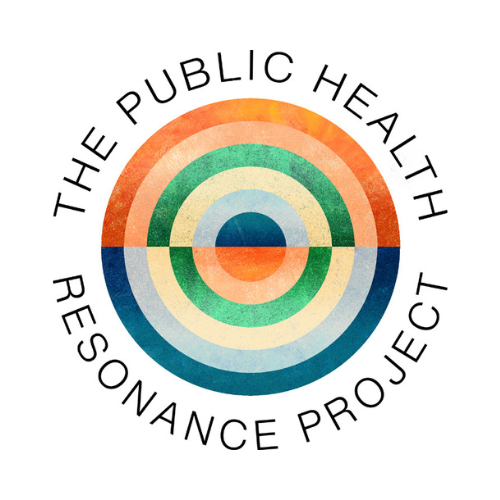
    Tetine: I am so happy to be here because we’ve been working on this international, collaborative project for so many years, and one of the things we really wanted to do was make it so beautiful and really make it so it could be disseminated and shared in ways that inspire and engage and delight people. And so I developed this logo as we began consolidating and thinking about disseminating in collaboration with some partners, and in particular with my husband and all who helped build it. So thank you, Craig. It was a meaningful logo. We felt it was really important. I have this slide here to really show we were inspired by the Hawaiian colors and the deep ocean from the shore to the sunset, and really thinking about the levels of influence and the social ecological model, which is our theoretical influence in the background from a public health perspective and thinking about the ripple effects and the waves that grow and build and move across. And really thinking about the place to connect the project and the connections and the links, the ripples, the reflections.

    We had this endowed chair and this opportunity, and so I was really reflecting and thinking about this and this absolutely beautiful art came in my alumni magazine. Can you see how beautiful that is? It’s so pretty. I even have the one I pulled out of my alumni magazine and it was Rebecca’s artwork and it was so beautiful and it really had the feeling of what we were thinking about of these reflections, of these perspectives. You can see it has a lot of depth and story to the artwork as well as just being so peaceful and beautiful and meaningful. And so that’s how I found the artwork and had no idea how to engage with artwork or what to do in this particular way if it was contractable through a university through our funds. But anyway, just cold emailed through the link in the website and she has a beautiful website if you’ve seen it. And through that started a conversation that has just been really so fruitful and so exciting and just I’m so honored to be part of this. And in collaboration also with Esme and others who’ve really helped support and build the artwork into spaces that we can use it for all the things we wanted to do.

    Jennifer: That is amazing. I’m so happy that we had a chance to hear that kind of origin story because I feel like there’s so many possibilities that we just don’t know exist as researchers, as academics, even as artists. What can we do to better connect and help shape our ideas together? Rebecca, how did you feel when Tetine first reached out? Is this a kind of project that you’ve done in the past?

    Rebecca: No, actually it was really interesting because I haven’t really worked with other universities before. So was it, what university?

    Tetine: Middlebury.

    Rebecca: Yeah, Middlebury Magazine. That was my first alumni magazine that I worked with, university. And then when Tetine emailed me I was like, “Oh, I actually didn’t know it was released already.” That’s how I knew that magazine has been issued. Yeah, so that was really interesting. And then since then I’ve been working with a lot of universities in United States, so that opened a new opportunity for me as well.

    Jennifer: And so I’m curious Tetine, what about art helps bring the community together? Why invest in this kind of visual element?

    Tetine: Of course, art inspires us, engages us, pulls us in, makes us think, is important to us as humans, as people in the world. But I also think in academia we do a lot of intricate, thoughtful, engaged practices and activities that often are not accessible because they’re deep inside words and publications, sometimes even behind paywalls. And I think there is a lot of intricacy and story in even peer-reviewed academic journal papers, much less the smaller summaries of them. View open access resources from the PH Resonance Project.

    And so it just felt like this was such an opportunity relative to the work, work now, to disseminate and to share it, to think about how it’s helpful, how it’s good for mental health, how it’s engaging, how it’s good for physical health, how it’s good for strength. All that was sort of built in the background of how to share out, this was so important to disseminate in communities and to people. And then with that joy, right. This is a strength-based activity. It’s a thing that brings people together, makes them happy, makes them joyful, connect with each other. And I think that’s one of the things art can do. It felt like such a nice synergy and such an amazing opportunity to really tie all those things together.

    Jennifer: You brought up joy, and that’s something that I really get not just from the beautiful illustrations that have been customized to represent different activities that the project is researching, but also in the new version of the logo, in the thoughtfulness of how it all comes together through, you have created brochures, event flyers, like physical things and materials to help people engage in person. And that artwork also creates that same warmth and feeling online. Rebecca, I’m curious about your process working on what feels like something really representative of community. What was that process like for creating the artwork for this project?

    Rebecca: The process-wise, whenever I receive a brief, I start with the research. Understanding how each activity is carried out, what equipment is used, and learning about the cultural context, from coding to landscapes. And that process helped me make the imagery as accurate and respectful as possible. Also, every time I create the illustration, my goal was to highlight public health at the community level, showcasing people coming together, whether it’s a mother and a child, a family, or a wider community group. I wanted the artwork to capture the moment and that sense of connection and shared care. I believe illustration has the power to bring people closer and help them resonate more deeply with the subject matter. And I think that was my main goal in creating those illustrations. Usually, when I’m working on the brief, I come up with three different concepts or ideas for each illustration.

    Whenever, if I’m working on the canoe activity, I come up with three different composition or concept or focusing on something different for each illustration for the client to choose from. And that’s how I start creating the art. And then once we decide which concept we are going to go with and then I go render the illustration, my rendering process is quite interesting because I’m a printmaker as well. I create all the textures using printmaking techniques, either monoprinting, etching, or any kind of things that I can get hands on and I scan them in. And then in terms of the final illustration, I use Procreate on iPad and then bring all the textures together on iPad. So it’s a mix of digital and analog process.

    Tetine: That’s why it’s so tactile. It’s like you can really feel it even through the internet. It’s really beautiful that way.

    Esme: I felt the same way though. When I first saw the illustrations, I was like, “Oh, it’s almost like it’s painted on washi paper.” Like watercolor on washi. It’s so beautiful.

    Rebecca: I will sometimes use the watercolor and washi or, accurate. So in my studio I have bunch of papers with all different kinds of textures and colors, which I can just use on any kind of illustration.

    Esme: That’s so cool.

    Tetine: It is. It’s so beautiful. I just love how it all works together and it really has such a feeling about it. Your work is so specifically you, but then you’re also using it so collaboratively to share other people’s vision, which is not an easy thing to do, I think as an artist, and I really appreciate the collaborativeness with which you’ve approached this, these. The first one as the initial one, as thinking about how to share and showcase what we were trying to do. And then very specifically in a regional context and an actual, it’s a specific way, it’s a specific bay you’re coming into and the landscape like you mentioned, and the practice and the movement and the arms, and then really thinking about who is in the canoe and what they’re wearing. And then as we have thought about it for the other resonating activities, to be willing and offer the opportunity for us to really be in collaborative conversation, even as the artwork is pretty far along to be like, “Oh no, we’ve gotten comments from our community members that this isn’t correct or we need to fix this.” I’m just so grateful for that.

    Rebecca: Yeah, it was really, really interesting learning process for me as well because I knew about, briefly know about samba or Tongan, but I didn’t really specifically know about their clothing or how it works and how the body moves, things like that. So for me, it was a really, really good opportunity to learn about different activities as well.

    Tetine: And I think that’s actually, exactly the project. In the sense that each one has not only resonance across, but these unique, very specific pieces of engagement, the land with the ocean with movements particular, with stories and songs and clothing from the community and care. And so the opportunity to showcase that and to showcase that very specifically about, in place for people doing it with each other as families and as communities, not specifically as, not as a show, but as a practice in community. And that has been really important. And as we share and tell the story of the artwork, that’s a really important piece of the, of our sharing of what you’ve been doing as well. Aloha.

    Esme: I also want to say, Rebecca. I used to work in Heʻeia at the fish pond that kind of portrays that bay. And it was so funny because when we had the first kind of in-person activity, it actually took place in Heʻeia, but in the back of the valley. And it was so wonderful because when we showed the work to the people that are participating, they’re like, “Oh, that’s, Heʻeia, that’s here. They were able to instantly recognize from the art. And I think that, even people that weren’t affiliated with the project, were interested and curious. And I think the art was a big draw, seeing a place, recognizing it, feeling properly represented. So I just wanted to say thank you for that. That was so wonderful.

    Rebecca: Yeah, also thank you for all the feedback that Tetine gives. Also, all our illustrations were reviewed by experts and that’s how we can actually get a correct imagery and then representative of the place as well.

    Tetine: Yeah, and I’ll just say the funders of this, the endowed chair that I hold that has allowed this opportunity, it’s from a family enterprise and it’s all been in the background. I mentioned my husband helping with this. There’s a lot of family connections because Mele [Look], my beloved colleague who has done this project with me, certainly has helped connect to some of the cultural and regional experts, but in particular on the Heʻeia ridgeline, her husband Scott is a geologist, and he was like, “This ridge line is not correct. You have to go down. It happens like this, not like that.” And he drew a line for the ridge line so it was proper. That’s the level of detail and actually cultural consultation and regional consultation that’s been possible through this collaborative project.
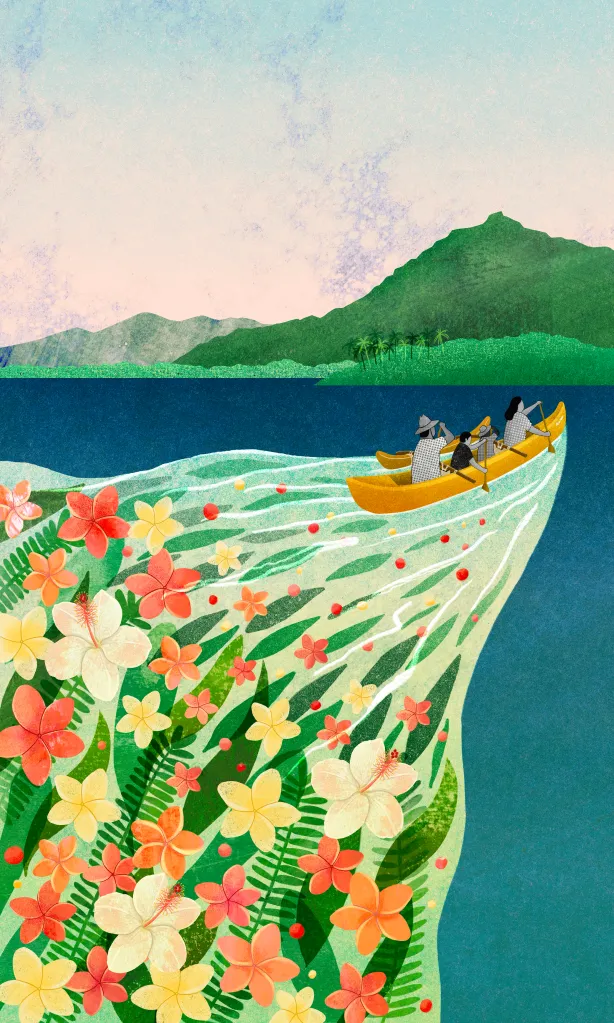
    Art by Sunnu Rebecca Choi

    Jennifer: It sounds like a lot of people were involved in the art making, and that’s something that’s probably really unexpected for folks who are listening to this. So it was the two of you as well as it sounds like experts?

    Tetine: Yeah, yeah yeah. As Rebecca mentioned, we had the brief, we have a conversation, and then she would send three sort of options of things. And then those three options we would run by people who practice those activities, who work in the region, who engage in the practice. That certainly included my colleague Mele, who’s been part of this all along in every way, but also, exactly, people who paddle for the paddling one, people who participate in wild skating for the ones you’ll see in a minute we’ll talk about, and people who do samba, people who do Tongan dance. And so exactly this. So out of the three that we’ve chosen one to go with, and that one is really prioritized. Community, that it’s about being with family or being with others to do practices that bring people joy together, collaboratively in their real lives. That this is about, sometimes they are ceremonies at a wedding or at a party with a community, but they’re not about a show. They’re about a practice together in community.

    And so that’s always been the background of the activities we’ve been showcasing. But then from those and from the one we’ve chosen, then she does a more developed artwork. And then from that more developed artwork, that’s where we really are like, okay, well this color or this clothes or this line or this is not how the arm would be, or this is not the exact proper direction of the canoe relative to the shoreline. That level of detail has been really important and part of the iterative conversation. And then we go back to consult and come back. So it’s a very iterative process.

    Jennifer: When you started the project, did you know how long it would take to produce art using all of this feedback?

    Tetine: For me, that is kind of how the process of most of the work that I do works, where there’s a lot of, we work a lot with community and in practice and public health is about that. I would say for me, not a surprise, but I did feel really bad for Rebecca. I felt it was a lot to ask the artist to engage in sort of the academic consultation process at that level of detail. But she was a really good sport about it.

    Rebecca: It was very interesting because I also, I do longer projects or shorter projects. Usually the book projects are very long. Sometimes it lasts from three months minimum to one year or more than one year. But then editorial projects usually ends within two weeks. I think this project was in between, I guess.

    Jennifer: I appreciate that. And for folks who are listening, if you’re considering working with an artist asking about their timeline, but also considering who you need to bring into the conversation for that art is helpful upfront so that you can talk about it together.

    Tetine: Could I just add to that exact thing, which is that because of this project being so specific about culture and place and about those practices, it was vital and we couldn’t have done it otherwise. Because if the artwork for the practice doesn’t make sense to the people participating, we shouldn’t do that artwork at all, right? And so that was built into this. I could imagine other scenarios where you wouldn’t need quite such level of detail because maybe you’d be talking about just a feeling or something to connect with this, but this was so vital that we have that level of detail

    Jennifer: Esme, as someone who is using the art to create flyers and other kinds of, I would say marketing materials, but is it marketing materials?

    Esme: Well, I would say my background is also in organizing, and that was where I had most of my social media, video editing experiences actually in making, for lack of a better word, propaganda. But kind of trying to inculcate people and inform them, somewhat a combination of educational materials. And I think the goal of this project is, Tetine spoke on, is just to shine a light and a spotlight on these different activities, on these different researchers, on the work that they’re doing and its value. I think for me, what I’ve really enjoyed about being a part of this team is how much Tetine specifically stresses the importance of cultural competence and humility. And I think that understanding how specific everything is, understanding how tailored it is, really conceptualizing who our audience is, who’s going to be benefited by our materials, is something that’s really important to me, specifically being in Native Hawaiian and Indigenous Health. Because I think having more culturally tailored interventions or even having more culturally tailored messaging, having artwork that is accurate that people can recognize, that immediately draws them in I think is really valuable and important. It’s been truly really fun, honestly, to make materials and just experiment with the different kinds of things, whether it’s making a video intro or editing a logo for a flyer or collaborating on a poster or any manner of things. It’s been a joy.

    Jennifer: Tetine, what would you like folks to know about, okay, there’s so many people out there who are like, “I do want a website. I do want to have beautiful artwork for my events. I do want these things, but I don’t know if it’s worth my time as the PI [Principal Investigator].” You are the decision maker here. And so I’m curious, what made you know that this was worth it for you in terms of your energy?

    Tetine: Yeah, I mean, I think it is a conundrum of academic practice these days actually. This how we engage in the PR of the work we do in a sort of dissemination campaign. Generally, people do so much valuable work that they don’t [promote] because of their own demands of academia. They don’t have the time, capacity, support system to help be sharing that out. I guess I would advocate not for this to be something that individuals need to do only because it isn’t something an individual can do only. I was able to pull this together by the amazing collaboration, by being fortunate to have, hold this endowed chair and being senior enough in my own career that the publication process or grant making process was not the only thing I really needed to prioritize relative to my own goals of my academic, what I wanted to do with my career.

    And so it has been actually a joy and an honor to be part of this collaboration, to keep building it, to keep growing it, to engage in sharing it out. Like as Esme is saying and dissemination materials might be one of the terms I might want to use for some of the things we’re doing to think about how we’re sharing out and why. What we want to do is think about how to build in the opportunity for innovative ways in which we showcase the work we do in academia and in art being one of the fundamental ways in which we can share out. And then the art being collateral, like Esme is mentioning and we’ve talked about. And that, Jennifer, is one of the great skills that you hold is how we share out the beautiful work that an artist achieves in collaboration with us, like Rebecca is doing. Then in YouTube and LinkedIn, or in community, and handouts and flyers. How do we do that? That’s certainly not something we learn in graduate school, but in the background is all this important work that deserves to be showcased.

    Jennifer: Ah, wonderful. Are there slides that you did not share that you want to be sure to get into the video? Is there anything else that we should be sure to talk about today?

    Esme: Only that I think from what I’ve experienced, because a lot of what I do specifically focuses on Indigenous Health and what did this Project was specifically trying to reach and elevate and focus on communities that have historically been marginalized, experienced disparity. But coming from the perspective of how is culture a source of strength, how is connectivity to land and to heritage a source of strength? And I think that using art is something that reinforces that message because a lot of times Indigenous Arts and Traditions, whether it’s storytelling or even hula, is considered an art form as well as a physical activity has been marginalized. So using art as a means to tell these stories and amplify these messages feels so right and is a source of resonance for me anyway. And engaging in this work.

    Rebecca: So much of this project, the process was about discovery for me as well. Through this collaboration, I learned so much about the diverse cultural backgrounds behind each brief. And also me as a Korean Canadian based in London, I have so much different cultural diversity within me as well. So it was really valuable experience for me to work on those illustrations and artistically it also encouraged me to explore new colors and compositions that I never used before as well. So finding ways to express not just the activities itself, but the joy and vitality that shines through them while highlighting the connection between people, community and nature, was really, really enjoyable working on this brief.
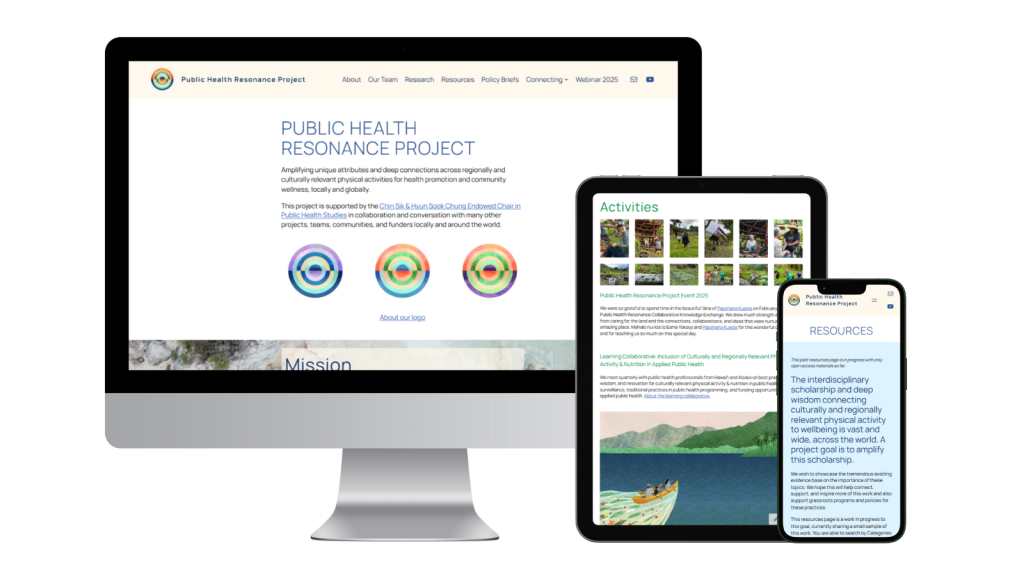
    PHResonance.com

    Jennifer: Well, I’m very excited for the art to come. I’ve never had such beautiful art packaged, ready for me to consider for a website design. I felt really honored to be able to work with the thoughtfulness that I could tell everyone who was involved with this project put into the creation of these art pieces. And there’s new ones that I guess they’re maybe going to be premiered on this video if they’re not on the website first, and I’m very excited to share them with all of you. So Tetine, let’s do your slides.

    Tetine: This was the beautiful artwork we talked about before that I was inspired by. And then this is exactly like, to showcase both the artwork itself and then the artwork, the initial one we’ve been talking about so much, the one, the paddling, the outrigger canoe paddling one, you can see the family, you can see Heʻeia in the background. And then you can also see how we used the artwork as a piece of the story we were telling, which was that we were doing various gatherings over the world, essentially, last year. And that we were thinking about, this was something, we had note cards, we had a poster, we had small business card size handouts to really share and tell the story about what we were doing. So the new artwork includes resonances specifically with this one. This is based in Hawaiʻi and our community here. And then we wanted to really think about how this resonated in other places.

    So this is wild skating in Scandinavian lands. And we had feedback, for instance, specifically here in this one about the trees that actually from our Swedish colleagues said no one would ever go out without a helmet. And so we put a helmet on the child because we were like, that makes sense. That’s the cultural practice. Same with the backpack and the way she’s holding her poles. That the backpack, they were like, we’d never go out into the wilderness without some sort of backpack or something to be safe. So again, really thinking about how communities engage in these practices in real life versus what you might see on a tourist brochure. That was really important to us. Again, you can see the mom and her child. And then really, dance is a really important culturally and regionally relevant community, relevant practice, again, all over the world.

    And so dance, a lot of the research is in dance specifically for so many different pieces of staving off dementia, Parkinson’s, community wellness, mental health. And so here we have our Tongan dance example we talked about earlier, and the samba dance example with input, in collaboration from colleagues from Tonga and Brazil, specifically talking about what this might look like in practice and what this might be like. And so for instance, in the samba one, at first we had these very elaborate headdresses and activities and our colleagues said, well, certainly we do that in Carnival and something, but that’s not what you would see in a community. That’s a special event for a different type of piece. And so if you want to think about how people would do these practices in real life, in community, it would be more casual like this. And same, we talked a lot about in the Tongan example about the clothes, what that might look like, how people would be engaged, what would be respectful, what would be expected, that this is a bit of a dressy event, but also a family event and what that might look like and how the arms are, the stories being told with the hands and the arms and the motions and what music would be relevant.

    You can see in the background a lot of those conversations. The last thing I just wanted to highlight is, as we talked about earlier, we have different logos to go with each one. Because the resonance is across, and the first one really started with the Hawaiian sunset and colors. And then you can see these colors in the background are from some of these other places as well. So highlighting that resonance across that, we really want to think about the colors and the schemes, in terms of people’s communities and specific places. Which is to share, we really talked about this, and I know I think Jennifer, you have an example, but just how we’ve been able to engage in our own activities and practices using this artwork because of Esme’s skillset as well. And because of the capacities and the conversations, including with you, Jennifer, and the website. How to share out and showcase the conversations we’ve had with so many wonderful experts across the globe. And this really is just such a tremendously collaborative project. And so that’s really been a great joy of this project as well, is how to all the strengths and experiences and skillsets that people bring to the table together, really thinking about where we showcase that and how to do that in the most beautiful, respectful, exciting, engaging way possible.

    Jennifer: Yay. Thank you so much for recording this with me. I feel like you were all so excited to talk that it really is going to make for an engaging episode for people, and I really hope that it inspires other folks to consider collaborating with an artist or even reaching out to Rebecca because you’re such a valuable resource for people. I love how much attention that you give to not just what needs to be communicated, but who it’s communicating with and who needs to be involved in the process. It’s just beautiful. Thank you all for being here today. Yeah. Anything else before we wrap up?

    Tetine: No, but thank you, Jennifer. You’re a great visual communicator also, and I’m just really grateful for all the expertise you’ve brought to the story of the Public Health Resonance Project and the capacity to share it out as well. Those are skillsets I didn’t have and didn’t have access to either, and really have been grateful for that as well. Just thank you and again, for bringing us all together for this great opportunity. This is a great joy. It’s been a great joy to meet and a great joy to meet Rebecca, to have Esme here, who’s just been a joy as well. And Jennifer, thank you for all that you do for us as well. You also are a great joy!

    Esme: Thank you so much.

    Jennifer: Yay!

    Subscribe to The Social Academic blog.

    The form above subscribes you to new posts published on The Social Academic blog.
    Want emails from Jennifer on building your online presence? Subscribe to her email list.
    Looking for the podcast? Subscribe on Spotify.
    Prefer to watch videos? Subscribe on YouTube.

    A special thank you to my husband, Dr. Matthew M. Pincus, for his editing and storytelling support with this episode. If you need help with a video, reach out to him at [email protected]

    Source link

  • FAQ for Academic Writers When You Want an Authentic Digital Presence

    FAQ for Academic Writers When You Want an Authentic Digital Presence

    What can academic writers do to have a digital presence that shares their writing and helps them connect with people online? Dr. Katy Peplin interviews The Social Academic podcast host, Jennifer van Alstyne in honor of Academic Writing Month (AcWriMo) in November.

    Timestamps

    0:00 Academic Writing Month (AcWriMo) with Dr. Katy Peplin and Jennifer van Alstyne
    2:28 Your online presence is more than just social media
    5:02 Cultivating authentic connections online for graduate students and faculty
    10:18 Overcoming imposter syndrome and the lasting impact of sharing your story
    14:56 Safety and community building online for academics and researchers
    22:39 Jennifer van Alstyne’s tips for your personal academic website or research lab website
    31:20 Did your university offer you a website? Yay. Keep this in mind
    36:44 Aligning your online presence with your personal and professional goals
    39:52 Your impact, your writing, your academic life matters
    45:17 Build confidence by being intentional about how you show up online
    49:09 Increase your impact with strategic approaches to your online presence

    Academic Writing Month (AcWriMo)

    Jennifer van Alstyne: Yay. I am so excited to talk about academic writing today because this is honestly a love of mine and I don’t do it anymore, but I help academic writers all the time with their online presence. I’m really focused on the digital side. Today I have Dr. Katy Peplin from Thrive PhD, and she’s going to ask me questions for academic writers because next month is academic writing month. Well, before we get to the questions, tell us a little bit about amo.

    Katy Peplin, PhD: Okay, so I’m so excited here, but AcWriMo, which is so much more fun to write than it is to say, but is a National Novel Writing Month, which is a sort of longstanding decades old internet tradition at this point where people sign up and try and write 10,000 words of a novel draft in the month of November. There had long been sort of a community around novel writing in that way. Starting the origins of it now are sort of lost to the miss of internet time, but academics have been jumping onto it. I’ve been doing programming for this since 2018, which is quite a few years ago now. But I am really excited because the kind of way that we do it in the Thrive PhD universe, and now I have this great collaborator, Dr. Kate Henry, but we really believe in sort of building a writing practice.

    Not necessarily belting yourself to your chair until you write that journal article or that chapter, but thinking about this as a month to intentionally touch in with your writing, touch in with your projects, experiment with things, and build some awareness around that writing practice. Let’s face it, November is the time where the end of the year looms closer and closer. All of these things that felt really far away in September or July when you’re like, “Sure, I’ll have that done by the end of the year,” suddenly become very real at the same time that semesters end and holiday stuff ramps up. Human things are so complicated. And, at least where I am in the northern hemisphere, the daylight goes away very suddenly. There’s just a lot of things that make writing in November even more challenging. I find that it’s been really fun and helpful to provide as much support as we possibly can for free that whole month.

    Jennifer: I love it. This is one of the things that we’re creating to be a free resource for people. If you’re watching this and you are an academic writer, you’re friends with or supervise an academic writer, please share it with them. We’re going to be sharing tips, advice, and really the struggles that people sometimes go through when it comes to sharing their writing. So this video is for you. It really is.

    Katy: Yes. I’m so excited to be asking you some questions because you’re such a leader and expert in this space.

    I would love to just for the academics among us, how do you define an online presence? Because I know that’s one of those things that can feel bigger than it is, but also smaller than it is. What do you include under that umbrella?

    Jennifer: I’m so glad you asked this question because I feel like people have a really limited view of what it is to the things that we create about ourselves. “If I don’t have a website, if I don’t have a social media, then I don’t have an online presence.” But that’s not true.

    Your online presence is anything that people can find about you online, whether it’s intentionally created by you or not. So that’s Google Search results. Maybe if people ChatGPT get to learn a little bit more about you, what comes up? There’s a lot of ways that we can find what our online presence is, but there’s also a lot of ways that we can be intentional in creating and shaping how people find our story online.

    Katy: That’s such a generous way to look at it because I know so many people who are like, I don’t want to be on LinkedIn or I don’t want to be on this platform. I don’t want to be here. I don’t want to be there. All of that makes sense to me. But it also can be what you want it to be. The kind of point is to be intentional about it.

    Here’s 19 ideas for your digital presence as a faculty or researcher.

    Jennifer: When we think it’s only social media, or only websites, or sometimes even only faculty profile, the thing that we’re often missing is your academic bio. Your bio is ending up on conference websites for journals, for events, programming, maybe fellowships or associations that you’re involved with. There’s so many places where your bio can show up online that it really ends up becoming a massive part of your online presence. People don’t expect that.

    Katy: As somebody who has to regularly produce bios about myself and almost always feels some tension about it. Yes. That it’s such a good point that it’s more information about us circulates beyond where we put it on purpose. Right, exactly. Okay.

    Cultivating authentic connections online for graduate students and faculty

    Katy: What are the benefits that you see of for academics or people in the scholarly space that really do take that step to be intentional and thoughtful about the way that they show up online? What are the benefits that people can see from that?

    Jennifer: I think the benefits that people maybe assume that they’re going to see is a lot of reach or maybe a ton of reads on their writing. And that kind of myth is, I mean, it’s not inaccurate. If you share more, people will find you more.

    But the truth is that the benefits are really about the more individual connections, the reader who reads your writing and not only understands it and relates to it, but is citing it and helping share it with a larger goal in mind of being part of the research community. When I think about the connections that people are sometimes hoping for online, it doesn’t always equate to the meaningful deep relationships that they really enjoy that have come out of it. So whether that’s research, collaborations, new friends in your field, learning about a new conference or association that maybe you hadn’t heard of before, there’s so many opportunities for connection that we miss because maybe we just don’t think there’s agency in doing that, especially if networking feels uncomfortable to you.

    Katy: Yeah, absolutely. I love the sort of way that you’re framing that because I think that for so many of us who reads us or even our H-index or these kind of really concrete data things are the easiest to measure. So we measure them first. But often they not separate from, but not necessarily as meaningful as we might want them to be in terms of the results we’re actually looking for.

    Jennifer: To give you an example, so to be honest, I don’t share my academic writing much. I haven’t done academic writing since grad school. When I think about my own academic writing and my experience of sharing it, it’s been very surprising. I shared I’m in medievalist literature, and so when I shared an article that I had published, I was very surprised by the people who were responding to me: people who were not in my field, people who were not academics, people who cared about the literature, but I didn’t know that they did because they weren’t in the kind of environment that I was used to having these discussions in. Even my own experience, even though it’s relatively old now, I think that it was so meaningful for me to see the kind of invitation that my post ended up being that I didn’t expect.

    I wasn’t like, “Oh my gosh, eight people are going to go read this article now that I’ve posted it on my personal Facebook.” But that’s what happened. Not only did that happen, but someone was like, “Oh, after I read this article, I brought it back to the grad school class where we’re talking about this book.” So then everyone ended up reading it, and I really thought that I was just posting to brag to be like, “Hey, I got this article out.” Like, you did it. This is great. As a grad student, I was very proud of myself and I wanted to share that feeling with people. While sharing your article can be the intention of your post, it’s also okay if you know what you’re sharing is more like me, like a feeling or the kind of warmth that we feel about our article and about our writing. It’s okay to be open about that even if you think that the people aren’t going to read it.

    Katy: I love that so much, and I think that it’s such a brave and kind of generous thing to share because so much of the academic discourse is like I have officially done this important thing and I talk about it with important people and in important stoic ways. And sometimes you really are just like, listen folks, I passed my exams. There’s something so important about sharing authentically. I think that that’s something that academics can miss because in a lot of spaces we have that authenticity gently guided out of us or sometimes with a lot more force than that.

    Jennifer: That’s true. Sometimes when my faculty clients we’re working together on social media. It’s pretty rare, but sometimes we’re actually focused on sharing their book or a specific publication or report that they’ve written. When that happens, they think that I’m going to tell them what to do. They think that I’m going to give them: here’s the specific template, we’re going to do all the things. Instead oftentimes we’re just having a conversation. I’m taking notes while we’re talking.

    The things that you think already? The things that you want to share about your book already? Are good enough. They don’t need someone else to come in and tell you how to do it. Or what to do or what to say. It’s just that sometimes there’s things that we can add, or tweak, or enhance, because the thing that comes right out of our mouth, sometimes it needs a little bit of revision to help more people understand it.

    Subscribe to The Social Academic blog.

    The form above subscribes you to new posts published on The Social Academic blog.
    Want emails from Jennifer on building your online presence? Subscribe to her email list.
    Looking for the podcast? Subscribe on Spotify.
    Prefer to watch videos? Subscribe on YouTube.

    Overcoming imposter syndrome and the lasting impact of sharing your story

    Katy: That leads so beautifully into this question that I have because I tend to work with a lot of early career scholars, so grad students, post-docs, people who are just getting their feet wet. There is this real anxiety about who am I to be sharing about this thing? To your mind, what counts as expertise? What makes this important enough to share? Or do you measure it with something else altogether?

    Jennifer: That’s a good question. I don’t think that I measure it, which is maybe the most interesting part of that. I’ll give an example. I had Meg Mindlin, who is an amazing graduate student, here on The Social Academic podcast. She has a very large platform on social media. She shares video. She shares octopus art. She is so cool. And, she has that same kind of feeling like, is this good enough to share? It doesn’t matter how large your platform is. You can still have that imposter syndrome. And frankly, it doesn’t matter where in your career you are. Meg is feeling that as a recent master’s student graduate.

    And my clients who are mid-career and senior faculty? Many of them also still feel that way. I would encourage you to recognize that feeling. But maybe still practice it anyway because it might not go away. But you know what always makes it go away?

    When my clients and I are doing this live on a call, we have a post, we’re ready to post it, we put it up and they get engagement sometimes while we’re still live. They’re like, “Oh, that’s a relief.” That’s a relief because I was scared about posting it. I did it. I was on the call with you, but now it’s out there and people are seeing it. The act of actually doing it, even if it’s just once or twice for this, even if you feel uncomfortable, it’s good practice. And I would say it’s okay to sit with that discomfort a little bit if you’re talking about something sensitive.

    If you’re attracting negative reactions, I think that’s a different consideration. But for the vast majority of the things that you post, there are ways to talk about it that are not necessarily going to invite that kind of negative reaction. I just want people to feel a little bit more open to exploring it.

    If you draft a post, hit publish, if it’s about your publication. Hit publish even if you’re not sure. So many of the people that I chat with are like, “Oh yeah, I drafted it, but it didn’t end up published.” Yeah, my hope for you is that it ends up published.

    Katy: Oh, what a generous hope. It really reminds me of some of my favorite pieces of writing advice, which almost all boiled down to doing the thing is doing the thing. Writing isn’t necessarily thinking about writing, learning about writing, strategizing about your writing, drafting your writing, writing is writing. I think what you’re saying is sharing and building your presence is about sharing and building your presence. That there’s so much benefit in practice and doing it and learning that way as opposed to trying to perfect it up here first.

    Jennifer: The results are long-term. Especially if we’re thinking about, I guess to be specific like a social media platform like LinkedIn, your post goes out today, maybe tomorrow, but that post has potential to reach people next week, next month, next year.

    I literally went into my LinkedIn analytics yesterday and was like, wow, some of these posts are from over a year ago and they’re still reaching people this week. It’s surprising, but I think that potential was missed on old Twitter. You could reach a lot of people fast, but when the relevant people missed it the first time, they’re not going to see it later. That potential is possible on a profile like LinkedIn. It means that maybe it’s okay, you put a little bit of energy into your LinkedIn profile, even if you’re not job searching, you’re not doing any of the things like I get it, but LinkedIn can still help you reach all those people when you have something you want to say. It doesn’t have to be all the time.

    Katy: As somebody who’s trying to uplevel on LinkedIn at this exact moment, I’m really resonating with what you say because it is this kind of vulnerable. They make it so easy to measure things like likes and metrics and shares, and you’re chasing that dopamine hit. You forget that the post lives beyond that initial kind of chemical brain reaction. It’s helpful to know good or bad that there’s a long tail.

    Safety and community building online for academics and researchers

    Katy: So I now have as from where you’re sitting, say I’m a graduate student, I’m an early faculty member, I’m even a late faculty member. Goodness knows, we’re all busy. I only have a certain amount of time.

    What’s your best pitch for investing some of my precious energy into building this presence when it might not necessarily be something that’s directly measured by my advisor, my chair, my tenure committee, my colleagues? Why do it?

    Jennifer: That’s a good question. I think that the advice that I had even a year ago probably would have been different, but I’ve had a lot of graduate students reach out this year because they want a stronger online presence. They don’t have the time, especially mid-career people with family or folks that are in a transition of fields. If you don’t have the time, but you still want an online presence, there’s ways to have that happen. You don’t have to work with me, but just know that there’s people that can help you and that you don’t have to do it yourself. Or, you can do it with a friend. There’s different ways to take back or make better use of some of that time if doing it yourself is not ideal. When you are planning to stay in academia, when you’re planning to have the research thinking projects that you’re working on now, be something that people can engage with long-term.

    It’s always a good investment of your time to create your online presence. I would never suggest someone not create an online presence unless personal safety was really at not just the forefront of their minds but could affect their mental health. I’m saying that as someone who has been there before, I’m a survivor of domestic violence. When I left my physically abusive ex-husband, I deleted all my socials. I didn’t have anything. I didn’t want to be found online by anyone. So I’ve been there. But I also know the power of taking that space back and being really intentional about what people find there. Do I literally still worry that my ex-husband is going to email my clients and harass them? Yes, I’m not going to lie. Honestly, that is possible. And so when I think about how I show up online, I am very intentional about who is going to see this, how they can engage with it, and what the potential ramifications are if something goes wrong.

    I think about that also right now in terms of protecting my clients when things in America are politically quite volatile for freedom of speech. There’s a lot of things that we can take into consideration in terms of time and energy that are beyond just us, that are a part of the larger world. But when it’s your own time, it doesn’t all have to happen at once. Any small change that you can make for your online presence.

    Whether you’re in grad school or early career researcher, or much later on in your academic career, that time and energy makes a difference. Maybe you’re only updating a sentence or two in your bio. Maybe you’re spending a day focusing on creating that LinkedIn profile that you really did not feel like you needed in the past.

    There are things that you can do and you have agency in doing, but it doesn’t all have to happen at once. And, it doesn’t have to happen at all if it’s not a goal for you. But for most writers that I talk to, it is a goal at least sharing their writing, sharing their research is a goal. I encourage you to have that online presence, even if it’s not the personal online presence that maybe you see friends or colleagues having too.

    Katy: That is such generous advice. I’m so happy to hear you talk about the sort of risk of this because I know that I personally am working with a lot of clients who are afraid not just for their own sort of reputation online, but for the funding of their labs, for the ability to get doxed if they’re studying a thing that somebody finds. I think what you said earlier in kind of our conversation that you have an online presence, whether you work on it or not, that being able to shape things like how I appear on my department website, how I appear in my bios in places that people can access and could potentially freedom of information actor get access to.

    All of that information exists online for most of us through these old conference programs, through all of these other things that more and more are being ingested or searchable in maybe ways that weren’t even two years ago. It’s going to happen whether you are intentionally engaging with it or not. This is maybe a moment for people to say, okay, how can I think about these presences and show up in them in a way that accurately represents my research. But also takes into account that “I need to stay safe, my colleagues need to stay safe, my students need to stay safe, and if they’re going to write it, I might as well write it.”

    Jennifer: There’s power when we show up online. There is also an invitation for folks who maybe look like us, or think like us, or worry about the same things as us, or care about the same things. There is potential for those people to see the space that you’ve taken online and feel that they can claim some of that too, that they can also create more storytelling, more openness, more connection through what they’re able to share online.

    Katy: I think about that with sort of my own presence all of the time because I am pretty open about my mental health struggles on my blog. I am incredibly privileged to do that in a lot of ways because I’m my own boss, so nobody’s going to fire me if I say something. If I can be the one to take on some of that risk and say, “Hey, I had a really crappy mental health day, and here are six ways that I reset,” and knowing that I’m putting that information out for people to encounter it when they need it to? If I can take that risk, then that lets other people take some of that burden off. That’s one of the ways that communities can function really generously is to say, okay, I have this space to take some of this on. Why don’t I host the meeting point for this idea so that you can benefit from it and maybe not have to take that on yourself.

    Jennifer: Yeah, I really like that. And for graduate students who are teaching, early career researchers who teaching, is not just a focus for you, but something that you care about your online presence can really help your students. I have a whole article on The Social Academic blog. I feel like there’s so many people who maybe they’re not going to make an online presence for themselves. They’re not going to make an online presence for their writing, even if they want more people to read it. But they will make an online presence if they understand ways in which it helps more people, especially the people they’re teaching or helping mentor. I encourage you, even if you’re not thinking about this for yourself, it’s okay to think about it for other people too. Because sometimes you’re doing it for other people, and it ends up helping all of you. I think that’s really beautiful.

    Katy: Yes, please do link that for me and for everybody. I think that’s one of the important ways to sort of think about this is that this nourishes all the way down. Just to give a practical example, I work with a lot of people who are looking for labs to join, looking for advisors, or they’re looking for even job searches and they’re trying to figure out fit. There’s so much information intentionally there and not sometimes that lets people know this is a good fit for me. I would be safe to research here. If you think about it like that, these are secret love letters to help you find the grad students who would be really aligned for you, the collaborations that would be really helpful. Then that can give an incentive where you should make a LinkedIn so that you can have a LinkedIn might not have that same hit.

    Jennifer van Alstyne’s tips for your personal academic website or research lab website

    Jennifer: Could I give an example of that?

    Katy: Yes, please do.

    Jennifer: I was working with a PI. We were working on the content for her website pages for the teaching section, and she was kind of wondering, “Should I make this more for the students? Should it be more for people who are evaluating me? I’m not sure who the audience of this page was.” I was like, first of all, let’s make it for the students because I think that’s what’s going to be most helpful. But second, if we can provide a little bit more information for them about your lab, about what it’s like to work with you, it will help them in their future careers.

    She had this light bulb moment, which was, “Oh, last time I was looking through applications for people who wanted to join my lab. I noticed that one of the candidates had a specific lab that I had no idea what it was listed in their resume.” And she was like, “I couldn’t find information about it online other than a quick mention on a university website. So I had no idea how the research from this lab related to mine, and I almost passed the graduate student up.” When they met, they actually talked about the lab and had opportunity to see the connection more clearly, but that hesitation that almost stopped her from reaching out to the student to schedule that interview. When I think about the potential that is missed because PIs haven’t taken the chance to have a little bit of a stronger online presence, it can harm your students. I don’t want that to happen. If you have the capacity, if you have the space to think about how you’re showing up online. Or, if you’re a student in that lab that doesn’t have an online presence, can you add a description of it to your LinkedIn profile so people can learn more about it? You have agency, whether that’s inviting or letting your PI know that you would love for them to have a stronger online presence, or trying to find ways to create space for that yourself. You have options.

    Katy: Yeah. That makes me sort of lead into this next question, which is writing for an online audience is such a specific skill. Are there ways that you can suggest that people can? Because I know that personally, if somebody said, “Hey, make a website to describe your lab,” I might be like, “I don’t know how to do that,” and sort of push it off because it’s so much harder. What are your top tips for helping people build that skill of writing for this specific context?

    Jennifer: Before we can write for the specific contents, we kind of have to know what we want to write. The best resources that I have for folks who are like, “I want to create a website and I’m not sure what goes on it” is: I have one for personal academic websites and one for research lab websites. So there’s an answer for both of you, but it is a long list, a descriptive list of page ideas for your website. There’s so much content that you could add. And, there’s only a handful of that content that probably is most relevant to you. Before you start writing, think about what’s most important for me to share? I will link those articles below as well because they are great resources for anyone who is creating a website, updating a website. If you’re an academic who has that kind of permanent space online, check out these resources because that’s definitely the first place that I would recommend going.

    A lot of people get stuck in the writing process. It’s a reason the services that I create really take most of that away, off of the plate of the faculty who I’m working with. So, I end up doing a lot of writing for folks. Sometimes that’s bio writing, which is its own project. Oftentimes, it’s condensing the things that we talk about in interviews and the materials that they’ve sent to me into written website content. But I want you to know that if you are like, “I can design my own website and I don’t really want to do my own writing,” there are still people who can help you with that. So reach out to me and I’ll help connect you with someone who may be able to support you in that process if you’re not wanting to do it yourself.

    You can be a very strong academic writer. You can be a very good public speaker. You can be very good at all of these things and still feel like your web writing isn’t where you want it to be. This is not an insult to you. This is not a lack of knowledge or skills or capacity. Oftentimes, it’s much harder to write about ourselves than it is to write about other things. Especially things where, yes, you’re in research, you’re getting all of these inputs, data, places that you can cite and source and organize and reorganize. You are used to spending a lot of time on that. And when you think about spending that same amount of time on writing about yourself? It probably doesn’t feel the same way as you feel about your research. That’s okay. One: it’s okay to seek help.

    Two: it’s okay to do it in steps. You could do a one page website first and grow it over time. Three: it’s okay to just publish it. If you’re not sure about your web writing and you maybe want to improve it, but you still want your website up, please, please publish it. Writing can always change over time and your website will 100% change over time. There is almost no one that I’ve ever met that is like, “I made this website once and haven’t touched it since then.” Oftentimes, it’s not going to happen every year, but every once in a while you’re going to notice, “This doesn’t quite feel like me anymore.” Those are things that you can address and change because it’s your space, because it’s your website.

    Katy: There’s so much good advice and strategy in there. One of the things that I’m really hearing that is one of the common phrases out of my mouth too is that as academics, we are sort of taught that “writing is forever.” Once it gets published, it’s a thing and it exists and it’s citable. The reality is both about anything that’s kind of online and also in a lot of ways your academic writing, there’s snapshots of your thinking and time. If time changes and your thinking changes, then you get a new snapshot.

    Did your university offer you a website? Yay. Keep this in mind

    Katy: So many of us carry this kind of really resistance to being like, “I’m not sure that this accurately captures everything.” I can’t tell you: I changed my website five, six times a month because I’m always catching typos or things that didn’t flow or things I want to change or things I want to tweak.

    Those things are so much more visible to me than they are to anybody else. I have built a thriving web presence with zero capital letters and many typos everywhere all of the time. That’s just sort of the brain that I have and the way that I show up. I move a little bit faster and break more stuff and have to kind of redo it. There’s something to be said for learning to do a skill and building it in public. A lot of us as academics are really used to learning in private building, in private researching in private and then presenting publicly and having it be really big stakes. I’m so much better of an academic writer because I started publicly writing those skills feed each other in a way that I didn’t expect.

    Jennifer: Now, one thing that I want to mention about that is a free tool, especially for graduate students, early career researchers. Owlstown is a free academic website builder. If you are wanting a website and you’re like, “I don’t have website skills, I don’t really want to develop them,” Owlstown can set up your website in like 15-30 minutes. You can have a website today for free that’s easy to update and keep with you and kind of personalize a little bit even over time. I just want you to know that that is an option for you. If you’re wanting a website, you’re not wanting to do it yourself or work with an academic website designer like me, that’s okay. There’s options for you to still have that space online.

    Katy: Also to have another sort of low cost plug, I know that my first academic website was hosted through my library at my university. Oftentimes there is somebody in the kind of beautiful war in of resources in libraries that if they don’t know where to do it for free on campus, they can absolutely help you with almost all of those parts.

    Jennifer: This is definitely true, but I am hesitant to recommend it to folks. That’s because I have met so many people whose websites just disappeared when their universities decided to stop offering that service.

    Katy: Oh, wow, okay.

    Jennifer: Sometimes there’s notice, but sometimes there’s not. And so, I just want to be a friend. If you are creating a space on a site that is internal, that’s hosted by your university, yay, I’m so excited for you. Save a copy of all of your text. Save a copy of all your photos just in case. Just in case something goes wrong, I want you to have that so it’s movable to another space if you ever need it.

    Katy: Yes. Speaking from people who lose access to their emails all the time, there is real wisdom in being use the university if they’ve got it. But keep a copy for you.

    Jennifer: Oh, I feel like when I was in grad student, so much of the advice that was given to me was always use your university email address. This is how people are going to know that you’re legit. But the truth is, I lost access to all of those emails. I have no idea of any of the conversations that were shared, and I did not save them in time in order to keep them. When I think about that loss, that loss of what feels like archive to me, it makes me sad. So when I think about the writing that you do, yes, academic writing is important, public writing is important, anything that you create is important, but so are the emails and conversations that you have if they’re meaningful for you to keep. Yeah, this is kind of all areas of your life. If it’s meaningful for you, try and find a way of saving it.

    Katy: Wow. That’s such good writing and information. This is what I find with so many of my conversations with really brilliant people in the academic spaces that we all find the places where everything all connects. One of them is that it just is really important to keep hold of what’s yours, whether that is your data, your information, and if there are ways to keep it personally, then it almost always behooves you to do it because as much as we would like to trust that the Higher Ed institutions are eternal and that our web space and storage will always be there. Goodness knows that things really can shift.

    Jennifer: They really can shift. I was actually just hosting for ContentEd Live. It was a 48-hour Higher Education conference. What I found was that there’s so many people who are making very large decisions about things like website, things like technology infrastructure. They’re coming from a top down approach of making decisions that help and improve things for the entire community. Oftentimes they’re making decisions that affect faculty without recognizing some of the loss that can happen when this kind of decision happens. One example (this is not from the conference), but last year I had a client who came to me because his faculty profile. All of a sudden they’d removed all the email addresses from faculty profiles. So the place that was the home for his online presence no longer helped connect media, journalists, or research collaborators with how to actually get in touch with him.

    All of a sudden there was this new need for an online presence that allowed for those things. Sometimes when those decisions come down from the top, they really do help everyone. This university got 30+ million SPAM and phishing emails each month. I understand why decisions are sometimes made. But when we don’t have control over them, it means that we need to be aware of what our options are for taking up space outside of those structures. We’re all working towards helping students, helping research, helping facilitate the meaning of Higher Education in the world and how it impacts the real lives of the people who are in it. But if we’re losing access to the things that matter most to us, then sometimes we have to recreate those spaces ourselves.

    Katy: Absolutely. There’s something so important as we think about this whole umbrella of an online presence is thinking through what are the most important things for you in this presence? If one of them is “I want outside collaborators to find me, I want to be available for media, I want to be public facing,” then probably where you’re going to spend your time and energy is completely different than “I’m a PI. I want a steady stream of people in my lab who are values aligned and project aligned. They might spend their two or three hours a month completely differently than somebody who has these other kind of options.

    Aligning your online presence with your personal and professional goals

    Katy: One of the things that I’m sure that you see as well as I do is that people kind of get the advice. You have to have a website, you have to have this, you have to have that. And they don’t really think through, okay, what do I want this project? Because it is a project to do for me. And the more clarity you can have about that, the easier it is to make that project fit the need as opposed to trying to collage seven or eight things because somebody told you they were important.

    Jennifer: 100%. Oftentimes I found that actually it may be seven or eight things that are important to you, but there’s a hierarchy for what those things are in terms of your energy, your capacity, what actually fits into your life. Sometimes we’re designing a website that is going to be attractive for media, for podcast invitations, even if that’s not something you’re actively reaching out to. But, the vast majority of our energy is going into explaining the lab and inviting people to explore the projects that you’re doing. I want to encourage people to create intentional time for yourself to think about the people you want to come to your website or to come to visit your online presence. Maybe it’s a LinkedIn profile. Who do you want to come there? How do you hope that they can engage with you? I had one person be like, I just want a repository.

    I don’t actually want to engage with people, but I want them to find my writing.” That’s okay too. We just published her website. It is out there and it’s going to be with her for, frankly, a lifetime. Websites can be there with you for your lifetime. They can grow and adapt with you as your goals and needs change. Maybe media, podcasting, is not a goal for you now. But when you’re running a lab in three years, actually it would be great to have your research on a research podcast in your field. How cool would that be to reach only people who are really into the thing that you’re talking about?

    Katy: Exciting. That’s pretty cool too. Yeah, I think it just is. So with so many things, the intentionality is key. And a little bit of effort in the front to be like, what am I doing with this? And, why do I want it? Can just pay dividends.

    Jennifer: If you don’t want to work through that on your own, reach out. I’m happy to help you with that process. Or, to design your website for you. Whatever feels supportive.

    Your impact, your writing, your academic life matters

    Katy: Awesome. Are there any other things? I guess my last final question is if you were to kind of sum up the very best thing about working with academics specifically on their online presences (as opposed to micro influencers or content house kids or, I taught digital media, so I’m always like, Ooh, the handlers of famous internet cats). What’s sort of so special about this group that keeps you coming back to this incredibly specific but pretty diverse niche?

    Jennifer: I’m really glad you asked about this. This is a question I’ve been thinking of a lot this year. This is the first year in my business where people from outside Higher Education are really like, what are you doing in there? What are you doing? It seems like your industry is imploding. You should consider coming and working over here, go work over there. I’ve had referrals for very large projects that are outside of academia and I don’t want any of them. The people who refer them, they love that about me to be honest, but they keep trying. And when I think about that, it’s really because the researchers, academics, graduate students that I work with, they are each creating meaning in the world. They’re each creating really interesting thinking, writing, teaching. The things that they do are also really varied. So my brain that really likes to be creative in different ways gets to work with people in a lot of different fields.

    I get to learn so much from the people that I work with. I get to hear their stories and experiences and I relate to them. Even though I’m not in academia, I only work with academics. I mostly work with individuals. I’m not part of the academic world entirely, but I am supportive of this world entirely. Actually, at the conference yesterday, someone said, “We’re all across universities all around the world. We’re all working towards this hope.” And I thought, oh my goodness. I’m not a Chief Marketing Officer at a university, but I am someone who’s working on the same problem, who’s working towards this same future where research, and education, and teaching, and mentoring, and the service work, and all the things that faculty do for their society, it’s meaningful. And it makes a difference. And it doesn’t have to stay hidden.

    I help people make connections that make more meaning and matter in the world for the things that they care about. And yes, I could go do that for a big company. I could go do that for, I don’t know, celebrities if I wanted to. I remember the first time that I actually, I pitched a musician on bio writing and he said yes. And I was like, “Oh wait. I dunno.” I didn’t end up doing that project, but I remember feeling like I can do a lot more. And also I don’t want to explore that, because I love who I work with. I’ve had to build some things into that flexibility to reschedule things. And that does change how I work with people. But it also means that I get to work with exactly who I care about supporting and I love it.

    Katy: I got choked up when you talked about the hope because I think that I know. I was on parental leave for about 18 months and I kind of came back to a completely different online landscape. But also a pretty different higher education landscape too. I work with people and I think that appeals to a lot of people who are like, listen, I wouldn’t do this work if I didn’t believe so strongly that someone needed it somewhere.

    There’s something so important to me about being a tiny bit of the support that holds up the people who are doing that work. There’s so much. I think about it a lot. I am not the rock that goes in the pond that has the ripples that we can’t even track, but if I can help hold that hand up just long enough so that they can drop it, they did all of the work. But if I could be on the side of the pond cheering and be like, it’s okay to drop it, I love it. I think that that really goes because there’s such a misperception about what academics are or what we’re doing or what we spend our time on. The majority of people are deeply invested in their research because they believe it has the power to change something for someone oftentimes for the better. The more that we can do this important work of being like, this is what happens in this lab, this is why it’s important that we put shrimp on treadmills, and this is why it’s important that I go through these archives and I look at all of these things. The more visibility, I think the more options that we have to change that narrative that we’re all just spending money and brainwashing kids because that’s not it.

    Build confidence by being intentional about how you show up online

    Jennifer: I think that the hope that I am feeling that I’m working towards, I really felt it yesterday because, so I was hosting (moderating) four keynotes, seven breakout sessions, two Welcome to the Americas. It was two days back-to-back of being host and moderator and I loved it. But I realized at the very last session, the speaker who was so amazing, he was like, “I had recognized you from tv.” And I’m like, “Oh! TV. Am I on TV?” Have I been on TV? I was like, “Wait, ooooh, you mean the conference lobby screen.” And all of the sessions I introduced and led Q&A for. I literally forgot that I was on camera. Many people met me and got to know me over the last two days, even though I didn’t really get to know them as well because they were webinar attendees.

    But I’m so proud of my online presence. I’m so proud of what I know they’ll find if they want to connect with me further. That feeling of relief for networking, for sharing something, for putting myself out there in some way is huge. As an introverted person, I dunno, that surprises some people, but I’m very introverted. I spend most of my time at home working from my office here in San Diego. I connect with people online. But part of that connection, I would not feel as comfortable with it if I didn’t feel confident in what people found about me. So if you’re feeling like networking, or sharing your writing, or just being more open about who you are is uncomfortable? Sometimes doing this work upfront is the key to making it feel [sigh of relief].

    Katy: Yeah, I absolutely do know. I send out a newsletter every Thursday and I had published a pretty vulnerable one this week about how I had gotten this advice to write every day as a early PhD student, and I pretty much destroyed myself trying to follow it and all of the work that it’s taken me to be like, you know what? I’m an okay writer even though I’ve never had an unbroken writing streak and I’m an okay writer even though I’ve never done 30 days of writing. I woke up, my emails are scheduled to send out at 5:56 AM Eastern time, and I woke up out of a dead sleep at 5:45 and was like, “I should cancel that email. That feels vulnerable, that feels tender. I’m not going to do it.” And I was like: Go back to sleep. The baby is asleep. You should be sleeping.

    Then sort of went about my morning and kind of forgot that I had put this thing out there and to thousands of people. When I came back from drop off and breakfast, there were three emails in there that were like, “Thank you for saying this.” This is something I didn’t know. I just remembered how I am never going to be the person who will say that to a stranger on a bus. I probably wouldn’t even have said it live to my students, but if I can take the time to craft it, if I can revise it, if I can think about it, if I can be intentional about it and send it out in this way, I can also connect, I can share, and it doesn’t have to be gate kept. I can do it. This is my email list. People can unsubscribe if they choose not to be interested in this kind of vulnerable share. I wish them well in that particular way. But there’s a power that I didn’t always feel as an academic trying to publish or go to conferences or be in those places that when I control the flow, I can show up in ways that are so much more intentional.

    Increase your impact with strategic approaches to your online presence

    Jennifer: One of the things you said really brought up something I want to be sure to add to this call, which is that there are so many people who feel like a social media post should be a 10 minute project or less. The truth is that if we’re talking about even your university, even your college, your department, if they have someone who’s in charge of this, they are probably putting a lot more effort, a lot more time into social media posts than you think. This is true for the vast majority of creators on the internet. If you’re seeing something, it’s possible 30 hours went into that one minute short video, like a short vertical video. So I just really want people to consider, yes, your time is precious. Yes, your time is limited. But your words are meaningful. It’s okay to give yourself more time for that social media posts, or revision time for that social media posts, if it’s something that you feel like will help you. You can take more time. You can take as much time as you want. But just don’t let it be so much time that you’re never hitting publish at all.

    Katy: Yes. Well, and not to sing the praises of LinkedIn because it’s not really my particular jam, but there is something really beautiful about some of these other, X was so fast and things were so ephemeral. And now there have been sort of algorithm shifts in a lot of different places. But for better or for worse, LinkedIn is one of the places where you don’t necessarily get punished for publishing once every six months, once a year. Definitely not. They do kind of maintain this beautiful archive for you. If you are a person who likes to think about things and likes to be really deliberate and really intentional it, you don’t need to necessarily opt out of all of these things. You can find a project, a place in the sort of online umbrella that meets the tempo that makes you feel safe enough to do it

    Jennifer: And meeting the tempo, it makes you feel safe. That’s a really good point. There are people who push themselves to be on social media platforms they think they should be on, but it really doesn’t work for their personalities. And it really doesn’t work for their lifestyle. And sometimes it makes them angry, and frustrated, and even guilty at not having done more of this. When people come to me and they’re feeling like that, I say, “Get rid of it. It’s okay. Stop.” It’s okay to stop. It’s okay to not do it. If you are going to have a platform that I still recommend you have a profile on but you’re not posting it, that’s not what you want to do. LinkedIn is that place. I have a free LinkedIn Profile course that’s great for grad students, researchers, faculty. I have lots of links to drop in the chat after this, but I want you to know that this LinkedIn Profile course exists. It will walk you through step-by-step making that profile because that profile is one of my favorite ways to have an online presence. If you are a graduate student, if you are an early career researcher, this will really help you get connected with people who can inform your career, who can help guide the decision making that you have, especially if you’re open to chatting with them.

    Katy: Yeah. Well thank you. This has filled me up top to bottom, just this…

    Jennifer: …Has been so good! This is the first time I’ve done this kind of Q&A. love it.

    Katy: Okay, good. We’ll keep going. You’re a star at it. Just appreciate star in the making. Thank you so much for having me on and for being willing to spread a little bit of the word about AcWriMo out. If you’re looking for someplace where you want intention around your writing and not necessarily belt yourself to the chair and get it done, Dr. Kate Henry and I we’re your people

    Jennifer: Sign up for the free resources for Academic Writing Month from Dr. Katy Peplin.

    Katy: Awesome. Thank you so much.

    Jennifer: Thank you so much. Everyone. Be sure to like subscribe. Hit the notification bell if you want to let get an email next time we go live. Thank you everyone.

    Subscribe to The Social Academic blog.

    The form above subscribes you to new posts published on The Social Academic blog.
    Want emails from Jennifer on building your online presence? Subscribe to her email list.
    Looking for the podcast? Subscribe on Spotify.
    Prefer to watch videos? Subscribe on YouTube.

    Bio

    Dr. Katy Peplin is the founder of Thrive PhD, a business born out of her own journey through the PhD, and the joys and challenges of being a grad student and a human at the same time. She earned her doctorate at the University of Michigan, with a dissertation centered on animals on film and media. Throughout her degree, she also worked as a teaching consultant at the Center for Research on Learning and Teaching, practiced yoga regularly, and lived with chronic illness and anxiety. These days, she’s super into knitting, colorful water bottles, and helping graduate students around the world treat graduate school like part of their career and life, and not just the holding period before the real stuff begins.

    Dr. Katy Peplin is hiking. She's wearing a light blue visor and bright pink sunglasses.

    Source link

  • What is Civic Courage? A Conversation for Faculty and Educators with Dr. Brielle Harbin

    What is Civic Courage? A Conversation for Faculty and Educators with Dr. Brielle Harbin

    Dr. Brielle Harbin helps educators prepare to practice civic courage. She supports faculty and leaders that it’s okay to feel discomfort. Learn why it’s necessary to practice ‘civic courage,’ a term she coined.

    Discomfort and difference is a natural part of the learning process. Dr. Brielle Harbin found ‘civic courage’ better emphasizes the importance of embracing that discomfort instead of minimizing or avoiding it.

    Yes, it feels safer to retreat from discomfort, feelings like:

    • Racing heartbeat
    • Your body tensing up
    • A feeling in your stomach
    • Rolling your eyes
    • A tinge of irritation

    Dr. Brielle Harbin says, “You have to acknowledge the idea that it actually feels safer to retreat, but decide to not do it anyway.”

    When people embrace the power of connection, when we share our ideas and engage in conversations, we can help more people. I’m delighted to share this conversation about civic courage with you. This is The Social Academic podcast with Jennifer van Alstyne. Thank you!

    0:00 Dr. Brielle Harbin on Civic Courage for Educators
    1:37 Dr. Harbin’s Path to Empowering Educators and Recognizing Burnout
    6:04 Coining Civic Courage: Leaning into Discomfort for Growth
    10:02 Building Community Through Substack (Notes From A Work Friend)
    15:57 The Power of One: Amplifying Voices and Serving Others Online
    26:32 Developing Civic Courage: A Journey of Worthiness and Unlearning
    30:42 Embracing Authenticity and Engaging with Dr. Brielle Harbin

    Subscribe to The Social Academic blog.

    The form above subscribes you to new posts published on The Social Academic blog.
    Want emails from Jennifer on building your online presence? Subscribe to her email list.
    Looking for the podcast? Subscribe on Spotify.
    Prefer to watch videos? Subscribe on YouTube.

    A full text version of this episode will be added here in the next 1-2 weeks.

    Bio

    Photo by Stacy Godfrey

    Dr. Brielle Harbin is a political scientist, award-winning educator, and keynote strategist who helps colleges and faculty cultivate civic courage and sustainable academic systems. As the founder of Your Cooperative Colleague LLC, Brielle partners with higher education leaders to move their institutions from compliance and burnout toward belonging, creativity, and care. Her work centers nervous-system-aligned writing, ethical leadership, and faculty well-being as catalysts for innovation.

    Through her flagship programs—Faculty Writing Rituals Unlocked, Steady Strides, and Steady in the Storm—she helps educators build restorative, purpose-driven writing practices that last beyond the semester.

    A former tenured associate professor and public scholar, Brielle’s research and consulting focus on civic courage as a framework for leading change inside systems not built for everyone’s thriving. Her weekly newsletter, Notes From a Work Friend, offers practical and soulful reflections for faculty navigating the realities of academic life.

    You can learn more about her work at YourCooperativeColleague.com

    Or, on Substack at NotesFromAWorkFriend.substack.com

    Source link

  • Public Scholarship with Drs. Ben Railton and Vaughn Joy

    Public Scholarship with Drs. Ben Railton and Vaughn Joy

    What is public scholarship? And, if it’s something you value as an academic, how do you house the resources you want to share online? Dr. Ben Railton and Dr. Vaughn Joy are featured in this episode of The Social Academic podcast. Jennifer van Alstyne asks them about their just-launched public website collaboration, Black and White and Read All Over.

    Who do you hope visits your website? How do you hope they engage with what you share with them? When this married couple wanted a permanent space for their public scholarship, they chose to create it together. A special thank you to Dr. Walter Greason for sharing #ScholarSunday would make for a great podcast episode! I’m delighted to have these two on the show for you just in time for the launch of their new website. Congratulations!

    This episode was broadcast live on September 29, 2025.

    This episode will be available on Spotify soon. English captions for the video and a full text transcription will be added for you in the next 1-2 weeks. Thank you.

    Visit their website
    Dr. Ben Railton during a talk or lecture

    Ben Railton is Professor of English Studies, Director of Graduate English, and Coordinator of American Studies at Fitchburg State University. He’s the author of six books, most recently Of Thee I Sing: The Contested History of American Patriotism (2021). He also contributes the bimonthly Considering History column to the Saturday Evening Post. He’s most proud to be Dad to two college student sons, Aidan and Kyle; and husband to his badass wife and website co-host Vaughn.

    Vaughn Joy is an independent researcher and recent graduate with a PhD in History from University College London. Her first book, Selling Out Santa: Hollywood Christmas Films in the Age of McCarthy, explores how Hollywood manipulated the American Christmas holiday for socially conservative ends in the post-war, early Cold War period in response to federal pressures on the motion picture industry. Her other work concerns McCarthyism, Hollywood business practices and politics, and media literacy of pop culture.

    Dr. Vaughn Joy wears a red sweater, red lipstick, and cute glasses

    Black and White and Read All Over

    Ben and Vaughn have recently launched a shared website that hosts Ben’s daily AmericanStudier blog and weekly round up of public scholarship in his #ScholarSunday threads, as well as Vaughn’s weekly film review newsletter, Review Roulette.

    The site, called Black and White and Read All Over, also welcomes announcements from other scholars to share their achievements, upcoming events, and forthcoming publications to promote academic pride and joy in our community.

    Ben Railton and Vaughn Joy cuddle, smiling close

    Source link

  • Start a Podcast with Your Friend, Two Therapists Nerd Out

    Start a Podcast with Your Friend, Two Therapists Nerd Out

    Dr. Zori Paul and Natalie Jeung started a podcast about their geeky passions and mental health. What’s it like to start a podcast with your friend? An academic interview with Jennifer van Alstyne.

    JUST LIVE

    What’s it like to start a podcast with your friend? Dr. Zori Paul and Natalie Jeung, LCPC, NCC met in their master’s program. Years later, they started a podcast together where two therapists nerd out about their geeky passions and mental health. Video games, movies, and interests they love are a scope for new episodes of the podcast. Zori and Natalie share about their podcasting journey. Not just the process behind getting started, but the emotional and social journey of putting your podcast out there too.

    0:00 Meet Zori Paul and Natalie Jeung
    2:50 What sparked the idea for having your podcast?
    4:31 Social media and video editing for the podcast
    6:22 Different methods of doing the podcast
    9:24 What’s Therapy on a Tangent about? What Zori and Natalie love to talk about
    12:01 Video games, Inside Out, and Miyazaki, and clinical work as therapists
    17:50 When is something not quite right for your show?
    19:56 Looking back to the start, celebrating 1 year for their show
    23:29 Podcasting equipment and skills you’ve grown over time
    32:18 What’s it like to share your podcast with people?
    39:15 At the heart of their podcast is friendship, trust, and collaboration

    A full text transcript will be coming to the blog in the coming week or so. I’ll also be adding English captions to the YouTube video for you too. Thank you! —Jennifer

    Therapy on a Tangent Podcast

    Hosted by Zori Paul, PhD, LPC, NCC and Natalie Jeung, LCPC, NCC

    Bios

    Zori Paul

    Dr. Zori Paul (she/her) is a Chicago native, licensed professional counselor, counselor educator, and researcher. She is also the co-host of Therapy on a Tangent, a podcast where two therapists nerd out about their geeky passions and mental health. Dr. Paul received her Ph.D. in counseling from the University of Missouri – St. Louis, her M.A. in clinical mental health counseling from Northwestern University, and her B.A. in comparative human development and minor in gender and sexuality studies from the University of Chicago. Her research focuses on the mental health and stressors of individuals with multiple marginalized identities, specifically bisexual+/queer people of color; cross-cultural mentorship in counseling programs; and the ethical use of social media and AI by counselors and other mental health professionals.

    Natalie Jeung, LCPC, NCC

    Natalie Jeung, LCPC, NCC, is a Licensed Clinical Professional Counselor. She is the owner of Side Quest Counseling Services, which provides counseling services in Illinois, Indiana, and Iowa. She enjoys doing life with people and destigmatizing gamers and geeks in the mental health space. Her passion for working with video gamers came from her journey as a video gamer and desire to bring inclusive care to those who feel marginalized by society. Her clinical work also includes working with people navigating their different identities, family systems and family of origin issues, parenting, and inner child work. When she is not wearing her therapist hat, she enjoys hanging out with her cat, playing video games, being a foodie, and going on random adventures.

    Source link

  • Lab Logos and Visual Branding for Your Research with Dr. Makella Coudray

    Lab Logos and Visual Branding for Your Research with Dr. Makella Coudray

    Dr. Makella Coudray cares about how her research shows up online. She knows that when your science is visually engaging, it can reach more people. We worked together on a number of elements that make up her visual online presence for the Sexual Health, Equity, and Empowerment Research Lab (SHEER Lab).

    In this conversation, we talk about branding for your research. Specifically, her logos, social media, and what it’s like to share her online presence with people. We also chat about what prompted her to create a personal academic website and her research lab website.

    A full text transcript will be added to this blog in the coming week, along with English captions for the YouTube live. Thank you!

    Mentioned in this episode:

    Makella Coudray, PhD, MPH, CPH is an Assistant Professor of Medicine in the Department of Population Health Sciences at the University of Central Florida (UCF). She is the Director and Principal Investigator of the Sexual Health, Equity, and Empowerment Research (SHEER) Lab.

    Dr. Makella Courday

    She is an epidemiologist and implementation scientist whose work focuses on improving sexual and reproductive health outcomes for communities historically underserved by healthcare systems. Her research prioritizes STI prevention and access to care, especially in populations facing barriers to care. Through the SHEER Lab, she leads efforts to design practical, evidence-informed solutions. Her STRiP project explores innovative testing approaches to reduce STI burden and improve access.
    Dr. Makella Coudray has a PhD in Public Health (Epidemiology) from Florida International University. She has a CPH (Certified in Public Health) credential from the National Board of Public Health Examiners (NBPHE). She got her Masters in Public Health (MPH) and Bachelor of Science (BSc) in Biology from St. George’s University in Grenada.
    She was born and raised in Trinidad and Tobago. Visit her website MakellaSCoudray.com

    Source link

  • Mindfulness for Your Life in Academia with Jennifer Askey

    Mindfulness for Your Life in Academia with Jennifer Askey

    What does it mean to be a mindful academic? Jennifer Askey, PhD asked me about mindful practices when I was a guest on her podcast. While I went to a graduate program for creative writing where that was a focus, the mindful practices I’ve kept are simple. The one I shared with Jennifer? My favorite room spray, a ritual spritz I use just before meetings. Lavender, apple blossom, clover.

    It got me thinking how just talking about mindfulness can help us be more intentional with the care we give to ourselves. And, the spaces we create for other people. Not just mindfulness for self-care. When academics are more intentional about their thoughts and actions it makes a difference for all areas of your life.

    Join me and executive leadership and mindfulness coach, Dr. Jennifer Askey in this live conversation.

    Dr. Jennifer Askey is an executive leadership and mindfulness coach who works with higher education leaders all over North America. She leverages assessments, mindfulness practices, and powerful coaching conversations to help her clients build the career impact they want to see. In her coaching, the client’s own journey of self-awareness comes to the forefront, so that their personal and professional decisions are rooted in their values, their awareness of their skills and assets, and their commitments to community, organization, and family.

    Jennifer Askey, PhD, PCC

    Jennifer is also a sought-after workshop leader and team alignment facilitator. She works with units to establish a solid connection between their success parameters and their strategic and operational tactics. Her clients appreciate her sense of humour, her dedication to their growth, and her willingness to share resources, ideas, and inspiration with them. She is currently pursuing certification in the Sustained Dialogue methodology and Next-Stage Facilitation.

    Dr. Askey hasn’t always been a coach. She came to coaching first as a client in 2016, when she was seeking a career change. In her first career, she was a professor of German literature, language, and culture, specializing in young adult literature in German and comparative literature studies of Holocaust fiction. She holds a PhD in German Studies from Washington University in St Louis, is a Certified Professional Co-Active Coach, a Certified Positive Intelligence Coach, and a Professional Certified Coach through ICF.

    Source link

  • Octopus researcher Meg Mindlin on science art and video for social media

    Octopus researcher Meg Mindlin on science art and video for social media

    What’s it like to be an artist and scientist? Meg Mindlin studies octopuses, shares videos for Instagram Reels and TikTok. And, she’s a talented artist who helps people communicate science in engaging way. I felt lucky to attend her thesis defense live on YouTube.

    In this conversation, we talk about her research, dealing with the political spectrum when speaking up on social media, and sharing her art online.

    Meg Mindlin (@invertebabe) is a molecular biologist and science communicator. She combines her background in art with an ability to communicate complex science in an engaging manner. She received her Masters in Biology studying octopuses and how ocean acidification effects a molecular process known as RNA editing.

    Meg Mindlin sits on a desk at the front of a lecture hall. She's just defended her master's thesis, titled Tickled Zinc. On the screen behind her is a beautiful title slide for her research presentation which features original art.

    Source link

  • Academic Entrepreneurship with Toyin Alli, PhD

    Academic Entrepreneurship with Toyin Alli, PhD

    Dr. Toyin Alli returns to The Social Academic podcast to talk about showing up online for yourself and your business as an academic. As an entrepreneur herself, Toyin has balanced full time academic life with her business. Now, she helps academics like you create a semester-proof business that works for your full time academic life.

    In this episode: finding community, video for YouTube, and running a business in 5 hours a week or less.

    Dr. Toyin Alli is a math professor, business strategist, and the founder of The Academic Society, where she helps grad students with time management, productivity, self-care and grad school success strategies.

    After building her own six-figure business while teaching full-time, Toyin now mentors other professors through her signature program Six Figure Professor and her community, The Secret Society of Academic Entrepreneurs.

    She’s been featured on various academic podcasts and has spoken at universities across the country.

    Whether she’s teaching in the classroom, facilitating a virtual workshop, or coaching behind the scenes, Dr. Toyin Alli is on a mission to help academics reclaim their time, expand their influence, and redefine success on their own terms.

    Watch our past interview with Dr. Toyin Alli about grad school.

    Source link

  • How to Be A Great Podcast Guest with Cheryl Lau

    How to Be A Great Podcast Guest with Cheryl Lau

    Academic voices should be heard. Are you open to sharing yours? This episode of The Social Academic is about podcasting. Podcast host, coach, and producer, Cheryl Lau joins me to talk about podcasting for academics like you.

    Have you been a guest on a podcast? Have you thought about starting your own podcast as an academic? Much of this conversation is advice for people who want to be guests on the show.

    Cheryl Lau shares great advice toward the end specific for those of you dreaming about having your own podcast. What else do you dream about for your online presence, academics?

    Cheryl Lau is the host of the EDIT HISTORY podcast, podcast content strategist, and podcast producer.

    Cheryl started her own podcast in 2020. Her show was shortlisted for the 2024 Asia Podcast Awards (by Radioinfo Asia) in the “Best Money and Business Podcast” category and won the 2023 Golden Crane Award (by the Asian American Podcasters Association) in the “Best Entrepreneur/Solopreneur Podcast” category.

    Today, she helps business owners, consultants, and creators build a podcast content strategy that resonates with their audience, differentiates their brand, and establishes their position in the industry.

    She also works with organizations and established shows through podcast production. From ideation and guest prep to editing, publishing, and promotion, Cheryl oversees every stage of podcast production.

    Source link