After decades of trying, conservatives this year succeeded in creating the first national school voucher program.
The Republican megabill that President Donald Trump signed into law in July will establish new tax credit scholarships for families to use at private schools, including religious ones — a long-held goal of school privatization advocates who argue parents should get taxpayer support if they want to opt out of their neighborhood school.
Under the “big, beautiful bill,” donors can receive dollar-for-dollar tax credits of up to $1,700 for contributions to scholarship-granting nonprofits. Those groups then distribute the money to families seeking help paying for private school, tutoring and other educational expenses.
The program, while significant, is less expansive than in earlier drafts of the legislation. Previous versions gave donors larger tax credits — a match up to $5,000 or 10 percent of their income, whichever is greater — and mandated that all states participate rather than allowing them to opt in.
Here are 10 things to know about the program. If you have other questions or there’s more you’d like to know, write to us: [email protected].
When does it start?
Jan. 1, 2027. Families have until then to research where they might want to spend a scholarship — and if the school in mind even plans to accept one. Taxpayers who want to contribute to support the scholarships can do so beginning in late 2026.
How will the scholarships work?
The law opens the door to churches, universities, education nonprofits, rotary clubs and potentially even public schools (more on that below) to accept and distribute donations for the program. These “scholarship-granting organizations,” or SGOs, can keep up to 10 percent of the donations for administrative costs.
In some states with existing scholarship programs, families apply with a third-party contractor that works with eligible schools and selects students for awards. Other states allow religious groups and other nonprofits to create and manage their own scholarship funds. The federal bill gives states wide flexibility to make those sorts of decisions about how the program is administered, experts say.
Who’s eligible for the scholarships?
To qualify, students need to check these boxes: They must be eligible to attend a public school, their state must opt in to the program, and their families must earn no more than three times the area median income — a threshold that would include households with incomes nearing $500,000 in some parts of the United States.
Students who already attend private school qualify, since they are eligible for public school, even if they don’t attend one. The scholarships also may cover home-schoolers. (Keep reading for more on that.)
How much money will families receive?
While the bill set a $1,700 cap on how much individual donors can contribute through their taxes, it’s unclear whether it limits how much an individual student could collect in scholarships.
In theory, a student could apply for several scholarships. An SGO might also offer a scholarship that reimburses a family for all costs associated with attending their preferred school. In states that already offer similar school choice programs, a student might be able to collect scholarships from both the new program and the existing state program. Still, the average cost of private school tuition is roughly $13,000, so even students who combine several scholarships may not receive enough to cover the full cost of attending.
The Treasury Department is expected to issue regulations on the program, and we may not know these kinds of details until it does.
Quite a lot. The legislation suggests that families could use the money not only to help pay for private school tuition, but also for room and board, services for students with disabilities, transportation, tutoring, and school supplies like books, computers and uniforms.
The rules may depend on the individual state and its definition of an “eligible school.” In some states, home schooling might qualify students for the scholarships, but in other states it might not, said Robert Enlow, president of EdChoice, a pro-school choice group.
It’s also possible that public schools could charge scholarship students — as some do with home-schoolers — for services like tutoring, special education or advanced courses.
So students can use the money at public schools? How would that work?
Yes, potentially. In some states, schools already charge activity or participation fees for non-enrolled students who want to join clubs and sports. Marguerite Roza, director of the Edunomics Lab at Georgetown University, said some states may write their own rules that allow schools to extend the menu of services they could charge for.
Meanwhile, most school districts — roughly 4 in 5 — already partner with foundations that raise money to help students with transportation, school supplies and basic needs. Both Enlow and Roza said they expected nonprofits and districts to partner on finding ways to tap the federal scholarship dollars as well.
“Imagine you could have a public school foundation going out and helping with transportation and books and computers and tutors and all sorts of stuff, right?” Enlow said. “The potential is huge.”
Will all private schools accept the scholarships?
No, private schools are not required to accept the scholarships, and many states that offer school choice don’t require private schools to participate. Private schools generally can accept or reject a student for any reason, whether they have a scholarship or not.
In Arizona, for example, the tax credit program provided scholarships to students at 348 schools last year. More than 400 private schools operated in the state as of 2022.
Roughly 21 states — including Arizona, Georgia and Montana — offer their own tax credit scholarships, according to the group EdChoice, so it’s expected they would opt into the federal program. Conservative lawmakers in North Carolina already introduced a bill to allow families there to take part in the federal scholarships.
If public schools can benefit too, even Democratic governors may consider joining the program, said Roza.
“Ultimately if the state can open this to summer camp and tutoring, obviously there would be a lot of pressure to unlock so much money with this,” she said.
How much will the scholarships cost the government?
It depends on how many taxpayers claim the credit.
While an earlier version of the bill would have capped the tax credits at $10 billion a year, the final legislation contains no such limit — so the exact amount in lost revenue won’t be known until much later. That said, an analysis by the nonpartisan Joint Committee on Taxation found that the legislation would cost the Treasury up to $4 billion per year.
Others think the cost will be higher. The Institute on Taxation and Economic Policy, a left-leaning research group, placed its projection closer to $51 billion, while Roza estimated the cost at $28 billion per year. Still, she hesitated to count that as a direct loss to K-12 funding. “It’s new money in the sense that it doesn’t go into or out of the federal pie,” Roza said.
What’s been the reaction to the plan?
Critics, including teachers unions and many education experts, have been quick to raise alarms about the voucher program, arguing that it’s a handout for wealthy families and will harm public schools by reducing funding for them.
“It’s the centerpiece of the Great American Heist — a privatization scheme wrapped in tax policy,” Denise Forte, president of the left-leaning nonprofit EdTrust, said at a hearing before the Senate Democratic Caucus in July.
Advocates for the separation of church and state worry about the program channeling money from government coffers to religious schools, while disability advocates note that private schools are not required to serve students with disabilities.
Some supporters of school vouchers, meanwhile, wish the legislation had gone further.
“This is a very positive program for taxpayers in America. You can help families get better education and claim a tax credit for it,” said EdChoice’s Enlow. “It’s going to benefit middle- and low-income families.” But he added, “It’s not as generous as we would like, which is universal.”
Others are focused now on encouraging states to participate in the program. “The fight doesn’t end with the passing of the bill,” said Sydney Altfield, national director of Teach Coalition, which advocates for Jewish schools to get access to government funding. “States must opt into the program.”
Contact staff writer Neal Morton at 212-678-8247, on Signal at nealmorton.99, or via email at [email protected].
The Hechinger Report provides in-depth, fact-based, unbiased reporting on education that is free to all readers. But that doesn’t mean it’s free to produce. Our work keeps educators and the public informed about pressing issues at schools and on campuses throughout the country. We tell the whole story, even when the details are inconvenient. Help us keep doing that.
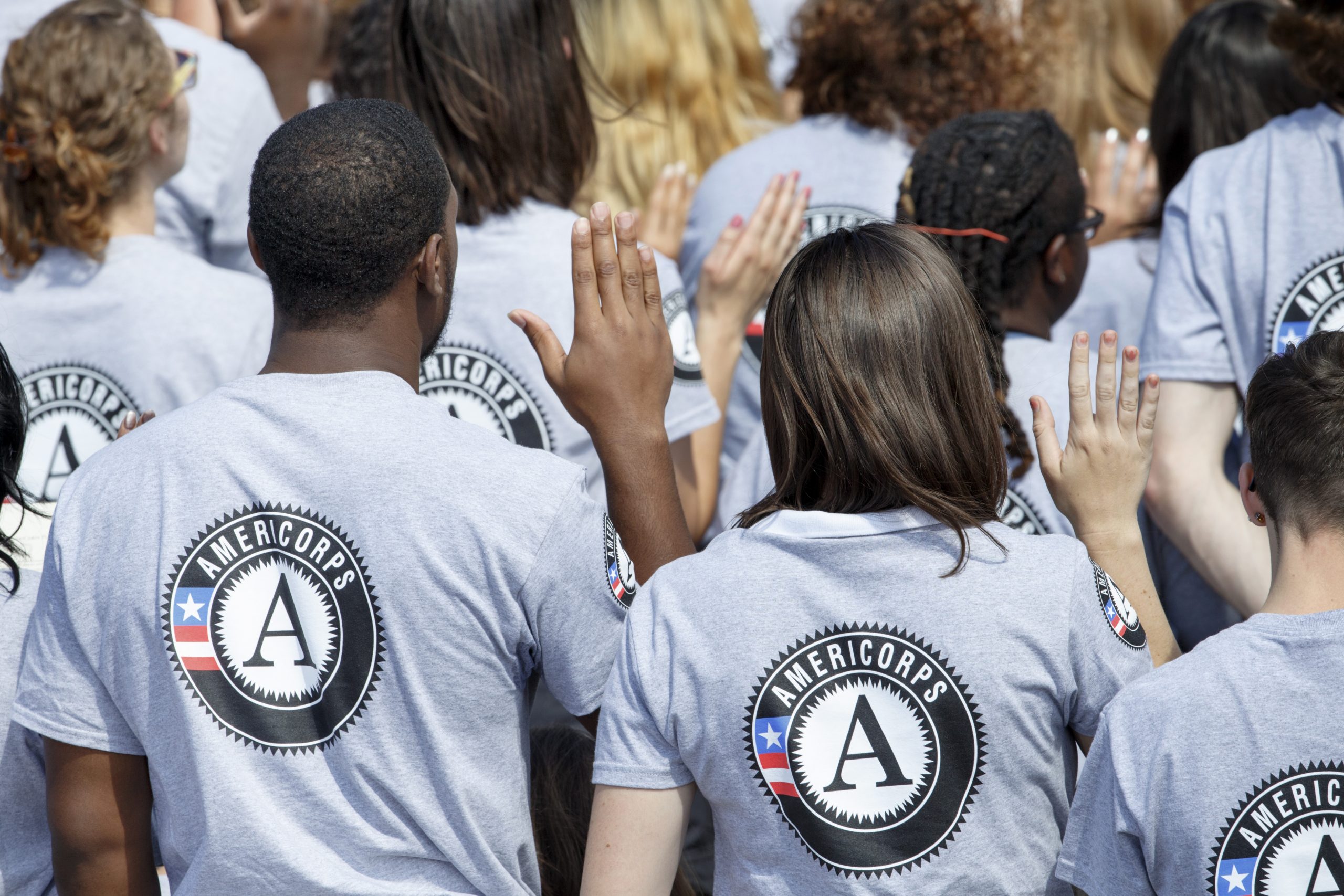
This story about AmeriCorps jobs was produced by The Hechinger Report, a nonprofit, independent news organization focused on inequality and innovation in education. Sign up for the Hechinger newsletter.
Lily Tegner didn’t know what she wanted to do when she graduated from Oregon State University with a chemical engineering degree five years ago. She entered the workforce at a point when unemployment briefly skyrocketed and companies were freezing hiring because of the Covid pandemic. “I didn’t have a very clear direction as far as where I was going in life,” she said.
Like hundreds of thousands of other young adults, Tegner kick-started her career through AmeriCorps, a federal agency that sends its members to communities across the country to tutor students, help after disasters strike and restore wildlife habitats, among other activities. She took a position at the Alaska Afterschool Network, where her job was to help find ways to expand science, technology, engineering and math access in its programs. Four years later, she’s still there — now, as a full-time employee managing the nonprofit’s AmeriCorps program.
“This state became my home,” Tegner said, adding that her year in AmeriCorps “completely changed the trajectory of my career.”
An AmeriCorps member poses with a student in one of the Alaska Afterschool Network’s funded programs. The organization lost its AmeriCorps funding last spring. Credit: Courtesy of Alaska Afterschool Network
This spring, Alaska Afterschool Network was one of hundreds of organizations abruptly notified that its AmeriCorps funding had been terminated. Federal funding cuts forced the nonprofit to eliminate three full-time positions and cancel 19 internships scheduled for this summer. Tegner’s job is also at risk, though the organization is trying to find a way to keep her on.
In late April, the Trump administration slashed 41 percent of AmeriCorps’ funding, cutting about $400 million in grants and letting go of more than 32,000 members serving in hundreds of programs across the United States. In June and also this month, judges ordered the government to restore some funding, but the ruling does not reinstate all the money that was taken away. Shrinking AmeriCorps is among the many steps the Trump administration has taken to curb what he has called “waste, fraud and abuse” of federal funds. More action is expected in the months ahead.
Related: Become a lifelong learner. Subscribe to our free weekly newsletter featuring the most important stories in education.
Over the years, the program former President Bill Clinton created has deployed more than a million people.On top of gutting AmeriCorps, the cuts have diminished the reach of an agency that has been a critical path to a career for recent high school and college graduates at a time when entry-level jobs can be difficult to find.
AmeriCorps was created more than three decades ago to oversee expanded federal volunteer programs, incorporating existing projects including Volunteers in Service to America and the National Civilian Community Corps. Its members take on community service positions across the country that can last for up to two years. They receive a small living stipend, and full-time members are eligible for health insurance. At the end of their terms, members are awarded a grant that can be used to pay college tuition or student loans.
“AmeriCorps dollars have a powerful ripple effect, for both the AmeriCorps members and the students that they serve,” said Leslie Cornfeld, founder and CEO of the National Education Equity Lab, a nonprofit that brings college courses to high-poverty schools. “In many instances, it helps them define their careers.”
About half of the AmeriCorps funding for the Philadelphia Higher Education Network for Neighborhood Development was cut this spring. Credit: Courtesy of PHENND
Federal surveys of AmeriCorps members from 2019, 2021 and 2023 show that 90 percent of members joined the national program in part to gain skills that would help them in school and work, and well over 80 percent said their experience in AmeriCorps helped further their “professional goals and endeavors.”
The Trump administration cited fraud as part of its reason for nearly halving the AmeriCorps budget. Audits of the agency have raised questions about its financial management.
Peter Fleckenstein, 23, joined Aspire Afterschool in Arlington, Virginia, through AmeriCorps last year after graduating from the University of Delaware with a degree in psychology. He saw AmeriCorps as a way to build out his resume; even the entry-level positions he encountered during his job search required experience in the field.
In his position at the after-school program, Fleckenstein leads daily activities for a group of about two dozen fourth grade students. The experience has helped him crystallize his career aspirations: Before AmeriCorps, he was considering clinical social work or teaching. Now, he wants to become a counselor.
“Working with the kids here is a lot of behavior management: problem solving, helping them regulate themselves,” Fleckenstein said. “Doing one-on-one work with them, building habits and routines with them — that is something that I could focus on more if I was in a counseling job.”
Fleckenstein’s position was cut in April before he could complete his one-year term set to end in August, but Aspire Afterschool was able to raise money through donations to hire him and some of the nonprofit’s other AmeriCorps members part-time to finish out their grant year.
The Philadelphia Higher Education Network for Neighborhood Development lost half of its AmeriCorps funding this past spring when the federal agency was slashed. Credit: Courtesy of PHENND
While some members have joined Americorps after graduating, student Deja Johnson, 24, joined as a way to help pay for college. Her term at The Scholarship Academy — a nonprofit in Atlanta helping low-income high school students navigate financial aid applications — was supposed to end with a $7,400 education grant. Because the terms were cut short, members have been told they’ll get only a prorated portion of the money.
“It’s a little bit of a shame,” said Johnson, who is using the education grant to pursue a bachelor’s degree in nonprofit leadership.
“That’s what a lot of us look forward to with this work that we’re doing, because we know how much of a sacrifice it can be at times. It’s that ‘pouring into our community’ — and that’s how our community pours into us,” Johnson said.
The AmeriCorps termination letters told grantees that their programs no longer met agency priorities, but the nonprofits were not told what those priorities are. Programs with different missions, in both Democratic- and Republican-led communities, were cut.
Sira Coulibaly, a member with the Philadelphia Higher Education Network for Neighborhood Development’s Next Steps AmeriCorps program, packs bags of food for the Metropolitan Area Neighborhood Nutrition Alliance. Credit: Courtesy of PHENND
The Hindman Settlement School, a nonprofit in rural Kentucky, was one victim of the cuts. The organization receives about $1 million a year from AmeriCorps for its program tutoring students with math and reading learning disabilities in more than two dozen schools. Losing that funding means drastically scaling back services, said Josh Mullins, senior director of operations at the Hindman Settlement School. He said he does not know why Hindman’s grants were terminated: The nonprofit regularly passes its audits, and its last annual report showed an average gain of seven months in reading levels among students in its dyslexia intervention program.
A statement published in January on an AmeriCorps webpage says the agency is in the process of “conducting a full review” to comply with President Donald Trump’s executive order banning diversity, equity and inclusion in federal programs. But Mullins and other AmeriCorps grantees said diversity, equity and inclusion efforts were not listed anywhere as part of their operations.
“That’s what’s devastating,” Mullins said. “It was completely out of our control. There was nothing you could do.”
The administration also gutted 85 percent of the agency’s federal staff, which has caused problems even for programs that are still receiving AmeriCorps funding.
The federal government terminated about half of the AmeriCorps grants for the Philadelphia Higher Education Network for Neighborhood Development. The group uses the funding to place members in local nonprofits and to help develop community partnerships in high-poverty schools. Director Hillary Kane said she’s been experiencing delays from the national AmeriCorps office in getting members approved for the programs that are still operating.
“We need the humans in D.C. to do the stuff that they do, so we can do the stuff that we do,” Kane said. “The person we communicate with isn’t there.”
About half of the AmeriCorps funding for the Philadelphia Higher Education Network for Neighborhood Development was cut this spring. Credit: Courtesy of PHENND
On June 5, a federal judge granted a temporary injunction ordering the Trump administration to restore AmeriCorps funding in states that had sued over the budget cuts. The lawsuit, which was filed by two dozen Democratic-led states in May, challenges the administration’s authority to cancel the funding without Congressional approval. But the judge’s injunction does not require the Trump administration to reinstate AmeriCorps’ federal employees, and funding is not being restored to programs in states that did not sign on to the lawsuit, including Alaska, home of the Alaska Afterschool Network, or Virginia, where Aspire Afterschool is based.
The Hindman Settlement School in Kentucky was one organization whose funding was restored this summer because of the lawsuit. Mullins said he’s hopeful the nonprofit will continue to receive AmeriCorps funding for the upcoming grant cycle in the fall.
For Kane, the injunction does not undo the chaos caused by the abrupt cancellation of half of her Philadelphia organization’s funding. Many terminated members that were with Kane’s organization have already moved on.
Programs whose grants were cut can apply again in the next grant cycle, but the president’s 2026 budget calls for shutting down AmeriCorps entirely.
While the debate in Washington rages, current and former volunteers mourn the potential loss of a program they said gave their lives meaning and led to employment. The avenue AmeriCorps provided for Tegner to start a career at the Alaska Afterschool Network gave her purpose in life, she said. She’s worried if the program ends, there won’t be another pathway on the same scale for young idealists who aren’t sure what they want to do with their lives.
“It helps young people of all ages grow and try new things,” Tegner said. “That’s very much what it was for me.”
Contact staff writer Ariel Gilreath on Signal at arielgilreath.46 or at [email protected].
The Hechinger Report provides in-depth, fact-based, unbiased reporting on education that is free to all readers. But that doesn’t mean it’s free to produce. Our work keeps educators and the public informed about pressing issues at schools and on campuses throughout the country. We tell the whole story, even when the details are inconvenient. Help us keep doing that.
The Trump administration moved quickly after taking office to open dozens of investigations into schools and universities nationwide. Most of those announced publicly mark a dramatic shift in priorities from previous administrations.
The Education Department and other agencies are looking into allegations of antisemitism and racial discrimination against white students at dozens of colleges. The agency also has begun investigating policies that protect transgender athletes and, in some cases, targeted entire state departments of education as part of that work.
Related: Become a lifelong learner. Subscribe to our free weekly newsletter featuring the most important stories in education.
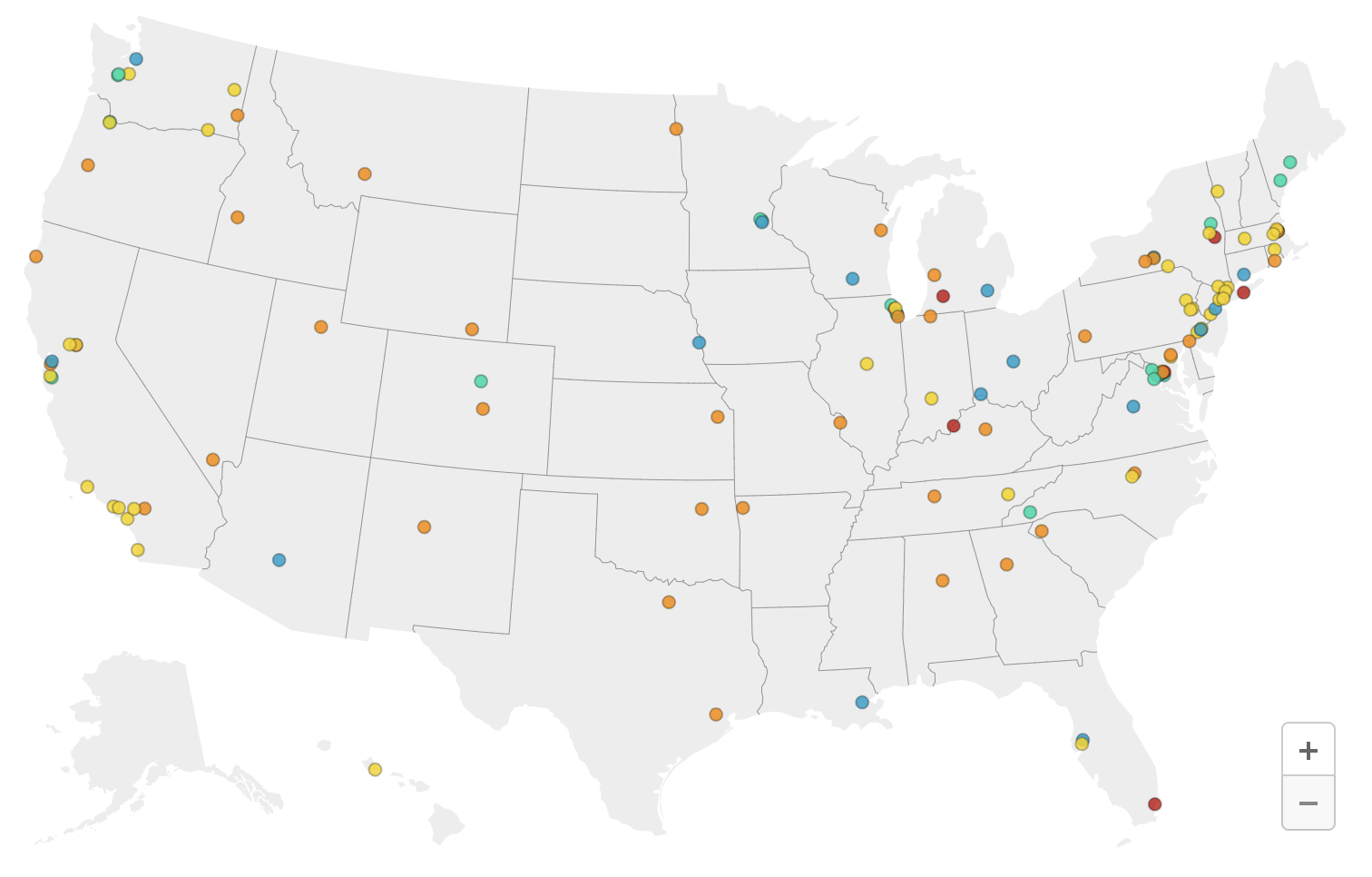
Here’s a look at investigations the Trump administration has announced. This map and list will be updated. Know of an investigation we missed? Tell us: [email protected].
Although the majority of investigations that have been opened are in states considered to be liberal, almost every state in the country has at least one entity under scrutiny. And many institutions face more than one investigation.
To date, colleges and universities have received the most attention from the administration, with more than 60 targeted over alleged incidents of antisemitism and another 45 under scrutiny over their work with a program that aims to increase diversity among Ph.D. candidates. Most of the K-12 investigations involve transgender policies, including those about access to sports and locker rooms.
Contact investigations editor Sarah Butrymowicz at [email protected] or on Signal: @sbutry.04
The Hechinger Report provides in-depth, fact-based, unbiased reporting on education that is free to all readers. But that doesn’t mean it’s free to produce. Our work keeps educators and the public informed about pressing issues at schools and on campuses throughout the country. We tell the whole story, even when the details are inconvenient. Help us keep doing that.
ALBUQUERQUE, N.M. — Maggi’s home in a suburban neighborhood here is a haven for local families. It’s a place where after just a few weeks in Maggi’s family-run child care program this spring, one preschooler started calling Maggi “mama” and Maggi’s husband “papa.” Children who have graduated from Maggi’s program still beg their parents to take them to her home instead of school.
Over the past few months, fewer families are showing up for care: Immigration enforcement has ramped up and immigration policies have rapidly changed. Both Maggi and the families who rely on her — some of whom are immigrants — no longer feel safe.
“There’s a lot of fear going on within the Latino community, and all of these are good people — good, hard-working people,” Maggi, 47, said in Spanish through an interpreter on a recent morning as she watched a newborn sleep in what used to be her living room. Since she started her own child care business two years ago, she has dedicated nearly every inch of her common space to creating a colorful, toy-filled oasis for children. Maggi doesn’t understand why so many immigrants are now at risk of deportation. “We’ve been here a long time,” she said. “We’ve been doing honest work.”
Immigrants like Maggi play a crucial role in home-based child care, as well as America’s broader child care system of more than 2 million predominantly female workers. (The Hechinger Report is not using Maggi’s last name out of concern for her safety and that of the families using her care.) Caregivers are notoriously difficult to find and keep, not only because the work is difficult, but because of poverty-level wages and limited benefits. Nationwide, immigrants make up nearly 20 percent of the child care workforce. In New York City, immigrants make up more than 40 percent of the child care workforce. In Los Angeles, it’s nearly 50 percent.
The Trump administration’s far-reaching war on immigration, which includes daily quotas for immigrant arrests, new restrictions on work permits and detainment of legal residents, threatens America’s already-fragile child care system. Immigrant providers, especially those who serve immigrant families, have been hit especially hard. Just like at Maggi’s, child care providers nationwide are watching families disappear from their care, threatening the viability of those businesses. In America, 1 in 4 children under the age of 6 has at least one foreign-born parent. Some kids who could benefit from experienced caregivers are now instead at home with older siblings or elderly relatives, losing out on socialization and kindergarten preparation. Some immigrant workers, regardless of status, are too scared to come to work, exacerbating staffing shortages. And in recent days, the administration announced that it would bar undocumented children from Head Start, the federally funded child care program for children from low-income families.
Related: Young children have unique needs and providing the right care can be a challenge. Our free early childhood education newsletter tracks the issues.
“Anti-immigrant policy can and will weaken our entire caregiving infrastructure,” said Karla Coleman-Castillo, senior policy analyst at the National Women’s Law Center. Home-based programs in particular will feel the squeeze, she said, since they tend to serve more immigrant families. “Anything that threatens the stability of families’ ability and comfort accessing early childhood education — and educators’ comfort entering or remaining in the workforce — is going to impact an already precarious sector.”
For Maggi, the fallout has been swift. In February, just a few weeks after the first changes were announced, her enrollment dropped from as many as 15 children each day to seven. Some families returned to Mexico. Others became too nervous to stray from their work routes for even a quick drop off. Some no longer wanted to give their information to the state to get help paying for care.
Maggi plays with a child in the back yard of her child care program. Maggi runs one of a few child care programs that provides 24/7 care in her town. Credit: Jackie Mader/The Hechinger Report
By May, only two children, an infant and a 4-year-old, were enrolled full time, along with six kids who came for before- or after-school care. She accepts children who pay privately and those who pay with child care subsidies through the state program for low-income children. She brings in about $2,000 a month for the infant and preschooler, and a couple hundred more each week for after-school care — down significantly from the $9,000 to $10,000 of late 2024. For parents who don’t receive a state subsidy, she keeps her rates low: less than $7 an hour. “They tell me that I’m cheap,” Maggi said with a slight smile. But she isn’t willing to raise her rates. “I was a single mom,” she said. “I remember struggling to find someone to care for my children when I had to work.”
Like many child care providers who emigrated to the United States as adults, Maggi started her career in an entirely different field. As a young mother, Maggi earned a law degree from a college in Mexico and worked in the prosecutor’s office in the northern Mexico state of Coahuila. Her job required working many weekends and late evenings, which took a toll on her parenting as a single mother. “I really feel bad that I was not able to spend more time with my daughters,” she added. “I missed a lot of their childhood.”
For a year when her girls were in elementary school, Maggi enrolled them in a boarding school, dropping them off Sunday nights and picking them up Friday afternoons. On some weekends, she took the girls to her office, even though she knew it wasn’t a place for children. Maggi longed for a different job where she could spend more time with them.
She started thinking seriously of emigrating about 15 years ago, as violence escalated. Her cousin was kidnapped and police officers she worked with were killed. Maggi received death threats from criminals she helped prosecute. Then one day, she was stopped by men who told her they knew where she lived and that she had daughters. “That’s when I said, this is not safe for me.”
In 2011, Maggi and the girls emigrated to America, bringing whatever they could fit into four suitcases. They ended up in El Paso, Texas, where Maggi sold Jell-O and tamales to make ends meet. Three years later, they moved here to Albuquerque. Maggi met her husband and they married, welcoming a son, her fourth child, shortly after.
In Albuquerque, Maggi settled into a life of professional caregiving, which came naturally and allowed her to spend more time with her family than she had in Mexico. She and her husband went through an intensive screening process and became foster parents. (New Mexico does not require individuals to have lawful immigration status to foster.) Maggi enrolled her youngest in a Head Start center, where administrators encouraged her to start volunteering. She loved being in the classroom with children, but without a work permit could not become a Head Start teacher. Instead, after her son started elementary school, she started offering child care informally to families she knew. Maggi became licensed by the state two years ago after a lengthy process involving several inspections, a background check and mandatory training in CPR and tenets of early childhood care.
It didn’t take long for Maggi to build up a well-respected business serving an acute need in Albuquerque. Hers is one of few child care programs in the area that offers 24/7 care, a rarity in the industry despite the desperate need. The parents who rely on her are teachers, caregivers for the elderly and people answering 911 calls.
In Maggi’s living room, carefully curated areas allow children to move freely between overflowing shelves of colorful toys, art supplies parked on a miniature table and rows of books. Educational posters on her walls reinforce colors, numbers and shapes. She delights in exposing the children to new experiences, frequently taking them on trips to grocery stores or restaurants. She is warm, but has high expectations for the children, insisting they clean up after themselves, follow directions and say “please” and “thank you.”
“I want them to have values,” Maggi said. “We teach them respect toward animals, people and each other.”
By the end of 2024, Maggi’s business was flourishing, and she looked forward to continued growth.
Data has yet to be released about the extent to which the current administration’s immigration policies have affected the availability of child care. But interviews with child care providers and research hint at what may lie ahead — and is already happening.
After a 2008 policy allowed Immigration and Customs Enforcement to check the immigration status of people taken into custody by local police, there was a marked decline in enrollment in child care among both immigrant and non-immigrant children. There was also a decrease in the supply of child care workers. Even though women were the minority of those deported, researchers found the policy sparked fear in immigrant communities, and many pulled back from their normal routines.
In the child care sector, that’s problematic, experts say. Immigrants in the industry tend to be highly educated and skilled at interacting with children positively, more so even than native workers. If a skilled portion of the workforce is essentially “purged” because they’re too afraid to go to work, that will lower the quality of child care, said Chris Herbst, an associate professor at Arizona State University who has studied immigration policy’s effect on child care. “Kids will be ill-served as a result.”
On a recent morning, Maggi stood in her living room, wearing white scrubs adorned with colorful cartoon ladybugs. Last year, the room would have been buzzing with children. Now, it’s quiet, save for chatter from Kay, the sole preschooler in her care each day. (The Hechinger Report is not using Kay’s full name to protect her privacy.) While Kay sat at a table working on a craft, Maggi cradled the infant, who had just woken up from a nap. The baby’s eyes were latched onto Maggi’s face as she fawned over him.
“Hello little one!” she cooed in Spanish. He cracked a smile and Maggi’s face lit up.
As one of her daughters took over to feed the newborn, Maggi followed Kay outside. The preschooler bounced around from the sandbox to the swings to a playhouse, with Maggi diligently following and playing alongside her.
Advocates and experts say upticks in immigration enforcement can cause stress and trauma for young children. In America, 1 in 4 children under the age of 6 has at least one foreign-born parent. Credit: Jackie Mader/The Hechinger Report
Finally Kay came to a standstill, resting her head against Maggi’s hip. Maggi gently patted her head and asked if she was ready to show off her pre-kindergarten skills. The pair sat down at a small table in the shade and Kay watched eagerly as Maggi poured out small plastic trinkets. Kay pulled three plastic toy turtles into a pile. “Mama, look! They’re friends!” Kay said, giggling.
Kay came to Maggi’s program after her mother pulled her out of another program where she felt the girl wasn’t treated well. Here, Kay is so happy, she hides when her mom comes back to get her. Still, a key aspect of the child care experience is missing for Kay. Normally, the girl would have several friends her own age to play with. Now when she is asked who her friends are, she names Maggi’s adult daughters.
Maggi worries even more about the children she doesn’t see anymore. Most are cared for by grandparents now, but those relatives are unlikely to know how to support child development and education, Maggi said. Many are unable to run around with the children like she does, and are more likely to turn to tablets or televisions for them.
She has seen the effects in children who leave her program and come back later having regressed. “Some of them are doing things well with me, and then when they come back, they have fallen behind,” she said. One child Maggi used to care for, for example, had just started to walk when the mother pulled them out of full-time care earlier this year, at the start of the immigration crackdown. In the care of a relative, Maggi found out they now spend much of the day sitting at home.
Before the second Trump administration began, the child care landscape looked bright in New Mexico, a state with a chronically high child poverty rate. In 2022, New Mexico started rolling out a host of child care policy changes. Voters approved a constitutional amendment guaranteeing a right to early childhood education, with sustained funding to support it. The state now allows families earning up to 400 percent of the federal poverty level, or nearly $125,000 a year, to qualify for free child care. That includes the majority of households in the state. Among the other changes: Providers are now paid more for children they enroll via the state’s assistance program.
The increase has been helpful for many providers, including Maggi. Before the pandemic, she received about $490 a month from the state for each preschooler enrolled in her program, compared to $870 a month now. If she enrolls infants who qualify for child care assistance, she gets paid $1,100 a month, nearly $400 more than pre-pandemic. She needs children enrolled to get the payments, however. Running her program 24 hours a day, seven days a week helps. She earns extra money from the state when caring for children evenings and weekends, and she is paid monthly to cover the cost of housing foster children.
Child care advocates in New Mexico are concerned that immigration policy will affect the industry’s progress. “I am worried because we could be losing early childhood centers that could help working families,” said Maty Miranda, an organizer for OLÉ New Mexico, a nonprofit advocacy organization. “We could lose valuable teachers and children will lose those strong connections.” Immigration crackdowns have had “a huge impact emotionally” on providers in the state, she added.
State officials did not respond to a request for data on how many child care providers are immigrants. Across the state, immigrants account for about 13 percent of the entire workforce.
Many local early educators are scared due to more extreme immigration enforcement, as are the children in their care, Miranda said. They are trying to work regardless. “Even with the fear, the teachers are telling me that when they go into their classrooms, they try to forget what’s going on outside,” she added. “They are professionals who are trying to continue with their work.”
Maggi said she’s so busy with the children who remain in her care that there is no extra time to work an additional job and bring in more income. She won’t speculate on how long her family can survive, instead choosing to focus on the hope that things will improve.
Maggi’s biggest fear at the moment is the well-being of the children of immigrants she and so many other home-based providers serve. She knows some of her kids and families are at risk of being detained by ICE, and that interactions like that, for kids, can lead to post-traumatic stress disorder, disrupted brain development and behavior changes. Some of Maggi’s parents have left her with emergency numbers in case they are detained by immigration officials.
Many of the children Maggi cares for after school are old enough to understand that deportation is a threat. “They show fear, because their parents are scared,” Maggi said. “Children are starting to live with that.”
Amid the dizzying policy changes, Maggi is trying to keep looking forward. She is working on improving her English skills. Her husband is pursuing a credential to be able to help more in her program. All three of her daughters are studying to become early childhood educators, with the goal to join the family business. Eventually, she wants to serve pre-K children enrolled in the state’s program, which will provide a steady stream of income.
In spite of all the uncertainty, Maggi said she is sustained by a bigger purpose. “I want them to enjoy their childhood,” she said on a sunny afternoon, looking fondly at Kay as the girl flung her tiny pink shoes aside and hopped into a sandbox. It’s the type of childhood Maggi remembers from her earliest days in Mexico. Kay giggled with delight as Maggi crouched down and poured cool sand over the little girl’s feet. “Once you grow up, there’s no going back.”
The Hechinger Report provides in-depth, fact-based, unbiased reporting on education that is free to all readers. But that doesn’t mean it’s free to produce. Our work keeps educators and the public informed about pressing issues at schools and on campuses throughout the country. We tell the whole story, even when the details are inconvenient. Help us keep doing that.
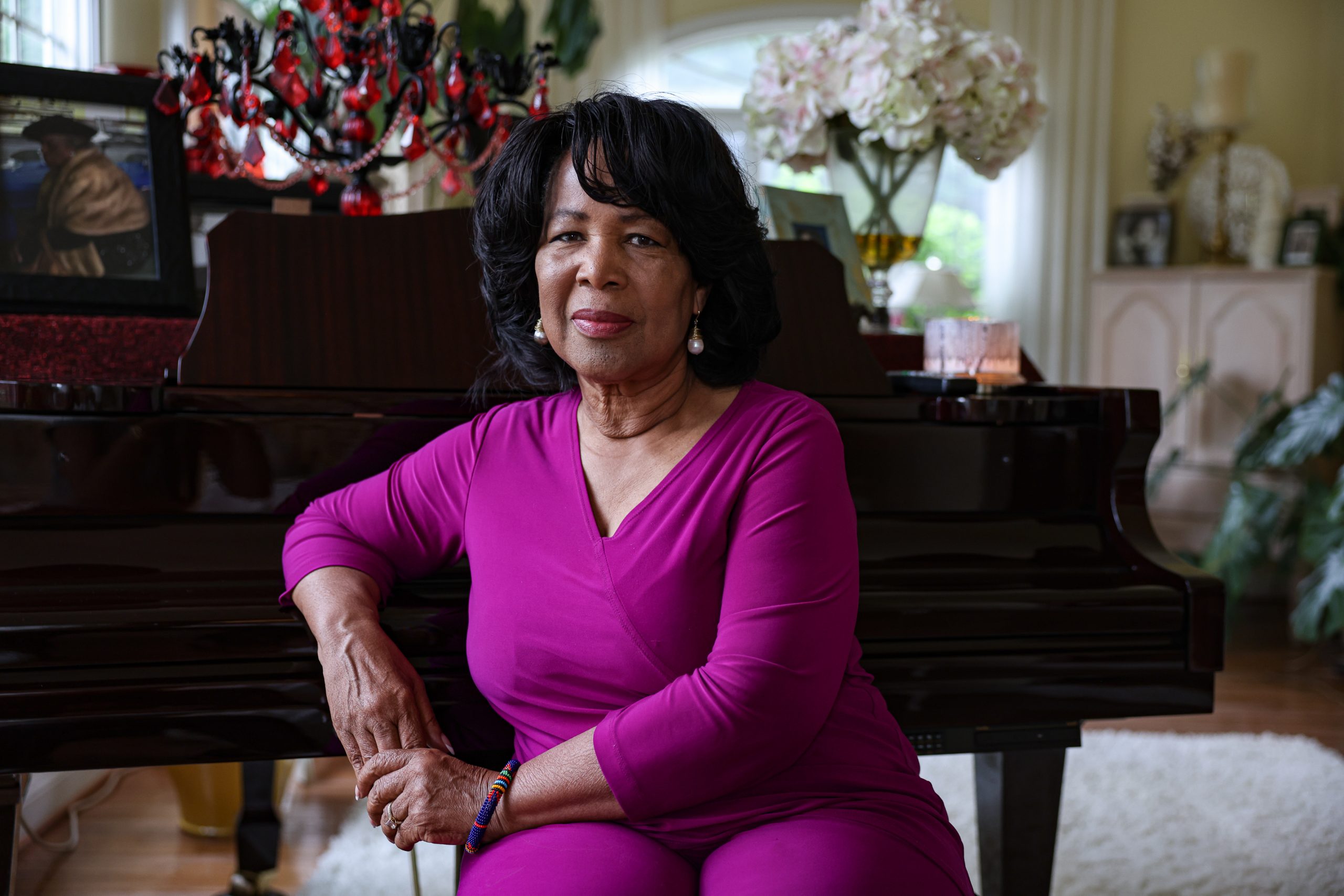
Peggy Carr, the former commissioner of the National Center for Education Statistics, at her Maryland home on July 1. Carr worked for the Education Department for more than 35 years before the Trump administration placed her on administrative leave on Feb. 24. Credit: Valerie Plesch for The Hechinger Report
Peggy Carr’s last day on the job came so abruptly that she only had time to grab a few personal photos and her coat before a security officer escorted her out of her office and into a chilly February afternoon. She still doesn’t know why she was summarily dismissed as commissioner of the National Center for Education Statistics (NCES), where she helped buildthe National Assessment of Educational Progress into the influential Nation’s Report Card. NCES is the federal government’s third-largest statistical agency after the Census Bureau and the Bureau of Labor Statistics. Running it for three and a half years was the capstone of Carr’s 35-year career at the Education Department.
And suddenly, she was out in the cold with no explanation.
“I would say that what has happened is a professional tragedy, not just for me, but for all of NCES and my staff,” said Carr, 71, in a recent interview. “But for me, it really was a personal tragedy because I have spent my career helping NCES build its solid reputation as a premier statistical agency in the federal system.”
Carr doesn’t know if the decision to fire her came from the White House, Elon Musk’s Department of Government Efficiency or an outside policy advocate.
But she is clear about what was lost by the firing of the head of a nonpartisan statistical agency: an objective assessment of how American students are doing. And she finds it “ironic,” she said, that her increasingly grim reports were President Donald Trump’s public rationale for dismantling the Education Department.
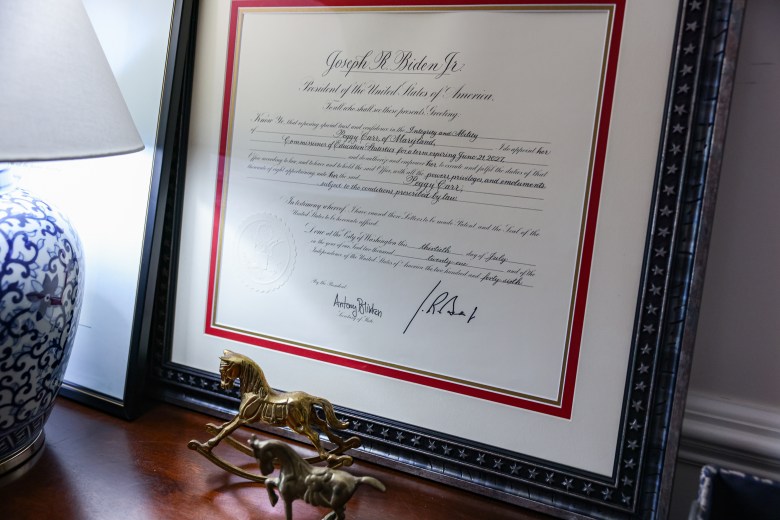
Although Carr was the first woman and the first Black person to run NCES, her “firsts” go back decades. She joined NCES in 1993, after teaching statistics at Howard University and a stint as a statistician in the Education Department’s Office of Civil Rights. “I was the first person of color in NCES to ever have a managerial job, period,” said Carr. She broke a long record: The education statistical agency dates back to 1867, created in the aftermath of the Civil War as part of an effort to help the South recover during Reconstruction. She was appointed commissioner by former President Joe Biden in 2021.
Related: Our free weekly newsletter alerts you to what research says about schools and classrooms.
“It’s a kill-the-messenger strategy,” she said. “We have just been the messenger of how students in this country are faring.”
Congress established a six-year term for the commissioner so that the job would straddle administrations and insulate statistics from politics. Carr’s term was supposed to extend through 2027, but she made history with yet another first: the first NCES commissioner to be fired by a president.
Carr wasn’t thinking about her gender or her race, despite the fact that three days earlier, Trump had abruptly fired another Black senior official, Gen. Charles Q. Brown Jr., the chairman of the Joint Chiefs of Staff. “Maybe they found out I was the only Biden appointee left in the department,” Carr said. “Maybe they didn’t realize that until then.”
Carr has reason to be puzzled by her firing. She is hardly a radical. She defended standardized tests against charges that they are racist. She publicly made the case that the nation needs to pay attention to achievement gaps, even if it sometimes means putting a spotlight on the low achievement of Black and Hispanic students. “The data can reveal things about what people can do to improve it,” Carr said.
She was dismissed on Feb. 24, more than a week before Education Secretary Linda McMahon’s Senate confirmation on March 3. The department named Carr’s deputy, Chris Chapman, to act as her replacement, but subsequently fired him in a round of mass layoffs on March 11. The agency was then leaderless until July 7,when another senior department official was told to add NCES to his responsibilities.
Civil servant
In January, at the start of the second Trump administration, Carr thought her job was relatively safe. As a career civil servant, she’d worked with many Republican administrations and served as second in command under James “Lynn” Woodworth, whom Trump appointed as NCES commissioner in his first term. Both Woodworth and Carr say they had a good working relationship because they both cared about getting the numbers right. Indeed, Woodworth was so troubled and disturbed by Carr’s dismissal and the fate of the nation’s education statistics agency that he spoke out publicly, risking retaliation.
Even Carr’s fiercest critics, who contend she was an entrenched bureaucrat who failed to modernize the statistical service and allowed costs to balloon, condemned the humiliating way she was dismissed.
“She deserves the nation’s gratitude and thanks” for setting up a whole system of assessments, said Mark Schneider, who served as the director of the Institute of Education Sciences (IES), which oversees NCES, from 2018 to 2024 and as NCES commissioner from 2005 to 2008.
The official appointment of Peggy Carr as commissioner of the National Center for Education Statistics by former President Joe Biden. Credit: Valerie Plesch for The Hechinger Report
A landing team
The transition seemed normal at first. A “landing team” — emissaries from the Trump transition team — arrived in mid-January and Carr briefed them three times. They asked questions about NCES’s statistical work. “They were quite pleasant, to be honest,” Carr said. “They seemed curious and interested.”
Days later, DOGE arrived. Still, Carr wasn’t worried. “We actually thought we were going to be OK,” Carr said. “We thought that their focus was going to be on grants, not contracts.”
The Institute of Education Sciences had awarded millions of dollars in grants to professors and private-sector researchers to study ways to improve diversity and equity in the classroom — priorities that were now out of favor with the Trump team. Carr’s agency is housed under the IES umbrella, but Carr’s work didn’t touch upon any of that.
However, NCES has an unusual structure. Unlike other statistics agencies, NCES has never had many statisticians on staff and didn’t do much in-house statistical work. Because Congress put restrictions on its staffing levels, NCES had to rely on outside contractors to do 90 percent of the data work. Only through outside contractors was the Education Department able to measure academic achievement, count students and track university tuition costs. Its small staff of 100 primarily managed and oversaw the contracts.
Keyword searches
Following DOGE instructions, Carr’s team conducted keyword searches of DEI language in her agency’s contracts. “Everyone was asked to do that,” she said. “That wasn’t so bad. The chaotic part really started when questions were being asked about reductions in the contracts themselves.”
Carr said she never had direct contact with anyone on Musk’s team, and she doesn’t even know how many of them descended upon the Education Department. Her interaction with DOGE was secondhand. Matthew Soldner, acting director of IES, summoned Carr and the rest of his executive team to his office to respond to DOGE’s demands. “We met constantly, trying to figure out what DOGE wanted,” Carr said. DOGE’s orders were primarily transmitted through Jonathan Bettis, an Education Department attorney, who was experienced with procurement and contracts. It was Bettis who talked directly with the DOGE team, Carr said.
The main DOGE representative who took an interest in NCES was “Conor.” “I don’t know his last name,” said Carr. “My staff never saw anyone else but Conor if they saw him at all.” Conor is 32-year-old Conor Fennessy, according to several media reports. His deleted LinkedIn profile said he has a background in finance. (Fennessy has also been involved in getting access to data at Health and Human Services and spearheading cuts at the National Park Service, according to media reports.) Efforts to reach Fennessy through the Education Department and through DOGE were unsuccessful.
“It was chaotic,” said Carr. “Bettis would tell us what DOGE wanted, and we ran away to get it done. And then things might change the next day. ‘You need to cut more.’ ‘I need to understand more about what this contract does or that contract does.’”
It was a lot. Carr oversaw 60 data collections, some with multiple parts. “There were so many contracts and there were hundreds of lines on our acquisition plans,” she said. “It was a very complex and time-consuming task.”
Lost in translation
The questions kept coming. “It was like playing telephone tag when you have complicated data collections and you’re trying to explain it,” Carr said. Bettis “would sometimes not understand what my managers or I were saying about what we could cut or could not cut. And so there was this translation problem,” she said. (Efforts to reach Bettis were unsuccessful.) Eventually a couple of Carr’s managers were allowed to talk to DOGE employees directly.
Carr said her staff begged DOGE not to cut a technology platform called EDPass, which is used by state education agencies to submit data to the federal Education Department on everything from student enrollment to graduation rates. For Carr, EDPass was a particular point of pride in her effort to modernize and process data more efficiently. EDPass slashed the time it took to release data from 20 months in 2016-17 to just four months in 2023-24.
Carr said DOGE did not spare EDPass. Indeed, DOGE did not spare much of NCES.
On Feb 10, only about a week after DOGE arrived, Carr learned that 89 of her contracts were terminated, which represented the vast majority of the statistical work that her agency conducts. “We were in shock,” said Carr. “What do you mean it’s all gone?”
Even its advocates concede that NCES needed reforms. The agency was slow to release data,it usedsomeoutdated collection methods and there were places where costs could be trimmed. Education Department spokesperson Madi Biedermann said that the department, “in partnership with DOGE employees,” found contracts with overhead and administrative expenses that exceeded 50 percent, “a clear example of contractors taking advantage of the American taxpayer.”
Piloting an old airplane
Carr said she was never a fan of the contracting system and wished she could have built an in-house statistical agency like those at the Census Bureau and the Bureau of Labor Statistics. But that would have required congressional authorization for the Education Department to increase its headcount. That never happened. Carr was piloting an old airplane, taped together through a complicated network of contracts, while attempting to modernize and fix it. She said she was trying to follow the 2022 recommendations of a National Academies panel, but it wasn’t easy.
The chaos continued over the next two weeks. DOGE provided guidelines for justifying the reinstatement of contracts it had just killed and Carr’s team worked long hours trying to save the data. Carr was particularly worried about preserving the interagency agreement with the Census Bureau, which was needed to calculate federal Title I allocations to high-poverty schools. Those calculations needed to be ready by June and the clock was ticking.
The DOGE sledgehammer came just as schools were administering an important international test — the Program for International Student Assessment (PISA). The department was also in the midst of a national teachers and principals survey. “People were worried about what was going to happen with those,” said Carr.
Even though DOGE terminated the PISA contract, the contractor continued testing in schools and finished its data collection in June. But now it’s unclear who will tabulate the scores and analyze them. The Education Department disclosed in a June legal brief that it is restarting PISA. “I was told that they’re not going to do the national report, which is a little concerning to me,” Carr said. Asked for confirmation, the Education Department did not respond.
Another widely used data collection, the Early Childhood Longitudinal Survey (ECLS-K 2024), which tracks a cohort of students from kindergarten through elementary school, was supposed to collect its second year of data as the kindergarteners progressed to first grade. “We had to give up on that,” said Carr.
NAEP anxiety
Carr said that behind the scenes, her priority was to save NAEP. DOGE was demanding aggressive cuts, and she worked throughout the weekend of Feb. 22-23with her managers and the NAEP contractors to satisfy the demands. “We thought we could cut 28 percent — I even remember the number — without cutting into critical things,” she said. “That’s what I told them I could do.”
DOGE had been demanding 50 percent cuts to NAEP’s $185 million budget, according to several former Education Department employees. Carr could not see a way to cut that deep. The whole point of the exam is to track student achievement over time, and if too many corners were cut, it could “break the trend,” she said, making it impossible to compare the next test results in 2026 with historical scores.
“I am responsible in statute and I could not cut NAEP as much as they wanted to without cutting into congressionally mandated activities,” Carr said. “I told them that.”
While Carr and DOGE remained far apart in negotiations over cost, a security officer appeared at her office door at 3:50 p.m. on Feb. 24. Carr remembers the exact time because colleagues were waiting at her door to join her for a 4 p.m. Zoom meeting with the chair of the board that oversees NAEP.
The security officer closed the door to her office so he could tell her privately that he was there to escort her out. He said she had 15 minutes to leave. “Escort me where? What do you mean?” Carr asked. “I was in shock. I wasn’t even quite understanding what he was asking, to be honest.”
The security officer told her about an email saying she was put on administrative leave. Carr checked her inbox. It was there, sent within the previous hour.
The security officer “was very nice,” she said. “He refused to call me Peggy,” and addressed her as Dr. Carr. “He helped me collect my things, and I left.” He opened the doors for her and walked her to her car.
“I had no idea that this was going to happen, so it was shocking and unexpected,” Carr said. “I was working like I do every other day, a busy day where every minute is filled with something.”
She said she’s asked the department why she was dismissed so abruptly, but has not received a response. The Education Department said it does not comment to the public on its personnel actions.
Packing via Zoom
Two days later, Carr returned to pick up other belongings. Via Zoom, Carr’s staff had gone through her office with her — 35 years worth of papers and memorabilia — and packed up so many boxes that Carr had to bring a second car, an SUV.
When Carr and her husband arrived, she said, “there were all these people waiting in the front of the building cheering me on. The men helped me put the things in my husband’s car and my car. It was a real tearjerker. And that was before they would be dismissed. They didn’t know they would be next.”
Less than two weeks later, on March 11, most of Carr’s staff — more than 90 NCES staffers — was fired. Only three remained. “I thought maybe they just made a mistake, that it was going to be a ‘whoops moment’ like with the bird flu scientists or the people overseeing the weapons arsenal,” Carr said.
The fate of NCES remains uncertain. The Education Department says that it is restarting and reassessing some of the data collections that DOGE terminated, but the scope of the work might be much smaller. Carr says it will take years to understand the full extent of the damage. Carr was slated to issue a statement about her thoughts on NCES on July 14.
The damage
The immediate problem is that there aren’t enough personnel to do the work that Congress mandates. So far, NCES has missed an annual deadline for delivering a statistical report to Congress — a deadline NCES had “never, ever missed” in its history, Carr said — and failed to release the 2024 NAEP science test scores in June because there was no commissioner to sign off on them. But the department managed to calculate the Title I allocations to high-poverty schools “in the nick of time,” Carr said.
In addition to the collection of fresh data, Carr is concerned about the maintenance of historical datasets. When DOGE canceled the contracts, Carr counted that NCES had 550 datasets scattered in different locations. NCES doesn’t have its own data warehouse and Carr was trying to corral and store the datasets. She’s worried about protecting privacy and student confidentiality.
An Education Department official said that this data is safe and will soon be transferred to IES’s secure servers.
Peggy Carr holds artwork made by a former colleague at the National Center for Education Statistics. NAEP stands for the National Assessment of Educational Progress, which Carr helped build into the influential barometer of how American students are faring. Credit: Valerie Plesch for The Hechinger Report
In the meantime, Carr says she plans to stay involved in education statistics — but from the outside. “With this administration wanting to push education down to the states, there are opportunities that I see in my next chapter,” Carr said. She said she’s been talking with states and school districts about calculating where they rank on an international yardstick.
Carr is in close touch with her former team. In May, 50 of them gathered at a church in Virginia to commiserate. A senior statistician gave Carr a homespun plaque of glued blue buttons spelling the letters NAEP with a shiny gold star above it. It was a fitting gift. NAEP is regarded as the best designed test in the country, the gold standard. Carr built that reputation, and now it has gone home with her.
This story about Peggy Carr was written by Jill Barshay and produced by The Hechinger Report, a nonprofit, independent news organization focused on inequality and innovation in education. Sign up for Proof Points and other Hechinger newsletters.
The Hechinger Report provides in-depth, fact-based, unbiased reporting on education that is free to all readers. But that doesn’t mean it’s free to produce. Our work keeps educators and the public informed about pressing issues at schools and on campuses throughout the country. We tell the whole story, even when the details are inconvenient. Help us keep doing that.
DES MOINES, Iowa — Macon Smith stood in front of a nearly empty classroom 1,000 miles from home. He asked his opponent and the two judges in the room if they were ready to start, then he set a six-minute timer and took a deep breath.
“When tyranny becomes law, rebellion becomes duty,” he began.
In front of Macon, a 17-year-old high school junior, was a daunting task: to outline and defend the argument that violent revolution is a just response to political oppression.
In a few hours, Macon would stand in another classroom with new judges and a different opponent. He would break apart his entire argument and undo everything he had just said.
“An eye for an eye makes the whole world blind,” Macon started.
It doesn’t really matter what opinion Macon holds on violence or political oppression. In this moment in front of the judges, he believes what he’s saying. His job is to get the judges to believe with him.
Macon was one of more than 7,000 middle and high school students to compete in the National Speech and Debate Tournament this summer in Iowa, run by an organization that is celebrating a century in existence.
In that time, the National Speech and Debate Association has persevered through economic and social upheaval. It is entering its next era, one in which the very notion of engaging in informed and respectful debate seems impossible. The organizers of this event see the activity as even more important in a fracturing society.
“I don’t think there’s an activity in the world that develops empathy and listening skills like speech and debate,” said Scott Wunn, the organization’s president. “We’re continuing to create better citizens.”
Macon Smith, a rising senior from Bob Jones Academy in South Carolina, competes in the third round of the Lincoln-Douglas Debate at the National Speech and Debate Tournament in Iowa this summer. Credit: Meenakshi Van Zee for The Hechinger Report
Though the tournament is held in different cities around the country, for the 100th anniversary, the organizers chose to host it in Des Moines, where the association’s headquarters is based.
Preparing for this competition was a year in the making for Macon, who will be a senior at Bob Jones Academy, a Christian school in Greenville, South Carolina, this fall. Students here compete in more than two dozen categories, such as Original Oratory, in which they write and recite their own 10-minute speeches, or Big Questions, where they attempt to argue broad, philosophical ideas.
Macon’s specialty, the Lincoln-Douglas Debate, is modeled after a series of public, three-hour debates between Abraham Lincoln and Sen. Stephen Douglas in 1858. In this event, two students have just 40 minutes to set up their arguments, cross-examine each other and sway the judges.
“Even if I don’t personally believe it, I can still look at the facts and determine, OK, this is a good fact, or it’s true, and argue for that side,” Macon said.
Debaters often have to tackle topics that are difficult, controversial and timely: Students in 1927 debated whether there was a need for a federal Department of Education. In 1987, they argued about mandatory AIDS testing. In 2004, they debated whether the United States was losing the war on terror. This year, in the Public Forum division, students debated whether the benefits of presidential executive orders outweigh the harms.
While the speech and debate students practiced for their national event, adults running the country screamed over each other during a congressional hearing on state sanctuary policies. A senator was thrown to the floor and handcuffed during a press conference on sending the National Guard to immigration enforcement protests in Los Angeles. Most Americans feel political discourse is moving in the wrong direction — both conservatives and progressives say talking politics with someone they disagree with has become increasingly stressful and frustrating.
Speech and debate club, though, is different.
“First of all, it gives a kid a place to speak out and have a voice,” said Gail Nicholas, who for 40 years has coached speech and debate at Bob Jones Academy alongside her husband, Chuck Nicholas, who is Macon’s coach. “But then also learn to talk to other people civilly, and I think that’s not what’s being modeled out there in the real world right now.”
Macon Smith, a rising senior from Bob Jones Academy in South Carolina, shows off the notes that he took during debates at the National Speech and Debate Tournament in Iowa. Credit: Meenakshi Van Zee for The Hechinger Report
On the second day of the competition in a school cafeteria in West Des Moines, Macon was anxiously refreshing the webpage that would show the results of his rounds to learn whether he would advance to semifinals.
For most of the school year, Macon spent two days a week practicing after school, researching and writing out his arguments. Like many competitors, he has found that it’s easy to make snap judgments when you don’t know much about an issue. Decisively defending that view, to yourself and to others, is much harder.
“I tend to go in with an opinion and lose my opinion as the topic goes on,” said Daphne DiFrancesco, a rising senior from Cary Academy in Cary, North Carolina.
Traveling for regional events throughout the school year means Macon has become friends with students who don’t always share his conservative views. He knows this because in debate, discussing politics and religion is almost unavoidable.
“It doesn’t make me uncomfortable at all,” Macon said. “You don’t want to burn down a bridge before you make it with other people. If you stop your connection with a person right at their political beliefs, you’re already cutting off half of the country. That’s not a good way to conduct yourself.”
Macon, and other students in the clubs, said participating has made them think more deeply about their own beliefs. Last year, Macon debated a bill that would defund Immigration and Customs Enforcement, an agency he supports. After listening to other students, he developed a more nuanced view of the organization.
“When you look at the principle of enforcing illegal immigration, that can still be upheld, but the agency that does so itself is flawed,” he said.
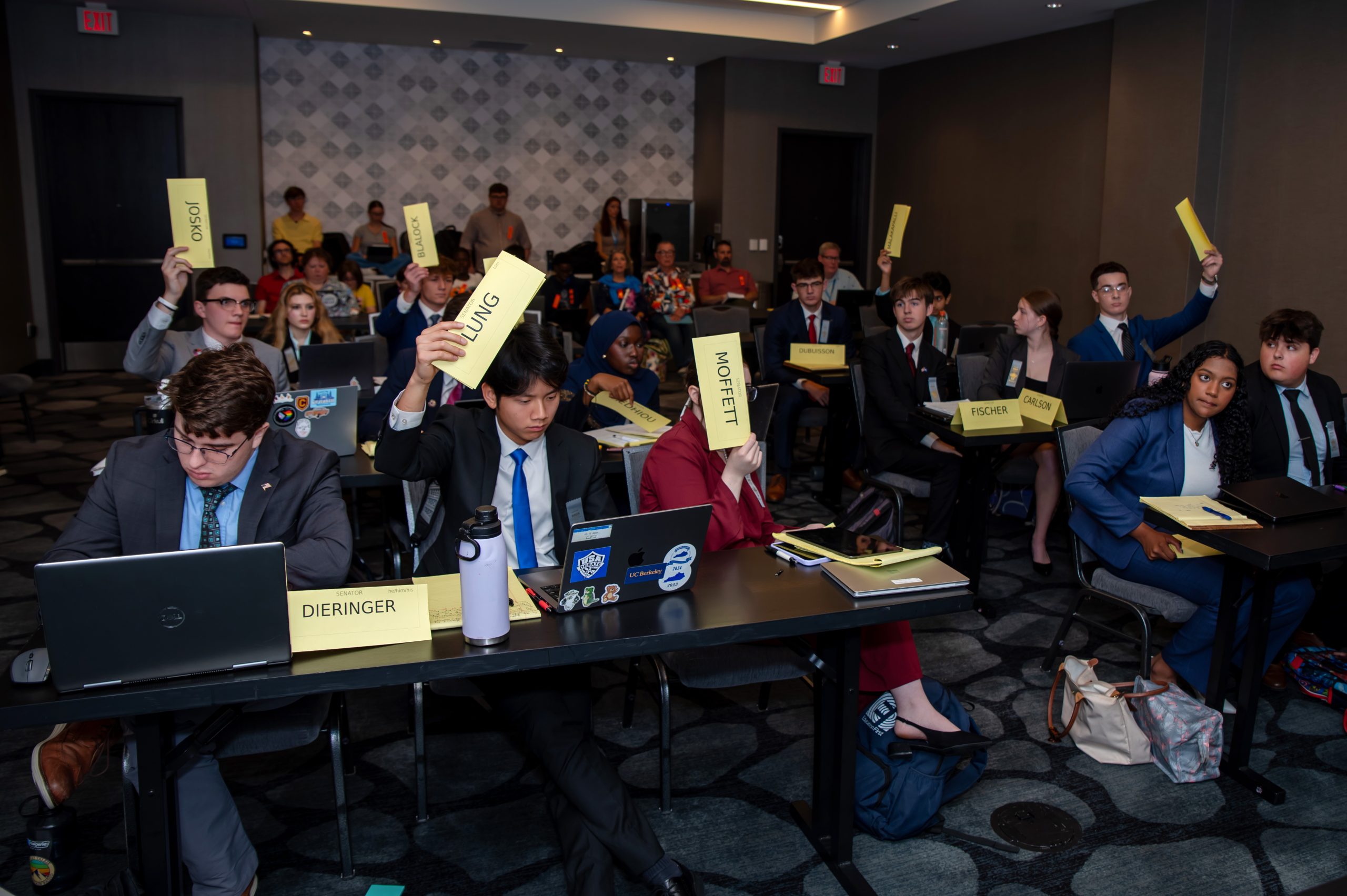
Henry Dieringer, a senior from L.C. Anderson High School in Austin, Texas, went into one competition thinking he would argue in favor of a bill that would provide work permits for immigrants, which he agrees with. Further research led him to oppose the idea of creating a federal database on immigrants.
“It made me think more about the way that public policy is so much more nuanced than what we believe,” Henry said.
On the afternoon of the second day of the national tournament, Macon learned he didn’t advance to the next round. What’s sad, he said, is he probably won’t have to think this hard about the justness of violent revolution ever again.
“There’s always next year,” Macon said.
Callista Martin, 16, a rising senior from Bainbridge High School in Washington state, also didn’t make the semifinals. Callista and Macon met online this year through speech and debate so they could scrimmage with someone they hadn’t practiced with before. It gave them the chance to debate someone with differing political views and argument styles.
Macon Smith, a rising senior from Bob Jones Academy in South Carolina, takes notes during a round of the Lincoln-Douglas Debate at the National Speech and Debate Tournament in Iowa. Credit: Meenakshi Van Zee for The Hechinger Report
“In the rounds, I’m an entirely different person. I’m pretty aggressive, my voice turns kind of mean,” Callista said. “But outside of the rounds, I always make sure to say hi to them before and after and say things I liked about their case, ask them about their school.”
Talking to her peers outside of rounds is perhaps the most important part of being in the club, Callista said. This summer, she will travel to meet with some of her closest friends, people she met at debate camps and tournaments in Washington.
Since Callista fell in love with speech and debate as a freshman, she has devoted herself to keeping it alive at her school. No teacher has volunteered to be a coach for the debate club, so the 16-year-old is coaching both her classmates and herself.
A lack of coaches is a common problem. Just under 3,800 public and private high schools and middle schools were members of the National Speech and Debate Association at the end of this past school year, just a fraction of the tens of thousands of secondary schools in the country. The organization would like to double its membership in the next five years.
That would mean recruiting more teachers to lead clubs, but neither educators nor schools are lining up to take on the responsibility, said David Yastremski, an English teacher at Ridge High School in New Jersey who has coached teams for about 30 years.
It’s a major time commitment for teachers to dedicate their evenings and weekends to the events with little supplemental pay or recognition. Also, it may seem like a risk to some teachers at a time when states such as Virginia and Louisiana have banned teachers from talking about what some call “divisive concepts,” to oversee a school activity where engaging with controversial topics is the point.
“I primarily teach and coach in a space where kids can still have those conversations,” Yastremski said. “I fear that in other parts of the country, that’s not the case.”
Dennis Philbert, a coach from Central High School in Newark, New Jersey, who had two students become finalists in the tournament’s Dramatic Interpretation category, said he fears for his profession because of the scrutiny educators are under. It takes the fun out of teaching, he said, but this club can reignite that passion.
“All of my assistant coaches are former members of my team,” Philbert said. “They love this activity [so much] that they came back to help younger students … to show that this is an activity that is needed.”
On the other side of Des Moines, Gagnado Diedhiou was competing in the Congressional Debate, a division of the tournament that mimics Congress and requires students to argue for or against bills modeled after current events. During one round, Gagnado spoke in favor of a bill to shift the country to use more nuclear energy, for a bill that would grant Puerto Rico statehood, and against legislation requiring hospitals to publicly post prices.
Gagnado Diedhiou, a senior from Eastside High School in South Carolina, competing in the first round of the Congressional Debate at the National Speech and Debate Tournament in Iowa in June. Credit: Meenakshi Van Zee for The Hechinger Report
Just like in Congress, boys outnumbered girls in this classroom. Gagnado was the only Black teenager and the only student wearing a hijab. The senior, who just graduated from Eastside High School in Greenville, South Carolina, is accustomed to being in rooms where nobody looks like her — it’s part of the reason she joined Equality in Forensics, a national student-led debate organization that provides free resources to schools and students across the country.
“It kind of makes you have to walk on eggshells a little bit. Especially because when you’re the only person in that room who looks like you, it makes you a lot more obvious to the judges,” said Gagnado, who won regional Student of the Year for speech and debate in her South Carolina district this year. “You stand out, and not always in a good way.”
Camille Fernandez, a rising junior at West Broward High School in Florida, said the competitions she has participated in have been dominated by male students. One opponent called her a vulgar and sexist slur after their round was over. Camille is a member of a student-led group — called Outreach Debate — trying to bridge inequities in the clubs.
“A lot of people think that debate should stay the same way that it’s always been, where it’s kind of just — and this is my personal bias — a lot of white men winning,” Camille said. “A lot of people think that should be changed, me included.”
Despite the challenges, Gagnado said her time in debate club has made her realize she could have an influence in the world.
“With my three-minute speech, I can convince a whole chamber, I can convince a judge to vote for this bill. I can advocate and make a difference with some legislation,” said Gagnado, who is bound for Yale.
About 10,000 people attended the National Speech and Debate Tournament in Iowa this June during the organization’s centennial anniversary. Credit: Meenakshi Van Zee for The Hechinger Report
A day before the national tournament’s concluding ceremony, a 22-year-old attendee rushed the stage at the Iowa Event Center in Des Moines during the final round of the Humorous Interpretation speech competition, scaring everyone in the audience. After he bent down to open his backpack, 3,000 people in the auditorium fled for the exits. The man was later charged with possession of a controlled substance and disorderly conduct. For a brief moment, it seemed like the angry discourse and extreme politics from outside of the competition had become a part of it.
In response, the speech and debate organization shifted the time of some events, limited entrances into the building and brought in metal detectors, police officers and counselors. Some students, Gagnado among them, chose not to return to the event.
Still, thousands of attendees stayed until the end to celebrate the national champions. During the awards ceremony, where therapy dogs roamed the grounds, Angad Singh, a student from Bellarmine College Preparatory in California competing in Original Oratory, took the national prize for his speech on his Sikh identity and the phrase “thoughts and prayers” commonly repeated by American leaders after a tragedy, titled “Living on a Prayer.”
“I’ve prayed for change,” Singh told the audience. “Then I joined speech and debate to use my voice and fight for it.”
The Hechinger Report provides in-depth, fact-based, unbiased reporting on education that is free to all readers. But that doesn’t mean it’s free to produce. Our work keeps educators and the public informed about pressing issues at schools and on campuses throughout the country. We tell the whole story, even when the details are inconvenient. Help us keep doing that.
ELKHART, Ind. — Ever since Ty Zartman was little, people told him he had to go to college to be successful. “It was engraved on my brain,” he said.
But despite earning straight A’s, qualifying for the National Honor Society, being voted prom king and playing on the high school football and baseball teams, the teen never relished the idea of spending another four years in school. So in fall 2023 he signed up through his Elkhart, Indiana, high school for an apprenticeship at Hoosier Crane Service Company, eager to explore other paths. There, he was excited to meet coworkers who didn’t have a four-year degree but earned good money and were happy in their careers.
Through the youth apprenticeship, Ty started his day at the crane manufacturing and repair business at 6:30 a.m., working in customer service and taking safety and training courses while earning $13 an hour. Then, he spent the afternoon at his school, Jimtown High, in Advanced Placement English and U.S. government classes.
In June, the 18-year-old started full-time at Hoosier Crane as a field technician.
“College is important and I’m not dissing on that,” Ty said. “But it’s not necessarily something that you need.”
Elkhart County is at the forefront of a movement slowly spreading across Indiana and the nation to make apprenticeships a common offering in high school.
In 2019, as part of a plan to boost the region’s economic prospects, county leaders launched an effort to place high schoolers in apprenticeships that combine work-based training with classroom instruction. About 80 students from the county’s seven school districts participated this academic year, in fields such as health care, law, manufacturing, education and engineering. In April, as part of a broader push to revamp high school education and add more work-based learning, the state set a goal of 50,000 high school apprentices by 2034.
Tim Pletcher, the principal of Jimtown High, said students are often drawn first to the chance to spend less time in class. But his students quickly realize apprenticeships give them work-based learning credits and industry connections that help them after graduation. They also earn a paycheck. “It’s really causing us to have a paradigm shift in how we look at getting kids ready for the next step,” he said.
Related: Become a lifelong learner. Subscribe to our free weekly newsletter featuring the most important stories in education.
This “earn and learn” model is taking hold in part because of deepening disillusionment with four-year college, and the fact that well-paying jobs that don’t require bachelor’s degrees are going unfilled nationally. The past three presidential administrations invested in expanding apprenticeships, including those for high schoolers, and in April, President Donald Trump signed an executive order calling for 1 million new apprentices. In a recent poll, more than 80 percent of people said they supported expanding partnerships between schools and businesses to provide work-based learning experiences for students.
Yet in the United States, the number of so-called youth apprenticeships for high schoolers is still “infinitesimally small,” said Vinz Koller, a vice president at nonprofit group Jobs for the Future. One estimate suggests they number about 20,000 nationally, while there are some 17 million high school students.By contrast, in Switzerland — which has been praised widely for its apprenticeship model, including by U.S. Education Secretary Linda McMahon — 70 percent of high schoolers participate. Indiana is among several states, including Colorado, South Carolina and Washington, that have embraced the model and sent delegations to Switzerland to learn more.
Elkhart, Indiana, known as the “RV capital of the world,” saw widespread unemployment during the Great Recession. That led community leaders to focus on apprenticeships as a way to diversify their economy. Credit: Camilla Forte/The Hechinger Report
Experts including Ursula Renold, professor of education systems at the Swiss Federal Institute of Technology (ETH) Zurich, note that importing the model to the United States at a large scale won’t be simple. Most businesses aren’t accustomed to employing apprentices, parents can be resistant to their students trading four-year college aspirations for work, and public transportation to take students to apprenticeships is limited, especially in rural areas. Many high schoolers don’t have a driver’s license, access to a car or money for gas. School districts already face a shortage of bus drivers that makes transporting students to apprenticeships difficult or impossible.
Still, Renold, who is known as the “grande dame of apprenticeships,” said Indiana’s commitment to apprenticeships at the highest levels of state government, as well as the funding the state has invested in work-based learning, at least $67 million, seem to be setting the state up for success, though it could take a decade to see results.
“If I had to make a bet,” said Renold, “I would say it’s Indiana who will lead the way.”
Elkhart County’s experiment with apprenticeships has its roots in the Great Recession. Recreational vehicle manufacturing dominates the local economy, and demand for the vehicles plummeted, contributing to a regional unemployment rate at that time of nearly 20 percent. Soon after, community leaders began discussing how to better insulate themselves from future economic instability, eventually focusing on high school education as a way to diversify industries and keep up with automation, said Brian Wiebe, who in 2012 founded local nonprofit Horizon Education Alliance, or HEA, to help lead that work.
Elkhart County, Indiana, was the first community in Indiana to encourage businesses to employ high school students as apprentices, where they can earn work-based learning credits and make industry connections that help them, even if they decide to go on to college. Credit: Camilla Forte/The Hechinger Report
That year, Wiebe and two dozen local and state political, business, nonprofit and education leaders visited Switzerland and Germany to learn more about the apprenticeship model. “We realized in the U.S., there was only a Plan A, a path to college,” he recalled. “We were not supporting the rest of our young people because there was no Plan B.”
HEA partnered with Elkhart County school districts and businesses, as well as with CareerWise, a youth apprenticeship nonprofit that works nationally. They began rolling out apprenticeships in 2019, eventually settling on a goal of increasing participation by 20 percent each year.
In 2021, Katie Jenner, the new secretary of education for Indiana, learned about Elkhart’s apprenticeships as she was trying to revamp high school education in the state so it better prepared students for the workforce. Elkhart, as well as six other apprenticeship pilot sites funded by Indianapolis-based philanthropy the Richard M. Fairbanks Foundation, provided a proof of concept for the apprenticeship model, said Jenner.
In December, the state adopted a new diploma system that includes an emphasis on experiential and work-based learning, through apprenticeships, internships and summer jobs.
On a weekday this winter, 17 sophomores at Elkhart’s Concord High School were sitting at computers, creating resumes they planned to use to apply for apprenticeships. The students were among some 50 sophomores at the high school who’d expressed interest in apprenticing and met the school’s attendance and minimum 2.5 GPA requirements, out of a class of roughly 400. They would receive coaching and participate in mock interviews before meeting with employers.
Becca Roberts, a former English teacher who now oversees the high school’s college and career programs, said apprenticeships help convince students of the importance of habits like punctuality, clear communication and regular attendance. “It’s not from a book,” she said. “They’re dealing with real life.”
Becca Roberts, who oversees college and career programs at Concord High School in Indiana, helps students research different companies offering apprenticeships, including job descriptions, work schedules and commuting distances. Credit: Camilla Forte/The Hechinger Report
One student, Ava Cripe, said she hoped for an apprenticeship of some sort in the health care field. She’d only been a pet sitter and was nervous at the thought of having a professional job. “You’re actually going out and working for someone else, like not for your parents or your grandma, so it’s a little scary,” she said.
CareerWise Elkhart has recently beefed up its support for students and businesses participating in apprenticeships. It employs a business partnership manager and customer success managers who help smooth over issues that arise in the workplace — an apprentice who isn’t taking initiative, for example, or an apprenticeship that isn’t sufficiently challenging. “Before, if an issue came up, a business would just fire a student or a student would leave,” said Sarah Koontz, director of CareerWise Elkhart County. “We’re now more proactive.”
In Elkhart and across the state, the embrace of work-based learning has worried some parents who fear it will limit, not expand, their children’s opportunities. In previous generations, career and technical programs (then known as vocational education) were often used to route low-income and Black and Hispanic students away from college and into relatively low-paying career paths.
Anitra Zartman, Ty’s mother, said she and her husband were initially worried when their son said he wanted to go straight to work. They both graduated from college, and her husband holds a master’s degree. “We were like, ‘Don’t waste your talent. You’re smart, go to college.’” But she says they came around after seeing how the work experience influenced him. “His maturity has definitely changed. I think it’s because he has a responsibility that he takes very seriously,” she said. “He doesn’t want to let people down.”
Her eldest daughter, Senica Zartman, also apprenticed during her final two years of high school, as a teacher’s assistant. She is now in college studying education. “The apprenticeship solidified her choice,” Anitra Zartman said, and it helped her decide to work with elementary students. Anitra Zartman said she would encourage her two youngest children to participate in apprenticeships too.
Ty Zartman works from 6 a.m. to noon at his apprenticeship at Hoosier Crane Service Company before he goes to school for afternoon classes. Credit: Camilla Forte/The Hechinger Report
Sarah Metzler, CEO of the nonprofit HEA, said apprenticeships differ from the vocational education of the past that tended only to prepare students for relatively low paid, entry-level jobs. With apprenticeships, she said, students must continually learn new skills and earn new licenses and industry certifications as part of the program.
Litzy Henriquez Monchez, 17, apprentices in human resources at a company of 50 people, earning $13.50 an hour. “I deal with payroll, I onboard new employees, I do a lot of translating. Anything that has to do with any of the employees, I deal with,” she said. She’s also earning an industry-recognized certification for her knowledge of a human resources management system, and says the company has offered to pay for her college tuition if she continues in the position.
Koontz said most companies pay for their apprentices to attend Ivy Tech, a statewide community college system, if they continue to work there. One is even paying for their apprentice’s four-year degree, she said.
Attracting employers has proven to be the biggest challenge to expanding youth apprenticeships — in Elkhart and beyond. In total, 20 companies worked with the Elkhart school districts last year, and 28 have signed on for this coming school year — only enough to employ about a third of interested students.
The obstacles, employers say, include the expense of apprentices’ salaries, training and other costs.
Metzler and others, though, point to studies showingbenefits for employers, including cost savings over time and improved employee loyalty. And in Indiana, the Fairbanks foundation and other organizations are working on ways to reduce employer costs, including by developing a standard curriculum for apprenticeships in industries like health care and banking so individual companies don’t bear the costs alone.
Business leaders who do sign on say they are happy with the experience. Todd Cook, the CEO of Hoosier Crane Service Company, employs 10 high schoolers, including Ty Zartman, as engineering and industrial maintenance technician apprentices, approximately 10 percent of his staff. He said the pipeline created by the apprenticeship program has helped reduce recruiting costs.
“We’re starting to build our own farm system of talent,” he said. Students initially earn $13 an hour, and finish their apprenticeship earning $18. If they continue with the company, he said, they can earn up to $50 an hour after about five years. And if they go on to become trainers or mentors, Cook said, “Honestly, there is no ceiling.”
Transportation has been a limiting factor too. There’s no public transit system, and students who can’t rely on their parents for rides are often out of luck. “We’d love to offer a bus to every kid, to every location, but we don’t have people to run those extra bus routes,” said Principal Pletcher.
The state has tried to help by investing $10 million to help students pay for costs such as transportation, equipment and certifications. Each school that provides work-based learning opportunities also receives an additional $500 per student.
Indiana has a goal to employ 50,000 high school students as apprentices by 2034. State leaders in business, education, government and nonprofits are working closely with Swiss experts to adopt a youth apprenticeship program similar to the one in that country. Credit: Camilla Forte/The Hechinger Report
Trump’s executive order called for the secretaries of education, labor and commerce to develop a plan by late August for adding 1 million new apprenticeships. The order does not set a date for reaching that milestone, and it applies to apprentices of all ages, not just high schoolers. Vinz Koller of Jobs for the Future said the goal is modest, and achievable; the number of youth apprenticeships has doubled just in the past few years, he said, and California alone has a goal of reaching 500,000 apprenticeships, across all ages, by 2029.
Still, the order did not include additional funding for apprenticeships, and the Trump administration’s proposed budget includes major cuts to workforce development training. In an email, a White House spokesperson said the administration had promoted apprenticeships through outreach programs but did not provide additional information including on whether that outreach had a focus on youth apprenticeships.
Back in Elkhart, Ty Zartman, the Hoosier Crane apprentice, has begun his technician job with the company after graduating in early June. He is earning $19 an hour. He is also taking a class at the local community college on electrical work and recently received a certificate of completion from the Department of Labor for completing 2,000 hours of his apprenticeship.
Anitra Zartman said she wishes he’d attended more school events like pep rallies, and sometimes worried he wasn’t “being a kid.” But Ty said his supervisor is “super flexible” and he was able to go to the winter formal and prom. “I think I still live a kid life,” he said. “I do a lot of fun things.”
Of his job, he said, “I love it so much.”
Contact editor Caroline Preston at 212-870-8965, via Signal at CarolineP.83 or on email at [email protected].
The Hechinger Report provides in-depth, fact-based, unbiased reporting on education that is free to all readers. But that doesn’t mean it’s free to produce. Our work keeps educators and the public informed about pressing issues at schools and on campuses throughout the country. We tell the whole story, even when the details are inconvenient. Help us keep doing that.
The kindergartners of South Dakota’s Hamlin County are, in fact, in space. To be specific, they are on planet Earth, near the geographic center of North America, sitting crisscross applesauce inside an 11-foot-high inflatable planetarium set up in their school gym.
The darkness is velvety. Childish whispers skitter around the dome like mice. The kids are returning from a short mission to Jupiter, piloted by Kristine Heinen, a young museum educator with a ponytail who knows how to make her voice BIG AND EXCITED and then inviting and quiet to hold little ones’ attention.
“Now we’re over China!” Heinen says.
“My friend went to China!” a girl calls out.
“The other side is nighttime and this side’s bright,” expounds a boy with a crew cut. “The sun shines here so it can’t shine over there.“
The school is in eastern South Dakota, 34 miles northeast of the settlement where Laura Ingalls Wilder grew up and attended a one-room schoolhouse. The sprawling Hamlin Education Center is a modern-day analogue, serving an entire district in one building, with just under 900 students, pre-K through 12. Notable graduates include U.S. Homeland Security Secretary Kristi Noem, the former governor of South Dakota.
The center is roughly equidistant from four tiny towns, surrounded by open fields where cornstalks shine in the sun; 95 percent of students arrive by bus, from up to 20 miles away. Over a third of them qualify for free or reduced-price lunch, said Dustin Blaha, the elementary school’s principal.
Hamlin Elementary students line up for their turn visiting a traveling planetarium sponsored by the South Dakota Discovery Center. Credit: Anya Kamenetz for The Hechinger Report
During the planetarium’s daylong visit to the small community of Hayti, S.D., an educator from the South Dakota Discovery Center wowed 500 elementary school students with a presentation about the planets and stars. Credit: Anya Kamenetz for The Hechinger Report
Many Hamlin Elementary haven’t had a chance to visit the South Dakota Discovery Center in Pierre three hours away, so the museum brings traveling exhibits like a portable planetarium to them. Credit: Anya Kamenetz for The Hechinger Report
Blaha said that most of these children have never been to the South Dakota Discovery Center, a hands-on science museum three hours west in the state capital. But thanks to a federal agency called the Institute of Museum and Library Services, a part of the museum can come to them.
The IMLS was established in 1996, combining previously separate programs. The small agency became the largest source of federal funding for museums and libraries, last year awarding $266.7 million in program grants, research and policy development across all 50 states. IMLS awarded the South Dakota Discovery Center about $45,000 in 2023 to upgrade this traveling planetarium.
But students around the state may be waiting a long time for the next upgrade.
Related: Young children have unique needs and providing the right care can be a challenge. Our free early childhood education newsletter tracks the issues.
President Donald Trump signed an executive order in mid-March calling for the agency to be “eliminated to the maximum extent consistent with applicable law.” Mass firings followed.
On May 1, the U.S. District Court in Washington, D.C., issued a temporary restraining order to block the agency’s dismantling, followed on May 6 by a second federal judge finding the dismantling of this and two other agencies unconstitutional. On May 20, the American Library Association reported that employees are returning to work and some grants have been restored.
But the administration is continuing its legal battle to all but shutter the IMLS. The latest post on the agency’s Instagram account is captioned, “The era of using your taxpayer dollars to fund DEI grants is OVER,” holding up for criticism grants that were aimed at addressing systemic racism in museums, equitable library practices, and diverse staff development. The IMLS and the Department of Government Efficiency did not respond to requests for comment.
A veteran of the agency who asked to remain anonymous because of fear of reprisal said they first saw DOGE staffers meeting with leadership on March 28. “On the 31st, we were put on administrative leave. We had about two hours to turn in your key cards, your ID, get everything off your laptop you’re ever going to need. We were locked out of our computer systems by 3:30 and told to get out of the building.” A skeleton crew was hastily rehired the next day.
The ex-staffer points out that the Institute of Museum and Library Services spends, or spent, just 7 percent of its budget on its 70 staff, passing the rest along as grants. “We are not a bloated agency.” They have two kids at home, one with special needs and are married to another federal employee whose job is also at risk; but they are almost as worried about their grantees as themselves.
“After 20 years, I didn’t even get to put an out-of-office response up. Is someone emailing me right now and getting nothing, because all of a sudden their grant just ended? I hate that,” the former IMLS employee said.
Almost all grants awarded required a one-to-one cost share out of the local institution’s budget, the staffer said. Plus, typically the grantees pay for activities first and then apply to get reimbursed. “We’re leaving these often small rural museums and libraries on the hook.”
Anne Lewis, executive director of the South Dakota Discovery Center, said that organizations like hers would be “wobbly” without federal funding and would have to scale back on ambitious programs like the planetarium upgrade.
“The new system has much better interaction and control,” said Heinen, the museum educator. An earlier version had a static point of view, but upgraded visual effects means that “now we have spaceship mode,” she said. “We can travel to destinations including planets, and go in a full 360-degree mode around galaxies.”
With a flick of the touchscreen menu, she can also display the constellations of a dozen different cultures including Lakota, a significant benefit especially when she visits tribal schools.
The South Dakota Discovery Center, based in Pierre, has used federal support from the Institute for Museum and Library Services to pay for a traveling planetarium exhibit. Credit: Anya Kamenetz for The Hechinger Report
It’s a lean operation: Heinen drove solo nearly 200 miles from Pierre to Watertown the evening before and spent the night at an Econo Lodge. From there, it was another 20-some miles to Hayti, where she arrived at 7:30 in the morning, set up the dome herself, and ran 30-minute programs all day.
The whole elementary school, about 500 kids in total, saw the planetarium, with each show customized to the children’s interest and grade level; and she also conducted a parent engagement program in the afternoon. Heinen said she never tires of being a “Santa Claus” for science. ”As soon as they see me, they know something fun is going to happen.”
During this visit, the fan favorites were Jupiter, Mars and the sun. “It was cool when we went to Mars,” said Nash Christensen, 6. “And the volcano on that one moon, and the big hurricane on Jupiter. I think Jupiter is a dangerous place to live.”
Grant recipients of the Institute of Museum and Library Services say the support from the federal government has been critical to running their programs. For example, the Boston Children’s Museum, the second-oldest children’s museum in the country, has used federal grant money to improve school readiness. One of the outcomes was a new exhibit in the museum, “Countdown to Kindergarten,” that mimics a kindergarten classroom, complete with a school bus you can sit in out front.
“It’s helpful not only for the kids, but some of our caregivers who came from other countries and may not have gone to a school like this,” said Melissa Higgins, the museum’s vice president of programs and exhibits.
At the Madison Children’s Museum in Wisconsin, federal funds paid for a multistate partnership that provides climate education for young children and their families. In Fort Lauderdale, Florida, a grant covered five “STEMobiles,” which offer hands-on science activities for children ages 3-5 in low-income parts of Broward County. The Philadelphia School District won a two-year planning grant to try to improve its pipeline of school librarians; they were down to only a handful for a district of 200,000 students.
But the greatest impact may come in rural, often deep-red areas.
“Rural communities have particularly unique challenges,” said Lewis at the South Dakota Discovery Center. “There’s 800,000 people in the state, and they’re dispersed. We don’t have a concentration of funders and donors who can help support these enrichment activities.”
She said the teachers she serves are “passionate, committed and, like every other place in the world, underfunded.” If not for institutions like hers, students would probably go without this kind of hands-on science experience, she said.
Blaha, the elementary school principal, concurred. “The planetarium brings excitement and expertise that we don’t typically have in a community like this,” he said.
For now, the excitement is coming to an end. The class has “landed” on a green lawn, under a deep blue sky. Heinen announces “It’s time to leave.” She’s met with a chorus of, “Noo!”
“You guys, we were in here for a full 30 minutes.”
“It felt like 10!”
“It felt like a second!”
Tonight, many of them will be able to look up at the dark sky over the prairie and show their parents Jupiter, Ursa Major and Mars.
Contact the editor of this story, Christina Samuels, at 212-678-3635 via Signal at cas.37 or [email protected].
The Hechinger Report provides in-depth, fact-based, unbiased reporting on education that is free to all readers. But that doesn’t mean it’s free to produce. Our work keeps educators and the public informed about pressing issues at schools and on campuses throughout the country. We tell the whole story, even when the details are inconvenient. Help us keep doing that.
DAVENPORT, Iowa — The Catholic prayer for the faithful echoed off the limestone walls and marble floor of the high-ceilinged chapel.
It implored God to comfort the poor and the hungry. The sick and the suffering. The anxious and the afraid.
Then it took an unexpected turn.
“Lord, hear our prayer for St. Ambrose and Mount Mercy University,” the young voice said, “that the grace of the Holy Spirit may help us to follow God’s plan for our new partnership.”
The speaker was talking about ongoing efforts to unite St. Ambrose University, where this weeknight Mass was being held, with fellow Catholic university Mount Mercy. Small religious schools in rural states are shutting down at an accelerating rate, a fate these two are attempting to avoid.
Credit: Mike Rundle for The Hechinger Report
“Lord, hear our prayer,” responded the congregation of students in St. Ambrose-branded T-shirts and hoodies.
The heads of both St. Ambrose and Mount Mercy, which is in Cedar Rapids, said they’ve watched as nearby religiously affiliated colleges, athletic rivals and institutions that employed their friends and former colleagues closed.
With falling numbers of applicants to college — especially in the Midwest — “we just don’t have the demographics anymore,” said St. Ambrose President Amy Novak. Now, as fewer graduates emerge from high schools, combining forces is a way to forestall “the reality that we might all see in five or seven years,” Novak said.
For many other small religiously affiliated institutions, time has already run out.
More than half of the 77 nonprofit colleges and universities that have closed or merged since 2020, or announced that they will close or merge, were religiously affiliated, according to a Hechinger Report analysis of news coverage and federal data. More than 30 that are still in business are on a U.S. Department of Education list of institutions considered “not financially responsible” because of comparatively low cash reserves and net income and high levels of debt.
Related: Interested in innovations in higher education? Subscribe to our free biweekly higher education newsletter.
Some small, religiously affiliated institutions that are not on these lists are also showing signs of strain. Saint Augustine’s University in North Carolina, which is Episcopal, has 200 students, down from 1,100 two years ago, and has lost its accreditation. The 166-year-old St. Francis College in New York, which is Catholic, has sacked a quarter of its staff. Catholic Saint Louis University in Missouri laid off 20 employees, eliminated 130 unfilled faculty and staff positions and sold off its medical practice after running a deficit.
Bluffton University in Ohio, which is Mennonite, is looking for a new partner after a planned merger fell through in February and the president resigned. Catholic St. Norbert College in Wisconsin is eliminating 11 majors and minors and 21 faculty positions. And Georgetown College in Kentucky averted closing only after an alumnus gave it $16 million, which, along with another $12 million in donations, was enough to pay off crippling debt that was costing the small Baptist institution $3 million a year just in interest.
Other religiously affiliated schools are also taking steps to buttress themselves against demographic and financial challenges. Ursuline College in Ohio, for instance, which has fewer than 1,000 students, has agreed to merge with larger Gannon University, 95 miles away. Both are Catholic. Spring Hill College in Alabama and Rockhurst University in Missouri, both also Catholic, are teaming up so they can jointly offer more academic programs, though they will remain independent.
More than a fifth of colleges and universities in the United States, or 849 out of 3,893, are religiously affiliated, according to the most recent figures from the National Center for Education Statistics.
The threats to them are getting new attention. Presidents of 20 Catholic universities and colleges met in November in Chicago at a conference sponsored by DePaul University and held at the offices of the Deloitte consulting firm, which collected data to help them figure out solutions to the challenges they face.
“The intent was to think about a blueprint for the future of Catholic higher education,” including more partnerships, shared services and other kinds of alliances, said Donna Carroll, president of the Association of Catholic Colleges and Universities. “Survival of the fittest is not the strategy that will advance the common good of Catholic higher education. We have to work together.”
The American Council on Education last year launched a Commission on Faith-Based Colleges and Universities, with leaders of what has since grown to 17 institutions including Pepperdine, Brigham Young and Yeshiva universities and the University of Notre Dame.
The idea of the commission, which is scheduled to meet in Washington in June, is “to increase visibility for the important contributions of religious and faith-based colleges and universities and to foster collaboration” among them.
Some religious colleges and universities are doing fine, and even posting enrollment gains — at least in part because of growing political divisions, campus protests and ideological attacks on secular institutions, said David Hoag, president of the Council for Christian Colleges and Universities.
Credit: Mike Rundle for The Hechinger Report
Parents are “wanting to put their son or daughter at a safe place that’s going to have a biblical worldview or a way to look at challenges that’s not polarized,” Hoag said. “At our institutions, you’re not going to be seeing protests or things that are happening at many of these [other] universities and colleges. You’re going to see them rallying together, whether it’s for a sporting event or for a revival or baptisms.”
Other trends also offer some hope to religiously affiliated colleges and universities. A long decline in the proportion of adults who consider themselves affiliated with a religion appears to have leveled off, the Pew Research Center finds. And while enrollment at parochial schools that feed graduates to Catholic universities fell more than 10 percent from 2017 to 2021, the most recent year for which the figure is available, the number of students at other kinds of religious primary and secondary schools is up.
Even religiously affiliated institutions confronting the realities of falling enrollment and financial woes fill a critically important role, their advocates say. They often serve low-income students who are the first in their families to go to college and are reluctant to enroll at large public universities.
Many are in rural areas where access to higher education is more limited than in urban and suburban places and is becoming less available still as public universities in rural states have merged or closed or cut dozens of majors.
Attending a small rural, religiously affiliated institution “is, I think — especially for rural students — a great opportunity,” said Todd Olson, president of Mount Mercy, above the sound of trains crossing Cedar Rapids outside his window. “I know kids from very small towns around Iowa,” like the one where he grew up, Olson said. “This campus is a much more comfortable place for them.”
Credit: Mike Rundle for The Hechinger Report
When Jacob Lange arrived at St. Ambrose from East Dubuque, Illinois, and attended a Mass on campus, “all of a sudden all these new people I had never met were kind of chatting with me and it was really kind of nice. It felt like I was kind of included and I didn’t really think I would be originally,” he said. “You figure, ‘I’m probably going to sit in the back and probably not talk to anyone all night,’ and then I showed up, and I walked out here and all of a sudden they’re, like, ‘Here, come join our group.’ ”
His parents also liked that he decided to go to a Catholic university, Lange said. “You know, you go to one of these big schools with 25,000 kids, and you’re kind of worried about your kid — like, what kind of dumb things is he going to get up to?”
Catholic universities in particular have a slightly higher four-year graduation rate than the national average, according to the Center for Catholic Studies at St. Mary’s University in Texas. Graduates have a stronger sense of community purpose, the center found in a survey. Alumni are 9 percentage points more likely to say they participate in civic activities.
More students at religiously affiliated than at secular institutions receive financial aid, the American Council on Education says. Three out of five get scholarships from the colleges themselves, compared to fewer than one in four at other kinds of schools. At both Mount Mercy and St. Ambrose, which have about 1,450 and 2,700 students, respectively, 100 percent get financial aid.
But these benefits for students can be vulnerabilities for budgets, said Novak, at St. Ambrose.
“We serve the poor. We educate the poor,” she said. “That is a risky financial proposition at the moment for small, regional institutions that are largely tuition-driven.”
The threats to smaller religiously affiliated institutions in rural areas stem largely from the downturn in the already short supply of high school graduates choosing to enroll. The proportion of such students going straight to college has fallen even more sharply in many largely rural states.
While they’re generous with their financial aid, religiously affiliated colleges are also generally more expensive than many other higher education institutions, at a time when many families are questioning the return on their investments in tuition. Median tuition and fees average $25,416 a year, according to the American Council on Education.
St. Ambrose and Mount Mercy, about 90 minutes away,are teaming up from positions of relative strength. Publicly available financial documents suggest that neither faces the immediate enrollment or financial crises that threaten many similar institutions. But their leaders say that they’re trying to fend off problems that could arise later. By joining forces, each can increase its number of programs while lowering administrative costs.
Reaction among students and alumni has been mixed.
Combining with St. Ambrose “was kind of nerve-racking at the beginning because it’s, like, ‘Oh, this is a lot of change,’ ” said Alaina Bina, a junior nursing major at Mount Mercy.
She picked the university in the first place because she liked the small, hilly campus.
“I came from a small town, so I didn’t really want to go bigger,” she said. “Even when I came here on a tour, people would say ‘Hi’ to each other. You just know everyone, and that’s kind of how it is in a small town, too.”
Students were worried about what name would appear on their degrees (the degrees will still say “Mount Mercy”) and whether sports teams that once competed against each other would be merged. Novak and Olson promised to keep their athletics programs separate and even add a sport at Mount Mercy: football, beginning in 2026.
Combining sports teams “would not be wise at all from a business perspective,” Olson said the two agreed, because they are “a powerful enrollment driver” for both schools.
Credit: Mike Rundle for The Hechinger Report
“Honestly, this was probably the biggest student concern,” said Nasharia Patterson, student government president at Mount Mercy, who was wearing a brace on her wrist from an awkward back tuck basket catch during cheer practice. Keeping the athletics teams “gives us a piece of Mount Mercy specifically to just hold on to.”
Among alumni, meanwhile, “there’s mixed feelings” about what’s happening to their alma mater, said Sarah Watson, a leadership development consultant who graduated from Mount Mercy in 2008.
Still, she said, “I know the great challenges that higher ed is facing right now. It’s not just Mount Mercy. It’s not just St. Ambrose. It’s the bigger schools, too. Enrollment numbers have dropped. The desire to go to a traditional four-year college is just not quite what it used to be.”
For Mount Mercy, which was founded by an order of nuns in 1928, Watson said, “If we don’t do this, what’s the alternative? We want to be around for another hundred years.”
After all, said Novak, the St. Ambrose president, “to watch universities close across the heartland because we can’t make it work will leave our communities fallow.”
Carroll, of the Catholic colleges and university association, said that many other religiously affiliated institutions are closely watching what’s happening at St. Ambrose and Mount Mercy.
“It’s a leap of faith,” she said. “And who better to take a leap of faith than a Catholic institution?”
Religiously affiliated colleges that have closed or merged, or announced that they will merge, since 2020
Alderson Broaddus University, West Virginia, Baptist
Alliance University, New York, Christian
Ancilla College, Indiana, Catholic
B. H. Carroll Theological Institute, Texas, Baptist
Birmingham-Southern College, Alabama, Methodist
Bloomfield College, New Jersey, Presbyterian
Cabrini University, Pennsylvania, Catholic
Cardinal Stritch University, Wisconsin, Catholic
Chatfield College, Ohio, Catholic
Clarks Summit University, Pennsylvania, Baptist
College of Saint Rose, New York, Catholic
Compass College of Film & Media, Michigan, Christian
Concordia College New York, Lutheran
Concordia University, Oregon, Lutheran
Eastern Nazarene College, Massachusetts, Christian
Finlandia University, Michigan, Lutheran
Fontbonne University, Missouri, Catholic
Holy Family College, Wisconsin, Catholic
Holy Names University, California, Catholic
Iowa Wesleyan University, Iowa, Methodist
Judson College, Alabama, Baptist
Limestone University, South Carolina, Christian
Lincoln Christian University, Illinois, Christian
MacMurray College, Illinois, Methodist
Magdalen College, New Hampshire, Catholic
Martin Methodist College, Tennessee, Methodist
Marymount California University, California, Catholic
Mount Mercy University, Iowa, Catholic
Multnomah University, Oregon, Christian
Nebraska Christian College, Nebraska, Christian
Notre Dame College of Ohio, Catholic
Ohio Valley University, West Virginia, Christian
Presentation College, South Dakota, Catholic
Rosemont College, Pennsylvania, Catholic
St. Louis Christian College, Missouri, Christian
St. Augustine College, Illinois, Episcopal
St. John’s University Staten Island campus, New York, Catholic
University of Saint Katherine, California, Orthodox Christian
Ursuline College, Ohio, Catholic
Wave Leadership College, Virginia, Christian
Wesley College, Delaware, Methodist
SOURCE: Hechinger Report analysis of news coverage and federal data.
The Hechinger Report provides in-depth, fact-based, unbiased reporting on education that is free to all readers. But that doesn’t mean it’s free to produce. Our work keeps educators and the public informed about pressing issues at schools and on campuses throughout the country. We tell the whole story, even when the details are inconvenient. Help us keep doing that.
Oklahoma wants some of its less-expensive universities to cut travel and operational costs, consolidate departments and reduce energy use — all in the name of saving money.
Already, earning a degree at one of these regional institutions is relatively inexpensive for students, costing in total as much as $15,000 less per year than bigger state universities in Oklahoma. And the schools, including Southeastern Oklahoma State University and the University of Central Oklahoma, graduate more teachers and nurses than those research institutions. Those graduates can fill critically needed roles for the state.
Still, state policymakers think there are more efficiencies to be found.
Higher education is one of the specific areas targeted by a new state-run agency with a familiar name, with the goal of “protecting our Oklahoma way of life,” Republican Gov. Kevin Stitt said in the first DOGE-OK report this spring. The Oklahoma Division of Government Efficiency, created around the same time as the federal entity with a similar title, counts among its accomplishments so far shifting to automated lawn mowers to cut grass at the state capital, changing to energy-efficient LED lighting and cutting down on state government cell phone bills. The Oklahoma governor’s office did not respond to a request for comment about this effort.
Oklahoma is one of about a dozen states that has considered an approach similar to the federal DOGE, though some state attempts were launched before the Trump administration’s. The federal Department of Government Efficiency, established the day Trump took office on Jan. 20, has commanded deep cuts to federal spending and the federal workforce, with limited justification.
As academia becomes a piñata for President Donald Trump and his supporters, Republican state lawmakers and governors are assembling in line: They want to get their whacks in too.
Related: Interested in more news about colleges and universities? Subscribe to our free biweekly higher education newsletter.
Beyond Oklahoma, Florida Gov. Ron DeSantis launched FL DOGE in February, with a promise to review state university and college operations and spending. Republicans in the Ohio statehouse formed an Ohio DOGE caucus. One of the Iowa DOGE Task Force’s three main goals is “further refining workforce and job training programs,” some of which are run through community colleges, and its members include at least two people who work at state universities.
The current political environment represents “an unprecedented attack on higher education,” said Veena Dubal, a law professor at the University of California, Irvine, and general counsel for the American Association of University Professors.
The state-level scrutiny comes atop those federal job cuts, which include layoffs of workers who interact with colleges, interdepartmental spending cuts that affect higher education and the shrinking of contracts that support research and special programs at colleges and universities. Other research grants have been canceled outright. The White House is pursuing these spending cuts at the same time as it is using colleges’ diversity efforts, their handling of antisemitism and their policies about transgender athletes to force a host of changes that go beyond cost-cutting — such as rules about how students protest and whether individual university departments require more supervision.
Florida Atlantic University students Zayla Robinson, Aadyn Hoots and Meadow Swantic (from left to right) sit together at the Boca Raton campus. Swantic objects to Florida’s efforts to dictate what subjects universities can or can’t teach: “You can’t erase history.” Credit: Michael Vasquez for The Hechinger Report
Higher education, which relies heavily on both state dollars and federal funding in the form of student loans and Pell grants, research grants and workforce training programs, faces the prospect of continued, and painful, budget cuts.
“Institutions are doing things under the threat of extinction,” Dubal said. “They’re not making measured decisions about what’s best for the institution, or best for the public good.”
For instance, the Trump administration extracted a number of pledges from Columbia University as part of its antisemitism charge, suspending $400 million in federal grants and contracts as leverage. This led campus faculty and labor unions to sue, citing an assault on academic freedom. (The Hechinger Report is in an independent unit of Teachers College.) Now Harvard faces a review of $9 billion in federal funding, also over antisemitism allegations, and the list of universities under similar scrutiny is only growing.
Budget cuts are nothing new for higher education — when a recession hits, it is one of the first places state lawmakers look to cut, in blue states or red. One reason: Public universities can sometimes make up the difference with tuition increases.
What DOGE brings, in Washington and statehouses, is something new. The DOGE approach is engaging in aggressive cost-cutting that specifically targets certain programs that some politicians don’t like, said Jeff Selingo, a special adviser to the president at Arizona State University.
“It’s definitely more political than it is fiscal or policy-oriented,” said Selingo, who is also the author of several books on higher education.
“Universities haven’t done what certain politicians wanted them to do,” he added. “This is a way to control them, in a way.”
The current pressure on Florida colleges extends far beyond budget matters. DeSantis has criticized college campuses as “intellectually repressive environments.” In 2021, Florida state lawmakers passed a law, signed by the governor, to fight this perceived ideological bent by requiring a survey of public university professors and students to assess whether there is enough intellectual diversity on campus.
A diversity-themed bus transports students at the University of Central Florida’s Orlando campus. Credit: Michael Vasquez for The Hechinger Report
At New College in Sarasota, DeSantis led an aggressive cultural overhaul to transform the college’s atmosphere and identity into something more politically conservative. The governor has cited Hillsdale College, a conservative private Christian institution in Michigan, as a role model.
Faculty and students at New College sued. Their complaints included allegations of academic censorship and a hostile environment for LGBTQ+ students, many of whom transferred elsewhere. One lawsuit was ultimately dropped. Since the takeover, the college added athletics programs and said it has attracted a record number of new and transfer students.
Across America, Republicans control both the legislature and the governor’s mansion in 23 states, compared with 15 states fully controlled by Democrats. In those GOP-run states, creating a mini-DOGE carries the potential for increased political might, with little oversight.
In Florida, “state DOGE serves as an intimidation device,” one high-ranking public university administrator told The Hechinger Report. The administrator, who asked not to be named for fear of retribution, said “there’s also just this atmosphere of fear.”
In late March, university presidents received a letter signed by the “DOGE Team” at the governor’s office. The letter promised a thorough review by FL DOGE officials, with site visits and the expectation that each college appoint a designated liaison to handle FL DOGE’s ongoing requests.
The letter highlighted some of the items FL DOGE might request going forward, including course codes, descriptions and syllabi; full detail of all centers established on campus; and “the closure and dissolution of DEI programs and activities, as required by law.”
The student union at Florida Atlantic University in Boca Raton. Florida Gov. Ron DeSantis, a Republican, launched FL DOGE in February, promising to review state university and college operations and spending. Credit: Michael Vasquez for The Hechinger Report
The state did not respond to a question about whether FL DOGE is designed to attack higher education in the state. Molly Best, the deputy press secretary, noted that FL DOGE is now up and running, and cities and counties are also receiving letters requesting certain information and that the public will be updated in the future.
DOGE in Florida also follows other intervention in higher education in the state: Florida’s appointed Board of Governors, most of whom are chosen by the governor, removed dozens of courses from state universities’ core curriculum to comply with the Stop WOKE Act, a state law that took effect in 2022. The law, which DeSantis heavily promoted, discourages the teaching of concepts such as systemic racism or sexism. The courses removed from Florida’s 12 state universities were primarily sociology, anthropology and history courses.
“You can’t erase history,” said Meadow Swantic, a criminal justice major at Florida Atlantic University, a public institution, in an interview at its Boca Raton campus. “There’s certain things that are built on white supremacy, and it’s a problem.”
Fellow Florida Atlantic student Kayla Collins, however, said she has noticed some professors’ liberal bias during class discussions.
“I myself have witnessed it in my history class,” said Collins, who identifies as Republican. “It was a great history class, but I would say there were a lot of political things brought up, when it wasn’t a government class or a political science class.”
At the University of Central Florida in Orlando, political science major Liliana Hogan said she had a different experience of her professors’ political leanings.
“You hear ‘people go to university to get woke’ or whatever, but actually, as a poli-sci student, a lot of my professors are more right-wing than you would believe,” Hogan said. “I get more right-leaning perspectives from my teachers than I would have expected.” Hogan said.
Another UCF student, Johanna Abrams, objected to university budget cuts being ordered by the state government. Abrams said she understands that tax dollars are limited, but she believes college leaders should be trusted with making the budget decisions that best serve the student body.
“The government’s job should be providing the funding for education, but not determining what is worthy of being taught,” Abrams said.
Whatever their missions and attempts at mimicry, state-level DOGE entities are not necessarily identical to the federal version.
For instance, in Kansas, the Committee on Government Efficiency, while inspired by DOGE, is in search of ideas from state residents about ways to make the state bureaucracy run better rather than imposing its own changes. A Missouri Senate portal inspired by the federal DOGE works in a similar way. Yet the federal namesake isn’t taking suggestions from the masses to inform its work.
And at the federal level, then-DOGE chief Elon Musk in February emailed workers, asking them to respond “to understand what they got done last week,” he posted on X. “Failure to respond will be taken as a resignation.” Employees were asked to reply with a list of five accomplishments.
The Ohio DOGE Caucus noted explicitly it won’t be doing anything like that.
“We’re not going to be emailing any state employees asking them to give us five things they worked on throughout the week,” Ohio state Rep. Tex Fischer, a Republican, told a local radio station. “We’re really just trying to get like-minded people into a room to talk about making sure that government is spending our money wisely and focusing on its core functions that we all agree with.”
Contact editor Nirvi Shah at 212-678-3445, securely on Signal at NirviShah.14 or via email at [email protected].
The Hechinger Report provides in-depth, fact-based, unbiased reporting on education that is free to all readers. But that doesn’t mean it’s free to produce. Our work keeps educators and the public informed about pressing issues at schools and on campuses throughout the country. We tell the whole story, even when the details are inconvenient. Help us keep doing that.