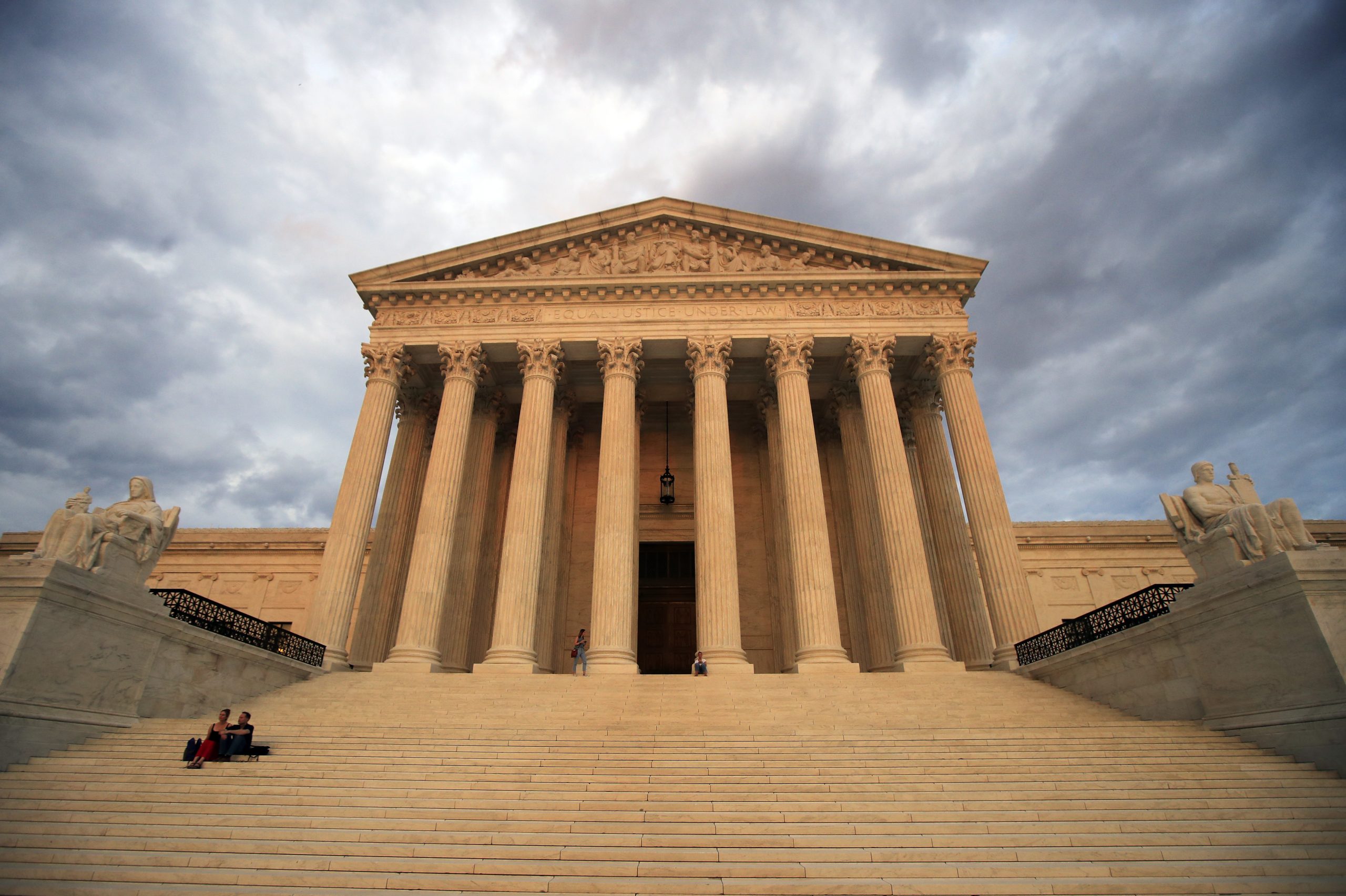
The Supreme Court over the next two weeks will hear two cases that have the potential to erode the separation of church and state and create a seismic shift in public education.
Mahmoud v. Taylor, which goes before the court on April 22, pits Muslim, Roman Catholic and Ukrainian Orthodox families, as well as those of other faiths, against the Montgomery County school system in Maryland. The parents argue that the school system violated their First Amendment right of free exercise of religion by refusing to let them opt their children out of lessons using LGBTQ+ books. The content of the books, the parents say, goes against their religious beliefs.
Oklahoma Statewide Charter School Board v. Drummond, which will be argued on April 30, addresses whether the St. Isidore of Seville Virtual Charter School should be allowed to exist as a public charter school in Oklahoma. The Archdiocese of Oklahoma City and the Diocese of Tulsa had won approval for the charter school from the state charter board despite acknowledging that St. Isidore would participate “in the evangelizing mission of the Church.”
The state’s attorney general, Gentner Drummond, later overruled the approval, saying the school could not be a charter because charter schools must be public and nonsectarian. The petitioners sued and ultimately appealed to the Supreme Court, claiming Drummond violated the First Amendment’s free exercise clause by prohibiting a religious entity from participating in a public program.
Teachers unions, parents groups and organizations advocating for the separation of church and state have said that rulings in favor of the plaintiffs could open the door for all types of religious programs to become part of public schooling and give parents veto rights on what is taught. In the most extreme scenario, they say, the rulings could lead to the dismantling of public education and essentially allow public schools to be Sunday schools.
Related: A lot goes on in classrooms from kindergarten to high school. Keep up with our free weekly newsletter on K-12 education.
At issue in both cases is the question of whether the First Amendment rights of parents and religious institutions to the free exercise of religion can supersede the other part of the amendment, the establishment clause, which calls for the separation of church and state.
“I think a chill wind is blowing, and public education as we know it is in extreme jeopardy of becoming religious education and ceasing to exist,” said Rachel Laser, president of Americans United for Separation of Church and State, an advocacy organization that has filed an amicus brief in the St. Isidore case. “The whole idea is to have churches take control of education for American children. It’s about money and power.”
For some conservative lawmakers, evangelical Christian groups and law firms lobbying for more religiosity in the public square, decisions in the petitioners’ favor would mean religious parents get what they have long been owed — the option of sending their children to publicly funded religious schools and the right to opt out of instruction that clashes with their religious beliefs.
“If we win this case, it opens up school choice across the country,” said Mathew Staver, founder of Liberty Counsel, an Orlando, Florida-based conservative Christian legal firm that has filed a brief supporting the petitioners in both cases. “I see school choice as a reaction to the failed system in the public schools, which is failing both in academia but also failing in the sense they are pushing ideology that undermines the parents and their relationship with their children.”
By taking the cases, the Supreme Court once again inserts itself in ongoing culture wars in the nation, which have been elevated by presidential orders threatening to take away funding if schools push diversity, equity and inclusion initiatives and state laws banning teaching on various controversial subjects. Legal scholars predict that the Supreme Court will lean toward allowing St. Isidore and the opt-outs for parents because of how the justices ruled in three cases between 2017 and 2022. In each case, the justices decided that states could not discriminate against giving funds or resources to a program because it was religious.
Related: How Oklahoma’s superintendent set off a holy war in classrooms
Of the two cases, St. Isidore likely could have the greatest impact because it is attempting to change the very definition of a public school, say opponents of the school’s bid for charter status. Since charter schools first started in the 1990s, they have been defined as public and nonsectarian in each of the 46 state statutes allowing them, according to officials at the National Alliance for Public Charter Schools. Today, charter schools operate in 44 states, Guam, Puerto Rico and Washington, D.C., and serve roughly 7.6 percent of all public school students.
“It would be a huge sea change if the court were to hold they were private entities and not public schools bound by the U.S. Constitution’s establishment clause,” said Rob Reed, the alliance’s vice president of legal affairs.
A victory for St. Isidore could lead to religious-based programs seeping into several aspects of public schooling, said Steven Green, a professor of both law and history and religious studies at Willamette University in Salem, Oregon.
“The ramification is that every single time a school district does some kind of contracting for any kind of service or curricular issues, you’re going to find religious providers who will make the claim, ‘You have to give me an opportunity, too,’” Green said.
St. Isidore’s appeal to the Supreme Court is part of an increasing push by the religious right to use public funds for religious education, said Josh Cowen, a professor of education policy at Michigan State University and author of a 2024 book on school vouchers. Because of previous court decisions, several voucher programs across the country already allow parents to use public money to send their children to religious schools, he said.
“What’s going to happen if the court says a public school can be run by a religious provider?” Cowen asked. “It almost turns 180 degrees the rule that voucher systems play by right now. Right now, they’re just taking a check. They’re not public entities.”
The effect of a St. Isidore victory could be devastating, he added. “It would be one more slippery slope to really kicking down the wall between church and state,” Cowen said.
Related: Inside the Christian legal campaign to return prayer to public schools
Jim Campbell, chief legal counsel for Alliance Defending Freedom, which is representing St. Isidore’s bid to become a charter, discounted the idea that a St. Isidore win would fundamentally change public schools. Like Staver, he views St. Isidore as simply providing another parental option. “We’re not asking the state to run a religious school,” Campbell said. “These are private entities that run the schools. This is a private organization participating in a publicly funded program.”
Opponents of religious charter schools question whether St. Isidore would have to play by the same rules as public schools.
“How are they going to handle it when there’s a teacher who has a lifestyle that doesn’t align with Catholic school teaching? They’re talking out of both sides of the mouth,” said Erika Wright, an Oklahoma parent and plaintiff in a lawsuit protesting a Bible in the classroom mandate by Oklahoma’s state superintendent of instruction. She also joined an amicus brief against St. Isidore’s formation.
“As a taxpayer, I should not be forced to fund religious instruction, whether it’s through a religious charter school or a Bible mandate,” Wright said. “I shouldn’t be forced to fund religious indoctrination that doesn’t align with my family’s personal beliefs.”
Notably, in the Montgomery County parents’ case going before the court, parents use similar reasoning to support their right to opt out of instruction. “A school ‘burdens’ parents’ religious beliefs when it forces their children to undergo classroom instruction about gender and sexuality at odds with their religious convictions,” the parents’ brief said.
The school district in 2022 adopted several books with LGBTQ+ themes and characters as part of the elementary language arts curriculum. Initially, families were allowed to opt out. But then the school system reversed its policy, saying too many students were absent during the lessons and keeping track of the opt-outs was too cumbersome. The reversal led to the lawsuit.
Historically, school districts have given limited opt-outs to parents who, for example, do not want their child to read a particular book, but the Montgomery County parents’ request is broader, said Charles C. Haynes, a First Amendment expert and senior fellow for religious liberty at the Freedom Forum in Washington, D.C. The parents are asking to exclude their children from significant parts of the curriculum for religious reasons.
“If the court sides with the parents, I think the next day, you’re going to have parents across the country saying, ‘I want my kids to opt out of all the references to fill-in-the-blank.’ … It would change the dynamic between public schools and parents overnight,” Haynes said.
Related: Tracking Trump: His actions to abolish the Education Department, and more
Sarah Brannen, author of “Uncle Bobby’s Wedding,” one of the LGBTQ+ books Montgomery County schools adopted, sees major logistical issues if the school system loses. “Allowing parents to interfere in the minutia of the curriculum would make their already difficult jobs impossible,” she said.
Colten Stanberry, a lawyer with the Becket Fund for Religious Liberty representing the Montgomery County parents, disagreed. School systems manage to balance different student needs all the time, he said.
A triumph for the Montgomery County families and St. Isidore would cause much more than logistical issues, said Becky Pringle, president of the National Education Association. It could lead to a public education system where parents can pick a school based on religious beliefs or try to change a traditional public school’s curriculum by opting out of lessons in droves.
“For us to be a strong democracy, then we necessarily need to learn about all of us. To separate us flies in the face of why we were founded,” Pringle said.
This story about church and state was produced by The Hechinger Report, a nonprofit, independent news organization focused on inequality and innovation in education. Sign up for the Hechinger newsletter.