Category: Trump administration

  • She was a rising senior on the honor roll. ICE just upended her life

    She was a rising senior on the honor roll. ICE just upended her life

    This story was produced by The 19th and reprinted with permission. 

    On July 4, Nory Sontay Ramos stepped off a flight from San Antonio into a country she hardly recognized: Guatemala. 

    The summer wasn’t supposed to start this way. The 17-year-old had plans. In early June, she wrapped up 11th grade on a high note, having made the honor roll and represented her Los Angeles high school in the city finals for track. With track season over, she turned her attention to cross-country, showing up to campus for practice after the school year ended. 

    Everything changed when she and her mother, Estela Ramos — both undocumented — appeared at what they thought was a standard check-in visit with immigration officials on June 30. 

    “ICE took us to a room, and they ended up telling my mom, ‘Your case is over, so we have to take you guys with us,’” Sontay Ramos told The 19th. Over the objections of their attorney, federal agents led them away.

    The next day, she and her mother were shipped to Texas. And by July 4, they were on a plane to Guatemala, a country where neither of them have lived for over a decade. On Independence Day — an occasion associated with freedom, with hope — their American dream shattered. Sontay Ramos has no idea what will become of the friends, family members and school community her deportation forced her to leave behind in Los Angeles.

    A lawyer hired after she and her mother were detained said Monday that a motion to reopen the case has been filed with the Board of Immigration Appeals but provided no other information to The 19th. 

    A year shy of becoming a high school graduate in the United States, the teen’s life — and opportunities — completely changed in the span of five days.

    “I’m confused,” Sontay Ramos said, her voice breaking. “I don’t know. I’m just really sad about everything.”

    President Donald Trump campaigned for a return to office with the promise of mass deportations, characterizing undocumented immigrants as criminals and threats to women and girls. But as his administration has ramped up enforcement of his policy priority, undocumented people with no criminal backgrounds have made up the largest share of immigrants targeted. Those who are pursuing legal status through the proper channels have also become vulnerable — showing up to check-ins, like Sontay Ramos and her mother — only to be detained. These developments, recent polls reveal, have led to public disapproval of the Trump administration’s strategies. 

    Civil liberties and advocacy groups have raised concerns that undocumented immigrants are being removed so quickly they have been denied the right to due process. With Trump’s One Big Beautiful Bill Act directing $150 billion more toward mass deportations, expedited removals of undocumented immigrants will almost certainly increase — and those immigrants who arrived in the United States as children like Sontay Ramos stand to get caught in the middle. 

    Related: A lot goes on in classrooms from kindergarten to high school. Keep up with our free weekly newsletter on K-12 education.

    The Trump administration deported more than 93,800 people from January 20 to June 11, with ICE more than doubling its arrests compared with the same period in 2024, revealed an analysis by the Washington Post based on information from the Deportation Data Project. (The data does not reflect arrest and removal numbers from Customs and Border Protection.) Of those, 61 percent did not have criminal records and almost 90 percent were men, underscoring how relatively uncommon it is for a mother and daughter to be removed. 

    The Trump administration has not provided a tally of how many minors have been deported this year, but The 19th’s review of figures from the Deportation Data Project found that only about 3 percent of removals involved children. When ICE targets juveniles, the incidents often make national headlines, such as when a 9-year-old boy and his father living in Torrance, California, were detained in May and swiftly deported to Honduras. In states including Michigan, Massachusetts and New York, the detainment of teenagers, including those who are technically legal adults, have also garnered widespread media attention this year.

    But when Sontay Ramos and her mother exited their Guatemala-bound flight on Friday, they weren’t met with fanfare. None of their family members in the Central American nation knew to expect them. With the help of an internet connection, they managed to contact one of Sontay Ramos’ older sisters, with whom they’re now living. The teenager isn’t sure which part of Guatemala she’s in, though she describes the area as rural. 

    Just six when she left Guatemala, Sontay Ramos struggles to recall what life there was like. But she remembers the emotion she felt as a small child: fear.

    “I was scared because there’s gangsters here, and they tried to kill my mom,” she said. A family member involved in a gang threatened her mother, once attacking her so badly she needed to be hospitalized, she said. “My mom was scared.”

    A research study exploring the root causes of immigration from Guatemala from 2012 to 2019 found violence, poverty, climate change and corruption to be among the driving factors and that many such migrants hail from rural parts of the country.  

    “The two major reasons, especially if we look at families, have to do with violence and drought,” said David Leblang, a coauthor of that study and politics professor at the University of Virginia.  “It has been drought and then flood, hurricane and then drought that has just decreased the ability for families to put food on the table, so you see a combination of economic insecurity, but more so for families, food insecurity — because when you can’t feed your kids, that’s when families are going to pick up and they’re going to move first to more urban areas and then out of the country.”

    About 11 years ago, Sontay Ramos and her mother headed by car to the United States in search of safety and opportunity. There, other family members awaited them and they hoped to be granted asylum, she said. 

    The transition was not easy. They left behind three of Sontay Ramos’ older siblings who did not want to come to the United States, she said. Her father remained in Guatemala, too. His death from illness shortly after she moved away was devastating.

    “Unfortunately, her dad passed away at a young age, just like two weeks after her arrival to the States,” recalled Jennifer Ramos, Sontay Ramos’ 22-year-old cousin who lives in Los Angeles. “She grew up with her dad, so that also hit her at such a young age, just coming to a new country at six years old and not knowing the language here and losing her father. It was definitely hard for her.”

    Getting accustomed to life in Los Angeles also wasn’t easy. Sontay Ramos and her mother are Indigenous Guatemalans, fluent in K’iche’. Few resources in their native tongue made assimilation more challenging in a city where English and Spanish are the primary languages.

    Related: A superintendent made big gains with English learners. His success may have been his downfall

    Jennifer Ramos helped her little cousin learn to speak English. “She would come over, and I would help her with her homework. When she first came to the States, my younger sister was kind of her only friend in school because she didn’t know anybody and, again, the language barrier. She actually does struggle speaking Spanish.”

    In time, Sontay Ramos and her mother adjusted to life in California. Her mother ultimately became a garment worker, employed as a seamstress until physical setbacks — illness and surgery — sidelined her earlier this year. Her deportation has separated her from her life partner, with whom she and her daughter shared an apartment in the Westlake District of Los Angeles, the neighborhood where an ICE raid at a Home Depot close to an elementary school in June panicked families, and days of demonstrations in nearby downtown escalated after Trump deployed 4,000 National Guard troops and 700 Marines. 

    Los Angeles is a deeply blue city in a liberal state, with the nation’s highest concentration of immigrants — a place that the president has made ground zero for his immigration raids. In November, the City Council voted unanimously to make L.A. a sanctuary city, which bars it from using resources for immigration enforcement. Last week, the Trump administration filed suit, challenging the law. Meanwhile, advocacy groups including the American Civil Liberties Union of Southern California and Public Counsel are suing the Trump administration for what it describes as a pattern of federal violations during immigration raids in Greater Los Angeles.  

    Before Trump’s immigration policies roiled her neighborhood and upended her life, Sontay Ramos was indistinguishable from her peers born in the United States. She grew up on the Netflix shows “Stranger Things” and “Cobra Kai,” enjoys the music of Lana Del Rey and The Weeknd and dotes on her cat, Max, who turned one on May 15. He is black — one of her two favorite colors. In her spare time, Sontay Ramos practices taekwondo, which she’s been learning for nearly four years.  

    “I just liked it,” she said of the martial art. Knowing how to fight, she added, helps her feel protected. 

    Sontay Ramos never sensed she was in danger before the immigration check-in that would push her out of the United States.

    But her cousin Jennifer Ramos worried. The night before, Ramos’ father invited the family over to have Sunday dinner with his wife and three daughters. The evening was largely festive. Her father made shrimp ceviche and was eager for his family to enjoy the tangy, citrusy dish — especially Estela Ramos, who had just celebrated her 45th birthday. But when Estela mentioned that she and her daughter had an immigration check-in scheduled, everyone fell quiet.

    “We were kind of scared,” Jennifer Ramos said. “We were like, ‘Are you sure you should go?’”

    Estela Ramos poses for a picture with Jennifer Ramos at her quinceanera in 2017. Credit: COURTESY OF JENNIFER RAMOS

    But her aunt tried to reassure them by letting them know their lawyer said it would be fine. After all, they had shown up for previous check-ins without incident, and if they didn’t appear, immigration officials would just find them at home. 

    Now, Jennifer Ramos doesn’t know when she’ll see her aunt and cousin again.

    “It is unfair that a young student like her has been detained,” she said. “She’s the most deserving person. This should be the least of her worries.”

    Sontay Ramos couldn’t help but tear up when she described what she was looking forward to about senior year — graduation, her friends, track-and-field and cross-country.

    Although excited to reunite with family members they hadn’t seen in years, she and her mother have been weeping off and on since they arrived in Guatemala.

    “I was happy, but I was expecting to see them in another way,” she said of her relatives. “Not like this.”

    Sleeping and eating have been tough as has the constant feeling of disorientation. She doesn’t know where she is. In K’iche’, she asked her mother for the name of the town they’re in, but it didn’t register. 

    She also continues to feel blindsided about why she and her mother were deported at all. She doesn’t understand how or why their case was closed.

    Recent polls, particularly those conducted after the immigration raids in Los Angeles, reveal that the Trump’s administration’s immigration crackdowns may be unpopular with the majority of the public. A PBS News/NPR/Marist poll released July 1 found that just 43 percent of Americans support Trump’s tactics

    Sixty-four percent of registered voters support giving most undocumented immigrants in the United States a pathway to legal status, with 31 percent preferring deportation for most of them, according to a Quinnipiac University national poll released June 26. Six months ago, only 55 percent of voters supported giving unauthorized immigrants a path to legal status, while 36 percent backed deportation. 

    Leblang, the politics professor, said that ultimately the economy will sway the public to take a stand on immigration. 

    “All of those people who are being deported, they’re consuming goods that are produced by natives,” he said. “So, what the evidence suggests is that’s going to affect native workers’ wages, so across the board, this is going to have a negative effect on the economy.” 

    Related: They crossed the border for better schools. Now, some families are leaving the US

    For Manuel Guevara — a physical education teacher and coach at the Miguel Contreras Learning Complex, where Sontay Ramos is enrolled as a student — immigration isn’t an economic issue but a personal one. He came to the United States at 11 months in the mid-1980s amid El Salvador’s horrific 12-year civil war, becoming a citizen as a teenager. He fears that more deportations of youth from his school are imminent. He knows some families skipped school graduations in the area due to their concerns over raids. Some are so worried they refuse to let their children attend football practice. He’s heard that other families intend to self deport.

    “This is not normal,” Guevara said. “Our whole community is beyond vulnerable. A lot of their [students’] parents, sad to say, don’t know how to read and write. Their kids need to do that for them. If they’re presented with [immigration] paperwork, they might not even be able to read it because that’s not their primary language.”

    Before her deportation, Nory Sontay Ramos was recognized at school for her academic and athletic achievements. Credit: COURTESY OF JENNIFER RAMOS

    He can hardly believe that Sontay Ramos, whom he taught for most of her high school years, is gone. 

    “She was smiling, happy-go-lucky,” Guevara said. He’s astounded that she was detained and deported in less than a week. “Nory is going into her senior year, which is another thing that’s just killing me. She was going into her senior year with all this momentum.”

    Guevara fondly recalled the teen’s high-pitched voice that gets even higher when she’s excited. 

    “You could tell when she’s coming from down the hallway, for sure,” he said. But her trademark voice is now subdued due to her deportation ordeal. Through tears, she expressed gratitude for how her teachers, classmates and other supporters have donated nearly $7,000 to her GoFundMe campaign. 

    “I just want to thank everybody for the support and tell them to just be safe out there and be strong no matter what’s going to happen,” she said. 

    If she can’t return to the United States, she will figure out how to finish her education in Guatemala, Sontay Ramos said. 

    Guevara is certain she has the aptitude for greatness. Her academics and extracurricular activities are just hints of what she’s capable of, he said. 

    “She was about to reach cruising altitude,” he said. “Some of our students are capable of reaching the clouds up there and doing some great things. And I really believe that she was on her way.”

    The Hechinger Report provides in-depth, fact-based, unbiased reporting on education that is free to all readers. But that doesn’t mean it’s free to produce. Our work keeps educators and the public informed about pressing issues at schools and on campuses throughout the country. We tell the whole story, even when the details are inconvenient. Help us keep doing that.

    Join us today.

    Source link

  • Suddenly sacked

    Suddenly sacked

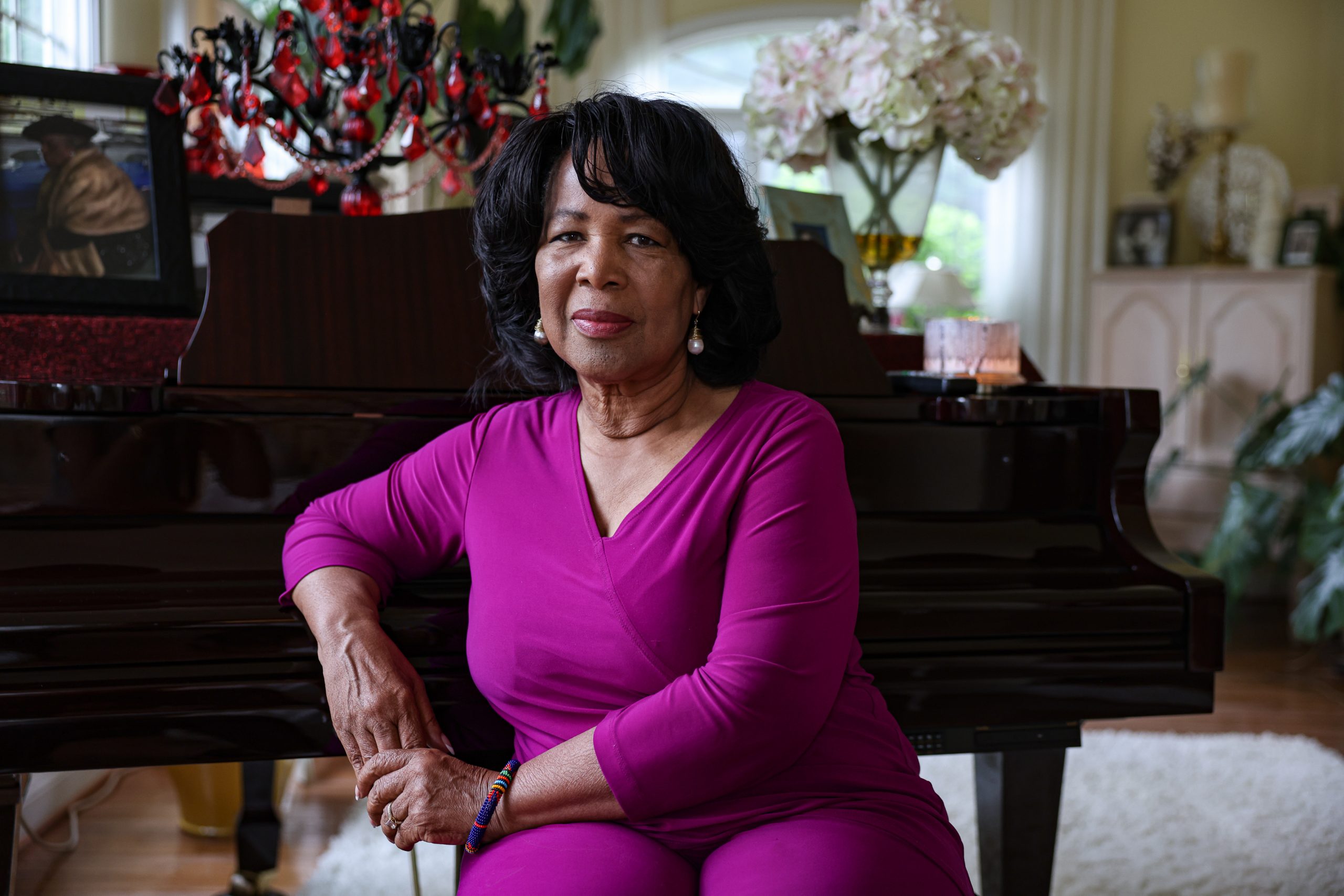
    Peggy Carr, the former commissioner of the National Center for Education Statistics, at her Maryland home on July 1. Carr worked for the Education Department for more than 35 years before the Trump administration placed her on administrative leave on Feb. 24. Credit: Valerie Plesch for The Hechinger Report

    Peggy Carr’s last day on the job came so abruptly that she only had time to grab a few personal photos and her coat before a security officer escorted her out of her office and into a chilly February afternoon. She still doesn’t know why she was summarily dismissed as commissioner of the National Center for Education Statistics (NCES), where she helped build the National Assessment of Educational Progress into the influential Nation’s Report Card. NCES is the federal government’s third-largest statistical agency after the Census Bureau and the Bureau of Labor Statistics. Running it for three and a half years was the capstone of Carr’s 35-year career at the Education Department. 

    And suddenly, she was out in the cold with no explanation. 

    “I would say that what has happened is a professional tragedy, not just for me, but for all of NCES and my staff,” said Carr, 71, in a recent interview. “But for me, it really was a personal tragedy because I have spent my career helping NCES build its solid reputation as a premier statistical agency in the federal system.” 

    Carr doesn’t know if the decision to fire her came from the White House, Elon Musk’s Department of Government Efficiency or an outside policy advocate. 

    But she is clear about what was lost by the firing of the head of a nonpartisan statistical agency: an objective assessment of how American students are doing. And she finds it “ironic,” she said, that her increasingly grim reports were President Donald Trump’s public rationale for dismantling the Education Department

    Although Carr was the first woman and the first Black person to run NCES, her “firsts” go back decades. She joined NCES in 1993, after teaching statistics at Howard University and a stint as a statistician in the Education Department’s Office of Civil Rights. “I was the first person of color in NCES to ever have a managerial job, period,” said Carr. She broke a long record: The education statistical agency dates back to 1867, created in the aftermath of the Civil War as part of an effort to help the South recover during Reconstruction. She was appointed commissioner by former President Joe Biden in 2021.

    Related: Our free weekly newsletter alerts you to what research says about schools and classrooms.

    “It’s a kill-the-messenger strategy,” she said. “We have just been the messenger of how students in this country are faring.” 

    Congress established a six-year term for the commissioner so that the job would straddle administrations and insulate statistics from politics. Carr’s term was supposed to extend through 2027, but she made history with yet another first: the first NCES commissioner to be fired by a president. 

    Carr wasn’t thinking about her gender or her race, despite the fact that three days earlier, Trump had abruptly fired another Black senior official, Gen. Charles Q. Brown Jr., the chairman of the Joint Chiefs of Staff. “Maybe they found out I was the only Biden appointee left in the department,” Carr said. “Maybe they didn’t realize that until then.”

    Carr has reason to be puzzled by her firing. She is hardly a radical. She defended standardized tests against charges that they are racist. She publicly made the case that the nation needs to pay attention to achievement gaps, even if it sometimes means putting a spotlight on the low achievement of Black and Hispanic students. “The data can reveal things about what people can do to improve it,” Carr said.

    She was dismissed on Feb. 24, more than a week before Education Secretary Linda McMahon’s Senate confirmation on March 3. The department named Carr’s deputy, Chris Chapman, to act as her replacement, but subsequently fired him in a round of mass layoffs on March 11. The agency was then leaderless until July 7, when another senior department official was told to add NCES to his responsibilities. 

    Civil servant

    In January, at the start of the second Trump administration, Carr thought her job was relatively safe. As a career civil servant, she’d worked with many Republican administrations and served as second in command under James “Lynn” Woodworth, whom Trump appointed as NCES commissioner in his first term. Both Woodworth and Carr say they had a good working relationship because they both cared about getting the numbers right. Indeed, Woodworth was so troubled and disturbed by Carr’s dismissal and the fate of the nation’s education statistics agency that he spoke out publicly, risking retaliation. 

    Even Carr’s fiercest critics, who contend she was an entrenched bureaucrat who failed to modernize the statistical service and allowed costs to balloon, condemned the humiliating way she was dismissed.

    “She deserves the nation’s gratitude and thanks” for setting up a whole system of assessments, said Mark Schneider, who served as the director of the Institute of Education Sciences (IES), which oversees NCES, from 2018 to 2024 and as NCES commissioner from 2005 to 2008. 

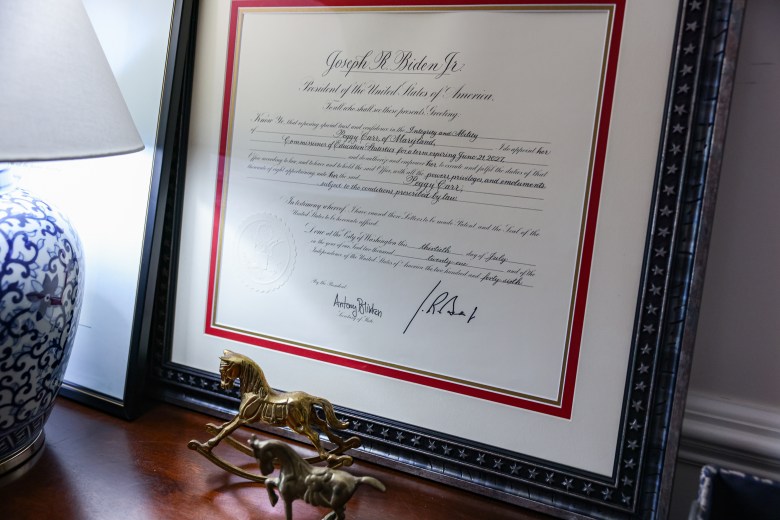
    The official appointment of Peggy Carr as commissioner of the National Center for Education Statistics by former President Joe Biden. Credit: Valerie Plesch for The Hechinger Report

    A landing team

    The transition seemed normal at first. A “landing team” — emissaries from the Trump transition team — arrived in mid-January and Carr briefed them three times. They asked questions about NCES’s statistical work. “They were quite pleasant, to be honest,” Carr said. “They seemed curious and interested.”

    “But that was before DOGE got there,” she said. 

    Carr released the 2024 Nation’s Report Card on Jan. 29. More students than ever lacked the most basic reading and math skills. It was front-page news across the nation.

    Days later, DOGE arrived. Still, Carr wasn’t worried. “We actually thought we were going to be OK,” Carr said. “We thought that their focus was going to be on grants, not contracts.” 

    Related: Tracking Trump: His actions to dismantle the Education Department, and more

    The Institute of Education Sciences had awarded millions of dollars in grants to professors and private-sector researchers to study ways to improve diversity and equity in the classroom — priorities that were now out of favor with the Trump team. Carr’s agency is housed under the IES umbrella, but Carr’s work didn’t touch upon any of that. 

    However, NCES has an unusual structure. Unlike other statistics agencies, NCES has never had many statisticians on staff and didn’t do much in-house statistical work. Because Congress put restrictions on its staffing levels, NCES had to rely on outside contractors to do 90 percent of the data work. Only through outside contractors was the Education Department able to measure academic achievement, count students and track university tuition costs. Its small staff of 100 primarily managed and oversaw the contracts.

    Keyword searches

    Following DOGE instructions, Carr’s team conducted keyword searches of DEI language in her agency’s contracts. “Everyone was asked to do that,” she said. “That wasn’t so bad. The chaotic part really started when questions were being asked about reductions in the contracts themselves.”

    Carr said she never had direct contact with anyone on Musk’s team, and she doesn’t even know how many of them descended upon the Education Department. Her interaction with DOGE was secondhand. Matthew Soldner, acting director of IES, summoned Carr and the rest of his executive team to his office to respond to DOGE’s demands. “We met constantly, trying to figure out what DOGE wanted,” Carr said. DOGE’s orders were primarily transmitted through Jonathan Bettis, an Education Department attorney, who was experienced with procurement and contracts. It was Bettis who talked directly with the DOGE team, Carr said. 

    The main DOGE representative who took an interest in NCES was “Conor.” “I don’t know his last name,” said Carr. “My staff never saw anyone else but Conor if they saw him at all.” Conor is 32-year-old Conor Fennessy, according to several media reports. His deleted LinkedIn profile said he has a background in finance. (Fennessy has also been involved in getting access to data at Health and Human Services and spearheading cuts at the National Park Service, according to media reports.) Efforts to reach Fennessy through the Education Department and through DOGE were unsuccessful.

    “It was chaotic,” said Carr. “Bettis would tell us what DOGE wanted, and we ran away to get it done. And then things might change the next day. ‘You need to cut more.’ ‘I need to understand more about what this contract does or that contract does.’”

    It was a lot. Carr oversaw 60 data collections, some with multiple parts. “There were so many contracts and there were hundreds of lines on our acquisition plans,” she said. “It was a very complex and time-consuming task.”

    Lost in translation

    The questions kept coming. “It was like playing telephone tag when you have complicated data collections and you’re trying to explain it,” Carr said. Bettis “would sometimes not understand what my managers or I were saying about what we could cut or could not cut. And so there was this translation problem,” she said. (Efforts to reach Bettis were unsuccessful.) Eventually a couple of Carr’s managers were allowed to talk to DOGE employees directly.

    Carr said her staff begged DOGE not to cut a technology platform called EDPass, which is used by state education agencies to submit data to the federal Education Department on everything from student enrollment to graduation rates. For Carr, EDPass was a particular point of pride in her effort to modernize and process data more efficiently. EDPass slashed the time it took to release data from 20 months in 2016-17 to just four months in 2023-24

    Carr said DOGE did not spare EDPass. Indeed, DOGE did not spare much of NCES. 

    On Feb 10, only about a week after DOGE arrived, Carr learned that 89 of her contracts were terminated, which represented the vast majority of the statistical work that her agency conducts. “We were in shock,” said Carr. “What do you mean it’s all gone?” 

    Even its advocates concede that NCES needed reforms. The agency was slow to release data, it used some outdated collection methods and there were places where costs could be trimmed. Education Department spokesperson Madi Biedermann said that the department, “in partnership with DOGE employees,” found contracts with overhead and administrative expenses that exceeded 50 percent, “a clear example of contractors taking advantage of the American taxpayer.”

    Piloting an old airplane

    Carr said she was never a fan of the contracting system and wished she could have built an in-house statistical agency like those at the Census Bureau and the Bureau of Labor Statistics. But that would have required congressional authorization for the Education Department to increase its headcount. That never happened. Carr was piloting an old airplane, taped together through a complicated network of contracts, while attempting to modernize and fix it. She said she was trying to follow the 2022 recommendations of a National Academies panel, but it wasn’t easy. 

    The chaos continued over the next two weeks. DOGE provided guidelines for justifying the reinstatement of contracts it had just killed and Carr’s team worked long hours trying to save the data. Carr was particularly worried about preserving the interagency agreement with the Census Bureau, which was needed to calculate federal Title I allocations to high-poverty schools. Those calculations needed to be ready by June and the clock was ticking. 

    Her agency was also responsible for documenting geographic boundaries for school districts and classifying locales as urban, rural, suburban or town. Title I allocations relied on this data, as did a federal program for funding rural districts. “My staff was panicking,” said Carr. 

    The DOGE sledgehammer came just as schools were administering an important international test — the Program for International Student Assessment (PISA). The department was also in the midst of a national teachers and principals survey. “People were worried about what was going to happen with those,” said Carr. 

    Even though DOGE terminated the PISA contract, the contractor continued testing in schools and finished its data collection in June. But now it’s unclear who will tabulate the scores and analyze them. The Education Department disclosed in a June legal brief that it is restarting PISA. “I was told that they’re not going to do the national report, which is a little concerning to me,” Carr said. Asked for confirmation, the Education Department did not respond.

    Another widely used data collection, the Early Childhood Longitudinal Survey (ECLS-K 2024), which tracks a cohort of students from kindergarten through elementary school, was supposed to collect its second year of data as the kindergarteners progressed to first grade. “We had to give up on that,” said Carr.

    NAEP anxiety

    Carr said that behind the scenes, her priority was to save NAEP. DOGE was demanding aggressive cuts, and she worked throughout the weekend of Feb. 22-23 with her managers and the NAEP contractors to satisfy the demands. “We thought we could cut 28 percent — I even remember the number — without cutting into critical things,” she said. “That’s what I told them I could do.”

    DOGE had been demanding 50 percent cuts to NAEP’s $185 million budget, according to several former Education Department employees. Carr could not see a way to cut that deep. The whole point of the exam is to track student achievement over time, and if too many corners were cut, it could “break the trend,” she said, making it impossible to compare the next test results in 2026 with historical scores. 

    “I am responsible in statute and I could not cut NAEP as much as they wanted to without cutting into congressionally mandated activities,” Carr said. “I told them that.” 

    Related: NAEP, the Nation’s Report Card, was supposed to be safe. It’s not

    While Carr and DOGE remained far apart in negotiations over cost, a security officer appeared at her office door at 3:50 p.m. on Feb. 24. Carr remembers the exact time because colleagues were waiting at her door to join her for a 4 p.m. Zoom meeting with the chair of the board that oversees NAEP.

    The security officer closed the door to her office so he could tell her privately that he was there to escort her out. He said she had 15 minutes to leave. “Escort me where? What do you mean?” Carr asked. “I was in shock. I wasn’t even quite understanding what he was asking, to be honest.”

    The security officer told her about an email saying she was put on administrative leave. Carr checked her inbox. It was there, sent within the previous hour.

    The security officer “was very nice,” she said. “He refused to call me Peggy,” and addressed her as Dr. Carr. “He helped me collect my things, and I left.” He opened the doors for her and walked her to her car.

    “I had no idea that this was going to happen, so it was shocking and unexpected,” Carr said. “I was working like I do every other day, a busy day where every minute is filled with something.” 

    She said she’s asked the department why she was dismissed so abruptly, but has not received a response. The Education Department said it does not comment to the public on its personnel actions. 

    Packing via Zoom

    Two days later, Carr returned to pick up other belongings. Via Zoom, Carr’s staff had gone through her office with her — 35 years worth of papers and memorabilia — and packed up so many boxes that Carr had to bring a second car, an SUV. 

    When Carr and her husband arrived, she said, “there were all these people waiting in the front of the building cheering me on. The men helped me put the things in my husband’s car and my car. It was a real tearjerker. And that was before they would be dismissed. They didn’t know they would be next.”

    Less than two weeks later, on March 11, most of Carr’s staff — more than 90 NCES staffers — was fired. Only three remained. “I thought maybe they just made a mistake, that it was going to be a ‘whoops moment’ like with the bird flu scientists or the people overseeing the weapons arsenal,” Carr said.

    The fate of NCES remains uncertain. The Education Department says that it is restarting and reassessing some of the data collections that DOGE terminated, but the scope of the work might be much smaller. Carr says it will take years to understand the full extent of the damage. Carr was slated to issue a statement about her thoughts on NCES on July 14.

    The damage

    The immediate problem is that there aren’t enough personnel to do the work that Congress mandates. So far, NCES has missed an annual deadline for delivering a statistical report to Congress — a deadline NCES had “never, ever missed” in its history, Carr said — and failed to release the 2024 NAEP science test scores in June because there was no commissioner to sign off on them. But the department managed to calculate the Title I allocations to high-poverty schools “in the nick of time,” Carr said.

    In addition to the collection of fresh data, Carr is concerned about the maintenance of historical datasets. When DOGE canceled the contracts, Carr counted that NCES had 550 datasets scattered in different locations. NCES doesn’t have its own data warehouse and Carr was trying to corral and store the datasets. She’s worried about protecting privacy and student confidentiality. 

    An Education Department official said that this data is safe and will soon be transferred to IES’s secure servers. 

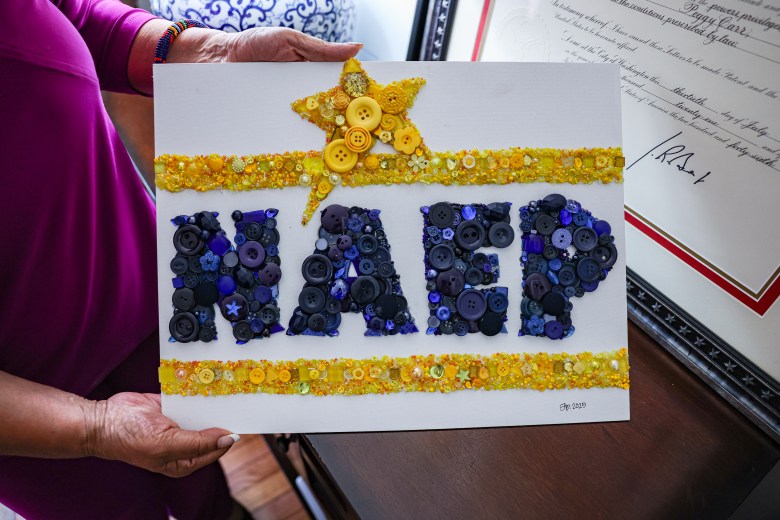
    Peggy Carr holds artwork made by a former colleague at the National Center for Education Statistics. NAEP stands for the National Assessment of Educational Progress, which Carr helped build into the influential barometer of how American students are faring. Credit: Valerie Plesch for The Hechinger Report

    In the meantime, Carr says she plans to stay involved in education statistics — but from the outside. “With this administration wanting to push education down to the states, there are opportunities that I see in my next chapter,” Carr said. She said she’s been talking with states and school districts about calculating where they rank on an international yardstick.

    Carr is in close touch with her former team. In May, 50 of them gathered at a church in Virginia to commiserate. A senior statistician gave Carr a homespun plaque of glued blue buttons spelling the letters NAEP with a shiny gold star above it. It was a fitting gift. NAEP is regarded as the best designed test in the country, the gold standard. Carr built that reputation, and now it has gone home with her.

    Contact staff writer Jill Barshay at 212-678-3595, jillbarshay.35 on Signal, or [email protected].

    This story about Peggy Carr was written by Jill Barshay and produced by The Hechinger Report, a nonprofit, independent news organization focused on inequality and innovation in education. Sign up for Proof Points and other Hechinger newsletters.

    The Hechinger Report provides in-depth, fact-based, unbiased reporting on education that is free to all readers. But that doesn’t mean it’s free to produce. Our work keeps educators and the public informed about pressing issues at schools and on campuses throughout the country. We tell the whole story, even when the details are inconvenient. Help us keep doing that.

    Join us today.

    Source link

  • High school speech and debate allows students to find common ground

    High school speech and debate allows students to find common ground

    This story about high school speech and debate was produced by The Hechinger Report, a nonprofit, independent news organization focused on inequality and innovation in education. Sign up for the Hechinger newsletter.

    DES MOINES, Iowa — Macon Smith stood in front of a nearly empty classroom 1,000 miles from home. He asked his opponent and the two judges in the room if they were ready to start, then he set a six-minute timer and took a deep breath.

    “When tyranny becomes law, rebellion becomes duty,” he began. 

    In front of Macon, a 17-year-old high school junior, was a daunting task: to outline and defend the argument that violent revolution is a just response to political oppression.

    In a few hours, Macon would stand in another classroom with new judges and a different opponent. He would break apart his entire argument and undo everything he had just said.

    “An eye for an eye makes the whole world blind,” Macon started.

    It doesn’t really matter what opinion Macon holds on violence or political oppression. In this moment in front of the judges, he believes what he’s saying. His job is to get the judges to believe with him.

    Related: A lot goes on in classrooms from kindergarten to high school. Keep up with our free weekly newsletter on K-12 education.

    Macon was one of more than 7,000 middle and high school students to compete in the National Speech and Debate Tournament this summer in Iowa, run by an organization that is celebrating a century in existence.

    In that time, the National Speech and Debate Association has persevered through economic and social upheaval. It is entering its next era, one in which the very notion of engaging in informed and respectful debate seems impossible. The organizers of this event see the activity as even more important in a fracturing society.

    “I don’t think there’s an activity in the world that develops empathy and listening skills like speech and debate,” said Scott Wunn, the organization’s president. “We’re continuing to create better citizens.” 

    Macon Smith, a rising senior from Bob Jones Academy in South Carolina, competes in the third round of the Lincoln-Douglas Debate at the National Speech and Debate Tournament in Iowa this summer. Credit: Meenakshi Van Zee for The Hechinger Report

    Though the tournament is held in different cities around the country, for the 100th anniversary, the organizers chose to host it in Des Moines, where the association’s headquarters is based.

    Preparing for this competition was a year in the making for Macon, who will be a senior at Bob Jones Academy, a Christian school in Greenville, South Carolina, this fall. Students here compete in more than two dozen categories, such as Original Oratory, in which they write and recite their own 10-minute speeches, or Big Questions, where they attempt to argue broad, philosophical ideas. 

    Macon’s specialty, the Lincoln-Douglas Debate, is modeled after a series of public, three-hour debates between Abraham Lincoln and Sen. Stephen Douglas in 1858. In this event, two students have just 40 minutes to set up their arguments, cross-examine each other and sway the judges.

    “Even if I don’t personally believe it, I can still look at the facts and determine, OK, this is a good fact, or it’s true, and argue for that side,” Macon said.

    Debaters often have to tackle topics that are difficult, controversial and timely: Students in 1927 debated whether there was a need for a federal Department of Education. In 1987, they argued about mandatory AIDS testing. In 2004, they debated whether the United States was losing the war on terror. This year, in the Public Forum division, students debated whether the benefits of presidential executive orders outweigh the harms. 

    Related: Teaching social studies in a polarized world

    While the speech and debate students practiced for their national event, adults running the country screamed over each other during a congressional hearing on state sanctuary policies. A senator was thrown to the floor and handcuffed during a press conference on sending the National Guard to immigration enforcement protests in Los Angeles. Most Americans feel political discourse is moving in the wrong direction — both conservatives and progressives say talking politics with someone they disagree with has become increasingly stressful and frustrating

    Speech and debate club, though, is different.

    “First of all, it gives a kid a place to speak out and have a voice,” said Gail Nicholas, who for 40 years has coached speech and debate at Bob Jones Academy alongside her husband, Chuck Nicholas, who is Macon’s coach. “But then also learn to talk to other people civilly, and I think that’s not what’s being modeled out there in the real world right now.” 

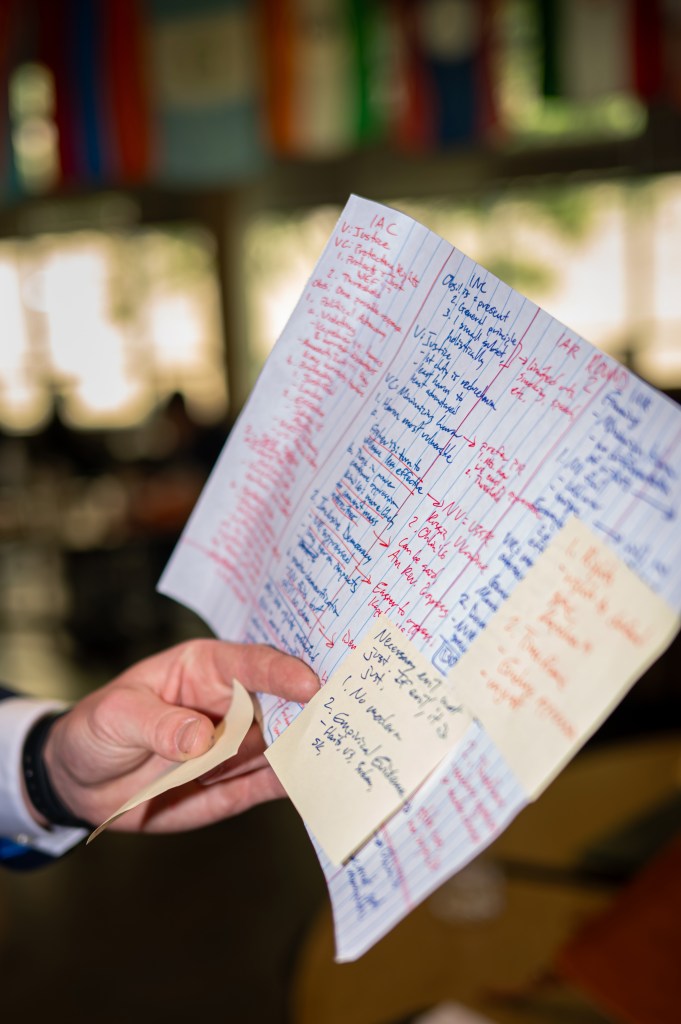
    Macon Smith, a rising senior from Bob Jones Academy in South Carolina, shows off the notes that he took during debates at the National Speech and Debate Tournament in Iowa. Credit: Meenakshi Van Zee for The Hechinger Report

    On the second day of the competition in a school cafeteria in West Des Moines, Macon was anxiously refreshing the webpage that would show the results of his rounds to learn whether he would advance to semifinals.  

    For most of the school year, Macon spent two days a week practicing after school, researching and writing out his arguments. Like many competitors, he has found that it’s easy to make snap judgments when you don’t know much about an issue. Decisively defending that view, to yourself and to others, is much harder.  

    “I tend to go in with an opinion and lose my opinion as the topic goes on,” said Daphne DiFrancesco, a rising senior from Cary Academy in Cary, North Carolina.

    Traveling for regional events throughout the school year means Macon has become friends with students who don’t always share his conservative views. He knows this because in debate, discussing politics and religion is almost unavoidable.

    “It doesn’t make me uncomfortable at all,” Macon said. “You don’t want to burn down a bridge before you make it with other people. If you stop your connection with a person right at their political beliefs, you’re already cutting off half of the country. That’s not a good way to conduct yourself.”

    Macon, and other students in the clubs, said participating has made them think more deeply about their own beliefs. Last year, Macon debated a bill that would defund Immigration and Customs Enforcement, an agency he supports. After listening to other students, he developed a more nuanced view of the organization. 

    “When you look at the principle of enforcing illegal immigration, that can still be upheld, but the agency that does so itself is flawed,” he said.

    Related: ‘I can tell you don’t agree with me’:’ Colleges teach kids how to hear differing opinions

    Henry Dieringer, a senior from L.C. Anderson High School in Austin, Texas, went into one competition thinking he would argue in favor of a bill that would provide work permits for immigrants, which he agrees with. Further research led him to oppose the idea of creating a federal database on immigrants.

    “It made me think more about the way that public policy is so much more nuanced than what we believe,” Henry said. 

    On the afternoon of the second day of the national tournament, Macon learned he didn’t advance to the next round. What’s sad, he said, is he probably won’t have to think this hard about the justness of violent revolution ever again. 

    “There’s always next year,” Macon said.

    Callista Martin, 16, a rising senior from Bainbridge High School in Washington state, also didn’t make the semifinals. Callista and Macon met online this year through speech and debate so they could scrimmage with someone they hadn’t practiced with before. It gave them the chance to debate someone with differing political views and argument styles.

    Macon Smith, a rising senior from Bob Jones Academy in South Carolina, takes notes during a round of the Lincoln-Douglas Debate at the National Speech and Debate Tournament in Iowa. Credit: Meenakshi Van Zee for The Hechinger Report

    “In the rounds, I’m an entirely different person. I’m pretty aggressive, my voice turns kind of mean,” Callista said. “But outside of the rounds, I always make sure to say hi to them before and after and say things I liked about their case, ask them about their school.”

    Talking to her peers outside of rounds is perhaps the most important part of being in the club, Callista said. This summer, she will travel to meet with some of her closest friends, people she met at debate camps and tournaments in Washington.  

    Since Callista fell in love with speech and debate as a freshman, she has devoted herself to keeping it alive at her school. No teacher has volunteered to be a coach for the debate club, so the 16-year-old is coaching both her classmates and herself.

    A lack of coaches is a common problem. Just under 3,800 public and private high schools and middle schools were members of the National Speech and Debate Association at the end of this past school year, just a fraction of the tens of thousands of secondary schools in the country. The organization would like to double its membership in the next five years.

    That would mean recruiting more teachers to lead clubs, but neither educators nor schools are lining up to take on the responsibility, said David Yastremski, an English teacher at Ridge High School in New Jersey who has coached teams for about 30 years.

    It’s a major time commitment for teachers to dedicate their evenings and weekends to the events with little supplemental pay or recognition. Also, it may seem like a risk to some teachers at a time when states such as Virginia and Louisiana have banned teachers from talking about what some call “divisive concepts,” to oversee a school activity where engaging with controversial topics is the point.

    “I primarily teach and coach in a space where kids can still have those conversations,” Yastremski said. “I fear that in other parts of the country, that’s not the case.” 

    Related: A school district singled out by Trump says it teaches ‘whole truth history’ 

    Dennis Philbert, a coach from Central High School in Newark, New Jersey, who had two students become finalists in the tournament’s Dramatic Interpretation category, said he fears for his profession because of the scrutiny educators are under. It takes the fun out of teaching, he said, but this club can reignite that passion.

    “All of my assistant coaches are former members of my team,” Philbert said. “They love this activity [so much] that they came back to help younger students … to show that this is an activity that is needed.”

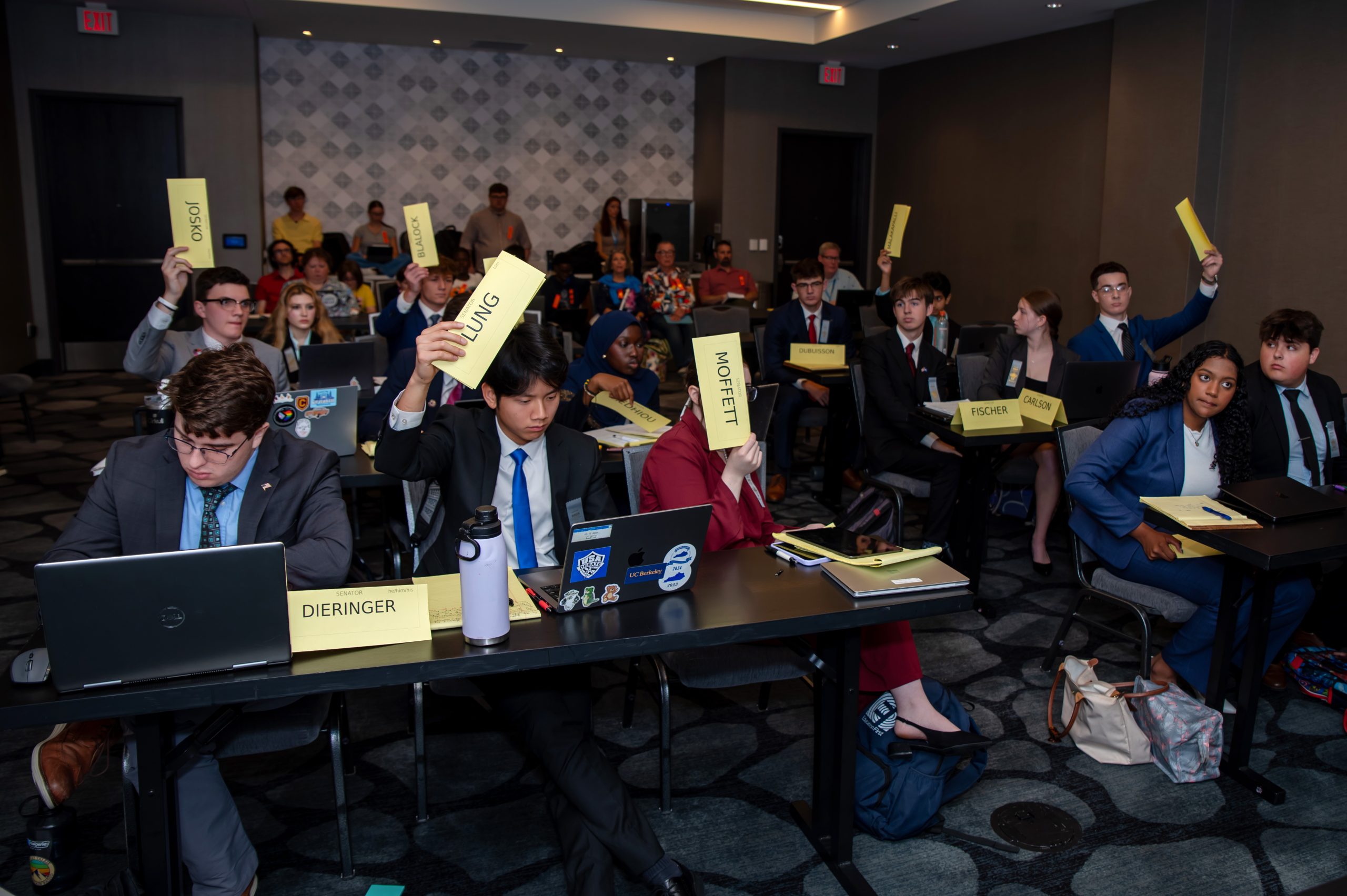
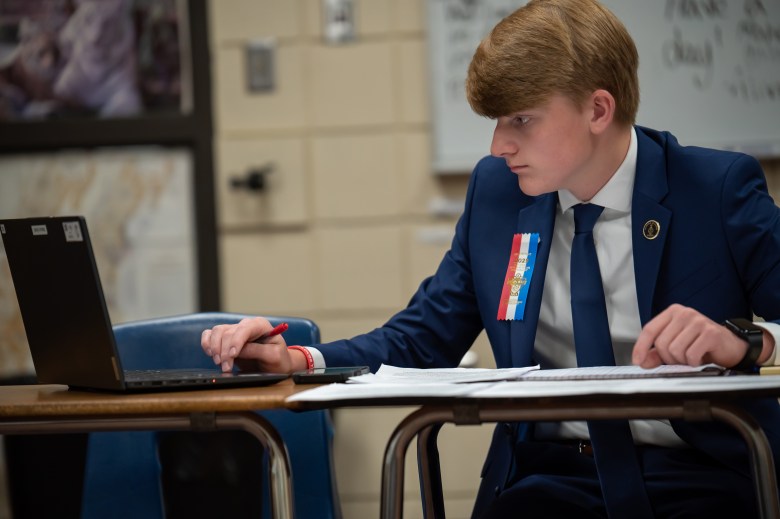
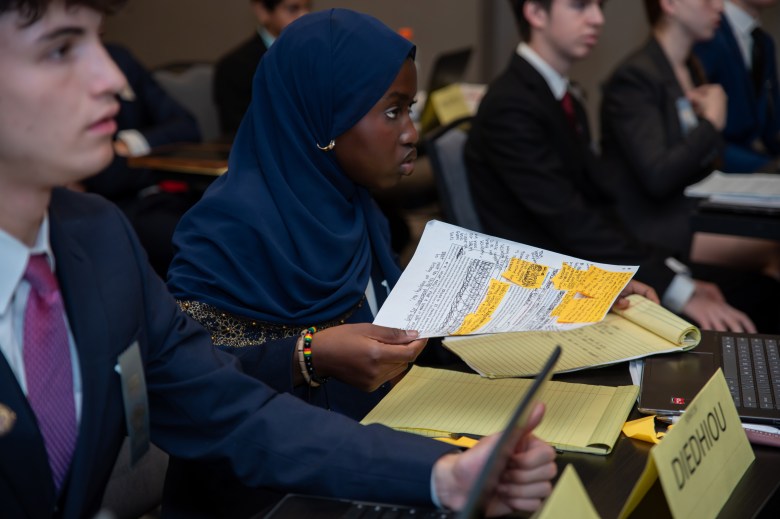
    On the other side of Des Moines, Gagnado Diedhiou was competing in the Congressional Debate, a division of the tournament that mimics Congress and requires students to argue for or against bills modeled after current events. During one round, Gagnado spoke in favor of a bill to shift the country to use more nuclear energy, for a bill that would grant Puerto Rico statehood, and against legislation requiring hospitals to publicly post prices.

    Gagnado Diedhiou, a senior from Eastside High School in South Carolina, competing in the first round of the Congressional Debate at the National Speech and Debate Tournament in Iowa in June. Credit: Meenakshi Van Zee for The Hechinger Report

    Just like in Congress, boys outnumbered girls in this classroom. Gagnado was the only Black teenager and the only student wearing a hijab. The senior, who just graduated from Eastside High School in Greenville, South Carolina, is accustomed to being in rooms where nobody looks like her — it’s part of the reason she joined Equality in Forensics, a national student-led debate organization that provides free resources to schools and students across the country.

    “It kind of makes you have to walk on eggshells a little bit. Especially because when you’re the only person in that room who looks like you, it makes you a lot more obvious to the judges,” said Gagnado, who won regional Student of the Year for speech and debate in her South Carolina district this year. “You stand out, and not always in a good way.”

    Camille Fernandez, a rising junior at West Broward High School in Florida, said the competitions she has participated in have been dominated by male students. One opponent called her a vulgar and sexist slur after their round was over. Camille is a member of a student-led group — called Outreach Debate — trying to bridge inequities in the clubs. 

    “A lot of people think that debate should stay the same way that it’s always been, where it’s kind of just — and this is my personal bias — a lot of white men winning,” Camille said. “A lot of people think that should be changed, me included.” 

    Despite the challenges, Gagnado said her time in debate club has made her realize she could have an influence in the world.

    “With my three-minute speech, I can convince a whole chamber, I can convince a judge to vote for this bill. I can advocate and make a difference with some legislation,” said Gagnado, who is bound for Yale. 

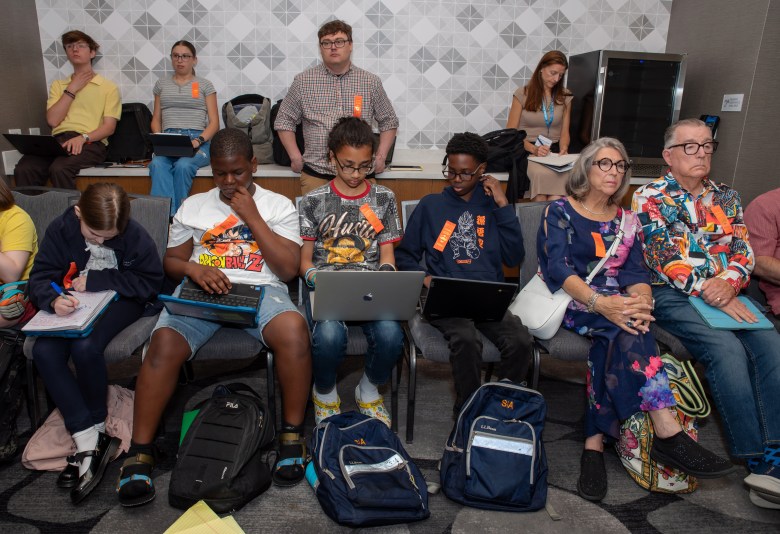
    About 10,000 people attended the National Speech and Debate Tournament in Iowa this June during the organization’s centennial anniversary. Credit: Meenakshi Van Zee for The Hechinger Report

    A day before the national tournament’s concluding ceremony, a 22-year-old attendee rushed the stage at the Iowa Event Center in Des Moines during the final round of the Humorous Interpretation speech competition, scaring everyone in the audience. After he bent down to open his backpack, 3,000 people in the auditorium fled for the exits. The man was later charged with possession of a controlled substance and disorderly conduct. For a brief moment, it seemed like the angry discourse and extreme politics from outside of the competition had become a part of it. 

    In response, the speech and debate organization shifted the time of some events, limited entrances into the building and brought in metal detectors, police officers and counselors. Some students, Gagnado among them, chose not to return to the event. 

    Still, thousands of attendees stayed until the end to celebrate the national champions. During the awards ceremony, where therapy dogs roamed the grounds, Angad Singh, a student from Bellarmine College Preparatory in California competing in Original Oratory, took the national prize for his speech on his Sikh identity and the phrase “thoughts and prayers” commonly repeated by American leaders after a tragedy, titled “Living on a Prayer.”

    “I’ve prayed for change,” Singh told the audience. “Then I joined speech and debate to use my voice and fight for it.”

    This story about high school speech and debate was produced by The Hechinger Report, a nonprofit, independent news organization focused on inequality and innovation in education. Sign up for the Hechinger newsletter.

    The Hechinger Report provides in-depth, fact-based, unbiased reporting on education that is free to all readers. But that doesn’t mean it’s free to produce. Our work keeps educators and the public informed about pressing issues at schools and on campuses throughout the country. We tell the whole story, even when the details are inconvenient. Help us keep doing that.

    Join us today.

    Source link

  • Release of NAEP science scores

    Release of NAEP science scores

    UPDATE: After this story was published, the Education Department issued a press release Monday afternoon, July 7, announcing that Matthew Soldner will serve as acting commissioner of the National Center for Education Statistics, in addition to his role as acting director of the Institute of Education Sciences. The job of statistics chief had been vacant since March and had prevented the release of assessment results.

    The repercussions from the decimation of staff at the Education Department keep coming. Last week, the fallout led to a delay in releasing results from a national science test.

    The National Assessment of Educational Progress (NAEP) is best known for tests that track reading and math achievement but includes other subjects, too. In early 2024, when the main reading and math tests were administered, there was also a science section for eighth graders. 

    The board that oversees NAEP had announced at its May meeting that it planned to release the science results in June. But that month has since come and gone. 

    Why the delay? There is no commissioner of education statistics to sign off on the score report, a requirement before it is released, according to five current and former officials who are familiar with the release of NAEP scores, but asked to remain anonymous because they were not authorized to speak to the press or feared retaliation. 

    Related: Our free weekly newsletter alerts you to what research says about schools and classrooms.

    Peggy Carr, a Biden administration appointee, was dismissed as the commissioner of the National Center for Education Statistics in February, two years before the end of her six-year term set by Congress. Chris Chapman was named acting commissioner, but he was fired in March, along with half the employees at the Education Department. The role has remained vacant since.

    A spokesman for the National Assessment Governing Board, which oversees NAEP,  said the science scores will be released later this summer, but denied that the lack of a commissioner is the obstacle. “The report building is proceeding so the naming of a commissioner is not a bureaucratic hold-up to its progress,” Stephaan Harris said by email.

    The delay matters. Education policymakers have been keen to learn if science achievement had held steady after the pandemic or tumbled along with reading and math. (Those reading and math scores were released in January.)

    The Trump administration has vowed to dismantle the Education Department and did not respond to an emailed question about when a new commissioner would be appointed. 

    Related: Chaos and confusion as the statistics arm of the Education Department is reduced to a skeletal staff of 3

    Researchers hang onto data

    Keeping up with administration policy can be head-spinning these days. Education researchers were notified in March that they would have to relinquish federal data they were using for their studies. (The department shares restricted datasets, which can include personally identifiable information about students, with approved researchers.) 

    But researchers learned on June 30 that the department had changed its mind and decided not to terminate this remote access. 

    Lawyers who are suing the Trump administration on behalf of education researchers heralded this about-face as a “big win.” Researchers can now finish projects in progress. 

    Still, researchers don’t have a way of publishing or presenting papers that use this data. Since the mass firings in mid-March, there is no one remaining inside the Education Department to review their papers for any inadvertent disclosure of student data, a required step before public release. And there is no process at the moment for researchers to request data access for future studies. 

    “While ED’s change-of-heart regarding remote access is welcome,” said Adam Pulver of Public Citizen Litigation Group, “other vital services provided by the Institute of Education Sciences have been senselessly, illogically halted without consideration of the impact on the nation’s educational researchers and the education community more broadly.  We will continue to press ahead with our case as to the other arbitrarily canceled programs.”

    Pulver is the lead attorney for one of three suits fighting the Education Department’s termination of research and statistics activities. Judges in the District of Columbia and Maryland have denied researchers a preliminary injunction to restore the research and data cuts. But the Maryland case is now fast-tracked and the court has asked the Trump administration to produce an administrative record of its decision-making process by July 11. (See this previous story for more background on the court cases.)

    Related: Education researchers sue Trump administration, testing executive power

    Some NSF grants restored in California

    Just as the Education Department is quietly restarting some activities that DOGE killed, so is the National Science Foundation (NSF). The federal science agency posted on its website that it had reinstated 114 awards to 45 institutions as of June 30. NSF said it was doing so to comply with a federal court order to reinstate awards to all University of California researchers. It was unclear how many of these research projects concerned education, one of the major areas that NSF funds.

    Researchers and universities outside the University of California system are hoping for the same reversal. In June, the largest professional organization of education researchers, the American Educational Research Association, joined forces with a large coalition of organizations and institutions in filing a legal challenge to the mass termination of grants by the NSF. Education grants were especially hard hit in a series of cuts in April and May. Democracy Forward, a public interest law firm, is spearheading this case.

    Contact staff writer Jill Barshay at 212-678-3595, jillbarshay.35 on Signal, or [email protected].

    This story about delaying the NAEP science score report was written by Jill Barshay and produced by The Hechinger Report, a nonprofit, independent news organization focused on inequality and innovation in education. Sign up for Proof Points and other Hechinger newsletters.

    The Hechinger Report provides in-depth, fact-based, unbiased reporting on education that is free to all readers. But that doesn’t mean it’s free to produce. Our work keeps educators and the public informed about pressing issues at schools and on campuses throughout the country. We tell the whole story, even when the details are inconvenient. Help us keep doing that.

    Join us today.

    Source link

  • Trump Education Department Delays Return of Laid-Off Workers Over Logistics – The 74

    Trump Education Department Delays Return of Laid-Off Workers Over Logistics – The 74


    Get stories like this delivered straight to your inbox. Sign up for The 74 Newsletter

    Parking permits. Desk space. Access cards.

    Ordered to bring back roughly 1,300 laid-off workers, the U.S. Department of Education instead has spent weeks ostensibly working on the logistics. Meanwhile, the Trump administration wants the U.S. Supreme Court to decide they don’t have to restore those jobs after all.

    The legal argument over the job status of Education Department workers is testing the extent to which President Donald Trump and Education Secretary Linda McMahon can reshape the federal bureaucracy without congressional approval.

    The employees, meanwhile, remain in limbo, getting paid for jobs they aren’t allowed to perform.

    An analysis done by the union representing Education Department employees estimates the government is spending about $7 million a month for workers not to work. That figure does not include supervisors who are not part of the American Federation of Government Employee Local 252.

    “It is terribly inefficient,” said Brittany Coleman, chief steward for AFGE Local 252 and an attorney in the Office for Civil Rights. “The American people are not getting what they need because we can’t do our jobs.”

    McMahon announced the layoffs in March, a week after she was confirmed by the Senate, and described them as a first step toward dismantling the Education Department. A few days later, Trump signed an executive order directing McMahon to do everything in her legal authority to shut down the department.

    The Somerville and Easthampton school districts in Massachusetts, along with the American Federation of Teachers, other education groups, and 21 Democratic attorneys general sued McMahon over the cuts. They argued the layoffs were so extensive that the Education Department would not be able to perform its duties under the law.

    The layoffs hit the Office for Civil Rights, Federal Student Aid, and the Institute of Education Sciences particularly hard. These agencies are responsible for federally mandated work within the Education Department. By law, only Congress can get rid of the Education Department.

    U.S. District Court Judge Myong Joun agreed, issuing a sweeping preliminary injunction in May that ordered the Education Department to bring laid off employees back to work and blocked any further effort to dismantle or substantively restructure the department.

    The Trump administration sought a stay of that order, and the case is on the emergency docket of the Supreme Court, where a decision could come any day.

    In the administration’s request to the Supreme Court, Solicitor General John Sauer argued that the harms the various plaintiffs had described were largely hypothetical, that they had not shown the department wasn’t fulfilling its duties, and that they didn’t have standing to sue because layoffs primarily affect department employees, not states, school districts, and education organizations.

    Sauer further argued that the injunction violates the separation of powers, putting the judicial branch in charge of employment decisions that are the purview of the executive branch.

    “The injunction rests on the untenable assumption that every terminated employee is necessary to perform the Department of Education’s statutory functions,” Sauer wrote in a court filing. “That injunction effectively appoints the district court to a Cabinet role and bars the Executive Branch from terminating anyone.”

    The Supreme Court, with a conservative 6-3 majority, has been friendlier to the administration’s arguments than lower court judges. Already the court has allowed cuts to teacher training grants to go through while a lawsuit works its way through the courts. And it has halted the reinstatement of fired probationary workers.

    The Education Department did not immediately respond to a request for comment.

    Last week, Joun issued a separate order telling the Education Department that it must reinstate employees in the Office for Civil Rights. The Victims Rights Law Center and other groups had described thousands of cases left in limbo, with children suffering severe bullying or unable to safely return to school.

    Meanwhile, the Education Department continues to file weekly updates with Joun about the complexities of reinstating the laid-off employees. In these court filings, Chief of Staff Rachel Oglesby said an “ad hoc committee of senior leadership” is meeting weekly to figure out where employees might park and where they should report to work.

    Since the layoffs, the department has closed regional offices, consolidated offices in three Washington, D.C. buildings into one, reduced its contracts for parking space, and discontinued an interoffice shuttle.

    In the most recent filing, Oglesby said the department is working on a “reintegration plan.”

    Coleman said she finds these updates “laughable.”

    “If you are really willing to do what the court is telling you to do, then your working group would have figured out a way to get us our laptops,” she said.

    This story was originally published by Chalkbeat. Chalkbeat is a nonprofit news site covering educational change in public schools. Sign up for their newsletters at ckbe.at/newsletters.


    Get stories like these delivered straight to your inbox. Sign up for The 74 Newsletter

    Source link

  • We have to work together to improve school culture and make our public schools great places to teach, work and learn

    We have to work together to improve school culture and make our public schools great places to teach, work and learn

    A torrent of controversy has erupted over the Trump administration’s decision to shutter the federal Department of Education. Critics howl that it will destroy public education in America. Supporters insist it will somehow make things better.

    The only thing that’s clear is that our public education system is broken. It’s time for politicians to stop using education as a political football, with blue and red teams competing for control rather than sharing the responsibility to prepare our children for their futures.

    The resulting chaos and confusion and rigid policies choke the joy out of learning and of working in our schools. Insufficient attention by leaders to education culture can result in fear and distrust, turf wars and a tendency to blame and make excuses for a lack of progress.

    Such behaviors produce a toxicity that disables learning and disempowers leadership. Instead of increasing our nation’s economic prosperity, we’re deepening inequality, limiting opportunity and sadly wasting the potential of many children, on whose ability to thrive our country depends.

    Poor work conditions, insufficient support, inadequate pay and limited career opportunities are among some of the reasons teachers are leaving and schools are struggling to attract top talent. Reductions in funding from the Great Recession through the present render our facilities dangerous in some instances and unwelcoming in others. Would you buy a house with barbed wire fencing and unkempt grounds that make you wonder whether the aim is to keep something out or in?

    Related: A lot goes on in classrooms from kindergarten to high school. Keep up with our free weekly newsletter on K-12 education.

    What should we do to change what is going on inside our schools?

    We must first of all start working together to make our public schools great places to teach and learn.

    Great places to work and learn are places that are well led, fueled by purpose and guided by shared, positive behaviors that advance learning goals and serve as “rules of the road” for how employees and students are expected to behave.

    In great schools, employees, students and families are respected and valued. Leaders in great schools inspire their employees — all of them — to do more than they think they can. Employees align behind the purpose of enabling learning, which creates momentum and camaraderie for what they are working to attain together.

    In great schools, leaders inspire their communities to join them in cheering for and supporting kids’ future successes. Families, no matter their socioeconomic status, feel a sense of belonging.

    Problems are perceived as opportunities to get better, not sources of indiscriminate blame. Solutions are found by looking in the mirror first. External threats to learning, such as poverty or parents’ underemployment, are acknowledged and addressed. Schools don’t dodge their responsibility to educate all kids.

    In great schools, kids are known by caring employees; they feel seen and heard and are deeply engaged and invested in their learning.

    Every employee working in a great school district feels responsible for achieving the district’s mission, no matter whether they work inside or outside of the classroom.

    When kids return after being absent, employees welcome them back, tell them they were missed and focus on catching them up. They do not judge the constraints of their families’ lives or mete out punishment as though missing school is a crime.

    Related: Horticulture, horses and ‘Chill Rooms’: One district goes all-in on mental health support

    Great places to learn must also be great places to work. We must reframe our concept of schools as not just places where kids learn. Great places to work care about the needs of all the human beings in their care, including and especially their employees.

    “To win in the marketplace, you must first win in the workplace,” Douglas R. Conant, former Campbell Soup Company CEO famously said. He knew what is becoming clearer within our public school systems — that unhappy, unfulfilled employees lead to high turnover, disengagement by students and staff and disaffected families turning to alternative educational offerings.

    It is no secret that attracting and retaining top talent to work in our schools is increasingly difficult as employees seek more stability. Attracting younger workers is even more difficult.

    Many of those who currently work in schools, especially teachers, are stressed, burned out and dissatisfied. Being stressed and burned out is not a normative experience; it’s a symptom of a weak culture, and an organizational problem to be solved. And employee turnover is no longer limited to teachers. There are increasing vacancies among principals, bus drivers and food service and facilities staff.

    The quality of the experiences of employees working in our schools must be higher. Every point along the employee experience continuum, from applying for a job to choosing to leave, is an opportunity to deepen employee engagement and commitment to being a high performer.

    We can fix what we have broken. Thinking differently about making our public schools great places to work and learn is a good place to start. No policy changes are required to demonstrate concern for the human beings the system employs and seeks to educate.

    Etienne R. LeGrand is a thought leader, writer and culture-shaping strategist and adviser at Vivify Performance.

    Contact the opinion editor at [email protected].

    This story about school culture was produced by The Hechinger Report, a nonprofit, independent news organization focused on inequality and innovation in education. Sign up for Hechinger’s weekly newsletter.

    The Hechinger Report provides in-depth, fact-based, unbiased reporting on education that is free to all readers. But that doesn’t mean it’s free to produce. Our work keeps educators and the public informed about pressing issues at schools and on campuses throughout the country. We tell the whole story, even when the details are inconvenient. Help us keep doing that.

    Join us today.

    Source link

  • Education Department reinstates some research and data activities

    Education Department reinstates some research and data activities

    Education Secretary Linda McMahon has repeatedly said that the February and March cancellations and firings at her department cut not only the “fat” but also into some of the “muscle” of the federal role in education. So, even as she promises to dismantle her department, she is also bringing back some people and restarting some activities. Court filings and her own congressional testimony illuminate what this means for the agency as a whole, and for education research in particular. 

    McMahon told a U.S. House committee last month she rehired 74 employees out of the roughly 2,000 who were laid off or agreed to separation packages. A court filing earlier this month says the agency will revive about a fifth of research and statistics contracts killed earlier this year, at least for now, though that doesn’t mean the work will look exactly as it did before.  

    The Trump administration disclosed in a June 5 federal court filing in Maryland that it either has or is planning to reinstate 20 of 101 terminated contracts to comply with congressional statutes. More than half of the reversals will restart 10 regional education laboratories that the Trump administration had said were engaged in “wasteful and ideologically driven spending,” but had been very popular with state education leaders. The reinstatements also include an international assessment, a study of how to help struggling readers, and Datalab, a web-based data analysis tool for the public. 

    Related: Our free weekly newsletter alerts you to what research says about schools and classrooms.

    Even some of the promised reinstatements are uncertain because the Education Department plans to put some of them up for new bids (see table below). That process could take months and potentially result in smaller contracts with fewer studies or hours of technical assistance. 

    These research activities were terminated by Elon Musk’s Department of Government Efficiency (DOGE) before McMahon was confirmed by the Senate. The Education Department’s disclosure of the reinstatements occurred a week after President Donald Trump bid farewell to Musk in the Oval Office and on the same day that the Trump-Musk feud exploded on social media. 

    See which IES contracts have been or are slated to be restarted, or under consideration for reinstatement
    Description Status
    1 Regional Education Laboratory – Mid Atlantic Intends to seek new bids and restart contract
    2 Regional Education Laboratory – Southwest Intends to seek new bids and restart contract
    3 Regional Education Laboratory – Northwest Intends to seek new bids and restart contract
    4 Regional Education Laboratory – West Intends to seek new bids and restart contract
    5 Regional Education Laboratory – Appalachia Intends to seek new bids and restart contract
    6 Regional Education Laboratory – Pacific Intends to seek new bids and restart contract
    7 Regional Education Laboratory – Central Intends to seek new bids and restart contract
    8 Regional Education Laboratory – Midwest Intends to seek new bids and restart contract
    9 Regional Education Laboratory – Southeast Intends to seek new bids and restart contract
    10 Regional Education Laboratory – Northeast and Islands Intends to seek new bids and restart contract
    11 Regional Education Laboratory – umbrella support contract Intends to seek new bids and restart contract
    12 What Works Clearinghouse (website, training reviewers, but no reviewing of education research) Approved for reinstatement
    13 Statistical standards and data confidentiality technical assistance for the National Center for Education Statistics Reinstated
    14.  Statistical and confidentiality review of electronic data files and technical reports Approved for reinstatement
    15 Datalab, a web-based data analysis tool for the public Approved for reinstatement
    16 U.S. participation in the Program for International Student Assessment (PISA), an international test overseen by the Organization for Economic Cooperation and Development (OECD) Reinstated
    17 Data quality and statistical methodology assistance Reinstated
    18 EDFacts, a  collection of administrative data from school districts around the country Reinstated
    19 Demographic and geospatial estimates (e.g. school poverty and school locations) used for academic research and federal program administration Approved for reinstatement
    20 Evaluation of the Multi-tiered System of Supports in reading, an approach to help struggling students Approved for reinstatement
    21 Implementation of the Striving Readers Comprehensive Literacy Program and feasibility of conducting an impact evaluation of it.  Evaluating whether to restart
    22 Policy-relevant findings for the National Evaluation of Career and Technical Education Evaluating whether to restart
    23 The National Postsecondary Student Aid Study (how students finance college, college graduation rates and workforce outcomes) Evaluating whether to restart
    24 Additional higher ed studies Evaluating whether to restart
    25 Publication assistance on educational topics and the annual report Evaluating whether to restart
    26 Conducting peer review of applications, manuscripts and grant competitions at the Institute of Education Sciences Evaluating whether to restart

    The Education Department press office said it had no comment beyond what was disclosed in the legal brief. 

    Education researchers, who are suing the Trump administration to restore all of its previous research and statistical activities, were not satisfied.

    Elizabeth Tipton, president of the Society for Research on Educational Effectiveness (SREE) said the limited reinstatement is “upsetting.” “They’re trying to make IES as small as they possibly can,” she said, referring to the Institute of Education Sciences, the department’s research and data arm. 

    SREE and the American Educational Research Association (AERA) are suing McMahon and the Education Department in the Maryland case. The suit asks for a temporary reinstatement of all the contracts and the rehiring of IES employees while the courts adjudicate the broader constitutional issue of whether the Trump administration violated congressional statutes and exceeded its executive authority.

    The 20 reinstatements were not ordered by the court, and in some instances, the Education Department is voluntarily restarting only a small slice of a research activity, making it impossible to produce anything meaningful for the public. For example, the department said it is reinstating a contract for operating the What Works Clearinghouse, a website that informs schools about evidence-based teaching practices. But, in the legal brief, the department disclosed that it is not planning to reinstate any of the contracts to produce new content for the site. 

    Related: Education researchers sue Trump administration, testing executive power

    In the brief, the administration admitted that congressional statues mention a range of research and data collection activities. But the lawyers argued that the legislative language often uses the word may instead of must, or notes that evaluations of education programs should be done “as time and resources allow.” 

    “Read together, the Department has wide discretion in whether and which evaluations to undertake,” the administration lawyers wrote. 

    The Trump administration argued that as long as it has at least one contract in place, it is technically fulfilling a congressional mandate. For example, Congress requires that the Education Department participate in international assessments. That is why it is now restarting the contract to administer the Program for International Student Assessment (PISA), but not other international assessments that the country has participated in, such as the Trends in International Mathematics and Science Study (TIMSS).

    The administration argued that researchers didn’t make a compelling case that they would be irreparably harmed if many contracts were not restarted. “There is no harm alleged from not having access to as-yet uncreated data,” the lawyers wrote.

    One of the terminated contracts was supposed to help state education agencies create longitudinal data systems for tracking students from pre-K to the workforce. The department’s brief says that states, not professional associations of researchers, should sue to restore those contracts. 

    Related: DOGE’s death blow to education studies

    In six instances, the administration said it was evaluating whether to restart a study. For example, the legal brief says that because Congress requires the evaluation of literacy programs, the department is considering a reinstatement of a study of the Striving Readers Comprehensive Literacy Program. But lawyers said there was no urgency to restart it because there is no deadline for evaluations in the legislative language.

    In four other instances, the Trump administration said it wasn’t feasible to restart a study, despite congressional requirements. For example, Congress mandates that the Education Department identify and evaluate promising adult education strategies. But after terminating such a study in February, the Education Department admitted that it is now too difficult to restart it. The department also said it could not easily restart two studies of math curricula in low-performing schools. One of the studies called for the math program to be implemented in the first year and studied in the second year, which made it especially difficult to restart. A fourth study the department said it could not restart would have evaluated the effectiveness of extra services to help teens with disabilities transition from high school to college or work. When DOGE pulled the plug on that study, those teens lost those services too. 

    Contact staff writer Jill Barshay at 212-678-3595, jillbarshay.35 on Signal, or [email protected].

    This story about the reinstatement of education statistics and research was written by Jill Barshay and produced by The Hechinger Report, a nonprofit, independent news organization focused on inequality and innovation in education. Sign up for Proof Points and other Hechinger newsletters.

    The Hechinger Report provides in-depth, fact-based, unbiased reporting on education that is free to all readers. But that doesn’t mean it’s free to produce. Our work keeps educators and the public informed about pressing issues at schools and on campuses throughout the country. We tell the whole story, even when the details are inconvenient. Help us keep doing that.

    Join us today.

    Source link

  • International students “crucial” for US growth, states new report

    International students “crucial” for US growth, states new report

    The study, published by the Institue of International Education (IIE), outlines the importance of expanding international study to the US over the next five years as American universities brace for an impending domestic “enrolment cliff”. 

    “Attracting global talent is crucial to driving the US economy and growth, and maintaining US leadership” IIE’s head of research, evaluation and learning Mirka Martel told The PIE News. 

    Martel, co-author of the Outlook 2030 Brief, highlighted the unique capacity of the US to host more international students, who currently make up just 6% of the overall student population.  

    In comparison, international students comprise a much larger proportion of the total student body in the UK (27%), Australia (31%) and Canada (38%). 

    Notably, 36 US states were identified by IIE with international student populations below the 6% line, with Massachusetts, New York and Washington DC the regions with the highest proportions of international students.  

    Meanwhile, US universities are facing a much reported on domestic enrolment cliff, with government figures showing undergraduate enrolment declining by more than two million between 2010 and 2022. 

    What’s more, projections indicate that the number of high school graduates will peak in 2025 and decline by 13% by 2041, with IIE warning that US colleges and universities will be left with “empty seats” if they do not focus on international enrolments.  

    Despite recent reports of declining student interest in the US driven by the Trump administration’s hostile policies, IIE’s Fall 2024 Snapshot predicted a 3% growth in international student levels in the 2024/15 academic year.  

    Martel said she expected this forecast to hold true, pointing to the “exciting” fall increase in undergraduate rates for the first time since Covid and the continuing increase in Optional Practical Training (OPT) stemming from rising graduate rates over the last three years. 

    Outside the US, the total number of globally mobile students has seen exponential growth in recent years, nearly doubling over the past decade to reach 6.9 mil in 2024.   

    With last year witnessing the largest growth since the pandemic, some expect global mobility to exceed 9 million by 2030, driven by the growth of youthful populations in South Asia and Sub-Saharan Africa.  

    This, the report says, will create “a steady pipeline of students seeking future academic study”, highlighting the case of Nigeria where the country’s universities can only admit one-third of the two million annual applicants due to capacity constraints.  

    Elsewhere in India, domestic institutions have significantly expanded their undergraduate studies, but “there remains a strong interest in pursuing graduate studies abroad,” according to IIE. 

    Attracting global talent is crucial to driving the US economy and growth

    Mirka Martel, IIE

    In 2023/24, the number of international students in the US reached a record level of 1.1 million, which was primarily driven by a surge in OPT rather than new enrolments.  

    IIE’s 2030 Outlook highlights the $50bn contribution of international students to the US in 2024, with California ($6.4bn), New York ($6.3bn) and Massachusetts ($3.9) reaping the highest economic benefits.  

    What’s more, last year international students created nearly 400,000 jobs in the US, with the report highlighting their role in driving innovation in key industries, as more than half of international students in the US graduate from STEM fields.  

    It points to Chamber of Commerce predictions of incoming labour market shortages across healthcare, computer and mathematical sciences, and business and financial operations, with international students with US training well-poised to fill the gaps.  

    Beyond the numbers, “[international students] are a political and economic asset for America,” states the report: broadening perspectives in the classroom and furthering business, cultural, economic and political ties after they return home.  

    Source link

  • The view from 4 campuses

    The view from 4 campuses

    A Black History Month event, canceled. A lab working to fight hunger, shuttered. Student visas revoked, then reinstated, uncertain for how long. Opportunities for students pursuing science careers, fading.

    The first six months of the Trump administration have brought a hailstorm of changes to the nation’s colleges and universities. While the president’s faceoffs with Harvard and Columbia have generated the most attention, students on campuses throughout the country are noticing the effects of the administration’s cuts to scientific and medical research, clampdown on any efforts promoting diversity equity and inclusion (DEI), newly aggressive policies for students with loan debt, revoking of visas for international students and more

    Many of the administration’s actions are being challenged in court, but they are influencing the way students interact with each other, what support they can get from their institutions — and even whether they feel safe in this nation.   

    The Hechinger Report traveled to campuses around the country to look at what these changes mean for students. Reporters visited universities in four states — California, Illinois, Louisiana and Texas — to understand this new era for higher education.

    Related: Interested in more news about colleges and universities? Subscribe to our free biweekly higher education newsletter.

    Louisiana State University 

    BATON ROUGE, La. — Last fall, Louisiana State University student A’shawna Smith had an idea for a new campus group to educate students about their legal rights and broader problems in the criminal justice system. Smith, a sociology major, had spent the prior summer interning at a law firm and noticed how many clients didn’t know their rights after an arrest. 

    Smith, now a rising senior, called it The Injustice Reform and soon recruited classmates and a campus adviser. They wrote a mission statement and trained as student group leaders. On Feb. 20, LSU’s student government, which awards money to campus groups that comes from student fees, gave them $1,200; Smith and her classmates planned to use the award to recruit members and organize events. 

    At Louisiana State University, in Baton Rouge, students say actions taken by the school’s administration in response to the federal crackdown on diversity, equity and inclusion are changing the campus culture and harming the operations of student government. Credit: Tyler Kaufman/AP Photo

    But on April 8, Injustice Reform’s treasurer received a text message from Cortney Greavis, LSU’s student government adviser. She said LSU was rescinding the money: The group’s mission statement ran afoul of new federal and state restrictions on DEI. Its mission mentions racial disparities and police brutality, but the organizers were never told which words violated the rules. Smith and fellow leaders started chipping in their own money to keep the group going: $10 here and there, whatever they could afford, said Bella Porché, a rising senior on the group’s executive board. 

    Canceling awards to student groups is one way students say administrators at LSU, the state’s flagship university, have restricted what they can do and say since the U.S. Department of Education wrote to schools and colleges nationwide on Valentine’s Day. The letter described DEI efforts — designed to rectify current and historic discrimination — as discriminatory and threatened schools with the loss of federal money unless they ended the consideration of race in admissions, financial aid, housing, training and other practices. 

    Since the letter, discussion of DEI on campus “has become an anti-gay, anti-Black sort of conversation,” said Emma Miller, a rising senior and elected student senator. “People who are minorities don’t feel safe anymore, don’t feel represented, don’t feel seen, because DEI is being wiped away and their university is not saying anything.” 

    In a March 7 report, the university detailed dozens of changes made to comply with the letter’s demands. For example, it ended any preference granted to students from historically underrepresented groups for certain privately funded scholarships; opened membership in school-funded student organizations — like a women-in-business group — to all; and canceled activities perceived to emphasize race, even a fitness class kicking off Black History Month.  

    Student government leaders say the restrictions hinder their ability to operate. Rising junior Tyhlar Holliway, a member of the student government’s Black Caucus, said school administrators essentially shut down the caucus’ proposal that the student government issue a statement after the Department of Education letter in support of DEI programs and initiatives. 

    LSU public relations staff did not respond to interview requests or to an emailed list of questions, and the school’s civil rights and Title IX division director declined to speak.

    Miller said administrators have told student leaders that all their proposed legislation must be reviewed by the school’s general counsel for compliance with the March 7 guidelines. The administration, for example, blocked a student government bill to fund a Black hair care event designed to help students prepare for career and professional opportunities, said senior Paris Holman, a student government member. “We have conferences and interviews and need to know how to take care of our hair,” said Holman, who is Black. 

    Students have also tailored the language of other bills to avoid the appearance of support for DEI. Holman said that in one case the student senate changed the language in a bill funding an end-of-year event for a minority student organization to remove any reference to the organization as serving minority students. 

    The school also overrode student government decisions about which groups, like A’shawna Smith’s, could be funded by student fees. In February, the student government voted to provide $641 to help a pre-med student, who is Black, attend a student medical education conference, in part so she could share what she’d learn with other pre-med students. A few weeks later, she received an email from Greavis, the student government adviser, saying she wouldn’t be able to attend with university funds because that money could no longer be used for “DEI-related events, initiatives, programs, or travel.” Greavis didn’t respond to requests for an interview.

    The email didn’t specify why the medical conference crossed the line. But the sponsoring organization’s mission statement notes its commitment to “supporting current and future underrepresented minority medical students,” and a conference plenary speaker was scheduled to address the “enduring case for DEI in medicine.” Fewer than 6 percent of doctors are Black and research has shown improved health outcomes for Black patients who are seen by physicians of the same race.    

    “It doesn’t feel like a democracy,” said Holman of serving in student government at this moment. 

    She and other students say the university’s actions are starting to change the broader culture at LSU, which serves nearly 40,000 undergraduate and graduate students on its campus of Italian Renaissance buildings shaded by magnolias and Southern live oaks. About 60 percent of students are white and 18 percent are Black, according to federal data

    Mila Fair, a rising sophomore journalism major and a reporter for the campus TV station, said students tell her they’re afraid to join protests, in part because of LSU’s new anti-DEI rules and the national crackdown on student demonstrations. Those who do attend are often afraid to go on camera with her, she said. 

    Professor Andrew Sluyter of Louisiana State University. The university purged hundreds of webpages referencing DEI-related content, including a press release announcing a prestigious fellowship he’d won that mentioned “higher education’s racial inequities.” Credit: Steven Yoder for The Hechinger Report

    Latin American studies professor Andrew Sluyter said administrators normally listen to the student government — even more than to the faculty government — but now worry about students getting the school into “political hot water.” He had his own run-in with the DEI ban: As part of a February effort to scrub school websites of diversity references, in which the university purged hundreds of webpages referencing DEI-related content, LSU deleted a 2022 press release announcing a prestigious fellowship he’d won that mentioned “higher education’s racial inequities.” 

    Students recognize the pressure LSU is under from the federal government, but they want administrators to stand up for them, said graduate student Alicia Cerquone, a student senator. “We want some sort of communication from the university that shows commitment to its community, that they have our backs and they’ll protect students,” she said. 

    Steven Yoder

    The University of California, Berkeley  

    BERKELEY, Calif. — Since early April, Rayne Xue, a junior at the University of California, Berkeley, has watched with trepidation as the Trump administration has taken one step after another to limit international students’ access to American higher education. 

    First came the abrupt cancellation, then reinstatement, of visas for 23 Berkeley students and recent graduates. Then the government cut off Harvard’s ability to enroll international students — a move since blocked by a federal judge — raising fears that something similar could happen at Berkeley. And late last month, as this year’s graduates were celebrating their recent commencements, Secretary of State Marco Rubio paused interviews for all new student visas and announced he would “aggressively revoke” those of Chinese students.

    About 16 percent of University of California, Berkeley, students come from outside the United States. Credit: Eric Risberg/AP Photo

    Xue, who is from Beijing and won a student senate seat this past spring on a platform of supporting international students, said the administration’s actions strike at a critical part of campus life at Berkeley.

    “College is the opportunity of a lifetime to unlearn prejudices and embrace new perspectives, neither of which is possible without a student body that comes from a wide range of geographic and cultural backgrounds,” she said.

    About 16 percent of UC Berkeley’s more than 45,000 students come from outside the United States to study at the crown jewel of California’s public research university system, where creeks run through campus beneath cooling redwoods and parking spaces are set aside for Nobel laureates. China, India, South Korea and Canada send the biggest numbers. International students pay higher tuition than California residents, boosting the university’s coffers and subsidizing some of their peers. Many of them conduct cutting-edge research in fields like computer science, engineering and chemistry.

    Now the Trump administration’s immigration crackdown, magnified by the yanking of billions in federal research dollars, has international students worried about their future on campus. Many are changing their behavior to avoid scrutiny: Some canceled travel plans and many said they avoid walking near any campus protests in fear of being photographed.

    “It’s difficult for international students to feel secure when they cannot anticipate what the administration might charge against them next — or whether they might be unfairly targeted,” said one global studies major who asked not to be identified for fear of attracting retaliation.

    Tomba Morreau, a rising junior from the Netherlands studying sociology, said he stopped posting about politics on social media — just in case.

    That kind of self-censorship troubles Paul Fine, co-chair of the Berkeley Faculty Association, which represents about a fifth of the university’s tenure-track faculty. 

    Federal policies are “creating this culture of fear where people start to censor themselves and try to stay under the radar and not show up in their full selves, whether for academic work or activism,” he said.

    Related: International students are rethinking coming to the U.S. That’s a problem for colleges

    International students in Fine’s classes told him they wanted to attend a recent protest against federal threats to higher education but were afraid of the consequences, he said. Others told him they were skipping academic conferences outside the United States that they otherwise would have attended.

    “Berkeley really prides ourselves on being an intellectual hub that convenes people from all over the world to work on the most important problems,” Fine said. Now that identity is at risk, he said, especially as actual and threatened cuts to grants make it harder for faculty to hire international graduate students and postdocs. 

    Most poignant, he said, was hearing from demoralized Chinese students who left a repressive government to come to the United States only to see attacks on academic freedom replicated here. 

    Xue said she hopes the crisis facing universities would draw attention to the challenges international students face, including limited financial aid and the stereotype that all of them are wealthy. With her colleagues in student government, she is lobbying for Berkeley to spend more on the international office, which provides one-on-one advising on visa issues and employment.

    For Lily Liu, a Chinese computer scientist, 2025 was shaping up to be a year of milestones. She graduated with a doctorate last month, has a job lined up at a leading artificial intelligence company and is engaged to be married in November.

    But the Trump administration’s changing policies toward international scholars have complicated celebrations for Liu, who’s in a federal program that extends her visa for up to a year beyond graduation so she can gain work experience here. She canceled summer travel plans with her family, concerned she might not be let back into the country. And she’s considering moving her wedding to the United States from China, even though many of her relatives wouldn’t be able to attend.

    “For international students, every policy affects us a lot,” she said. So Liu is careful. After the publication of her thesis was delayed, she visited Berkeley’s international office to make sure the setback wouldn’t affect her work permit. Her fiancé has a green card, which should theoretically mean his immigration status is more stable. But these days, she said, who knows? 

    — Felicia Mello 

    The University of Texas at San Antonio 

    SAN ANTONIO, Texas — Growing up here, Reina Saldivar had always loved science — all she wanted to watch on TV was “Animal Planet.” Yet until she applied on a whim to a program for aspiring researchers after her first year at the University of Texas at San Antonio, she assumed she would spend her life as a lab technician, running cultures. 

    The program, Maximizing Access to Research Careers, or MARC, was started by the National Institutes of Health decades ago at colleges around the country to prepare students, especially those from historically underrepresented backgrounds, for livelihoods in the biomedical sciences. 

    Saldivar got in. And through the program, she spent much of her time on campus in a university lab, helping develop a carrier molecule for a new Lyme disease vaccine. Now Saldivar, who graduated this spring, plans to eventually return to academia for a doctorate.  

    “What MARC taught me was that my dreams aren’t out of reach,” she said.

    Saldivar is among hundreds who’ve participated in the MARC program since its 1980 founding at the University of Texas at San Antonio. She may also be among the last. In April, the university’s MARC program director, Edwin Barea-Rodriguez, opened his email inbox to find a form letter terminating the initiative and advising against recruiting more cohorts. 

    The letter cited “changes in NIH/HHS [Health and Human Services] priorities.” In recent months, the Trump administration has canceled at least half a dozen programs meant to train scholars and diversify the sciences as part of an effort to root out what the president labels illegal DEI. 

    In a statement to The Hechinger Report, NIH said that it “is committed to restoring the agency to its tradition of upholding gold-standard, evidence-based science” and is reviewing grants to make sure the agency is “addressing the United States chronic disease epidemic.” 

    With MARC ending, Barea-Rodriguez is searching for a way to continue supporting current participants until they graduate next academic year. Without access to federal money, however, the young scientists are anxious about their futures — and that of public health in general. 

    “It took years to be where we are now,” said Barea-Rodriguez, who said he was not speaking on behalf of his university, “and in a hundred days everything was destroyed.” 

    UTSA’s sprawling campus sits on the northwest edge of San Antonio, far from tourist sites like the Alamo and the River Walk. Forty-four percent of the nearly 31,000 undergraduate students are the first in their families to attend college; more than 61 percent identify as Hispanic or Latino. The university was one of the first nationwide to earn Department of Education recognition as a Hispanic-serving institution, a designation for colleges where at least a quarter of full-time undergraduates are Hispanic.

    When Barea-Rodriguez arrived to teach at the school in 1995, many locals considered it a glorified community college, he said. But in the three decades since, the investments NIH made through MARC and other federal programs have helped it become a top-tier research university. That provided students like Saldivar with access to world-class opportunities close to home and fostered talent that propelled the economy in San Antonio and beyond. 

    The Trump administration has quickly upended much of that infrastructure, not only by terminating career pipeline programs for scholars, but also by pulling more than $8.2 million in National Science Foundation money from UTSA. 

    One of those canceled grants paid for student researchers and the development of new technologies to improve equity in math education and better serve elementary school kids from underrepresented backgrounds in a city that is about 64 percent Hispanic. Another aimed to provide science, technology, engineering and math programming to bilingual and low-income communities. 

    UTSA administrators did not respond to requests for comment about how federal funding freezes and cuts are affecting the university. Nationwide, more than 1,600 NSF grants have been axed since January.

    Related: So much for saving the planet. Climate careers, plus many others, evaporate for class of 2025 

    In San Antonio, undergraduates said MARC and other now-dead programs helped prepare them for academic and professional careers that might have otherwise been elusive. Speaking in a lab remodeled and furnished with NIH money, where leftover notes and diagrams on glass erase boards showed the research questions students had been noodling, they described how the programs taught them about drafting an abstract, honing public speaking and writing skills, networking, putting together a résumé and applying for summer research positions, travel scholarships and graduate opportunities. 

    “All of the achievements that I’ve collected have pretty much been, like, a direct result of the program,” said Seth Fremin, a senior biochemistry major who transferred to UTSA from community college and has co-authored five articles in major journals, with more in the pipeline. After graduation, he will start a fully funded doctoral program at the University of Pittsburgh to continue his research on better understanding chemical reactions. 

    Seth Fremin, a senior biochemistry major at the University of Texas at San Antonio, with Edwin Barea-Rodriguez. Credit: Alexandra Villareal for The Hechinger Report

    Similarly, Elizabeth Negron, a rising senior, is spending this summer at the Massachusetts Institute of Technology, researching skin microbiomes to see if certain bacteria predispose some people to cancers. 

    “It’s weird when you meet students who didn’t get into these programs,” Negron said, referring to MARC. “They haven’t gone to conferences. They haven’t done research. They haven’t been able to mentor students. … It’s very strange to acknowledge what life would have been without it. I don’t know if I could say I’d be as successful as I am now.” 

    With money for MARC erased, Negron said she will probably need a job once she returns to campus in the fall so she can afford day-to-day expenses. Before, research was her job. 

    “Without MARC,” she said, “it becomes a question of can I at least cover my tuition and my very basic needs.” 

    — Alexandra Villarreal 

    The University of Illinois Urbana-Champaign

    CHAMPAIGN, Ill. — When Peter Goldsmith received notice in late January that his Soybean Innovation Lab at the University of Illinois would soon lose all of its funding, he had no idea it was coming. Suddenly Goldsmith, the lab’s director, had to tell his 30 employees they would soon be out of a job and tell research partners across Africa that operations would come to a halt. The lab didn’t even have money to water its soybean fields in Africa. 

    One employee, Julia Paniago, was in Malawi when she got the news. “We came back the next day,” she said of her team, “and it was a lot of uncertainty. And a lot of people cried.”

    The University of Illinois’ Soybean Innovation Lab (SIL) was part of a network of 17 labs at universities across the country, all working on research related to food production and reducing global hunger, and all funded through the U.S. Agency for International Development — until the Trump administration shut down USAID.

    Brian Diers is former deputy director of the University of Illinois’ Soybean Innovation Lab. The lab lost its funding because of cuts to the U.S. Agency for International Development. Credit: Miles MacClure for The Hechinger Report

    Soybeans — which provide both oil and high-protein food — aren’t yet commonly grown in Malawi. SIL researchers have been working toward two related goals: helping local farmers increase soybean production and ameliorate malnutrition and generating enough interest in the crop there that a new export market will open for American farmers.

    The lab’s researchers work in soybean breeding, economics and mechanical research as well as education. They hope to show that soybean production in Africa is worth further investment so that eventually the private sector will come in after them.

    “The people who work at SIL, they like being right at the frontier of change,” Goldsmith said. “It’s high-risk work — that’s what the universities do, that’s what scientific research is about.”

    UI, the state’s flagship with a sprawling campus spread between the cities of Urbana and Champaign, is noted for its research work, especially agricultural research.

    Labs and researchers across the university lost funding in cuts made by the Trump administration; more than $25 million from agencies including NIH, NSF and the National Endowment for the Humanities was cut, Melissa Edwards, associate vice chancellor for research and innovation, said, a total of 59 grants amounting to 3.6 percent of their overall federal grant portfolio.

    Annette Donnelly, who just received her doctorate in education, is among those affected. Her research focuses on educating malnourished children in Africa and developing courses to help Africans learn how to process soybeans into oil.

    Related: The college degree gap between Black and white Americans was always bad. It’s getting worse

    In April, SIL was handed a lifeline — an anonymous $1 million gift that will keep the lab running through April 2026. The donation wasn’t enough for Goldsmith to rehire all of his employees; SIL’s annual operating budget before the USAID cuts was $3.3 million (and would have kept things running through 2027). But, he said, the money will allow SIL to continue its research in the Lower Shire Valley in Malawi, a project he hopes will attract future donors to fund the lab’s work. 

    The April donation saved Donnelly’s job, but her priorities shifted.  “We’re doing research,” she said, “but we’re also doing a lot of proposal writing. It has taken on a much greater priority.” 

    Donnelly hopes to attract more funding so she can resume research she had started in western Kenya, demonstrating that introducing soy into children’s diets increased their protein intake by up to 65 percent, she said.

    The impact that funding cuts will have on researchers at the soybean lab pales in comparison to the impact on their partners in Africa, Donnelly emphasized. There, she said, the cuts mean processors will likely slow production, limiting their ability to deliver soy products. “The consequences there are much bigger,” she said.

    The Soybean Innovation Lab was funded through the Feed the Future initiative, a program to help partner countries develop better agricultural practices that began under the Obama administration in 2010. All 17 Feed the Future innovation labs funded through USAID lost funding, except for the one at Kansas State University, which studies heat-tolerant wheat.

    The soybean lab’s office is housed on a quiet edge of the Illinois campus in a building once occupied by the university’s veterinary medicine program. Across the street, rows of greenhouses are home to the Crop Science Department’s experiments.

    There, Brian Diers is breeding soybean varieties that resist soybean rust, a disease that’s been an obstacle to ramping up soybean production across sub-Saharan Africa. A professor emeritus who is retired, Diers works part-time at SIL to assist with soybean breeding. The April donation wasn’t enough to cover his work. Now he volunteers his time.

    “ If we can help African agriculture take off and become more productive, that’s eventually going to help their economies and then provide more opportunities for American farmers to export to Africa,” he said.

    Goldsmith drew an analogy between his lab’s work and the state of American agriculture in the 1930s. As the Dust Bowl swept through the Great Plains, Monsanto or another company could have stepped in to help combat it, but didn’t. Public land-grant universities did. 

    “That’s where the innovation comes from, from the public land grants in the U.S.,” Goldsmith said. “And now the public land grants still work in U.S. agriculture but also in the developing world.” 

    Commercial soybean producers hesitate to dip their toes into unproven markets, he said, so it’s SIL’s job to demonstrate that a viable market exists. “That was our secret sauce, in that lots of commercial players liked the products, the technologies we had, and wanted to move into the soybean space, but it wasn’t a profitable market,” Goldsmith said of the African soybean market.

    Diers said federal funding cuts imperil not just the development of commerce and global food production but the next generation of scientists as well. 

    “We could potentially lose a generation of scientists who won’t go into science because there’s no funding right now,” he said. 

    — Miles MacClure

    Contact editor Lawrie Mifflin at [email protected] or 212-678-4078. Contact editor Caroline Preston at 212-870-8965, via Signal at CarolineP.83 or on email at [email protected].

    This story about international students was produced by The Hechinger Report, a nonprofit, independent news organization focused on inequality and innovation in education. Sign up for the Hechinger newsletter.

    The Hechinger Report provides in-depth, fact-based, unbiased reporting on education that is free to all readers. But that doesn’t mean it’s free to produce. Our work keeps educators and the public informed about pressing issues at schools and on campuses throughout the country. We tell the whole story, even when the details are inconvenient. Help us keep doing that.

    Join us today.

    Source link

  • Help us tell the story of how the Trump administration is changing higher education

    Help us tell the story of how the Trump administration is changing higher education

    Since January, President Donald Trump has taken countless steps to transform the nation’s colleges and universities. His administration has cut scientific and medical research, ended efforts to promote diversity equity and inclusion (DEI), introduced newly aggressive policies on loan repayment, revoked visas for international students, and more. While Trump’s battles with Harvard and Columbia have received the most attention, the administration’s actions have had consequences far beyond those two universities.  

    We want to know how the Trump administration is affecting higher education and life on your campus. What, if any, changes are you seeing at your college or university because of federal policy shifts? In what ways do you see higher education changing?

    If you prefer, you can also email us directly at [email protected]. Contact editor Lawrie Mifflin at [email protected] or 212-678-4078. Contact editor Caroline Preston at 212-870-8965, via Signal at CarolineP.83 or on email at [email protected].

    This story about higher education was produced by The Hechinger Report, a nonprofit, independent news organization focused on inequality and innovation in education. Sign up for our newsletters.

    The Hechinger Report provides in-depth, fact-based, unbiased reporting on education that is free to all readers. But that doesn't mean it's free to produce. Our work keeps educators and the public informed about pressing issues at schools and on campuses throughout the country. We tell the whole story, even when the details are inconvenient. Help us keep doing that.

    Join us today.


    Source link