Category: UCAS

  • High tariff providers may be making medium tariff offers

    High tariff providers may be making medium tariff offers

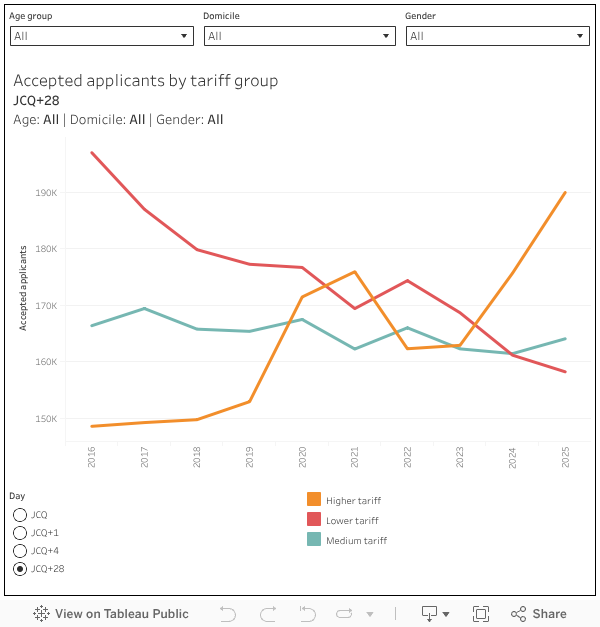
    There’s only really one headline from this year’s UCAS cycle – and that’s about the recruitment behavior of higher-tariff providers.

    The closest analogue is 2021: the so-called “mutant algorithm” year in which higher-than-predicted A level results (arguably the first accurate and fair set of results for many years, unconstrained by any predetermined curve) meant that traditionally selective providers were contractually obligated to honour a lot more offers than expected.

    But there was no such anomaly in results this year. The cohort did do very slightly better than expected (within the limits of the system), but this was – as it should be – down to their own hard work rather than any external factor.

    The assumption has to be that the growth in numbers at selective providers (those that have traditionally used tough level three requirements as a way of admitting only those with the best results) has to be down to a change in behavior. So what has changed, and why?

    What are we looking at

    Twenty-eight days after A level results day (JCQ results day to use the technical term) isn’t quite the final day of Clearing. You can still apply for 2025 entry up until 6pm on 24 September – which, depending on where you are heading, is pretty much welcome week.

    However, JCQ+28 is the last point at which UCAS releases statistics on applications and acceptances, before we get to the End of Cycle reports through December and January. These are the points where we can get a perspective on how this round of recruitment has gone (for the sector in December, by provider in January).

    But even this isn’t a final number. Many universities and colleges have multiple undergraduate entry points – and of course not all applications go via UCAS. End of cycle UCAS statistics do include the ones that they know about (the “Record of Prior Acceptance”) but the Clearing data does not.

    Volume up

    In most recent years around 10 per cent of applicants overall have been placed via Clearing, including both “direct to Clearing” applications (where someone hasn’t made choices of course and provider on their UCAS form) and standard “Clearing” (where someone has not been accepted, or not accepted a place at their firm or assurance choice). This proportion has grown slightly over the last decade – in 2016 it was nearer 9 per cent.

    [Full screen]

    A part of the reason for this is the introduction of the UCAS “decline your place” option, and the continued improvements in the Clearing system via the “Clearing Plus” tool that matches students with courses and providers based on interests and aptitudes. It is now easier for students to make a change to their plans – to decline a firm (and/or) insurance place even though they met the requirements, and to find another place that suits their needs. As you might guess, this has been a boon for high-tariff providers – who now find it much easier to recruit students who have exceeded results day expectations – but the benefits are wider.

    It is good news for the students in question as well – if you have done particularly well it may unlock a course or university that you wanted to go to but didn’t dare waste an application slot or firm acceptance status on. It might mean a more direct route to a career now you know more about professional requirements, a place nearer home (or further away!), a cheaper part of the country to live in (or an easier one to find term-time work in) or the uni where your friends are also heading. A lot can change in the life of an applicant between putting your form in on 15 January and getting your results in mid-August.

    An element of concern

    So the growth in acceptances at high-tariff providers is partially explained – but not entirely.

    [Full screen]

    You don’t have to spend a long time talking to admissions staff to hear that so-called high-tariff providers are now taking students with less stellar A level results in greater numbers. Making it easier to “trade up” (as the frankly unhelpful discourse would have it) is one thing, lowering the tariff is a different matter.

    The popular perception is that high-tariff providers are better. This is true in that they are better at being high-tariff providers.

    If you’ve done a few open days you will have been made aware that universities are not a homogenous lump. Even on a similarly named course, they will teach differently (more lectures, more tutorial, more blended, more hands on, more theoretical or academic), focus more on different parts of the subject, have different facilities (anything from lab kit to student support services), and even timetable differently. These are the differences that should really be driving applicant decision-making – and a high-tariff provider may not be better for a particular student (whatever their results).

    A choice of university governs a lot more of an applicant’s life than just what they’ll end up putting on their CV and who this might or might not impress – although a lot of popular commentary and ministerial statements take a more simplistic view of “undermatching”.

    Under the bonnet

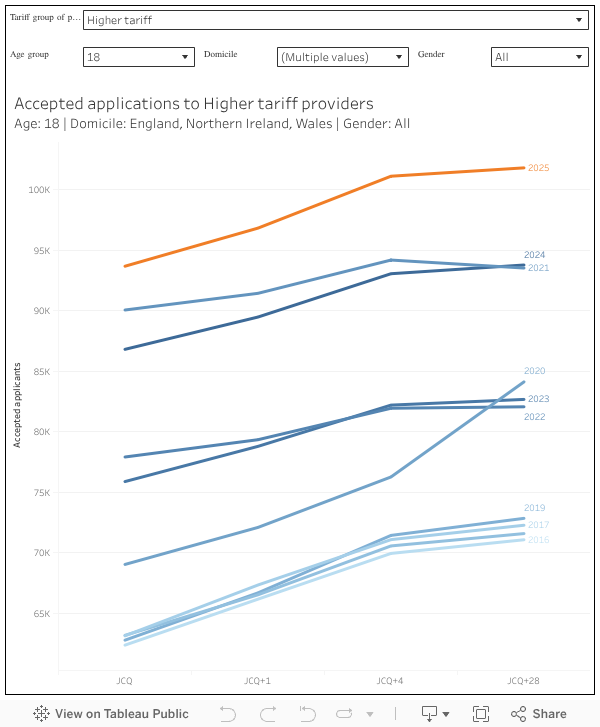
    Because we get stats on a mostly daily basis, we can get a sense of when the application deals are being sealed. I’ve not plotted every day of data because honestly who has time, but here we have results day, the day after, and the Monday of the next week (traditionally the three big Clearing days) plus day 28 which rounds up most of the rest of the action.

    There’s not much Clearing data in the JCQ results day release: that that is in there is mostly from applicants domiciled in Scotland with SQA results (they get their results a week earlier, the lucky things), mature students, and overseas students. So for 18 year old entry on that day in England, Wales, and Northern Ireland you are just seeing the automatic workings of the UCAS system – where applicants got the grades on the offer they get the place.

    [Full screen]

    And there’s our first clue. The number of initial placements at high tariff providers (England, Wales, and NI domiciled applicants, 18 years old) was higher than the total number of placed applicants last year. Or indeed any year on record.

    You don’t get that by being an aspirational destination, or by being active in Clearing. You get that by lowering the offers you make. We’ll see more in the end of cycle data, but in some cases this would be lowering them by quite a lot. Higher tariff providers didn’t take a lot of students in Clearing (we’re talking about 8,000 of this subgroup in 2025, rather than 7,000 last year or 10,000 in 2019), they took a lot of students.

    Why, though?

    It wasn’t a mistake. There was no underestimation of performance, because performance wasn’t meaningfully different than in any other non-pandemic year.

    And it can’t be pure greed. The best data we have on the cost of educating students (audited, regulated, everything) is TRAC and we know from the last release that selective providers (who tend to be in TRAC groups A and B) tend to recover around 85 per cent of the costs of public funded teaching. If you lose £1,430 on each (price group D) student then if you take more of them that just adds to your deficit?

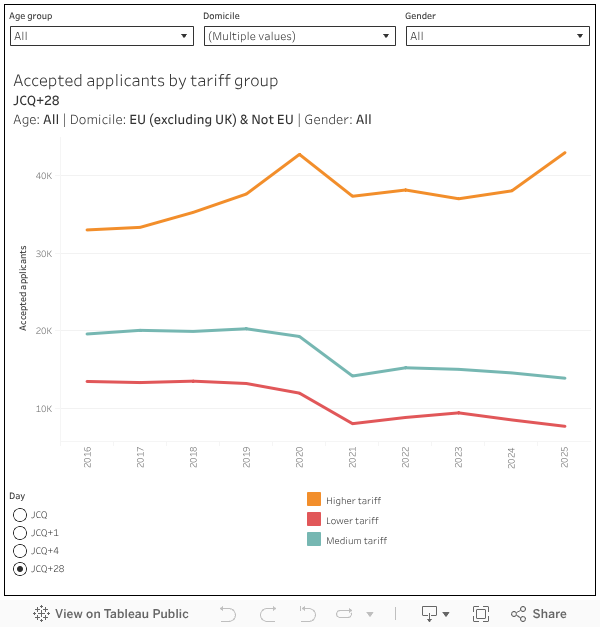
    There’s a suggestion that some universities are using home students to fill spaces that would previously have gone to (higher fee paying) international students. The thinking being that even some income is better than none, and helps to sustain capacity (departments, courses, jobs) that might otherwise be lost. However, there’s not a massive difference in the number of visas issued by the Home Office, which suggests that there will be a similar number of international students this year as last (still down on 2023 and earlier, mind).

    Any capacity backfilling, in other words, would have happened last year. And there’s been a sharp uptick in the proportion of international students heading to big name destinations this cycle: numbers at selective providers are now at a level above the golden age of the mid 2010s.

    [Full screen]

    The extra students, then, are simply extra students over last year. Growth in numbers, pure and simple. Very few universities have the finances to substantially invest in capacity (staff, estates) – so we have to assume that this means larger classes, less individual attention, more competition for resources, and a tighter accommodation market.

    The most able, and best connected, students will flourish. They pretty much always will – you could lock them in a darkened room for three years and they’d still get a good degree and a good job. It’s the rise in traditionally selective providers recruiting a substantially greater volume of students who have excellent potential but who need extra support and more opportunities to build networks and build confidence, that worries me. I hope these providers are ready to rise to what will be a new and substantial challenge.

    Source link

  • Behind the scenes at UCAS on level 3 results day

    Behind the scenes at UCAS on level 3 results day

    In Cheltenham they call it “UCAS Christmas” and it’s not hard to see why. Months of preparation, a whole lot of expectation riding on a single day, highs and lows of emotion, and more snacks than you can shake a stick at.

    Level 3 results day at UCAS HQ has the kind of jittery manic energy that comes when a lot of people have been anticipating this day for months, and half of them have been up since 2.00am the night before. By the time I arrive, the marquee moment – the national release of admissions decisions into 700k-plus inboxes at 8.00am – has passed without a hitch and the main business of Clearing, fielding queries from anxious applicants (and their parents), is under way.

    Nerve centre

    At the heart of the building sits Joint Operations Centre, or JOC for short, a room humming with the quiet buzz of people making sure the right things are happening. Courteney Sheppard, UCAS head of operations, explains that today, most UCAS people who have decision-making power on results day convene in this one space so that if anything happens that needs speedy resolution the right person is on hand. Those with deep subject expertise are housed temporarily in the office next door, ready to jump in to address issues as they arise.

    All along one wall there are massive screens – at least twenty and probably more like thirty, all monitoring different data in real time. One screen simply shows the current time (because in the critical two minutes before 8.00am release there are actions that are coordinated to the second); others track web traffic, database capacity, maximum wait times for calls, social media traffic, applicant behaviours, and much more besides. Opposite the screens is a flipchart where there are already a ream of jotted notes about ways to improve for next year.

    It’s easy to underestimate the logistical and technological challenge facing UCAS on results day but consider how rare it is for any system to have to cope with close to simultaneous login of every possible user. All over the country at 8.00am on the dot applicants’ UCAS results portal goes live and they can login to see whether they have secured their preferred course and higher education institution. Simultaneously they receive an email from UCAS with the same information. And, I’m told, UCAS creates a static web page for each and every applicant with the same information so that if there is any delay at all in getting into the portal, even of only a few seconds, the applicant can be redirected to the information they are looking for.

    “The 8 o’clock moment is always hairy,” says Lynsey Hopkins, UCAS director of admissions. “The preparation is incredible, and takes months, because there are so many moving parts. The tech is really complex and is getting more so all the time. You always worry that if any applicant wasn’t able to see their outcomes that could ramp up their anxiety on one of the highest stakes and most stressful experiences of their young lives.”

    But getting information on admissions decisions out to applicants is only the beginning. The vast majority – in fact the highest number on record this year – will have a place confirmed at their first choice of institution. Most of those will segue seamlessly into celebrating and looking forward to taking up their place. But a substantial number will pass through Clearing – and not only because they have been unlucky enough not to receive an offer from their preferred institution. Some applicants’ plans will have changed since they made their application through UCAS and will wish to decline their place in favour of a different option; others don’t even start applying until the Clearing period. Where UCAS holds data on applicants’ previous choices and qualifications the system will suggest possible matches for applicants to help them begin to sift their options.

    “The largest group of people in Clearing are those who have actively put themselves there,” says Ben Jordan, UCAS head of strategy. “Clearing doesn’t have negative connotations among young people at all – it’s just a brand.”This year 92 per cent of all higher education providers are offering courses through Clearing, and there are more than 30,000 courses available, offering an enormous degree of choice to applicants.

    Holding hands

    In theory, applicants contact institutions directly, and once they have secured an offer, are able to update their applications via their UCAS portal and have the application confirmed by the institution, without active intervention from UCAS. In practice, many applicants still need help and support from the central admissions service.

    Over in the “west wing” there’s the traditional call centre staffed by a mixture of UCAS’ customer service team, volunteers from across the business, and temporary staff, all sporting UCAS t-shirts, headsets and query cards they can wave to summon a senior staff member to help them answer the more complicated questions. On a normal day, UCAS has 50-60 people working on customer services; today it’s around 200.

    It’s not uncommon for calls to simply consist of an applicant saying, “My UCAS portal says I got in. Did I get in?” To which the correct answer is, “Yes, you got in, hurray!” Job done to everyone’s satisfaction. But it’s much more likely that applicants have more complicated questions – predictably many lose their login information, don’t fully understand the process, and generally need a bit of hand-holding at a stressful time.

    “We don’t just handle questions, we handle emotions,” says Jordan Court, customer call handler. “There can be so much riding on this day for applicants, they can get so anxious, it’s understandable they can sometimes lose the ability to deal with administrative stuff.” Every call handler, especially those volunteering receive detailed training, with a strong focus on emotional intelligence. “We tell people, ‘Imagine how you would want your child or your sibling to be treated’” says Courteney. “Nine of ten times what people want from the call is reassurance or validation, especially if they’re not able to get support from a school or college.”

    While the calls come in steadily, in this day and age much of the queries are via social media or the UCAS chatbot, Cassy, which is able to resolve the more transactional questions, reducing the overall call load by around 30 per cent. Some issues require intervention: Jordan is able to resolve one query by noticing from a screenshot that an applicant is trying to access his UCAS portal via a web browser that has been designed for gamers – advising the applicant to try again with a more mainstream browser.

    Without fail, everyone I speak to talks in glowing terms about their experience of being “on the phones” for Clearing. It’s clearly a formative experience for many UCAS staff, giving them a strong sense of purpose and of the importance of the work they do to connect applicants to higher education, as well as occasionally throwing up useful insight about how to improve the applicant experience.

    Lines to take

    Elsewhere in the building Jo Saxton, UCAS chief executive, is fielding media appearances and questions alongside minister for skills Jacqui Smith, who has the day before recorded a special message of congratulations to applicants from UCAS’ very own professional recording studio.

    UCAS director of data and analysis Maggie Smart talks me through the extraordinary process of data analysis that underpins the talking points everyone is reading in the morning papers. As a voluntary signatory to the UK Statistics Authority’s code of practice for statistics, Maggie is responsible for making sure that anything UCAS says about what the data indicates should be verifiable with actual data published on its website.

    Results day for the UCAS data team starts at 11.00pm the night before, capturing live operational data at 12.01am, wrestling it into a format that is publishable as public data, creating different datasets to inform governments in each of the UK Nations, and analysing the key insights that will inform the press release and briefing to the senior team until 5.00am. The press release covering the agreed talking points is signed off and released at 7.00am.

    Following results day the team will track and publish daily Clearing data, updating the public dashboards by 11.00am each day. One innovation for this year will be publication of weekly data on use of the “decline my place” function, seeking to understand more about which applicants are more likely to take up that option.

    In recent years the media around results day has presented something of a mixed picture, with celebratory stories of achievement and advice on securing a university place mixed with more critical queries of the value of higher education. For UCAS, engagement with stakeholders in government and in media is partly about giving confidence in the robustness of the system and partly about landing messages about the continued importance of higher education opportunity, in line with the emphasis on breaking down barriers to participation in UCAS’ recently published strategy.

    In its next strategic period, UCAS will focus on the 250k-odd individuals who register for UCAS but never get to the point of making an application. Understanding the experiences, hopes and aspirations of that cohort will help to inform not just UCAS, but the whole HE sector on how to meet the needs of those of that cohort that could potentially benefit from higher education.

    Given the complexity of the policy landscape for HE it’s invigorating to spend a day with people who share a core belief in the power of higher education to change lives, of which Ben Jordan is possibly one of the most heartfelt. As the policy narrative on access to university takes on a more regional and skills-led flavour, Ben argues that the enormous diversity of the higher education offer needs to be better understood so that students can truly appreciate the breadth of the options they have.

    “I’ve seen purpose-built factories, I’ve seen racing car courses on university campuses,” he says. “These days the majority of applicants aren’t those with just A levels, it’s a much more mixed picture, and it’s so important that they understand not only what is opened up or closed off by the choices they make but how much higher education has to offer them. It’s our job to get that message out.”

    This article is published in association with UCAS.

    Source link

  • Number of Chinese undergrads accepted to UK unis surges by 13%

    Number of Chinese undergrads accepted to UK unis surges by 13%

    According to UCAS data released today to coincide with A-level results day, the number of international students accepted to UK institutions has risen to 52,640 – up 2.9% on 2024 when this figure stood at 51,170.

    In just a year, the number of students from China accepted into university via the UCAS system went up a whopping 13% – with a total of 12,380 acceptances.

    Meanwhile, 2025 has proven to be a year of success for domestic students in the UK – with 28.3% of all grades being A or A* for students across England, Wales and Northern Ireland, according to the BBC.

    Commenting on the numbers, UCAS chief executive Jo Saxton pointed out the huge achievement of this year’s students, whose education was hit hard by the Covid-19 pandemic.

    “This year’s students were just thirteen when the pandemic hit, and their secondary schooling was turned upside down,” she said. “It’s great to see these applicants securing a university place in record numbers, seeking more education and investing in their futures. I am equally delighted to see how universities across the country have responded to their ambition.”

    Undergraduate international students have also found success this year despite some universities prioritising domestic students due to a focus on financial stability.

    According to a recent BBC article, Saxton explained that some UK universities were focussing on enrolling domestic undergraduates because of “uncertainty” around international students.

    She also pointed out that some institutions could accept a greater number of domestic students this year even if they did not meet the exact conditions of their offer because offering places to UK students, as opposed to international students, was more likely to result in financial stability for the institution.

    It’s great to see these applicants securing a university place in record numbers, seeking more education and investing in their futures
    Jo Saxton, UCAS

    It comes amid a turbulent time for the international education sector in the UK – with upcoming compliance changes forcing some universities to stop recruiting for certain courses or from some countries rather than risk falling foul of tightened BCA metrics.

    Many UK universities are currently facing financial difficulties, with around four in 10 universities currently at a deficit, according to a report by the Office for Students.

    Of the courses chosen by students, the most popular in the UK this year were Engineering and Technology, up 12.5% from last year at 30,020 acceptances, Mathematics with 9,220 acceptances and Law with 27,150.

    Source link

  • A levels and acceptances, 2025

    A levels and acceptances, 2025

    This article covers broad trends in results and university place acceptances. It’s not something you need to read if you are, or are supporting, someone on results day or with applying to university. This might be helpful though

    Though it is a perilous time to be a university one thing that is holding up seems to be undergraduate applications.

    It is a bumper year – good news for students, who are more likely to be starting on the course and at the provider they really want to be at this autumn, and good news for the sector, who may have started believing the narrative that university is declining in popularity.

    But we do need to separate things out – performance, both by students in achieving qualifications, by providers in running increasingly efficient and attractive recruitment operations, does mask some underlying issues. We’ve somehow reached a situation where study is becoming less affordable for students (especially relating to living costs, and especially affecting students from less advantaged backgrounds) and for universities (with the real value of fees far below 2012 levels, and changes in the market seeing growth among traditionally selective providers).

    Today’s results are spectacular news for the higher education sector, but it surely must be clear to everyone that we are beginning to run out of road.

    UCAS acceptances

    A record number of 18 year old applicants has yielded a record number and proportion (excepting 2021) taking up their firm offers in 2025. Just under 250,000 applicants (representing 63.51 per cent of all 18 year olds applying via UCAS) have started JCQ results day knowing that the university and course they had set their heart on will be where they will study next year.

    Couple this with a recovery in insurance places being taken up, and we have a historically low proportion of 18 year olds entering clearing. Just 15.15 per cent of applicants are currently in clearing, plus another 12.8 per cent still holding offers but yet to confirm.

    The picture is slightly different if you look at all ages – mature applicants are more likely to be in clearing than their younger counterparts – although a non-pandemic record proportion (57.25 per cent) of all students are taking up firm offers.

    That said, it is going to be a hugely competitive few days for admissions teams, but correspondingly good news for applicants looking for a place: there will be more courses looking for students.

    [Full screen]

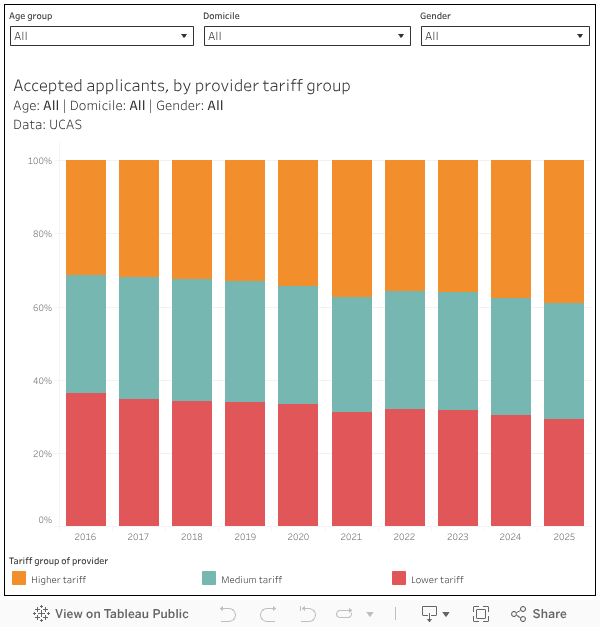
    The sector will have an eye on the distribution of students across types of provider, and will see another entry in a time series that shows the growth of high tariff providers. A record 39 per cent of students who have accepted places on JCQ results day have done so at a high tariff provider – just 29.3 per cent will be starting at a low tariff provider (a record low). What’s “high tariff” these days? Anything above about 125.8 tariff points, according to DfE.

    [Full screen]

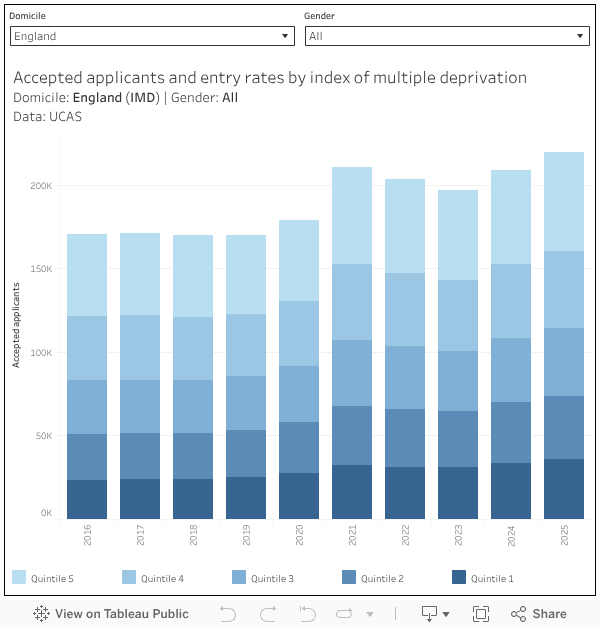
    The entry rate for the most disadvantaged quintile of 18 year olds in England was 22.9 per cent – the highest proportion on record, but still a long way off the 44.5 per cent of the most advantaged quintile that will start university this autumn. Expect clearing activity to shift this slightly.

    [Full screen]

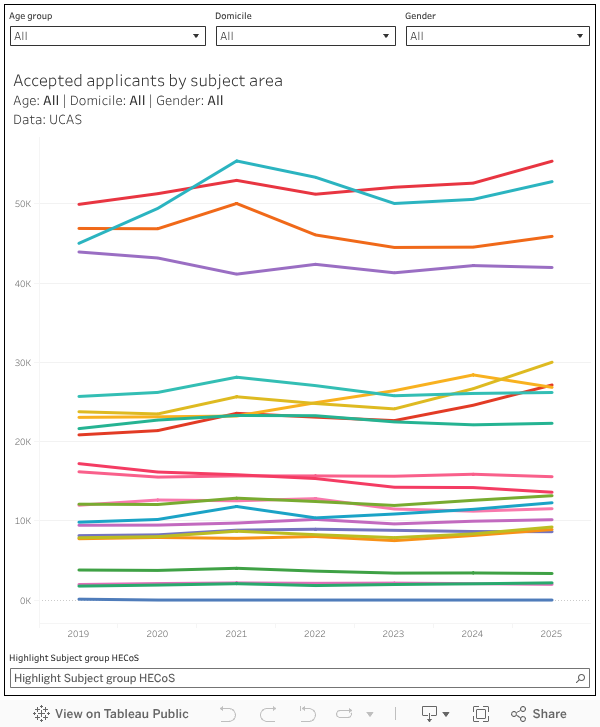
    We also have data on subject area choices (at the top level of the common academic hierarchy). Of those students who have already accepted a place, business and medicine-related courses continue to grow in attractiveness – there’s been an increase in social sciences, engineering, and law (continuing a post-pandemic trend) and a sharp drop in interest for computing courses.

    [Full screen]

    It is worth remembering that this represents just the first flush of acceptances – a historically large number of students, but far from the totality of this cohort. Most of the action in clearing happens early, and we’ll be covering that on Wonkhe over the next few days.

    International acceptances

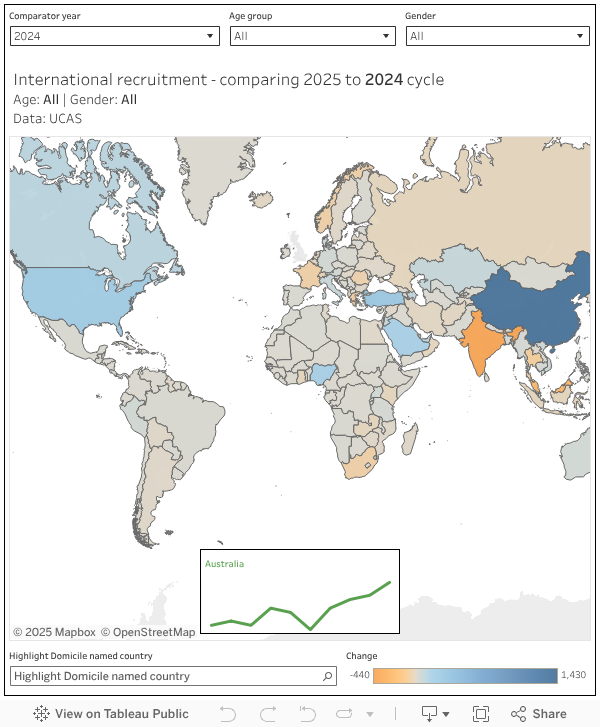
    Not all international recruitment flows through UCAS or conforms to what is (for most of the world) artificial deadlines like JCQ, so this is by necessity an incomplete picture. But, again in contrast to prevailing narratives, numbers are up – there were 52,640 acceptances (up 2.9 per cent on last year) in 2025. We see strong year on year growth in China (up 14.6 per cent), the US (up 10.38 per cent), and Turkey (up 21.71 per cent). India is declining (down 9.42 per cent) and Nigeria is starting to recover (up 20.83 per cent) but still a long way off the peaks of 2022 and 2023.

    [Full screen]

    A level results

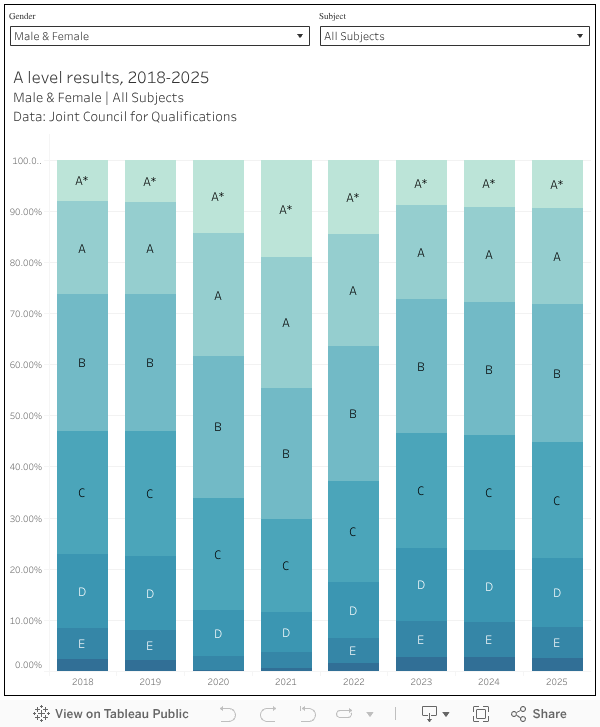
    A level performance (for students in England, Northern Ireland, and Wales) generally tends to see movements below the margin of error, as the methodology underpinning the award of marks contains elements of norm-referenced methodologies). The pandemic years (2020, 2021, 2022) are the exceptions here due to changes in the grading process.

    [Full screen] proportions

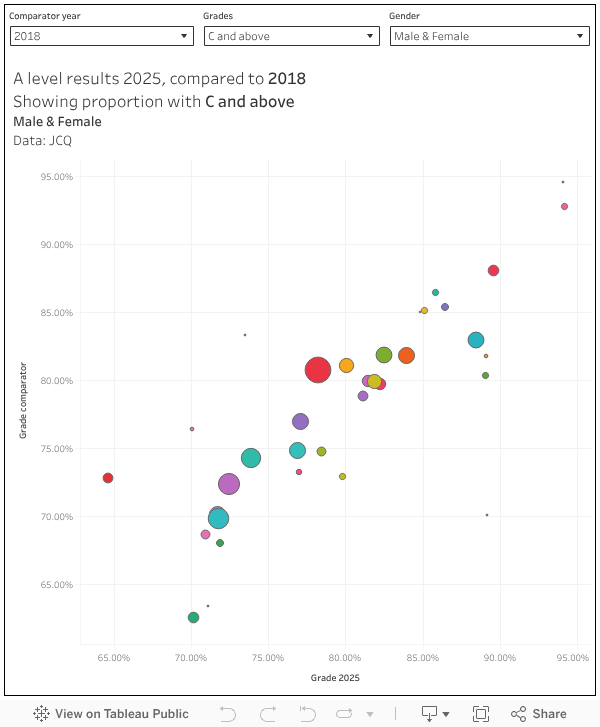
    That said, there are some interesting underlying trends. Overall performance in 2025 is up (nearly 78 per cent got C and above this year, compared to 76.3 per cent last year) – this is based on a smaller (entries were down 0.5 per cent) and academically stronger (the popularity of vocational routes is growing, this was the first cohort to have non-compensated GCSE grades) group of students.

    And, as always, there is huge variation by subject. Law remains the most difficult A level to achieve C and above in – just 64.6 per cent managed this in 2025, compared to 88.4 per cent in art and design disciplines. And law has got harder over time – in 2018 the proportion was 72.7 per cent.

    [Full screen]

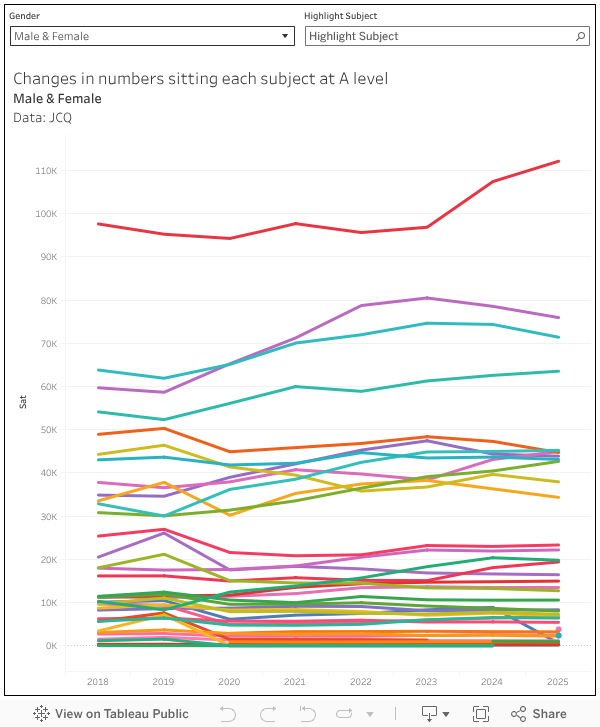
    Law still remains moderately popular (there were just under 15,000 entries in 2025, up 1 per cent on last year) but is a long way behind the “big four”: maths (112,000, 4.4 per cent), psychology (76,000, down 3.3 per cent), biology (71,000, down 4 per cent), and chemistry (63,500, up 1.5 per cent).

    [full screen] sat

    What of the more than 250,000 level 3 vocational and technical qualifications awarded by JCQ today? The majority of these are what JCQ call “applied generals” (BTECs and the like) – there were 220,553 awarded, compared to 12,000 T levels.

    Business and social policy qualifications are the dominant subject groups here (both had around 44,000 entries each). For the (most popular) medium sized qualifications – worth one-and-a-half A levels – 80 per cent achieved a Merit or above, and (for those graded A* to E) 75 per cent achieved a C above.

    This is the fourth year of T levels, the new style of vocational and technical level 3 qualification invented by the last government and available in England only – there are now 18 subject routes available. Of the 12,000 or so taking T levels, some 65 per cent achieved a Merit or above, 91 per cent achieved a Pass or above. The numbers are small but growing rapidly, making year on year comparisons tricky – DfE has published some data on these results that goes into a little more depth.

    The Ofqual release shows, once again, that independent and selective school settings have seen the highest proportions of top A level grades, with further education colleges seeing the lowest proportions. As usual, there is no data (or seemingly, interest) in performance at special schools – and neither the main release nor the analytics dashboard feel like special needs status is worth reporting on.

    Source link

  • UCAS applications and offer making by June deadline, 2025

    UCAS applications and offer making by June deadline, 2025

    The UCAS 30 June application deadline is the last point an applicant can apply outside of clearing.

    Though most applications (particularly from UK 18 year olds) happen by the January deadline, the June figures allow for a complete analysis of application behaviour in the UCAS main scheme.

    The number of 18 year old UK applicants has reached a record high of 328,390 (up 2.2 per cent on last year) – with the total number of applicants at 665,070 (up 1.3 per cent on last year).

    Application rates

    As always it is salutary to compare the often-pushed narrative that young people are being tempted away from expensive/poor-value/woke (delete as per your personal preference) higher education with the actuality that numbers are rising. You could even be tempted to imagine what the application rates might be like in a sector with a realistic student maintenance offer.

    I mention application rates because this is what declinist commentators will seize on. For UK domiciled 18 year old applicants, the application rate is 41.20 – down from 41.80 per cent last year. This fall is visible across most measures of deprivation: in England, for example, every IMD quintile but quintile 5 (the least disadvantaged) sees a falling application rate.

    [Full screen]

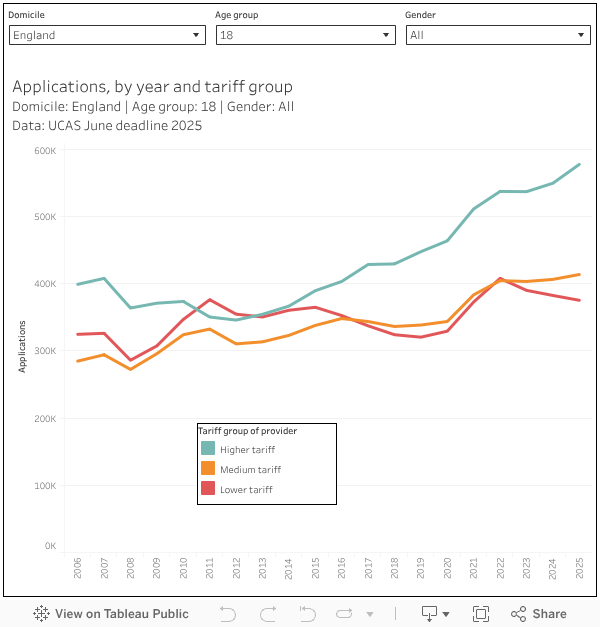
    In part, this could be a function of another year where the dominance of higher tariff providers in driving applications has increased: higher tariff providers disproportionately inspire applications from (and recruit) better off young people.

    This chart shows the number of applications to each of three tariff groups. For UK 18 year olds the default is fast becoming an application to a high tariff provider. We don’t (unfortunately) get application numbers by deprivation and tariff group.

    [Full screen]

    These number of placed students is likely to rise too: UCAS and Ofqual have suggested that there are 28,000 places available in Clearing this year.

    Offer rates

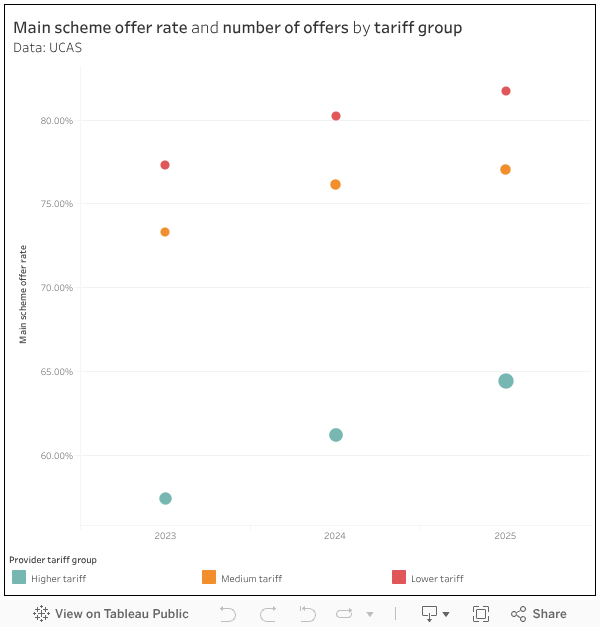
    One innovation in this year’s release is information on offer rates – the proportion of applications that result in an offer being made. We get three years of data, which demonstrate that offer rates are rising across the sector – and that (as you may expect) high tariff providers are less likely to make offers than lower tariff providers. The growth among high tariff providers is driven both by rising application numbers and a rising offer rate.

    [Full screen]

    For believers of the other recruitment myth (that universities load up on international students and are less keen to take even very able home students) we get a timely corrective. It turns out that 98.5 per cent of UK 18 year old applicants have an offer, compared with 89.7 per cent of international students.

    [Full screen]

    Subjects

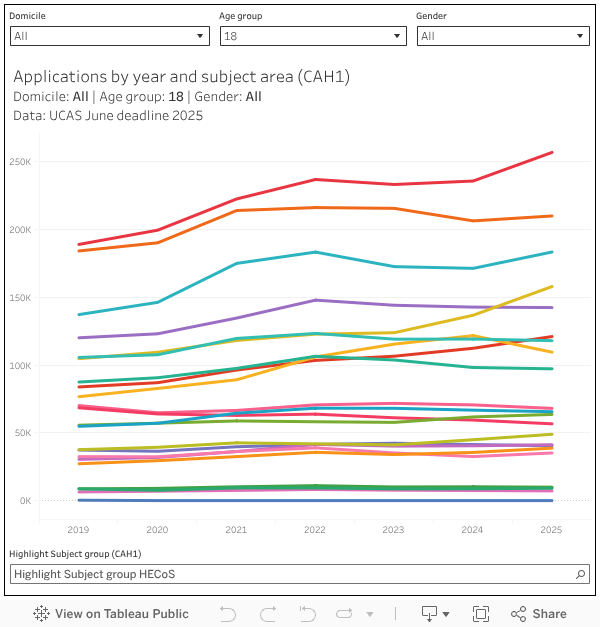
    Finally, it’s always fascinating to look at applications by subject area – a plot by CAH1 groups shows a sharp rise in the popularity of business, subjects allied to medicine, engineering, and law: with an intriguing drop in applications to computing subjects. There may be a generative AI effect on computing applications – the rise of “vibe coding” and other uses of agents in software development may mean that the attraction of learning to programme computers properly may be waning.

    That’s the best explanation I have – and it is curious that law (a domain where predictions of AI tools eating entry level roles are ten a penny) doesn’t appear to be experiencing a similar phenomenon.

    [Full screen]

    Source link

  • How cost of living is influencing UK student mobility

    How cost of living is influencing UK student mobility

    Drive along any motorway in September and you will see car after car full of duvets, pots and pans, and clothes as students head off to pastures new. I remember my own experience, crossing the Severn Bridge with the bedding on the front seat of my Fiesta muffling Oasis’ Definitely Maybe.

    This stereotypical view of a literal journey into higher education isn’t the case for everyone, however. In fact, far more students live at home during their studies than you may think.

    The UCAS application asks students about whether they intend to live at home. In 2024, 30 per cent of UK 18-year-olds said they planned to live at home during their studies – up from 25 per cent in 2019 and just 21 per cent in 2015.

    However, when we look beyond the headline numbers, over half of the most disadvantaged students (IMD Q1) live at home during their studies, compared to fewer than one in five of the least disadvantaged (IMD Q5). Regional distribution will have an impact here, particularly London.

    Scottish students are more likely to live at home during their studies. On a recent visit to Edinburgh, all the students I met spoke with excitement about their plans to study at their chosen university within the city. By contrast, Welsh domiciled students are the least likely to live at home during their studies.

    In London, 52 per cent of 18-year-olds progress to HE – with around half of those students staying in London, making it unsurprising that the capital sees the highest proportion of live at home students in England.

    Cost of living pressures

    Cost of living is undoubtedly influencing student choice. At the January equal consideration deadline, UCAS saw a 2.1 per cent increase in the number of UK 18-year-old applicants – a record high. However, regular readers of Wonkhe will know this also represents a decline in the application rate – the proportion of the 18-year-old population applying to HE, and UCAS insight increasingly points to the cost of living playing a role.

    Our latest survey insight suggests that 43 per cent of pre-applicants feel they are less likely to progress to HE due to cost-of-living pressures, up from 24 per cent in 2023 – although their commitment to going to university remains high.

    Financial support is also of growing importance to students when it comes to deciding where to study. While finding the perfect course content was the most important factor when shortlisting universities (49 per cent), the financial support available while studying (such as a scholarship or bursary) was a close second (46 per cent). Specific cost-of-living support offered by universities was third (34 per cent).

    The availability of support with the cost of living has risen in relative importance as a factor when shortlisting universities from 12th in 2022 to 3rd in 2024 – a significant shift, which suggests a change in student mindset. There have also been large changes in rank importance of “universities that are close to home” from 9th to 4th, “universities with low-cost accommodation” from 13th to 7th and “universities I can attend but still live with my parents” from 16th to 11th.

    Source: Potential applicants for 2025 entry, 1,023 UK respondents, Dec 2024–Jan 2025

    It isn’t just at the point of application where we see the cost of living impacting choice. In 2024, UCAS saw 43,000 students decline the place they were holding in favour of an alternative institution or subject – making this the largest group of students using Clearing.

    This is not a spur of the moment decision, with 52 per cent having already decided to do this prior to receiving their results and a further one in five considering it based on their results.

    When asked what drove their decision, 23 per cent told us they had a change in personal circumstances and 17 per cent wanted to live somewhere cheaper. We also know this impacts on all cohorts of students – 19 per cent of international students that don’t accept a university offer through UCAS tell us they have found a more attractive financial offer elsewhere.

    However, the primary reason that students use Decline My Place is linked to the course, with 31 per cent changing their mind about the subject they wish to study.

    Support measures

    It’s clear that cost of living and financial support is a key factor influencing student choice and so we must ensure this information is easily accessible and understood by students.

    Students tell us they’d like more practical information about student discounts, financial support packages or bursaries/scholarships. UCAS will shortly be launching a scholarships and bursary tool to promote these opportunities to students.

    Around half of offer holders in 2024 recalled receiving information about cost of living support. This presents a timely opportunity for any university staff working in marketing, recruitment or admissions to ensure information about financial support is easy to find on their website, along with information about timetabling to help students understand how they may be able to balance work and study commitments.

    There will be certain groups of students that are even more acutely impacted by cost of living challenges. Last cycle saw a record number of students in receipt of Free School Meals – 19.9 per cent – enter HE. Whilst it is only a small part of the puzzle, UCAS has removed the application fee for these students.

    Cost of living pressures are likely to persist, with students continuing to assess the value of HE in this context. The sector should continue to highlight the benefits of university study as a vehicle for social mobility, along with the graduate premium – the higher earnings they typically earn compared to non-graduate peers. But we also need to make it clearer how HE of all forms remains accessible – from funds for travel to open days, to in study commuter breakfasts, hardship funds, cost of living support, and high-quality careers guidance to support graduate employability.

    This article is published in association with UCAS. It forms part of our ongoing series on commuter students – you can read the whole series here

    Source link

  • More engineering applications don’t make for more engineers

    More engineering applications don’t make for more engineers

    The latest UCAS data (applications by the January ‘equal consideration’ deadline) suggests a 14 per cent increase in applications to engineering and technology courses.

    It’s the second double-digit surge in two years.

    Good news, right? Sadly, it’s mostly not.

    STEM swing

    The upsurge in interest in engineering can be seen as part of a “swing to STEM” (science, technology, engineering, and medicine).

    As higher education has shifted to a reliance on student debt for funding, many people suspect applicants have felt greater pressure to search for clear, transactional returns which, it may seem, are offered most explicitly by STEM – and, most particularly, by engineering, which is not just STEM, but vocational too.

    Certainly, there’s a keen labour market for more engineers. Engineering UK has suggested the shortfall is around 29,000 graduates every year. According to the British Chambers of Commerce, it’s pretty much the largest skills gap in the UK economy.

    Engineering is also a key driver of the growth that the government is so keen to stimulate, adding £645b to the UK – that’s nearly a whopping third of the entire value of the economy. And – unlike financial services, say – engineering is a powerhouse of regional development as it is spread remarkably evenly throughout the country.

    And it drives that other key government mission, opportunity. An engineering degree confers a higher and more equal graduate premium than almost any other discipline.

    The downside

    So with all these benefits, why is the increase in engineering applications not good news?

    The answer is because it reveals the extent of the lost opportunity: most of these extra potential engineers will be denied places to study, dashing their hopes and the hopes of the country.

    Last year’s rise in applications did not lead to a rise in the number of UK engineering students. Absolute student numbers have more or less stagnated since 2019.

    It used to be that the number of engineering applications broadly aligned with places because it was a highly regarded discipline with great outcomes that universities would expand if they felt they could. The limiting factor was the number of able students applying.

    Now that demand outstrips supply, universities cannot afford to expand the places because each additional UK engineering student represents an ever-growing financial loss.

    Engineering courses are among the most expensive to teach. There are long contact hours and expensive facilities and materials. The EPC estimates the average cost per undergraduate to be around £18,800 a year. Even allowing for top-up funding that is available to many engineering degrees on top of the basic fee income, that leaves an average loss of £7,591 per year.

    It used to be that the way to address such losses was to try to admit more students to spread the fixed costs over greater numbers. That did run the risk of lowering standards, but it made financial sense.

    Now, however, for most universities, the marginal cost of each additional student means that the losses don’t get spread more thinly – they just keep piling up.

    Cross-subsidy

    The only way out is to bring in ever more international students to directly subsidise home undergraduates.

    Although the UCAS data shows a glimmer of hope for recovering international demand, at undergraduate level, there are only a few universities that can make this work. Most universities, even if they could attract more international engineering students, would no longer use the extra income to expand engineering for home students, but rather to shore up the existing deficits of maintaining current levels.

    The UCAS data also show higher tariff institutions are the main beneficiaries of application increases at the expense of lower tariff institutions which, traditionally have a wider access intake.

    What this means is that the increased demand for engineering places will not lead to a rise in engineering student numbers, let alone in skilled engineers, but rather a narrowing of the access to engineering such that it becomes ever harder to get in without the highest grades.

    High prior attainment correlates closely with socioeconomic advantage and so, rather than engineering playing to its strength of driving social mobility, it will run the risk of becoming ever more privileged.

    What about apprenticeships?

    Not to worry, suggests Jamie Cater, head of employment and skills at trade body Make UK, a university degree is not the only option available for acquiring these skills and “the apprenticeship route remains highly valued by manufacturers”.

    That’s small comfort, I’m afraid. The availability of engineering higher apprenticeships suggests competition is even fiercer than it is for degrees and, without the safeguard of fair access regulation, the apprenticeship access track record is poor. (And don’t get me started on drop-outs.)

    This is why I haven’t unfurled the bunting at applicants’ rising enthusiasm for engineering.

    Of course, it is wonderful that so many young people recognise engineering as a fulfilling and forward-looking discipline. An estimated £150m has been spent the last decade trying to stimulate this growth and there are over 600 third sector organisations working in STEM outreach in schools. It would be nice to think this has not been wasted effort.

    But it’s hard to celebrate a young person’s ambition to be an engineer if it’s likely to be thwarted. Similarly, I struggle to summon enthusiasm about kids wanting to get rich as TikTok influencers. Indeed, it’s all the more tragic when the country actually does need more engineers.

    This is why the Engineering Professors’ Council has recently called on the government to plug the funding gap in engineering higher education (and HE more widely) in the forthcoming Comprehensive Spending Review.

    Asking for nearly a billion pounds may seem ambitious, but the ongoing failure to fill the engineering skills gap may well be costing the country far more – possibly, given the importance of engineering to GDP, more than the entire higher education budget.

    Johnny Rich is Chief Executive of the Engineering Professors’ Council, the representative body for UK Engineering academics.

    Source link

  • Ignore the noise – university is overwhelmingly worth it for most

    Ignore the noise – university is overwhelmingly worth it for most

    New data from UCAS shows the number of 18 year old applications to undergraduate courses for autumn 2025 continues to climb, including from young people from disadvantaged backgrounds.

    The slight dip in the rate of applications can be explained in part by changes around how students engage with the application cycle. Year-on-year we see decision making happening later in the admissions cycle. There is a clear disconnect between the discourse around universities and the demand for them, where the long-term trend is up.

    Universities have long been used as political currency, despite being a core part of young people’s aspirations in the UK. It is not uncommon to hear influential politicians and commentators argue against the value of a degree, even though they generally have degrees themselves. If the government has its sights set on sparking economic growth and creating opportunity across society, encouraging more people to go to university is the answer, with jobs requiring higher education expected to see the most growth in the next ten years, according to analysis from Skills England.

    There has been a tremendous amount of progress in helping people from a wider range of backgrounds go to university in recent years, and this is reflected in new UCAS data. Applications from young people from areas with low participation in higher education is at its highest level in recent years. Not only does this afford thousands more young people opportunities that they might never otherwise have had, it also has huge economic benefits for them, and their communities.

    Reaping the rewards of participation

    However, there is much further to go. You are still about twice as likely to go to university if you are from the most affluent backgrounds, compared to the least affluent. This can’t be right, particularly as the data shows that the benefits of university are especially strong for people from disadvantaged backgrounds.

    Graduates who received free school meals earlier in life get a big earnings boost by going to university. On average, they’ll earn over a third more than non-graduates from the same background by the age of 31. And the benefits go beyond salary – universities play an important role in tackling economic inactivity and unemployment, one of the government’s key battles. Overall, graduates are far less likely to be claiming benefits, nearly three times less likely to be economically inactive, and over one and a half times more likely to be employed than non-graduates.

    The data shows that there is still a great deal of progress to be made in closing the regional participation gap. In London, 58 per cent of 18-year-olds applied to university; in the North East this was only 32 per cent. In Wales, the participation rate has been going backwards. This is a huge missed opportunity for the nation.

    If the government were to work with universities, colleges and schools to ensure all young people have the same educational opportunities, we’d see more people in work and more people able to adapt as the labour market changes around them, earning higher wages and filling the jobs being created in exciting new sectors of the economy.

    And, given that graduates are statistically more likely to enjoy better health, we’d probably have a healthier population too. In the UK we’re lucky to have exceptional universities in every region of the UK, and producing and attracting more graduates to these areas could significantly boost regional productivity.

    That’s not to say that everyone should want to, or needs to go to university to have a successful career or spark regional growth, but graduates’ skills make a vital contribution to local economies. Regions with high numbers of graduates perform better economically, and these benefits spillover to non-graduates. All eight growth-driving sectors identified by the government, including clean energy and the creative industries, are dependent on a bigger supply of graduates to expand. Last year, these industries reported having a 50 per cent higher proportion of graduates than in the UK workforce as a whole.

    The bottom line

    For the many young people who don’t know exactly what they want to do in life, going to university can be the difference between gaining skills and experience that will set them up for life or falling into economic inactivity. Despite what a great deal of headlines will tell you, universities are essential to young people’s prospects in this country, and the new application data shows that young people feel this too.

    As well as the huge economic benefits for wider society, university has huge appeal for individuals. It’s an opportunity to gain career skills, immerse yourself in a subject you enjoy and meet lifelong friends. And above all, thanks to the UK’s diverse offering of institutions and courses, including academic and vocational styles, it’s a realistic goal for most people. Perhaps, in a world where young people are being increasingly discouraged about the future ahead, university represents something more optimistic, and that’s why they continue to want to go there.

    Source link

  • UCAS End of Cycle provider data, 2024

    UCAS End of Cycle provider data, 2024

    Chat to anyone involved in sector admissions and you will hear a similar story.

    And the story appears to be true.

    It is now clear “high tariff” providers have been lowering their entry tariff (often substantially) in order to grow recruitment – meaning students with less-than-stellar grades have been ending up in prestigious institutions, and the kinds of places students like this would more usually attend have been struggling to recruit as a result.

    In other words, the 2024 looks a lot like a lockdown cycle (without the examnishambles and Zoom pub quizzes).

    Any major dude will tell you

    We noted, at a sector level, the rise in the number of offers made by high-tariff providers – it was the highest number on record. There was no parallel rise in A level attainment, which suggests a strategic decision, made early on, to widen access.

    Today’s release of UCAS End of Cycle data for 2024 at provider level illustrates that this picture is a generalisation. Some high-tariff providers have acted in the way described above, others have pursued alternative strategies. And other providers have hit on other ways to drive undergraduate recruitment.

    Starting with my favourite chart, we can think about these individual strategies in more detail. This scatter plot shows the year-on-year change in the number of applications along the horizontal axis and the year-on-year change in acceptances on the vertical. There’s filters for gender, domicile, age group and subject group (at the top level) – and I’ve provided a choice of comparator years if you want to look at changes over a longer term. The size of the dots represents the total recruitment by that provider in 2024, given the parameters we can see.

    [Full screen]

    In essence this illustrates popularity (among applicants) and selectivity. What we can see here for 2024 (defaulting to UK 18 year olds applying to all subjects compared to 2023) is that pretty much the entire Russell group has made significant (c500 or above) increases in recruitment, whether or not they saw a corresponding growth in applications.

    It’s not the full story – the picture for other pre-92 and post-92 providers is more mixed, with some providers able to leverage popularity (or desperation) to find growth.

    My old school

    We can’t look directly at provider behaviour by tariff, but we can examine what qualifications students placed at the provider have – here a key indicator might be an increase in the number of students entering without A levels (a group that tends to have lower tariffs overall).

    [Full screen]

    The trouble is, A level entry rates have also increased – pretty much anyone who wants to and can do A levels is now doing A levels. With the decline in BTEC popularity, and the still uncertain interest in T levels, this is to be expected. All this means most providers have seen an increase or steady state in the number of students entering with A levels (when you include that A level plus project options). In Scotland – and recall we don’t get the complete picture of Scottish applications from UCAS because of a wonderful little thing called intercalation – it’s SQA pretty much all the way.

    Everything you did

    If you are wondering whether a change in age groups placed as undergraduates could also have an impact on recruitment patterns, it looks as if the pattern of low and slowly falling mature recruitment continues for most providers. For larger universities most of the action is around 18 year old home recruitment – and specialist providers that focus on mature students (often via part-time or flexible study) tend to struggle.

    [Full screen]

    The other key factor is domicile – the changes to visa arrangements this time last year had a huge impact on international applications (particularly from countries like India and Nigeria that have become important for lower tariff providers) and coupled with some of the changes described above this has resulted in some providers seeing undergraduate international admissions fall off a cliff.

    [Full screen]

    As always, undergraduate isn’t the full story – we’ve still no reliable way of understanding postgraduate recruitment in the round until we get the HESA data long after the academic year in question has finished. I just hope that regulators with new duties to understand the financial stability of the sector have more of a clue.

    Any world that I’m welcome to

    With some providers stuffed to the seams and beyond with students they wouldn’t usually accept – many with support needs it is unclear whether they are able to meet – it is unclear who exactly benefits from this new state of affairs. The claim we regularly hear is that universities lose money on educating home students, and that these must be cross subsidised by international recruitment.

    The corollary of this is that in times where international student recruitment is restricted you would expect to see the number of home students at providers reliant on this income fall – after all, if you lose money on every home student the more you recruit the more money you lose. Though measures to widen access and participation are important (and indeed, we see welcome evidence of contextual admissions at selective providers in the chart below) the fact of it is that you need to spend money to support students without the cultural capital to succeed.

    [Full screen]

    The rather painful conclusion I reach is that the only way to make this year’s sums add up is a reduction in spend per student – and, thus, most likely, the quality of the student experience among precisely the students who would have been overjoyed to get a place at a famous university. We should keep a close eye on continuation metrics and the national student survey this year.

    Source link