Category: University of Phoenix

  • Is the Federal Trade Commission FOIA program still in operation?

    Is the Federal Trade Commission FOIA program still in operation?

    In light of recent developments at the Federal Trade Commission under the current administration — including staffing reductions and a temporary 2025 government shutdown — many observers and researchers are questioning whether the FTC’s Freedom of Information Act (FOIA) program is still functioning. The answer remains: yes — the FOIA program is still formally operational, but its capacity and responsiveness appear diminished under current conditions.

    The FTC continues to administer FOIA through its Office of General Counsel (OGC), which processes all FOIA requests. As of the 2024 fiscal year, the FTC’s FOIA Unit comprised four attorneys, five government-information specialists, and one paralegal, with occasional support from contractors and other staff. In that year, the agency processed 1,919 requests (and 29 appeals), up from 1,812 in 2023. The agency’s publicly available “FOIA Handbook,” last updated in April 2025, continues to outline how requests should be submitted, what records are on the public record, and how exemptions are applied.

    The FTC’s website still provides instructions for submitting a FOIA request via its online portal, email, fax, or mail. That means requests remain legally eligible — including those related to for-profit colleges, student loan servicers, institutional behavior, complaints, or decision-making memos.

    However, HEI’s own experience in 2025 highlights some of the challenges with the FTC’s current FOIA responsiveness. In January 2025, we submitted a FOIA request asking for a record of complaints against the University of Phoenix. Beyond an automated message, there was no response. In August 2025, we submitted another FOIA request asking for complaints against a company that dealt with student loans; in that case, not even an automated acknowledgment was received. On November 30, 2025, we received an automated response to our FOIA request about AidVantage, a student loan servicer and subsidiary of Maximus. While we did receive a reply, it reflected a stale message stating they would respond after the government reopened — even though the government had reopened on November 13.

    These examples illustrate that while FOIA is formally operational, actual responsiveness has deteriorated. For years, HEI had a good relationship with the FTC, obtaining critical information for a number of investigations in a timely manner. It remains to be seen whether that reliability can be restored.

    Compounding the issue are broader staffing and operational changes at the FTC. In testimony before Congress in May 2025, FTC Chair Andrew N. Ferguson reported that the agency began FY 2025 with about 1,315 personnel but had reduced to 1,221 full-time staff, with plans to potentially reduce further to around 1,100 — the lowest level in a decade. These staffing reductions coincide with scaled-back discretionary activities, such as rulemaking, public guidance publishing, and outreach. During the October 2025 lapse in government funding, the FTC announced that FOIA requests could still be submitted but would not be processed until appropriations resumed.

    For researchers, journalists, and advocates — including those pursuing records related to for-profit colleges, student loan servicers, regulatory decisions, or historical investigations — FOIA remains a legally viable tool. The path is open, though response times are slower, staff resources are constrained, and releases may be more limited, especially for sensitive or exempt material.

    Sources

    Congressional budget testimony on FTC staffing and budget: https://www.congress.gov/119/meeting/house/118225/witnesses/HHRG-119-AP23-Wstate-FergusonA-20250515.pdf

    FTC FOIA Handbook (April 2025): https://www.ftc.gov/system/files/ftc_gov/pdf/FOIA-Handbook-April-2025.pdf

    FTC 2024 Chief FOIA Officer Report (staffing, request volume): https://www.ftc.gov/system/files/ftc_gov/pdf/chief-foia-officer-report-fy2024.pdf

    FTC website instructions for submitting FOIA requests: https://www.ftc.gov/foia/make-foia-request

    FTC 2025 shutdown plan showing FOIA processing paused during funding lapse: https://www.ftc.gov/ftc-is-closed

    Reporting on FTC removal of business-guidance blogs in 2025: https://www.wired.com/story/federal-trade-commission-removed-blogs-critical-of-ai-amazon-microsoft/

    Source link

  • Phoenix Education Partners, FAFSA Fraud, and the Familiar Dance of Blame

    Phoenix Education Partners, FAFSA Fraud, and the Familiar Dance of Blame

    When Phoenix Education Partners (PXED) CEO Chris Lynne publicly blamed the U.S. Department of Education for missing fraud in FAFSA applications—fraud that allowed the University of Phoenix to enroll individuals engaged in financial-aid misconduct—he likely hoped to redirect scrutiny away from his own shop. Instead, the maneuver sent up a flare. For many observers of the for-profit college sector, it felt like the return of a well-worn tactic: deflect, distract, and deny responsibility until the heat dies down.

    The pivot toward blaming the Department of Education does not merely look defensive; it echoes a pattern that helped bring down an entire generation of predatory schools. And it raises a simple question: why is PXED responding like institutions that have something to hide?


    The Old Script, Updated

    The University of Phoenix, under PXED’s ownership, carries not just a long memory of investigations and settlements but a structural DNA shaped by years of aggressive enrollment management, marketing overreach, and high-pressure tactics. When the industry was confronted with evidence of systemic abuses—lying about job placement, enrolling ineligible students, manipulating financial-aid rules—the typical industry defense was to claim that problems were caused by bad actors, by misinterpreted regulations, or by a sluggish and incompetent Department of Education.

    Those excuses were not convincing then, and they ring even more hollow now.

    If individuals involved in financial-aid fraud managed to slip into the system, an institution with PXED’s history should be the first to strengthen internal controls, not pass the buck. Schools are required under federal law to verify eligibility, prevent fraud, and monitor suspicious patterns. Pretending that ED is solely responsible ignores the compliance structure PXED is obligated—by statute—to maintain.

    Why Blame-Shifting Looks So Suspicious

    Instead of demonstrating transparency or releasing information about internal controls that failed, PXED’s leadership has opted for a public relations gambit: blame the regulator. This raises several concerns.

    First, shifting responsibility before releasing evidence suggests that PXED may be more focused on reputational management than on institutional accountability. If the organization’s processes were sound, those facts would speak louder—and more credibly—than an accusatory press statement.

    Second, the posture is déjà vu for people who have tracked the sector for decades. Corinthian Colleges, ITT Tech, Education Management Corp., and Career Education Corporation all blamed ED at various stages of their collapses. In each case, deflection became part of the pattern that preceded deeper revelations of systemic abuse.

    When PXED’s CEO adopts similar rhetoric, observers reasonably wonder whether history is repeating itself—again.

    Finally, PXED’s argument undermines trust at a moment when the University of Phoenix is already under skepticism from accreditors, policymakers, student-borrower advocates, and the public. Instead of strengthening compliance, PXED’s messaging signals defensiveness. Institutions with nothing to hide usually take a different approach.

    The Structural Issues PXED Doesn’t Want to Discuss

    PXED acquired the University of Phoenix with promises of modernization, stabilization, and responsible stewardship. But beneath the marketing, core challenges remain:

    A business model dependent on federal aid. The more a school relies on federal dollars, the stronger its responsibility to prevent fraud—not the weaker.

    A compliance culture shaped by profit pressure. For-profit education has repeatedly shown how financial incentives can distort admissions and oversight.

    A credibility deficit. PXED took over an institution known internationally for deceptive advertising and financial-aid abuses. Blaming ED only magnifies the perception that nothing has fundamentally changed.

    A fragile regulatory environment. With oversight tightening and student-protection rules returning, PXED cannot afford to gesture toward the old for-profit playbook. Doing so suggests they are trying to manage optics instead of outcomes.

    What Accountability Would Look Like

    If PXED wanted to demonstrate leadership rather than defensiveness, a different response was available:

    • Conduct and publish a full internal review of financial-aid intake processes
    • Outline steps to prevent enrollment of fraudulent actors
    • Acknowledge institutional lapses—and explain how they occurred
    • Invite independent audits rather than blaming federal partners
    • Demonstrate an understanding of fiduciary obligations to students and taxpayers

    This is the standard expected of Title IV institutions. It is also the standard PXED insists they meet.

    A Familiar Pattern at a Familiar Institution

    Every moment of pressure reveals something about institutional culture. PXED’s choice to immediately fault the Department of Education—without presenting evidence of its own vigilance—suggests that the company may still be operating according to the old Phoenix playbook: when in doubt, blame someone else.

    But in 2025, the public, regulators, and students have seen this movie before. And they know how it ends.

    Sources
    U.S. Department of Education, Federal Student Aid Handbook
    Senate HELP Committee, For-Profit Higher Education: The Failure to Safeguard the Federal Investment and Ensure Student Success
    Federal Trade Commission, University of Phoenix Settlement Documents
    U.S. Department of Education, Program Review and Compliance Requirements
    Higher Education Inquirer archives

    Source link

  • PXED — A $22 Billion Student‑Debt Gamble Investors Should Beware

    PXED — A $22 Billion Student‑Debt Gamble Investors Should Beware

    Warning to Investors: Phoenix Education Partners (PXED) may present itself as a cutting‑edge solution in career-focused higher education, but it’s built on the same extractive infrastructure that powered the University of Phoenix. With nearly a million students still owing an estimated $22 billion in federal loans, backing PXED isn’t just a financial bet — it’s a moral and reputational risk.

    PXED’s leadership includes powerful private-equity players: Martin H. Nesbitt (Co‑CEO of Vistria and PXED trustee), Adnan Nisar (Vistria), and Theodore Kwon and Itai Wallach (Apollo Global Management). Also in the mix is Chris Lynne, PXED’s president and a former Phoenix CFO intimately familiar with UOP’s controversial enrollment and marketing strategies. These are not educational reformers — they are dealmakers aiming to extract value from a student-debt pipeline.

    Higher Education Inquirer’s College Meltdown Index highlights how PXED fits into a broader financialization of higher education. Rather than reforming the University of Phoenix, its backers have resurrected it under a new brand — one that continues to enroll vulnerable adult learners, harvest federal aid, and operate with considerably less public oversight. 

    Whistleblowers previously documented that Phoenix pressured recruitment staff to falsify student credentials, enrolling people who wouldn’t otherwise qualify for federal aid. Courses were allegedly kept deliberately easy — not to teach, but to keep students “active” enough to trigger aid disbursements. Internal marketing also exaggerated job prospects and corporate partnerships (e.g., with Microsoft and AT&T) to entice students. 

    PXED may lean on a three‑year default rate (often cited around 12–13%), but that number is deeply misleading. Many UOP students stay stuck in deferment, forbearance, or income-driven repayment, masking the real long-term risk of non-payment. This is not just a short-term liability — it’s a potentially massive, multiyear financial exposure for PXED’s backers.

    There was a significant FTC settlement that canceled $141 million in student debt and refunded $50 million to some students. But the scale of harm far exceeds that payout. Untold numbers of borrowers still have unresolved Borrower Defense claims, and the reputational risk remains profound.

    Beyond financial concerns, there’s a major ethical dimension. HEI’s Divestment from Predatory Education argument makes a compelling case that investing in companies like PXED — or in loan servicers that profit from student debt — is not just risky, but morally indefensible. According to HEI, institutional investors (including university endowments, pension funds, and foundations) are complicit in a system that monetizes students’ aspirations and perpetuates financial harm. 

    For investors, the message is clear: Phoenix is not merely an education play — it’s a high-stakes, ethically fraught extraction machine built on a legacy of indebtedness and regulatory vulnerability.

    Unless PXED commits to real transparency, independent reporting on student outcomes, and accountability mechanisms — including reparations or debt relief — it should be approached not as a social-growth story, but as a dangerous gamble.


    Sources

    • HEI. “Divestment from Predatory Education Stocks: A Moral Imperative.” Higher Education Inquirer

    • HEI. “The College Meltdown Index: Profiting from the Wreckage of American Higher Education.” Higher Education Inquirer

    • HEI. “What Do the University of Phoenix and Risepoint Have in Common? The Answer Is a Compelling Story of Greed and Politics.” Higher Education Inquirer

    • HEI. “University of Phoenix Uses ‘Sandwich Moms’ to Sell a Debt Trap.” Higher Education Inquirer

    • HEI. “New Data Show Nearly a Million University of Phoenix Debtors Owe $21.6 Billion.” Higher Education

    Source link

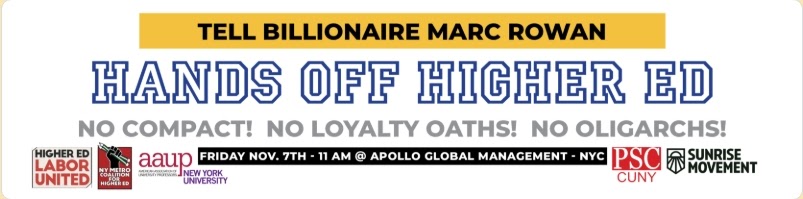
  • BORROWERS AGAINST APOLLO EVENT, FRIDAY NOVEMBER 7TH, NEW YORK CITY (HELU, AAUP, AFT)

    BORROWERS AGAINST APOLLO EVENT, FRIDAY NOVEMBER 7TH, NEW YORK CITY (HELU, AAUP, AFT)

    Higher Ed Unions, Student Unions, and For-Profit College Borrowers Unite Against Trump’s “Higher Education Compact”

    Several higher education unions, student unions, and former students of for-profit colleges are organizing in opposition to the Trump administration’s proposed “higher education compact”—a plan heavily shaped and promoted by private-equity billionaire Marc Rowan.

    Rowan, the CEO of Apollo Global Management, has played a central role in advancing this proposal. Apollo owns several predatory for-profit institutions, including the University of Phoenix, one of the most notorious offenders in the industry.

    In a recent New York Times op-ed, Rowan took public credit for the compact, writing:

    “The evidence is overwhelming: outrageous costs and prolonged indebtedness for students; poor outcomes, with too many students left unable to find meaningful work after graduating…”

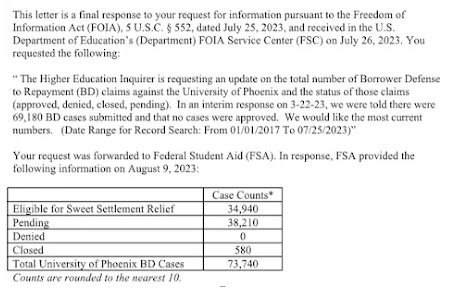
    Yet, under Rowan’s leadership, the University of Phoenix has become the largest source of Borrower Defense claims of any for-profit school, with more than 100,000 pending applications as of July 2025. Borrower Defense is a federal protection that allows students to seek loan forgiveness if their school misled them or violated state or federal law.

    The University of Phoenix has faced multiple law enforcement investigations for deceptive recruiting tactics that targeted veterans, service members, and working adults nationwide. The school’s misconduct led to a $191 million settlement with the Federal Trade Commission for falsely claiming partnerships with major employers. More recently, the university attempted to portray itself as a public institution while seeking to sell to two states—both of which ultimately rejected the deal after public backlash.

    While Rowan’s personal fortune exceeds $7 billion, borrowers continue to shoulder crushing debt from degrees that delivered little to no value. His leadership has fueled a system that profits from student harm—and now, through this compact, he is setting his sights on reshaping major public universities.

    We refuse to stay silent. Borrowers, students, and educators are standing together to demand accountability and defend higher education from predatory perpetrators.

    Source link

  • The Right-Wing Roots of EdTech

    The Right-Wing Roots of EdTech

    The modern EdTech industry is often portrayed as a neutral, innovative force, but its origins are deeply political. Its growth has been fueled by a fusion of neoliberal economics, right-wing techno-utopianism, patriarchy, and classism, reinforced by racialized inequality. One of the key intellectual architects of this vision was George Gilder, a conservative supply-side evangelist whose work glorified technology and markets as liberating forces. His influence helped pave the way for the “Gilder Effect”: a reshaping of education into a market where technology, finance, and ideology collide, often at the expense of marginalized students and workers.

    The for-profit college boom provides the clearest demonstration of how the Gilder Effect operates. John Sperling’s University of Phoenix, later run by executives like Todd Nelson, was engineered as a credential factory, funded by federal student aid and Wall Street. Its model was then exported across the sector, including Risepoint (formerly Academic Partnerships), a company that sold universities on revenue-sharing deals for online programs. These ventures disproportionately targeted working-class women, single mothers, military veterans, and Black and Latino students. The model was not accidental—it was designed to exploit populations with the least generational wealth and the most limited alternatives. Here, patriarchy, classism, and racism intersected: students from marginalized backgrounds were marketed promises of upward mobility but instead left with debt, unstable credentials, and limited job prospects.

    Clayton Christensen and Michael Horn of Harvard Business School popularized the concept of “disruption,” providing a respectable academic justification for dismantling public higher education. Their theory of disruptive innovation framed traditional universities as outdated and made way for venture-capital-backed intermediaries. Yet this rhetoric concealed a brutal truth: disruption worked not by empowering the disadvantaged but by extracting value from them, often reinforcing existing inequalities of race, gender, and class.

    The rise and collapse of 2U shows how this ideology plays out. Founded in 2008, 2U promised to bring elite universities online, selling the dream of access to graduate degrees for working professionals. Its “flywheel effect” growth strategy relied on massive enrollment expansion and unsustainable spending. Despite raising billions, the company never turned a profit. Its high-profile acquisition of edX from Harvard and MIT only deepened its financial instability. When 2U filed for bankruptcy, it was not simply a corporate failure—it was a symptom of an entire system built on hype and dispossession.

    2U also became notorious for its workplace practices. In 2015, it faced a pregnancy discrimination lawsuit after firing an enrollment director who disclosed her pregnancy. Women workers, especially mothers, were treated as expendable, a reflection of patriarchal corporate norms. Meanwhile, many front-line employees—disproportionately women and people of color—faced surveillance, low wages, and impossible sales quotas. Here the intersections of race, gender, and class were not incidental but central to the business model. The company extracted labor from marginalized workers while selling an educational dream to marginalized students, creating a cycle of exploitation at both ends of the pipeline.

    Financialization extended these dynamics. Lenders like Sallie Mae and Navient, and servicers like Maximus, turned students into streams of revenue, with Student Loan Asset-Backed Securities (SLABS) trading debt obligations on Wall Street. Universities, including Purdue Global and University of Arizona Global, rebranded failing for-profits as “public” ventures, but their revenue-driven practices remained intact. These arrangements consistently offloaded risk onto working-class students, especially women and students of color, while enriching executives and investors.

    The Gilder Effect, then, is not just about technology or efficiency. It is about reshaping higher education into a site of extraction, where the burdens of debt and labor fall hardest on those already disadvantaged by patriarchy, classism, and racism. Intersectionality reveals what the industry’s boosters obscure: EdTech has not democratized education but has deepened inequality. The failure of 2U and the persistence of predatory for-profit models are not accidents—they are the logical outcome of an ideological project rooted in conservative economics and systemic oppression.


    Sources

    Source link

  • Elite Power, Higher Education, and Political Ambition

    Elite Power, Higher Education, and Political Ambition

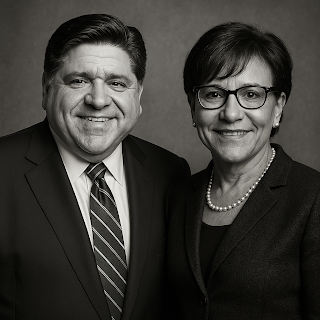
              [JB and Penny Pritzker] 

    The Pritzker family stands as a symbol of wealth, influence, and access in American public life. From the luxury of Hyatt Hotels to the boardrooms of private equity and the highest ranks of government, their reach extends across economic sectors and institutional spheres. But beneath the carefully managed public image lies a troubling contradiction—one that implicates higher education, for-profit exploitation, and national politics.

    Penny Pritzger

    Penny Pritzker, a former U.S. Secretary of Commerce and current trustee of Harvard University, has been a key figure in shaping education policy from elite perches. She also had a working relationship with Vistria Group, a private equity firm that now owns the University of Phoenix and Risepoint. These two entities have been central to the subprime college industry—profiting from the hopes of working-class students while delivering poor outcomes and burdensome debt.

    Pritzker’s relationship with Vistria runs deeper than simple association. In the late 1990s, she partnered with Vistria co-founder Marty Nesbitt to launch The Parking Spot, a national airport parking venture that brought them both business success and public recognition. When Nesbitt founded Vistria in 2013, he brought with him the experience and elite networks formed during that earlier partnership. Penny Pritzker’s family foundation—Pritzker Traubert—was among the early funders of Vistria, helping to establish its brand as a more “socially conscious” private equity firm. Although she stepped away from any formal role when she joined the Obama administration, her involvement in Vistria’s formation and funding set the stage for the firm’s expansion into sectors like for-profit education and healthcare.

    Vistria’s acquisition of the University of Phoenix, and later Risepoint, positioned it as a major player in the privatization of American higher education. The firm continues to profit from schools that promise economic mobility but often deliver student debt and limited job prospects. This is not just a critique of business practices, but a systemic indictment of how elite networks shape education policy, finance, and outcomes.

    Penny’s role as a trustee on the Harvard Corporation only sharpens this contradiction. Harvard, a university that markets itself as a global champion of meritocracy and inclusion, remains silent about one of its trustees helping to finance and support a firm that monetizes educational inequality. The governing body has not publicly addressed any potential conflict of interest between her Harvard role and her involvement with Vistria.

    JB Pritzger

    These contradictions are not limited to Penny. Her brother, J.B. Pritzker, is currently the governor of Illinois and one of the wealthiest elected officials in the country. Though he has no documented personal financial stake in Vistria, his administration has significant ties to the firm. Jesse Ruiz, J.B. Pritzker’s Deputy Governor for Education during his first term, left state government in 2022 to take a top leadership position at Vistria as General Counsel and Chief Compliance Officer.

    This revolving-door dynamic—where a senior education policymaker transitions directly from a progressive administration to a private equity firm profiting from for-profit colleges—underscores the ideological alignment and operational synergy between the Pritzker political machine and firms like Vistria. While the governor publicly champions equity and expanded public education access, his administration’s former top education official is now helping manage legal and compliance operations for a firm that extracts value from struggling students and public loan programs.

    J.B. Pritzker has announced plans to run for a third term as governor in 2026, but many observers believe he is positioning himself for a 2028 presidential campaign. His high-profile public appearances, pointed critiques of Donald Trump, and increased visibility in early primary states all suggest a national campaign is being tested. With his vast personal wealth, Pritzker could self-fund a serious run while drawing on elite networks built over decades—networks that include both his sister’s role at Harvard and their shared business and political allies.

    Elites in US Higher Education, A Familiar Theme 

    What emerges is a deeply American story—one in which the same elite networks shape both the problems and the proposed solutions. The Pritzkers are not alone in this dynamic, but their dual influence in higher education and politics makes them a case study in elite capture. They are architects and beneficiaries of a system in which public office, private equity, and nonprofit institutions converge to consolidate power.

    The for-profit education sector continues to exploit regulatory gaps, marketing expensive credentials to desperate individuals while avoiding the scrutiny that traditional nonprofit colleges face. When private equity firms like Vistria acquire troubled institutions, they repackage them, restructure their branding, and keep extracting value from public loan dollars. The government lends, students borrow, and investors profit. The people left behind are those without political clout—low-income students, veterans, working parents—who believed the marketing and now face debt with little return.

    Harvard’s silence, University of Phoenix’s reinvention, the rebranding of Academic Partnerships/Risepoint, and J.B. Pritzker’s ambitions all signal a troubling direction for American democracy. As more billionaires enter politics and public institutions become more dependent on private capital, the line between public service and private gain continues to erode.

    The Higher Education Inquirer believes this moment demands not only scrutiny, but structural change. Until elite universities hold their trustees accountable, until political candidates reject the influence of exploitative industries, and until the public reclaims its voice in higher education policy, the Pritzker paradox will continue to define the American experience—where access to opportunity is sold to the highest bidder, and democracy is reshaped by those who can afford to buy it.

    Sources

    – U.S. Department of Education College Scorecard

    – University of Phoenix outcome data (IPEDS, 2024)

    – Harvard University governance and trustee records

    – Vistria Group investor reports and public filings

    – Wall Street Journal, “America’s Second-Richest Elected Official Is Acting Like He Wants to Be President” (2025)

    – Associated Press, “Governor J.B. Pritzker positions himself as national Democratic leader” (2025)

    – Vistria.com, “Marty Nesbitt on his friendship with Obama and what he learned from the Pritzkers”

    – Politico, “Former Obama Insiders Seek Administration’s Blessing of For-Profit College Takeover” (2016)

    – Vistria Group announcement, “Jesse Ruiz Joins Vistria as General Counsel and CCO” (2022)

    Source link

  • Higher Education Inquirer continues to follow IPO/sale of University of Phoenix

    Higher Education Inquirer continues to follow IPO/sale of University of Phoenix

    On March 6, 2025, Apollo and Vistria publicly announced a possible IPO or sale of the University of Phoenix.  These companies have been trying to sell the University of Phoenix since 2021, but there have been no takers. The owners claim the school is worth $1.5M to $1.7M, but we (and experts we know) are skeptical, given the financials we have seen so far. The University of Phoenix was previously on sale for about $500M-$700M but the University of Arkansas System, the State of Idaho, and apparently other colleges declined the offers. 

    The University of Phoenix offers subprime education to folks,
    historically targeting servicemembers, veterans, and people of color. While some students may profit from these robocollege credentials, one wonders what
    these workers actually learn. The current student-teacher ratio at the
    University of Phoenix, according to the US Department of Education, is
    132 to 1.   

    In 2023 we made a Freedom of Action (FOIA) request to the US Department of Education (ED) to get Phoenix’s most recent audited financials. In March 2025, more than 20 months later, we were provided with a 35-page report, audited by Deloitte, with numbers from 2021 and 2022. 

    This month the Higher Education Inquirer followed up with a Freedom of Information request with the ED to obtain more up-to-date financial numbers for the University of Phoenix. We hope they will be responsive and timely enough to get the word out to the public.   

    Source link

  • U of Idaho President Seems To Temper His Cheerleading for U of Phoenix Purchase (David Halperin)

    U of Idaho President Seems To Temper His Cheerleading for U of Phoenix Purchase (David Halperin)

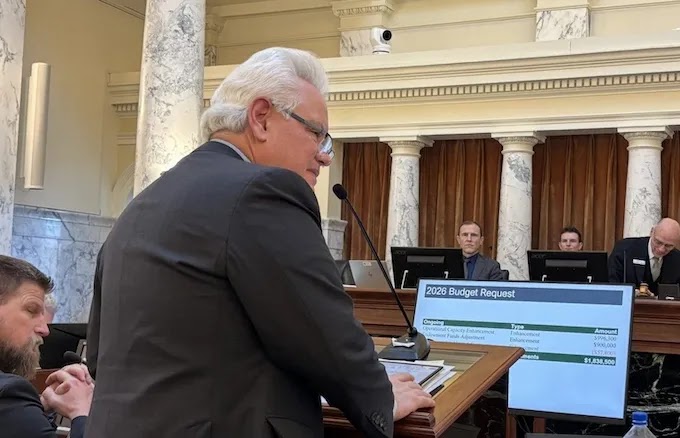
    In testimony Monday before a joint committee of the Idaho
    legislature, University of Idaho president C. Scott Green seemed a
    little less committed to the deal he has relentlessly touted for more
    than a year and a half — for his school to buy, for $685 million, the
    huge for-profit University of Phoenix from private equity giant Apollo
    Global Management.

    According to Idaho Education News, Green said the next move was Apollo’s. “We’re waiting to hear what they would like to do,” Green said.

    Green’s plan has been thwarted again and again, with negative votes in the Idaho legislature, a successful court challenge by the state’s attorney general, criticism from the state treasurer, and sharp scrutiny from news outlets in the state.

    The Green school deal has assumed that operation of Phoenix would
    bring millions in new revenue to fund his university. But it ignores
    that running a for-profit college, one that has repeatedly gotten in trouble with law enforcement,
    would be a tremendous challenge: If Green pushed to end Phoenix’s
    predatory practices and improve student outcomes, it probably would
    start losing money, because predatory practices, coupled with high
    prices and low spending on education, have made up the school’s secret
    sauce. But if Green allowed the deceptive conduct to persist, the school
    could face more legal peril. And, whatever route he took, Green’s
    school might end up assuming massive liability for student loan debt the
    government has cancelled based on past abuses at Phoenix.

    At its peak, Phoenix was the largest for-profit college in the
    country and got upwards of $2 billion a year in federal student aid,
    while boasting dismal graduation rates and high levels of loan defaults.

    Last summer, the University of Idaho and Apollo agreed to a one-year extension of their purchase deal. That arrangement expires June 10. Meanwhile Apollo has the right to talk with other potential buyers.

    Apollo already has sent Idaho $5 million to cover the school’s
    high-priced legal and consulting fees in connection with the deal, and
    it has agreed to pay up to $20 million to Idaho if the deal falls
    through.

    Green told the legislature that $20 million would cover his school’s
    costs with perhaps $2 to $3 to spare. “I think we’re well-protected,” he
    boasted.

    Kind of. Green, whose background is in corporate management and
    finance, could potentially walk away without losing money for the
    school. But he has tied up state university, executive, legislative, and
    judicial resources for many hundreds of hours jousting over an effort
    that would keep alive a predatory school that has buried thousands of
    graduates in debt they can’t afford to repay, while wasting billions in
    federal taxpayer dollars, when that time could have been focused on the
    real challenges of state higher education.

    If Idaho can’t work out a deal, Apollo may run out of options to dump
    the school, and this taxpayer-funded multi-billion dollar disgrace may
    at last be put down.

    [Editor’s note: This article originally appeared on Republic Report.] 

    Source link