
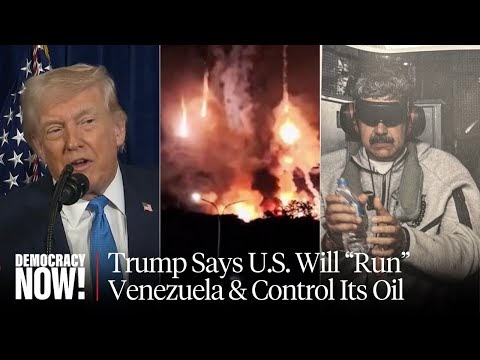
From the mid‑19th century to today, U.S. interventions in Latin America and the Caribbean have consistently combined military force, political influence, and economic pressure. Across this long arc, millions of lives have been shaped—often shattered—by policies that prioritize strategic advantage over human flourishing. Today’s geopolitical tensions with Venezuela are the latest flashpoint in a historical pattern that rewards elites while exacting profound human costs.
Note on Timing: This article is intentionally posted on Christmas Day 2025, a day traditionally associated with peace, goodwill, and reflection, to underscore the contrast between those ideals and the ongoing human toll of U.S. militarism and intervention abroad. The symbolic timing is a reminder that while many celebrate, others suffer the consequences of policies driven by power, profit, and geopolitics.
As Higher Education Inquirer has repeatedly argued, the United States’ military footprint—its wars, recruitment programs, and entanglements with higher education—has deep consequences not just abroad but at home. ROTC programs and military enlistment are often marketed as pathways to education and economic stability, but they also funnel young people into systems with long‑term obligations, moral hazards, and psychological risk. Prospective enlistees and their families should think twice before committing to military pathways that may bind them to morally questionable conflicts and institutional control.
Moreover, U.S. higher education has become deeply entwined with kleptocracy, militarism, and colonialism, supporting war economies and benefiting from federal research contracts with defense and intelligence partners that obscure the real human costs of empire. These warnings are especially salient in the context of Venezuela and similar interventions, where human toll and geopolitical stakes demand deeper scrutiny.
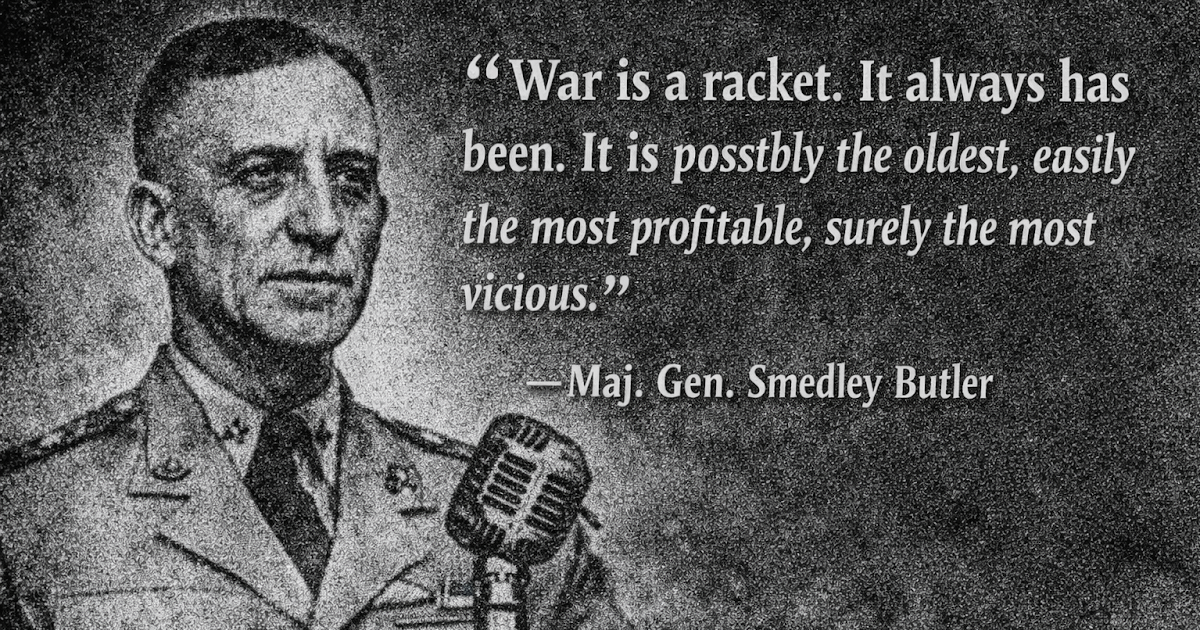
Major General Smedley D. Butler, among the most decorated U.S. Marines, became one of the U.S. military’s most outspoken critics. In his 1935 War Is a Racket, Butler rejected romantic notions of military glory and exposed the economic motives behind many interventions:
“War is a racket. It always has been. It is possibly the oldest, easily the most profitable, surely the most vicious.”
“I spent 33 years and four months in active military service… being a high‑class muscle man for Big Business, for Wall Street and for the bankers. In short, I was a racketeer for capitalism.”
“Only a small inside group knows what it is about. It is conducted for the benefit of the very few at the expense of the masses.”
Butler’s warnings were not abstract. In 1933, he was approached to lead a coup against President Franklin D. Roosevelt, known as the Business Plot, which he publicly exposed. His testimony before Congress revealed how elite interests sought to use military power to overthrow democratic government, an episode that underscores his critique of war as a tool for entrenched interests at the expense of ordinary people.
Below is a timeline of major U.S. interventions in the Americas, with estimated deaths, showing the human cost of policies that often served strategic or economic interests over humanitarian ones:
| Period | Location | Event / Nature of Intervention | Estimated Deaths |
|---|---|---|---|
| 1846–1848 | Mexico | Mexican-American War: Territorial conquest | ~25,000 Mexicans |
| 1898 | Cuba/P.R. | Spanish-American War: U.S. seized P.R.; Cuba protectorate | ~15,000–60,000 (90% disease) |
| 1914 | Mexico | Occupation of Veracruz: U.S. port seizure | ~300 Mexicans |
| 1915–1934 | Haiti | Military Occupation: Suppression of rebellions | ~3,000–15,000 |
| 1916–1924 | Dominican Rep. | Marine Occupation: Control of customs/finance | ~4,000 |
| 1954 | Guatemala | Op. PBSuccess: CIA coup against Árbenz; led to civil war | 150,000–250,000* |
| 1965 | Dominican Rep. | Op. Power Pack: U.S. intervention during civil war | ~3,000 |
| 1973–1990 | Chile | U.S.-backed Coup/Regime: Pinochet dictatorship | 3,000–28,000* |
| 1975–1983 | S. America | Operation Condor: CIA-supported intelligence network | ~60,000* |
| 1976–1983 | Argentina | Dirty War: U.S.-supported military junta and coup | ~30,000* |
| 1979–1992 | El Salvador | Civil War: Massive military aid to govt forces | 35,000–75,000* |
| 1981–1990 | Nicaragua | Iran-Contra Affair: Covert support for Contras | ~30,000–50,000* |
| 1989 | Panama | Operation Just Cause: Invasion to remove Noriega | 500–3,000 |
| 2025 | Venezuela | Naval Blockade: Active maritime strikes and standoff | 100+ (to date) |
*Estimates include civilian casualties and deaths indirectly caused by U.S.-supported interventions.
Venezuela’s 2025 crisis is the latest in a long history of U.S. pressure in the hemisphere. A naval blockade—accompanied by maritime strikes and political isolation—has already produced more than 100 confirmed deaths. Historically, interventions like this have often prioritized U.S. strategic or economic interests over local welfare.
The situation is further complicated by global geopolitics. Former President Donald Trump, who recently pardoned key figures involved in controversial interventions, including Iran‑Contra actors, also maintains strategic ties with China and Russia, highlighting how interventions are entangled with global power plays that affect universities, recruitment pipelines, and domestic politics alike.
Smedley Butler’s critique remains urgent: to “smash the racket,” profit must be removed from war, military force should be strictly defensive, and decisions about war must rest with those who bear its consequences. From Mexico to Venezuela—and including covert operations like Iran‑Contra—the historical record shows how interventions serve a narrow elite while imposing massive human costs.
HEI’s warnings underscore that higher education, ROTC programs, and military recruitment pipelines are not neutral pathways but deeply embedded parts of systems that reproduce extraction, militarism, and inequality. Students, educators, and families must critically evaluate the incentives and promises of military pathways and demand institutions that serve learning, opportunity, and justice rather than empire.
Butler, Smedley D. War Is a Racket. Round Table Press, 1935.
U.S. Congressional Record and Butler testimony on the Business Plot, 1934.
Kinzer, Stephen. Overthrow: America’s Century of Regime Change from Hawaii to Iraq.
Scott, Peter Dale. Cocaine Politics: Drugs, Armies, and the CIA in Central America.
Reporting on Trump pardons, Iran‑Contra participants, and global alliances (2020–2025).
Higher Education Inquirer, “Kleptocracy, Militarism, Colonialism: A Counterrecruiting Call for Students and Families,” December 7, 2025. (link)
Higher Education Inquirer, “The Hidden Costs of ROTC — and the Military Path,” November 28, 2025. (link)
Historical records on U.S. interventions: Mexican‑American War, Spanish‑American War, Guatemala (1954), Chile (1973), Argentina (1976–1983), El Salvador, Nicaragua, Panama, Venezuela (2025).

The Western Hemisphere is entering a new and dangerous phase of global rivalry—one shaped by old imperial habits, new economic pressures, and resurgent great-power maneuvering. From Washington to Beijing to Caracas, political leaders are escalating tensions over Venezuela’s future, reviving a familiar script in which Latin America becomes the proving ground for foreign powers and a pressure cooker for working-class people who have no say in the geopolitical games unfolding above them.
What looks like a confrontation over oil, governance, or regional security is better understood as a collision of neoliberal extraction, colonial legacies, and competing empires, each claiming moral authority while pursuing strategic advantage. In this moment, it is essential to remember what history shows again and again: ordinary people—soldiers, students, workers—pay the highest price for elite ambitions.
The U.S. role in Latin America cannot be separated from its imperial foundations. Over more than a century, Washington has repeatedly intervened—militarily, covertly, and financially—to shape political outcomes in the region:
1898–1934: The “Banana Wars.” U.S. Marines were deployed throughout the Caribbean and Central America to secure plantations, protect U.S. investors, and maintain favorable governments in Cuba, Puerto Rico, Nicaragua, Haiti, the Dominican Republic, Panama, and Honduras.
1954: Guatemala. The CIA overthrew democratically elected President Jacobo Árbenz after he challenged United Fruit Company landholdings.
1961: Bay of Pigs Invasion. A failed U.S.-backed attempt to overthrow Fidel Castro.
1973: Chile. U.S. support for the coup against Salvador Allende ushered in the Pinochet dictatorship and a laboratory for neoliberal economics.
1980s: Nicaragua, El Salvador, Guatemala. Funding death squads, supporting Contra rebels, and fueling civil wars that killed hundreds of thousands.
1989: Panama. A full-scale U.S. invasion to remove Manuel Noriega, with civilian casualties in the thousands.
2002: Venezuela. U.S. officials supported the brief coup against Hugo Chávez.
2020s: Economic warfare continues. Sanctions, diplomatic isolation, and support for factions opposing Nicolás Maduro all sustain a long-running pressure campaign.
This is not ancient history. It is the operating system of U.S. hemispheric influence.
While the U.S. escalates military signaling toward Venezuela, China is expanding soft power, economic influence, and political relationships throughout Latin America—including with Venezuela. Beijing’s strategy is centered not on direct military confrontation but on long-term infrastructure, trade, and diplomatic partnerships designed to reduce U.S. dominance.
Recent statements from Beijing underscore this shift. Chinese President Xi Jinping publicly backed Venezuelan President Nicolás Maduro, describing China and Venezuela as “intimate friends” as the U.S. intensifies military pressure in the region. China’s role extends beyond rhetoric: loans, technology transfers, energy investments, and political support form a web of influence that counters U.S. objectives.
This is the new terrain: the U.S. leaning on sanctions and military posture, China leveraging soft power and strategic alliances.
Any honest assessment of the current geopolitical climate must include Russia, which has expanded its presence in Latin America as part of its broader campaign to counter U.S. power globally. Moscow has supplied Venezuela with military equipment, intelligence support, cybersecurity assistance, and diplomatic cover at the United Nations. It has strengthened ties with Nicaragua, Cuba, and other governments willing to challenge U.S. regional dominance.
Russia’s involvement is not ideological; it is strategic. It seeks to weaken Washington’s influence, create leverage in distant theaters, and embed itself in the Western Hemisphere without deploying large-scale military forces. Where China builds infrastructure and invests billions, Russia plays the spoiler: complicating U.S. policy, reinforcing embattled leaders when convenient, and offering an alternative to nations seeking to escape U.S. hegemony.
The result is a crowded geopolitical arena in which Venezuela becomes not just a domestic crisis but a theater for multipolar contention, shaped by three major powers with very different tools and interests.
Viewed in historical context, today’s crisis is simply the newest iteration of a long-standing pattern:
Colonial logics justify intervention. The idea that Washington must “manage” or “stabilize” Latin America recycles the paternalism of earlier eras.
Neoliberal extraction drives policy. Control over energy resources, access to markets, and geopolitical leverage matter more than democracy or human well-being.
Foreign powers treat the region as a chessboard. The U.S., China, and Russia approach Latin America not as sovereign equals but as terrain for influence.
People—not governments—bear the cost. Sanctions devastate civilians. Military escalations breed proxy conflicts. Migration pressures rise. And working-class youth are recruited to fight battles that are not theirs.
This is why today’s developments must be understood as part of a wider global system that treats nations in the Global South as resources to exploit and battlegrounds to dominate.
In moments like this, the pressure on young people—especially working-class youth—to join the military increases. Recruiters frame conflict as opportunity: tuition money, job training, patriotism, adventure, or stability. But the truth is starker and more political.
Muhammad Ali’s stance during the Vietnam War remains profoundly relevant today. He refused the draft, famously stating that the Vietnamese “never called me [a slur]” and declaring that he would not fight a war of conquest against people who had done him no harm.
The same logic applies to today’s geopolitical brinkmanship. Young Americans are asked to risk their lives in conflicts that protect corporate interests, reinforce imperial ambitions, and escalate global tensions. Venezuelan workers, Chinese workers, Russian workers, and U.S. workers are not enemies. They are casualties-in-waiting of decisions made by governments and corporations insulated from the consequences of their actions.
Before enlisting—or joining ROTC—young people deserve to understand the historical cycle they may be pulled into. Wars in Latin America, proxy or direct, have never served the interests of everyday people. They serve empires.
Firstpost. “Xi Backs Maduro, Calls China and Venezuela ‘Intimate Friends’ as Trump Steps Up Military Pressure.”
Greg Grandin, Empire’s Workshop: Latin America, the United States, and the Rise of the New Imperialism
Naomi Klein, The Shock Doctrine
Stephen Kinzer, Overthrow: America’s Century of Regime Change
U.S. Congressional Research Service reports on U.S. policy in Venezuela and China-Latin America relations
UN Human Rights Council documentation on sanctions and civilian impact

The Higher Education Inquirer has gained a strong international influence. Here are the viewership numbers for the last 24 hours.

