Category: white supremacy

  • Avoid Contact with Turning Point USA

    Avoid Contact with Turning Point USA

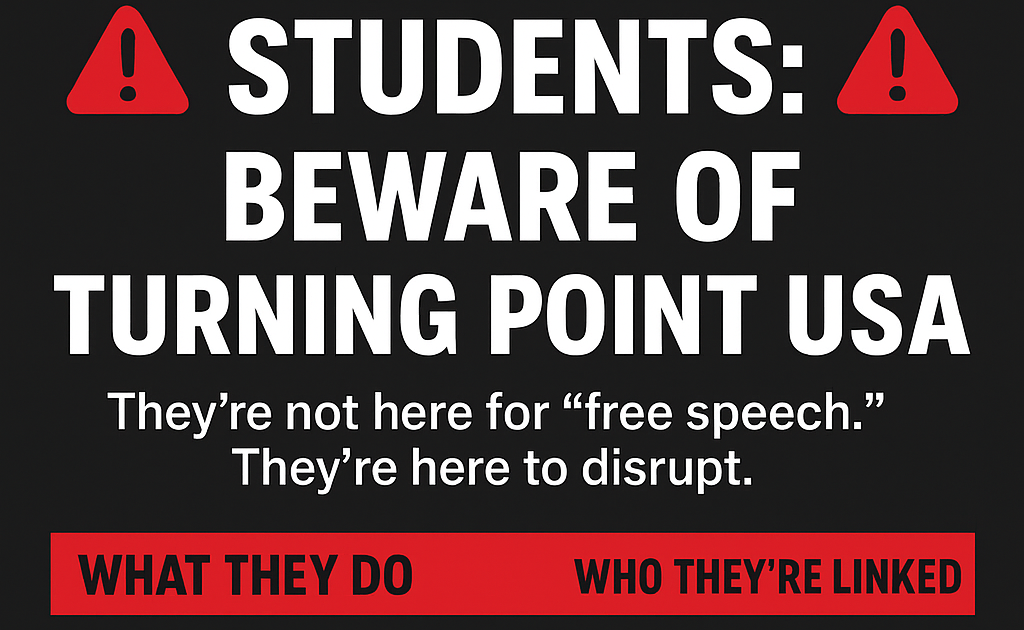
    Turning Point USA (TPUSA) brands itself as a conservative youth movement dedicated to free markets and limited government. In reality, a growing body of investigative reporting, watchdog research, and student testimony reveals an organization built on intimidation, manipulation, and close ties to extremists. Students should be aware of the risks before engaging with TPUSA in any capacity.

    From its inception, TPUSA has sought to be confrontational. One of its most notorious tools, the Professor Watchlist, publishes the names, photos, and alleged offenses of professors the group deems “anti-conservative.” This public shaming campaign has been condemned by educators and civil liberties advocates as a threat to academic freedom and personal safety. In more recent years, TPUSA has expanded its targets beyond individual professors, with initiatives like the School Board Watchlist, designed to stir distrust of public education and stoke fear around diversity, equity, and inclusion initiatives.

    These campaigns are paired with questionable political tactics. Investigations have shown that TPUSA has engaged in covert influence efforts on college campuses, including secretly funding student government elections and running coordinated online disinformation campaigns. Their political arm, Turning Point Action, has been compared to a troll farm for its use of deceptive social media operations.

    The group’s leadership and chapters have repeatedly been linked to white supremacist and far-right extremist figures. TPUSA events have hosted or associated with members of Nick Fuentes’ “Groyper” movement, Holocaust deniers, and other alt-right personalities. The Southern Poverty Law Center, Anti-Defamation League, and multiple journalists have documented these associations, which TPUSA leaders routinely downplay. Internal communications and leaked chapter messages have exposed racist, homophobic, and Islamophobic rhetoric from members. Charlie Kirk, TPUSA’s founder, once falsely claimed that a Black woman had “taken his place” at West Point, a statement criticized as both untrue and racially inflammatory.

    TPUSA’s messaging also extends beyond politics into science denial. The group has repeatedly dismissed the scientific consensus on climate change, framing environmental concerns as a hoax or left-wing scare tactic, and hosting events that platform climate change skeptics over credible experts. TPUSA has received significant funding from fossil fuel interests, including Koch network-affiliated donors, and from political megadonors such as Foster Friess and Rebekah Mercer, who are known for underwriting climate denial campaigns. Other key allies include right-wing think tanks like the Heritage Foundation and media figures such as Tucker Carlson, who have amplified TPUSA’s messaging to broader audiences. The organization has also benefitted from support by religious nationalist groups and political operatives who share its hardline positions on education, race, and gender.

    TPUSA’s confrontational model often invites chaos. At UC Davis, a TPUSA-sponsored event erupted into physical clashes involving Proud Boys. Across campuses, students and faculty report that TPUSA representatives deliberately provoke heated exchanges, record them, and circulate the footage to mobilize their base and fundraise off manufactured outrage. Former members have confirmed that such confrontations are not accidental, but rather part of the playbook.

    While TPUSA presents itself as a mainstream conservative voice, the evidence paints a darker picture: an organization willing to distort, harass, and align with extremists to achieve its goals. Students seeking honest political debate should look for groups that engage in respectful dialogue, value truth over theatrics, and reject intimidation as a tool.

    Sources:

    Southern Poverty Law Center – Turning Point USA: Case Study in the Hard Right

    Media Matters – Turning Point USA’s History of Racism and White Nationalist Ties

    The New Yorker – A Conservative Nonprofit That Seeks to Transform College Campuses Faces Allegations of Racial Bias and Illegal Campaign Activity

    Anti-Defamation League – Extremism in American Politics: Turning Point USA

    Wired – How Charlie Kirk Plans to Discredit Martin Luther King Jr. and the Civil Rights Act

    Chron – Texas A&M Turning Point Chat Exposes Racist and Homophobic Comments

    The Guardian – What I Learned When Turning Point USA Came to My Campus

    OpenSecrets – Turning Point USA Donors and Political Funding

    DeSmog – Turning Point USA and Fossil Fuel Industry Influence
    Source link

  • The Complicity of Higher Education in Slavery

    The Complicity of Higher Education in Slavery

    New Jersey’s legacy as a “slave state of the North” is often overlooked, especially in the sanitized histories of its most prestigious universities. Yet a closer examination reveals that the state’s institutions of higher education—particularly Princeton University and Rutgers University—were not only complicit in slavery, but were active beneficiaries of racial exploitation. Their histories are deeply intertwined with a system that built wealth and social power through the bondage of Black people.

    This article is based on the findings of For Such a Time as This: The Nowness of Reparations for Black People in New Jersey, a landmark report from the New Jersey Reparations Council. The report is an urgent call for transformative change through reparative justice. It draws a direct throughline from New Jersey’s foundational embrace of slavery, through its Jim Crow era and more recent forms of structural racism, to today’s reality of “Two New Jerseys”—one Black, one white, separated by a staggering $643,000 racial wealth gap between median Black and white family wealth.

    Princeton University: Built by the Enslaved, for the Elite

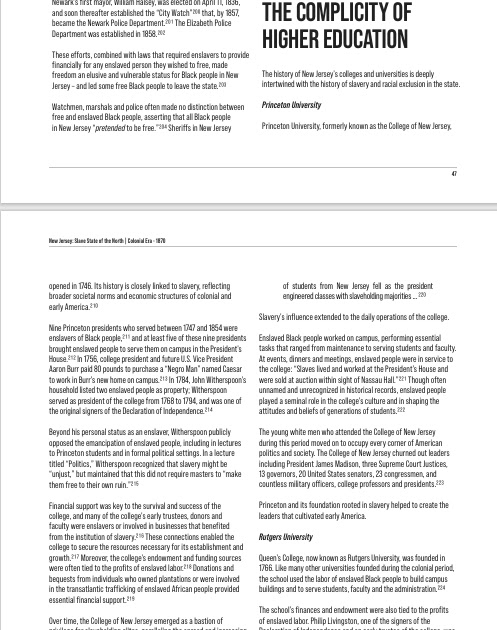
    Founded in 1746 as the College of New Jersey, Princeton University’s early leadership reads like a roll call of slaveholders. Nine of its first presidents enslaved Black people. At least five brought enslaved individuals to live and labor on campus—including Aaron Burr Sr., who in 1756 purchased a man named Caesar to work in the newly built President’s House. Another, John Witherspoon, signer of the Declaration of Independence and president from 1768 to 1794, kept two people in bondage and spoke out against emancipation, claiming that freeing enslaved people would bring “ruin.”

    Financially and culturally, Princeton thrived on slavery. Many of its trustees, donors, and faculty enriched themselves through plantation economies and the transatlantic slave trade. Historian Craig Steven Wilder has shown that the university’s enrollment strategy was deliberately skewed toward elite southern families who owned enslaved people. From 1768 to 1794, the proportion of southern students doubled, while the number of students from New Jersey declined. Princeton became a finishing school for the sons of America’s racial aristocracy.

    Slavery was not just in the background—it was present in the daily life of the institution. Enslaved Black people worked in kitchens, cleaned dormitories, and served food at official university events. Human beings were bought and sold in full view of Nassau Hall. These men and women, their names often lost to history, were the invisible labor force that built the foundation for one of the wealthiest universities in the world.

    The results of this complicity are measurable. Princeton graduates shaped the American Republic—including President James Madison, three U.S. Supreme Court justices, 13 governors, 20 senators, and 23 congressmen. Many of them carried forward the ideologies of white supremacy and anti-Black violence they absorbed in their youth.

    Rutgers University: Queen’s College and the Profits of Enslavement

    Rutgers University, originally established as Queen’s College in 1766, shares a similarly grim legacy. The college’s early survival depended on donations and labor directly tied to slavery. Prominent among its early trustees was Philip Livingston, a signer of the Declaration of Independence who made his fortune by trading enslaved people and operating Caribbean plantations.

    Enslaved labor helped build Rutgers, too. A man named Will, enslaved by the family of a college trustee, is among the few individuals whose name has survived. His work helped construct the early physical campus, though his story, like so many others, is only briefly mentioned in account books and correspondence.

    The intellectual environment of Queen’s College mirrored the dominant racial attitudes of the time. While some students and faculty opposed slavery, their voices were overwhelmed by an institution that upheld the social, political, and economic status quo. Rutgers, like Princeton, prepared white elites to rule a society built on racial exclusion.

    Toward Reparative Justice

    The For Such a Time as This report from the New Jersey Reparations Council underscores that the legacy of slavery is not a relic of the past—it is embedded in the material realities of today. New Jersey’s racial wealth gap—$643,000 between Black and white families—is not accidental. It is the result of centuries of dispossession, disinvestment, and discrimination.

    The state’s leading universities played a formative role in that history. Acknowledgment of this fact is only a first step. True reckoning means meaningful reparative action. It means directing resources and power toward the communities that have been systematically denied them. It means funding education, housing, healthcare, and business development in Black communities, and making structural changes to how wealth and opportunity are distributed.

    Princeton and Rutgers are not just relics of the past; they are major economic and political actors in the present. As institutions with billion-dollar endowments and vast influence, they have both the means and the moral obligation to contribute to a just future.

    The question now is whether they will answer the call. 

    Source link