Category: wildfires

  • After L.A.’s Wildfires, Reshaping Disaster Response to Address Children’s Needs – The 74

    After L.A.’s Wildfires, Reshaping Disaster Response to Address Children’s Needs – The 74


    Get stories like this delivered straight to your inbox. Sign up for The 74 Newsletter

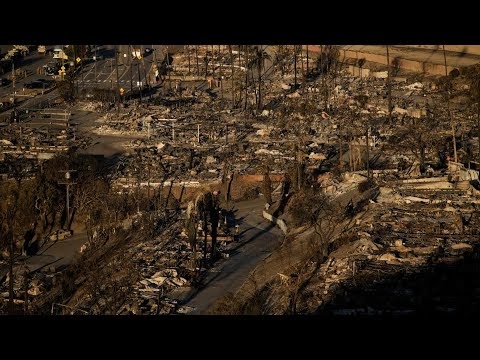
    As the one-year anniversary of the Los Angeles wildfires passes, rebuilding efforts continue to lag despite assurances to the contrary and many families are still navigating their search for a return to normalcy. For children in particular, the effects of a disaster do not end when the smoke clears or the debris is removed. 

    As more people’s lives are upended each year due to climate disasters communities — and our political leaders at the local, state and federal levels — must do more to ensure the needs of children and families are met during these emergencies.

    During wildfires and other disasters, we continually see the familiar pattern of school closures, child care disruption, families moving into temporary housing and routines essential to children’s sense of safety abruptly severed. Communities and political leaders at every level must confront a hard truth: Our emergency systems were not designed with children in mind. 

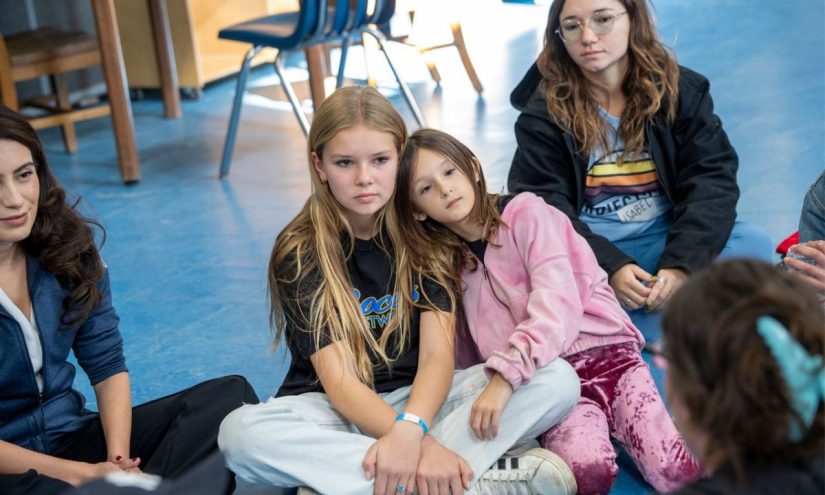
    During wildfires, schools and child care systems are among the first institutions to fail. Children are displaced from classrooms, separated from trusted adults and thrust into shelters or hotel rooms never designed to support their physical, emotional or developmental needs. Studies show that stress brought on by exposure to natural disasters can have an outsized impact on children and lead to lifelong trauma. This trauma can lead to socio-emotional impairments; health-risk behaviors, such as alcohol and drug abuse; and even early death, according to the Adverse Childhood Experiences study published in 2011 by the Centers for Disease Control and Prevention and Kaiser Permanente. 

    This past year has made it clear that local jurisdictions can no longer rely on federal disaster systems to carry the full burden of recovery. As the future of entities such as the Federal Emergency Management Agency becomes more uncertain, states, cities and counties must assume greater responsibility for protecting their most vulnerable citizens. 

    This starts with treating schools as critical infrastructure. While schools became formally recognized as part of critical infrastructure — specifically within the Education Facilities subsector in 2003 under Homeland Security Presidential Directive-7 (HSPD-7) — they are not allocated commensurate resources and protections for security as other designated critical infrastructure. 

    The Covid-19 pandemic underscored the central role that schools play in economic stability, as widespread closures rapidly disrupted labor markets and productivity. Treating schools as critical infrastructure would align education with other essential public systems that underpin public health, safety and economic performance; as such, it merits long-term investment.

    Second, schools need contingency plans that ensure continuity of in-person education when normal operations are disrupted. After the LA wildfires, many schools scrambled to set up alternate sites or transitioned to online learning. Students are still making up learning losses from the pandemic, and it is unclear whether those losses can be stemmed. Online learning should be used only when all other options have been exhausted, given the devastating impacts on student learning. The planning needs to begin now, not after disaster strikes.  

    Third, practice is key to success. Emergency plans often fail children not because they are poorly written but because they are never written with children in mind. Children experience disasters differently than adults, and procedures designed without them can inadvertently heighten fear and trauma. Age-appropriate drills, school-based tabletop exercises and responder training in developmentally appropriate communication can dramatically improve outcomes. 

    Local governments can formally integrate school districts, child care providers and pediatric health systems into emergency planning rather than treating them as afterthoughts once a crisis unfolds. Practicing with children builds familiarity, reduces panic and accelerates recovery — not just for young people, but for entire communities.

    Finally, funding structures must reflect the realities families face after disasters. While billions are allocated for fire suppression and mitigation, far fewer resources are earmarked for sustaining schools, child care and pediatric mental health in the months and years that follow. Local and state governments should establish dedicated funding streams for child- and family-centered recovery — supporting school continuity, mental health care and family stabilization — since these investments can reduce long-term social and economic costs.

    Implementing a family-centric disaster response model isn’t just a moral imperative. Adverse childhood experiences lead to an economic burden of  hundreds of billions of dollars annually in the U.S, much of it absorbed by taxpayers through Medicaid and Medicare spending, special education, disability programs and lost lifetime tax revenue. When disaster responses destabilize children, short-term emergencies are converted into long-term public liabilities, driving government inefficiency and reactive spending. These failures also spill into insurance markets, increasing claims, raising premiums and deepening reliance on federal backstops that distort risk pools and shift costs to the public.

    In an era of escalating disasters and constrained budgets, policies that protect family stability during crises are not social add-ons but high-return investments: reducing future taxpayer exposure, stabilizing insurance systems and limiting the need for costly federal intervention after the fact.

    The one-year mark of the Los Angeles wildfires should not serve as a memorial to what was lost, but as a reckoning with what must change. Disasters will continue to test our systems, but allowing children to bear the brunt of those failures is a policy choice, not an inevitability. Protecting children during emergencies necessitates radical change. If we fail to act, we are not merely accepting risk: We are knowingly passing preventable harm and long-term costs onto the next generation.


    Did you use this article in your work?

    We’d love to hear how The 74’s reporting is helping educators, researchers, and policymakers. Tell us how
    Source link

  • LA Wildfires Reduce Classrooms to Ashes, Uproot Students’ Lives – The 74

    LA Wildfires Reduce Classrooms to Ashes, Uproot Students’ Lives – The 74

    Republish This Article

    We want our stories to be shared as widely as possible — for free.

    Please view The 74’s republishing terms.


    Source link

  • LA Schools Reopen, But Recovery Will Be Long and Painful – The 74

    LA Schools Reopen, But Recovery Will Be Long and Painful – The 74


    Get stories like this delivered straight to your inbox. Sign up for The 74 Newsletter

    It was just after 1 am when Los Angeles charter school superintendent Ian Mcfeat started getting text messages and phone calls at a relative’s house where he was sheltering from the fires. 

    His neighbors said his house was burning down in the wildfires – along with his entire Altadena neighborhood of Los Angeles.

    Aveson School of Leaders, which McFeat runs and where his kids attended school just three blocks from his house, was also burning.

    Unable to sleep, Mcfeat drove away from his in-law’s house that he’d been evacuated to and made the drive back to Altadena.

    He drove through the fire lines and into his neighborhood to see if he could salvage anything, save anyone, or put out the fires that had raged on the east side for more than 48 hours straight, and decimated the Palisades in the west. 

    He was greeted with a scene out of a horror movie. Fueled by a violent windstorm and piles of brush left from a particularly wet winter last year, the firestorm was like a tornado shooting flames, blasting through his neighborhood.

    “It was like driving through a bomb scene,” said Mcfeat. “There were homes exploding. I probably shouldn’t have been there.” 

    Despite the devastating losses, Mcfeat can’t imagine not rebuilding his home and school right where they were in Altadena. But the road to recovery will be a long and painful one.

    “No doubt about it. We are going to rebuild,” said Mcfeat. Aveson has started a GoFundMe. At this point, a new site for the school has not been identified. The district hasn’t been able to help them yet.

    “I don’t know what we’re going to do,” said Mcfeat.

    The wildfires that burned Los Angeles this month are the costliest and most destructive in the city’s history, displacing more than 150,000 residents and killing at least 25 people. Two massive blazes fed by windstorms, the Palisades Fire and the Eaton Fire, simultaneously scorched the city from the sea to the mountains, filling the air with vast plumes of ash and smoke.

    As the wind and flames began to retreat last week, and firefighters gained control of the fires, schools began to reopen. And the kids began to return to class.

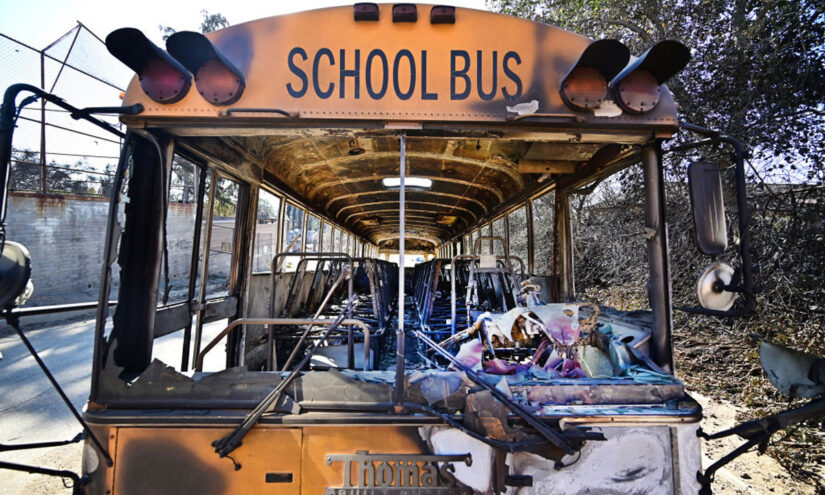
    The Los Angeles Unified School District, which is by far the largest district of about 80 in Los Angeles County, resumed instruction Monday after being totally closed since last Thursday. Seven schools remain shut because they’re located in evacuation zones. Another three won’t reopen because their buildings were badly burned or destroyed in the fires.  

    Dozens of much smaller districts in Los Angeles County also reopened this week, with the exceptions of two districts, Pasadena Unified, which encompasses Altadena, and La Cañada Unified, which neighbors Altadena to the west. 

    The Eaton fire has destroyed at least five schools but was mostly contained by Friday. 

    Kids from two of the LAUSD schools that burned in the Palisades, Marquez Charter Elementary School and Palisades Charter Elementary School, were placed, with intact school rosters, in close-ish LAUSD school buildings that already had other schools in them.

    The students who attended the burned schools were given their own entrances, classrooms and courtyards for kids to play. When parents dropped them off at class this week, there were a lot of tearful reunions.

    Families from Palisades Charter were somber, but excited to return to normalcy with their new space located inside of Brentwood Science Magnet School.  

    Joseph Koshki, a parent from the Palisades whose son attends third grade at Palisades Charter, walked holding hands with his son to their new classroom at Brentwood Science, which had been stacked with balloons.

    “When he saw his school burned on the news he was crying for days,” Koshki said of his child. “But when he heard that he was going to his new school with his old friends, he was so happy”.

    Nina Belden, a parent of a Palisades Charter student who had made an emergency evacuation from her house in the Palisades with her family, said it was important for the students at her daughter’s school to stay together and receive in-person instruction.

    “We were worried they were going to do something like remote learning,” said Beldon.

    Marquez Charter, which also burned in the Palisades fire, has a long history in the community, having opened in 1955 when the Palisades still had a frontier feel, before the neighborhood became a favorite of Hollywood stars and media execs.

    For Victoria Flores, who works as a paraeducator at Marquez, the school is part of her family. Flores went to Marquez when she was in elementary school, and her mother works in the cafeteria.

    “It was my home away from home. We are devastated by what happened,” Flores said.

    But Flores said she and the rest of the staff were glad to be relocated together at a LAUSD school called Nora Sterry, about ten miles from the burned Marquez campus.

    “We are a really close family,” said Flores. “That’s helped us a lot.”

    Upstairs at Nora Sterry, Clare Gardner’s class had about eight of twenty students show up on the first day of relocation.

    Her third-grade class was playing with clay and Mrs. Gardner, who is a twenty-seven-year veteran of Marquez, held back her tears as she helped students arrive into class.

    “We always call it the Marquez family,” Gardner said as the children greeted each other.

    One boy in Mrs. Gardner’s class said he was happy to be around his friends and teacher but sad about his classroom fish and books, which were lost in the fire.

    Later in the morning, LAUSD Superintendent Alberto Carvalho went to visit parents at Nora Sterry.

    After nearly a week off school, Carvalho says attendance is still below normal.

    “I think where that attendance is lacking is in schools that were directly affected” by the fires, Carvalho said.

    Also hurting attendance, Carvalho said, is the fact that many families are enduring temporary relocations, while others lack stable housing entirely.

    LAUSD staff attendance is back to normal, he said, while student attendance is about 88% — down from an average of about 90%, representing about 10,000 fewer students than normal.

     “As conditions of the families begin to normalize and stabilize, those [attendance] numbers will rise,” said Carvalho.

    For other schools in other areas of Los Angeles, recovery may be longer in the making. 

    Bonnie Brinecomb, principal of Odyssey Charter School – South in Altadena, which burned to the ground in the Eaton Fire, estimates that the homes of 40% of the students enrolled in the school also burned.

    Families and school staffers are scrambling to ensure displaced families have food, shelter and clothing, Brinecomb said. Some students are turning up for daycare at a nearby Boys and Girls Club that offered to take them in.  

    Brinecomb said Odyssey has partnered with McFeat’s school Aveson to search for new facilities. But the double loss of students’ homes and the schools’ campuses is a gutpunch.  

    “It’s just heartbreak. Pure shock,” she said. “You don’t even process how bad of a situation just happened.”

    Like Aveson, Odyssey has launched an online fundraiser and Brinecomb says the school will rebuild. How long that will take, though, remains an open question.  

    From the perspective of displaced children and families, the faster things return to normal, the better, said Dr. Frank Manis, professor emeritus of psychology at the University of Southern California. 

    The experience of trauma can intensify if routines are disrupted for longer periods, and the intensity of the disruption matters as well, said Manis. Kids who lost their homes to fires may have a harder time bouncing back than those who only lost their schools, he said.    

    “It’s sort of on that spectrum of wartime PTSD, but not as bad,” said Manis. “So what it could lead to is nightmares, difficulty sleeping, and emotional or behavior problems that can last for quite a while.”

    Children fighting post-traumatic stress from the fires may become withdrawn, or act out in class, said Manis. But mostly, he said, the research from past natural disasters shows that even children badly impacted by the fires may begin to feel normal within a few months. 

    “Kids are pretty resilient,” said Manis. “But trauma can disappear for a while, and then it can resurface later. When everyone’s forgotten how bad it was, it can resurface.” 


    Get stories like these delivered straight to your inbox. Sign up for The 74 Newsletter

    Source link

  • The Harsh Truth Behind the Los Angeles Wildfires (Stephanie Pincetl)

    The Harsh Truth Behind the Los Angeles Wildfires (Stephanie Pincetl)

    UCLA Professor Stephanie Pincetl is calling the wildfires in Los Angeles a biblical catastrophe that was at least a century in the making. Pincell teaches at the UCLA Institute of the Environment and Sustainability and is director of the California Center for Sustainable Communities, specializing in land use and the interaction between urban development and wildfire risks,


    Source link